wheel size MITSUBISHI LANCER 2015 8.G User Guide
[x] Cancel search | Manufacturer: MITSUBISHI, Model Year: 2015, Model line: LANCER, Model: MITSUBISHI LANCER 2015 8.GPages: 434, PDF Size: 16.59 MB
Page 266 of 434
Vehicle preparation before driving
Driving safety 6-3
6
N00629000337
For a safer and more enjoyable trip, always observe the following: Before starting the vehicle, make certain that you and all passengers are seated and wearing their seat belts properly (with children in the rear seat, in appropriaterestraints), and that all the doors are locked.
Move the driver’s seat as far backward as possible, while still keeping good visibil- ity, and good control of the steering wheel, brakes, accelerator, and controls.Check the instrument panel indicators and multi-information display for any possible problem. Move the front passenger seat as far back as possible. Make sure that infants and small children are properly restrained in accordance withall laws and regulations.
Check these by selecting the defroster mode, and set the blower switch on high. You should be able to feel the air blowing against the windshield. (Refer to “Defrosting or defogging the wind- shield and door windows” on page 7-6, 7-12, 7-17, 7-22, 7-27.) Check all the tires for heavy tread wear or uneven wear patterns. Look for stones, nails,glass, or other objects stuck in the tread. Look for any tread cuts or sidewall cracks. Check the wheel nuts for tightness, and the tires(including spare tire) for proper pressures.
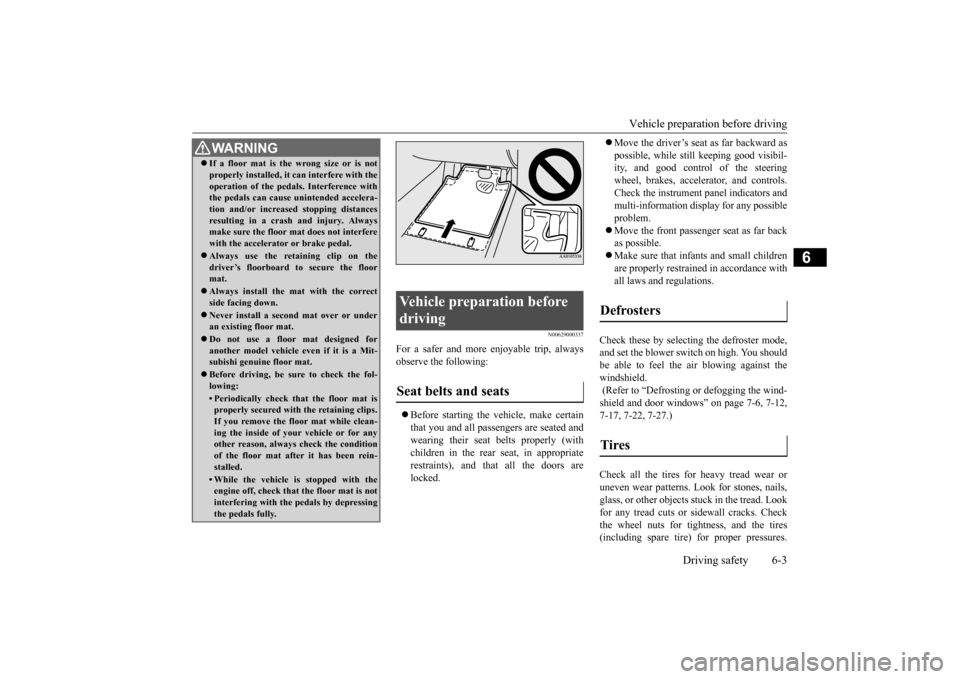
WA R N I N G If a floor mat is the wrong size or is not properly installed, it can interfere with the operation of the pedals. Interference with the pedals can cause unintended accelera- tion and/or increased stopping distancesresulting in a crash and injury. Always make sure the floor mat does not interfere with the accelerator or brake pedal. Always use the retaining clip on the driver’s floorboard to secure the floormat. Always install the mat with the correct side facing down. Never install a second mat over or under an existing floor mat. Do not use a floor mat designed for another model vehicle ev
en if it is a Mit-
subishi genuine floor mat. Before driving, be sure to check the fol- lowing:• Periodically check that the floor mat isproperly secured with the retaining clips. If you remove the floor mat while clean-ing the inside of your vehicle or for any other reason, always check the condition of the floor mat after it has been rein-stalled.• While the vehicle is stopped with the engine off, check that the floor mat is not interfering with the pedals by depressingthe pedals fully.
Vehicle preparation before driving Seat belts and seats
Defrosters Tires
BK0210300US.bo
ok 3 ページ 2014年4月8日 火曜日 午前10時46分
Page 268 of 434
Braking
Driving safety 6-5
6
If there is not enough coolant because of a leak or from engine overheating, add Mit- subishi Motors Genuine Super Long Life Coolant Premium or equivalent.Please read this section in conjunction with the “Engine coolant” on page 9-8.
[For RALLIART vehicles sold in U.S.A.] Mitsubishi Motors recommends that the standard equipment tires be replaced withwinter tires when the vehicle is going to be used in winter. The standard equipment tires providedwith this vehicle are summer tires and use a high-grip compound that provides supe- rior grip.The road grip, however, is reduced in win- ter. When replacing the standard equipmenttires with winter tires, all four tires must be replaced using radial identicalsize win- ter tires.
N00629500446
All the parts of the brake system are criticalto safety. Have the vehicle serviced by an authorized Mitsubishi Motors dealer or a repair facility of your choice at regular inter-vals according to the “WARRANTY AND MAINTENANCE MANUAL”. Check the brake system while driving at a low speed immediately after starting, espe- cially when the brakes are wet, to confirmthey work normally.
A film of water can be formed on the brake discs or brake drums and prevent normal braking after driving in heavy rain or through large puddles, or after the vehicle is washed.If this occurs, dry the brakes out by driving slowly while lightly depressing the brake pedal. On snowy roads, ice can form on the braking system, making the brakes less effective. While driving in such conditions, pay closeattention to preceding and following vehicles and to the condition of
the road surface. From
time to time, lightly depress the brake pedaland check how effective the brakes are. It is important to take advantage of the engine braking by shifting to a lower gear while driving on steep downhill roads in order to prevent the brakes from overheating.
WA R N I N G Never open the radiator cap when the radiator is hot. You could be seriously burned.
NOTE
As your vehicle is equipped with a tire pres- sure monitoring system, there is a risk of damage to the tire inflation pressure sensors when the tire is replaced on the rim. Tire replacement should, therefore, be performedonly by an authorized Mitsubishi Motors dealer. If you use new wheels w
ith new tire inflation
pressure sensors, their ID codes must be pro- grammed into the tire pressure monitoringsystem. Refer to “Whenever the tires and wheels are replaced with new ones” on page 5-105.
Braking When brakes are wet
When driving in cold weather When driving downhill
BK0210300US.bo
ok 5 ページ 2014年4月8日 火曜日 午前10時46分
Page 349 of 434
How to change a tire 8-8 For emergencies
8
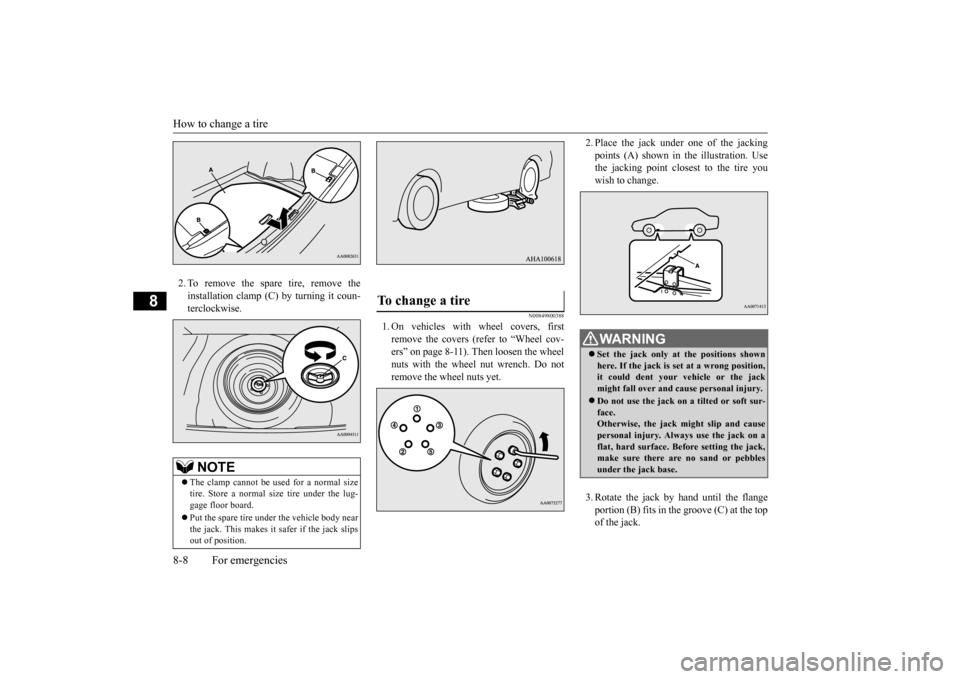
2. To remove the spare tire, remove the installation clamp (C) by turning it coun-terclockwise.
N00849800388
1. On vehicles with wheel covers, firstremove the covers (refer to “Wheel cov-ers” on page 8-11). Then loosen the wheel nuts with the wheel nut wrench. Do not remove the wheel nuts yet.
2. Place the jack under
one of the jacking
points (A) shown in the illustration. Use the jacking point closest to the tire you wish to change. 3. Rotate the jack by hand until the flange portion (B) fits in the groove (C) at the top of the jack.
NOTE
The clamp cannot be used for a normal size tire. Store a normal size tire under the lug- gage floor board. Put the spare tire under the vehicle body near the jack. This makes it safer if the jack slipsout of position.
To change a tire
WA R N I N G Set the jack only at the positions shown here. If the jack is set at a wrong position,it could dent your vehicle or the jack might fall over and cause personal injury. Do not use the jack on a tilted or soft sur- face. Otherwise, the jack might slip and causepersonal injury. Always use the jack on a flat, hard surface. Before setting the jack, make sure there are no sand or pebblesunder the jack base.
BK0210300US.bo
ok 8 ページ 2014年4月8日 火曜日 午前10時46分
Page 352 of 434
How to change a tire
For emergencies 8-11
8
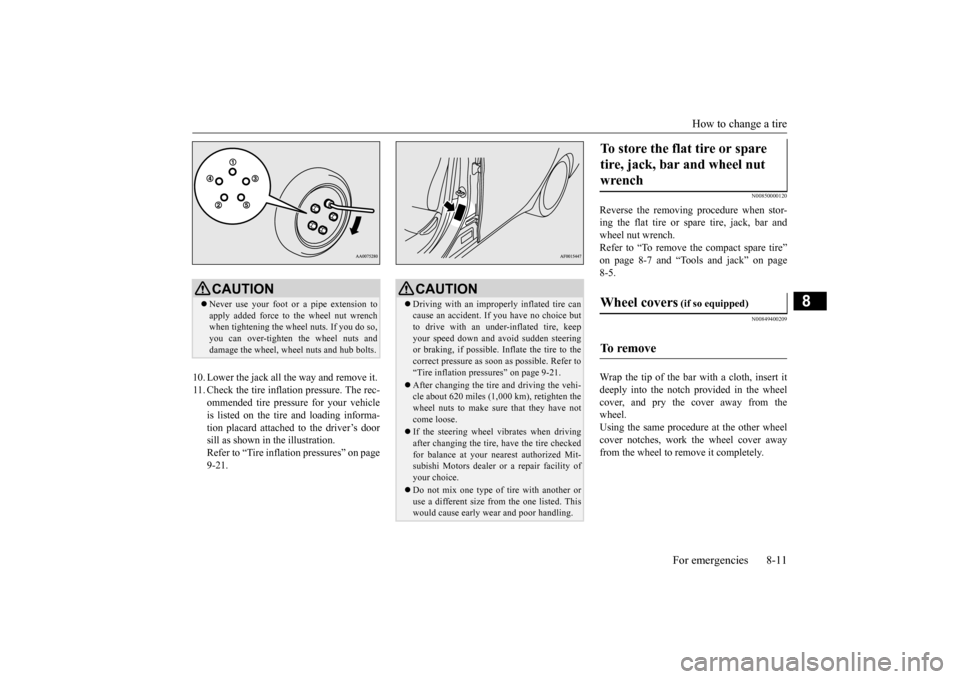
10. Lower the jack all the way and remove it. 11. Check the tire inflation pressure. The rec-
ommended tire pressure for your vehicle is listed on the tire and loading informa-tion placard attached to the driver’s door sill as shown in the illustration. Refer to “Tire inflation pressures” on page9-21.
N00850000120
Reverse the removing procedure when stor- ing the flat tire or spare tire, jack, bar and wheel nut wrench.Refer to “To remove the compact spare tire” on page 8-7 and “Tools and jack” on page 8-5.
N00849400209
Wrap the tip of the bar with a cloth, insert itdeeply into the notch provided in the wheelcover, and pry the cover away from the wheel. Using the same procedure at the other wheelcover notches, work the wheel cover away from the wheel to remove it completely.
CAUTION Never use your foot or a pipe extension to apply added force to the wheel nut wrench when tightening the wheel nuts. If you do so,you can over-tighten the wheel nuts and damage the wheel, wheel nuts and hub bolts.
CAUTION Driving with an improperly inflated tire can cause an accident. If you have no choice but to drive with an under-inflated tire, keep your speed down and avoid sudden steeringor braking, if possible
. Inflate the tire to the
correct pressure as soon as possible. Refer to “Tire inflation pressures” on page 9-21. After changing the tire and driving the vehi- cle about 620 miles (1,000 km), retighten thewheel nuts to make sure that they have not come loose. If the steering wheel vibrates when driving after changing the tire, have the tire checked for balance at your nearest authorized Mit-subishi Motors dealer or a repair facility of your choice. Do not mix one type of tire with another or use a different size from the one listed. This would cause early wear and poor handling.
To store the flat tire or spare tire, jack, bar and wheel nut wrench Wheel covers
(if so equipped)
To remove
BK0210300US.bo
ok 11 ページ 2014年4月8日 火曜日 午前10時46分
Page 378 of 434

Tires
Vehicle care and maintenance 9-21
9
under controlled conditions on speci- fied government test surfaces of asphalt and concrete. A tire marked C may have poor traction perfor- mance. The temperature grades are A (the highest), B and C, representing the tire’s resistance to the generation ofheat and its ability to dissipate heat when tested under controlled condi- tions on a specified indoor laboratorytest wheel. Sustained high tempera- ture can cause the material of the tire to degenerate and reduce tire life, andexcessive temperature can lead to sudden tire failure. The grade C cor- responds to a level of performancewhich all passenger car tires must meet under the Federal Motor Vehi- cle Safety Standard No. 109. Grades B and A represent higher levels of performance on the laboratory testwheel than the minimum required by law.
N00939300844
Proper tire inflation pressure is essential for the safe and satisfactory operation of yourvehicle. The wrong tire pressure will cause problems in three major areas: Safety Too little pressure increases flexing in thetire and can cause tire failure. Too muchpressure can cause a tire to lose its ability to cushion shock. Objects on the road and potholes could then cause tire damage thatmay result in tire failure. Economy The wrong tire pressure can cause unevenwear patterns in the tire tread. These abnormal wear patterns will reduce the tread life, and the tire will have to bereplaced sooner. Too little pressure also makes it harder for the tire to roll, and this uses up more fuel. Ride comfort and vehicle stability The superior riding experience built into your vehicle partly depends on the correcttire pressure. Too much pressure gives an uncomfortable and jarring ride. Too little pressure feels as if your vehicle is slow torespond. Unequal tire pressures can make steering your vehicle uneven and unpredictable.
The correct tire pressure for your vehicle is listed on the placard attached to the sill of the driver’s door. (Refer to “Tire and loading information plac-ard” on page 11-3.) The recommended inflation pressures should be used for the tires listed below.
Temperature
Tire inflation pressures
Except for vehicles with turbo- charger
Item
Tire size
Front
Rear
Normal tire
P205/60 R16
250 KPA, 36 PSI
250 KPA, 36 PSI
P215/45 R18
240 KPA, 35 PSI
240 KPA, 35 PSI
Compact spare tire
T125/70 D16 T125/90D16
420 KPA, 60 PSI
Vehicles with turbocharger
Item
Tire size
Front
Rear
Normal tire
P215/45 R18215/45R
18
240 KPA, 35 PSI
240 KPA, 35 PSI
BK0210300US.bo
ok 21 ページ 2014年4月8日 火曜日 午前10時46分
Page 379 of 434
Tires 9-22 Vehicle care and maintenance
9
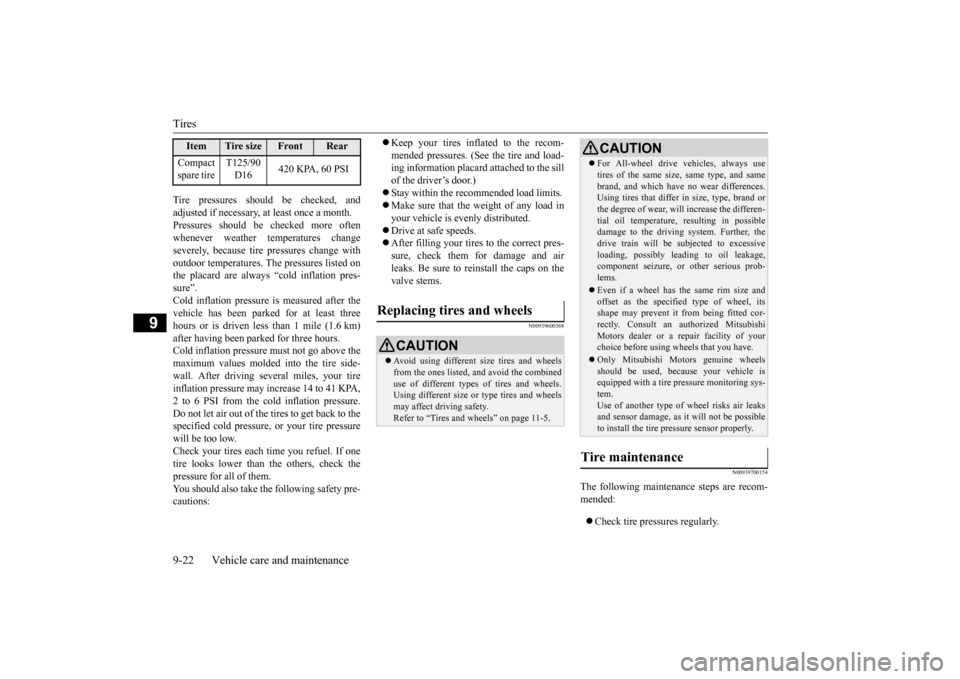
Tire pressures should be checked, and adjusted if necessary, at least once a month. Pressures should be checked more often whenever weather temperatures changeseverely, because tire pressures change with outdoor temperatures. The pressures listed on the placard are always “cold inflation pres-sure”. Cold inflation pressure
is measured after the
vehicle has been parked for at least threehours or is driven less than 1 mile (1.6 km)after having been parked for three hours. Cold inflation pressure must not go above the maximum values molded into the tire side-wall. After driving several miles, your tire inflation pressure may increase 14 to 41 KPA, 2 to 6 PSI from the cold inflation pressure.Do not let air out of the tires to get back to the specified cold pressure, or your tire pressure will be too low.Check your tires each time you refuel. If one tire looks lower than the others, check the pressure for all of them.You should also take the following safety pre- cautions:
Keep your tires inflated to the recom- mended pressures. (See the tire and load- ing information placard attached to the sill of the driver’s door.) Stay within the recommended load limits. Make sure that the weight of any load in your vehicle is evenly distributed. Drive at safe speeds. After filling your tires to the correct pres- sure, check them for damage and airleaks. Be sure to reinstall the caps on thevalve stems.
N00939600368
N00939700154
The following maintenance steps are recom- mended: Check tire pressures regularly.
Compact spare tire
T125/90 D16
420 KPA, 60 PSI
Item
Tire size
Front
Rear
Replacing tires and wheels
CAUTION Avoid using different size tires and wheels from the ones listed, and avoid the combined use of different types of tires and wheels.Using different size or type tires and wheels may affect driving safety. Refer to “Tires and wheels” on page 11-5.
For All-wheel drive vehicles, always use tires of the same size, same type, and same brand, and which have no wear differences. Using tires that differ in size, type, brand or the degree of wear, will increase the differen-tial oil temperature, resulting in possible damage to the driving system. Further, the drive train will be subjected to excessiveloading, possibly leading to oil leakage, component seizure, or other serious prob- lems. Even if a wheel has the same rim size and offset as the specified type of wheel, itsshape may prevent it from being fitted cor- rectly. Consult an authorized Mitsubishi Motors dealer or a repair facility of yourchoice before using wheels that you have. Only Mitsubishi Motors genuine wheels should be used, because your vehicle is equipped with a tire pressure monitoring sys- tem.Use of another type of wheel risks air leaks and sensor damage, as it will not be possible to install the tire pressure sensor properly.
Tire maintenance
CAUTION
BK0210300US.bo
ok 22 ページ 2014年4月8日 火曜日 午前10時46分
Page 381 of 434
Clutch pedal free play (if so equipped) 9-24 Vehicle care and maintenance
9
N00940000359
In some areas of the country, snow tires are required for winter driving. If snow tires arerequired in your area, you must choose snow tires of the same size and type as the original tires provided with your vehicle. Snow tiresshould also be installed on all four wheels. Otherwise your safety and vehicle handling can be reduced.Even where laws may permit it, snow tiresshould not be operated at sustained speeds over 75 mph (120 km/h).
N00940100129 N00940201097
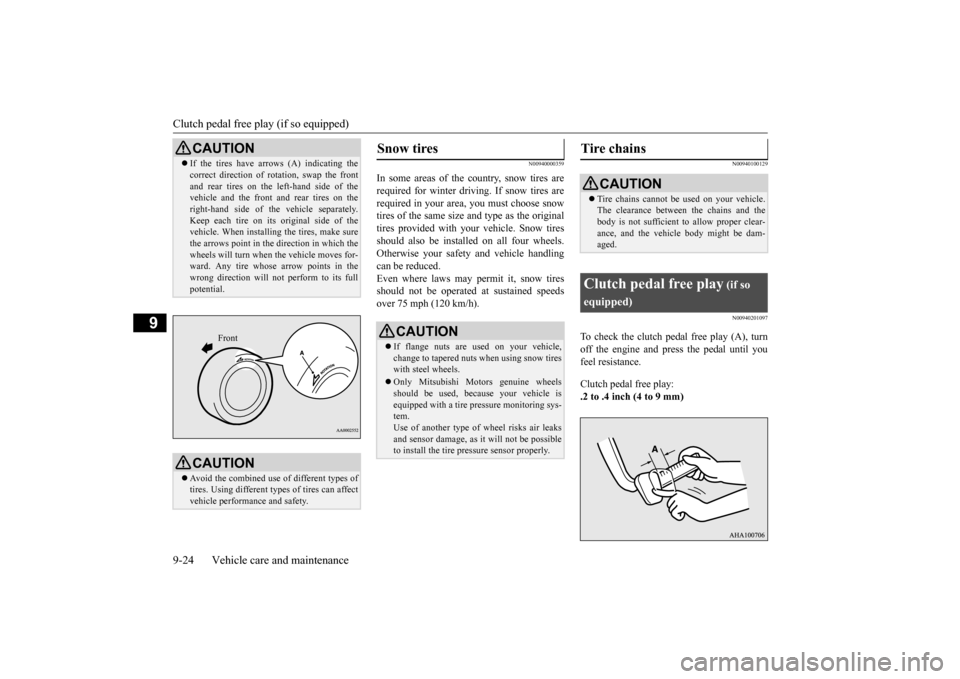
To check the clutch pedal free play (A), turn off the engine and press the pedal until you feel resistance. Clutch pedal free play: .2 to .4 inch (4 to 9 mm)
CAUTION If the tires have arrows (A) indicating the correct direction of rotation, swap the front and rear tires on the left-hand side of the vehicle and the front and rear tires on the right-hand side of the vehicle separately.Keep each tire on its original side of the vehicle. When installing the tires, make sure the arrows point in the direction in which thewheels will turn when the vehicle moves for- ward. Any tire whose arrow points in the wrong direction will not perform to its fullpotential.CAUTION Avoid the combined use of different types of tires. Using different types of tires can affectvehicle performance and safety.
Front
Snow tires
CAUTION If flange nuts are used on your vehicle, change to tapered nuts when using snow tireswith steel wheels. Only Mitsubishi Motors genuine wheels should be used, because your vehicle is equipped with a tire pressure monitoring sys- tem.Use of another type of wheel risks air leaks and sensor damage, as it will not be possible to install the tire pressure sensor properly.
Tire chains
CAUTION Tire chains cannot be used on your vehicle. The clearance between the chains and the body is not sufficient to allow proper clear- ance, and the vehicle body might be dam-aged.
Clutch pedal free play
(if so
equipped)
BK0210300US.bo
ok 24 ページ 2014年4月8日 火曜日 午前10時46分
Page 422 of 434
Engine specifications Specifications 11-5
11
Seating capacity: the number of maximum occupants
N01147700439
N01147800182
Battery is a 12 volt type.
N01147901786
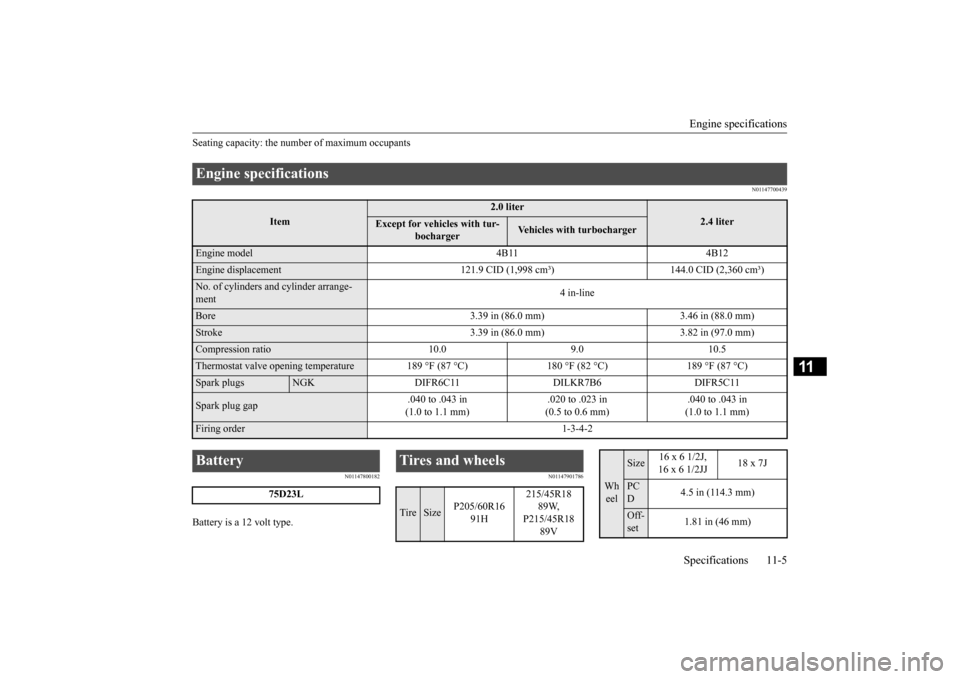
Engine specifications
Item
2.0 liter
2.4 liter
Except for vehicles with tur-
bocharger
Vehicles with turbocharger
Engine model 4B11 4B12Engine displacement 121.9 CID (1,998 cm³) 144.0 CID (2,360 cm³)No. of cylinders and cylinder arrange- ment
4 in-line
Bore 3.39 in (86.0 mm) 3.46 in (88.0 mm)Stroke 3.39 in (86.0 mm) 3.82 in (97.0 mm)Compression ratio 10.0 9.0 10.5Thermostat valve opening temperature 189 °F (87 °C) 180 °F (82 °C) 189 °F (87 °C)Spark plugs
NGK DIFR6C11 DILKR7B6 DIFR5C11
Spark plug gap
.040 to .043 in (1.0 to 1.1 mm)
.020 to .023 in (0.5 to 0.6 mm)
.040 to .043 in (1.0 to 1.1 mm)
Firing order 1-3-4-2Battery
75D23L
Tires and wheels Tire
Size
P205/60R16
91H
215/45R18
89W,
P215/45R18
89V
Wheel
Size
16 x 6 1/2J, 16 x 6 1/2JJ
18 x 7J
PC D
4.5 in (114.3 mm)
Off- set
1.81 in (46 mm)
BK0210300US.bo
ok 5 ページ 2014年4月8日 火曜日 午前10時46分
Page 430 of 434

Alphabetical index
12-5
12
Sun visors
.....................
...................
5-184
Supplemental Restraint System
............
4-21
How the Supplement Restraint System works
.....................
.....................
4-24
Servicing
..................
.....................
4-36
Warning light/display
......................
4-27
T
Tank capacity
..............................
3-4
, 11-6
Theft-alarm system
System
......................
.....................
5-42
Time Setting
..................
.....................
7-59
Tire pressure monitoring system
.........
5-102
Warning light/display
....................
5-103
Tires
..........................
........................
9-17
How to change a tire
.........................
8-6
Inflation pressure
............................
9-21
Maintenance
..................
.................
9-22
Quality grading
...............................
10-2
Replacing tires and wheels
...............
9-22
Rotation
....................
.....................
9-23
Size (tire and wheel)
.......................
11-5
Snow tires
.....................
.................
9-24
Tire and loading information placard
.6-7
,
11-3 Tire chains
....................
.................
9-24
Tread wear indicators
......................
9-23
Tissue holder
.....................
...............
5-190
Tools
.........................
..........................
8-5
Storage
.........................
...................
8-5
Towing
........................
......................
8-12
Trailer towing
.....................
...............
6-11
Transfer oil
......................
..................
9-12
Trunk area light
Replacement
...................
...............
9-48
Trunk lid
.........................
..................
5-39
Turbocharger operation
.......................
5-59
Turn signal light
Indicators
....................
.................
5-143
Turn signal lights
Bulb capacity
..................
...............
9-34
Lever
......................
.....................
5-152
Replacement
...................
...............
9-40
Twin Clutch SST (Sportronic Shift Transmission)
...................
...............
5-70
Fluid
....................
.................
9-12
, 11-6
Gearshift lever operation
.................
5-70
Gearshift lever position display
........
5-71
Manual shift
....................
...............
5-76
Manual shift display
.......................
5-79
Twin Clutch SST control mode display
....
5-76 Twin Clutch SST control mode switch
.....
5-75 Warning display
.............................
5-72
U
USB input terminal
............................
5-181
How to connect an iPod
.................
5-182
USB input terminal device
How to connect a USB memory
.....
5-181
V
Vanity mirror
.....................
...............
5-184
Vehicle care precautions
......................
9-48
Vehicle dimensions
.............................
11-4
Vehicle labeling
.................
.................
11-2
Vehicle preparation before driving
..........
6-3
Vehicle weights
.................
.................
11-4
Vents
............................
.......................
7-2
W
Warning lights
...................
...............
5-144
Washer
Fluid
..................
...................
9-13
, 11-6
Switch
......................
...................
5-157
Windshield washer
........................
5-157
Waxing
......................
........................
9-51
Weights
........................
.....................
11-4
Welcome light
...................
...............
5-151
Wheel
Covers
......................
.....................
8-11
Specification
.................
.................
11-5
Wiper
Rain sensor
...................
...............
5-155
Windshield
....................
...............
5-154
BK0210300US.bo
ok 5 ページ 2014年4月8日 火曜日 午前10時46分