brake MITSUBISHI LANCER 2016 8.G User Guide
[x] Cancel search | Manufacturer: MITSUBISHI, Model Year: 2016, Model line: LANCER, Model: MITSUBISHI LANCER 2016 8.GPages: 392, PDF Size: 13.12 MB
Page 87 of 392
Free-hand Advanced Security Transmit
ter (F.A.S.T.-key) (if so equipped)
Features and controls
5-25
5
Turn
the
eme
rgency
key
to the
“LO
CK
” pos
i-
tion.Turn the steering wheel until it is locked.Turn
the
emer
gency
key
to
the
“ACC”
posi-
tion
while
moving
the
steering
wheel
slightly
.
Tips for starting
Do not
operate
the
starter
motor
continu-
ously
for
longer
than
15
seconds
as
this
could
run
the
battery
down
or damage
the
starter
motor
. If the
engine
does
not
start,
turn
the
eme
rgency
key
back
to
the
“LO
CK
” pos
ition,
wait a few
seconds
,
and
then
try
again.
Trying
repeatedly
with
the
engine
or
starter
motor
still
turning
will damage the starter mechanism.If the
engine
will
not
start
because
the
bat-
tery
is
weak
or
dischar
ged,
refer
to
“Jump-starting
the
engine”
on
page
8-2
for instructions.A longer
warm
up
period
will
only
con-
sume
extra
fuel.
The
engine
is warmed
up
enough
for
driving
when
the
bar
graph
of
the
engine
coolant
temperature
display
starts
to move.
Refer
to “Interrupt
display
screen
(W
ith
ignition
switch
in the
“ON”
position)” on page 5-101.
Starting the engineYour
vehicle
is equipped
with
an
electroni-
cally
controlled
fuel
injection
system.
This
is
a system
that
automatically
controls
the
fuel
injection.
There
is
no
need
to
depress
the
accelerator pedal when starting the engine.The starter
mo
tor sho
uld
not
be run
for
mo
re
than
15
seconds
at a time.
To prevent
battery
drain,
wait
a few
seconds
between attempts to restart the engine.1.Make
sure
all
occupants
are
properly
seated with seat belts fastened.2.Make sure the parking brake is applied.3.While
pushing
the
lock
release
buttons
(A),
remove
the
cover
of
the
ignition
switch.
To lock
To u
nlock
CAUTIONRemove
the emer
gency key whe
n leav
ing
the
vehicle.
If your
vehicle
needs
to be
towed,
turn
the
emer
gency
key to the
“ACC”
position
to
unlock the steering wheel.NOTE
If the
front
wheels
are
turned,
the
anti-theft
lock
may
sometimes
make
it difficult
to turn
the
emer
gency
key
from
“LO
CK” to “ACC”.
Firmly
turn
the steer
ing
wheel
to the left or
to the right
as you t
urn
the emer
gency ke
y.
Starting
W
AR
NING
Never
run
the engin
e in a clos
ed or poorly
ven
tilated
area
any lon
ger
than is need
ed
to move
you
r veh
icle
out of the area.
Car-
bon
monoxi
de gas,
which
is odorless
and
extr
emely
poi
sonous,
coul
d build
up
and
cause
serious
injur
y or
death.
CAUTIONDo not push-star
t the vehicle.
Do
not run
the engin
e at high
rpms
or drive
at high
speeds
until
the
engine
has
had
a
chance to
warm up.
Releas
e the
emer
gency
key
as soon
as the
engine
starts
. It
will
damage
the
starter
motor.
CAUTION
Page 88 of 392
Free-hand Advanced Security Transmitter (F.A.S.T.-key) (if so equipped)5-26
Features and controls
5
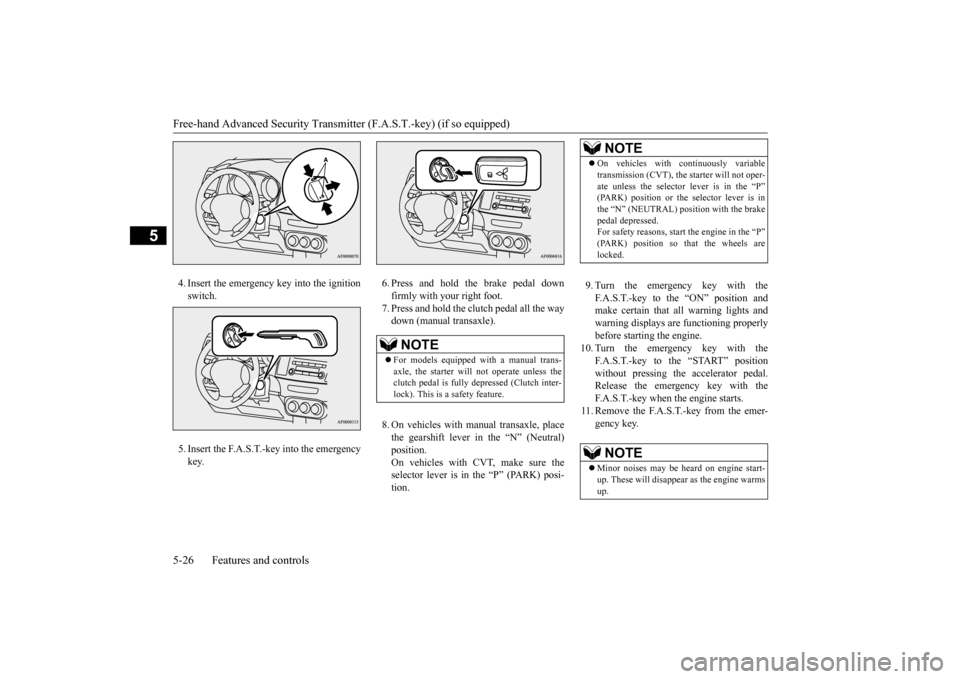
4.Insert
the
emer
gency
key
into
the
ignition
switch.5.Insert
the
F.A.S.T
.-key
into
the
emer
gency
key
.
6.Press
and
hold
the
brake
pedal
down
firmly with your right foot.7.Press
and
hold
the
clutch
pedal
all
the
way
down
(manual
transaxle).
8.On
vehicles
with
manual
transaxle,
place
the
gearshift
lever
in
the
“N”
(Neutral)
position. On
vehicles
with
CVT
, make
sure
the
selector
lever
is in
the
“P”
(PARK)
posi-
tion.
9.Turn
the
emer
gency
key
with
the
F.A.S.T
.-key
to
the
“ON”
position
and
make
certain
that
all
warning
lights
and
warning
displays
are
functioning
properly
before starting the engine.
10.
Turn
the
emer
gency
key
with
the
F.A.S.T.-key
to
the
“START”
pos
ition
without
pressing
the
accelerator
pedal.
Release
the
emer
gency
key
with
the
F.A.S.T
.-key when the engine starts.
11.Remove
the
F.A.S.T
.-key
from
the
emer
-
gency key
.
NOTE
For
models
equipped
with
a manual
trans
-
axle,
the
starter
will
not
operate
unless
the
clu
tch
pedal is fully
depre
ssed (Cl
utch
inter-
lock). This is a safety feature.
NOTE
On
vehicles
with
continuously
variable
trans
mission
(CV
T),
the
starter
will not
oper
-
ate
unless
the
selector
lever
is in
the
“P”
(PARK)
position
or
the
selector
lever
is in
the “N” (NE
UTRA
L) position
with
the brake
pedal depr
essed.
For s
afety
reas
ons, s
tart the eng
ine in t
he “P”
(PARK)
position
so
that
the
wheels
are
locked.NOTE
Minor
noi
ses may
be heard
on
engi
ne start-
up.
These will disappear
as the engi
ne warms
up.
Page 89 of 392
Free-hand Advanced Security Transmit
ter (F.A.S.T.-key) (if so equipped)
Features and controls
5-27
5
After
several
attempts,
you
may
experience
that the engine still does not start.1.Make
sure
that
all
electric
devices,
such
as
lights,
air
conditioning
blower
and
rear
window defogger
, are turned of
f.
2.While
depressing
the
brake
pedal
on
vehi-
cles
equipped
with
continuously
variable
transmission
(CVT)
or the
clutch
pedal
on
the
vehicles
equipped
with
manual
trans-
axle,
press
the
accelerator
pedal
halfway
and
hold
it there,
then
crank
the
engine.
Release
the
accelerator
pedal,
immedi-
ately after the engine starts.3.If the
engine
still
will
not
start,
the
engine
could
be
flooded
with
too
much
gasoline.
While
depressing
the
brake
pedal
on
vehi-
cles
equipped
with
CVT
or
the
clutch
pedal
on
the
vehicles
equipped
with
man-
ual
transaxle,
push
the
accelerator
pedal
all the
way
down
and
hold
it there,
then
crank
the
engine
for
5
to
6
seconds.
Return
the
ignition
switch
to the
“LOCK”
position
and
release
the
accelerator
pedal.
Wait
a few
seconds,
and
then
crank
the
engine
again
for
5 to
6 seconds
while
depressing
the
brake
pedal
or
the
clutch
pedal,
but
do
not
push
the
accelerator
pedal.
Release
the
ignition
key
if
the
engine
starts.
If the
engine
fails
to
start,
repeat
these
procedures.
If the
engine
still
will
not
start,
contact
your
local
Mitsubi-
shi
Motors
dealer
or
a repair
facility
of
your choice for assistance.
When
the
ambient
temperature
is
-4°F
(-20
°C)
or
lower
, it may
not
be
possible
to
start
from
a standstill
even
with
the
selector
lever
in
the
“D”
(DRIVE)
or
“R”
(REVERSE) position. This
phenomenon
occurs
because
the
trans-
axle has
not warmed
up sufficiently
; it does
not
indicate
a problem.
If this
occurs,
place
the
selector
lever
in the
“P”
(PARK)
position
and let the engine idle for at least 10
minutes.
The
transaxle
will
warm
up,
and
you
will
be
able to drive normally
.
Do
not
leave
the
vehicle
during
warm-up
operation.
N00529600
101
The
electronic
immobilizer
is designed
to sig-
nificantly
reduce
the
possibility
of
vehicle
theft.
The
purpose
of
the
system
is to immo-
bilize
the
vehicle
if
an
invalid
start
is
attempted.
A valid
start
attempt
can
only
be
achieved
(subject
to certain
conditions)
using
a F.A.S.T
.-Key
“registered”
to
the
immobi-
lizer system.
W
AR
NING
Mak
e sur
e to
remove
the F.A.S.T.-key
from
the
emergency
key
after
the
engine
is
start
ed.
If not
removed,
the
F.A.S.T
.-key
could
fall
to
the
floor
, which
may
interf
ere with
pedal
operati
on.
Furthermor
e, the
F.A.S.T
.-ke
y coul
d pre-
vent
the
driv
er’s knee
airbag
from
inflat-
ing
normally
or
could
be
propelled
to
cause serious injury if the airbag inflates.NOTE
When
using
the
emer
gency
key
to start
the
engine,
firs
t remove
the
key
from
the
key
holder
. If the
emer
gency
key
is attached
to a
key holder
(key
ring), it may
beco
me
impos-
sible
to insert
the
keyless
operation
key
into
the emer
gency key, and
it may
pre
vent the
engi
ne from
being
started.
When the engine is hard to start
Startability
of
continuously
variable
transmission
(CVT)
vehicles
at extr
emely
cold ambient temperatur
e
Elect
ronic immobilizer (Anti-
theft starting system)
Page 110 of 392
Parking brake 5-48 Features and controls
5
N00511401439
To park the vehicle, first bring it to a com- plete stop and fully engage the parking brake.For vehicles with a manual transaxle, move the gear shift lever to 1st (on a uphill) or “R” (Reverse) (on a downhill) position.For vehicles with a continuously variable transmission (CVT), set the selector lever to “P” (PARK) position.
When parking on a hill, apply the parking brake and turn the front wheels toward thecurb on a downhill grade, away from the curb on an uphill grade.
Be sure to close the sunroof completely when washing the vehicle or when leaving the vehicle. Do not put any wax on the weatherstrip (black rubber) around the sunroof opening. If it is waxed, the weatherstrip cannot maintain a weatherproof seal with the sunroof. After washing the vehicle or after rain be sure to wipe off any water that is on the sun-roof before operating it. Operating the sunroof repeatedly with the engine turned off will run down the battery. Operate the sunroof only while the engine is running.
Parking brake
NOTE
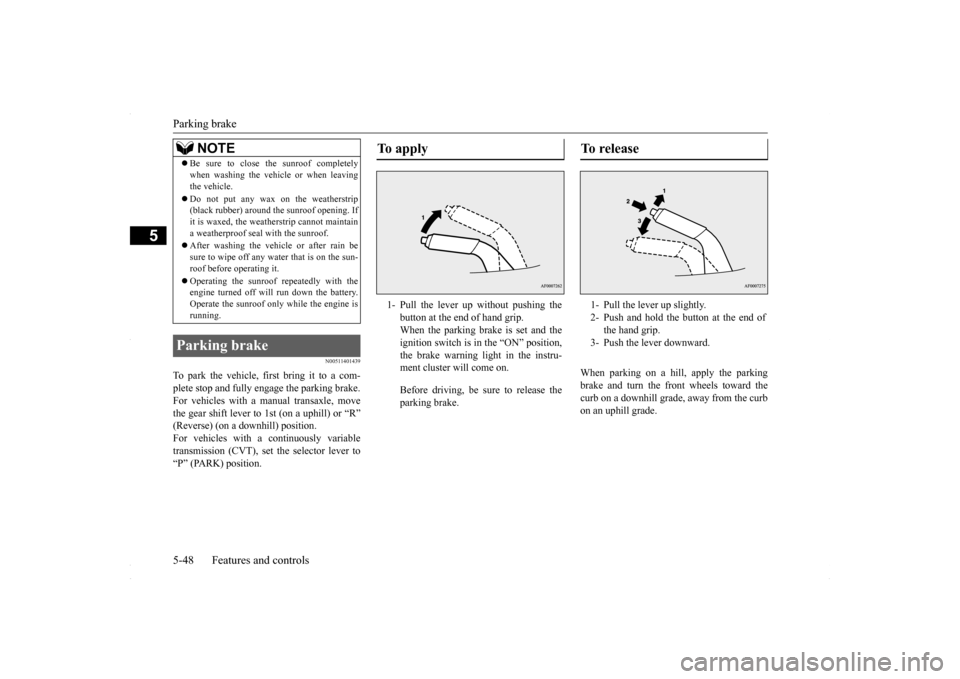
To apply 1- Pull the lever up without pushing the
button at the end of hand grip. When the parking brake is set and theignition switch is in the “ON” position, the brake warning light in the instru- ment cluster will come on. Before driving, be sure to release the parking brake.
To r e l e a s e 1- Pull the lever up slightly. 2- Push and hold the button at the end of
the hand grip.
3- Push the lever downward.
BK0230300US.bo
ok 48 ページ 2015年7月30日 木曜日 午後8時38分
Page 111 of 392
Steering wheel tilt lock lever Features and controls 5-49
5
N00511500215
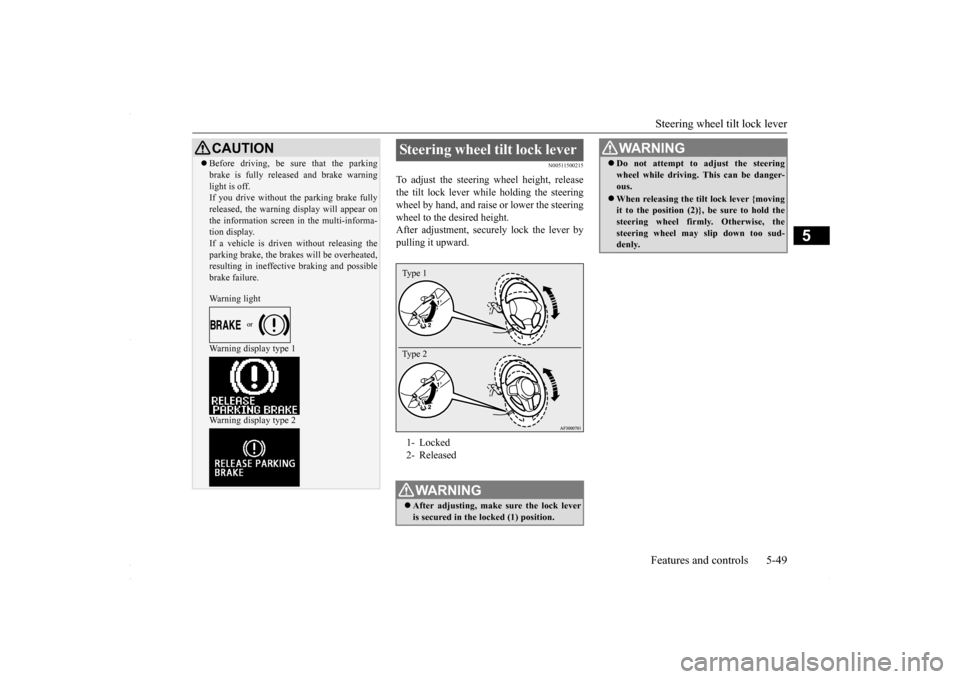
To adjust the steering wheel height, release the tilt lock lever while holding the steeringwheel by hand, and raise or lower the steering wheel to the desired height. After adjustment, securely lock the lever bypulling it upward.
CAUTION Before driving, be sure that the parking brake is fully released and brake warning light is off. If you drive without the parking brake fully released, the warning display will appear onthe information screen in the multi-informa- tion display. If a vehicle is driven without releasing theparking brake, the brakes will be overheated, resulting in ineffective braking and possible brake failure. Warning light Warning display type 1 Warning display type 2
Steering wheel tilt lock lever 1- Locked 2- ReleasedWA R N I N G After adjusting, make sure the lock lever is secured in the locked (1) position. Type 1 Type 2
Do not attempt to adjust the steering wheel while driving. This can be danger- ous. When releasing the tilt lock lever {moving it to the position (2)}, be sure to hold the steering wheel firmly. Otherwise, the steering wheel may slip down too sud-denly. WA R N I N G
BK0230300US.bo
ok 49 ページ 2015年7月30日 木曜日 午後8時38分
Page 116 of 392
![MITSUBISHI LANCER 2016 8.G User Guide Steering wheel lock 5-54 Features and controls
5
position, and then turn the key to the “LOCK” position and remove it.
N00512500195
[For vehicles equipped with the F.A.S.T.-key]For information on](/img/19/7463/w960_7463-115.png "MITSUBISHI LANCER 2016 8.G User Guide Steering wheel lock 5-54 Features and controls
5
position, and then turn the key to the “LOCK” position and remove it.
N00512500195
[For vehicles equipped with the F.A.S.T.-key]For information on")
Steering wheel lock 5-54 Features and controls
5
position, and then turn the key to the “LOCK” position and remove it.
N00512500195
[For vehicles equipped with the F.A.S.T.-key]For information on operations for vehicles equipped with the F.A.S.T.-key, refer to “F.A.S.T.-key: Steering wheel lock” on page5-20. [Except for vehicles equipped with the F. A . S . T. - k e y ]
Remove the key at the “LOCK” position. Turn the steering wheel until it is locked. Turn the key to the “ACC” position while moving the steering wheel slightly.
NOTE
For vehicles with a CVT, the key cannot be removed unless the selector lever is set to the“P” (PARK) position, wh
ich allows the igni-
tion switch to turn to the “LOCK” position.CAUTION Do not remove the ignition key from the ignition switch while driving. The steering wheel will lock, causing loss of control. If the engine is turned off while driving, the power brake booster will stop functioning and braking efficiency will be reduced. Also,the power steering system will not function and it will require greater effort to manually steer the vehicle.CVT
Do not leave the key in the “ON” position for a long time when the engine is not running. This will cause the battery to run down. Do not turn the key to the “START” position when the engine is running. It will damage the starter motor.
Steering wheel lock
CAUTION
To l o c k To u n l o c k
CAUTION Remove the key when leaving the vehicle.NOTE
If the front wheels are turned, the anti-theft lock may sometimes make it difficult to turn the key from “LOCK” position to “ACC” position. Firmly turn the steering wheel tothe left or to the right as you turn the key.
BK0230300US.bo
ok 54 ページ 2015年7月30日 木曜日 午後8時38分
Page 117 of 392
Starting and stopping the engine Features and controls 5-55
5
N00542101096
Do not operate the starter motor continu- ously for longer than
15 seconds as this
could run the battery down or damage thestarter motor. If the engine does not start,turn the ignition switch back to the “LOCK” position, wait a few seconds, and then try again. Trying repeatedly withthe engine or starter motor still turning will damage the starter mechanism. If the engine will not start because the bat- tery is weak or discharged, refer to “Jump-starting the engine” (on page 8-2) for instructions. The engine is warmed up enough for driv- ing when the bar graph of engine coolant temperature display starts to move. A lon-ger warm up period will only consume extra fuel.
N00542201198
[For vehicles equipped with the F.A.S.T.- key.]For information on operation for vehicles equipped with the F.A.S.T.-key, refer to “F.A.S.T.-key: Starting the engine” on page5-20. [Except for vehicles equipped with the F. A . S . T. - k e y. ]Your vehicle is equipped with an electroni- cally controlled fuel injection system, which automatically controls the release of fuel.
There is usually no need to depress the accel- erator pedal when starting the engine. The starter should not be run for more than 15 seconds at a time.To prevent battery drain, wait a few seconds between attempts to restart the engine. 1. Make sure all occupants are properly seated with seat belts fastened 2. Insert the ignition key. 3. Make sure the parking brake is applied.4. Press and hold the brake pedal downfirmly with your right foot. 5. Press and hold the clutch pedal all the way down (manual transaxle). 6. On vehicles with manual transaxle, place the gearshift lever in the “N” (Neutral) position.On vehicles with continuously variable transmission (CVT), make sure the selec- tor lever is in the “P” (PARK) position.
Starting and stopping the engine Tips for starting
WA R N I N G Never run the engine in a closed or poorly ventilated area any longer than is needed to move your vehicle out of the area. Car- bon monoxide gas, which is odorless and extremely poisonous, could build up andcause serious injury or death.CAUTION Do not push-start the vehicle.Do not run the engine
at high rpms or drive
at high speeds until the engine has had a chance to warm up. Release the ignition switch as soon as the engine starts. Otherwise, the starter motorwill be damaged.
Starting the engine
NOTE
For models equipped with a manual trans- axle, the starter will not operate unless the clutch pedal is fully depressed (Clutch inter-lock). This is a safety feature.
BK0230300US.bo
ok 55 ページ 2015年7月30日 木曜日 午後8時38分
Page 118 of 392
Starting and stopping the engine 5-56 Features and controls
5
7. Turn the ignition switch to the “ON” posi- tion and make certain that all warning lights are functioning properly beforestarting the engine.8. Turn the ignition switch to the “START” pedal. Release the key when the enginestarts.
After several attempts, you may experience that the engine still does not start. 1. Make sure that all electric devices, such as lights, air conditioning blower and rearwindow defogger, are turned off.
2. While depressing the brake pedal on vehi- cles equipped with continuously variable transmission (CVT) or the clutch pedal on the vehicles equipped with manual trans-axle, press the accelerator pedal halfway and hold it there, then crank the engine. Release the accelerator pedal, immedi-ately after the engine starts. 3. If the engine still will not start, the engine could be flooded with too much gasoline.While depressing the brake pedal on vehi-cles equipped with CVT or the clutch pedal on the vehicles
equipped with man-
ual transaxle, push the accelerator pedalall the way down and hold it there, then crank the engine for 5 to 6 seconds. Return the ignition switch to the “LOCK”position and release the accelerator pedal. Wait a few seconds, and then crank the engine again for 5 to 6 seconds whiledepressing the brake pedal or the clutch pedal, but do not push the accelerator pedal. Release the ignition key if theengine starts. If the engine fails to start, repeat these procedures. If the engine still will not start, contact your local Mitsubi-shi Motors dealer or a repair facility of your choice for assistance.
When the ambient temperature is -4 °F (-20 °C) or lower on vehicles with CVT, itmay not be possible to start from a standstill even with the selector lever in the “D” (DRIVE) or “R” (REVERSE) position.This phenomenon occurs because the trans-axle has not warmed up sufficiently; it does not indicate a problem. If it occurs, place the selector lever in the “P” (PARK) position andlet the engine idle for at least 10 minutes. The transaxle will warm up, and you will be able to start normally.Do not leave the vehicle during warm-up operation.
N00542301102
1. Bring the vehicle to a complete stop. 2. Fully engage the parking brake while depressing the brake pedal. 3. For vehicles with a manual transaxle, turn the ignition switch to the “LOCK” posi- tion to stop the engine, and then move thegearshift lever to the 1st (on a uphill) or “R” (Reverse) (on a downhill) position.
NOTE
On vehicles with CVT, the starter will not operate unless the selector lever is in the “P” (PARK) or “N” (NEUTRAL) position. For safety reasons, start the engine in the “P” (PARK) position so that the wheels arelocked.NOTE
Minor noises may be heard on engine start- up. These will disappear as the engine warms up.
When the engine is hard to start
Startability of continuously vari- able transmission (CVT) vehicles at extremely cold ambient temper- ature Stopping the engine
BK0230300US.bo
ok 56 ページ 2015年7月30日 木曜日 午後8時38分
Page 120 of 392
Manual transaxle (if so equipped) 5-58 Features and controls
5
N00512900131
For the best fuel economy and performance in using your manual transaxle, upshift as listed below. At low altitude locations, shift at the vehicle speeds listed. Upshifting earlier during cruiseconditions (relatively steady speeds) will improve your fuel economy.
At high altitude locations, upshift as listed below.
N00513000096
It is recommended that you downshift to alower gear when needed to maintain thedesired speed, according to the table.Avoid downshifting at too high a speed. The engine may suffer damage.
To maintain a safe speed and prolong brake life, shift down to 2nd or 1st when descend- ing a steep hill. Downshifting is also important to avoid “lug-ging” the engine at too low a speed, such as when turning a corner or when driving up a steep hill.
N00513100215
The table below shows the maximum recom- mended driving speed for in each gear. Do not drive near or at these speeds for pro-longed periods of time.
NOTE
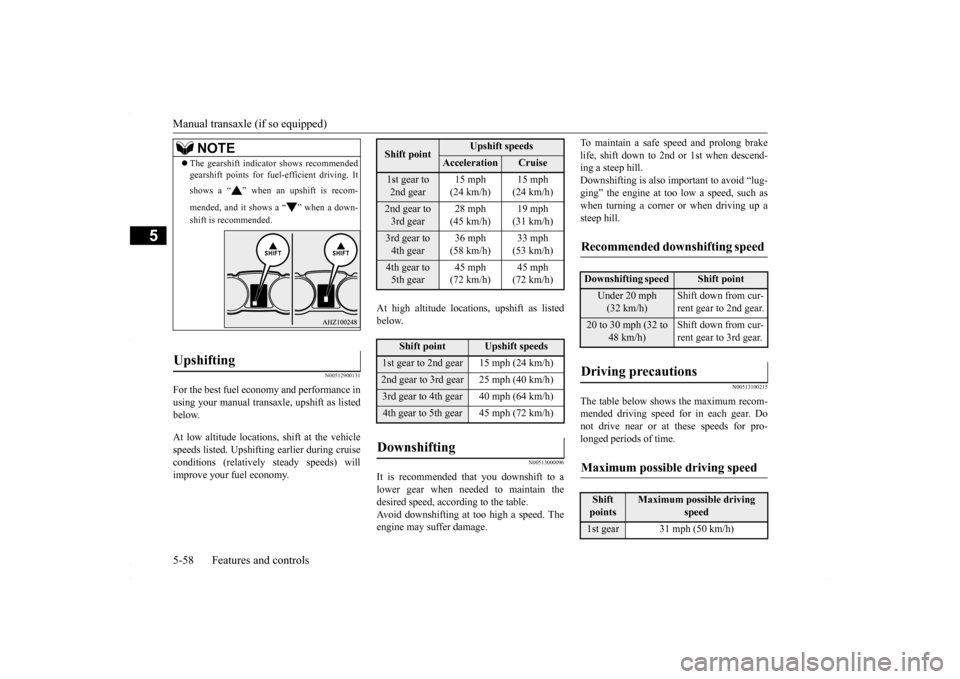
The gearshift indicator shows recommended gearshift points for fuel-efficient driving. It shows a “ ” when an upshift is recom- mended, and it shows a “ ” when a down- shift is recommended.
Upshifting
Shift point
Upshift speeds
Acceleration
Cruise
1st gear to 2nd gear
15 mph (24 km/h)
15 mph (24 km/h)
2nd gear to 3rd gear
28 mph (45 km/h)
19 mph (31 km/h)
3rd gear to 4th gear
36 mph (58 km/h)
33 mph (53 km/h)
4th gear to 5th gear
45 mph (72 km/h)
45 mph (72 km/h)
Shift point
Upshift speeds
1st gear to 2nd gear 15 mph (24 km/h)2nd gear to 3rd gear 25 mph (40 km/h)3rd gear to 4th gear 40 mph (64 km/h)4th gear to 5th gear 45 mph (72 km/h)Downshifting
Recommended downshifting speed
Downshifting speed
Shift point
Under 20 mph (32 km/h)
Shift down from cur- rent gear to 2nd gear.
20 to 30 mph (32 to
48 km/h)
Shift down from cur- rent gear to 3rd gear.
Driving precautions
Maximum possible driving speed
Shift points
Maximum possible driving
speed
1st gear 31 mph (50 km/h)
BK0230300US.bo
ok 58 ページ 2015年7月30日 木曜日 午後8時38分
Page 121 of 392
Continuously variable transmission (CVT) (if so equipped)
Features and controls 5-59
5
Do not use the gearshift lever as a handrest. This can result in premature wear of the transaxle shift forks.
N00513200229
The CVT will automatically and continuouslychange its gear ratio depending on road and driving conditions. This helps achievesmooth driving and excellent fuel efficiency. Also you can manually shift up and shift down the transmission. Refer to “Sportsmode” on page 5-64. The transmission prevents unnecessary upshifts even when the accelerator pedal is released and ensures smooth driving.
According to the condi
tions, the transmission
will automatically shift to a lower gear ratioto achieve stronger engine braking. This may help reduce your need to use the service brake.
N00513800384
As an additional safe
ty precaution, models
equipped with a continuously variable trans- mission have a shift-lock device that holdsthe selector lever in the “P” (PARK) position. To move the selector lever from the “P” (PARK) position to another position, followthe steps below. 1. Press and hold the brake pedal down. 2. Move the selector lever to the desired position.
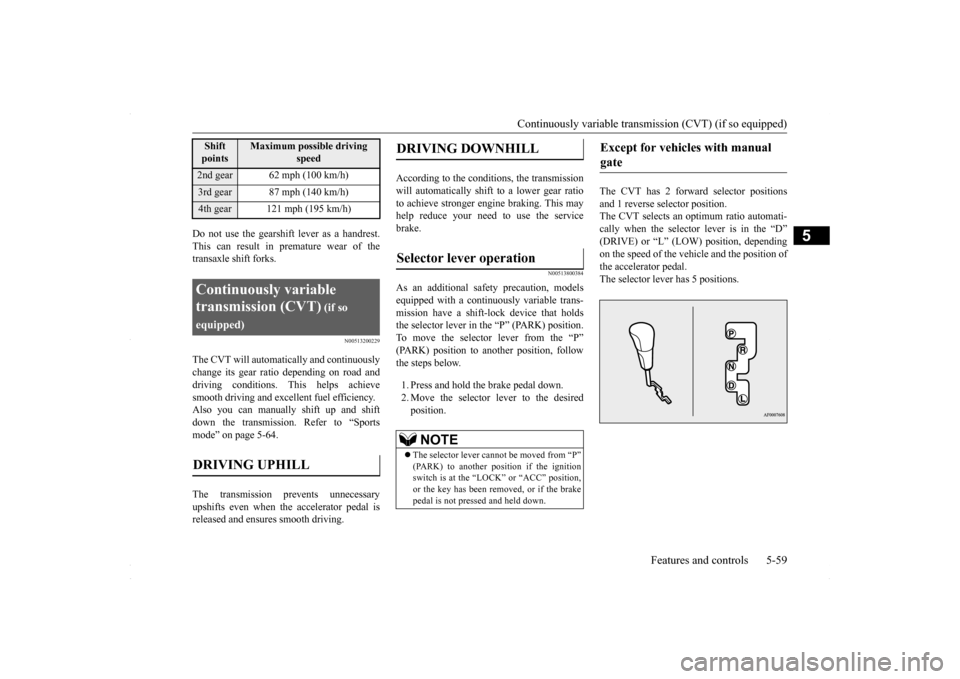
The CVT has 2 forward selector positions and 1 reverse selector position. The CVT selects an optimum ratio automati-cally when the selector lever is in the “D” (DRIVE) or “L” (LOW) position, depending on the speed of the vehicle and the position ofthe accelerator pedal.The selector lever has 5 positions.
2nd gear 62 mph (100 km/h)3rd gear 87 mph (140 km/h)4th gear 121 mph (195 km/h)Continuously variable transmission (CVT)
(if so
equipped)DRIVING UPHILL
Shift points
Maximum possible driving
speed
DRIVING DOWNHILL
Selector lever operation
NOTE
The selector lever cannot be moved from “P” (PARK) to another position if the ignitionswitch is at the “LOCK” or “ACC” position, or the key has been removed, or if the brake pedal is not pressed and held down.
Except for vehicles with manual gate
BK0230300US.bo
ok 59 ページ 2015年7月30日 木曜日 午後8時38分