roof MITSUBISHI LANCER 2016 8.G Owners Manual
[x] Cancel search | Manufacturer: MITSUBISHI, Model Year: 2016, Model line: LANCER, Model: MITSUBISHI LANCER 2016 8.GPages: 392, PDF Size: 13.12 MB
Page 5 of 392
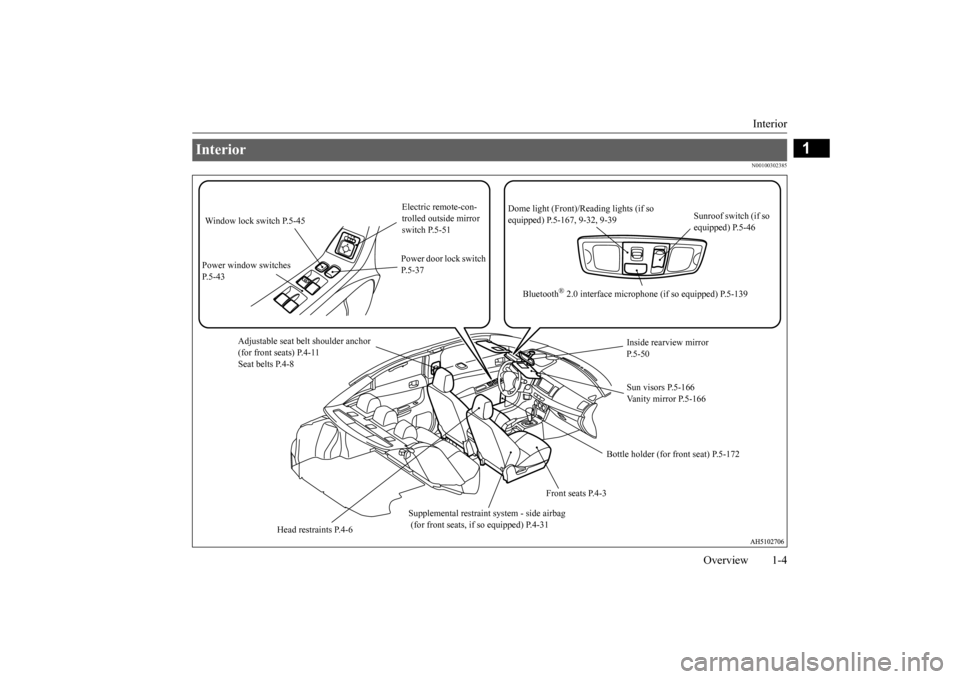
Interior
Overview
1-4
1
N00100302
385
Interior
Electric remote-con- trolled outside mirror switch
P.5-51
Dome light (
Front)/Reading lights (if so
equipped) P
.5-167, 9-32, 9-39
Sun
roof
switch
(if so
equipped)
P.5-46
Window lock switch P
.5-45
Power window s
witches
P.5-43
Power
door
lock
switch
P.5-37
Bluetoot
h® 2.0 interface micro
phone (i
f so
equipped) P
.5-139
Adj
ustable
seat
belt
shoul
der anchor
(for fro
nt seats) P
.4-11
Seat belts P
.4-8
Inside
rearview
mirror
P.5-50Sun
visors
P.5-166
Vanity mirror P
.5-166
Bottle holde
r (fo
r front seat) P
.5-1
72
Front seats P
.4-3
Supplemental
restraint
system
- side
airbag
(for
front
seats,
if so equipped)
P.4-31
Head
restraint
s P.4-6
Page 53 of 392
Supplemental Restraint System (SRS) - airbag
Seat and restraint systems
4-29
4
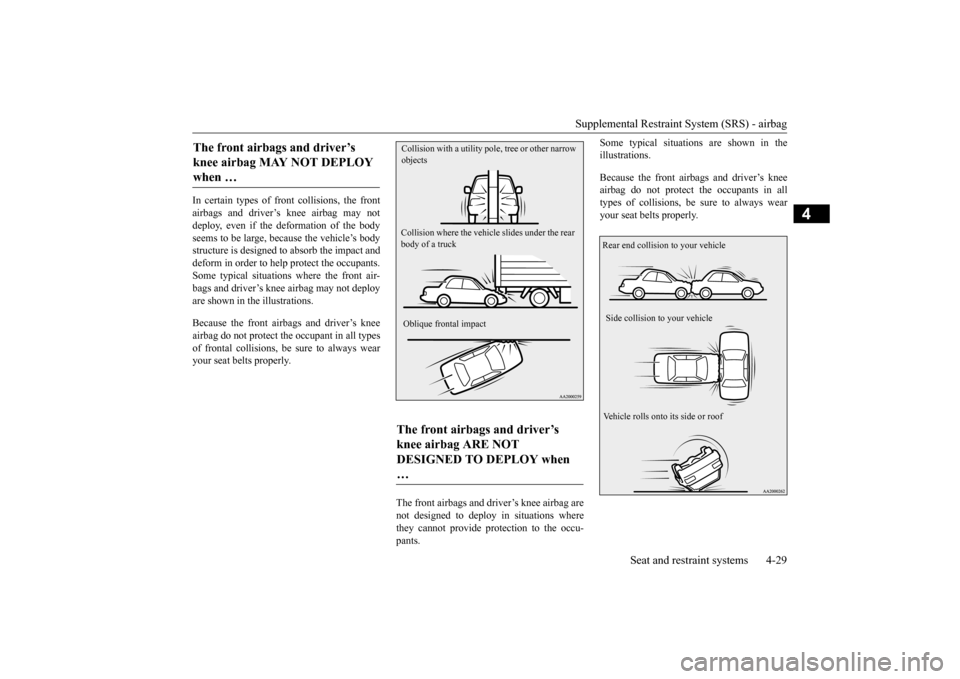
In
certain
types
of
front
collisions,
the
front
airbags
and
driver
’s knee
airbag
may
not
deploy
, even
if the
deformation
of
the
body
seems
to be
large,
because
the
vehicle’
s body
structure is designed to absorb the impact and deform
in order
to help
protect
the
occupants.
Some
typical
situations
where
the
front
air-
bags
and
driver
’s knee
airbag
may
not
deploy
are
shown
in the
illustrations.
Because
the
front
airbags
and
driver
’s knee
airbag
do
not
protect
the
occupant
in all
types
of
frontal
collisions,
be
sure
to
always
wear
your
seat
belts
properly
.
The front airbags and driver
’s knee airbag are
not
designed
to
deploy
in
situations
where
they
cannot
provide
protection
to
the
occu-
pant
s.
Some
typical
situations
are
shown
in
the
illustrations. Because
the
front
airbags
and
driver
’s knee
airbag
do
not
protect
the
occupants
in
all
types
of
collisions,
be
sure
to
always
wear
your
seat
belts properl
y.
The fr
ont airbags and driver
’s
knee airbag MA
Y NOT DEPLOY
when
…
The fr
ont airbags and driver
’s
knee airbag ARE NOT DESIGNED T
O DEPLOY when
…
Collision
where
the
vehicle
slides
under
the
rear
body of a
truc
k
Oblique
frontal
impact
Collision
with
a utility
pol
e, tree
or other
narrow
objects
Rear end collision
to your
vehicle
Side collision to your vehicleVehicle
rolls
onto
its side
or roof
Page 56 of 392
Supplemental Restraint System (SRS) - airbag4-32
Seat and restraint systems
4
N0041920
1230
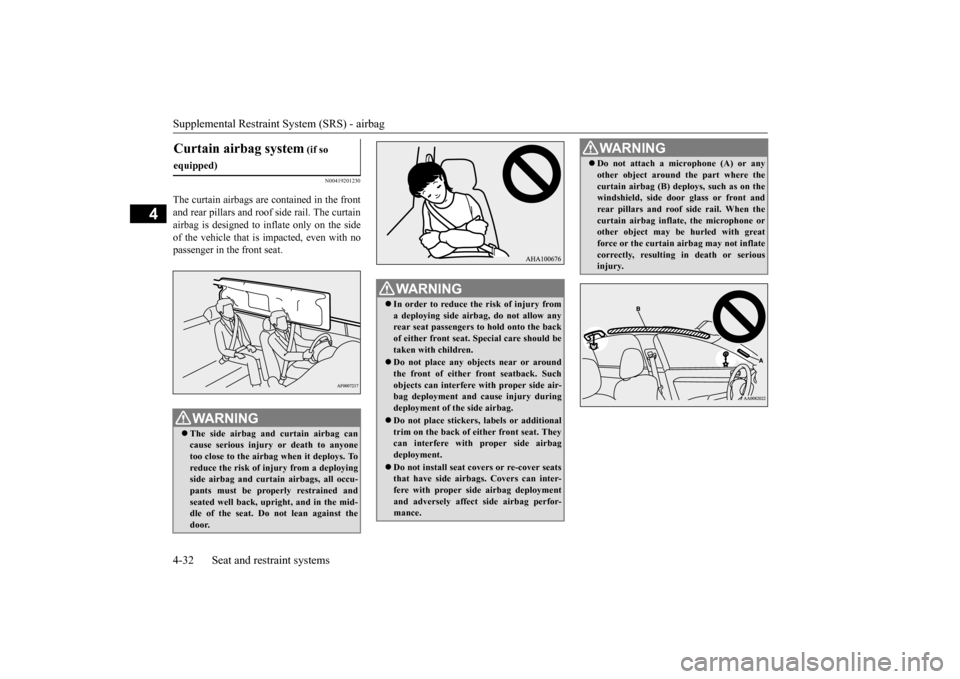
The
curtain
airbags
are
contained
in the
front
and
rear
pillars
and
roof
side
rail.
The
curtain
airbag
is designed
to inflate
only
on
the
side
of
the
vehicle
that
is impacted,
even
with
no
passenger in the front seat.Curtain airbag system
(if so
equipped)
W
AR
NING
The side airb
ag
and
curtain airbag
can
cause
serious
injur
y or death
to
any
one
too close
to the
airbag
whe
n it deploys.
To
reduce
the
risk
of injur
y from a deployin
g
side airb
ag and
curtain
airb
ags,
all
occu
-
pants
must
be properly
restrained and
seated
well
back,
upright,
and
in the
mid-
dle of
the
seat.
Do
not
lean
agai
nst
the
door
.
W
AR
NING
In
ord
er to reduce
the
risk
of injury
from
a deploying
side
airbag,
do
not
allow
any
rear seat passe
ngers
to hol
d onto
the
bac
k
of either
front
seat.
Specia
l care shoul
d be
take
n with children.
Do not place
any
objects
near or around
the
front
of
either
front
seatback.
Such
objects
can
interf
ere with proper
side air-
bag deployment
and
cause
injury
durin
g
deployme
nt of the
side airb
ag.
Do
not
place stick
ers,
labels
or addi
tional
trim
on
the
bac
k of either
front
seat.
The
y
can
interf
ere with
proper
side airbag
deploymen
t.
Do
not
install
seat
covers
or re-cover
seats
that
have
side
airbags.
Covers
can
inter
-
fere with proper
side airb
ag
deploymen
t
and
adversely
affect
side
airbag
perfor
-
mance.
Do
not
attach
a micr
ophone
(A)
or
any
other
object
around
the
part
wher
e the
curtain
airbag
(B)
deploys,
such
as on
the
windshield,
side
door
glass
or
front
and
rear
pillars
and
roof
side
rail.
When
the
curtain
airbag
inflate,
the
micr
ophone
or
other
object
may
be
hurled
with
great
for
ce or the
curtain
airbag
may
not
inflate
corr
ectly
, resulting
in
death
or
serious
injury.
W
AR
NING
Page 58 of 392
Supplemental Restraint System (SRS) - airbag4-34
Seat and restraint systems
4
your
safety
and
the
safety
of all occupants,
be
sure to always wear your seat belts properl
y.
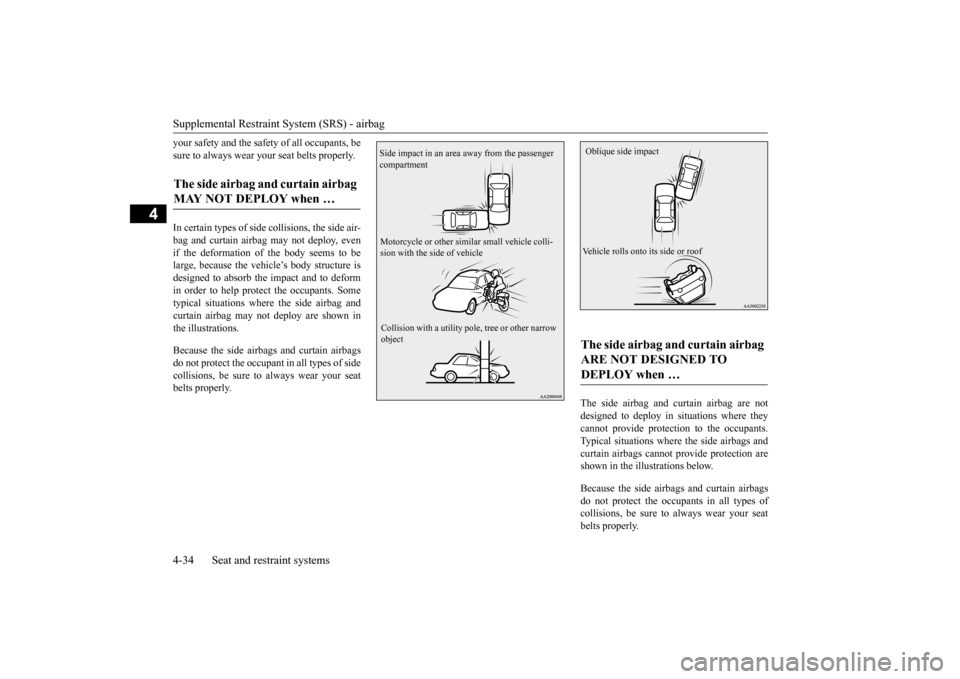
In certain
types
of side
collisions,
the
side
air-
bag
and
curtain
airbag
may
not
deploy
, even
if the
deformation
of
the
body
seems
to
be
large,
because
the
vehicle’
s body
structure
is
designed
to absorb
the
impact
and
to deform
in
order
to
help
protect
the
occupants.
Some
typical
situations
where
the
side
airbag
and
curtain
airbag
may
not
deploy
are
shown
in
the illustrations.Because
the
side
airbags
and
curtain
airbags
do
not
protect
the
occupant
in all
types
of side
collisions,
be
sure
to
always
wear
your
seat
belts
properly
.
The
side
airbag
and
curtain
airbag
are
not
designed
to
deploy
in
situations
where
they
cannot
provide
protection
to
the
occupants.
Typical
situations
where
the
side
airbags
and
curtain
airbags
cannot
provide
protection
are
shown in the illustrations below
.
Because
the
side
airbags
and
curtain
airbags
do
not
protect
the
occupants
in
all
types
of
collisions,
be
sure
to
always
wear
your
seat
belts
properly
.
The
side
airbag
and
curtain
airbag
MA
Y NOT DEPLOY when …
Side impact in a
n area awa
y from the
passenge
r
compartmentMotorcycle or other si
milar small ve
hicle c
olli-
sion
with
the
side
of vehicle
Collision
with
a utility
pole
, tree
or other
narrow
object
The
side
airbag
and
curtain
airbag
ARE NOT DESIGNED T
O
DEPLOY
when
…
Oblique
side impact
Vehicle rolls onto its side or roof
Page 59 of 392
Supplemental Restraint System (SRS) - airbag
Seat and restraint systems
4-35
4
N00408500
672
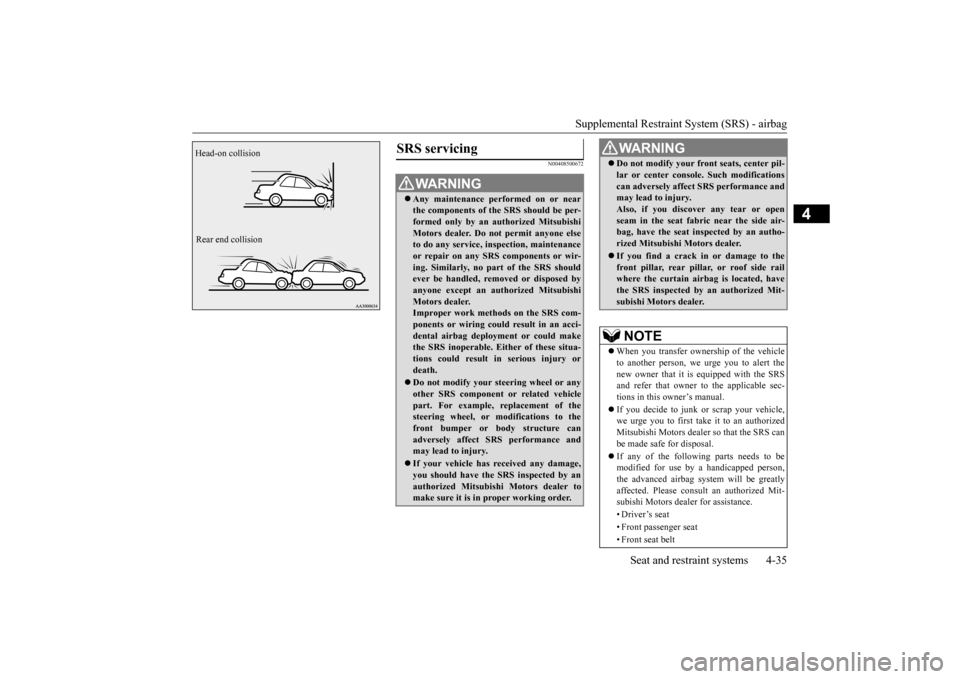
Head-on
collision
Rear e
nd c
ollisi
on
SRS
servicing W
AR
NING
Any
mai
nte
nance
perfor
med on or
near
the
compone
nts
of the
SRS
shoul
d be per-
form
ed only by
an
authorized
Mitsubi
shi
Motor
s dealer
. Do
not
perm
it any
one
else
to do any
serv
ice,
inspect
ion,
mai
nte
nanc
e
or
repair
on any
SRS
compone
nts
or wir-
ing.
Similarly, no par
t of the
SRS
shoul
d
ever
be
handled,
removed
or
disposed
by
anyone
except
an
authorized
Mitsubishi
Motor
s dealer
.
Impr
oper work
methods
on the
SRS
com
-
ponents
or
wiring
could
result
in an
acci-
dental
airb
ag deployme
nt
or coul
d make
the
SRS
inoperable.
Either
of these
situa-
tions
could
result
in
serious
injury
or
death. Do not modify your
steering
wheel
or
any
other
SRS
component
or
related
vehicle
part.
For
example,
replacement
of
the
steering
wheel,
or
modifications
to
the
front
bumper
or body
structur
e can
advers
ely
affect
SRS
perfor
mance
and
may
lead
to injury
.
If your
vehicle
has
receiv
ed any
damage
,
you
shoul
d have
the
SRS
inspect
ed by
an
authorized
Mitsubishi
Motors
dealer
to
make sur
e it is in pr
oper working order
.
Do
not
modi
fy your
front
seats,
center
pil-
lar or center
console.
Suc
h modi
ficati
ons
can
advers
ely
affect
SRS
performan
ce and
may
lead
to injury.
Also,
if you
discover
any
tear or ope
n
seam
in the seat
fab
ric
near
the side air-
bag,
have
the seat
inspected
by an autho-
rized
Mitsubi
shi
Motors
dealer
.
If you find
a cra
ck in or damage
to the
front
pillar
, rear
pillar
, or
roof
side
rail
wher
e the
curtain
airbag
is located,
have
the
SRS
inspected
by
an
authorized
Mit-
subishi
Motors
dealer
.
NOTE
When
you
trans
fer
owners
hip
of the
vehicle
to another
person,
we
urge
you
to alert
the
new
owner
that
it is equipped
with
the
SRS
and
refer
that
owner
to the
applicable
sec-
tions i
n this owne
r’s manual.
If you
decide
to junk
or scrap
your
vehicle,
we urge
you
to firs
t take
it to an
authorized
Mitsubi
shi Mot
ors
dealer
so that the SRS
can
be made s
afe
for
dispos
al.
If any
of
the
following
parts
needs
to
be
mod
ified
for
use by
a handicap
ped
person,
the adv
anced
airbag
system
will
be greatly
affected.
Pleas
e consult
an authorized
Mit-
subishi
Motors
dealer
for
assistance.
•Driver
’s seat
•Front
passenger
seat
•Front seat
belt
W
AR
NING
Page 63 of 392
5
Features and controlsBreak-in recommendation
s ..............................................................
5-3
Keys
..........................................
.......................................................
5-3
Electronic
immobilizer
(Anti-thef
t starting system)
........................
5-4
Keyless entry system (if so equipped)
..............................................
5-7
Free-hand Advanced Security T
ransmitter
(F.A.S.T
.-key)
(if
so
equipped
)..................................................
5-12
Door locks
.......................
...............................................................
5-34
Power door locks
............
...............................................................
5-37
“Child safety locks” for
rear door
..................................................
5-38
Trunk lid
...................................
.....................................................
5-39
Inside emer
gency trunk lid
release
................................................
5-40
Theft-alarm system
................................................
........................
5-41
Power windows
...............
...............................................................
5-43
Sunroof (if so equipped
).........................................
........................
5-46
Parking brake
..................
...............................................................
5-48
Steering wheel tilt lock lever
.........................................................
5-49
Inside
day/night
rearview
mirror
...................................................
5-50
Outside
rearview
mirr
ors
...............................................................
5-51
Ignition switch
......
.................................................
........................
5-52
Steering wheel lock
................................................
........................
5-54
Starting
and
stopping
the
engine
....................................................
5-55
Manual transaxle (if so equipped)
..................................................
5-57
Continuously variable transmissi
on
(CVT)
(if
so
equipped)
..........
5-59
Electronically controlled 4WD system (if so equipped)
.................
5-68
All-wheel driving opera
tion
...........................................................
5-70
Cautions on handling of all-wheel drive vehicles
..........................
5-71
Service brake
..................
...............................................................
5-72
Brake assist system
................................................
........................
5-73
Anti-lock
braking
syst
em
.....................................
.........................
5-74
Active
Stability Control (ASC
) (if
so
equipped
)............................
5-76
Power
steering
system
..........................................
.........................
5-79
Cruise control (if so eq
uipped)
.......................................................
5-80
Tire pressure monitoring
system
...................................................
5-84
Rear
-view camera (if so
equipped
)..............
...................................
5-88
Instrument cluster
.................................................
.........................
5-90
Multi-information
disp
lay
....................................
.........................
5-91
Indicator light, warning light, and information screen display list
.................................................
..........................................
5-1
12
Indicators
.................................
....................................................
5-123
Warning lights
................
.................................................
.............
5-124
Information screen disp
lay
...................................
.......................
5-125
Combination headlights and dimmer switch
...............................
5-127
Headlight leveling switch (if
so equipped)
...................................
5-132
Turn signal lever
...................................................
.......................
5-133
Hazard warning flasher
switch
....................................................
5-133
Front fog light switch (if so
equipped)
.........................................
5-134
Wiper and washer swit
ch
......................................
.......................
5-134
Electric rear window def
ogger switch
.........................................
5-138
Horn switch
.............................
....................................................
5-139
Link System (if so equi
pped)
.......................................................
5-139
Bluetooth
® 2.0 interface (if so
equipped)
.....................................
5-139
USB input terminal
...............................................
.......................
5-162
Sun visors
......................
.................................................
.............
5-166
12 V power outlet
..........
.................................................
.............
5-166
Interior
lights
.................
.................................................
.............
5-167
Storage spaces ................
.................................................
.............
5-169
Page 108 of 392
Sunroof (if so equipped) 5-46 Features and controls
5
N00551400014
Wind buffeting can be described as the per- ception of pressure on the ears or a booming or rumbling sound. Your vehicle may exhibit wind buffeting when driving with one or bothrear door windows down or partially opened. This is a normal occurrence that can be mini- mized. If the buffeting occurs with the reardoor windows open, open the front door win-dows as well as the rear door windows to minimize the condition.
N00511000656
The sunroof can be opened and closed with the ignition switch in the “ON” position.
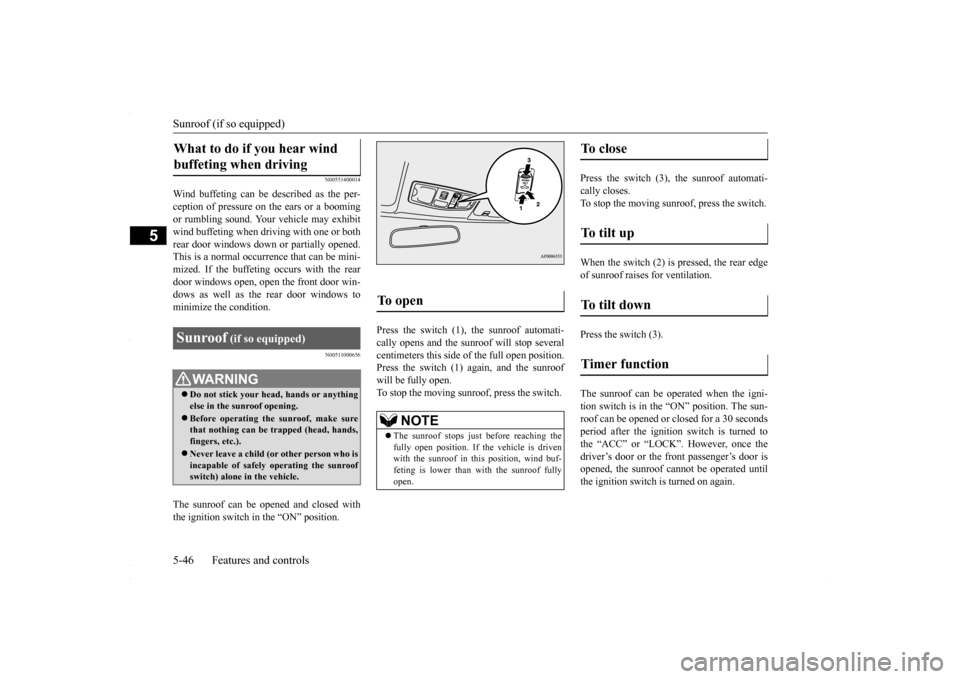
Press the switch (1), the sunroof automati- cally opens and the sunroof will stop several centimeters this side of the full open position. Press the switch (1) again, and the sunroofwill be fully open.To stop the moving sunroo
f, press the switch.
Press the switch (3), the sunroof automati- cally closes.To stop the moving sunroof, press the switch. When the switch (2) is pressed, the rear edge of sunroof raises for ventilation. Press the switch (3). The sunroof can be oper
ated when the igni-
tion switch is in the “ON” position. The sun- roof can be opened or closed for a 30 secondsperiod after the ignition switch is turned to the “ACC” or “LOCK”. However, once the driver’s door or the front passenger’s door isopened, the sunroof cannot be operated until the ignition switch is turned on again.
What to do if you hear wind buffeting when driving Sunroof
(if so equipped)
WA R N I N G Do not stick your head, hands or anything else in the sunroof opening. Before operating the sunroof, make sure that nothing can be trapped (head, hands,fingers, etc.). Never leave a child (or other person who is incapable of safely operating the sunroof switch) alone in the vehicle.
To open
NOTE
The sunroof stops just before reaching the fully open position. If the vehicle is driven with the sunroof in this position, wind buf- feting is lower than with the sunroof fullyopen.
To close
To tilt up
To tilt down
Timer function
BK0230300US.bo
ok 46 ページ 2015年7月30日 木曜日 午後8時38分
Page 109 of 392
Sunroof (if so equipped)
Features and controls 5-47
5
If a hand or head is trapped in the closing sunroof opening, the safety mechanism willcause the sunroof to re-open automatically. The opened sunroof will become operational again after a few seconds.If the safety mechanism is activated 5 or more times consecutively, normal closing of the sunroof will be aborted.As an emergency measure, the sunroof can beclosed in small increments until it is com- pletely closed by repeatedly pressing the switch (2).After performing the emergency measure, consult an authorized Mitsubishi Motors dealer.
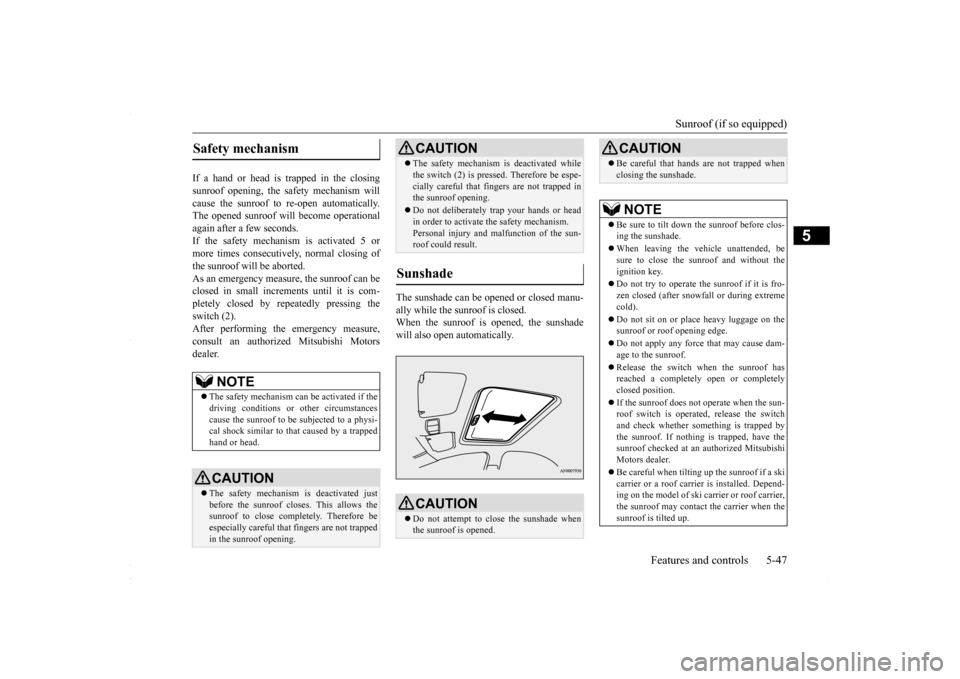
The sunshade can be opened or closed manu- ally while the sunroof is closed. When the sunroof is opened, the sunshade will also open automatically.
Safety mechanism
NOTE
The safety mechanism can be activated if the driving conditions or other circumstances cause the sunroof to be subjected to a physi-cal shock similar to that caused by a trapped hand or head.CAUTION The safety mechanism is deactivated just before the sunroof closes. This allows the sunroof to close completely. Therefore beespecially careful that fingers are not trapped in the sunroof opening.
The safety mechanism is deactivated while the switch (2) is pressed. Therefore be espe- cially careful that fingers are not trapped in the sunroof opening. Do not deliberately trap your hands or head in order to activate the safety mechanism. Personal injury and malfunction of the sun-roof could result.
Sunshade
CAUTION Do not attempt to close the sunshade when the sunroof is opened.CAUTION
Be careful that hands are not trapped when closing the sunshade.NOTE
Be sure to tilt down the sunroof before clos- ing the sunshade. When leaving the vehicle unattended, be sure to close the sunroof and without the ignition key. Do not try to operate the sunroof if it is fro- zen closed (after snowfall or during extreme cold). Do not sit on or place heavy luggage on the sunroof or roof opening edge. Do not apply any force that may cause dam- age to the sunroof. Release the switch when the sunroof has reached a completely open or completelyclosed position. If the sunroof does not operate when the sun- roof switch is operated, release the switch and check whether something is trapped by the sunroof. If nothing is trapped, have thesunroof checked at an authorized Mitsubishi Motors dealer. Be careful when tilting
up the sunroof if a ski
carrier or a roof carrier is installed. Depend-ing on the model of ski car
rier or roof carrier,
the sunroof may contact the carrier when the sunroof is tilted up.CAUTION
BK0230300US.bo
ok 47 ページ 2015年7月30日 木曜日 午後8時38分
Page 110 of 392
Parking brake 5-48 Features and controls
5
N00511401439
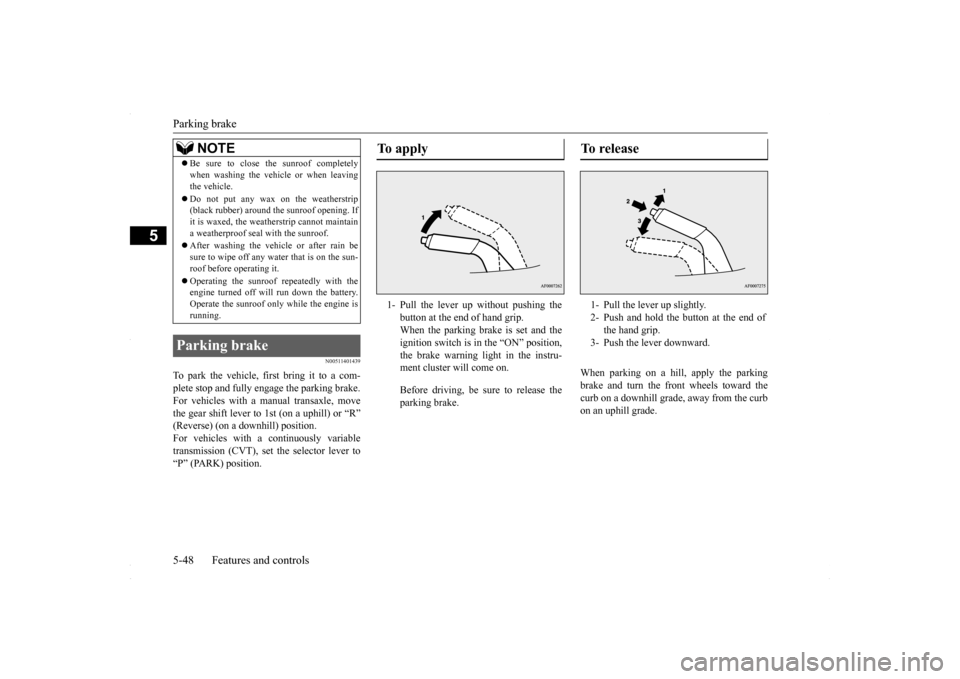
To park the vehicle, first bring it to a com- plete stop and fully engage the parking brake.For vehicles with a manual transaxle, move the gear shift lever to 1st (on a uphill) or “R” (Reverse) (on a downhill) position.For vehicles with a continuously variable transmission (CVT), set the selector lever to “P” (PARK) position.
When parking on a hill, apply the parking brake and turn the front wheels toward thecurb on a downhill grade, away from the curb on an uphill grade.
Be sure to close the sunroof completely when washing the vehicle or when leaving the vehicle. Do not put any wax on the weatherstrip (black rubber) around the sunroof opening. If it is waxed, the weatherstrip cannot maintain a weatherproof seal with the sunroof. After washing the vehicle or after rain be sure to wipe off any water that is on the sun-roof before operating it. Operating the sunroof repeatedly with the engine turned off will run down the battery. Operate the sunroof only while the engine is running.
Parking brake
NOTE
To apply 1- Pull the lever up without pushing the
button at the end of hand grip. When the parking brake is set and theignition switch is in the “ON” position, the brake warning light in the instru- ment cluster will come on. Before driving, be sure to release the parking brake.
To r e l e a s e 1- Pull the lever up slightly. 2- Push and hold the button at the end of
the hand grip.
3- Push the lever downward.
BK0230300US.bo
ok 48 ページ 2015年7月30日 木曜日 午後8時38分
Page 242 of 392
Loading information 6-6 Driving safety
6
Your front bumper can be damaged if you scrape it over curbs or parking stop blocks.Be careful when traveling up or down steep slopes where your bumper can scrape the road. When leaving the vehicle unattended, always carry the key and lock all doors.Always try to park your vehicle in a well lit area.
N00629900349
It is very important to know how much weight your vehicle can carry. This weight iscalled the vehicle capacity weight and includes the weight of all occupants, cargo and non-factory-installed options. The tireand loading information placard located on the driver’s door sill of your vehicle will show how much weight it may properly carry. It is important to familiarize yourself with the following terms before loading your vehicle: Vehicle maximum load on the tire: load on an individual tire that is determined by distributing to each axle its share of the maximum loaded vehicle weight anddividing by two. Vehicle normal load on the tire: load on an individual tire that is determined by dis-tributing to each axle its share of the curb weight, accessory weight, and normal occupant weight and dividing by two.
Maximum loaded vehicle weight: the sum of - (a) Curb weight; (b) Accessory weight;(c) Vehicle capacity weight; and (d) Production options weight. Curb weight: the weight of a motor vehi- cle with standard equipment including the maximum capacity of fuel, oil, and cool- ant. Accessory weight: the combined weight (in excess of those standard items which may be replaced) of automatic transmis- sion, power steering, power brakes, powerwindows, power seats, radio, and heater, to the extent that these items are available as factory- installed equipment (whetherinstalled or not). Vehicle capacity weight: the rated cargo and luggage load plus 150 lbs (68 kg)
*
times the vehicle’s designated seating capacity. Production options weight: the combined weight of those installed regular produc- tion options weighing over 5 lbs (2.3 kg) in excess of those standard items whichthey replace, not previously considered in curb weight or accessory weight, includ- ing heavy duty brakes, ride levelers, roofrack, heavy duty battery, and special trim.
WA R N I N G Leaving the engine running risks injury or death from accidentally moving the gear- shift lever (manual transaxle or the selec- tor lever (CVT) or from the accumulation of toxic exhaust fumes in the passengercompartment.
Where you park
WA R N I N G Do not park your vehicle in areas where combustible materials such as dry grass or leaves can come in contact with a hotexhaust, since a fire could occur.
When leaving the vehicle
Loading information
WA R N I N G Never overload your vehicle. Overloading can damage your vehicle, adversely affectvehicle performance, including handling and braking, cause tire failure, and result in an accident.
BK0230300US.bo
ok 6 ページ 2015年7月30日 木曜日 午後8時38分