roof MITSUBISHI LANCER 2016 8.G User Guide
[x] Cancel search | Manufacturer: MITSUBISHI, Model Year: 2016, Model line: LANCER, Model: MITSUBISHI LANCER 2016 8.GPages: 392, PDF Size: 13.12 MB
Page 243 of 392
Loading information Driving safety 6-7
6
Normal occupant weight: 150 lbs (68 kg)
*
times the number of specified occupants. (In your vehicle the number is 3) Occupant distribution: distribution of occupants in a vehicle as specified. (In your vehicle the distribution is 2 in front, 1 in second row seat)
N00630100309
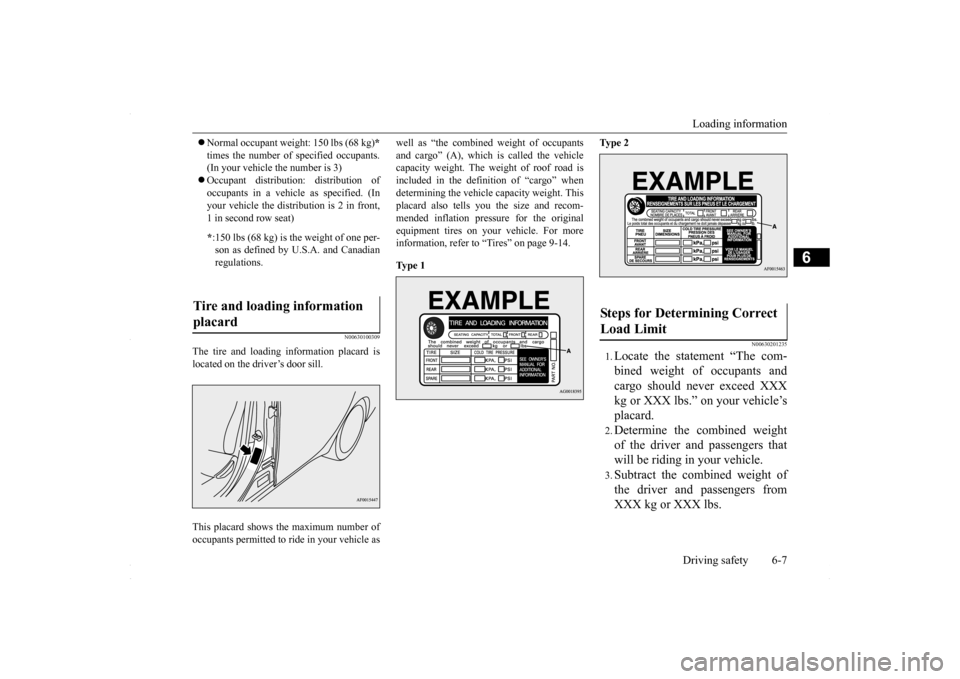
The tire and loading information placard islocated on the driver’s door sill. This placard shows the maximum number of occupants permitted to ride in your vehicle as
well as “the combined weight of occupants and cargo” (A), which is called the vehicle capacity weight. The weight of roof road is included in the definition of “cargo” whendetermining the vehicle capacity weight. This placard also tells you the size and recom- mended inflation pressure for the originalequipment tires on your vehicle. For more information, refer to “Tires” on page 9-14. Ty p e 1
Ty p e 2
N00630201235
1.Locate the statement “The com- bined weight of occupants and cargo should never exceed XXX kg or XXX lbs.” on your vehicle’splacard.2.Determine the combined weightof the driver and passengers thatwill be riding in your vehicle.3.Subtract the combined weight ofthe driver and passengers fromXXX kg or XXX lbs.
* :150 lbs (68 kg) is the weight of one per- son as defined by U.S.A. and Canadian regulations.
Tire and loading information placard
Steps for Determining Correct Load Limit
BK0230300US.bo
ok 7 ページ 2015年7月30日 木曜日 午後8時38分
Page 246 of 392
Cargo loads 6-10 Driving safety
6
N00629700464
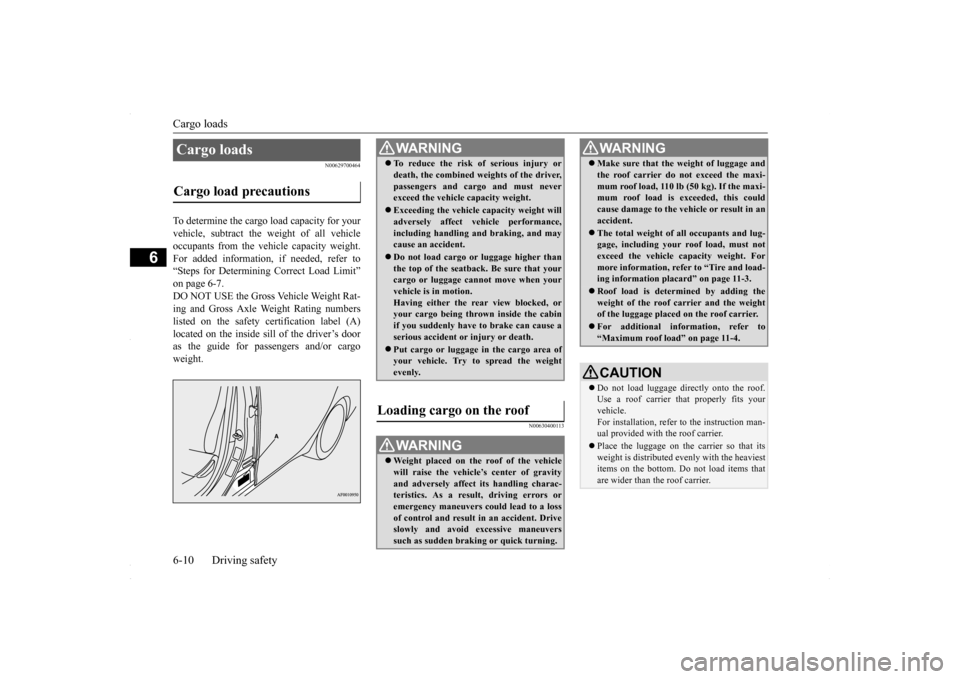
To determine the cargo load capacity for your vehicle, subtract the weight of all vehicleoccupants from the vehicle capacity weight. For added information, if needed, refer to “Steps for Determining Correct Load Limit”on page 6-7.DO NOT USE the Gross Vehicle Weight Rat- ing and Gross Axle Weight Rating numbers listed on the safety certification label (A)located on the inside sill of the driver’s door as the guide for passengers and/or cargo weight.
N00630400113
Cargo loads Cargo load precautions
WA R N I N G To reduce the risk of serious injury or death, the combined weights of the driver, passengers and cargo and must never exceed the vehicle capacity weight. Exceeding the vehicle capacity weight will adversely affect vehicle performance, including handling and braking, and maycause an accident. Do not load cargo or luggage higher than the top of the seatback. Be sure that your cargo or luggage cannot move when your vehicle is in motion.Having either the rear view blocked, or your cargo being thrown inside the cabin if you suddenly have to brake can cause aserious accident or injury or death. Put cargo or luggage in the cargo area of your vehicle. Try to spread the weight evenly.
Loading cargo on the roof
WA R N I N G Weight placed on the roof of the vehicle will raise the vehicle’s center of gravity and adversely affect its handling charac-teristics. As a result, driving errors or emergency maneuvers could lead to a loss of control and result in an accident. Driveslowly and avoid excessive maneuvers such as sudden braking or quick turning.
Make sure that the weight of luggage and the roof carrier do not exceed the maxi- mum roof load, 110 lb (50 kg). If the maxi- mum roof load is exceeded, this could cause damage to the ve
hicle or result in an
accident. The total weight of all occupants and lug- gage, including your roof load, must not exceed the vehicle capacity weight. For more information, refer to “Tire and load-ing information placard” on page 11-3. Roof load is determined by adding the weight of the roof carrier and the weight of the luggage placed on the roof carrier. For additional information, refer to “Maximum roof load” on page 11-4.CAUTION Do not load luggage directly onto the roof. Use a roof carrier th
at properly fits your
vehicle. For installation, refer to the instruction man- ual provided with the roof carrier. Place the luggage on the carrier so that its weight is distributed evenly with the heaviest items on the bottom. Do not load items that are wider than the roof carrier.WA R N I N G
BK0230300US.bo
ok 10 ページ 2015年7月30日 木曜日 午後8時38分
Page 247 of 392
Trailer towing
Driving safety 6-11
6
N00630600102
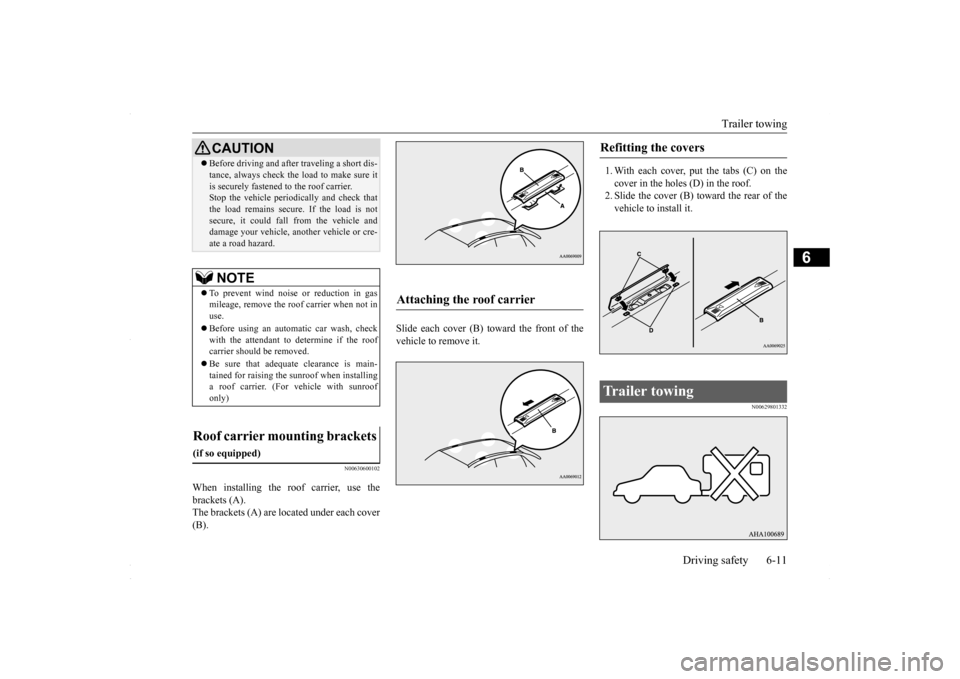
When installing the roof carrier, use the brackets (A). The brackets (A) are located under each cover (B).
Slide each cover (B) toward the front of the vehicle to remove it.
1. With each cover, put the tabs (C) on the cover in the holes (D) in the roof. 2. Slide the cover (B) toward the rear of thevehicle to install it.
N00629801332
Before driving and after traveling a short dis- tance, always check the load to make sure it is securely fastened to the roof carrier. Stop the vehicle periodically and check that the load remains secure. If the load is notsecure, it could fall from the vehicle and damage your vehicle, another vehicle or cre- ate a road hazard.NOTE
To prevent wind noise or reduction in gas mileage, remove the roof carrier when not in use. Before using an automatic car wash, check with the attendant to determine if the roof carrier should be removed. Be sure that adequate clearance is main- tained for raising the sunroof when installinga roof carrier. (For vehicle with sunroof only)
Roof carrier mounting brackets
(if so equipped)
CAUTION
Attaching the roof carrier
Refitting the covers
Trailer towing
BK0230300US.bo
ok 11 ページ 2015年7月30日 木曜日 午後8時38分
Page 305 of 392
Antenna
Comfort controls 7-55
7
N00734200426
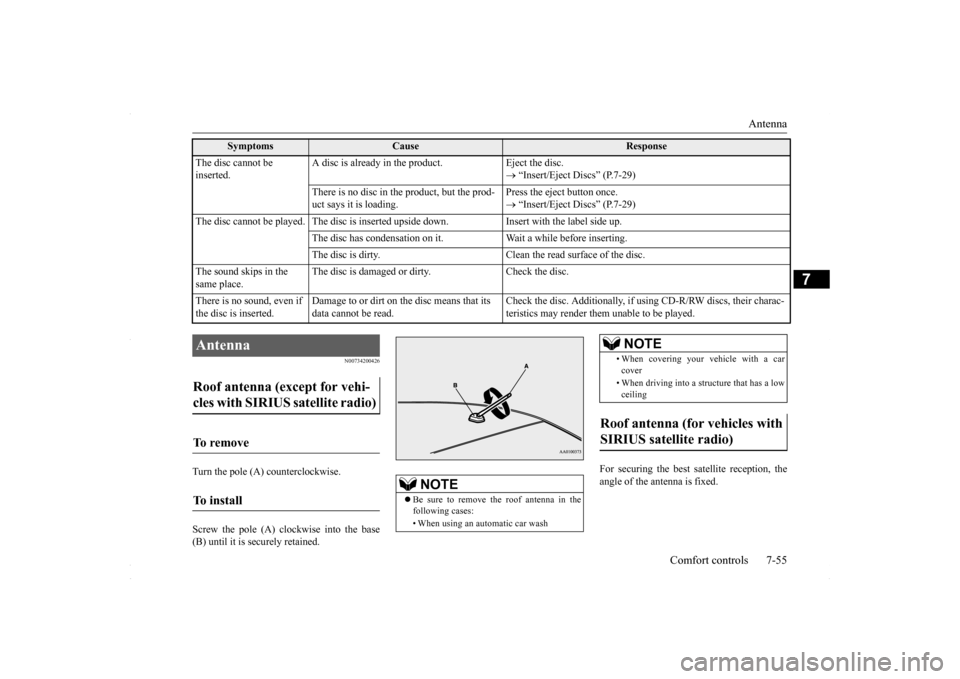
Turn the pole (A) counterclockwise. Screw the pole (A) clockwise into the base (B) until it is securely retained.
For securing the best satellite reception, the angle of the antenna is fixed.
The disc cannot be inserted.
A disc is already in the product. Eject the disc.
“Insert/Eject Discs” (P.7-29)
There is no disc in the product, but the prod- uct says it is loading.
Press the eject button once. “Insert/Eject Discs” (P.7-29)
The disc cannot be played. The disc is inserted upside down. Insert with the label side up.
The disc has condensation on it. Wait a while before inserting.The disc is dirty. Clean the read surface of the disc.
The sound skips in the same place.
The disc is damaged or dirty. Check the disc.
There is no sound, even if the disc is inserted.
Damage to or dirt on the disc means that its data cannot be read.
Check the disc. Additionally, if using CD-R/RW discs, their charac- teristics may render them unable to be played.
Symptoms
Cause
Response
Antenna Roof antenna (except for vehi- cles with SIRIUS satellite radio) To remove To install
NOTE
Be sure to remove the roof antenna in the following cases: • When using an automatic car wash
• When covering your vehicle with a car cover • When driving into a structure that has a low ceiling
Roof antenna (for vehicles with SIRIUS satellite radio)
NOTE
BK0230300US.bo
ok 55 ページ 2015年7月30日 木曜日 午後8時38分
Page 306 of 392
Clock (if so equipped) 7-56 Comfort controls
7
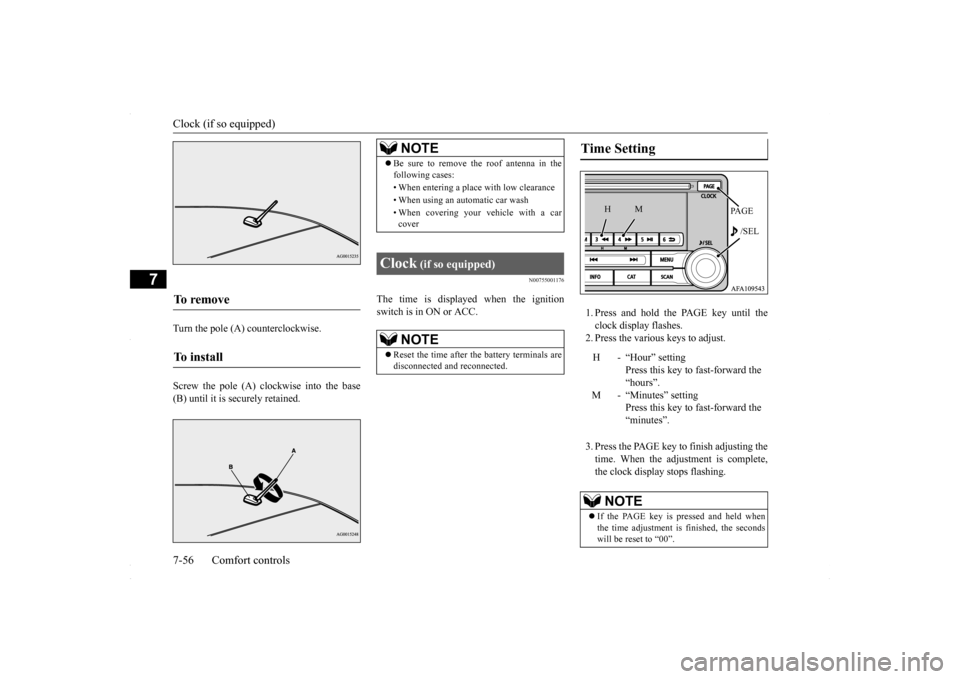
Turn the pole (A) counterclockwise. Screw the pole (A) clockwise into the base (B) until it is securely retained.
N00755001176
The time is displayed when the ignitionswitch is in ON or ACC.
1. Press and hold the PAGE key until the clock display flashes.2. Press the various keys to adjust. 3. Press the PAGE key to finish adjusting the time. When the adjustment is complete, the clock display stops flashing.
To remove To i n s t a l l
NOTE
Be sure to remove the roof antenna in the following cases: • When entering a place with low clearance • When using an automatic car wash • When covering your vehicle with a car cover
Clock
(if so equipped)
NOTE
Reset the time after the battery terminals are disconnected and reconnected.
Time Setting
H - “Hour” setting
Press this key to fast-forward the“hours”.
M - “Minutes” setting
Press this key to fast-forward the “minutes”.
NOTE
If the PAGE key is pressed and held when the time adjustment is finished, the seconds will be reset to “00”.
PA G E /SEL
M
H
BK0230300US.bo
ok 56 ページ 2015年7月30日 木曜日 午後8時38分
Page 352 of 392
Fuses 9-26 Vehicle care and maintenance
9
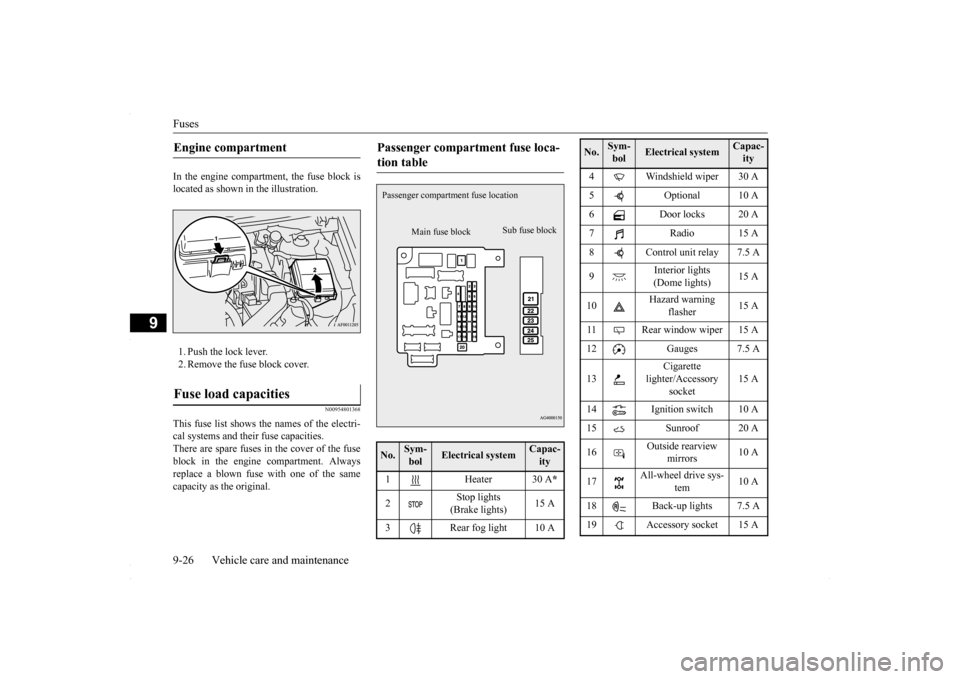
In the engine compartment, the fuse block is located as shown in the illustration. 1. Push the lock lever. 2. Remove the fuse block cover.
N00954801368
This fuse list shows the names of the electri- cal systems and their fuse capacities. There are spare fuses in the cover of the fuseblock in the engine compartment. Always replace a blown fuse with one of the same capacity as the original. Engine compartment Fuse load capacities
Passenger compartment fuse loca- tion table No.
Sym- bol
Electrical system
Capac-ity
1 Heater 30 A
*
2
Stop lights (Brake lights)
15 A
3 Rear fog light 10 A
Main fuse block
Sub fuse block
Passenger compartme
nt fuse location
4 Windshield wiper 30 A 5 Optional 10 A 6 Door locks 20 A 7Radio15 A8 Control unit relay 7.5 A 9
Interior lights (Dome lights)
15 A
10
Hazard warning
flasher
15 A
11 Rear window wiper 15 A 12 Gauges 7.5 A 13
Cigarette
lighter/Accessory
socket
15 A
14 Ignition switch 10 A 15 Sunroof 20 A 16
Outside rearview
mirrors
10 A
17
All-wheel drive sys-
tem
10 A
18 Back-up lights 7.5 A 19 Accessory socket 15 ANo.
Sym- bol
Electrical system
Capac-ity
BK0230300US.bo
ok 26 ページ 2015年7月30日 木曜日 午後8時38分
Page 370 of 392
Cleaning the outside of your vehicle 9-44 Vehicle care and maintenance
9
Salt and other chemicals spread on winter roads in some geographical areas can have adetrimental effect on the vehicle underbody. You should flush the underbody with a high pressure hose every time you wash the out-side of your vehicle. Take special care to remove mud or other debris which could trap and hold salt andmoisture. After washing your vehicle, wipe off all waterdrops from the rubber parts around thedoors to prevent the doors from freezing.
N00946000188
Wax your vehicle once or twice a year, orwhen water does not bead up on the paint. Use a soft cloth to put a small amount of wax on the painted surfaces. After the wax hasdried, polish with a dry soft cloth. Do not wax your vehicle in direct sunlight. You should wax when the painted surfacesare cool.
N00946100059
If painted surfaces have been severely dam-aged and lost their original luster and colortone, polish the surface lightly with a fine polishing compound. Avoid limiting your polishing to the damaged surface only; polisha somewhat wider area, moving the polishing cloth in one direction. After polishing, flush the compound from the surface and apply acoat of wax to regain a beautiful luster.
• Put down (except for vehicles with SIRIUS satellite radio antenna) or remove the antenna.• If your vehicle is equipped with rearspoiler, check with the car wash operator before using the car wash.• If your vehicle has rain sensor wipers, placethe wiper switch lever in the “OFF” posi- tion to deactivate the rain sensor.
During cold weather
CAUTION
NOTE
When the door is frozen, opening it by force may tear off or crack the rubber gasket installed around the door. Pour warm water to melt the ice. Be sure to thoroughly wipe off the water after opening the door. To pre-vent freezing of the weatherstripping on the doors, hood, etc., treat
with silicone lubri-
cant.
Waxing
CAUTION Waxes containing high abrasive compounds should not be used. These waxes remove rust and stain effectively from the paintwork, butare harmful to the finish on the paint and the plate, because they also remove clearcoat. They are also harmful to other glossy sur-faces such as the grill
e, trim, moldings, etc.
Do not use gasoline, kerosene, benzine or paint thinners to remove road tar or other dirt from the vehicle surface. Do not put wax on the areas having black matte coating because it can cause uneven discoloration, patches, blurs, etc. If these get wax on them, wipe the wax off right awaywith a soft cloth and warm water. On vehicles with sunroof, be careful not to apply any wax on the weatherstrip (black rubber) when waxing the area around the sunroof opening.If stained with wax, the weatherstrip cannot maintain a weatherproof seal with the sun- roof.
Polishing
CAUTION
BK0230300US.bo
ok 44 ページ 2015年7月30日 木曜日 午後8時38分
Page 372 of 392
Cleaning the outside of your vehicle 9-46 Vehicle care and maintenance
9
N00946800072
Clean the inside of the sunroof with a soft cloth. Hard deposits should be wiped away with a cloth dipped in warm, neutral deter-gent solution. Wipe away the solution with a sponge dipped in fresh water.
N00947000042
Never spray or splash water on the electricalcomponents in the engine compartment, as this may cause damage.Do not allow any nearby parts (such as plastic parts) come into contact with sulphuric acid (battery electrolyte), which may crack, stain,or discolour them. If this occurs, wipe the parts with a soft cloth saturated with a mild detergent and watersolution. Then immediately rinse the affected parts with plenty of water.Cleaning the sunroof
(if so
equipped)
NOTE
The surface treatment on the inside of the glass may be removed if a hard cloth or organic solvent is used.
Engine compartment BK0230300US.bo
ok 46 ページ 2015年7月30日 木曜日 午後8時38分
Page 382 of 392
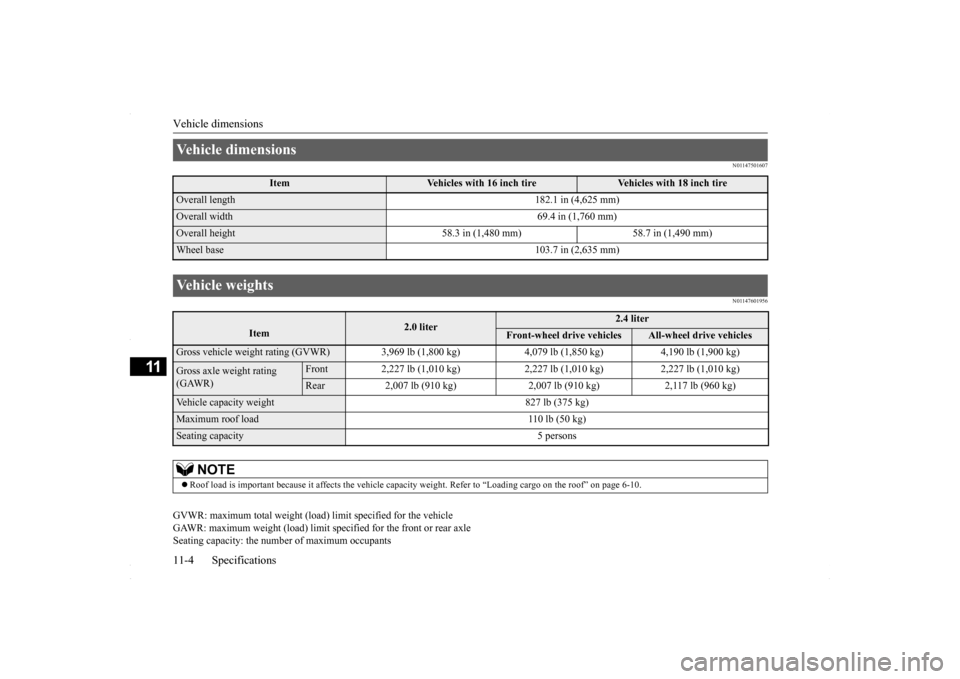
Vehicle dimensions 11-4 Specifications
11
N01147501607 N01147601956
GVWR: maximum total weight (load) limit specified for the vehicle GAWR: maximum weight (load) limit sp
ecified for the front or rear axle
Seating capacity: the number of maximum occupantsVehicle dimensions
Item
Vehicles with 16 inch tire
Vehicles with 18 inch tire
Overall length 182.1 in (4,625 mm) Overall width 69.4 in (1,760 mm) Overall height 58.3 in (1,480 mm) 58.7 in (1,490 mm)Wheel base 103.7 in (2,635 mm) Vehicle weights
Item
2.0 liter
2.4 liter
Front-wheel drive vehicles
All-wheel drive vehicles
Gross vehicle weight rating (GVWR) 3,969 lb
(1,800 kg) 4,079 lb (1,850
kg) 4,190 lb (1,900 kg)
Gross axle weight rating (GAWR)
Front 2,227 lb (1,010 kg) 2,227 lb
(1,010 kg) 2,227 lb (1,010 kg)
Rear 2,007 lb (910 kg) 2,007 lb (910 kg) 2,117 lb (960 kg)
Vehicle capacity weight 827 lb (375 kg)Maximum roof load 110 lb (50 kg)Seating capacity 5 persons
NOTE
Roof load is important because it affects the vehicle capacity
weight. Refer to “Loading cargo on the roof” on page 6-10.
BK0230300US.bo
ok 4 ページ 2015年7月30日 木曜日 午後8時38分
Page 387 of 392
Alphabetical index
12-1
12
A
Accessory (installation)
.........................
3-5
Active stability control (ASC)
..............
5-76
ASC OFF display or ASC indicator
..5-78
ASC operation display
....................
5-78
Air cleaner filter
...................
................
9-8
Air conditioning
Automatic air conditioning
.......
7-7
, 7-12
Important air conditioning operating tips
..
7-18
Air purifier
....................
.....................
7-18
All-wheel driving operation
.................
5-70
Aluminum wheels
...............................
9-45
AM/FM radio
....................
.................
7-19
Antenna
Roof antenna
.................
.................
7-55
Anti-lock braking system
.....................
5-74
Warning light / display
...........
5-74
, 5-75
Arm rest
........................
.......................
4-6
Assist grip
.....................
...................
5-172
Audio
AM/FM radio
................
.................
7-19
CD player
.....................
.................
7-19
Troubleshooting
.............................
7-53
Automatic air conditioning
...........
7-7
, 7-12
B
Back-up lights
Bulb capacity
..................
...............
9-30
Replacement
...................
...............
9-38
Ball joint, steering linkage seals and drive shaft boots
.....................
..................
9-23
Battery
........................
......................
9-12
Charging system warning light
.......
5-125
Checking battery electrolyte level
....
9-12
Disconnection and connection
.........
9-13
During cold weather
.......................
9-12
Specification
...................
...............
11-5
Bluetooth 2.0 interface
.......................
5-139
Bottle holder
....................
.................
5-172
Brake
Anti-lock braking system
................
5-74
Braking
.......................
....................
6-5
Fluid
....................
.................
9-11
, 11-6
Hose
.......................
......................
9-23
Parking brake
..................
...............
5-48
Parking brake lever stroke
...............
9-21
Pedal
.......................
......................
5-72
Pedal free play
................
...............
9-21
Power brakes
..................
...............
5-73
Service brake
..................
...............
5-72
Brake assist
......................
..................
5-73
Break-in recommendations
....................
5-3
Bulb capacity
...................
..................
9-30
C
California Perchlorate Materials Requirements
.....................
................
3-6
Capacities
.....................
.....................
11-6
Card holder
............................
5-166
, 5-170
Cargo loads
...................
.....................
6-10
Catalytic converter
................
................
9-2
CD player
......................
.....................
7-19
Certification label
...............................
11-3
Charging system warning light
...........
5-125
Chassis number
..................
.................
11-2
Child restraint
....................
.................
4-13
Child safety locks for rear door
............
5-38
Cleaning
Inside of your vehicle
......................
9-41
Outside of your vehicle
...................
9-43
Clock
.........................
........................
7-56
Clutch
Fluid
..................
...................
9-11
, 11-6
Pedal free play
...............
.................
9-20
Coat hooks
....................
...................
5-172
Combination headlights and dimmer switch
.
5-127 Coming home light
...........................
5-131
Consumer information
.........................
10-2
BK0230300US.bo
ok 1 ページ 2015年7月30日 木曜日 午後8時38分