brake MITSUBISHI LANCER 2017 8.G Repair Manual
[x] Cancel search | Manufacturer: MITSUBISHI, Model Year: 2017, Model line: LANCER, Model: MITSUBISHI LANCER 2017 8.GPages: 385, PDF Size: 14.34 MB
Page 318 of 385
Fuel Pump Shut-off System
For emergencies 8-15
8
When driving on a road covered with snow or ice, use snow tires. Tire chains cannot be used on your vehicle. There may be state or local regulations aboutusing snow tires. Always check the regu- lations in your local area before using them. Refer to the section entitled “Snowtires” on page 9-20 and “Tire chains” on page 9-20. Drive slowly. Do not make sudden starts or stops, sharp turns, or slam on the brakes. Allow extra distance between your vehi- cle and the vehicle in front of you, and avoid sudden braking. If a skid occurs when the accelerator pedal is depressed, take your foot off the pedal. Steer gently in the direction of the skid.
Your vehicle is equipped with an anti-lock braking system (ABS), hold the brake pedal down firmly and keep it depressed. Do not pump the brake pedal which willresult in reduced braking performance. After parking on snowy or icy road, it may be difficult to move your vehicle dueto freeze-up of the brake. Depress the accelerator pedal little by little to move the vehicle after confirming safety of thevehicle. Drive as slow as poss
ible when driving on
bumpy or rutted roads or over potholes etc.
N00860600044
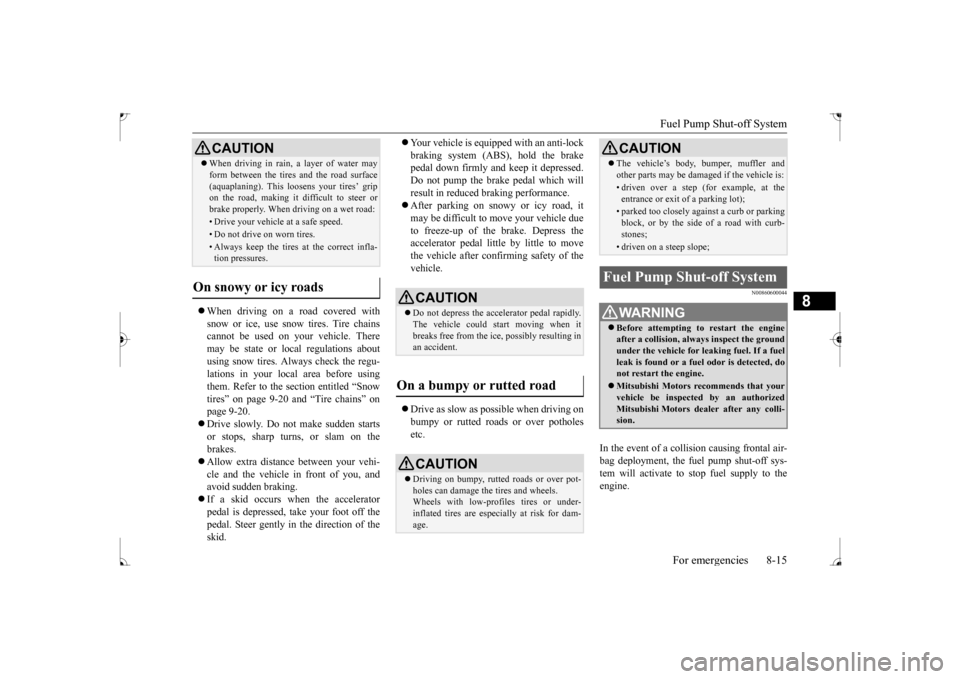
In the event of a collision causing frontal air-bag deployment, the fuel pump shut-off sys- tem will activate to stop fuel supply to the engine.
When driving in rain, a layer of water may form between the tires and the road surface (aquaplaning). This loosens your tires’ grip on the road, making it difficult to steer or brake properly. When driving on a wet road:• Drive your vehicle at a safe speed.• Do not drive on worn tires.• Always keep the tires at the correct infla-tion pressures.
On snowy or icy roads
CAUTION
CAUTION Do not depress the accelerator pedal rapidly. The vehicle could start moving when it breaks free from the ice, possibly resulting inan accident.
On a bumpy or rutted road
CAUTION Driving on bumpy, rutted roads or over pot- holes can damage the tires and wheels.Wheels with low-profiles tires or under- inflated tires are especially at risk for dam- age.
The vehicle’s body, bumper, muffler and other parts may be damaged if the vehicle is:• driven over a step (for example, at the entrance or exit of a parking lot);• parked too closely against a curb or parkingblock, or by the side of a road with curb-stones;• driven on a steep slope;
Fuel Pump Shut-off System
WA R N I N G Before attempting to restart the engine after a collision, always inspect the groundunder the vehicle for leaking fuel. If a fuel leak is found or a fuel odor is detected, do not restart the engine. Mitsubishi Motors recommends that your vehicle be inspected by an authorizedMitsubishi Motors dealer after any colli- sion.CAUTION
BK0237700US.bo
ok 15 ページ 2016年4月15日 金曜日 午前11時28分
Page 320 of 385
9
Vehicle care and maintenanceService precautions .........
.................................................................9-2
Catalytic converter
.................................................
..........................9-2
Engine hood ..............................
.......................................................9-3
View of the engine comp
artment .....................................................9-5
Engine oil and oil filt
er ................................
....................................9-5
Engine coolant ................
.................................................................9-7
Air cleaner filter ....
.................................................
..........................9-8
Manual transaxle oil (if so
equipped) ...............................................9-9
Continuously variable transmission (CVT) fluid (if so equipped) .
.................................................
........................9-10
Transfer oil (All-wheel dr
ive models) ...........................................9-10
Rear axle oil (All-wheel dr
ive models) ........................................9-10
Washer fluid ....................
...............................................................9-10
Brake fluid/Clutch fluid (if
so equipped)........................................ 9-11
Power steering fluid (if so equipped)..............................................9-12 Battery .......................................
.....................................................9-12
Tires ..........................................
.....................................................9-14
Clutch pedal free play (if so equipped)...........................................9-20 Brake pedal free play
.............................................
........................9-21
Parking brake lever stroke .............................................................9-21 Parking brake break-in
...........................................
........................9-21
Wiper blades ...................
...............................................................9-21
Emission-control system maintenance ..........................................9-22General maintenance
.............................................
........................9-23
For cold and snowy weat
her ..........................................................9-24
Fusible links ....................
...............................................................9-24
Fuses .........................................
.....................................................9-25
Replacement of light bu
lbs ............................................................9-29
Vehicle care precautions
.......................................
......................... 9-41
Cleaning the inside of you
r vehicle ............................................... 9-42
Cleaning the outside of your
vehicle ............................................. 9-43
BK0237700US.bo
ok 1 ページ 2016年4月15日 金曜日 午前11時28分
Page 324 of 385
View of the engine compartment
Vehicle care and maintenance 9-5
9
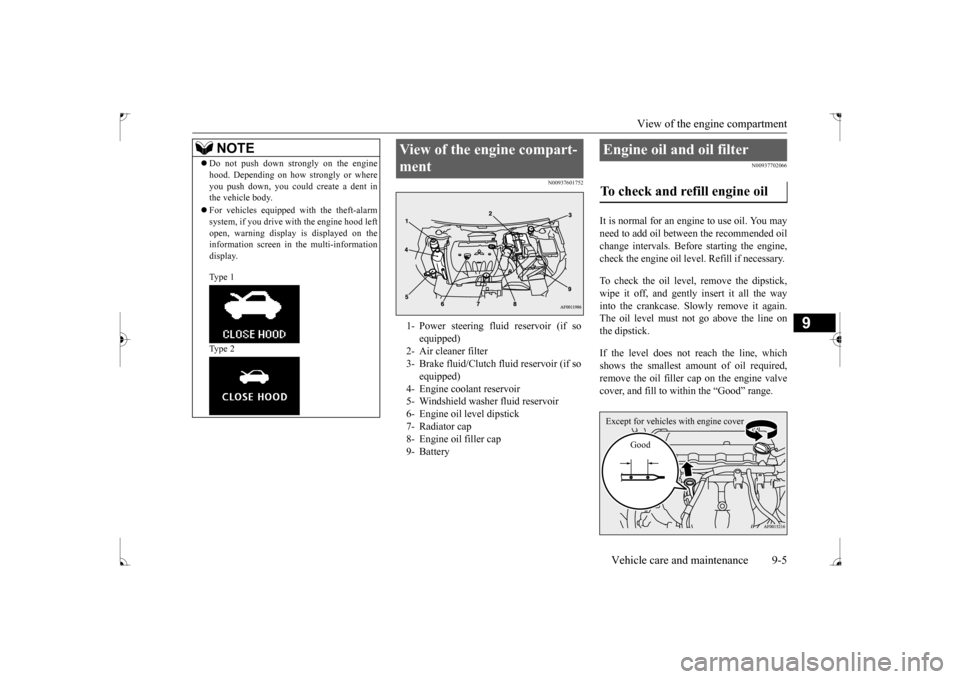
N00937601752
N00937702066
It is normal for an engi
ne to use oil. You may
need to add oil between the recommended oilchange intervals. Before starting the engine, check the engine oil level. Refill if necessary. To check the oil level, remove the dipstick, wipe it off, and gently insert it all the way into the crankcase. Slowly remove it again.The oil level must not go above the line on the dipstick. If the level does not reach the line, which shows the smallest amount of oil required,remove the oil filler cap on the engine valve cover, and fill to with
in the “Good” range.
Do not push down strongly on the engine hood. Depending on how strongly or where you push down, you could create a dent in the vehicle body. For vehicles equipped with the theft-alarm system, if you drive with the engine hood left open, warning display is displayed on theinformation screen in the multi-information display. Type 1 Type 2NOTE
View of the engine compart- ment 1- Power steering fluid reservoir (if so
equipped)
2- Air cleaner filter 3- Brake fluid/Clutch
fluid reservoir (if so
equipped)
4- Engine coolant reservoir 5- Windshield washer fluid reservoir 6- Engine oil level dipstick 7- Radiator cap8- Engine oil filler cap 9- Battery
Engine oil and oil filter To check and refill engine oil Except for vehicles with engine cover
Good
BK0237700US.bo
ok 5 ページ 2016年4月15日 金曜日 午前11時28分
Page 330 of 385
Brake fluid/Clutch fluid (if so equipped) Vehicle care and maintenance 9-11
9
Check the washer fluid level at regular inter- vals and add washer fluid to reservoir if nec- essary. Open the reservoir cap and check the fluidlevel with the dipstick. When freezing weather is anticipated, flush out the water in the reservoir by operating thepump. Fill the reservoir with windshield anti- freeze (not radiator antifreeze), and operate the system for a few seconds to flush out theresidual water.
N00938700186
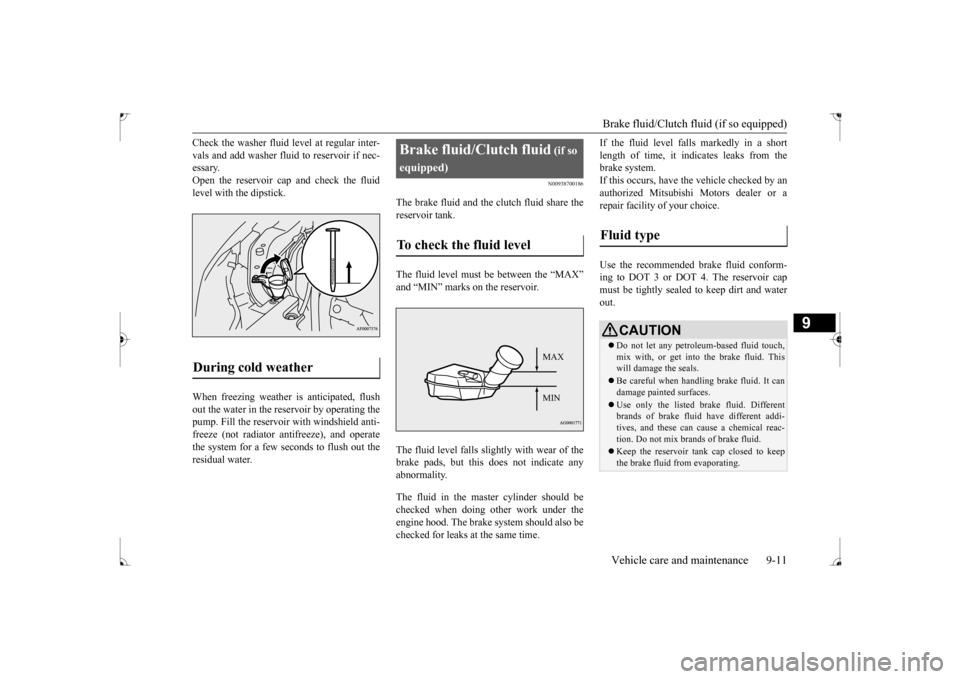
The brake fluid and the clutch fluid share thereservoir tank. The fluid level must be between the “MAX” and “MIN” marks on the reservoir. The fluid level falls slightly with wear of the brake pads, but this does not indicate any abnormality. The fluid in the master cylinder should be checked when doing other work under the engine hood. The brake
system should also be
checked for leaks at the same time.
If the fluid level falls markedly in a short length of time, it indicates leaks from the brake system. If this occurs, have the vehicle checked by anauthorized Mitsubishi Motors dealer or a repair facility of your choice. Use the recommended brake fluid conform- ing to DOT 3 or DOT 4. The reservoir cap must be tightly sealed to keep dirt and water out.
During cold weather
Brake fluid/Clutch fluid
(if so
equipped)To check the fluid level
MAX MIN
Fluid type
CAUTION Do not let any petroleum-based fluid touch, mix with, or get into
the brake fluid. This
will damage the seals. Be careful when handling brake fluid. It can damage painted surfaces. Use only the listed brake fluid. Different brands of brake fluid have different addi-tives, and these can cause a chemical reac- tion. Do not mix bra
nds of brake fluid.
Keep the reservoir tank cap closed to keep the brake fluid from evaporating.
BK0237700US.bo
ok 11 ページ 2016年4月15日 金曜日 午前11時28分
Page 340 of 385
Brake pedal free play
Vehicle care and maintenance 9-21
9
N00940301333
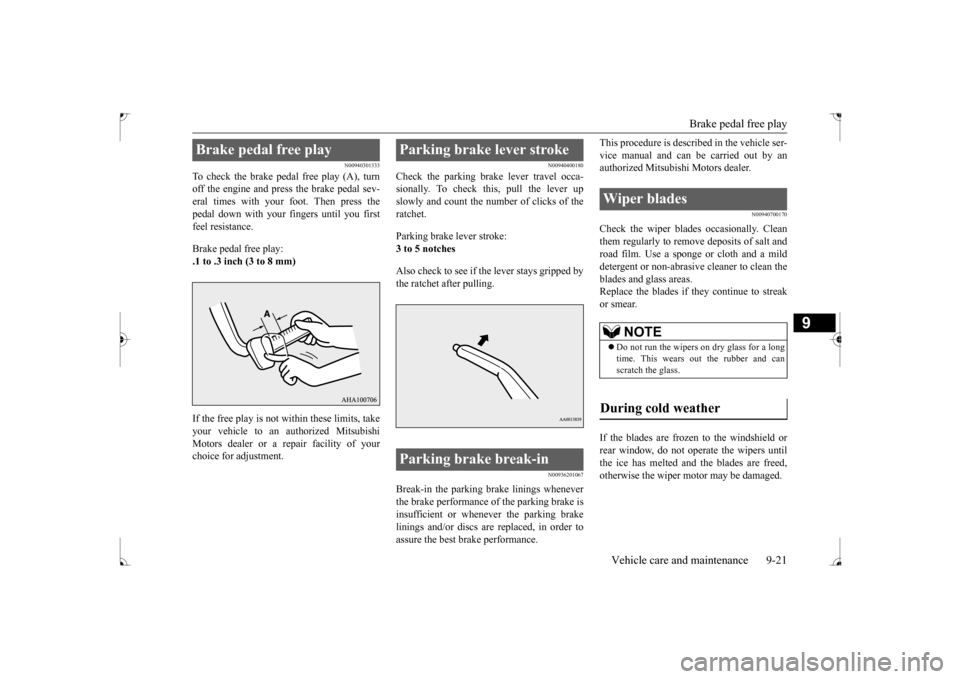
To check the brake pedal free play (A), turn off the engine and press the brake pedal sev-eral times with your foot. Then press the pedal down with your fingers until you first feel resistance. Brake pedal free play: .1 to .3 inch (3 to 8 mm) If the free play is not within these limits, take your vehicle to an authorized Mitsubishi Motors dealer or a repair facility of your choice for adjustment.
N00940400180
Check the parking brake lever travel occa-sionally. To check this, pull the lever upslowly and count the number of clicks of the ratchet. Parking brake lever stroke: 3 to 5 notches Also check to see if the lever stays gripped by the ratchet after pulling.
N00936201067
Break-in the parking brake linings whenever the brake performance of the parking brake is insufficient or whenever the parking brakelinings and/or discs are replaced, in order to assure the best brake performance.
This procedure is described in the vehicle ser- vice manual and can be carried out by an authorized Mitsubishi Motors dealer.
N00940700170
Check the wiper blades occasionally. Cleanthem regularly to remove deposits of salt and road film. Use a sponge or cloth and a milddetergent or non-abrasive cleaner to clean theblades and glass areas. Replace the blades if they continue to streak or smear. If the blades are frozen to the windshield or rear window, do not operate the wipers until the ice has melted and the blades are freed, otherwise the wiper motor may be damaged.
Brake pedal free play
Parking brake lever stroke Parking brake break-in
Wiper blades
NOTE
Do not run the wipers on dry glass for a long time. This wears out the rubber and can scratch the glass.
During cold weather
BK0237700US.bo
ok 21 ページ 2016年4月15日 金曜日 午前11時28分
Page 342 of 385
General maintenance
Vehicle care and maintenance 9-23
9
N00941300085
Check these regularly for damage or leaks in the fuel lines and connections. Check the fuel tank filler cap for damage or looseness. Payspecial attention to the fuel lines closest to high heat sources such as the exhaust mani- fold.
N00941400116
If the fuel-vapor vent line is clogged or dam-aged, the fuel-vapor mixture will escape, pol- luting the air. Have the system checked at an authorizedMitsubishi Motors dealer at the mileage spec-
ified in the “WARRANTY AND MAINTE- NANCE MANUAL”.
N00941500159
The next pages list the maintenance servicerecommended by Mitsubishi Motors Corpo- ration. In addition to the general maintenance that needs to be perfor
med at the times listed,
there are other parts which do not usuallyneed regular maintenance. But, if any of these parts stops working prop- erly, your vehicle performance could suffer.Have these items checked if you notice a problem with them. See your authorized Mitsubishi Motors dealer for assistance, if you have any questions.
N00941600033
Good brakes are essen
tial to safe driving.
Check the brake pads and brake linings for wear and check the rear wheel cylinders forleaks. For good braking performance, replace the brake pads with the
same type pads as the
originals.
N00941700047
Brake hoses and tubing should be checkedfor: Severe surface cracking, scuffing or worn spots. If the fabric casing of the hose is showing through any cracks or worn spots in the rubber hose cover, the hose shouldbe replaced. The brakes can fail if thehose wears through. Improper installation may cause twisting, or wheel, tire or chassis interference.
N00941800077
Check the following parts for damage andgrease leaks: Ball joint boots of the front suspension and steering linkage Bellows on both ends of the drive shaft
N00942200108
Fuel system (tank, pipe line and connection, and fuel tank filler cap)
WA R N I N G If you see a fuel leak or if you smell fuel, do not run the engine. Any spark (includ-ing from the ignition), flame or smoking material could cause an explosion or fire. Call an authorized Mitsubishi Motorsdealer or a repair facility of your choice for assistance.
Evaporative emission control system (except evaporative emission canister)
General maintenance Disc brake pads, rear drum brake linings and rear wheel cylinders
Brake hoses Ball joint, steering linkage seals and drive shaft boots Exhaust system
WA R N I N G Carbon monoxide gas from your vehicle’s exhaust is poisonous. Breathing these fumes can cause unconsciousness or death.
BK0237700US.bo
ok 23 ページ 2016年4月15日 金曜日 午前11時28分
Page 345 of 385
Fuses 9-26 Vehicle care and maintenance
9
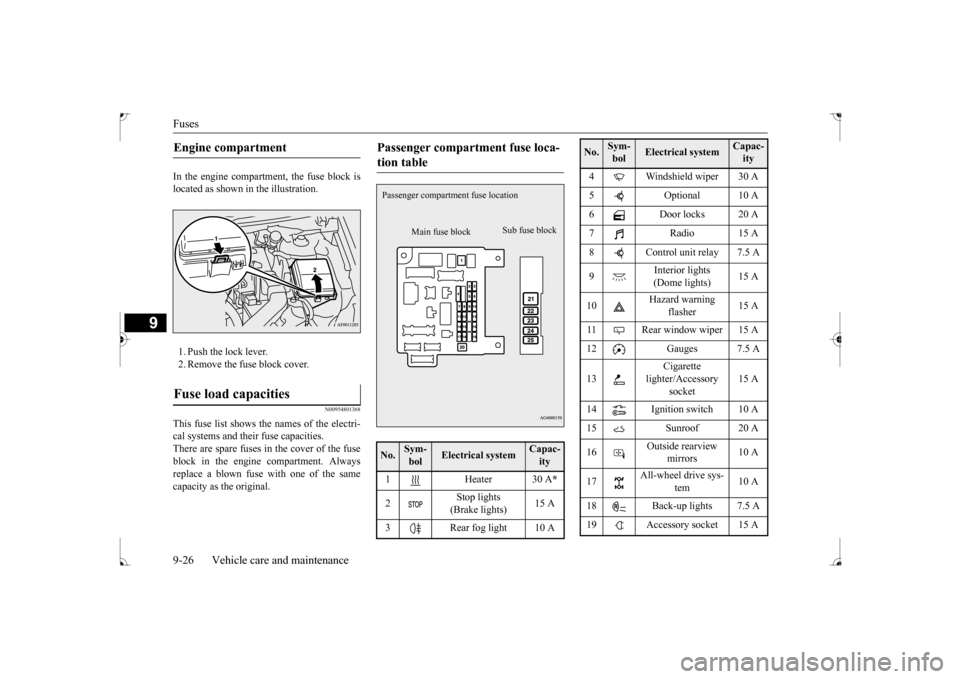
In the engine compartment, the fuse block is located as shown in the illustration. 1. Push the lock lever. 2. Remove the fuse block cover.
N00954801368
This fuse list shows the names of the electri- cal systems and their fuse capacities. There are spare fuses in the cover of the fuseblock in the engine compartment. Always replace a blown fuse with one of the same capacity as the original. Engine compartment Fuse load capacities
Passenger compartment fuse loca- tion table No.
Sym- bol
Electrical system
Capac-ity
1 Heater 30 A
*
2
Stop lights (Brake lights)
15 A
3 Rear fog light 10 A
Main fuse block
Sub fuse block
Passenger compartme
nt fuse location
4 Windshield wiper 30 A 5 Optional 10 A 6 Door locks 20 A 7Radio15 A8 Control unit relay 7.5 A 9
Interior lights (Dome lights)
15 A
10
Hazard warning
flasher
15 A
11 Rear window wiper 15 A 12 Gauges 7.5 A 13
Cigarette
lighter/Accessory
socket
15 A
14 Ignition switch 10 A 15 Sunroof 20 A 16
Outside rearview
mirrors
10 A
17
All-wheel drive sys-
tem
10 A
18 Back-up lights 7.5 A 19 Accessory socket 15 ANo.
Sym- bol
Electrical system
Capac-ity
BK0237700US.bo
ok 26 ページ 2016年4月15日 金曜日 午前11時28分
Page 364 of 385
Cleaning the outside of your vehicle Vehicle care and maintenance 9-45
9
N00946100059
If painted surfaces have been severely dam- aged and lost their original luster and colortone, polish the surface lightly with a fine polishing compound. Avoid limiting your polishing to the damaged surface only; polisha somewhat wider area, moving the polishing cloth in one direction. After polishing, flush the compound from the surface and apply acoat of wax to regain a beautiful luster.
N00946200063
Small cracks and scratches in the paint coatshould be touched up as soon as possible withtouch-up paint to prevent corrosion. Check body areas facing the road or the tires carefully for damage to the paint caused byflying stones, etc. The paint code number for your vehicle can be found on the vehicle information code plate in the engine compart-ment.
N00946300178
Use a sponge or chamois to clean these parts.If a vehicle wax sticks to a gray or blackrough surface of the bumper, molding or lights, the surface may appear white in color. In this case, wipe it
off using lukewarm water
and a soft cloth or chamois.
N00946400065
To prevent spots and corrosion of chrome parts, wash with water, dry thoroughly, and apply a nonabrasive automotive wax. If thechrome is severely damaged or pitted, use a commercially available chrome polish.
N00946500196
1. Remove dirt using a wet sponge. 2. Use a mild detergent on any dirt that can-not be removed easily with water. Rinse off the detergent after washing the wheel.3. Dry the wheel thoroug
hly using a chamois
leather or a soft cloth.
Do not use gasoline, kerosene, benzine or paint thinners to remove road tar or other dirt from the vehicle surface. Do not put wax on the areas having black matte coating because it can cause uneven discoloration, patches, blurs, etc. If these get wax on them, wipe the wax off right awaywith a soft cloth and warm water. On vehicles with sunroof, be careful not to apply any wax on the weatherstrip (black rubber) when waxing the area around the sunroof opening.If stained with wax, the weatherstrip cannot maintain a weatherproof seal with the sun- roof.
Polishing
CAUTION
Damaged paint Cleaning plastic parts
CAUTION Do not use a scrubbing brush or other rough scrubber as these may damage the plastic surface. Do not use wax containing compounds (pol- ishing powder) which may damage the plas-tic surface.
Do not let the plastic parts get soiled with gasoline, oil, brake fluids, engine oils, greases, paint thinner, and sulfuric acid (bat- tery electrolyte). These fluids, etc., may crack, stain or discolor the plastic parts.If any of these get on the plastic parts, wipe them up with a soft cloth or chamois and a mild solution of soap and water. Then rinsethem immediately with water.
Chrome parts Aluminum wheels (if so equipped)
CAUTION
BK0237700US.bo
ok 45 ページ 2016年4月15日 金曜日 午前11時28分
Page 377 of 385
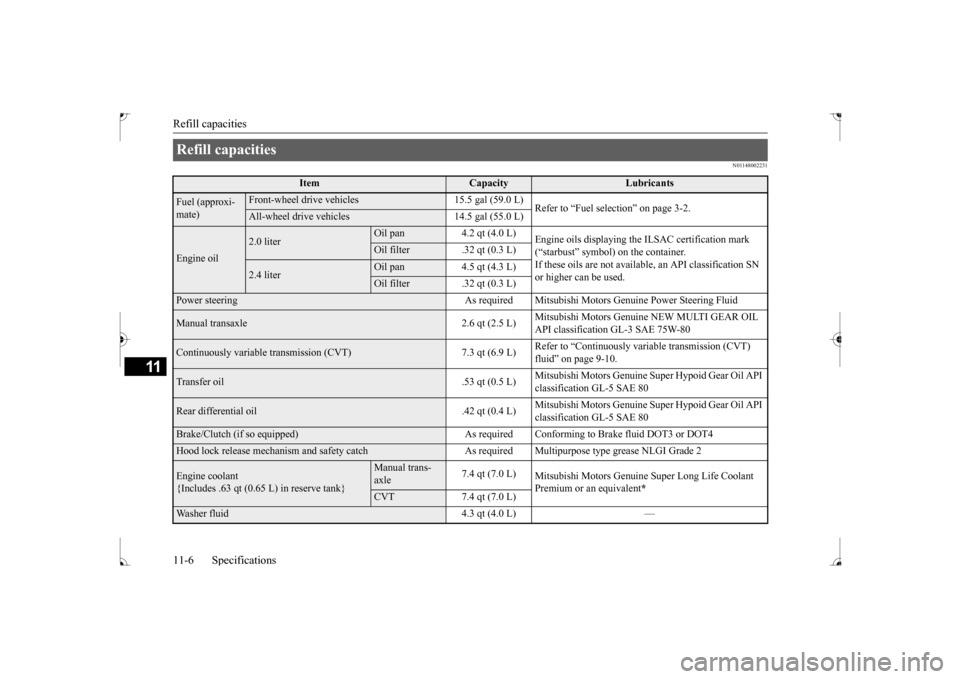
Refill capacities 11-6 Specifications
11
N01148002231
Refill capacities
Item
Capacity
Lubricants
Fuel (approxi- mate)
Front-wheel drive vehicles 15.5 gal (59.0 L)
Refer to “Fuel selection” on page 3-2.
All-wheel drive vehicles 14.5 gal (55.0 L)
Engine oil
2.0 liter
Oil pan 4.2 qt (4.0 L)
Engine oils displaying the ILSAC certification mark (“starbust” symbol) on the container.If these oils are not available, an API classification SN or higher can be used.
Oil filter .32 qt (0.3 L)
2.4 liter
Oil pan 4.5 qt (4.3 L)Oil filter .32 qt (0.3 L)
Power steering As required Mitsubishi Motors Genuine Power Steering Fluid Manual transaxle 2.6 qt (2.5 L)
Mitsubishi Motors Genuine NEW MULTI GEAR OIL API classification GL-3 SAE 75W-80
Continuously variable transmission (CVT) 7.3 qt (6.9 L)
Refer to “Continuously variable transmission (CVT) fluid” on page 9-10.
Transfer oil .53 qt (0.5 L)
Mitsubishi Motors Genuine
Super Hypoid Gear Oil API
classification GL-5 SAE 80
Rear differential oil .42 qt (0.4 L)
Mitsubishi Motors Genuine
Super Hypoid Gear Oil API
classification GL-5 SAE 80
Brake/Clutch (if so equipped) As required C
onforming to Brake fluid DOT3 or DOT4
Hood lock release mechanism and safety catch As
required Multipurpose type grease NLGI Grade 2
Engine coolant {Includes .63 qt (0.65 L) in reserve tank}
Manual trans- axle
7.4 qt (7.0 L)
Mitsubishi Motors Genuine Super Long Life Coolant Premium or an equivalent
*
CVT 7.4 qt (7.0 L)
Washer fluid 4.3 qt (4.0 L) — BK0237700US.bo
ok 6 ページ 2016年4月15日 金曜日 午前11時28分
Page 380 of 385
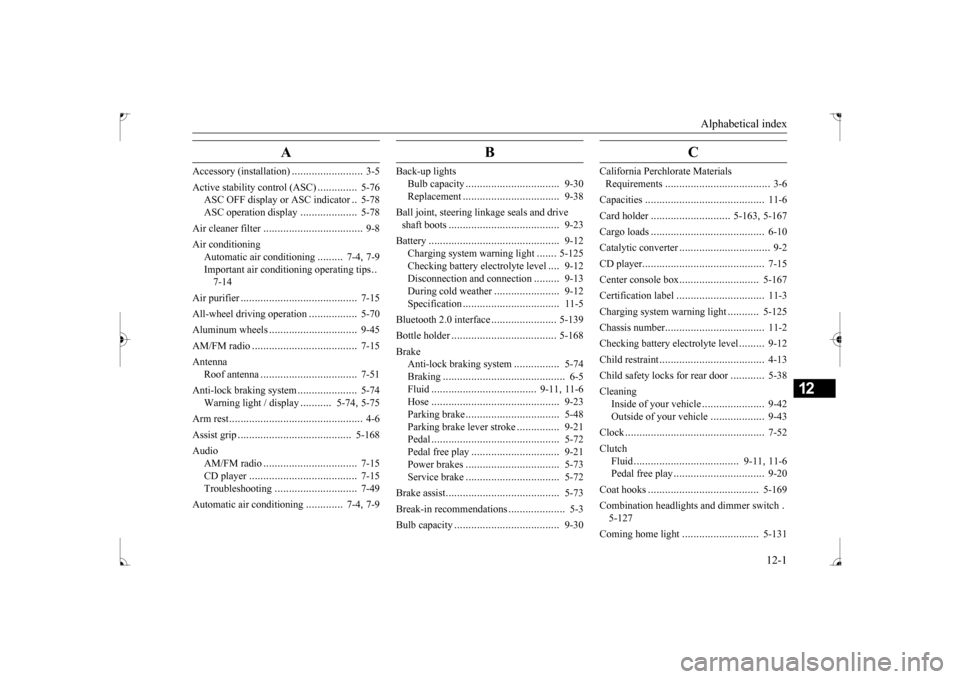
Alphabetical index
12-1
12
A
Accessory (installation)
.........................
3-5
Active stability control (ASC)
..............
5-76
ASC OFF display or ASC indicator
..5-78
ASC operation display
....................
5-78
Air cleaner filter
...................
................
9-8
Air conditioning
Automatic air conditioning
.........
7-4
, 7-9
Important air conditioning operating tips
..
7-14
Air purifier
....................
.....................
7-15
All-wheel driving operation
.................
5-70
Aluminum wheels
...............................
9-45
AM/FM radio
....................
.................
7-15
Antenna
Roof antenna
.................
.................
7-51
Anti-lock braking system
.....................
5-74
Warning light / display
...........
5-74
, 5-75
Arm rest
........................
.......................
4-6
Assist grip
.....................
...................
5-168
Audio
AM/FM radio
................
.................
7-15
CD player
.....................
.................
7-15
Troubleshooting
.............................
7-49
Automatic air conditioning
.............
7-4
, 7-9
B
Back-up lights
Bulb capacity
..................
...............
9-30
Replacement
...................
...............
9-38
Ball joint, steering linkage seals and drive shaft boots
.....................
..................
9-23
Battery
........................
......................
9-12
Charging system warning light
.......
5-125
Checking battery electrolyte level
....
9-12
Disconnection and connection
.........
9-13
During cold weather
.......................
9-12
Specification
...................
...............
11-5
Bluetooth 2.0 interface
.......................
5-139
Bottle holder
....................
.................
5-168
Brake
Anti-lock braking system
................
5-74
Braking
.......................
....................
6-5
Fluid
....................
.................
9-11
, 11-6
Hose
.......................
......................
9-23
Parking brake
..................
...............
5-48
Parking brake lever stroke
...............
9-21
Pedal
.......................
......................
5-72
Pedal free play
................
...............
9-21
Power brakes
..................
...............
5-73
Service brake
..................
...............
5-72
Brake assist
......................
..................
5-73
Break-in recommendations
....................
5-3
Bulb capacity
...................
..................
9-30
C
California Perchlorate Materials Requirements
.....................
................
3-6
Capacities
.....................
.....................
11-6
Card holder
............................
5-163
, 5-167
Cargo loads
...................
.....................
6-10
Catalytic converter
................
................
9-2
CD player
......................
.....................
7-15
Center console box
............................
5-167
Certification label
...............................
11-3
Charging system warning light
...........
5-125
Chassis number
..................
.................
11-2
Checking battery electrolyte level
.........
9-12
Child restraint
....................
.................
4-13
Child safety locks for rear door
............
5-38
Cleaning
Inside of your vehicle
......................
9-42
Outside of your vehicle
...................
9-43
Clock
.........................
........................
7-52
Clutch
Fluid
..................
...................
9-11
, 11-6
Pedal free play
...............
.................
9-20
Coat hooks
....................
...................
5-169
Combination headlights and dimmer switch
.
5-127 Coming home light
...........................
5-131
BK0237700US.bo
ok 1 ページ 2016年4月15日 金曜日 午前11時28分