Changes MITSUBISHI LANCER EVOLUTION 2007 Service User Guide
[x] Cancel search | Manufacturer: MITSUBISHI, Model Year: 2007, Model line: LANCER EVOLUTION, Model: MITSUBISHI LANCER EVOLUTION 2007Pages: 1449, PDF Size: 56.82 MB
Page 563 of 1449
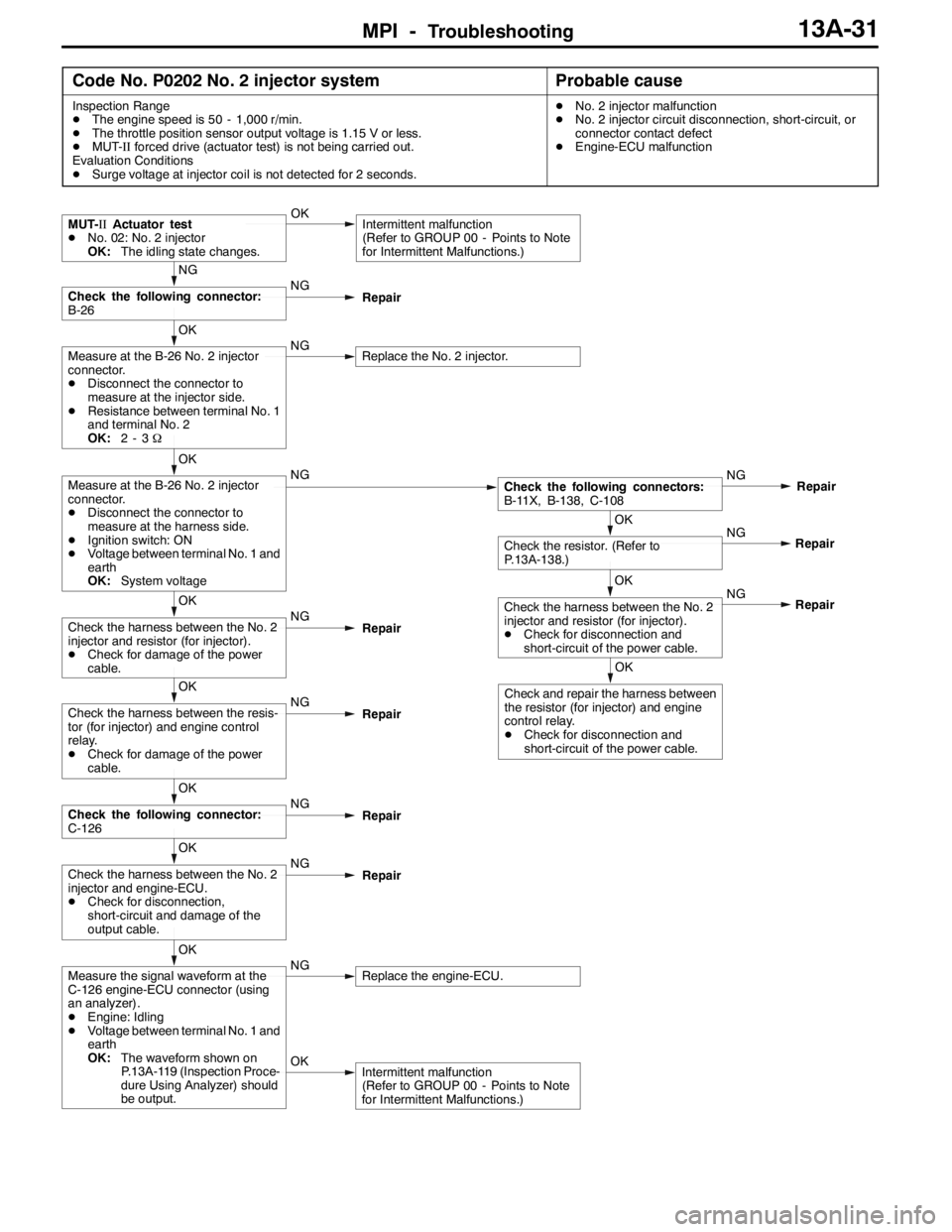
MPI -Troubleshooting13A-31
Code No. P0202 No. 2 injector systemProbable cause
Inspection Range
DThe engine speed is 50 - 1,000 r/min.
DThe throttle position sensor output voltage is 1.15 V or less.
DMUT-IIforced drive (actuator test) is not being carried out.
Evaluation Conditions
DSurge voltage at injector coil is not detected for 2 seconds.DNo. 2 injector malfunction
DNo. 2 injector circuit disconnection, short-circuit, or
connector contact defect
DEngine-ECU malfunction
OKIntermittent malfunction
(Refer to GROUP 00 - Points to Note
for Intermittent Malfunctions.)
OK
Measure the signal waveform at the
C-126 engine-ECU connector (using
an analyzer).
DEngine: Idling
DVoltage between terminal No. 1 and
earth
OK:The waveform shown on
P.13A-119 (Inspection Proce-
dure Using Analyzer) should
be output.NGReplace the engine-ECU.
OK
Check the harness between the No. 2
injector and engine-ECU.
DCheck for disconnection,
short-circuit and damage of the
output cable.NG
Repair
OK
Check the following connector:
C-126NG
Repair
OK
Check the harness between the resis-
tor (for injector) and engine control
relay.
DCheck for damage of the power
cable.NG
Repair
OK
Check and repair the harness between
the resistor (for injector) and engine
control relay.
DCheck for disconnection and
short-circuit of the power cable.NG
OK
Check the harness between the No. 2
injector and resistor (for injector).
DCheck for disconnection and
short-circuit of the power cable.Repair NG
OK
Check the resistor. (Refer to
P.13A-138.)Repair
OK
Check the harness between the No. 2
injector and resistor (for injector).
DCheck for damage of the power
cable.NG
Repair
OK
Measure at the B-26 No. 2 injector
connector.
DDisconnect the connector to
measure at the harness side.
DIgnition switch: ON
DVoltage between terminal No. 1 and
earth
OK:System voltageNGCheck the following connectors:
B-11X, B-138, C-108NG
Repair
OK
Measure at the B-26 No. 2 injector
connector.
DDisconnect the connector to
measure at the injector side.
DResistance between terminal No. 1
and terminal No. 2
OK:2-3ΩNGReplace the No. 2 injector.
NG
Check the following connector:
B-26NG
Repair
MUT-IIActuator test
DNo. 02: No. 2 injector
OK:The idling state changes.OKIntermittent malfunction
(Refer to GROUP 00 - Points to Note
for Intermittent Malfunctions.)
Page 564 of 1449
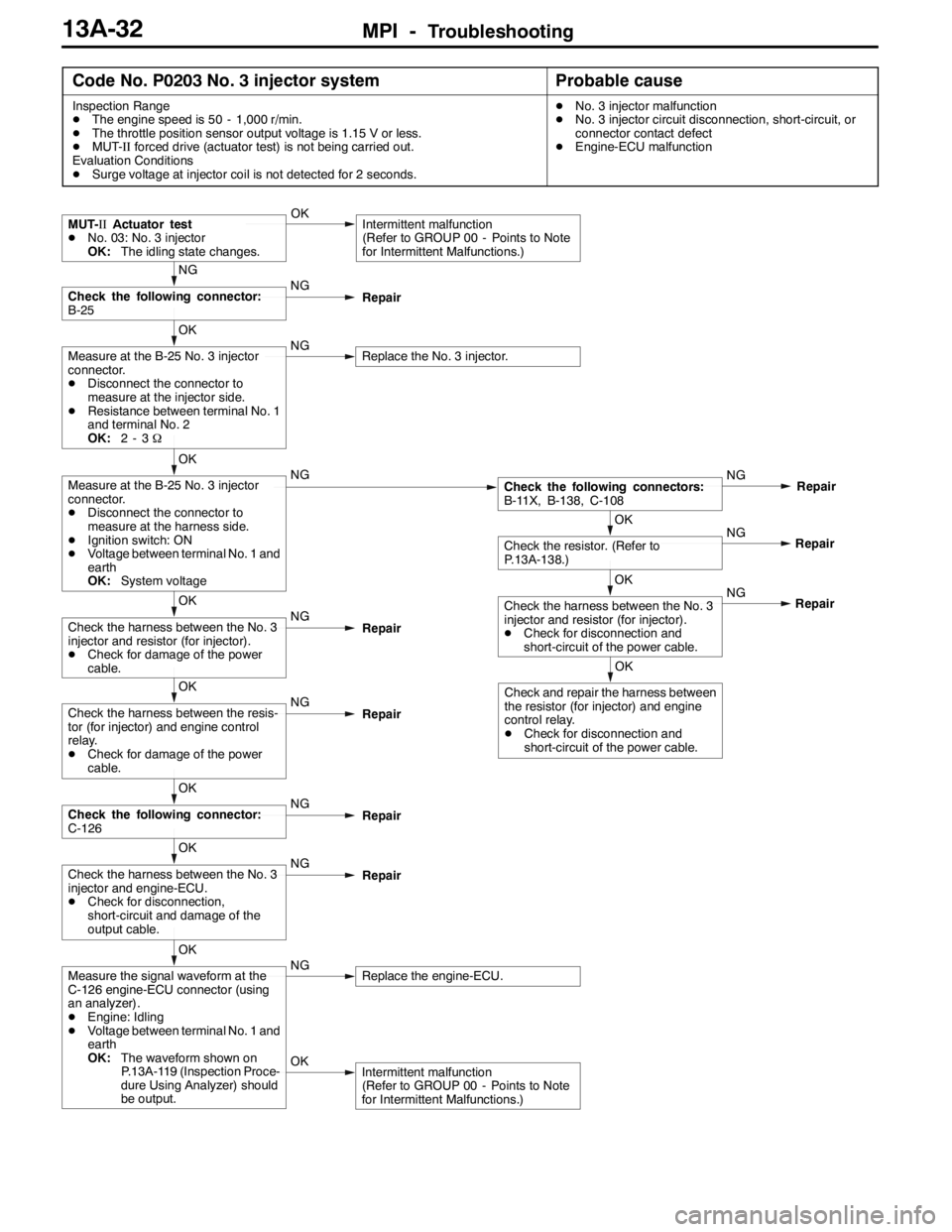
MPI -Troubleshooting13A-32
Code No. P0203 No. 3 injector systemProbable cause
Inspection Range
DThe engine speed is 50 - 1,000 r/min.
DThe throttle position sensor output voltage is 1.15 V or less.
DMUT-IIforced drive (actuator test) is not being carried out.
Evaluation Conditions
DSurge voltage at injector coil is not detected for 2 seconds.DNo. 3 injector malfunction
DNo. 3 injector circuit disconnection, short-circuit, or
connector contact defect
DEngine-ECU malfunction
OKIntermittent malfunction
(Refer to GROUP 00 - Points to Note
for Intermittent Malfunctions.)
OK
Measure the signal waveform at the
C-126 engine-ECU connector (using
an analyzer).
DEngine: Idling
DVoltage between terminal No. 1 and
earth
OK:The waveform shown on
P.13A-119 (Inspection Proce-
dure Using Analyzer) should
be output.NGReplace the engine-ECU.
OK
Check the harness between the No. 3
injector and engine-ECU.
DCheck for disconnection,
short-circuit and damage of the
output cable.NG
Repair
OK
Check the following connector:
C-126NG
Repair
OK
Check the harness between the resis-
tor (for injector) and engine control
relay.
DCheck for damage of the power
cable.NG
Repair
OK
Check and repair the harness between
the resistor (for injector) and engine
control relay.
DCheck for disconnection and
short-circuit of the power cable.NG
OK
Check the harness between the No. 3
injector and resistor (for injector).
DCheck for disconnection and
short-circuit of the power cable.Repair NG
OK
Check the resistor. (Refer to
P.13A-138.)Repair
OK
Check the harness between the No. 3
injector and resistor (for injector).
DCheck for damage of the power
cable.NG
Repair
OK
Measure at the B-25 No. 3 injector
connector.
DDisconnect the connector to
measure at the harness side.
DIgnition switch: ON
DVoltage between terminal No. 1 and
earth
OK:System voltageNGCheck the following connectors:
B-11X, B-138, C-108NG
Repair
OK
Measure at the B-25 No. 3 injector
connector.
DDisconnect the connector to
measure at the injector side.
DResistance between terminal No. 1
and terminal No. 2
OK:2-3ΩNGReplace the No. 3 injector.
NG
Check the following connector:
B-25NG
Repair
MUT-IIActuator test
DNo. 03: No. 3 injector
OK:The idling state changes.OKIntermittent malfunction
(Refer to GROUP 00 - Points to Note
for Intermittent Malfunctions.)
Page 565 of 1449
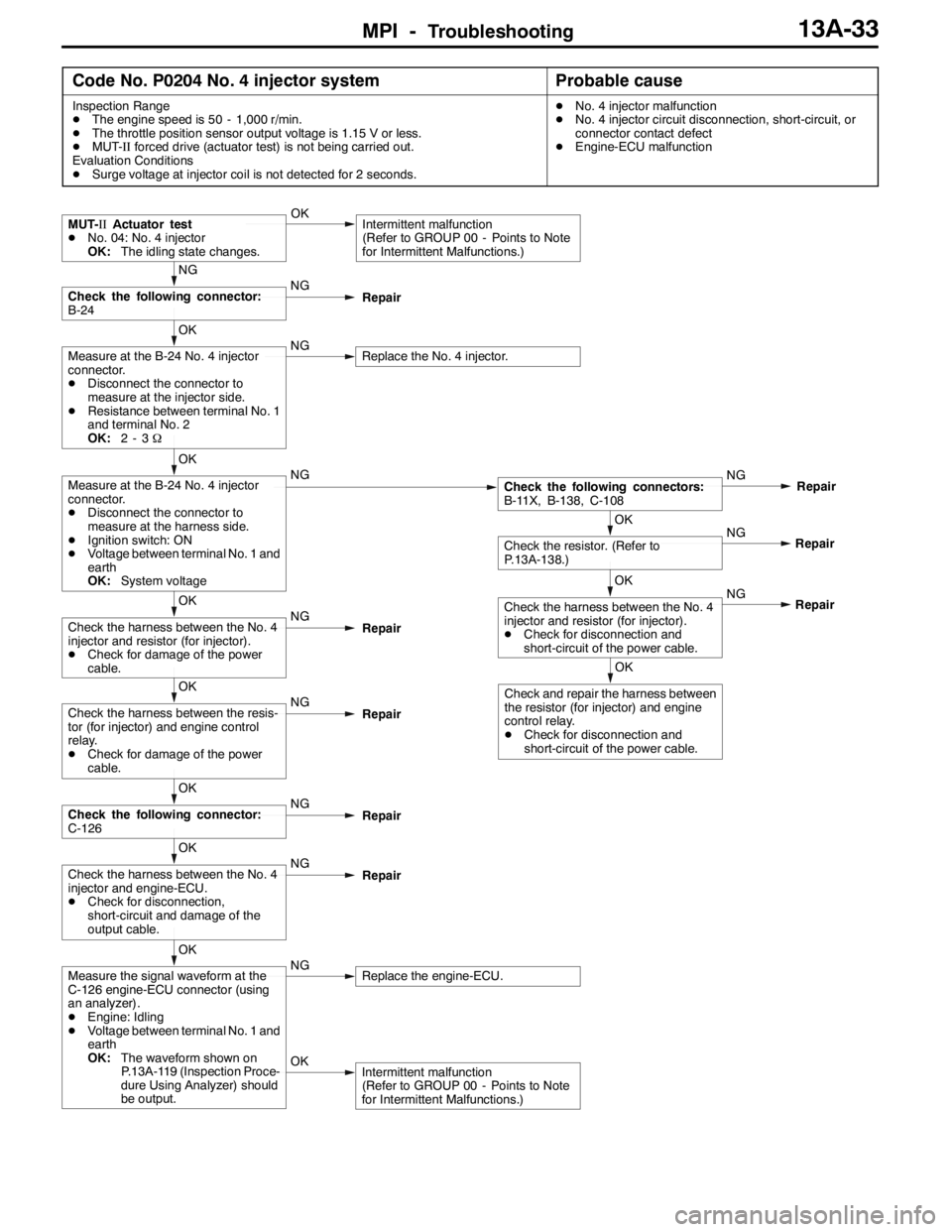
MPI -Troubleshooting13A-33
Code No. P0204 No. 4 injector systemProbable cause
Inspection Range
DThe engine speed is 50 - 1,000 r/min.
DThe throttle position sensor output voltage is 1.15 V or less.
DMUT-IIforced drive (actuator test) is not being carried out.
Evaluation Conditions
DSurge voltage at injector coil is not detected for 2 seconds.DNo. 4 injector malfunction
DNo. 4 injector circuit disconnection, short-circuit, or
connector contact defect
DEngine-ECU malfunction
OKIntermittent malfunction
(Refer to GROUP 00 - Points to Note
for Intermittent Malfunctions.)
OK
Measure the signal waveform at the
C-126 engine-ECU connector (using
an analyzer).
DEngine: Idling
DVoltage between terminal No. 1 and
earth
OK:The waveform shown on
P.13A-119 (Inspection Proce-
dure Using Analyzer) should
be output.NGReplace the engine-ECU.
OK
Check the harness between the No. 4
injector and engine-ECU.
DCheck for disconnection,
short-circuit and damage of the
output cable.NG
Repair
OK
Check the following connector:
C-126NG
Repair
OK
Check the harness between the resis-
tor (for injector) and engine control
relay.
DCheck for damage of the power
cable.NG
Repair
OK
Check and repair the harness between
the resistor (for injector) and engine
control relay.
DCheck for disconnection and
short-circuit of the power cable.NG
OK
Check the harness between the No. 4
injector and resistor (for injector).
DCheck for disconnection and
short-circuit of the power cable.Repair NG
OK
Check the resistor. (Refer to
P.13A-138.)Repair
OK
Check the harness between the No. 4
injector and resistor (for injector).
DCheck for damage of the power
cable.NG
Repair
OK
Measure at the B-24 No. 4 injector
connector.
DDisconnect the connector to
measure at the harness side.
DIgnition switch: ON
DVoltage between terminal No. 1 and
earth
OK:System voltageNGCheck the following connectors:
B-11X, B-138, C-108NG
Repair
OK
Measure at the B-24 No. 4 injector
connector.
DDisconnect the connector to
measure at the injector side.
DResistance between terminal No. 1
and terminal No. 2
OK:2-3ΩNGReplace the No. 4 injector.
NG
Check the following connector:
B-24NG
Repair
MUT-IIActuator test
DNo. 04: No. 4 injector
OK:The idling state changes.OKIntermittent malfunction
(Refer to GROUP 00 - Points to Note
for Intermittent Malfunctions.)
Page 566 of 1449
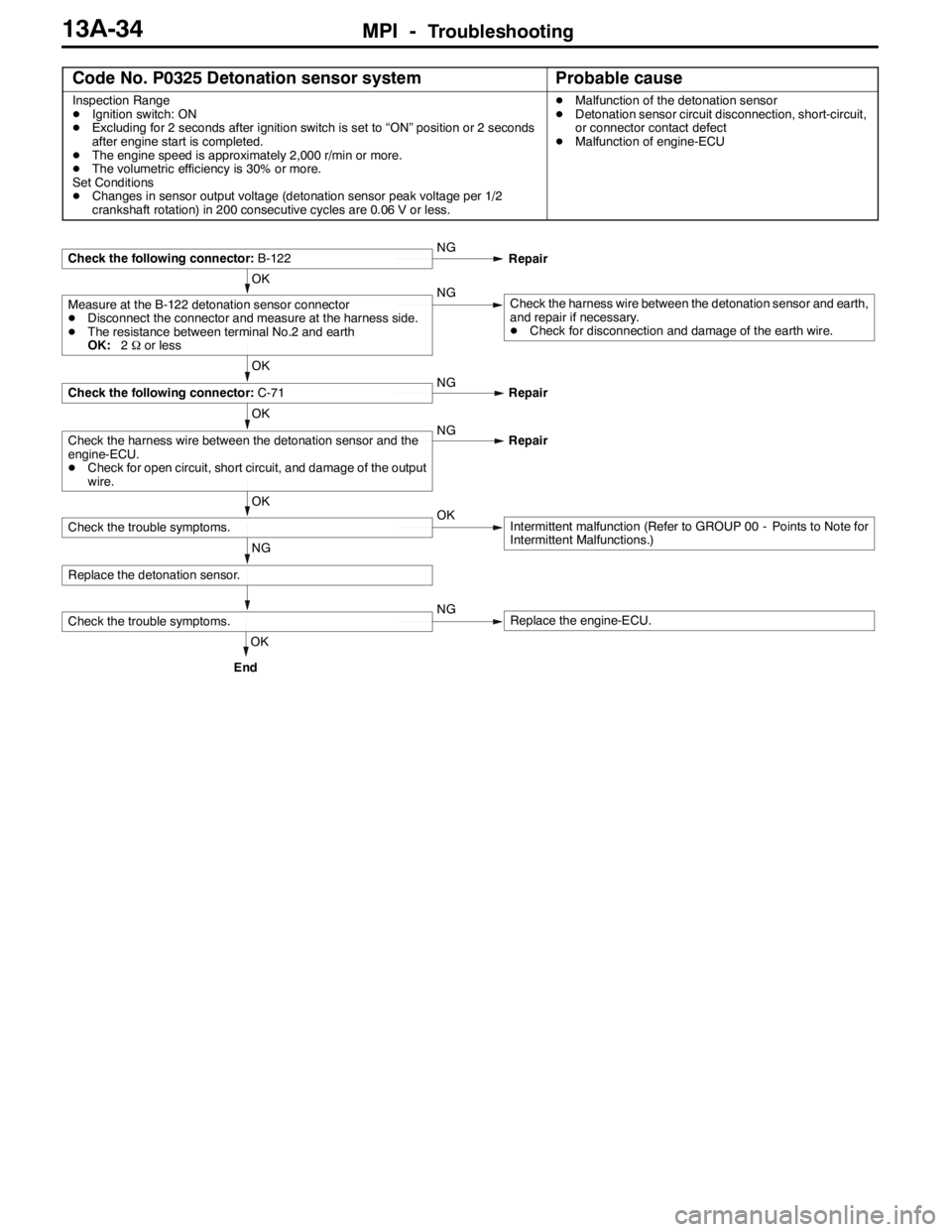
MPI -Troubleshooting13A-34
Code No. P0325 Detonation sensor systemProbable cause
Inspection Range
DIgnition switch: ON
DExcluding for 2 seconds after ignition switch is set to “ON” position or 2 seconds
after engine start is completed.
DThe engine speed is approximately 2,000 r/min or more.
DThe volumetric efficiency is 30% or more.
Set Conditions
DChanges in sensor output voltage (detonation sensor peak voltage per 1/2
crankshaft rotation) in 200 consecutive cycles are 0.06 V or less.DMalfunction of the detonation sensor
DDetonation sensor circuit disconnection, short-circuit,
or connector contact defect
DMalfunction of engine-ECU
OK
Check the trouble symptoms.NGReplace the engine-ECU.
NG
Replace the detonation sensor.
OK
Check the trouble symptoms.OKIntermittent malfunction (Refer to GROUP 00 - Points to Note for
Intermittent Malfunctions.)
OK
Check the harness wire between the detonation sensor and the
engine-ECU.
DCheck for open circuit, short circuit, and damage of the output
wire.NG
Repair
OK
Check the following connector:C-71NG
Repair
OK
Measure at the B-122 detonation sensor connector
DDisconnect the connector and measure at the harness side.
DThe resistance between terminal No.2 and earth
OK:2Ωor lessNGCheck the harness wire between the detonation sensor and earth,
and repair if necessary.
DCheck for disconnection and damage of the earth wire.
Check the following connector:B-122NG
Repair
End
Page 585 of 1449

MPI -Troubleshooting
Fig. 1
Vehicle
speedInitial ac-
celerator
pedal de-
pressionNormalHesitation
Sag
TimeFig. 2
Normal
Initial ac-
celerator
pedal de-
pression
IdlingStumble
Time Vehicle
speed
13A-53
PROBLEM SYMPTOMS TABLE (FOR YOUR INFORMATION)
ItemsSymptom
StartingWon’t startThe starter is used to crank the engine, but there is no combustion within the
cylinders, and the engine won’t start.
Fires up and diesThere is combustion within the cylinders, but then the engine soon stalls.
Hard startingEngine starts after cranking a while.
Idling
stability
HuntingEngine speed doesn’t remain constant; changes at idle.
stability
Rough idleUsually, a judgement can be based upon the movement of the tachometer
pointer, and the vibration transmitted to the steering wheel, shift lever, body, etc.
This is called rough idle.
Incorrect idle speedThe engine doesn’t idle at the usual correct speed.
Engine stall
(Die out)The engine stalls when the foot is taken from the accelerator pedal, regardless
of whether the vehicles is moving or not.
Engine stall
(Pass out)The engine stalls when the accelerator pedal is depressed or while it is being
used.
DrivingHesitation Sag“Hesitation” is the delay in response of the vehicle speed (engine speed) that
occurs when the accelerator is depressed in order to accelerate from the speed
at which the vehicle is now traveling, or a temporary drop in vehicle speed
(engine speed) during such acceleration.
Serious hesitation is called “sag”. (Refer to Fig. 1)
Poor accelerationPoor acceleration is inability to obtain an acceleration corresponding to the
degree of throttle opening, even though acceleration is smooth, or the inability
to reach maximum speed.
StumbleEngine speed increase is delayed when the accelerator pedal is initially
depressed for acceleration. (Refer to Fig. 2)
ShockThe feeling of a comparatively large impact or vibration when the engine is
accelerated or decelerated.
SurgeThis is repeated surging ahead during constant speed travel or during variable
speed travel.
KnockingA sharp sound like a hammer striking the cylinder walls during driving and which
adversely affects driving.
StoppingRun on
(“Dieseling”)The condition in which the engine continues to run after the ignition switch is
turned to “LOCK” (OFF) position. Also called “Dieseling”.
Page 607 of 1449
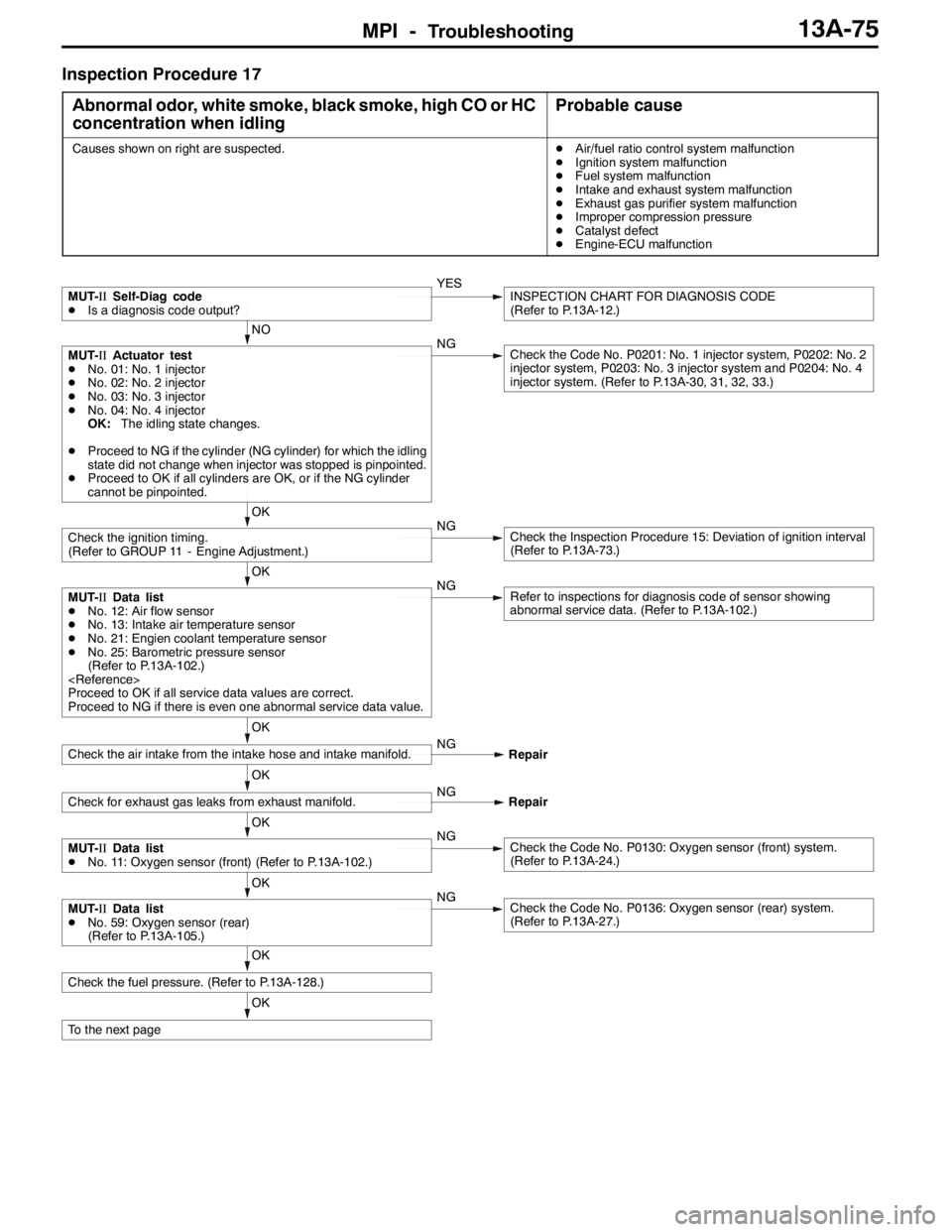
MPI -Troubleshooting13A-75
Inspection Procedure 17
Abnormal odor, white smoke, black smoke, high CO or HC
concentration when idling
Probable cause
Causes shown on right are suspected.DAir/fuel ratio control system malfunction
DIgnition system malfunction
DFuel system malfunction
DIntake and exhaust system malfunction
DExhaust gas purifier system malfunction
DImproper compression pressure
DCatalyst defect
DEngine-ECU malfunction
OK
To the next page
OK
Check the fuel pressure. (Refer to P.13A-128.)
OK
MUT-IIData list
DNo. 59: Oxygen sensor (rear)
(Refer to P.13A-105.)NGCheck the Code No. P0136: Oxygen sensor (rear) system.
(Refer to P.13A-27.)
OK
MUT-IIData list
DNo. 11: Oxygen sensor (front) (Refer to P.13A-102.)NGCheck the Code No. P0130: Oxygen sensor (front) system.
(Refer to P.13A-24.)
OK
Check for exhaust gas leaks from exhaust manifold.NG
Repair
OK
Check the air intake from the intake hose and intake manifold.NG
Repair
OK
MUT-IIData list
DNo. 12: Air flow sensor
DNo. 13: Intake air temperature sensor
DNo. 21: Engien coolant temperature sensor
DNo. 25: Barometric pressure sensor
(Refer to P.13A-102.)
Proceed to OK if all service data values are correct.
Proceed to NG if there is even one abnormal service data value.NGRefer to inspections for diagnosis code of sensor showing
abnormal service data. (Refer to P.13A-102.)
OK
Check the ignition timing.
(Refer to GROUP 11 - Engine Adjustment.)NGCheck the Inspection Procedure 15: Deviation of ignition interval
(Refer to P.13A-73.)
NO
MUT-IIActuator test
DNo. 01: No. 1 injector
DNo. 02: No. 2 injector
DNo. 03: No. 3 injector
DNo. 04: No. 4 injector
OK:The idling state changes.
DProceed to NG if the cylinder (NG cylinder) for which the idling
state did not change when injector was stopped is pinpointed.
DProceed to OK if all cylinders are OK, or if the NG cylinder
cannot be pinpointed.NGCheck the Code No. P0201: No. 1 injector system, P0202: No. 2
injector system, P0203: No. 3 injector system and P0204: No. 4
injector system. (Refer to P.13A-30, 31, 32, 33.)
MUT-IISelf-Diag code
DIs a diagnosis code output?YESINSPECTION CHART FOR DIAGNOSIS CODE
(Refer to P.13A-12.)
Page 641 of 1449

MPI -TroubleshootingMPI -Troubleshooting13A-109
Engine-ECU Connector Terminal Arrangement
Terminal No.Check itemCheck condition (Engine condition)Normal condition
1No. 1 injectorWhile engine is idling after having warmed up,
suddenlydepresstheacceleratorpedal
From 11 - 14 V, momentarily
dropsslightly
14No. 2 injector
suddenlydepressthe accelerator pedal.drops slightly
2No. 3 injector
15No. 4 injector
3Fuel pressure control
solenoidvalve
Ignition switch: “ON”System voltage
solenoidvalve
Engine: Cranking→Idle operation
(within approximately 2 minutes or less)1 V or less→System voltage
4Stepper motor coil
startedSystem voltage↔0-6V
(Changes repeatedly)
17Stepper motor coil
5Stepper motor coil
18Stepper motor coil
6EGR control solenoid
valve
Ignition switch: “ON”System Voltage
valve
While engine is idling, suddenly depress the
accelerator pedal.From system voltage,
momentarily drops
8A/C relayDEngine: Idle operation
DA/Cswitch:OFF→ON(A/Ccompressor
System voltage or momen-
tarily6Vormore→1VorDA/Cswitch:OFF→ON(A/Ccompressor
runs)tarily6Vor more→1Vor
less
9Purge control sole-
noidvalve
Ignition switch: “ON”System voltage
noidvalve
Engine: Idle operation1 V or less
10Ignition coil - No.1,
No.4Engine speed: 3,000 r/min0.3 - 3.0 V
23Ignition coil - No.2,
No.3
11Waste gate solenoid
valve
Ignition switch: “ON”System voltage
valve
Engine: After warm-up, idle operation
(When using premium gasoline)1 V or less
Page 644 of 1449

MPI -Troubleshooting13A-112
Terminal No.Normal condition Check condition (Engine condition) Check item
72Intake air
temperature sensorIgnition switch: “ON”Intake air
temperature: - 20_C3.8 - 4.4 V
Intake air
temperature: 0_C3.2 - 3.8 V
Intake air
temperature: 20_C2.3 - 2.9 V
Intake air
temperature: 40_C1.5 - 2.1 V
Intake air
temperature: 60_C0.8 - 1.4 V
Intake air
temperature: 80_C0.4 - 1.0 V
75Oxygen sensor
(Rear)DTransmission: Second gear
DDriving with the throttle widely open
DEngine: 3,500 r/min or more0.6 - 1.0 V
76Oxygen sensor (front)Engine: Running at 2,500 r/min after warmed
up (Check using a digital type voltmeter)0↔0.8 V
(Changes repeatedly)
80Backup power supplyIgnition switch: “LOCK” (OFF)System voltage
81Sensor impressed
voltageIgnition switch: “ON”4.9 - 5.1 V
82Ignition switch - IGIgnition switch: “ON”System voltage
83Engine coolant
temperature sensorIgnition switch: “ON”Coolant temperature:
-20_C3.9 - 4.5 V
Coolant temperature:
0_C3.2 - 3.8 V
Coolant temperature:
20_C2.3 - 2.9 V
Coolant temperature:
40_C1.3 - 1.9 V
Coolant temperature:
60_C0.7 - 1.3 V
Coolant temperature:
80_C0.3 - 0.9 V
84Throttle position
sensorIgnition switch: “ON”Set throttle valve to
idle position0.535 - 0.735 V
Fully open throttle
valve4.5 - 5.0 V
85Barometric pressure
sensor
Ignition switch: “ON”Altitude: 0 m3.8 - 4.2 V
sensor
Altitude: 600 m3.5 - 3.9 V
Altitude: 1,200 m3.2 - 3.8 V
Altitude: 1,800 m3.0 - 3.4 V
Page 645 of 1449

MPI -Troubleshooting13A-113
Terminal No.Normal condition Check condition (Engine condition) Check item
86Vehicle speed sensorDIgnition switch: “ON”
DMove the vehicle slowly forward0↔5V
(Changes repeatedly)
88Camshaft position
sensor
Engine: Cranking0.4 - 3.0 V
sensor
Engine: Idle operation0.5 - 2.0 V
89Crank angle sensorEngine: Cranking0.4 - 4.0 V
Engine: Idle operation1.5 - 2.5 V
90Air flow sensorEngine: Idle operation2.2 - 3.2 V
Engine speed: 2,500 r/min
91Intercooler water
spray switch (Manual)DIgnition switch: “ON”
DIntercooler water spray switch: ON1 V or less
DIgnition switch: “ON”
DIntercooler water spray switch: OFFSystem voltage
Page 666 of 1449
MPI -On-vehicle Service13A-134
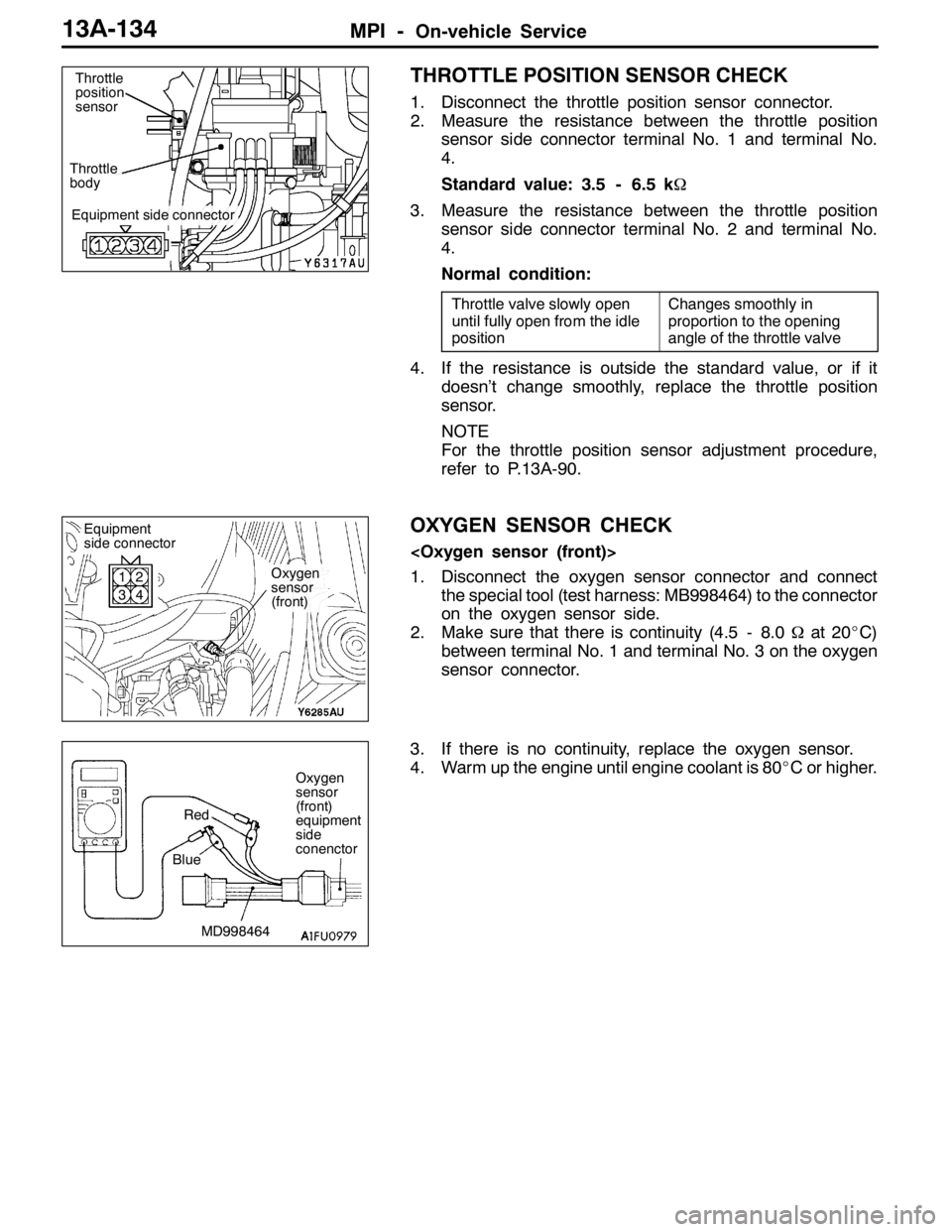
THROTTLE POSITION SENSOR CHECK
1. Disconnect the throttle position sensor connector.
2. Measure the resistance between the throttle position
sensor side connector terminal No. 1 and terminal No.
4.
Standard value: 3.5 - 6.5 kΩ
3. Measure the resistance between the throttle position
sensor side connector terminal No. 2 and terminal No.
4.
Normal condition:
Throttle valve slowly open
until fully open from the idle
positionChanges smoothly in
proportion to the opening
angle of the throttle valve
4. If the resistance is outside the standard value, or if it
doesn’t change smoothly, replace the throttle position
sensor.
NOTE
For the throttle position sensor adjustment procedure,
refer to P.13A-90.
OXYGEN SENSOR CHECK
1. Disconnect the oxygen sensor connector and connect
the special tool (test harness: MB998464) to the connector
on the oxygen sensor side.
2. Make sure that there is continuity (4.5 - 8.0Ωat 20_C)
between terminal No. 1 and terminal No. 3 on the oxygen
sensor connector.
3. If there is no continuity, replace the oxygen sensor.
4. Warm up the engine until engine coolant is 80_C or higher.
Equipment side connector
Throttle
bodyThrottle
position
sensor
Oxygen
sensor
(front)
Equipment
side connector
1
32
4
Oxygen
sensor
(front)
equipment
side
conenctor
MD998464 BlueRed