air bleeding MITSUBISHI LANCER EVOLUTION 2007 Service User Guide
[x] Cancel search | Manufacturer: MITSUBISHI, Model Year: 2007, Model line: LANCER EVOLUTION, Model: MITSUBISHI LANCER EVOLUTION 2007Pages: 1449, PDF Size: 56.82 MB
Page 912 of 1449

MANUAL TRANSMISSION OVERHAUL -Transmission Case22B-46
TRANSMISSION CASE
DISASSEMBLY AND REASSEMBLY
2*
3*
41
Disassembly steps
"CA1. Oil seal
"BA2. Needle bearing*"AA3. Bush*
4. Transmission case
NOTE
*: Refer to the installation procedures only when replacing the transmission case.
REASSEMBLY SERVICE POINTS
"AABUSH INSTALLATION
Press in the bush to the position shown in the illustration
so that the split face of the bush does not cover the air bleeding
groove on the case.
Bush Air
bleeding
hole
Page 1022 of 1449

POWER PLANT MOUNT - Crossmember32-8
CROSSMEMBER
REMOVAL AND INSTALLATION
Caution
1. Before removing the steering wheel and air bag module assembly, always refer to GROUP
52B - Service Precautions, Air bag Module and Clock Spring. Also, set the front wheels so
that they are facing straight forward, and remove the ignition key. If you fail to do this, the
SRS clock spring will be damaged, causing the SRS air bag to be inoperative and serious
injury.
2. *
1: Indicates parts which should be initially tightened, and then fully tightened after placing
the vehicle horizontally and loading the full weight of the engine on the vehicle body.
3. *
2: Indicates parts which should be temporarily tightened, and then fully tightened with the
vehicle on the ground in the unladen condition.
Caution
If the vehicle is equipped the Brembo disc brake, during maintenance, take care not to contact
the parts or tools to the caliper because the paint of caliper will be scratched.
Pre-removal Operations
DUnder Cover Removal
(Refer to GROUP 51 - Front Bumper.)
DCentermember, Crossmember Bar Removal
(Refer to P.32-6.)
DFront Exhaust Pipe Removal
(Refer to GROUP 15.)
DSteering Wheel Air Bag Module Assembly Removal
(Refer to GROUP 37A.)
DPower Steering Fluid Draining
(Refer to GROUP 37A - On-vehicle Service.)Post-installation Operations
DCentermember, Crossmember Bar Installation
(Refer to P.32-6.)
DFront Exhaust Pipe Installation
(Refer to GROUP 15.)
DSteering Wheel Air Bag Module Assembly
Installation (Refer to GROUP 37A.)
DPower Steering Fluid Supplying
(Refer to GROUP 37A - On-vehicle Service.)
DPower Steering Fluid Line Bleeding
(Refer to GROUP 37A - On-vehicle Service.)
DPress the dust cover with a finger to check whether
the dust cover is cracked or damaged.
DChecking Steering Wheel Position with Wheels
Straight Ahead
DFront Wheel Alignment Check and Adjustment
(Refer to GROUP 37A - On-vehicle Service.)
DUnder Cover Installation
(Refer to GROUP 51 - Front Bumper.)
Page 1052 of 1449

BASIC BRAKE SYSTEM -On-vehicle Service35A-10
BLEEDING
Caution
Specified brake fluid: DOT3 or DOT4
Always use the specified brake fluid. Avoid using a
mixture of the specified brake fluid and other fluid.
MASTER CYLINDER BLEEDING
The master cylinder used has no check valve, so if bleeding
is carried out by the following procedure, bleeding of air from
the brake pipeline will become easier. (When brake fluid is
not contained in the master cylinder.)
1. Fill the reserve tank with brake fluid.
2. Keep the brake pedal depressed.
3. Have another person cover the master cylinder outlet
with a finger.
4. With the outlet still closed, release the brake pedal.
5. Repeat steps 2 - 4 three or four times to fill the inside
of the master cylinder with brake fluid.
BREMBO DISC BRAKE BLEEDING
Caution
Take care not to contact the parts or tools to the caliper
because the paint of caliper will be scratched. And if
there is brake fluid on the caliper, wipe out quickly.
Connect a vinyl tube to the outer end of the air bleeder screw
to bleed the circuit of air. Then, connect the vinyl tube to
the inner end and bleed the circuit of air. Except for these,
the conventional procedures shall be followed. After the circuit
has been bled of air, tighten both air bleeder screws securely.
BRAKE PIPE LINE BLEEDING
Bleed the air in the sequence shown in the figure.
Air bleeder screw
( ): R.H. drive vehicles
4 (2)
1 (3)
2 (4)
3 (1)
( ): R.H. drive vehicles
4, 6 (1, 3)
2 (5)
1, 3 (4, 6)
5 (2)
Vehicles with ABS
Vehicles without ABS
Page 1059 of 1449
BASIC BRAKE SYSTEM -Brake Pedal/Proportioning Valve,
Master Cylinder and Brake Booster35A-17
INSPECTION
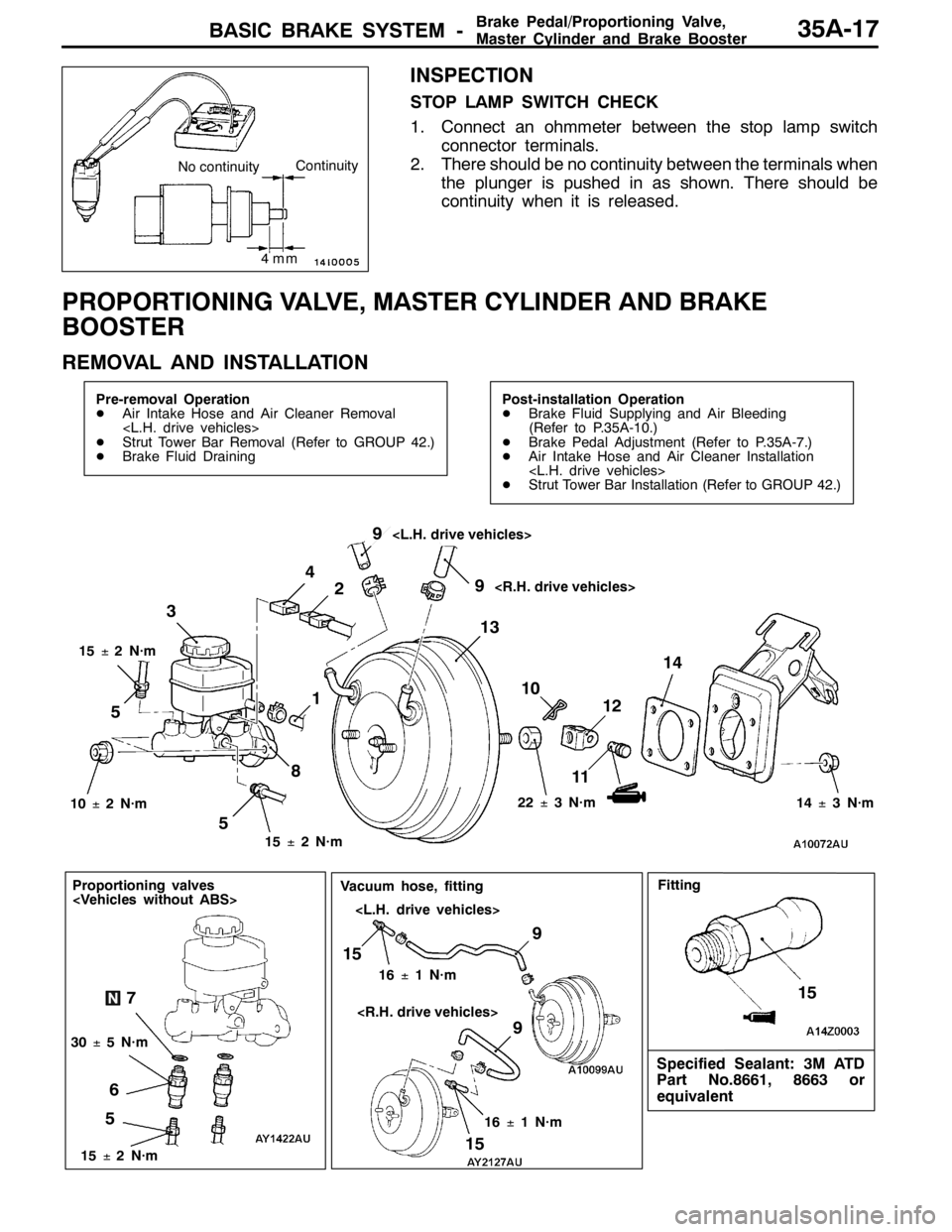
STOP LAMP SWITCH CHECK
1. Connect an ohmmeter between the stop lamp switch
connector terminals.
2. There should be no continuity between the terminals when
the plunger is pushed in as shown. There should be
continuity when it is released.
PROPORTIONING VALVE, MASTER CYLINDER AND BRAKE
BOOSTER
REMOVAL AND INSTALLATION
Pre-removal Operation
DAir Intake Hose and Air Cleaner Removal
DStrut Tower Bar Removal (Refer to GROUP 42.)
DBrake Fluid DrainingPost-installation Operation
DBrake Fluid Supplying and Air Bleeding
(Refer to P.35A-10.)
DBrake Pedal Adjustment (Refer to P.35A-7.)
DAir Intake Hose and Air Cleaner Installation
DStrut Tower Bar Installation (Refer to GROUP 42.)
510
11 3
12 4
14
15±2N·m 15±2N·m
22±3N·m
10±2N·m
13 2
8
14±3N·m
519
9
15±2N·m
5
Proportioning valves
67
30±5N·m
9
15
16±1N·m
9
15
16±1N·m
Vacuum hose, fitting
Specified Sealant: 3M ATD
Part No.8661, 8663 or
equivalent
15
Fitting
4mm
No continuityContinuity
Page 1062 of 1449

BASIC BRAKE SYSTEM -Disc Brake35A-20
DISC BRAKE
REMOVAL AND INSTALLATION
Caution
If the vehicle is equipped with the Brembo disc brake, during maintenance, take care not to contact
the parts or tools to the caliper because the paint of caliper will be scratched. And if there is
brake fluid on the caliper, wipe out quickly.
Pre-removal Operation
Brake Fluid DrainingPost-installation Operation
Brake Fluid Supplying and Air Bleeding
(Refer to P.35A-10.)
34
21
100±10 N·m
108±10 N·m
30±5 N·m
3 2 1
54±5 N·m
15±2 N·m
4
Removal steps
1. Brake hose connection
2. Gasket
"AA3. Disc brake assembly
4. Brake disc
Page 1101 of 1449
ABS <4WD> -Hydraulic Unit and ABS-ECU35B-31
Pre-removal Operation
DStrut Tower Bar Removal (Refer to GROUP 42.)
DBrake Fluid Draining
DAir Intake Hose and Air Cleaner RemovalPost-installation Operation
DBrake Fluid Supplying and Brake Line Bleeding
(Refer to GROUP 35A - On-vehicle Service.)
DHydraulic Unit Check (Refer to P.35B-28.)
DAir Intake Hose and Air Cleaner Installation
DStrut Tower Bar Installation (Refer to GROUP 42.)
213
4 2
2
2
15±2 N·m
25±6 N·m
25±6 N·m
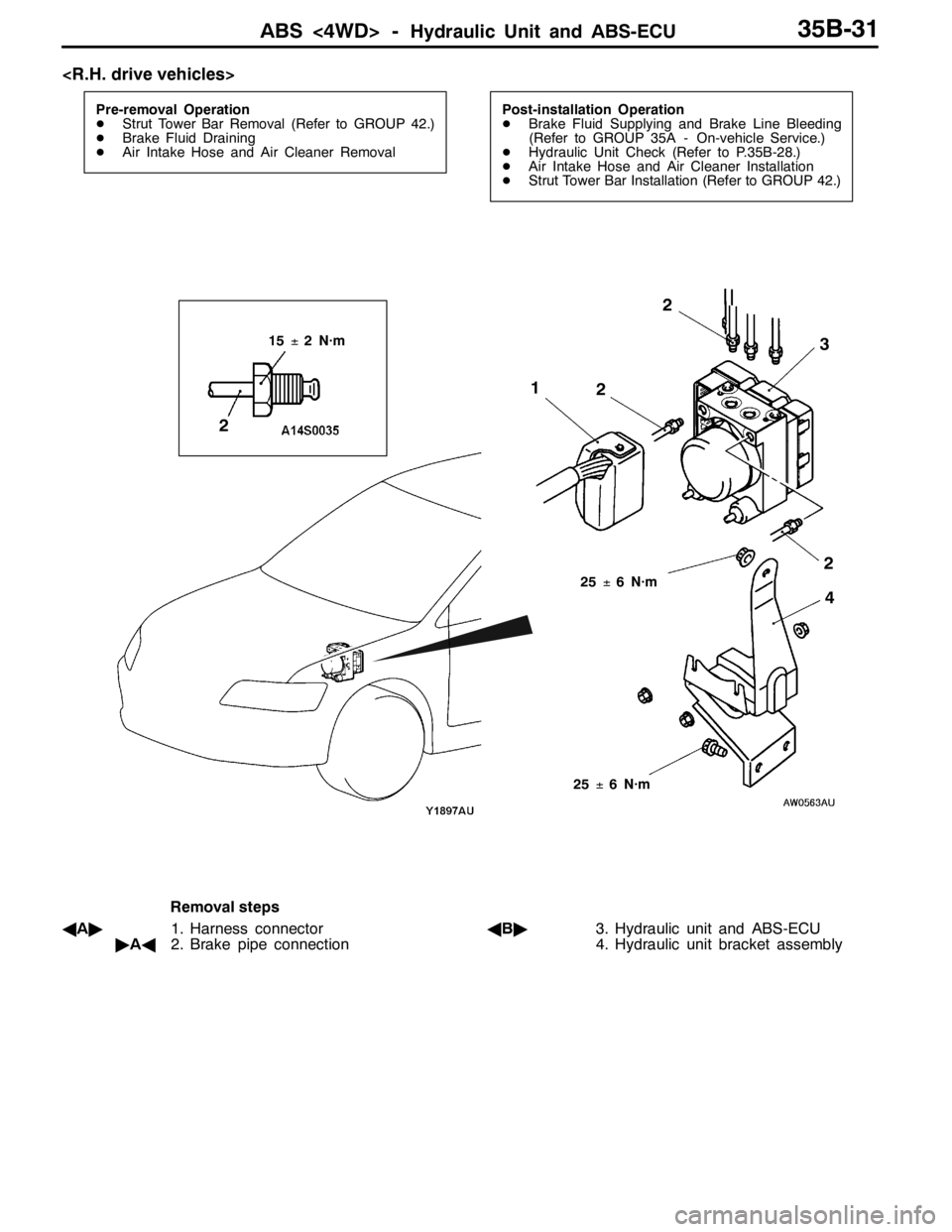
Removal steps
AA"1. Harness connector
"AA2. Brake pipe connectionAB"3. Hydraulic unit and ABS-ECU
4. Hydraulic unit bracket assembly
Page 1115 of 1449

37A-1
STEERING
CONTENTS
GENERAL INFORMATION 2..................
SERVICE SPECIFICATIONS 4.................
LUBRICANTS 4..............................
SEALANT 4..................................
SPECIAL TOOLS 4...........................
ON-VEHICLE SERVICE 7.....................
Steering Wheel Free Play Check 7..............
Steering Angle Check 7........................
Tie Rod End Ball Joint Turning Torque Check 7..
Stationary Steering Effort Check 8...............
Checking Steering Wheel Return to Centre 8.....
Drive Belt Tension Check 8.....................Power Steering Fluid Level Check 9.............
Power Steering Fluid Replacement 9.............
Power Steering System Bleeding 9..............
Oil Pump Pressure Test 10.....................
Power Steering Oil Pressure Switch Check 11....
Ball Joint Dust Cover Check 11.................
STEERING WHEEL* 12.......................
STEERING SHAFT* 14.......................
POWER STEERING GEAR BOX AND
LINKAGE* 16................................
POWER STEERING OIL PUMP 29............
POWER STEERING OIL HOSES 30...........
WARNINGS REGARDING SERVICING OF SUPPLEMENTAL RESTRAINT SYSTEM (SRS) EQUIPPED VEHICLES
WARNING!
(1) Improper service or maintenance of any component of the SRS, or any SRS-related component, can lead to personal
injury or death to service personnel (from inadvertent firing of the air bag) or to the driver and passenger (from rendering
the SRS inoperative).
(2) Service or maintenance of any SRS component or SRS-related component must be performed only at an authorized
MITSUBISHI dealer.
(3) MITSUBISHI dealer personnel must thoroughly review this manual, and especially its GROUP 52B - Supplemental
Restraint System (SRS) before beginning any service or maintenance of any component of the SRS or any SRS-related
component.
NOTE
The SRS includes the following components: SRS-ECU, SRS warning lamp, air bag module, clock spring and interconnecting
wiring. Other SRS-related components (that may have to be removed/installed in connection with SRS service or maintenance) are
indicated in the table of contents by an asterisk (*).
Page 1123 of 1449

STEERING -On-vehicle Service37A-9
POWER STEERING FLUID LEVEL CHECK
1. Park the vehicle on a flat, level surface, start the engine,
and then turn the steering wheel several times to raise
the temperature of the fluid to approximately 50 - 60_C.
2. With the engine running, turn the wheel all the way to
the left and right several times.
3. Check the fluid in the oil reservoir for foaming or milkiness.
Check the difference of the fluid level when the engine
is stopped, and while it is running. If the change of the
fluid level is 5 mm or more, air bleeding should be done.
POWER STEERING FLUID REPLACEMENT
1. Raise the front wheels on a jack, and then support them
with rigid racks.
2. Disconnect the return hose connection.
3. Connect a vinyl hose to the return hose, and drain the
oil into a container.
4. Disconnect the ignition coil connectors. (Refer to
GROUP16 - Ignition System.)
5. While operating the starting motor intermittently, turn the
steering wheel all the way to the left and right several
times to drain all of the fluid.
6. Connect the return hoses securely, and then secure it
with the clip.
7. Fill the oil reservoir with specified fluid up to the lower
position of the filter, and then bleed air.
Specified fluid:
Automatic transmission fluid DEXRONII
Caution
Do not use ATF-SPIIM and ATF-SPIII.
POWER STEERING SYSTEM BLEEDING
1. Jack up the vehicle and support the front wheels with
rigid racks.
2. Disconnect the ignition coil connectors. (Refer to
GROUP16 - Ignition System.)
3. Cranking the engine with the starter several times
intermittently (during 15 to 20 seconds), turn the steering
wheel left and right fully five or six times.
Caution
(1) During the bleeding, refill the fluid so that the
level never falls below the lower position of the
filter.
(2) Be sure to bleed air only while cranking. If the
bleeding is done with the engine running, the air
will be broken up and absorbed into the fluid.
4. Connect the ignition coil connectors and idle the engine.
5. Turn the steering wheel left and right fully until no bubbles
comes out in the oil reservoir.
6. See that the fluid is not milky and that the fluid level
is up to the specified position on the level gauge.
7. See that the fluid level changes little when the steering
wheel is turned left and right.
8. Check difference in fluid levels between the engine
stopped and running.
Fluid level change: Within 5 mm
While engine
runningWhile engine
stopped
Return hose
Vinyl hose
Page 1124 of 1449

STEERING -On-vehicle Service37A-10
9. If the level changes more than 5 mm, the air is badly
bled. So, bleed air again.
Caution
(1) If the fluid level rises suddenly after the engine
is stopped, the bleeding is incomplete.
(2) Incomplete bleeding causes abnormal noises
from the pump and the flow-control valve. This
could lessen the life of the pump and the other
parts.
OIL PUMP PRESSURE TEST
1. Disconnect the pressure hose from the oil pump, and
then connect the special tools.
2. Bleed the air, and then turn the steering wheel several
times while the vehicle is not moving so that the
temperature of the fluid rises to approximately 50 - 60_C.
3. Start the engine and idle it at 1,000±100 r/min.
4. Fully close the shut-off valve of the pressure gauge and
measure the oil pump relief pressure to confirm that it
is within the standard value range.
Standard value: 8.4 - 9.0 MPa
5. If the standard value is not met, the oil pump is defective.
So, replace the oil pump. Then, measure oil pressure
again.
6. With the pressure gauge shut - off valve fully open, check
the hydraulic pressure in unladen condition.
Standard value: 0.2 - 0.8 MPa
7. If the standard value is not met, the oil line or steering
gear is probably defective. So, repair and measure oil
pressure again.
8. Turn the steering wheel fully either left or right and check
the retention hydraulic pressure.
Standard value: 8.4 - 9.0 MPa
9. If the pressure is below the standard value, disassemble
and reassemble the steering gear. If above, replace the
oil pump. Then, measure oil pressure again.
10. Remove the special tools, and tighten the pressure hose
to the specified torque.
Tightening torque: 18±3 N·m
11. Bleed the system.
Fluid level change: Within 5 mm
While engine
runningWhile engine
stopped
Temperature
gaugePressure
gauge
(MB990662)Shut-off valve
Oil
pumpOil reservoir
Adapter
(MB990994)
Adapter
(MB990993)
Page 1130 of 1449

STEERING - Power Steering Gear Box and Linkage37A-16
POWER STEERING GEAR BOX AND LINKAGE
REMOVAL AND INSTALLATION
Caution: SRS
Before removing steering gear box, refer to GROUP 52B. Also, put the front wheels in straight-ahead
position. Failure to do so may damage the SRS clock spring and render the SRS air bag inoperative,
which results serious driver injury.
Caution
If the vehicle is equipped with the Brembo disc brake, during maintenance, take care not to contact
the parts or tools to the caliper because the paint of caliper will be scratched. And if there is
brake fluid on the caliper, wipe out quickly.
Pre-removal Operation
DClock Spring Removal (Refer to GROUP 52B.)
DPower Steering Fluid Draining (Refer to P.37A-9.)Post-installation Operation
DClock Spring Installation (Refer to GROUP 52B.)
DPower Steering Fluid Supplying and bleeding
(Refer to P.37A-9.)
DChecking Steering Wheel Position with Wheels
Straight Ahead
17
6
3 4
57±7 N·m5
8
70±10 N·m
2
15±3 N·m
9
10
12±2 N·m 12±2 N·m
70±10 N·m
Removal steps
1. Crossmember
(Refer to GROUP 32.)
DRear roll stopper(Refer to GROUP 32.)
2. Joint cover grommet
3. Return hose
4. Return tube5. O ring
6. Return tube
7. Eye bolt
8. Pressure hose assembly
9. Clamp
10. Steering gear and linkage