to pair MITSUBISHI LANCER EVOLUTION 2007 Service Repair Manual
[x] Cancel search | Manufacturer: MITSUBISHI, Model Year: 2007, Model line: LANCER EVOLUTION, Model: MITSUBISHI LANCER EVOLUTION 2007Pages: 1449, PDF Size: 56.82 MB
Page 1409 of 1449
HEATER, AIR CONDITIONER AND VENTILATION-Troubleshooting55-7
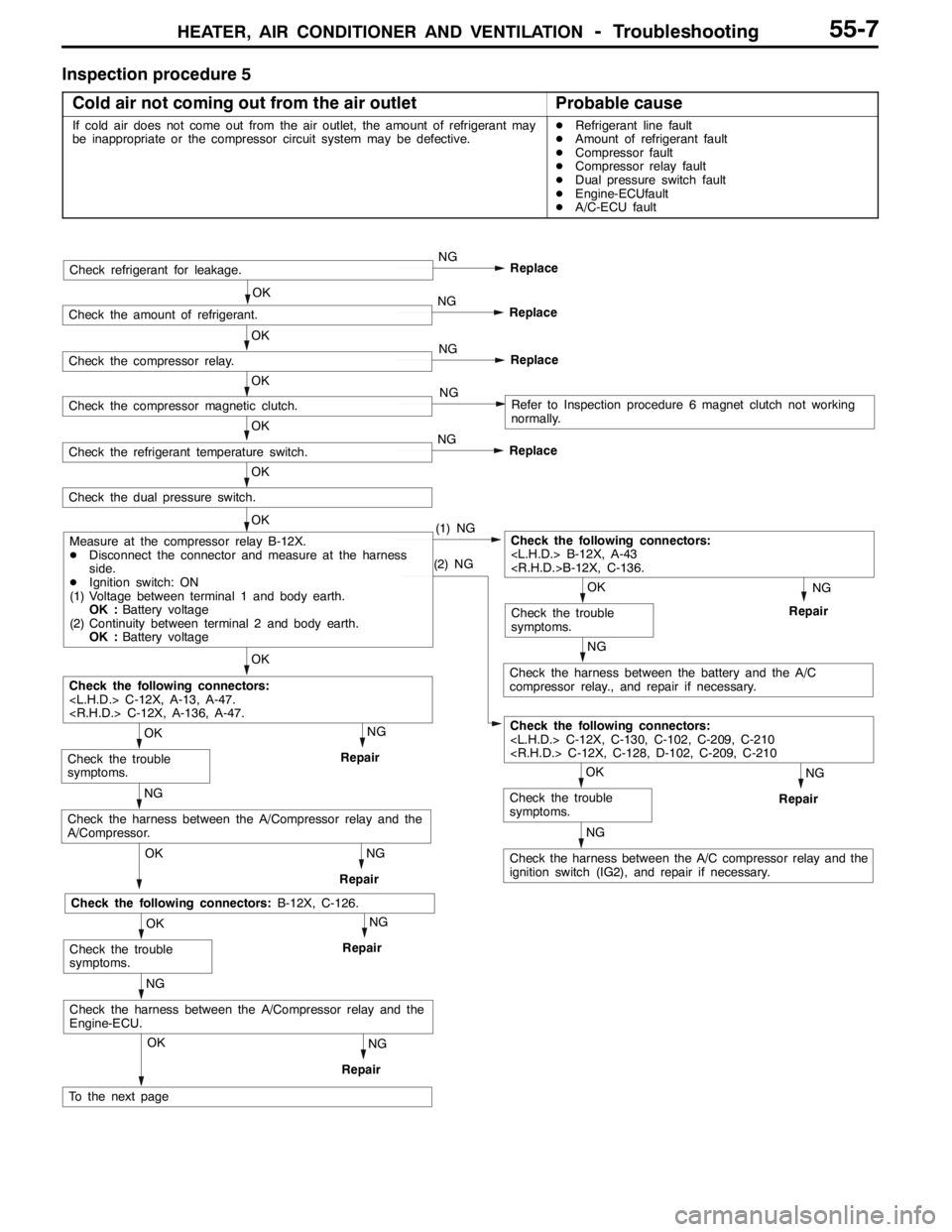
Inspection procedure 5
Cold air not coming out from the air outlet
Probable cause
If cold air does not come out from the air outlet, the amount of refrigerant may
be inappropriate or the compressor circuit system may be defective.DRefrigerant line fault
DAmount of refrigerant fault
DCompressor fault
DCompressor relay fault
DDual pressure switch fault
DEngine-ECUfault
DA/C-ECU fault
OK
NG
Repair
NG
Check the harness between the A/C compressor relay and the
ignition switch (IG2), and repair if necessary.
OK
Check the trouble
symptoms.
Check the following connectors:
Repair
Check the following connectors:
OK
OK
Check the trouble
symptoms.
NG
OK
NG
Replace
OK
OK
OK
NG
Check the harness between the battery and the A/C
compressor relay., and repair if necessary.
OK
Check the trouble
symptoms.
Check the following connectors:
RepairNG
(2) NG
OK
Check the dual pressure switch.
OK
NG
Repair
Check the harness between the A/Compressor relay and the
A/Compressor.
NG
Repair
Check the following connectors:B-12X, C-126.
OK
Check the trouble
symptoms.
NG
OKNG
Repair
Check the harness between the A/Compressor relay and the
Engine-ECU.
To the next page
Check refrigerant for leakage.
NG
Replace
NG
Replace
NG
NG
Replace
Check the amount of refrigerant.
Check the compressor relay.
Check the compressor magnetic clutch.
Check the refrigerant temperature switch.
Measure at the compressor relay B-12X.
DDisconnect the connector and measure at the harness
side.
DIgnition switch: ON
(1) Voltage between terminal 1 and body earth.
OK :Battery voltage
(2) Continuity between terminal 2 and body earth.
OK :Battery voltage
Refer to Inspection procedure 6 magnet clutch not working
normally.
Page 1410 of 1449
HEATER, AIR CONDITIONER AND VENTILATION-Troubleshooting55-8
Repair
Repair
NG
Replace the A/C-ECU .
Replace the Engine-ECU .
NG
Repair
Check the following connectors:
OK
Check the trouble
symptoms.
NG
OKNG
Check the harness between the dual pressure switch and the
Engine-ECU.
Check the following connectors:C-32, C-111, A-36.
OK
NG
OKNG
Check the harness between the dual pressure switch and the
A/C-ECU.
From the previous page
Check the trouble
symptoms.RepairNG
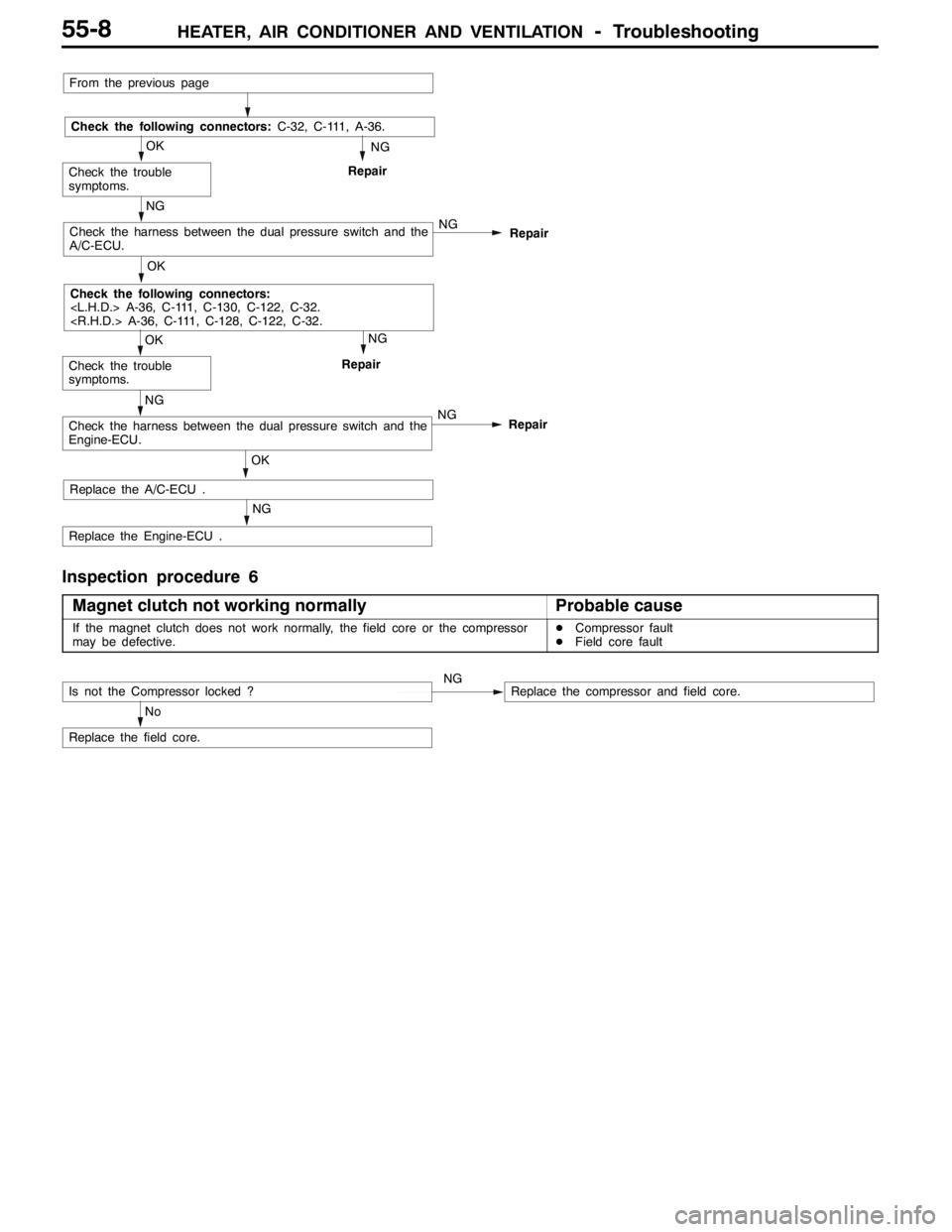
Inspection procedure 6
Magnet clutch not working normally
Probable cause
If the magnet clutch does not work normally, the field core or the compressor
may be defective.DCompressor fault
DField core fault
Replace the field core.
Is not the Compressor locked ?NGReplace the compressor and field core.
No
Page 1411 of 1449
HEATER, AIR CONDITIONER AND VENTILATION-Troubleshooting55-9
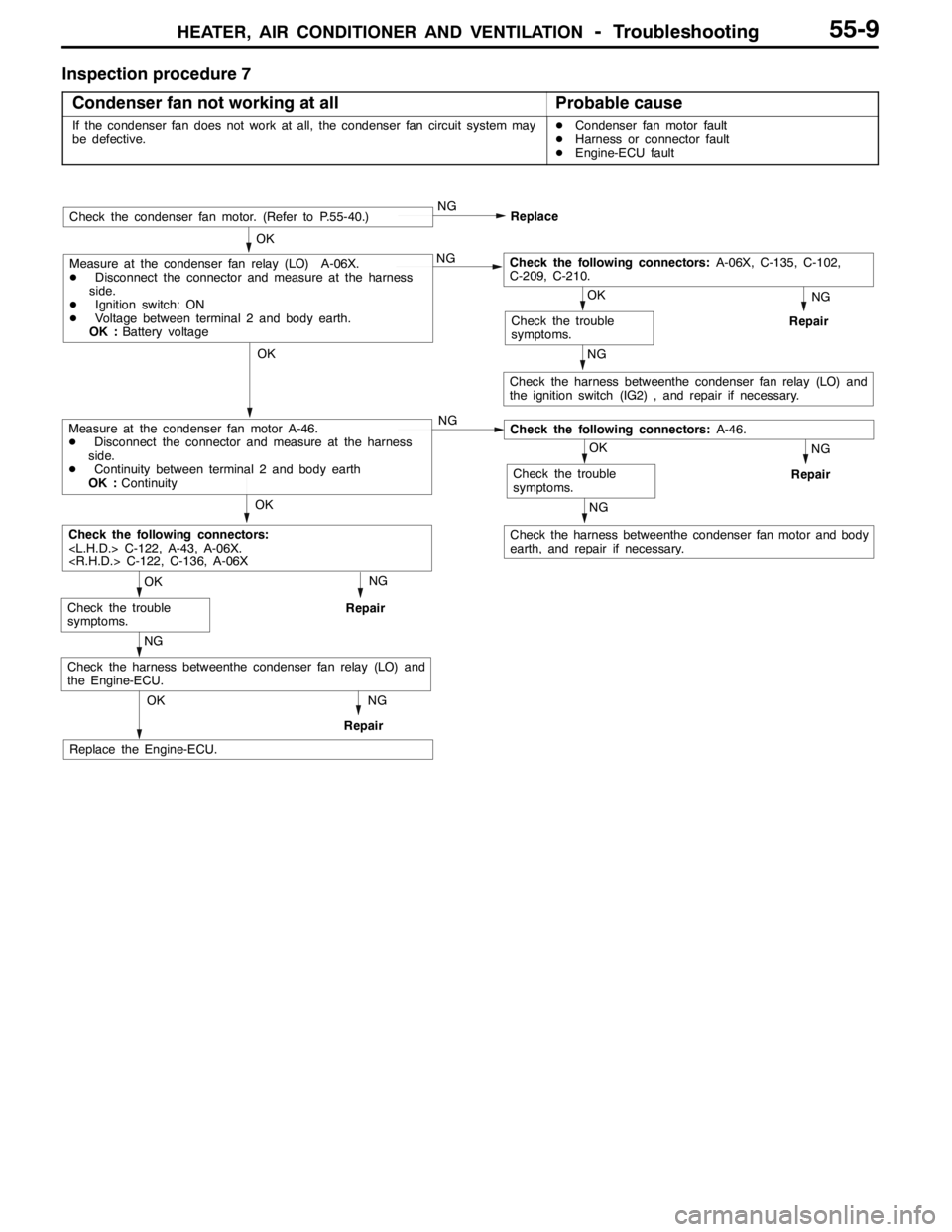
Inspection procedure 7
Condenser fan not working at all
Probable cause
If the condenser fan does not work at all, the condenser fan circuit system may
be defective.DCondenser fan motor fault
DHarness or connector fault
DEngine-ECU fault
NG
Check the harness betweenthe condenser fan relay (LO) and
the ignition switch (IG2) , and repair if necessary.
OK
Check the trouble
symptoms.
NG
Repair
NG
Replace
OK
Check the condenser fan motor. (Refer to P.55-40.)
NGCheck the following connectors:A-06X, C-135, C-102,
C-209, C-210.
OK
Measure at the condenser fan relay (LO) A-06X.
DDisconnect the connector and measure at the harness
side.
DIgnition switch: ON
DVoltage between terminal 2 and body earth.
OK :Battery voltage
NG
Check the harness betweenthe condenser fan motor and body
earth, and repair if necessary.
OK
Check the trouble
symptoms.Repair
NGCheck the following connectors:A-46.
NG
OK
Measure at the condenser fan motor A-46.
DDisconnect the connector and measure at the harness
side.
DContinuity between terminal 2 and body earth
OK :Continuity
NG
OK
Check the trouble
symptoms.RepairNG
Check the following connectors:
Replace the Engine-ECU.
OK
RepairNG
Check the harness betweenthe condenser fan relay (LO) and
the Engine-ECU.
Page 1412 of 1449
HEATER, AIR CONDITIONER AND VENTILATION-Troubleshooting55-10
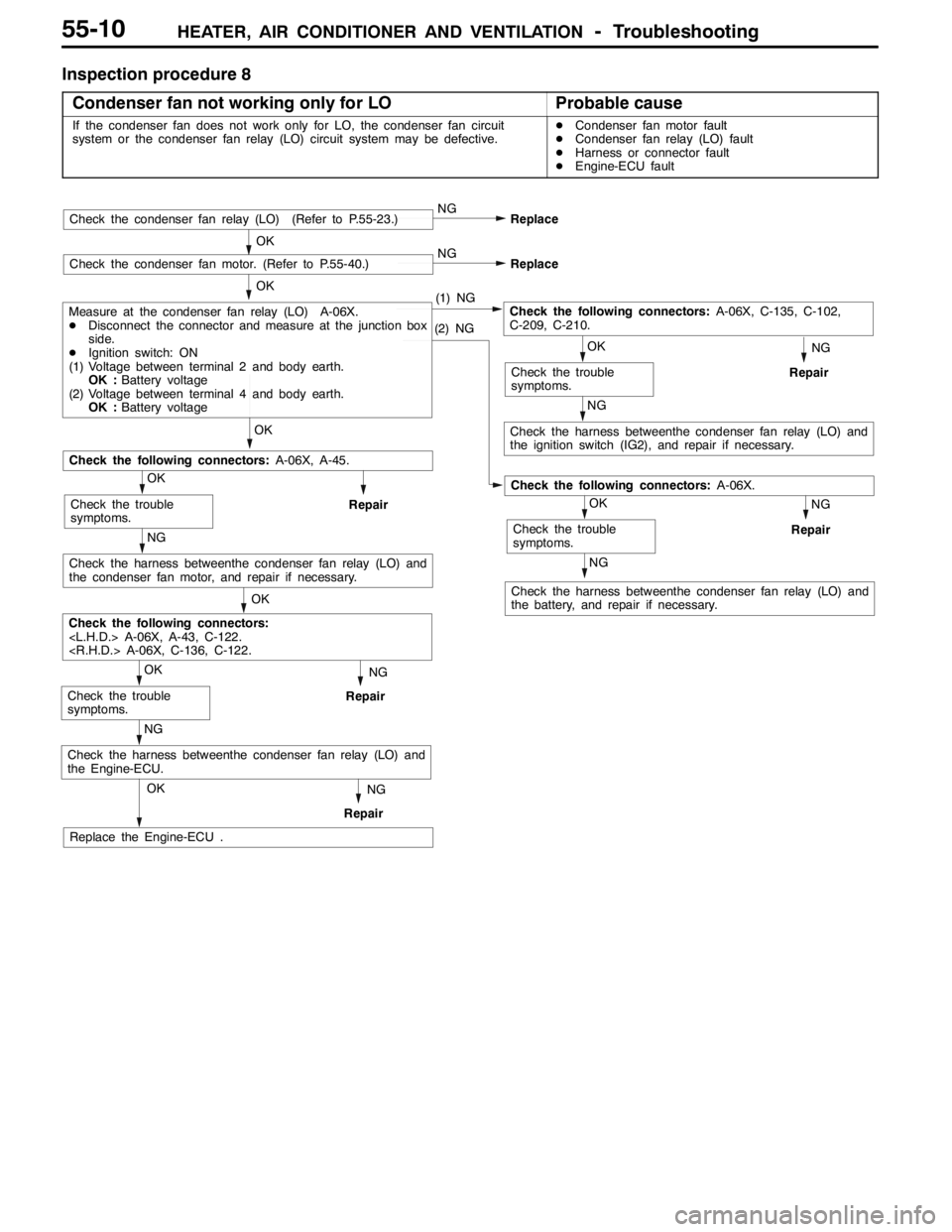
Inspection procedure 8
Condenser fan not working only for LO
Probable cause
If the condenser fan does not work only for LO, the condenser fan circuit
system or the condenser fan relay (LO) circuit system may be defective.DCondenser fan motor fault
DCondenser fan relay (LO) fault
DHarness or connector fault
DEngine-ECU fault
NG
Check the harness betweenthe condenser fan relay (LO) and
the ignition switch (IG2), and repair if necessary.
OK
Check the trouble
symptoms.
NG
Repair
NG
Replace
OK
Check the condenser fan motor. (Refer to P.55-40.)
Check the following connectors:A-06X, C-135, C-102,
C-209, C-210.
OK
NG
OK
Check the trouble
symptoms.Repair
Check the following connectors:A-06X.
NG
NG
OK
Check the trouble
symptoms.RepairNG
Check the following connectors:
Replace the Engine-ECU .
OK
RepairNG
Check the harness betweenthe condenser fan relay (LO) and
the Engine-ECU.
(2) NG
Measure at the condenser fan relay (LO) A-06X.
DDisconnect the connector and measure at the junction box
side.
DIgnition switch: ON
(1) Voltage between terminal 2 and body earth.
OK :Battery voltage
(2) Voltage between terminal 4 and body earth.
OK :Battery voltage(1) NG
NG
Replace
OK
Check the condenser fan relay (LO) (Refer to P.55-23.)
NG
OK
Check the trouble
symptoms.Repair
Check the following connectors:A-06X, A-45.
OK
Check the harness betweenthe condenser fan relay (LO) and
the condenser fan motor, and repair if necessary.
Check the harness betweenthe condenser fan relay (LO) and
the battery, and repair if necessary.
Page 1413 of 1449
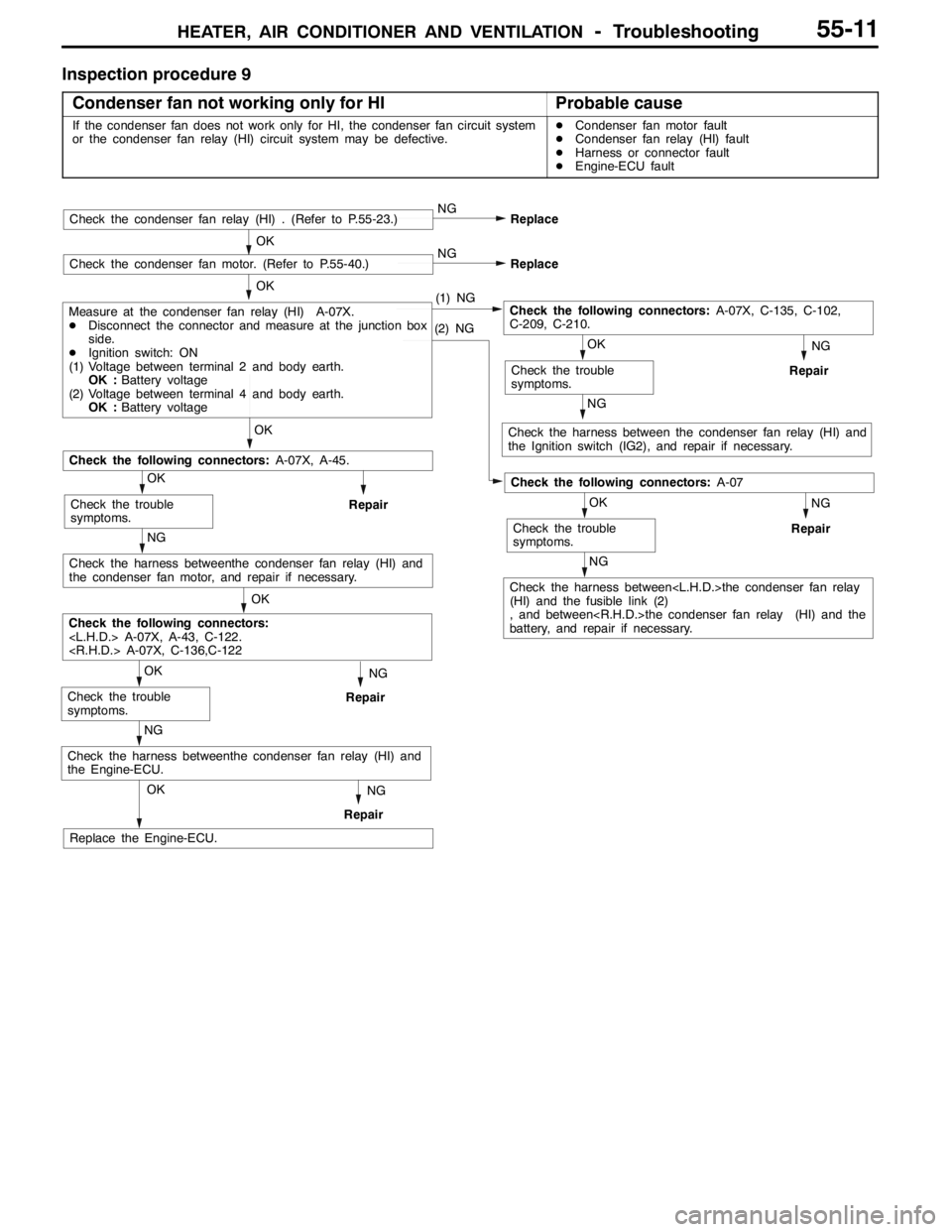
HEATER, AIR CONDITIONER AND VENTILATION-Troubleshooting55-11
Inspection procedure 9
Condenser fan not working only for HI
Probable cause
If the condenser fan does not work only for HI, the condenser fan circuit system
or the condenser fan relay (HI) circuit system may be defective.DCondenser fan motor fault
DCondenser fan relay (HI) fault
DHarness or connector fault
DEngine-ECU fault
NG
Check the harness between the condenser fan relay (HI) and
the Ignition switch (IG2), and repair if necessary.
OK
Check the trouble
symptoms.
NG
Repair
NG
Replace
OK
Check the condenser fan motor. (Refer to P.55-40.)
Check the following connectors:A-07X, C-135, C-102,
C-209, C-210.
OK
NG
Check the harness between
(HI) and the fusible link (2)
, and between
battery, and repair if necessary.
OK
Check the trouble
symptoms.Repair
Check the following connectors:A-07
NG
NG
OK
Check the trouble
symptoms.RepairNG
Check the following connectors:
Replace the Engine-ECU.
OK
RepairNG
Check the harness betweenthe condenser fan relay (HI) and
the Engine-ECU.
(2) NG
Measure at the condenser fan relay (HI) A-07X.
DDisconnect the connector and measure at the junction box
side.
DIgnition switch: ON
(1) Voltage between terminal 2 and body earth.
OK :Battery voltage
(2) Voltage between terminal 4 and body earth.
OK :Battery voltage(1) NG
NG
Replace
OK
Check the condenser fan relay (HI) . (Refer to P.55-23.)
NG
Check the harness betweenthe condenser fan relay (HI) and
the condenser fan motor, and repair if necessary.
OK
Check the trouble
symptoms.Repair
Check the following connectors:A-07X, A-45.
OK
Page 1423 of 1449

HEATER, AIR CONDITIONER AND VENTILATION–On-vehicle Service55-21
REFRIGERANT LEAK REPAIR
LOST CHARGE
If the system has lost all charge due to a leak:
1. Evacuate the system. (See procedure.)
2. Charge the system with approximately one
pound of refrigerant.
3. Check for leaks.
4. Discharge the system.
5. Repair leaks.
6. Replace receiver drier.
Caution
Replacement filter-drier units must be
sealed while in storage. The drier used in
these units will saturate water quickly upon
exposure to the atmosphere. When
installing a drier, have all tools and supplies
ready for quick reassembly to avoid keeping
the system open any longer than necessary.
7. Evacuate and charge system.
LOW CHARGE
If the system has not lost all of its refrigerant charge;
locate and repair all leaks. If it is necessary to
increase the system pressure to find the leak
(because of an especially low charge) add
refrigerant. If it is possible to repair the leak without
discharging the refrigerant system, use the
procedure for correcting low refrigerant level.HANDLING TUBING AND FITTINGS
Kinks in the refrigerant tubing or sharp bends in
the refrigerant hose lines will greatly reduce the
capacity of the entire system. High pressures are
produced in the system when it is operating.
Extreme care must be exercised to make sure that
all connections are pressure tight. Dirt and moisture
can enter the system when it is opened for repair
or replacement of lines or components. The
following precautions must be observed. The
system must be completely discharged before
opening any fitting of connection in the refrigeration
system. Open fittings with caution even after the
system has been discharged. If any pressure is
noticed as a fitting is loosened, allow trapped
pressure to bleed off very slowly.
Never attempt to rebend formed lines to fit. Use
the correct line for the installation you are servicing.
A good rule for the flexible hose lines is keep the
radius of all bends at least 10 times the diameter
of the hose.
Sharper bends will reduce the flow of refrigerant.
The flexible hose lines should be routed so that
they are at least 80 mm from the exhaust manifold.
It is good practice to inspect all flexible hose lines
at least once a year to make sure they are in good
condition and properly routed.
Unified plumbing connections with O-rings, these
O-rings are not reusable.
COMPRESSOR NOISE
You must first know the conditions when the noise
occurs. These conditions are: weather, vehicle
speed, in gear or neutral, engine temperature or
any other special conditions.
Noises that develop during A/C operation can often
be misleading. For example: what sounds like a
failed front bearing or connecting rod, may be
caused by loose bolts, nuts, mounting brackets,
or a loose clutch assembly. Verify accessory drive
belt tension (power steering or alternator).
Improper accessory drive belt tension can cause
a misleading noise when the compressor is
engaged and little or no noise when the compressor
is disengaged.
Drive belts are speed-sensitive. That is, at different
engine speeds, and depending upon belt tension,
belts can develop unusual noises that are often
mistaken for mechanical problems within the
compressor.ADJUSTMENT
1. Select a quiet area for testing. Duplicate
conditions as much as possible. Switch
compressor on and off several times to clearly
identify compressor noise. To duplicate high
ambient conditions (high head pressure),
restrict air flow through condenser. Install
manifold gauge set to make sure discharge
pressure doesn’t exceed 2,070 kPa.
2. Tighten all compressor mounting bolts, clutch
mounting bolt, and compressor drive belt.
Check to assure clutch coil is tight (no rotation
or wobble).
3. Check refrigerant hoses for rubbing or
interference that can cause unusual noises.
4. Check refrigerant charge. (See “Charging
System”.)
5. Recheck compressor noise as in Step 1.
6. If noise still exists, loosen compressor mounting
bolts and retorque. Repeat Step 1.
7. If noise continues, replace compressor and
repeat Step 1.