rear seat MITSUBISHI LANCER EVOLUTION 2007 Service Owner's Manual
[x] Cancel search | Manufacturer: MITSUBISHI, Model Year: 2007, Model line: LANCER EVOLUTION, Model: MITSUBISHI LANCER EVOLUTION 2007Pages: 1449, PDF Size: 56.82 MB
Page 968 of 1449

REAR AXLE -On-vehicle Service27B-22
8. If the measured value exceeds the standard value, replace
the hydraulic unit.
9. Connect the hydraulic unit and the hydraulic unit hose
assembly, and connect the torque transfer differential and
hydraulic unit hose assembly, tighten the flare nut in
specified torque.
Tightening torque: 34±5 N·m (Thread is not lubricated)
26±4 N·m (Thread is lubricated)
10. Supply the specified fluid up to the MAX level of the
oil reservoir, and bleed.
Specified fluid: ATF-SP III
Quantity: 1 L
WHEEL BEARING AXIAL PLAY CHECK
1. Remove the brake caliper and brake disc.
2. Check the bearing’s axial play.
Place a dial gauge against the hub surface; then move
the hub in the axial direction and check whether or not
there is axial play.
Limit: 0.05 mm
3. If the axial play exceeds the limit, the castle nut should
be tightened to the specified torque 225±25 N·m and
check the axial play again.
4. Replace the rear hub assembly if an adjustment cannot
be made to within the limit.
WHEEL BEARING ROTARY-SLIDING
RESISTANCE CHECK
1. Remove the brake caliper and brake disc.
2. After turning the hub a few times to seat the bearing,
wind a rope around the hub bolt and turn the hub by
pulling at a 90_angle with a spring balance. Measure
to determine whether or not the rotary-sliding resistance
of the rear hub is at the limit value.
Limit: 22 N or less
Page 1056 of 1449
BASIC BRAKE SYSTEM -On-vehicle Service35A-14
BRAKE DISC THICKNESS CHECK
Caution: Brembo disc brake
Take care not to contact the parts or tools to the caliper
because the paint of caliper will be scratched. And if
there is brake fluid on the caliper, wipe out quickly.
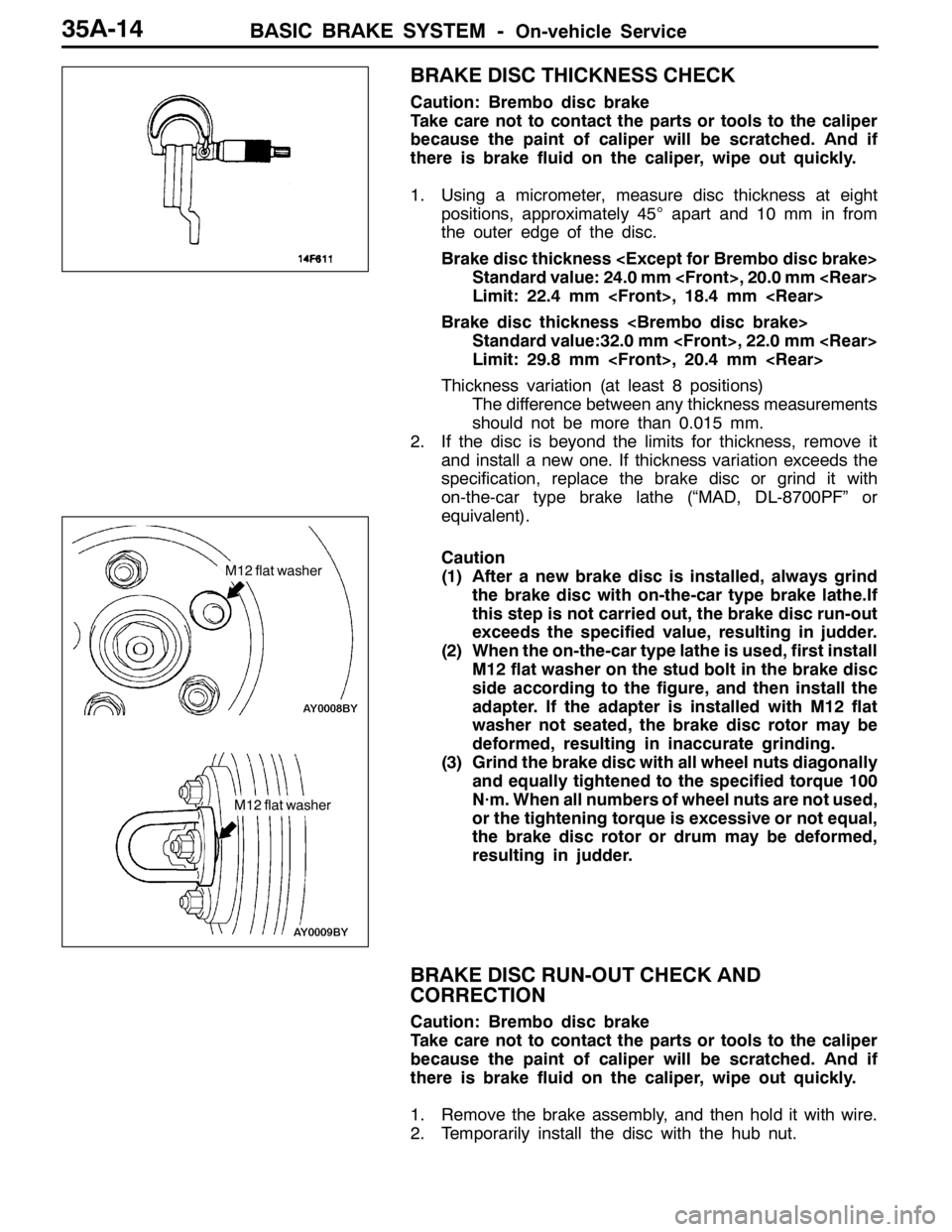
1. Using a micrometer, measure disc thickness at eight
positions, approximately 45°apart and 10 mm in from
the outer edge of the disc.
Brake disc thickness
Standard value: 24.0 mm
Limit: 22.4 mm
Brake disc thickness
Standard value:32.0 mm
Limit: 29.8 mm
Thickness variation (at least 8 positions)
The difference between any thickness measurements
should not be more than 0.015 mm.
2. If the disc is beyond the limits for thickness, remove it
and install a new one. If thickness variation exceeds the
specification, replace the brake disc or grind it with
on-the-car type brake lathe (“MAD, DL-8700PF” or
equivalent).
Caution
(1) After a new brake disc is installed, always grind
the brake disc with on-the-car type brake lathe.If
this step is not carried out, the brake disc run-out
exceeds the specified value, resulting in judder.
(2) When the on-the-car type lathe is used, first install
M12 flat washer on the stud bolt in the brake disc
side according to the figure, and then install the
adapter. If the adapter is installed with M12 flat
washer not seated, the brake disc rotor may be
deformed, resulting in inaccurate grinding.
(3) Grind the brake disc with all wheel nuts diagonally
and equally tightened to the specified torque 100
N·m. When all numbers of wheel nuts are not used,
or the tightening torque is excessive or not equal,
the brake disc rotor or drum may be deformed,
resulting in judder.
BRAKE DISC RUN-OUT CHECK AND
CORRECTION
Caution: Brembo disc brake
Take care not to contact the parts or tools to the caliper
because the paint of caliper will be scratched. And if
there is brake fluid on the caliper, wipe out quickly.
1. Remove the brake assembly, and then hold it with wire.
2. Temporarily install the disc with the hub nut.
M12 flat washer
M12 flat washer
Page 1057 of 1449
BASIC BRAKE SYSTEM -On-vehicle Service35A-15
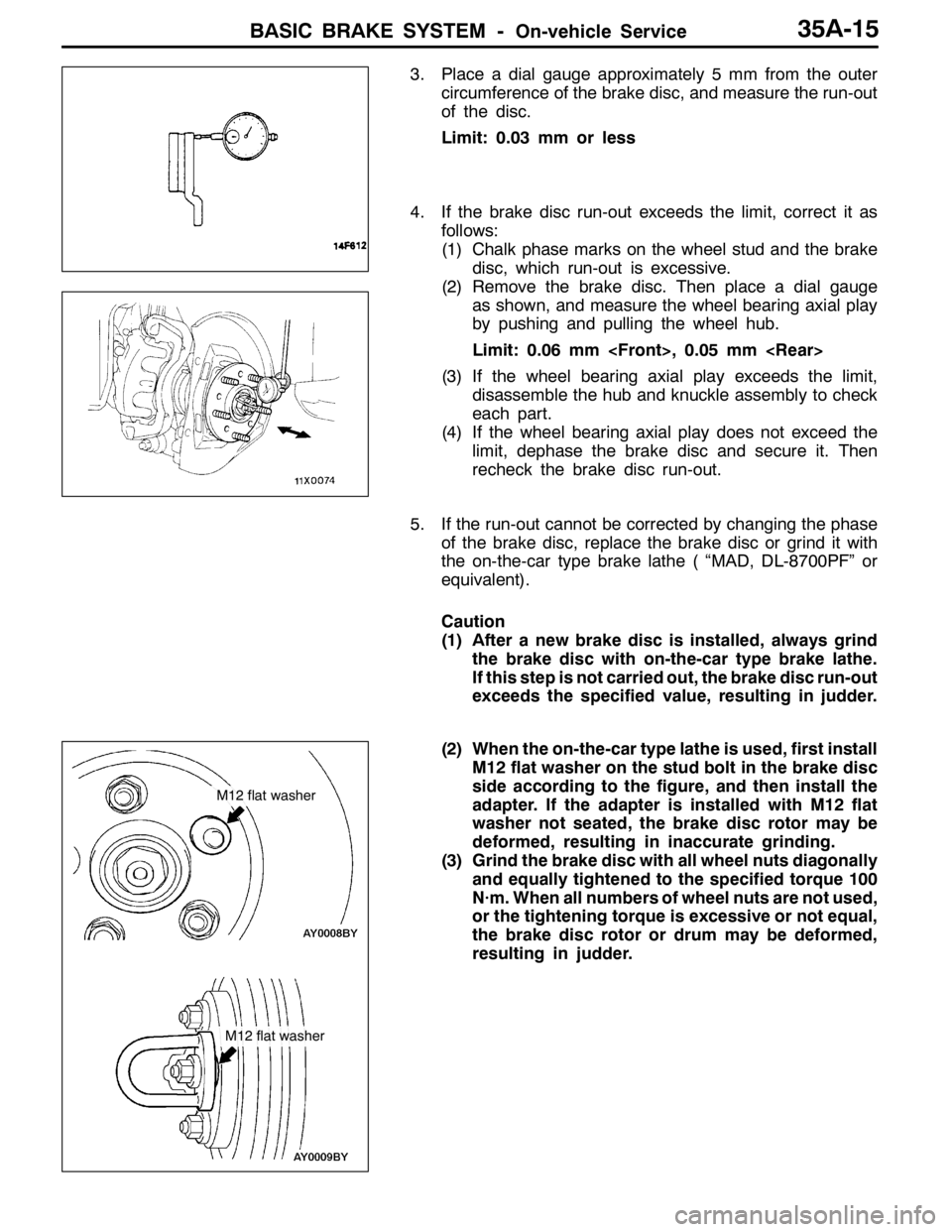
3. Place a dial gauge approximately 5 mm from the outer
circumference of the brake disc, and measure the run-out
of the disc.
Limit: 0.03 mm or less
4. If the brake disc run-out exceeds the limit, correct it as
follows:
(1) Chalk phase marks on the wheel stud and the brake
disc, which run-out is excessive.
(2) Remove the brake disc. Then place a dial gauge
as shown, and measure the wheel bearing axial play
by pushing and pulling the wheel hub.
Limit: 0.06 mm
(3) If the wheel bearing axial play exceeds the limit,
disassemble the hub and knuckle assembly to check
each part.
(4) If the wheel bearing axial play does not exceed the
limit, dephase the brake disc and secure it. Then
recheck the brake disc run-out.
5. If the run-out cannot be corrected by changing the phase
of the brake disc, replace the brake disc or grind it with
the on-the-car type brake lathe ( “MAD, DL-8700PF” or
equivalent).
Caution
(1) After a new brake disc is installed, always grind
the brake disc with on-the-car type brake lathe.
If this step is not carried out, the brake disc run-out
exceeds the specified value, resulting in judder.
(2) When the on-the-car type lathe is used, first install
M12 flat washer on the stud bolt in the brake disc
side according to the figure, and then install the
adapter. If the adapter is installed with M12 flat
washer not seated, the brake disc rotor may be
deformed, resulting in inaccurate grinding.
(3) Grind the brake disc with all wheel nuts diagonally
and equally tightened to the specified torque 100
N·m. When all numbers of wheel nuts are not used,
or the tightening torque is excessive or not equal,
the brake disc rotor or drum may be deformed,
resulting in judder.
M12 flat washer
M12 flat washer
Page 1109 of 1449

PARKING BRAKES -On-Vehicle Service36-3
ON-VEHICLE SERVICE
PARKING BRAKE LEVER STROKE CHECK
AND ADJUSTMENT
1. Pull the parking brake lever with a force of approx. 200
N and count the number of notches.
Standard value: 5 - 7 notches
2. If the parking brake lever stroke is not the standard value,
adjust as described below.
(1) Remove the floor console assembly. (Refer to
GROUP52A)
(2) Loosen the adjusting nut to move it to the cable rod
end so that the cable will be free.
(3) Depress the brake pedal repeatedly until the lever
has no change in its stroke.
NOTE
Depressing the brake pedal repeatedly adjusts shoe
clearance correctly.
(4) Turn the adjusting nut to adjust the parking brake lever
stroke to the standard value. After adjusting, check
that there is no space between the adjusting nut and
the parking brake lever. Check that the adjusting nut is
secured with the nut holder.
Caution
If the parking brake lever stroke is below the
standard value and the braking is too firm, the
rear brakes may drag.
(5) After adjusting the parking brake lever stroke, jack
up the rear end of the vehicle, and then release the
parking brake and turn the rear wheels to check that
the rear brakes are not dragging.
PARKING BRAKE SWITCH CHECK
1. Remove the floor console assembly. (Refer to
GROUP52A)
2. Remove the front seat assembly(RH). (Refer to
GROUP52A)
3. Check for continuity between the parking brake switch
terminal and the switch mounting bolt.
When parking brake lever is pulledContinuity
When parking brake lever is releasedNo continuity
Adjusting nut
Cable rod
Page 1112 of 1449

PARKING BRAKES -Parking Brake Cable36-6
PARKING BRAKE CABLE
REMOVAL AND INSTALLATION
CAUTION
If the vehicle is equipped with the Brembo disc brake, during maintenance, take care not to contact
the parts or tools to the caliper because the paint of caliper will be scratched. And if there is
brake fluid on the caliper, wipe out quickly.
Pre-removal Operation
DRear Floor Console Assembly and Rear Console
Bracket Removal (Refer to GROUP 52A-Floor
Console.)
DRear Seat Cushion Assembly Removal (Refer to
GROUP 52A-Seat.)Post-installation Operation
DParking Brake Lever Stroke Check and Adjustment
(Refer to P.36-3.)
DRear Seat Cushion Installation (Refer to GROUP
52A-Seat.)
DRear Floor Console Assembly and Rear Console
Bracket Installation (Refer to GROUP 52A-Floor
Console.)
1
Removal steps
DShoe and lining assembly
(Refer to P.36-7.)
DParking brake cable connection
(Refer to P.36-5.)
1. Parking brake cable
Page 1155 of 1449

BODY -Fuel Filler Door42-7
FUEL FILLER DOOR
REMOVAL AND INSTALLATION
Pre-removal and Post-installation Operations
DRear Seat Removal and Installation. (Refer to GROUP
52A.)
DFront Scuff Plate (Driver’s Side), Rear Scuff Plate(Driver’s Side), Center Pillar Lower Trim (Driver’s
Side), Quarter Trim (Driver’s Side) Removal and
Installation (Refer to GROUP 52A – Trim.)
5
1
3 4 3
2
5.0±1.0 N·m
Adjustment of clearance around
fuel filler door
Removal steps
1. Fuel filler door panel assembly
2. Clip
3. Fuel filler door hook assembly4. Fuel filler door lock release cable
5. Fuel filler door lock release handle
Page 1189 of 1449

BODY -Trunk lid42-41
TRUNK LID
REMOVAL AND INSTALLATION
2
34 56
7 89 10
111
12A
A
B
B5 5
99
14Measure of
length mm
15
4 9
12
8.9±1.9 N·m
Section A - A
Section B - B
Trunk lid weatherstrip removal
steps
DRear end trim
GROUP 52A.)
"BA1. Trunk lid weatherstrip
Trunk lid release cable and trunk
lid release handle removal steps
DTrunk rear side trim (Left side)
(Refer to GROUP 52A.)
DRear seat (Refer to GROUP 52A.)
DCenter pillar lower trim (Refer to
GROUP 52A.)
DCowl side trim
DAccelerator pedal stopper
2. Trunk lid release handle
3. Trunk lid release cable
Trunk lid striker removal steps
DRear end trim
GROUP 52A.)4. Trunk lid striker
Trunk lid panel removal steps
5. Trunk lid bumper
6. Trunk lid lock cylinder
7. Trunk lid latch assembly
8. Trunk lid hinge mounting bolt
9. Trunk lid panel assembly
Trunk lid latch assembly removal
7. Trunk lid latch assembly
Trunk lid hinge removal steps
DRear shelf trim
DRear seat (Refer to GROUP 52A.)
9. Trunk lid panel assembly
AA""AA10. Trunk lid torsion bar (Right side)
AA""AA11. Trunk lid torsion bar (Left side)
12. Trunk lid hinge
Page 1207 of 1449

EXTERIOR -Windshield Wiper and Washer51-15
5.0±1.0 NSm
4
1 3
2
NOTE: Refer to P.51-19 for more information regarding removal and installation of rear washer nozzle.
5
Washer hose removal steps
DSplash shild
GROUP 42 – Fender.)
DCowl side trim, front scuff plate, center
pillar trim, lower, rear scuff plate (Refer
to GROUP 52A – Trim.)
DRear seat (Refer to GROUP
52A – Seat.)
1. Washer hose
Windshield washer nozzle removal
steps
DConnection of washer hose
2. Windshield washer nozzleWasher tank and windshield washer
motor assembly removal steps
DRear end trim, trunk side trim (Refer
to GROUP 52A – Trim.)
DConnection of front washer hose
3. Washer tank assembly
4. Washer tank bracket
5. Washer motor
NOTE: Refer to GROUP 54A– Column Switch for
removal and installation of wiper washer switch.
Page 1220 of 1449

52A-2
INTERIOR
CONTENTS
SPECIAL TOOL 3............................
INSTRUMENT PANEL* 3......................
FRONT FLOOR CONSOLE 10................
REAR FLOOR CONSOLE 12..................
TRIMS 15....................................
HEADLINING 17..............................SEAT 19.....................................
Front Seat 19..................................
Rear Seat 22..................................
SEAT BELT 25...............................
Front Seat Belt 25.............................
Rear Seat Belt 26..............................
WARNINGS REGARDING SERVICING OF SUPPLEMENTAL RESTRAINT SYSTEM (SRS) EQUIPPED VEHICLES
WARNING!
(1) Improper service or maintenance of any component of the SRS, or any SRS-related component, can lead to personal
injury or death to service personnel (from inadvertent firing of the air bag) or to the driver and passenger (from rendering
the SRS inoperative).
(2) Service or maintenance of any SRS component or SRS-related component must be performed only at an authorized
MITSUBISHI dealer.
(3) MITSUBISHI dealer personnel must thoroughly review this manual, and especially its GROUP 52B - Supplemental
Restraint System (SRS) before beginning any service or maintenance of any component of the SRS or any SRS-related
component.
NOTE
The SRS includes the following components: SRS-ECU, SRS warning lamp, air bag module, clock spring and interconnecting
wiring. Other SRS-related components (that may have to be removed/installed in connection with SRS service or maintenance) are
indicated in the table of contents by an asterisk (*).
Page 1230 of 1449

INTERIOR -Rear Floor Console52A-12
REAR FLOOR CONSOLE
REMOVAL AND INSTALLATION
1
3 2
2
3
Removal steps
1. Console box mat
2. Rear console assembly
DRear seat cushion assembly
(Refer to P.52A-22.)
DFront scuff plate
(Refer to P.52A-15.)DRear scuff plate (Refer to P.52A-15.)
DCenter pillar trim, lower
(Refer to P.52A-15.)
DFloor carpet
3. Rear console bracket