specification MITSUBISHI LANCER EVOLUTION 2007 Service Owner's Manual
[x] Cancel search | Manufacturer: MITSUBISHI, Model Year: 2007, Model line: LANCER EVOLUTION, Model: MITSUBISHI LANCER EVOLUTION 2007Pages: 1449, PDF Size: 56.82 MB
Page 662 of 1449

MPI -On-vehicle Service13A-130
14. If any of fuel pressure measured in steps 10 to 13 is out of
specification, troubleshoot and repair according to the
table below.
SymptomProbable causeRemedy
DFuel pressure too low
DFuelpressuredropsafterracing
Clogged fuel filterReplace fuel filter
DFuelpressuredrops after racing
DNo fuel pressure in fuel return
hose
Fuel leaking to return side due to poor
fuel regulator valve seating or settled
springReplace fuel pressure regulator
Low fuel pump delivery pressureReplace fuel pump
Fuel pressure too highBinding valve in fuel pressure
regulatorReplace fuel pressure regulator
Clogged fuel return hose or pipeClean or replace hose or pipe
Same fuel pressure when vacuum
hose is connected and when
disconnected
Damaged vacuum hose or clogged
nippleReplace vacuum hose or clean nipple
disconnectedFuel pressure control system
malfunctionCheck the fuel pressure control
system
15. Stop the engine and check change of fuel pressure gauge
reading. Normal if the reading does not drop within 2
minutes. If it does, observe the rate of drop and
troubleshoot and repair according to the table below.
SymptomProbable causeRemedy
Fuel pressure drops gradually after
engineisstopped
Leaky injectorReplace injector
engineisstopped
Leaky fuel regulator valve seatReplace fuel pressure regulator
Fuel pressure drops sharply
immediately after engine is stoppedCheck valve in fuel pump is held openReplace fuel pump
16. Release residual pressure from the fuel pipe line.
(Refer to P.13A-125.)
17. Remove the fuel pressure gauge and special tool from
the delivery pipe.
Caution
Cover the hose connection with rags to prevent splash
of fuel that could be caused by some residual pressure
in the fuel pipe line.
18. Replace the O-ring at the end of the fuel high pressure
hose with a new one. Furthermore, apply engine oil to
the new O-ring before replacement.
19. Fit the fuel high pressure hose over the delivery pipe
and tighten the bolt to specified torque.
Tightening torque: 5.0±1.0 N·m
20. Check for any fuel leaks by following the procedure in
step 7.
21. Disconnect the MUT-II.
Page 689 of 1449

14-1
ENGINE COOLING
CONTENTS
GENERAL INFORMATION 2..................
SERVICE SPECIFICATIONS 2.................
LUBRICANT 2...............................
SEALANT 2..................................
SPECIAL TOOLS 3...........................
TROUBLESHOOTING 3.......................
ON-VEHICLE SERVICE 6.....................
Engine Coolant Leak Checking 6................
Radiator Cap Opening Pressure Check 6........Engine Coolant Replacement 6..................
Concentration Measurement 7...................
Radiator Fan Relay Continuity Check 8..........
Radiator Fan Controller Check 8................
Radiator Fan Motor Check 10...................
THERMOSTAT 11............................
WATER PUMP 13............................
WATER HOSE AND WATER PIPE 14..........
RADIATOR 15................................
Page 690 of 1449

ENGINE COOLING -GeneralInformation/
Service Specifications/Lubricant/Sealant14-2
GENERAL INFORMATION
The cooling system is designed to keep every part
of the engine at appropriate temperature in
whatever condition the engine may be operated.
The cooling method is of the water-cooled, pressure
forced circulation type in which the water pump
pressurizes coolant and circulates it throughout the
engine. If the coolant temperature exceeds the
prescribed temperature, the thermostat opens to
circulate the coolant through the radiator as well
so that the heat absorbed by the coolant may be
radiated into the air.The water pump is of the centrifugal type and is
driven by the drive belt from the crankshaft.
The radiator is the corrugated fin, down flow type.
The cooling fan is controlled by the radiator fan
controller and engine-ECU depend on driving
conditions.
ItemSpecification
Radiator performance kJ/h216,700
SERVICE SPECIFICATIONS
ItemsStandard valueLimit
Radiator cap opening pressure kPa93 - 12383
Range of coolant antifreeze concentration of radiator %30 - 60-
ThermostatValve opening temperature of thermostat_C80±1.5-
Full-opening temperature of thermostat_C93-
Valve lift (at 93_C) mm9.5 or more-
LUBRICANT
ItemSpecified coolantQuantity L
Engine coolantMITSUBISHI GENUINE COOLANT or equivalent6.0Enginecoolant
(including reserve tank)
MITSUBISHIGENUINECOOLANTorequivalent6.0
SEALANT
ItemSpecified sealantRemark
Cylinder block drain plug3M Nut Locking Part No. 4171 or equivalentDrying sealant
Page 701 of 1449
ENGINE COOLING -Water Pump14-13
WATER PUMP
Caution
If the vehicle is equipped with the Brembo disc brake, during maintenance, take care not to contact
the parts or tools to the caliper because the paint of caliper will be scratched.
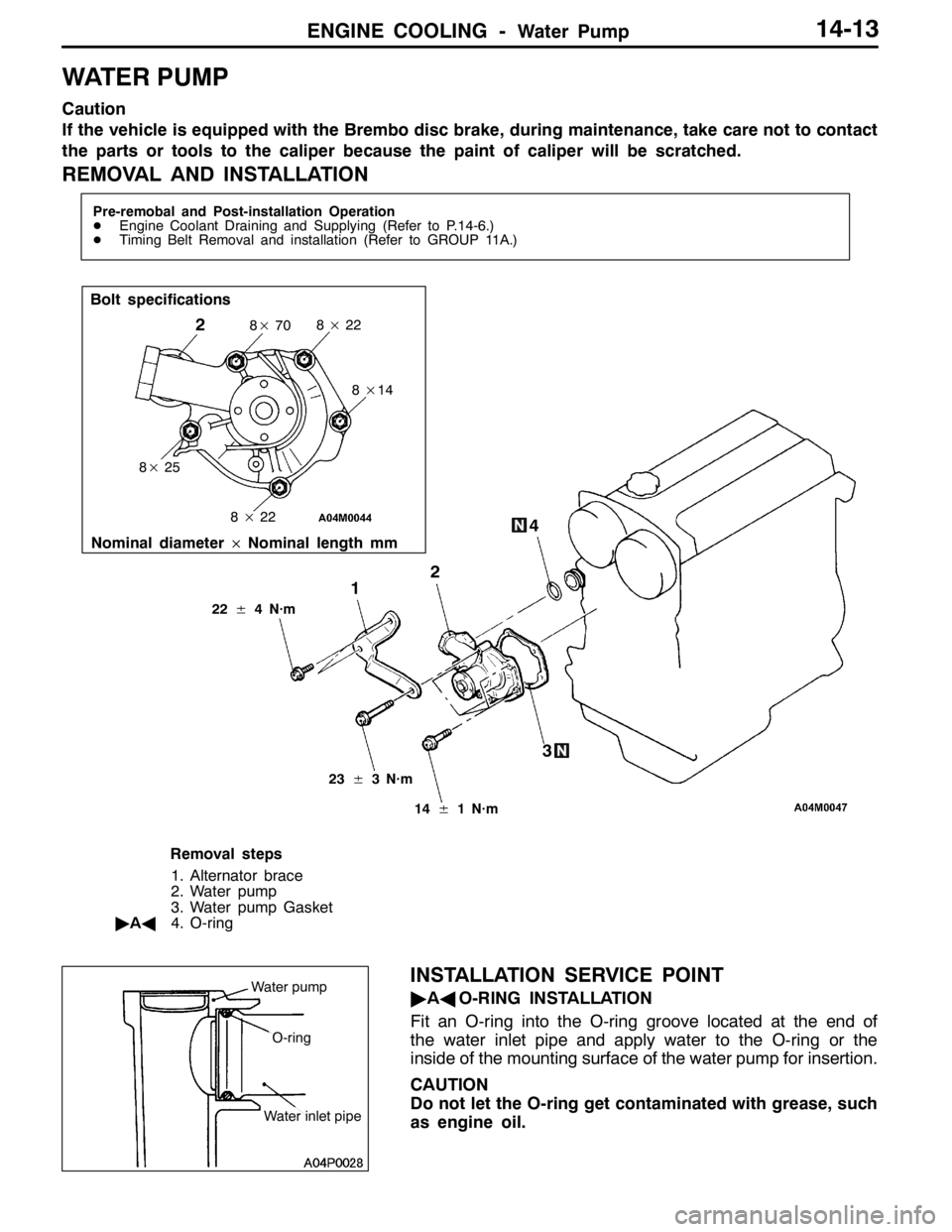
REMOVAL AND INSTALLATION
Pre-remobal and Post-installation Operation
DEngine Coolant Draining and Supplying (Refer to P.14-6.)
DTiming Belt Removal and installation (Refer to GROUP 11A.)
1
Bolt specifications
28×22
2
23±3 N·m
14±1 N·m
Nominal diameter×Nominal length mm
8×70
8×14
8×22 8×25
3 4
22±4 N·m
Removal steps
1. Alternator brace
2. Water pump
3. Water pump Gasket
"AA4. O-ring
INSTALLATION SERVICE POINT
"AAO-RING INSTALLATION
Fit an O-ring into the O-ring groove located at the end of
the water inlet pipe and apply water to the O-ring or the
inside of the mounting surface of the water pump for insertion.
CAUTION
Do not let the O-ring get contaminated with grease, such
as engine oil.Water pump
O-ring
Water inlet pipe
Page 707 of 1449

15-1
INTAKE AND
EXHAUST
CONTENTS
GENERAL INFORMATION 2..................
SERVICE SPECIFICATION 3..................
SPECIAL TOOL 3............................
ON-VEHICLE SERVICE 3.....................
Turbocharger Supercharging Pressure Check 3...
Supercharging Pressure Control System
Check 4.......................................
Waste Gate Actuator Check 4...................
Waste Gate Solenoid Valve Check 5.............
Air Bypass Valve Check 5......................
Intake Manifold Pressure Check 6...............
Secondary Air Control System Check 6..........
Secondary Air Control Solenoid Valve Check 6...
Secondary Air Valve Check 7...................Vacuum Tank Check 7.........................
AIR CLEANER 8.............................
INTERCOOLER 9............................
INTERCOOLER WATER SPRAY 10............
SECONDARY AIR SUPPLY SYSTEM 14.......
INTAKE MANIFOLD 16.......................
EXHAUST MANIFOLD 19.....................
TURBOCHARGER 22.........................
EXHAUST PIPE AND MAIN MUFFLER 26.....
CATALYTIC CONVERTER
(REFER TO GROUP 17.) ....................
Page 709 of 1449
INTAKE AND EXHAUST -Service Specifications/Special Tool/On-vehicle Service15-3
SERVICE SPECIFICATIONS
ItemStandard valueLimit
Turbocharger supercharging pressure (waste gate solenoid
valve not operating) kPa59 - 84-
Initial activation pressure of waste gate actuator (at the stroke
of approximately 1 mm) kPaApproximately 100-
Waste gate solenoid valve coil resistance (at 20_C)Ω29 - 35-
Initial activation pressure of air bypass valve kPaApproximately 53-
Secondary air control solenoid valve coil resistance
(at 20_C)Ω29 - 35-
Manifold distortion of the installation surface mm0.15 or less0.20
SPECIAL TOOL
ToolNumberNameUse
MD998770Oxygen sensor wrenchRemoval and installation of oxygen sensor
ON-VEHICLE SERVICE
TURBOCHARGER SUPERCHARGING
PRESSURE CHECK
Caution
Two persons should be in the vehicle when the test is
conducted; the person in the passenger seat should read
the indications shown by the pressure meter.
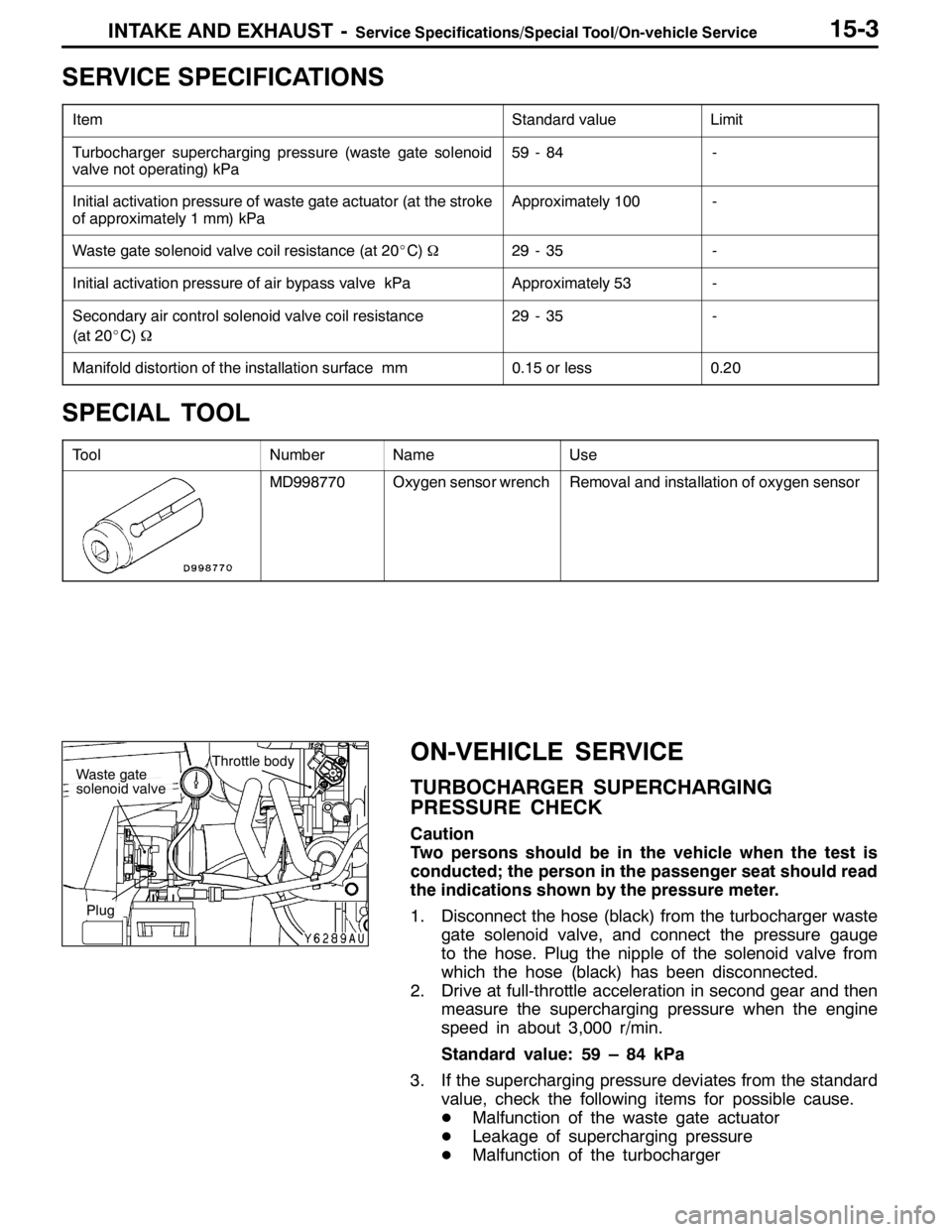
1. Disconnect the hose (black) from the turbocharger waste
gate solenoid valve, and connect the pressure gauge
to the hose. Plug the nipple of the solenoid valve from
which the hose (black) has been disconnected.
2. Drive at full-throttle acceleration in second gear and then
measure the supercharging pressure when the engine
speed in about 3,000 r/min.
Standard value: 59 – 84 kPa
3. If the supercharging pressure deviates from the standard
value, check the following items for possible cause.
DMalfunction of the waste gate actuator
DLeakage of supercharging pressure
DMalfunction of the turbocharger
Throttle bodyWaste gate
solenoid valve
Plug
Page 733 of 1449

16-1
ENGINE
ELECTRICAL
CONTENTS
CHARGING SYSTEM 2................
GENERAL INFORMATION 2................
SERVICE SPECIFICATIONS 3...............
SPECIAL TOOL 3..........................
ON-VEHICLE SERVICE 4...................
Alternator Output Line Voltage Drop Test 4......
Output Current Test 5........................
Regulated Voltage Test 7.....................
Waveform Check Using An Analyzer 8..........
ALTERNATOR 10..........................
STARTING SYSTEM 17................
GENERAL INFORMATION 17...............
SERVICE SPECIFICATIONS 17..............
ON-VEHICLE SERVICE 18..................
STARTER 18..............................
IGNITION SYSTEM 26.................
GENERAL INFORMATION 26...............
SERVICE SPECIFICATIONS 27..............
SPECIAL TOOL 27.........................
ON-VEHICLE SERVICE 28..................
Ignition Coil (With Built-in Power Transistor)
Check 28...................................
Resistive Cord Check 28.....................
Spark Plug Check, Cleaning and Replacement 29
Camshaft Position Sensor Check 29...........
Crank Angle Sensor Check 29................
Detonation Sensor Check 29..................
Waveform Check Using An Analyzer 30........
IGNITION COIL 34.........................
CAMSHAFT POSITION SENSOR 35.........
CRANK ANGLE SENSOR 35................
DETONATION SENSOR 37.................
Page 735 of 1449

ENGINE ELECTRICAL -Charging System16-3
ALTERNATOR SPECIFICATIONS
ItemsSpecifications
TypeBattery voltage sensing
Rated output V/A12/90
Voltage regulatorElectronic built-in type
SERVICE SPECIFICATIONS
ItemsStandard valueLimit
Alternator output line voltage drop (at 30 A) V-max. 0.3
Regulated voltage ambient
tempatvoltageregulatorV
-20_C14.2 - 15.4-
temp. atvoltage regulatorV
20_C13.9 - 14.9-
60_C13.4 - 14.6-
80_C13.1 - 14.5-
Output current-70 % of normal output current
Rotor coil resistanceΩApprox. 3 - 5-
Protrusion length of brush mm-2
SPECIAL TOOL
ToolNumberNameUse
MB991519Alternator test
harnessChecking the alternator (S terminal voltage)
Page 738 of 1449

ENGINE ELECTRICAL -Charging System16-6
This test determines whether the alternator output
current is normal.
(1) Before the test, always be sure to check the
following.
DAlternator installation
DBattery (Refer to GROUP 54 - Battery.)
NOTE
The battery should be slightly discharged.
The load needed by a fully-charged battery
is insufficient for an accurate test.
DAlternator drive belt tension
(Refer to GROUP 11 - On-vehicle Service.)
DFusible link
DAbnormal noise from the alternator while
the engine is running.
(2) Turn the ignition switch to the “LOCK” (OFF)
position.
(3) Disconnect the negative battery cable.
(4) Disconnect the alternator output wire from the
alternator “B” terminal. Connect a DC test
ammeter with a range of 0 - 100 A in series
between the “B” terminal and the disconnected
output wire. (Connect the (+) lead of the
ammeter to the “B” terminal. Connect the ( - )
lead of the ammeter to the disconnected output
wire.)
Caution
Never use clips but tighten bolts and nuts
to connect the line. Otherwise loose
connections (e.g. using clips) will lead to
a serious accident because of high current.
NOTE
An inductive-type ammeter which enables
measurements to be taken without
disconnecting the alternator output wire should
be recommended.
(5) Connect a voltmeter with a range of 0 - 20 V
between the alternator “B” terminal and the
earth. (Connect the (+) lead of the voltmeter
to the “B” terminal, and then connect the ( - )
lead of the voltmeter to the earth.)
(6) Connect the negative battery cable.
(7) Connect a tachometer or the MUT-II.
(Refer to GROUP 11 - On-vehicle Service.)
(8) Leave the hood open.
(9) Check that the reading on the voltmeter is equal
to the battery voltage.
NOTE
If the voltage is 0 V, the cause is probably
an open circuit in the wire or fusible link between
the alternator “B” terminal and the battery (+)
terminal.(10)Turn the light switch on to turn on headlamps
and then start the engine.
(11) Immediately after setting the headlamps to high
beam and turning the heater blower switch to
the high revolution position, increase the engine
speed to 2,500 r/min and read the maximum
current output value displayed on the ammeter.
Limit: 70 % of normal current output
NOTE
DFor the nominal current output, refer to the
Alternator Specifications.
DBecause the current from the battery will
soon drop after the engine is started, the
above step should be carried out as quickly
as possible in order to obtain the maximum
current output value.
DThe current output value will depend on
the electrical load and the temperature of
the alternator body.
DIf the electrical load is small while testing,
the specified level of current may not be
output even though the alternator is normal.
In such cases, increase the electrical load
by leaving the headlamps turned on for
some time to discharge the battery or by
using the lighting system in another vehicle,
and then test again.
DThe specified level of current also may not
be output if the temperature of the alternator
body or the ambient temperature is too
high. In such cases, cool the alternator and
then test again.
(12)The reading on the ammeter should be above
the limit value. If the reading is below the limit
value and the alternator output wire is normal,
remove the alternator from the engine and
check the alternator.
(13)Run the engine at idle after the test.
(14)Turn the ignition switch to the “LOCK” (OFF)
position.
(15)Remove the tachometer or the MUT-II.
(16)Disconnect the negative battery cable.
(17)Disconnect the ammeter and voltmeter.
(18)Connect the alternator output wire to the
alternator “B” terminal.
(19)Connect the negative battery cable.
Page 749 of 1449

ENGINE ELECTRICAL -Starting System16-17
STARTING SYSTEM
GENERAL INFORMATION
If the ignition switch is turned to the “START”
position, current flows in the pull-in and holding
coils provided inside magnetic switch, attracting
the plunger. When the plunger is attracted, the
lever connected to the plunger is actuated to
engage the starter clutch.
On the other hand, attracting the plunger will turn
on the magnetic switch, allowing the B terminaland M terminal to conduct. Thus, current flows to
engage the starter motor.
When the ignition switch is returned to the “ON”
position after starting the engine, the starter clutch
is disengaged from the ring gear.
An overrunning clutch is provided between the
pinion and the armature shaft, to prevent damage
to the starter.
SYSTEM DIAGRAM
Pull-in coilHolding coil
Ignition
switch
BatteryArmature
Brush
YokePlunger
Lever
Over-running
clutch
Pinion shaft
STARTER MOTOR SPECIFICATIONS
ItemsSpecifications
TypeReduction drive with planetary gear
Rated output kW/V1.2/12
No. of pinion teeth8
SERVICE SPECIFICATIONS
ItemsStandard valueLimit
Pinion gap mm0.5 - 2.0-
Commutator outer diameter mm29.428.8
Commutator runout mm0.050.1
Commutator undercut mm0.50.2
Brush length mm-7.0