ESP MITSUBISHI LANCER EVOLUTION 2007 Service Owner's Guide
[x] Cancel search | Manufacturer: MITSUBISHI, Model Year: 2007, Model line: LANCER EVOLUTION, Model: MITSUBISHI LANCER EVOLUTION 2007Pages: 1449, PDF Size: 56.82 MB
Page 821 of 1449
MANUAL TRANSMISSION - Troubleshooting
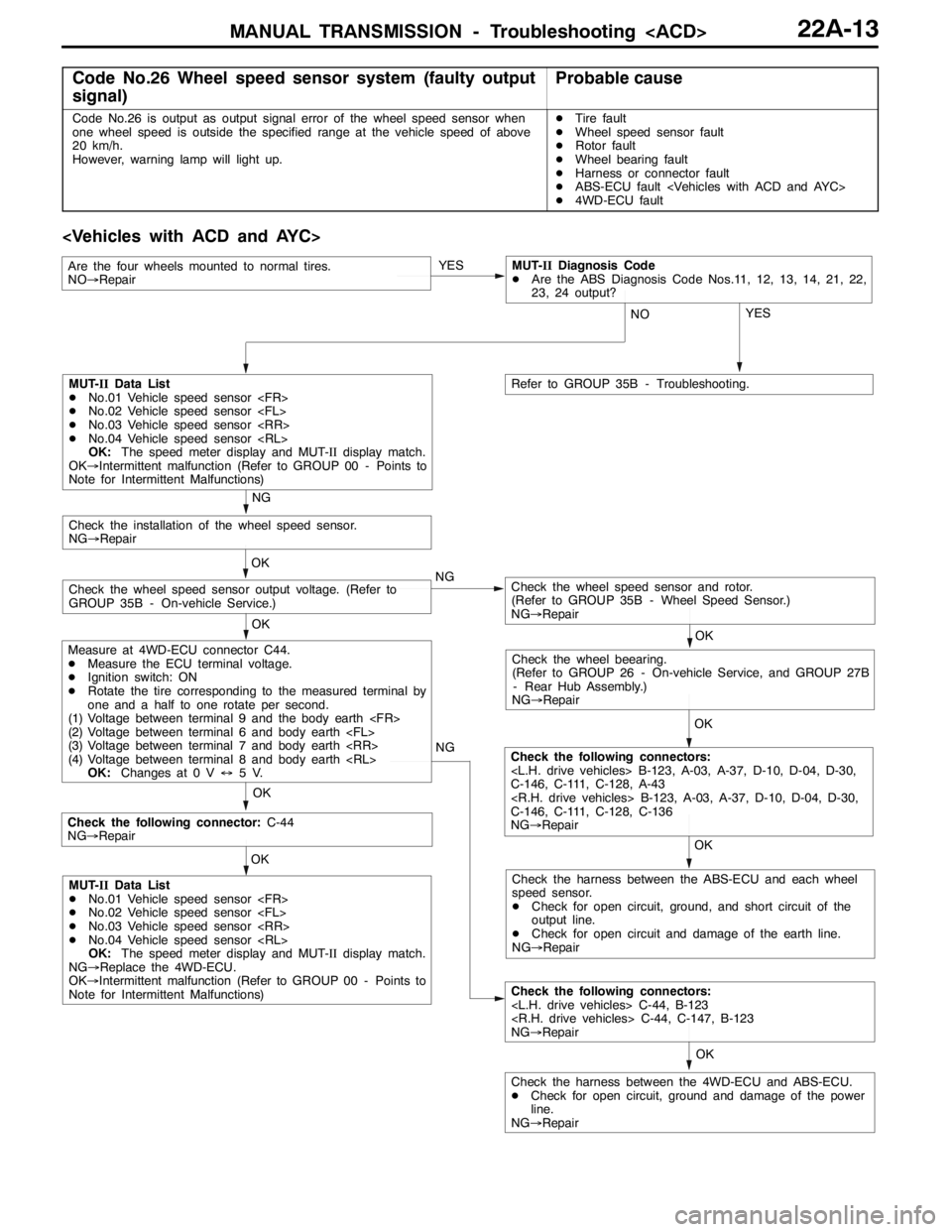
Code No.26 Wheel speed sensor system (faulty output
signal)Probable cause
Code No.26 is output as output signal error of the wheel speed sensor when
one wheel speed is outside the specified range at the vehicle speed of above
20 km/h.
However, warning lamp will light up.DTire fault
DWheel speed sensor fault
DRotor fault
DWheel bearing fault
DHarness or connector fault
DABS-ECU fault
D4WD-ECU fault
OK NG
OK
Check the following connector:C-44
NG→Repair
Check the following connectors:
NG→Repair OK
Check the harness between the 4WD-ECU and ABS-ECU.
DCheck for open circuit, ground and damage of the power
line.
NG→RepairYES
OK OK
Check the wheel speed sensor and rotor.
(Refer to GROUP 35B - Wheel Speed Sensor.)
NG→RepairCheck the wheel speed sensor output voltage. (Refer to
GROUP 35B - On-vehicle Service.)OK
Check the installation of the wheel speed sensor.
NG→Repair
NG
OK
Check the wheel beearing.
(Refer to GROUP 26 - On-vehicle Service, and GROUP 27B
- Rear Hub Assembly.)
NG→Repair
OK
Check the following connectors:
C-146, C-111, C-128, A-43
C-146, C-111, C-128, C-136
NG→Repair NG
MUT-IIData List
DNo.01 Vehicle speed sensor
DNo.02 Vehicle speed sensor
DNo.03 Vehicle speed sensor
DNo.04 Vehicle speed sensor
OK:The speed meter display and MUT-IIdisplay match.
OK→Intermittent malfunction (Refer to GROUP 00 - Points to
Note for Intermittent Malfunctions)
Measure at 4WD-ECU connector C44.
DMeasure the ECU terminal voltage.
DIgnition switch: ON
DRotate the tire corresponding to the measured terminal by
one and a half to one rotate per second.
(1) Voltage between terminal 9 and the body earth
(2) Voltage between terminal 6 and body earth
(3) Voltage between terminal 7 and body earth
(4) Voltage between terminal 8 and body earth
OK:Changes at 0 V↔5V.
MUT-IIData List
DNo.01 Vehicle speed sensor
DNo.02 Vehicle speed sensor
DNo.03 Vehicle speed sensor
DNo.04 Vehicle speed sensor
OK:The speed meter display and MUT-IIdisplay match.
NG→Replace the 4WD-ECU.
OK→Intermittent malfunction (Refer to GROUP 00 - Points to
Note for Intermittent Malfunctions)Check the harness between the ABS-ECU and each wheel
speed sensor.
DCheck for open circuit, ground, and short circuit of the
output line.
DCheck for open circuit and damage of the earth line.
NG→Repair YES
NO
Refer to GROUP 35B - Troubleshooting.
Are the four wheels mounted to normal tires.
NO→RepairMUT-IIDiagnosis Code
DAre the ABS Diagnosis Code Nos.11, 12, 13, 14, 21, 22,
23, 24 output?
Page 845 of 1449

MANUAL TRANSMISSION - Troubleshooting
ACTUATOR TEST JUDGEMENT VALUE
Item
no.Check itemTest descriptionNormal state
01Bleeding
according to the steering angle, and operate
the Proportional valve for five minutes.Make sure no air leaks from the bleeder
screw on the transfer.
02Bleeding
according to the steering angle, and operate
the directional valve for five minutes.Make sure no air leaks from the bleeder
screw on the torque transfer differential.
03Check the oil vol-
umeOperate the directional valve to the left and
right for 20 seconds.Check that the oil volume of the reservoir
tank is appropriate.
04Electric pump
driveOperate the electric pump for 5 seconds.Operation sounds of the electric pump
can be heard.
05Check the opera-
tions of the ACDOperate the Proportional valve
supply the maximum oil pressure to the multi
plate clutch.9Generate the tight corner braking
phenomenon.
06Check clutch op-
erations
maximum oil pressure to the left clutch.When the wheels are lifted, speed
difference will occur between the rear
left and right wheels.
07Check clutch op-
erations
maximum oil pressure to the right clutch.When the wheels are lifted, speed
difference will occur between the rear
left and right wheels.
08Control OFFTurn OFF the electric pump relay, and turn
OFF the control of the ACD and AYC.In actual driving, there is difference
between control ON and OFF.
(1) The actuator test can be executed only when all the following conditions are satisfied.
DAll wheel speed sensor inputs below 20 km/h
DNo system malfunction detected
DSteering angle is within±30 degrees from the neutral position
(2) When the actuator test corresponds to one of the following conditions, forced driving will be cleared.
DWhen any one of the wheel speed sensor input is detected to be above 20 km/h (excluding
Item No.08 “Control OFF”.)
DWhen system malfunction is detected (excluding diagnostic code No.82, 84, and 85)
DWhen the forced drive time is exceeded
DWhen the MUT-IIis removed
DWhen the Clear key of the MUT-IIis operated
Page 942 of 1449

FRONT AXLE -Drive Shaft26-14
DISASSEMBLY SERVICE POINTS
AA"T.J. CASE/SPIDER ASSEMBLY REMOVAL
1. Wipe off grease from the spider assembly and the inside
of the T.J. case.
2. Always clean the spider assembly when the grease
contains water or foreign material.
Caution
Do not disassemble the spider assembly.
AB"T.J. BOOT REMOVAL
1. Wipe off grease from the shaft spline.
2. When reusing the T.J. boot, wrap plastic tape around
the shaft spline to avoid damaging the boot.
REASSEMBLY SERVICE POINTS
"AASPIDER ASSEMBLY/T.J. CASE INSTALLATION
1. Apply the specified grease furnished in the repair kit to
the spider assembly between the spider axle and the
roller.
Specified grease: Repair kit grease
Caution
(1) The drive shaft joint uses special grease. Do not
mix old and new or different types of grease.
(2) If the spider assembly has been cleaned, take
special care to apply the specified grease.
2. Install the spider assembly to the shaft from the direction
of the spline bevelled section.
3. After applying the specified grease to the T.J. case, insert
the drive shaft and apply grease one more time.
Specified grease: Repair kit grease
Amount to use: 120±10 g
NOTE
The grease in the repair kit should be divided in half
for use, respectively, at the joint and inside the boot.
Caution
The drive shaft joint uses special grease. Do not mix
old and new or different types of grease.Bevelled
section
Page 979 of 1449

REAR AXLE -Drive Shaft27B-33
DISASSEMBLY SERVICE POINTS
AA"T.J. CASE/SPIDER ASSEMBLY REMOVAL
1. Wipe off grease from the spider assembly and the inside
of the T.J. case.
2. Always clean the spider assembly when the grease
contains water or foreign material.
Caution
Do not disassemble the spider assembly.
AB"T.J. BOOT REMOVAL
1. Wipe off grease from the shaft spline.
2. When reusing the T.J. boot, wrap plastic tape around
the shaft spline to avoid damaging the boot.
REASSEMBLY SERVICE POINTS
"AAT.J. BOOT/SPIDER ASSEMBLY/T.J. CASE
INSTALLATION
1. Apply the specified grease furnished in the repair kit to
the spider assembly between the spider axle and the
roller.
Specified grease: Repair kit grease
Caution
(1) The drive shaft joint uses special grease. Do not
mix old and new or different types of grease.
(2) If the spider assembly has been cleaned, take
special care to apply the specified grease.
2. Install the spider assembly to the shaft from the direction
of the spline bevelled section.
3. After applying the specified grease to the T.J. case, insert
the drive shaft and apply grease one more time.
Specified grease: Repair kit grease
Amount to use: 105±10 g
NOTE
The grease in the repair kit should be divided in half
for use, respectively, at the joint and inside the boot.
Caution
The drive shaft joint uses special grease. Do not mix
old and new or different types of grease.Bevelled
section
Page 1015 of 1449

32-1
POWER PLANT
MOUNT
CONTENTS
GENERAL INFORMATION 2..................
SPECIAL TOOL 3............................
ENGINE MOUNTING 4........................TRANSMISSION MOUNTING 5................
ENGINE ROLL STOPPER, CENTERMEMBER
6 ............................................
CROSSMEMBER* 8..........................
WARNING REGARDING SERVICING OF SUPPLEMENTAL RESTRAINT SYSTEM (SRS) EQUIPPED VEHICLES
WARNING!
(1) Improper service or maintenance of any component of the SRS, or any SRS-related component, can lead to personal
injury or death to service personnel (from inadvertent firing of the air bag) or to driver and passenger (from rendering
the SRS inoperative).
(2) Service or maintenance of any SRS component or SRS-related component must be performed only at an authorized
MITSUBISHI dealer.
(3) MITSUBISHI dealer personnel must thoroughly review this manual, and especially its GROUP 52B - Supplemental
Restraint System (SRS) before beginning any service or maintenance of any component of the SRS or any SRS-related
component.
NOTE
The SRS includes the following components: SRS-ECU, SRS warning lamp, air bag module, clock spring, and interconnecting
wiring. Other SRS-related components (that may have to be removed/installed in connection with SRS service or maintenance) are
indicated in the table of contents by an asterisk (*).
Page 1031 of 1449
FRONT SUSPENSION -On-vehicle Service33A-5
Tightening torque: 52±2 N·m
3. Confirm that the toe-in is at the standard value.
4. Use a turning radius gauge to check that the steering
angle is at the standard value.
Standard value:
Inner wheels31_45’±1_30’
Outer wheels (for reference)27_15’
TOE-OUT ANGLE ON TURNS
To check the steering linkage, especially after the vehicle
has been involved in an accident or if an accident is presumed,
it is advisable to check the toe-out angle on turns in addition
to the wheel alignment.
Conduct this test on the left turn as well as on the right turn.
Standard value:
ItemsSpecifications
Toe-out angle on turns
(inner wheel when outer wheel at 20_)22_00’±1_30’
CAMBER, CASTER AND KINGPIN INCLINATION
Standard value:
ItemsSpecifications
Camber
(Selectable from 2 options)-1_00’±30’* or - 2_00’±30’*
Caster3_55’±30’*
Kingpin inclination13_45’±1_30’
NOTE
1. *: difference between right and left wheels must be less
than 30’
2. Caster and kingpin inclination are preset at the factory
and cannot be adjusted.
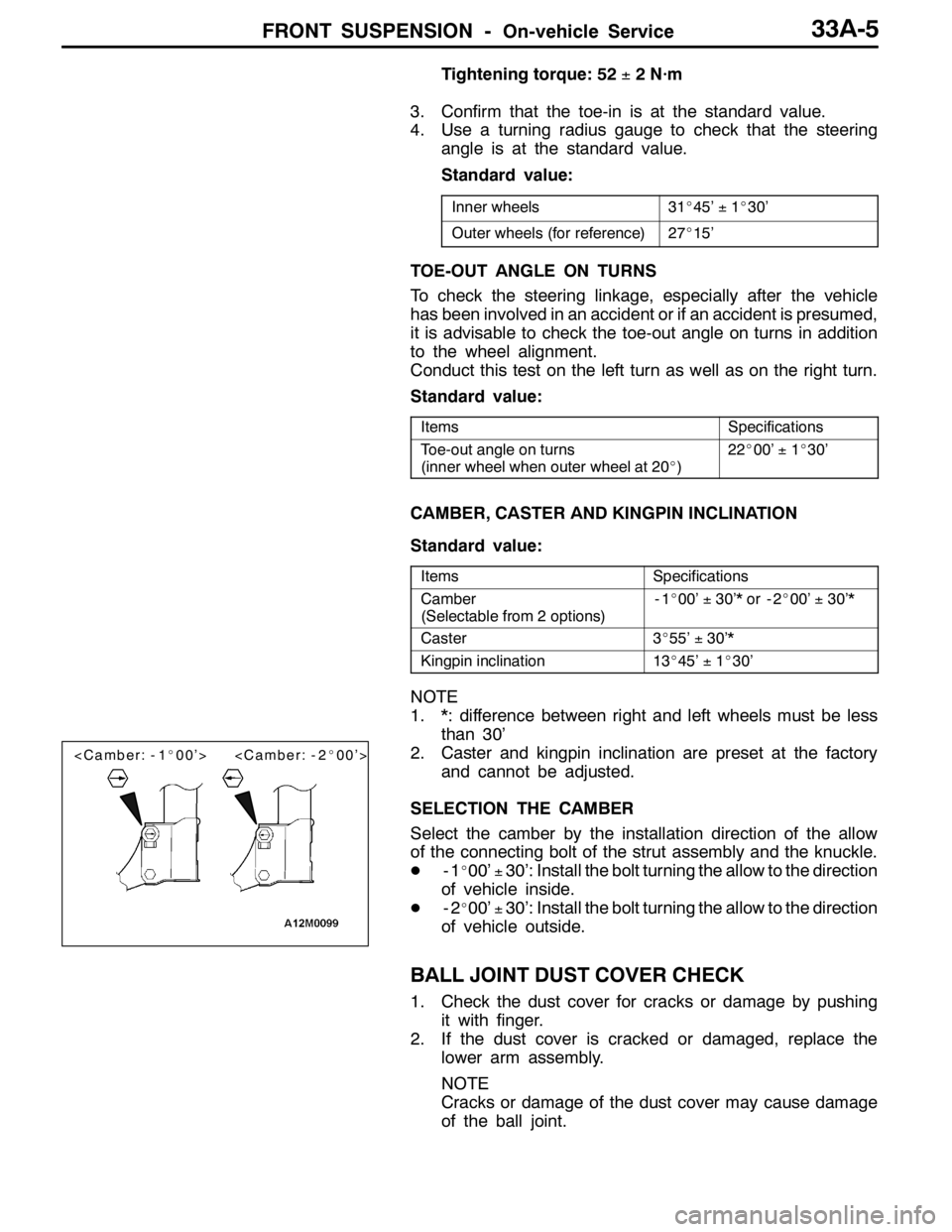
SELECTION THE CAMBER
Select the camber by the installation direction of the allow
of the connecting bolt of the strut assembly and the knuckle.
D-1
_00’±30’: Install the bolt turning the allow to the direction
of vehicle inside.
D-2
_00’±30’: Install the bolt turning the allow to the direction
of vehicle outside.
BALL JOINT DUST COVER CHECK
1. Check the dust cover for cracks or damage by pushing
it with finger.
2. If the dust cover is cracked or damaged, replace the
lower arm assembly.
NOTE
Cracks or damage of the dust cover may cause damage
of the ball joint.
Page 1051 of 1449
BASIC BRAKE SYSTEM -On-vehicle Service35A-9
CHECK VALVE OPERATION CHECK
1. Remove the vacuum hose. (Refer to P.35A-17.)
Caution
The check valve should not be disassembled from
the vacuum hose as they are united as one part.
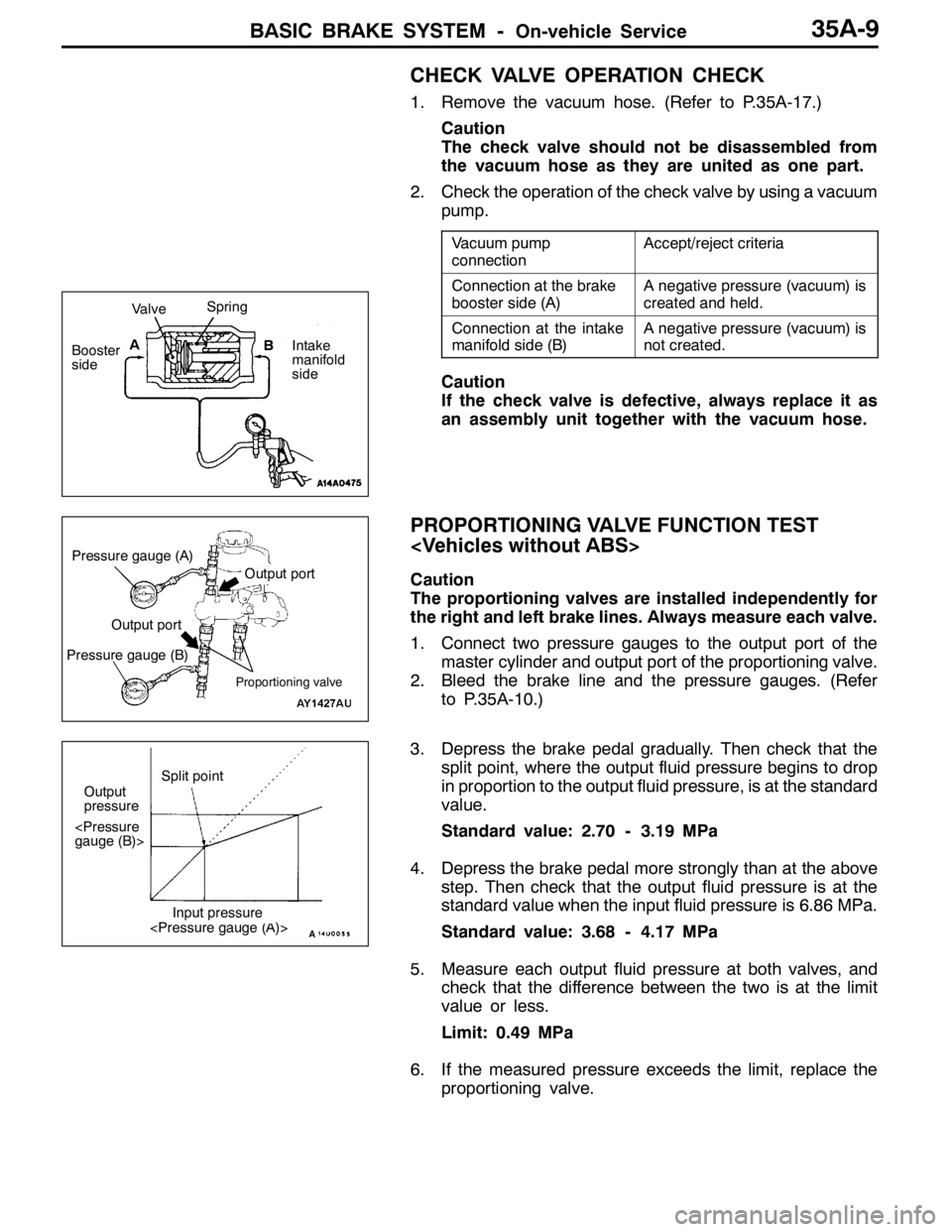
2. Check the operation of the check valve by using a vacuum
pump.
Vacuum pump
connectionAccept/reject criteria
Connection at the brake
booster side (A)A negative pressure (vacuum) is
created and held.
Connection at the intake
manifold side (B)A negative pressure (vacuum) is
not created.
Caution
If the check valve is defective, always replace it as
an assembly unit together with the vacuum hose.
PROPORTIONING VALVE FUNCTION TEST
Caution
The proportioning valves are installed independently for
the right and left brake lines. Always measure each valve.
1. Connect two pressure gauges to the output port of the
master cylinder and output port of the proportioning valve.
2. Bleed the brake line and the pressure gauges. (Refer
to P.35A-10.)
3. Depress the brake pedal gradually. Then check that the
split point, where the output fluid pressure begins to drop
in proportion to the output fluid pressure, is at the standard
value.
Standard value: 2.70 - 3.19 MPa
4. Depress the brake pedal more strongly than at the above
step. Then check that the output fluid pressure is at the
standard value when the input fluid pressure is 6.86 MPa.
Standard value: 3.68 - 4.17 MPa
5. Measure each output fluid pressure at both valves, and
check that the difference between the two is at the limit
value or less.
Limit: 0.49 MPa
6. If the measured pressure exceeds the limit, replace the
proportioning valve.
ValveSpring
Booster
sideA
B
Intake
manifold
side
Pressure gauge (A)
Proportioning valve
Output port
Output port
Pressure gauge (B)
Output
pressureSplit point
Page 1075 of 1449
ABS <4WD> -Troubleshooting35B-5
ABS WARNING LAMP INSPECTION
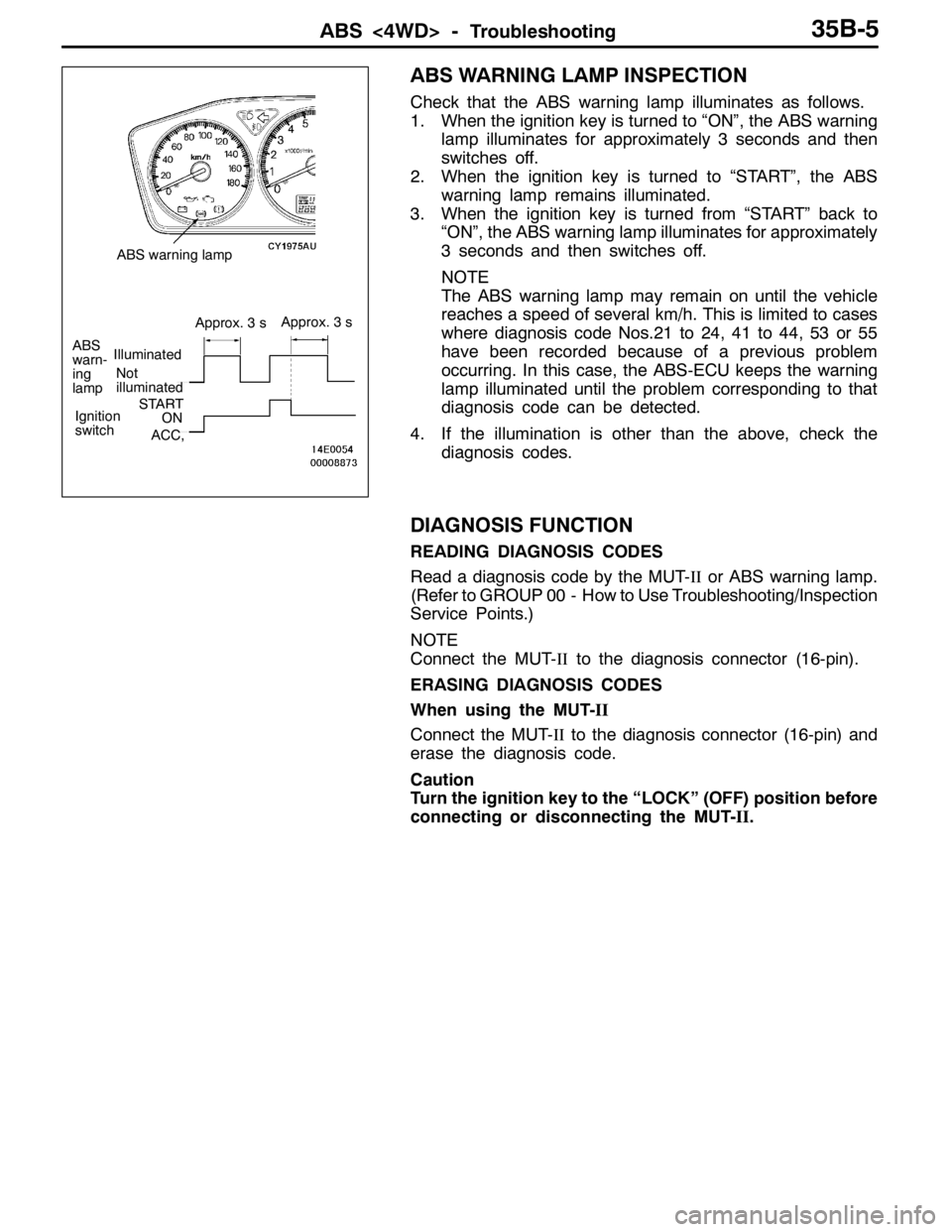
Check that the ABS warning lamp illuminates as follows.
1. When the ignition key is turned to “ON”, the ABS warning
lamp illuminates for approximately 3 seconds and then
switches off.
2. When the ignition key is turned to “START”, the ABS
warning lamp remains illuminated.
3. When the ignition key is turned from “START” back to
“ON”, the ABS warning lamp illuminates for approximately
3 seconds and then switches off.
NOTE
The ABS warning lamp may remain on until the vehicle
reaches a speed of several km/h. This is limited to cases
where diagnosis code Nos.21 to 24, 41 to 44, 53 or 55
have been recorded because of a previous problem
occurring. In this case, the ABS-ECU keeps the warning
lamp illuminated until the problem corresponding to that
diagnosis code can be detected.
4. If the illumination is other than the above, check the
diagnosis codes.
DIAGNOSIS FUNCTION
READING DIAGNOSIS CODES
Read a diagnosis code by the MUT-IIor ABS warning lamp.
(Refer to GROUP 00 - How to Use Troubleshooting/Inspection
Service Points.)
NOTE
Connect the MUT-IIto the diagnosis connector (16-pin).
ERASING DIAGNOSIS CODES
When using the MUT-II
Connect the MUT-IIto the diagnosis connector (16-pin) and
erase the diagnosis code.
Caution
Turn the ignition key to the “LOCK” (OFF) position before
connecting or disconnecting the MUT-II.
Not
illuminated
ABS
warn-
ing
lampIlluminated
Approx. 3 sApprox. 3 s
Ignition
switchSTARTON
ACC,
ABS warning lamp
Page 1077 of 1449

ABS <4WD> -Troubleshooting35B-7
INSPECTION CHART FOR DIAGNOSIS CODES
Diagnosis code No.Inspection itemReference page
11Front right wheel speed sensor (Open circuit or short circuit)35B-9
12Front left wheel speed sensor (Open circuit or short circuit)
13Rear right wheel speed sensor (Open circuit or short circuit)
14Rear left wheel speed sensor (Open circuit or short circuit)
16*ABS-ECU power supply system (Abnormal voltage drop or rise)35B-10
21Front right wheel speed sensor35B-9
22Front left wheel speed sensor
23Rear right wheel speed sensor
24Rear left wheel speed sensor
32Longitudinal G sensor system35B-11
41Front right solenoid valveThe diagnosis codes are output
whenthereisnoresponsetothe
35B-12
42Front left solenoid valve
whenthereis no responsetothe
drive signals for respective solenoid
valvesortheABS ECUpower43Rear right solenoid valvevalves or theABS-ECUpower
supply system is defective.
44Rear left solenoid valve
51Valve relay problem (stays on)35B-30, 31
(Replace the
hydraulic unit and
ABS-ECU.)
52Valve relay problem (stays off) or ABS-ECU power supply system
problem35B-12
53Motor relay problem (stays off) or ABS-ECU power supply system
problem
54Motor relay problem (stays on)35B-30, 31
(Replace the
hydraulic unit and
ABS-ECU.)
55Motor system (seized pump motor) or ABS-ECU power supply system
problem35B-12
63ABS-ECU35B-30, 31
(Replace the
hydraulic unit and
ABS-ECU.)
71Lateral G sensor system35B-13
Page 1115 of 1449

37A-1
STEERING
CONTENTS
GENERAL INFORMATION 2..................
SERVICE SPECIFICATIONS 4.................
LUBRICANTS 4..............................
SEALANT 4..................................
SPECIAL TOOLS 4...........................
ON-VEHICLE SERVICE 7.....................
Steering Wheel Free Play Check 7..............
Steering Angle Check 7........................
Tie Rod End Ball Joint Turning Torque Check 7..
Stationary Steering Effort Check 8...............
Checking Steering Wheel Return to Centre 8.....
Drive Belt Tension Check 8.....................Power Steering Fluid Level Check 9.............
Power Steering Fluid Replacement 9.............
Power Steering System Bleeding 9..............
Oil Pump Pressure Test 10.....................
Power Steering Oil Pressure Switch Check 11....
Ball Joint Dust Cover Check 11.................
STEERING WHEEL* 12.......................
STEERING SHAFT* 14.......................
POWER STEERING GEAR BOX AND
LINKAGE* 16................................
POWER STEERING OIL PUMP 29............
POWER STEERING OIL HOSES 30...........
WARNINGS REGARDING SERVICING OF SUPPLEMENTAL RESTRAINT SYSTEM (SRS) EQUIPPED VEHICLES
WARNING!
(1) Improper service or maintenance of any component of the SRS, or any SRS-related component, can lead to personal
injury or death to service personnel (from inadvertent firing of the air bag) or to the driver and passenger (from rendering
the SRS inoperative).
(2) Service or maintenance of any SRS component or SRS-related component must be performed only at an authorized
MITSUBISHI dealer.
(3) MITSUBISHI dealer personnel must thoroughly review this manual, and especially its GROUP 52B - Supplemental
Restraint System (SRS) before beginning any service or maintenance of any component of the SRS or any SRS-related
component.
NOTE
The SRS includes the following components: SRS-ECU, SRS warning lamp, air bag module, clock spring and interconnecting
wiring. Other SRS-related components (that may have to be removed/installed in connection with SRS service or maintenance) are
indicated in the table of contents by an asterisk (*).