Drain MITSUBISHI LANCER EVOLUTION 2007 Service Workshop Manual
[x] Cancel search | Manufacturer: MITSUBISHI, Model Year: 2007, Model line: LANCER EVOLUTION, Model: MITSUBISHI LANCER EVOLUTION 2007Pages: 1449, PDF Size: 56.82 MB
Page 1143 of 1449

STEERING - Power Steering Oil Pump37A-29
POWER STEERING OIL PUMP
REMOVAL AND INSTALLATION
Caution
After temporary tightening all bolts in * part, tighten in specific torque.
Pre-removal Operation
Power Steering Fluid Draining (Refer to P.37A-9.)Post-installation Operation
DPower Steering Fluid Supplying and Bleeding
(Refer to P.37A-9.)
DDrive Belt Tension Adjusting
(Refer to GROUP 11A – On-vehicle Service.)
22±4 N·m
8
40±5 N·m 18±3 N·m
3
45
2
5
22±4 N·m*
1 7
6
40±5 N·m* 22±4 N·m
Removal steps
1. Pressure switch connector
2. Drive belt (Refer to GROUP 11A.)
"BA3. Suction hose connection
"BA4. Pressure hose connection"AA5. O ring
6. Heat protecter
7. Oil pump assembly
8. Power steering pump bracket
INSTALLATION SERVICE POINTS
"AAO-RING INSTALLATION
No.ID×Width mm
111.0×1.9
213.0×1.9
21
Page 1145 of 1449
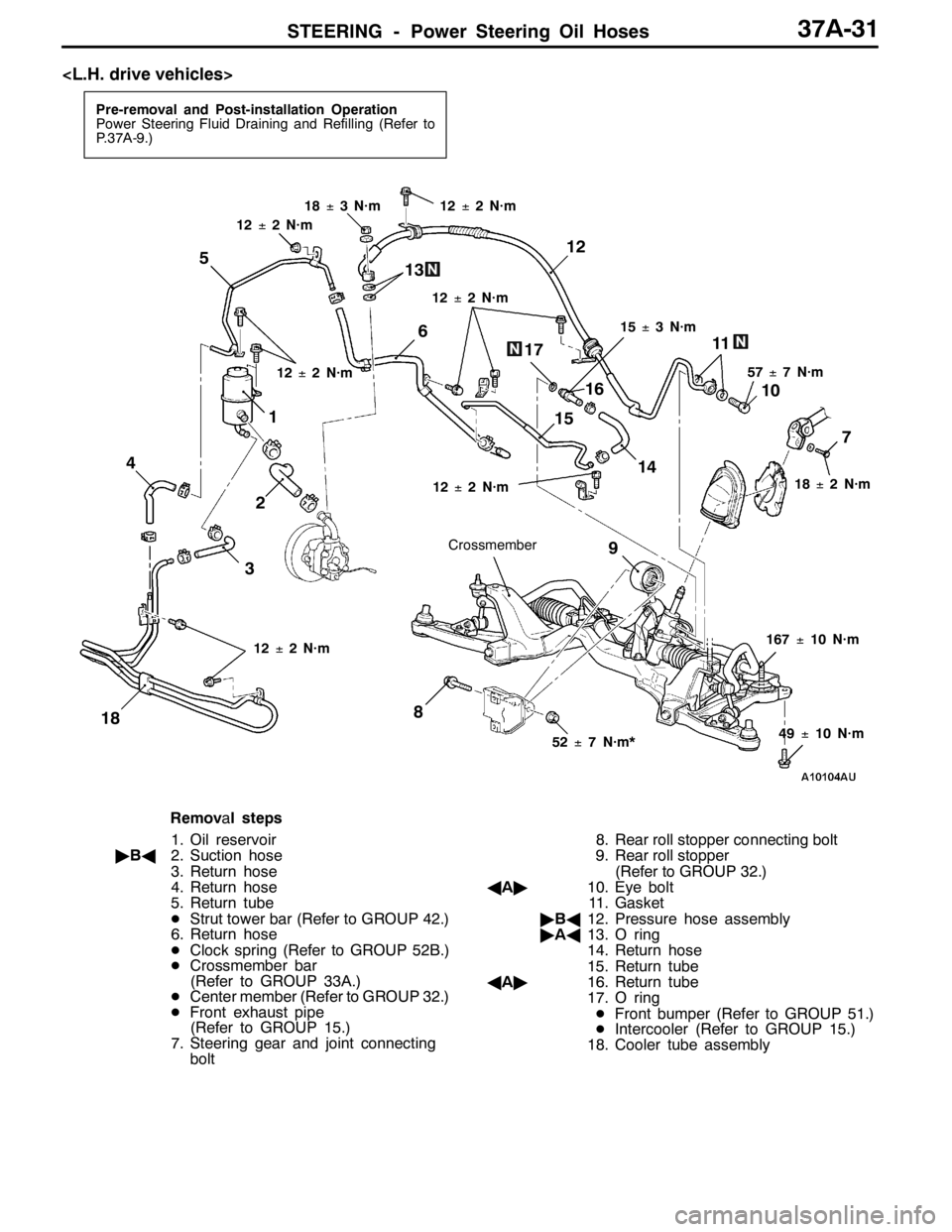
STEERING - Power Steering Oil Hoses37A-31
Pre-removal and Post-installation Operation
Power Steering Fluid Draining and Refilling (Refer to
P.37A-9.)
12±2 N·m
17
16
15
12
18±3 N·m
Crossmember
1
57±7 N·m
9
8 47
32 5
12±2 N·m15±3 N·m
18±2 N·m 12±2 N·m
49±10 N·m
52±7 N·m*
12±2 N·m
6
10
11
167±10 N·m
14 13
18
12±2 N·m
12±2 N·m
Removal steps
1. Oil reservoir
"BA2. Suction hose
3. Return hose
4. Return hose
5. Return tube
DStrut tower bar (Refer to GROUP 42.)
6. Return hose
DClock spring (Refer to GROUP 52B.)
DCrossmember bar
(Refer to GROUP 33A.)
DCenter member (Refer to GROUP 32.)
DFront exhaust pipe
(Refer to GROUP 15.)
7. Steering gear and joint connecting
bolt8. Rear roll stopper connecting bolt
9. Rear roll stopper
(Refer to GROUP 32.)
AA"10. Eye bolt
11. Gasket
"BA12. Pressure hose assembly
"AA13. O ring
14. Return hose
15. Return tube
AA"16. Return tube
17. O ring
DFront bumper (Refer to GROUP 51.)
DIntercooler (Refer to GROUP 15.)
18. Cooler tube assembly
Page 1146 of 1449
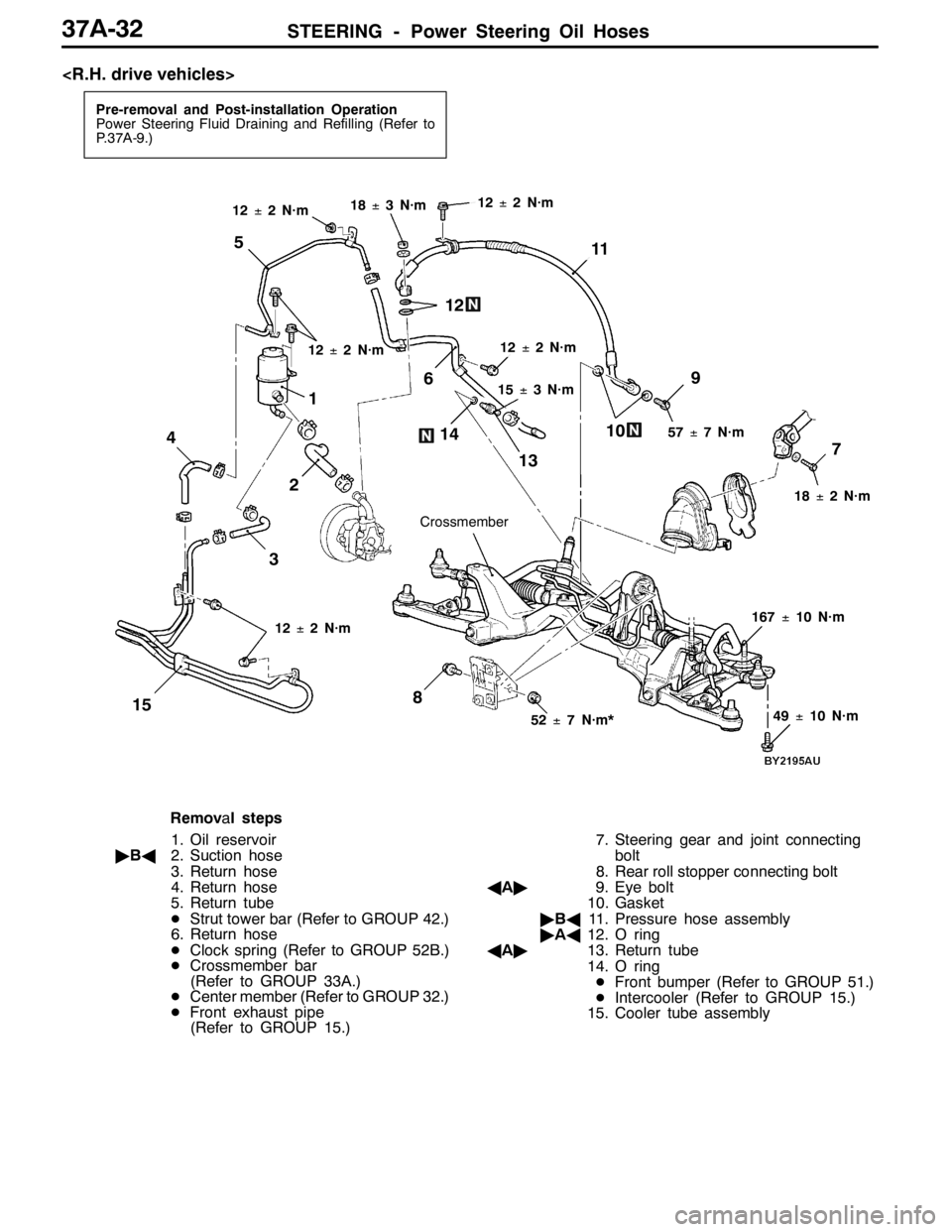
STEERING - Power Steering Oil Hoses37A-32
Pre-removal and Post-installation Operation
Power Steering Fluid Draining and Refilling (Refer to
P.37A-9.)
12±2 N·m
15
12
18±3 N·m
Crossmember
1
57±7 N·m
9
8 4
7
32 5
12±2 N·m
15±3 N·m
18±2 N·m 12±2 N·m
49±10 N·m
52±7 N·m*
12±2 N·m
6
10
11
167±10 N·m
14
13
12±2 N·m
Removal steps
1. Oil reservoir
"BA2. Suction hose
3. Return hose
4. Return hose
5. Return tube
DStrut tower bar (Refer to GROUP 42.)
6. Return hose
DClock spring (Refer to GROUP 52B.)
DCrossmember bar
(Refer to GROUP 33A.)
DCenter member (Refer to GROUP 32.)
DFront exhaust pipe
(Refer to GROUP 15.)7. Steering gear and joint connecting
bolt
8. Rear roll stopper connecting bolt
AA"9. Eye bolt
10. Gasket
"BA11. Pressure hose assembly
"AA12. O ring
AA"13. Return tube
14. O ring
DFront bumper (Refer to GROUP 51.)
DIntercooler (Refer to GROUP 15.)
15. Cooler tube assembly
Page 1341 of 1449

CHASSIS ELECTRICAL -Combination Meter54A-21
FLOAT HEIGHT OF FUEL GAUGE UNIT
When float is moved to contact float arm on stopper,
ensure that Position F (A) and E (B) are within standard
value.
Standard Value:
FloatPositionMainfuelgaugeunitSubfuelgaugeunitFloatPositionMainfuelgaugeunitSubfuelgaugeunit
Position F (A)33.3 mm10.7 mm
Position E (B)121.9 mm138.6 mm
ENGINE COOLANT TEMPERATURE GAUGE
UNIT CHECK
1. Drain coolant. (Refer to GROUP 14 - On-vehicle Service)
2. Remove water temperature gauge unit.
3. Put water temperature gauge unit into the hot water in
specified temperature, and ensure that basic resistance
is within standard value.
Standard value: 70_C 104±13.5Ω
Reference value:
TemperatureResistanceΩ
50_C230
60_C155
80_C73
4. After inspection, apply specified sealant at threads of
water temperature gauge unit, and tighten to the specified
torque.
Semi-drying sealant: 3M ATD Part No.1215 or
equivalent
5. Refill coolant. (Refer to GROUP 14 - On-vehicle Service.)
Main fuel gauge unit
Sub fuel gauge unit
A
B
A
B
ThermometerCircuit tester
11±1 N·m
Page 1416 of 1449

HEATER, AIR CONDITIONER AND VENTILATION–On-vehicle Service55-14
ON-VEHICLE SERVICE
REFRIGERANT LEVEL TEST THROUGH
PERFORMANCE TEST
1. Start the engine.
2. Turn on the A/C switch, and set the A/C control to MAX.
COOL.
3. Adjust the engine speed to 1,500 r/min.
4. Check the refrigerant level (bubble state) through the
sight glass.
ItemState
Insufficient refriger-
antMany bubbles are seen. If refrigerant
is extremely low, it appears white.
Sufficient or excess
refrigerantNo bubbles are seen
NOTE
1. If insufficient, replenish the refrigerant as follows.
a) Replenish until bubbles disappear from the sight
glass.
b) After the bubbles disappear from the sight glass,
replenish 100g of refrigerant.
2. If excessive, replenish the refrigerant as follows.
a) Drain the refrigerant until bubbles can be seen
through the sight glass.
b) Replenish until bubbles disappear from the sight
glass.
c) After the bubbles disappear from the sight glass,
replenish 100g of refrigerant.
MAGNETIC CLUTCH TEST
1. Disconnect the connector to the magnetic clutch.
2. Connect battery (+) voltage directly to the connector for
the magnetic clutch.
3. If the magnetic clutch is normal, there will be ”click”. If
the pulley and armature do not make contact (’click’),
there is a malfunction.
RECEIVER DRIER TEST
Operate the unit and check the piping temperature by touching
the receiver drier outlet and inlet.
If there is a difference in the temperatures, the receiver drier
is restricted.
Replace the receiver drier.
Insufficient
refrigerantSufficient or excess
refrigerant
Bubbles
Page 1430 of 1449
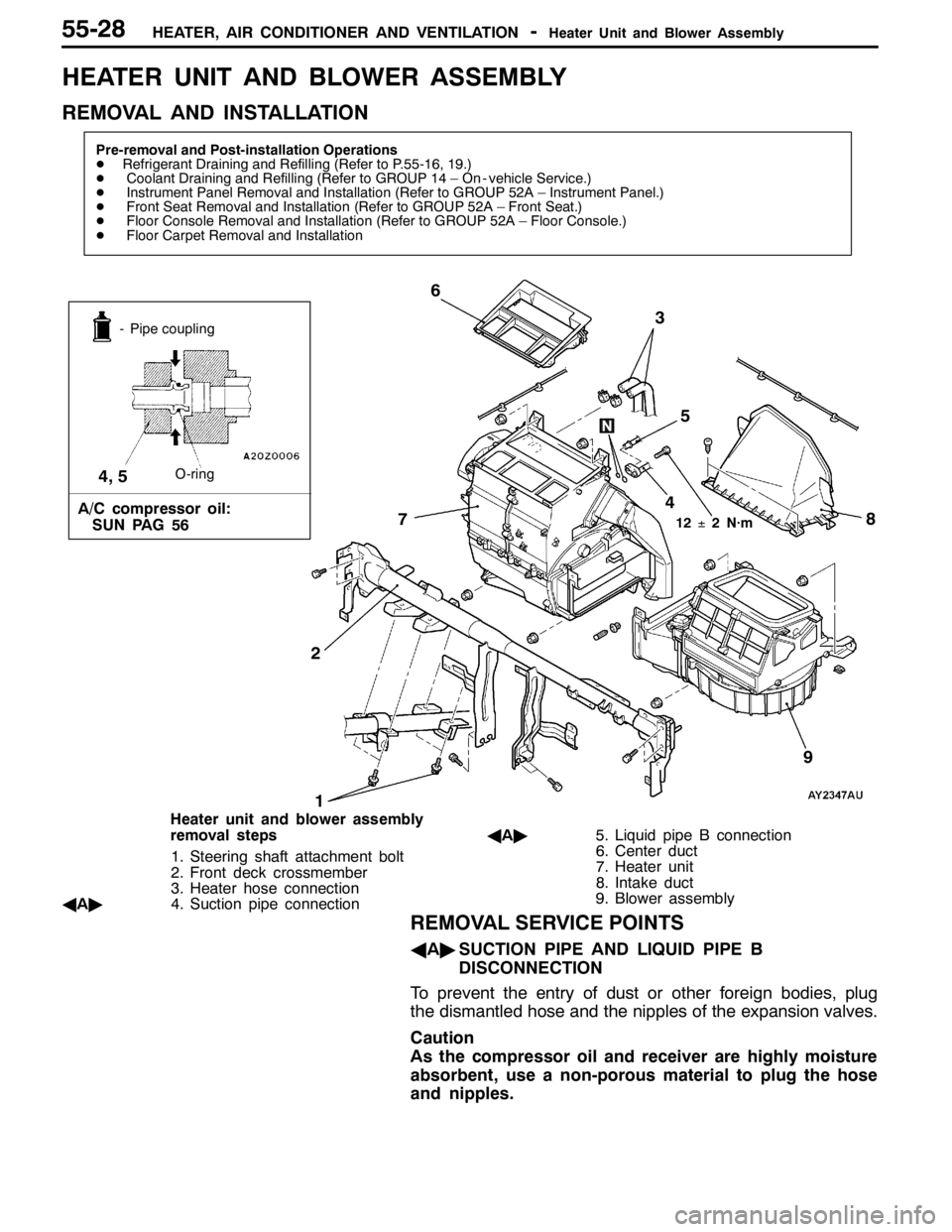
HEATER, AIR CONDITIONER AND VENTILATION-Heater Unit and Blower Assembly55-28
HEATER UNIT AND BLOWER ASSEMBLY
REMOVAL AND INSTALLATION
Pre-removal and Post-installation Operations
DRefrigerant Draining and Refilling (Refer to P.55-16, 19.)
DCoolant Draining and Refilling (Refer to GROUP 14 – On - vehicle Service.)
DInstrument Panel Removal and Installation (Refer to GROUP 52A – Instrument Panel.)
DFront Seat Removal and Installation (Refer to GROUP 52A – Front Seat.)
DFloor Console Removal and Installation (Refer to GROUP 52A – Floor Console.)
DFloor Carpet Removal and Installation
13
5 6
2
12±2 N·m
- Pipe coupling
O-ring
A/C compressor oil:
SUN PAG 56
4, 5
9
7
4
8
Heater unit and blower assembly
removal steps
1. Steering shaft attachment bolt
2. Front deck crossmember
3. Heater hose connection
AA"4. Suction pipe connectionAA"5. Liquid pipe B connection
6. Center duct
7. Heater unit
8. Intake duct
9. Blower assembly
REMOVAL SERVICE POINTS
AA"SUCTION PIPE AND LIQUID PIPE B
DISCONNECTION
To prevent the entry of dust or other foreign bodies, plug
the dismantled hose and the nipples of the expansion valves.
Caution
As the compressor oil and receiver are highly moisture
absorbent, use a non-porous material to plug the hose
and nipples.
Page 1431 of 1449
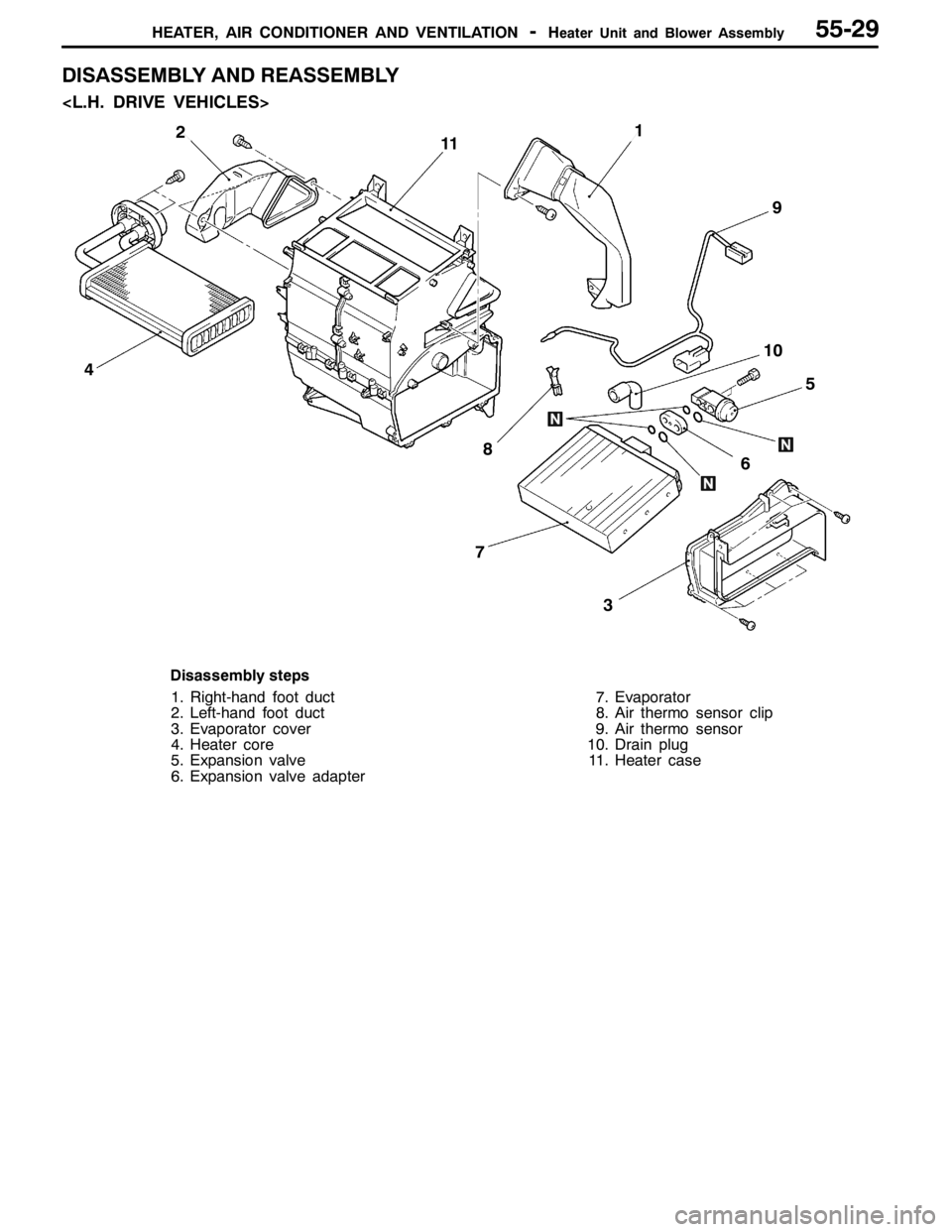
HEATER, AIR CONDITIONER AND VENTILATION-Heater Unit and Blower Assembly55-29
DISASSEMBLY AND REASSEMBLY
3 7
1
65 4
89
10211
Disassembly steps
1. Right-hand foot duct
2. Left-hand foot duct
3. Evaporator cover
4. Heater core
5. Expansion valve
6. Expansion valve adapter7. Evaporator
8. Air thermo sensor clip
9. Air thermo sensor
10. Drain plug
11. Heater case
Page 1432 of 1449

HEATER, AIR CONDITIONER AND VENTILATION-Heater Unit and Blower Assembly55-30
3
42
59
1
8 76
1011
12
Disassembly steps
1. Right-hand foot duct
2. Left-hand foot duct
3. Left-hand foot duct
4. Rear heater duct A upper LH
5. Evaporator cover6. Heater core
7. Expansion valve
8. Evaporator
9. Air thermo sensor clip
10. Air thermo sensor
11. Drain plug
12. Heater case
Page 1436 of 1449
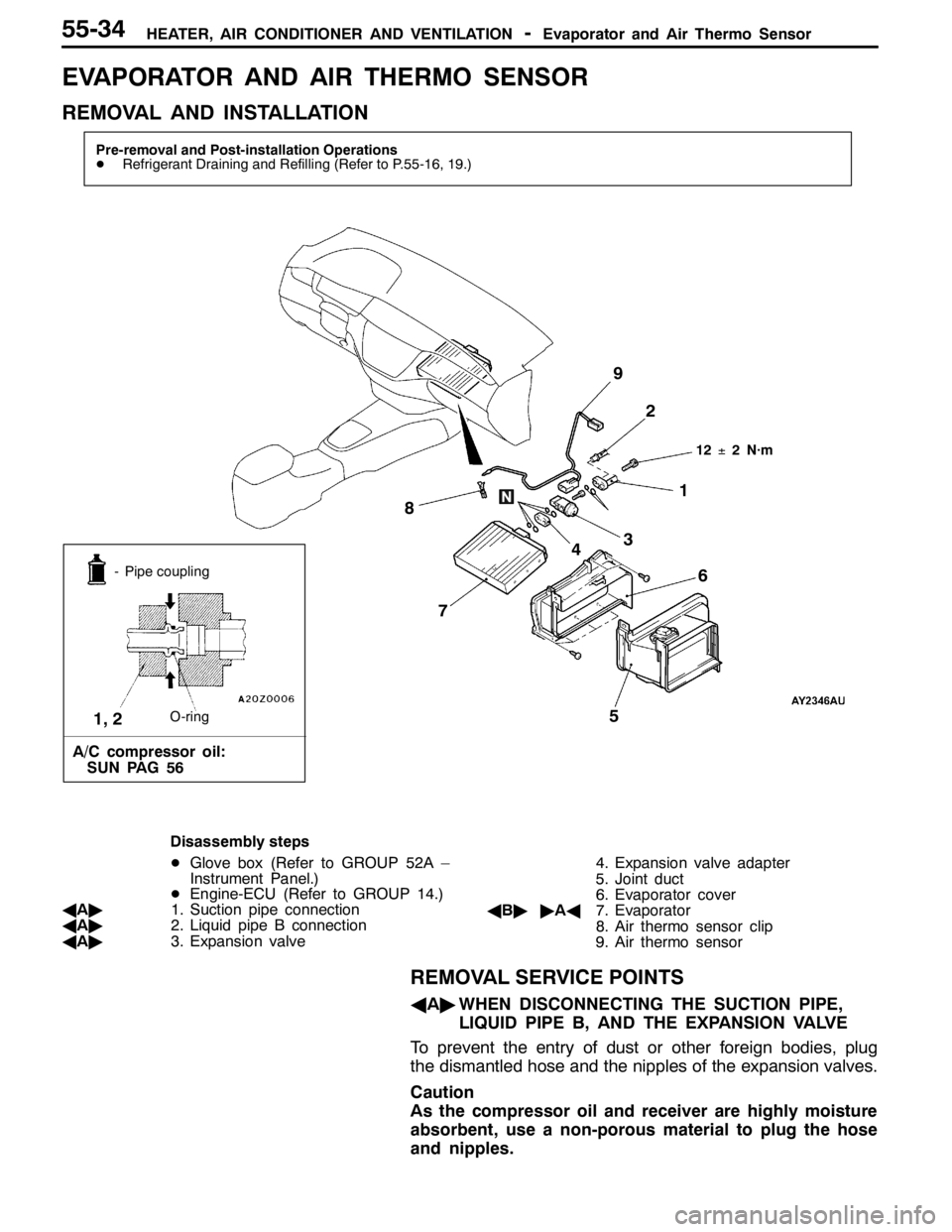
HEATER, AIR CONDITIONER AND VENTILATION-Evaporator and Air Thermo Sensor55-34
EVAPORATOR AND AIR THERMO SENSOR
REMOVAL AND INSTALLATION
Pre-removal and Post-installation Operations
DRefrigerant Draining and Refilling (Refer to P.55-16, 19.)
1 2
3
4
56
7 8
12±2 N·m
- Pipe coupling
O-ring
A/C compressor oil:
SUN PAG 56
1, 2
9
Disassembly steps
DGlove box (Refer to GROUP 52A –
Instrument Panel.)
DEngine-ECU (Refer to GROUP 14.)
AA"1. Suction pipe connection
AA"2. Liquid pipe B connection
AA"3. Expansion valve4. Expansion valve adapter
5. Joint duct
6. Evaporator cover
AB""AA7. Evaporator
8. Air thermo sensor clip
9. Air thermo sensor
REMOVAL SERVICE POINTS
AA"WHEN DISCONNECTING THE SUCTION PIPE,
LIQUID PIPE B, AND THE EXPANSION VALVE
To prevent the entry of dust or other foreign bodies, plug
the dismantled hose and the nipples of the expansion valves.
Caution
As the compressor oil and receiver are highly moisture
absorbent, use a non-porous material to plug the hose
and nipples.
Page 1438 of 1449
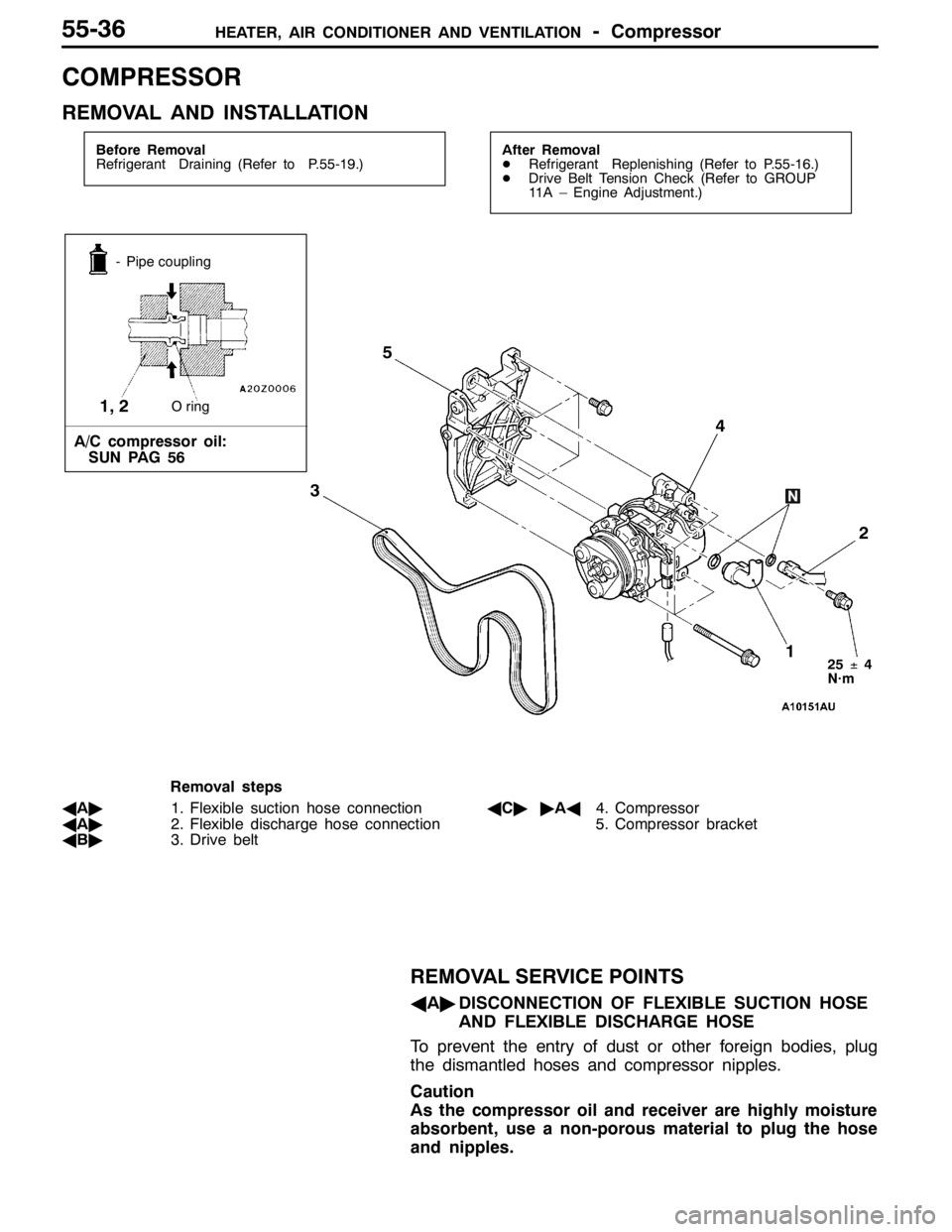
HEATER, AIR CONDITIONER AND VENTILATION-Compressor55-36
COMPRESSOR
REMOVAL AND INSTALLATION
Before Removal
Refrigerant Draining (Refer to P.55-19.)After Removal
DRefrigerant Replenishing (Refer to P.55-16.)
DDrive Belt Tension Check (Refer to GROUP
11A – Engine Adjustment.)
25±4
N·m
2 4
1
- Pipe coupling
O ring
A/C compressor oil:
SUN PAG 56
1, 2
5
3
Removal steps
AA"1. Flexible suction hose connection
AA"2. Flexible discharge hose connection
AB"3. Drive beltAC""AA4. Compressor
5. Compressor bracket
REMOVAL SERVICE POINTS
AA"DISCONNECTION OF FLEXIBLE SUCTION HOSE
AND FLEXIBLE DISCHARGE HOSE
To prevent the entry of dust or other foreign bodies, plug
the dismantled hoses and compressor nipples.
Caution
As the compressor oil and receiver are highly moisture
absorbent, use a non-porous material to plug the hose
and nipples.