charging MITSUBISHI LANCER EVOLUTION 2007 Service Repair Manual
[x] Cancel search | Manufacturer: MITSUBISHI, Model Year: 2007, Model line: LANCER EVOLUTION, Model: MITSUBISHI LANCER EVOLUTION 2007Pages: 1449, PDF Size: 56.82 MB
Page 96 of 1449

HOW TO READ THE WIRING DIAGRAMS -Abbreviation SymbolsA-10
ABBREVIATION SYMBOLS
The abbreviation symbols used in wiring diagrams are defined below.
1. Abbreviation symbols used for system name
Abbreviation
symbolsMeaningAbbreviation
symbolsMeaning
A/CAir conditionerEGRExhaust gas recirculation
ABSAnti-skid braking systemETACSElectronic time alarm control system
ACDActive center differentialSRSSupplemental restraint system
AY CActive yaw control
2. Abbreviation symbols used for combination meters
Abbreviation
symbolsMeaningAbbreviation
symbolsMeaning
ABSAnti-skid braking system warning lampSNOWActive center differential mode indicator
lamp
BEAMHigh beam indicator lampSPEEDSpeedmeter
BRAKEBrake warning lampSRSSupplemental restraint system warning
lamp
CHECK
ENGINECheck engine warning lampTARMACActive center differential mode indicator
lamp
CHGCharging warning lampT/GAEngine coolant temperature gauge
DOORDoor-ajar warning lampTACHOTachometer
F/GAFuel gaugeTAILTail, position and licence plate indicator
lamp
FRONT FOGFront fog indicator lamp
lamp
FUELLow fuel warning lampTRIPTripmeter
GRAVELActive center differential mode indicator
lampTURN (LH)Turn signal indicator lamp (LH)
ODOOdometerTURN (RH)Trun signal indicator lamp (RH)
OILOil pressure warning lampWATER
SPRAY
Intercooler water spray indicator lamp
REAR FOGRear fog indicator lamp
SPRAY
3. Abbreviation symbols used for switched and relay
Name of switches and
relaysAbbreviation
symbolsOperation
Blower switchLOBlower operates at low speed
MLBlower operates at medium low speed
MHBlower operates at medium high speed
HIBlower operates at high speed
Page 100 of 1449

B-2
S
PWGEE
IGNITION SYSTEM
L.H. drive vehicles 82.......................
R.H. drive vehicles 83.......................
CHARGING SYSTEM 84...................
ENGINE CONTROL SYSTEM
L.H. drive vehicles 86.......................
R.H. drive vehicles 94.......................
COOLING SYSTEM 102...................
HEADLAMP
L.H. drive vehicles 103......................
R.H. drive vehicles 106......................
TAIL LAMP, POSITION LAMP, LICENCE
PLATE LAMP AND LIGHTING MONITOR
BUZZER
L.H. drive vehicles 110......................
R.H. drive vehicles 114......................
ROOM LAMP AND LUGGAGE
COMPARTMENT LAMP
L.H. drive vehicles 118......................
R.H. drive vehicles 121......................
REAR FOG LAMP
L.H. drive vehicles 124......................
R.H. drive vehicles 127......................
HEADLAMP LEVELING SYSTEM
L.H. drive vehicles 130......................
R.H. drive vehicles 132......................
TURN-SIGNAL LAMP AND HAZARD
WARNING LAMP
L.H. drive vehicles 134......................
R.H. drive vehicles 138......................
BACK-UP LAMP
L.H. drive vehicles 142......................
R.H. drive vehicles 143......................
STOP LAMP
L.H. drive vehicles 144......................
R.H. drive vehicles 145......................
HORN 146................................
METER AND GAUGE
L.H. drive vehicles 148......................
R.H. drive vehicles 152......................
FUEL WARNING LAMP 156...............
OIL PRESSURE WARNING LAMP 157.....
BRAKE WARNING LAMP 157.............
POWER WINDOWS
L.H. drive vehicles 158......................
R.H. drive vehicles 164......................
CENTRAL DOOR LOCKING SYSTEM
L.H. drive vehicles 170......................
R.H. drive vehicles 172......................
HEATER AND MANUAL AIR CONDITIONER
L.H. drive vehicles 174......................
R.H. drive vehicles 180......................
DEFOGGER 185..........................
WINDSHIELD WIPER AND WASHER
L.H. drive vehicles 186......................
R.H. drive vehicles 189......................
REMOTE CONTROLLED MIRROR
L.H. drive vehicles 192......................
R.H. drive vehicles 193......................
CLOCK 194..............................
CIGARETTE LIGHTER AND ASHTRAY
ILLUMINATION LAMP 195.................
AUDIO SYSTEM 196......................
Page 182 of 1449

CIRCUIT DIAGRAMS
H1J04X04AA
B-84
CHARGING SYSTEM
Page 183 of 1449

CIRCUIT DIAGRAMSB-85
CHARGING SYSTEM (See P.B-84.)
OPERATION
When engine is stationary
DWhen the ignition switch is turned to the ON
position, current flows the alternator L terminal
and, at the same time, the charge warning lamp
illuminates.
When engine is started and after engine has
started
DWhen the engine is started, the charge warning
lamp goes out because of the charging voltage
begin applied to the alternator L terminal.
DThe battery voltage being applied to the
alternator S terminal is monitored by the voltage
regulator. Therefore, the amount of electricity
produced by the alternator is controlled by
allowing and cutting off the current flowing to
the field coil.
DThe alternator B terminal supplies power to
each load.TROUBLESHOOTING HINTS
1. Charging indicator lamp does not illuminate
when the ignition switch is turned to ON
position, before the engine starts.
DCheck multi-purpose fuse No.(2).
DCheck the bulb.
2. Charging indicator lamp fails to switch off once
the engine starts.
DCheck voltage regulator of alternator.
3. Discharged or overcharged battery.
DCheck voltage regulator of alternator.
4. Charge warning lamp illuminates dimly.
DCheck combination meter diode (for short).
Page 601 of 1449
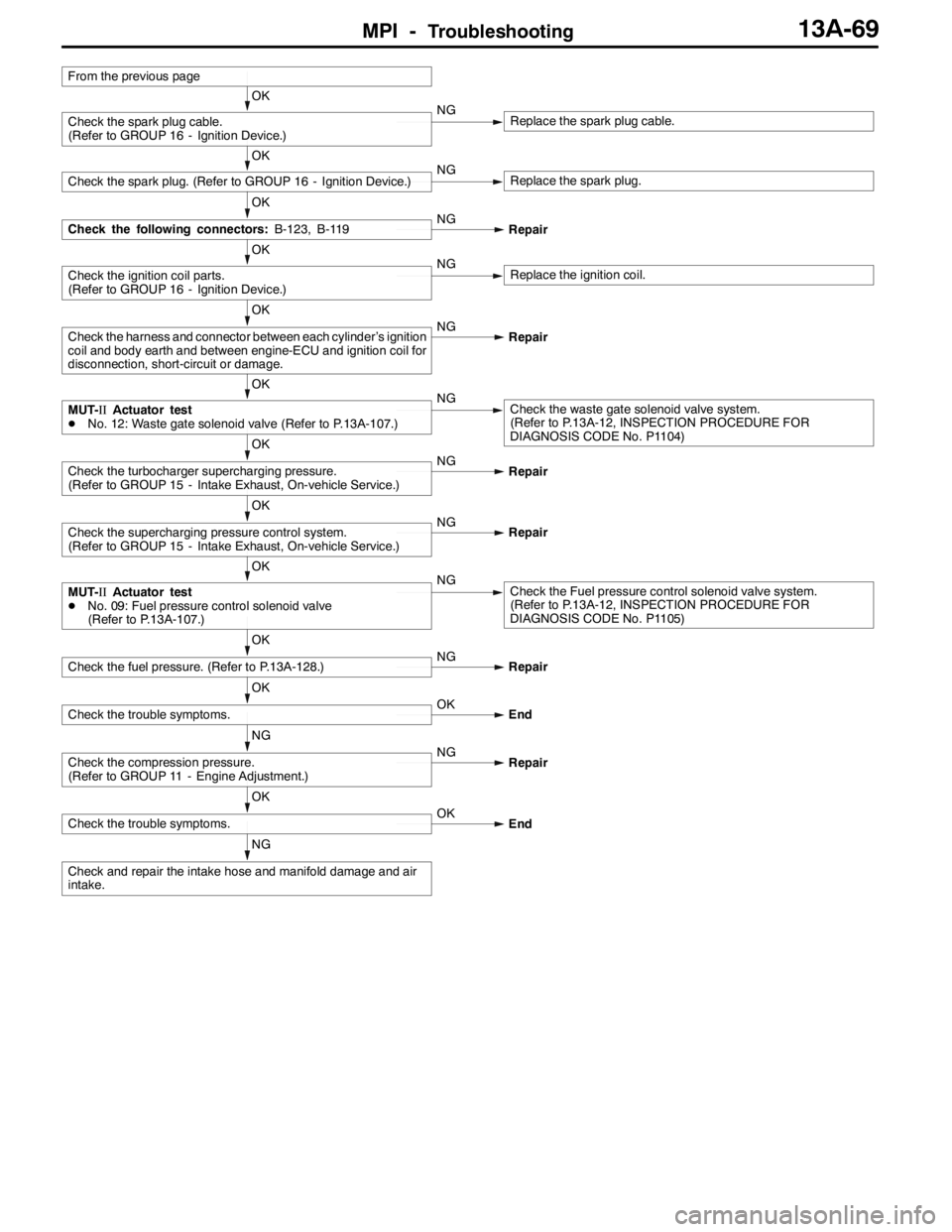
MPI -Troubleshooting13A-69
NG
Check and repair the intake hose and manifold damage and air
intake.
OK
Check the trouble symptoms.OK
End
NG
Check the compression pressure.
(Refer to GROUP 11 - Engine Adjustment.)NG
Repair
OK
Check the trouble symptoms.OK
End
OK
Check the fuel pressure. (Refer to P.13A-128.)NG
Repair
OK
MUT-IIActuator test
DNo. 09: Fuel pressure control solenoid valve
(Refer to P.13A-107.)NGCheck the Fuel pressure control solenoid valve system.
(Refer to P.13A-12, INSPECTION PROCEDURE FOR
DIAGNOSIS CODE No. P1105)
OK
Check the supercharging pressure control system.
(Refer to GROUP 15 - Intake Exhaust, On-vehicle Service.)NG
Repair
OK
Check the turbocharger supercharging pressure.
(Refer to GROUP 15 - Intake Exhaust, On-vehicle Service.)NG
Repair
OK
MUT-IIActuator test
DNo. 12: Waste gate solenoid valve (Refer to P.13A-107.)NGCheck the waste gate solenoid valve system.
(Refer to P.13A-12, INSPECTION PROCEDURE FOR
DIAGNOSIS CODE No. P1104)
OK
Check the harness and connector between each cylinder’s ignition
coil and body earth and between engine-ECU and ignition coil for
disconnection, short-circuit or damage.NG
Repair
OK
Check the ignition coil parts.
(Refer to GROUP 16 - Ignition Device.)NGReplace the ignition coil.
OK
Check the following connectors:B-123, B-119NG
Repair
OK
Check the spark plug. (Refer to GROUP 16 - Ignition Device.)NGReplace the spark plug.
OK
Check the spark plug cable.
(Refer to GROUP 16 - Ignition Device.)NGReplace the spark plug cable.
From the previous page
Page 610 of 1449
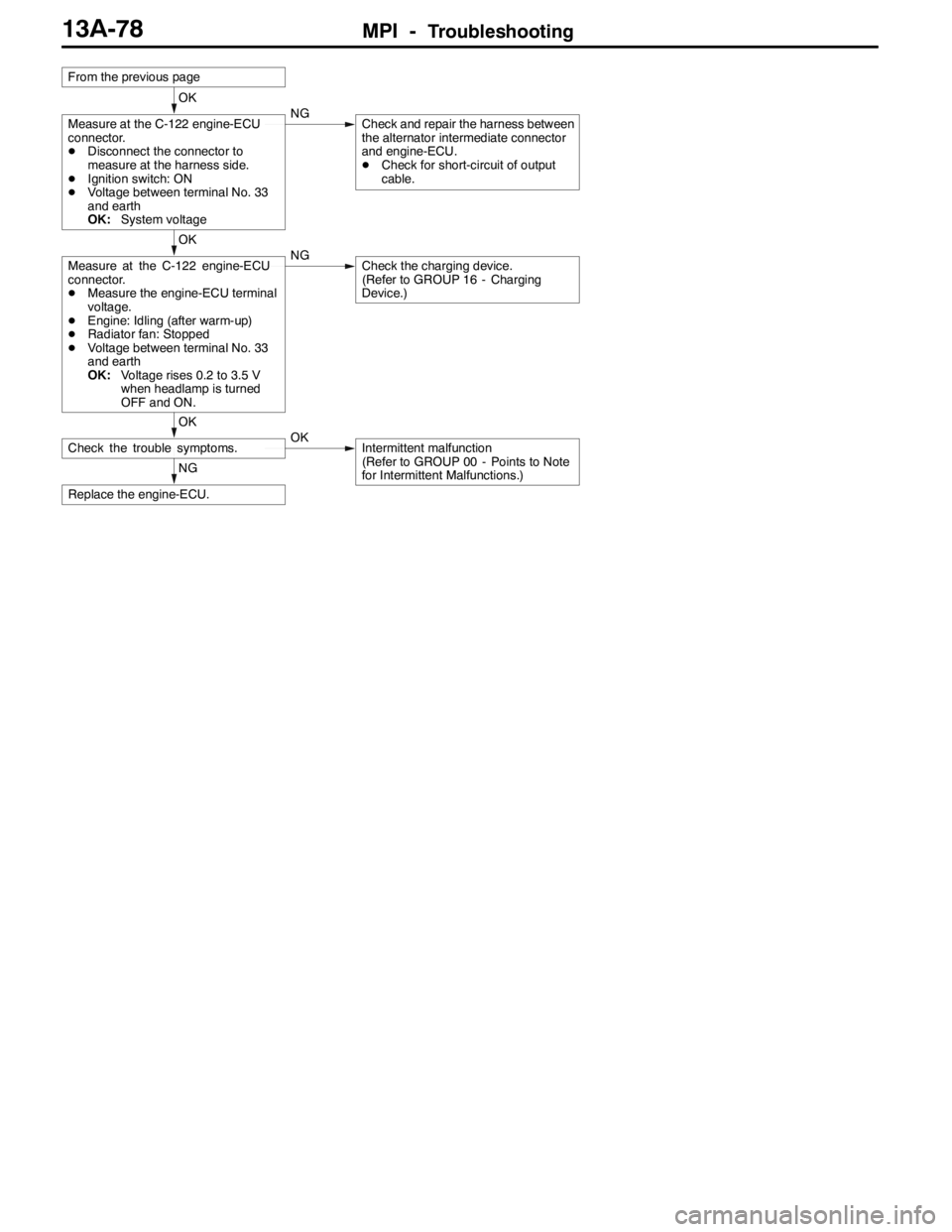
MPI -Troubleshooting13A-78
NG
Replace the engine-ECU.
OK
Check the trouble symptoms.OKIntermittent malfunction
(Refer to GROUP 00 - Points to Note
for Intermittent Malfunctions.)
OK
Measure at the C-122 engine-ECU
connector.
DMeasure the engine-ECU terminal
voltage.
DEngine: Idling (after warm-up)
DRadiator fan: Stopped
DVoltage between terminal No. 33
and earth
OK:Voltage rises 0.2 to 3.5 V
when headlamp is turned
OFF and ON.NGCheck the charging device.
(Refer to GROUP 16 - Charging
Device.)
OK
Measure at the C-122 engine-ECU
connector.
DDisconnect the connector to
measure at the harness side.
DIgnition switch: ON
DVoltage between terminal No. 33
and earth
OK:System voltageNGCheck and repair the harness between
the alternator intermediate connector
and engine-ECU.
DCheck for short-circuit of output
cable.
From the previous page
Page 707 of 1449

15-1
INTAKE AND
EXHAUST
CONTENTS
GENERAL INFORMATION 2..................
SERVICE SPECIFICATION 3..................
SPECIAL TOOL 3............................
ON-VEHICLE SERVICE 3.....................
Turbocharger Supercharging Pressure Check 3...
Supercharging Pressure Control System
Check 4.......................................
Waste Gate Actuator Check 4...................
Waste Gate Solenoid Valve Check 5.............
Air Bypass Valve Check 5......................
Intake Manifold Pressure Check 6...............
Secondary Air Control System Check 6..........
Secondary Air Control Solenoid Valve Check 6...
Secondary Air Valve Check 7...................Vacuum Tank Check 7.........................
AIR CLEANER 8.............................
INTERCOOLER 9............................
INTERCOOLER WATER SPRAY 10............
SECONDARY AIR SUPPLY SYSTEM 14.......
INTAKE MANIFOLD 16.......................
EXHAUST MANIFOLD 19.....................
TURBOCHARGER 22.........................
EXHAUST PIPE AND MAIN MUFFLER 26.....
CATALYTIC CONVERTER
(REFER TO GROUP 17.) ....................
Page 708 of 1449
INTAKE AND EXHAUST -General Information15-2
GENERAL INFORMATION
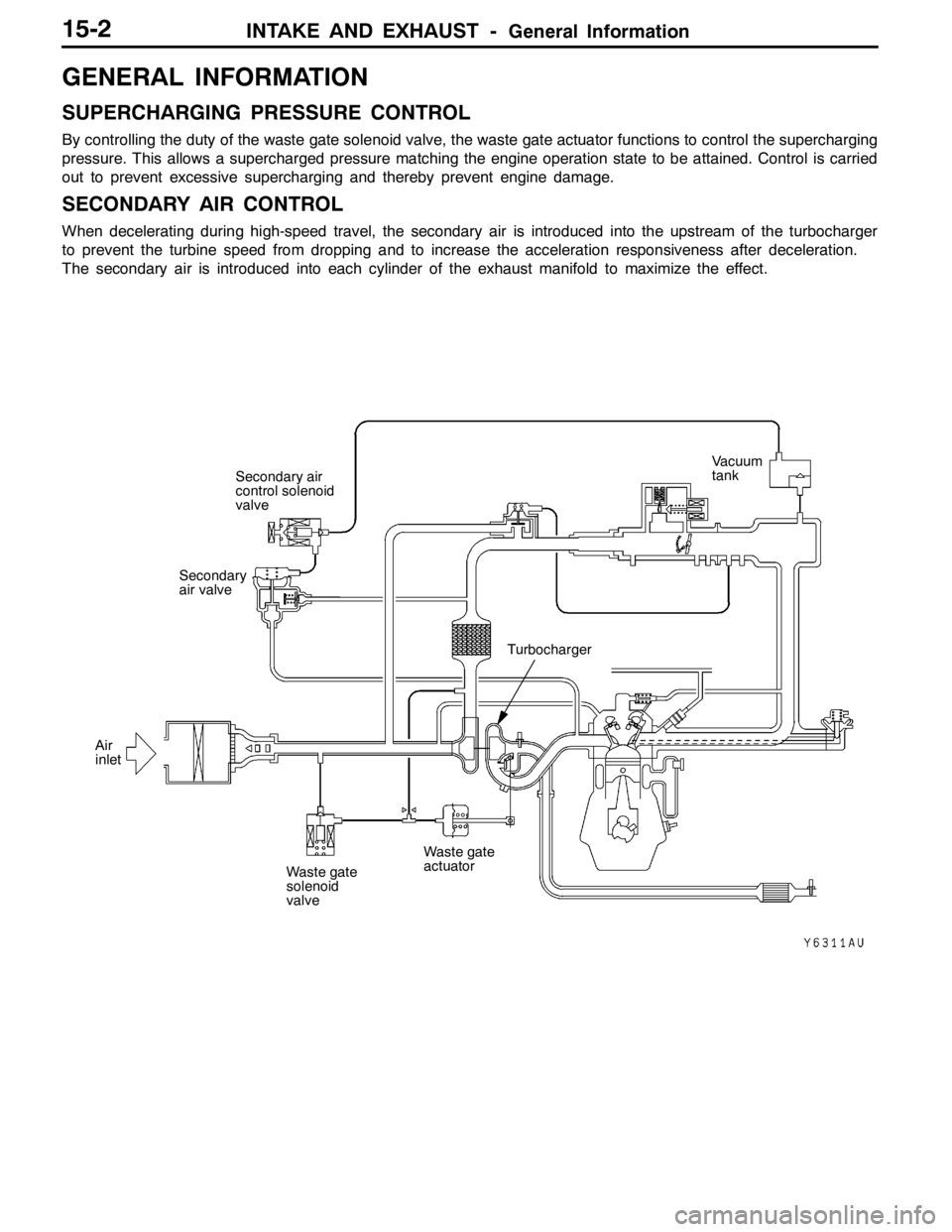
SUPERCHARGING PRESSURE CONTROL
By controlling the duty of the waste gate solenoid valve, the waste gate actuator functions to control the supercharging
pressure. This allows a supercharged pressure matching the engine operation state to be attained. Control is carried
out to prevent excessive supercharging and thereby prevent engine damage.
SECONDARY AIR CONTROL
When decelerating during high-speed travel, the secondary air is introduced into the upstream of the turbocharger
to prevent the turbine speed from dropping and to increase the acceleration responsiveness after deceleration.
The secondary air is introduced into each cylinder of the exhaust manifold to maximize the effect.
Secondary air
control solenoid
valve
Air
inletSecondary
air valve
Waste gate
solenoid
valve
Waste gate
actuator
TurbochargerVacuum
tank
Page 709 of 1449
INTAKE AND EXHAUST -Service Specifications/Special Tool/On-vehicle Service15-3
SERVICE SPECIFICATIONS
ItemStandard valueLimit
Turbocharger supercharging pressure (waste gate solenoid
valve not operating) kPa59 - 84-
Initial activation pressure of waste gate actuator (at the stroke
of approximately 1 mm) kPaApproximately 100-
Waste gate solenoid valve coil resistance (at 20_C)Ω29 - 35-
Initial activation pressure of air bypass valve kPaApproximately 53-
Secondary air control solenoid valve coil resistance
(at 20_C)Ω29 - 35-
Manifold distortion of the installation surface mm0.15 or less0.20
SPECIAL TOOL
ToolNumberNameUse
MD998770Oxygen sensor wrenchRemoval and installation of oxygen sensor
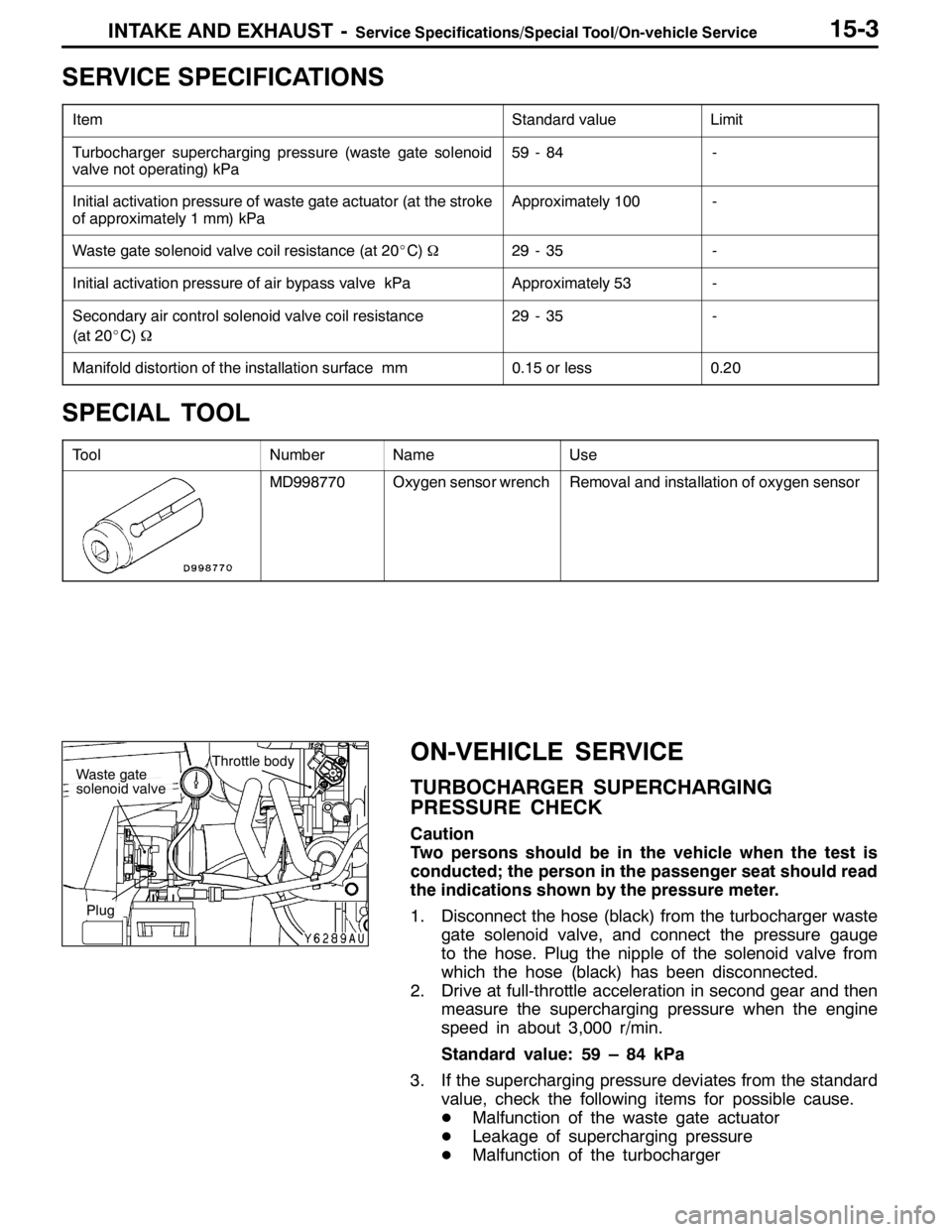
ON-VEHICLE SERVICE
TURBOCHARGER SUPERCHARGING
PRESSURE CHECK
Caution
Two persons should be in the vehicle when the test is
conducted; the person in the passenger seat should read
the indications shown by the pressure meter.
1. Disconnect the hose (black) from the turbocharger waste
gate solenoid valve, and connect the pressure gauge
to the hose. Plug the nipple of the solenoid valve from
which the hose (black) has been disconnected.
2. Drive at full-throttle acceleration in second gear and then
measure the supercharging pressure when the engine
speed in about 3,000 r/min.
Standard value: 59 – 84 kPa
3. If the supercharging pressure deviates from the standard
value, check the following items for possible cause.
DMalfunction of the waste gate actuator
DLeakage of supercharging pressure
DMalfunction of the turbocharger
Throttle bodyWaste gate
solenoid valve
Plug
Page 710 of 1449
INTAKE AND EXHAUST -On-vehicle Service15-4
4. When the indicated supercharging is more than standard
value, supercharging control may be faulty, therefore
check the followings.
DMalfunction of the waste gate actuator
DMalfunction of waste gate valve
DDisconnection or cracks of the waste gate actuator
rubber hose
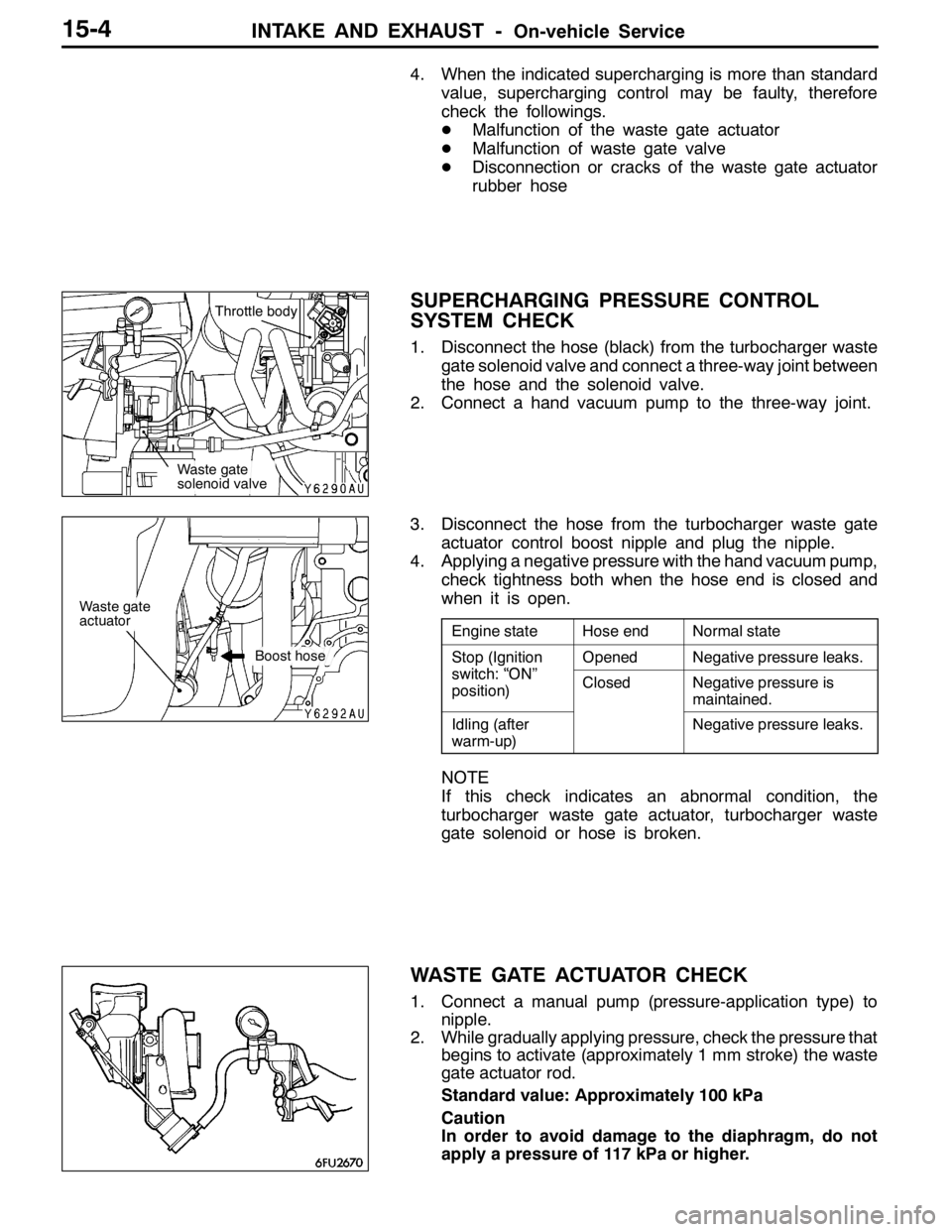
SUPERCHARGING PRESSURE CONTROL
SYSTEM CHECK
1. Disconnect the hose (black) from the turbocharger waste
gate solenoid valve and connect a three-way joint between
the hose and the solenoid valve.
2. Connect a hand vacuum pump to the three-way joint.
3. Disconnect the hose from the turbocharger waste gate
actuator control boost nipple and plug the nipple.
4. Applying a negative pressure with the hand vacuum pump,
check tightness both when the hose end is closed and
when it is open.
Engine stateHose endNormal state
Stop (Ignition
it h“ON”
OpenedNegative pressure leaks.p(g
switch: “ON”
position)ClosedNegative pressure is
maintained.
Idling (after
warm-up)Negative pressure leaks.
NOTE
If this check indicates an abnormal condition, the
turbocharger waste gate actuator, turbocharger waste
gate solenoid or hose is broken.
WASTE GATE ACTUATOR CHECK
1. Connect a manual pump (pressure-application type) to
nipple.
2. While gradually applying pressure, check the pressure that
begins to activate (approximately 1 mm stroke) the waste
gate actuator rod.
Standard value: Approximately 100 kPa
Caution
In order to avoid damage to the diaphragm, do not
apply a pressure of 117 kPa or higher.
Waste gate
solenoid valveThrottle body
Waste gate
actuator
Boost hose