brake light MITSUBISHI LANCER EVOLUTION 2014 10.G Owner's Guide
[x] Cancel search | Manufacturer: MITSUBISHI, Model Year: 2014, Model line: LANCER EVOLUTION, Model: MITSUBISHI LANCER EVOLUTION 2014 10.GPages: 338, PDF Size: 40.99 MB
Page 263 of 338
How to change a tire 8-6 For emergencies
8
N00836900763
Before changing a tire, first stop your vehicle in a safe, flat location. 1. Park the vehicle on level and stable ground. 2. Set the parking brake firmly.3. On vehicles with manual transaxle, turn the ignition switch to the “LOCK” posi- tion, and move the gearshift lever to the“R” (Reverse) position. On vehicles with Twin Clutch SST, move the gearshift lever to the “P” (PARK)position, and turn the ignition switch to the “LOCK” position. 4. Turn on the hazard flashers and set up awarning triangle, flashing signal light, etc., at an adequate distance from the vehicle, and have all your passengersleave the vehicle.
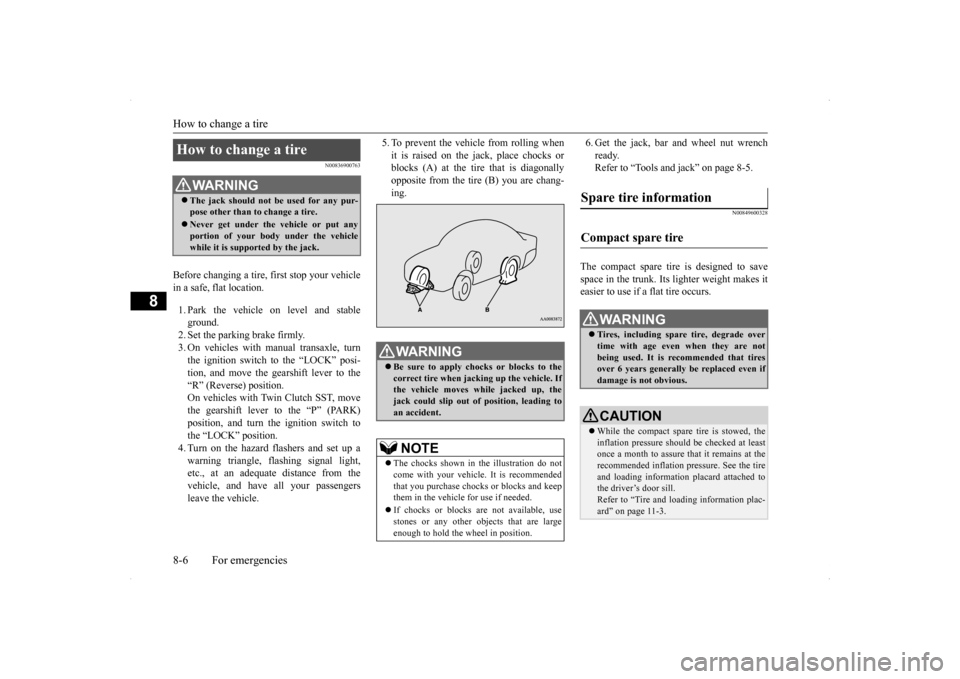
5. To prevent the vehicle from rolling when it is raised on the jack, place chocks or blocks (A) at the tire that is diagonally opposite from the tire (B) you are chang-ing.
6. Get the jack, bar and wheel nut wrench ready. Refer to “Tools and jack” on page 8-5.
N00849600328
The compact spare tire is designed to save space in the trunk. Its lighter weight makes it easier to use if a flat tire occurs.
How to change a tire
WA R N I N G The jack should not be used for any pur- pose other than to change a tire. Never get under the vehicle or put any portion of your body under the vehicle while it is supported by the jack.
WA R N I N G Be sure to apply chocks or blocks to the correct tire when jacking up the vehicle. Ifthe vehicle moves while jacked up, the jack could slip out of position, leading to an accident.NOTE
The chocks shown in the illustration do not come with your vehicle. It is recommended that you purchase chocks or blocks and keepthem in the vehicle for use if needed. If chocks or blocks are not available, use stones or any other objects that are large enough to hold the wheel in position.
Spare tire information Compact spare tire
WA R N I N G Tires, including spare tire, degrade over time with age even when they are notbeing used. It is recommended that tires over 6 years generally be replaced even if damage is not obvious.CAUTION While the compact spare tire is stowed, the inflation pressure should be checked at least once a month to assure that it remains at the recommended inflation pressure. See the tire and loading information placard attached tothe driver’s door sill. Refer to “Tire and loading information plac- ard” on page 11-3.
BK0200800US.bo
ok 6 ページ 2013年2月14日 木曜日 午後2時28分
Page 269 of 338
Operation under adverse driving conditions 8-12 For emergencies
8
N00837200691
If your vehicle becomes stuck in snow, sand, or mud, it can often be
moved by a rocking
motion. Rock your vehicle back and forth tofree it. Do not rev the engine or spin the wheels. Constant efforts to free a stuck vehicle cancause overheating and transaxle failure. Let the engine idle for a few minutes to cool the transaxle before trying again.If your vehicle is still stuck after several rock- ing attempts, call for a commercial tow truck service.
When driving on a road covered with snow or ice, use snow tires. Tire chains cannot be used on your vehicle. Theremay be state or local regulations about using snow tires. Always check the regu- lations in your local area before usingthem. Refer to the section entitled “Snow tires” on page 9-19
and “Tire chains” on
page 9-19. Drive slowly. Do not make sudden starts or stops, sharp turns, or slam on the brakes. Allow extra distance between your vehi- cle and the vehicle in front of you, and avoid sudden braking. If a skid occurs when the accelerator pedal is depressed, take your foot off the pedal. Steer gently in the direction of the skid. Your vehicle is equipped with an anti-lock braking system (ABS). Hold the brake pedal down firmly and keep it depressed.Do not pump the brake pedal which will result in reduced braking performance. After parking on snowy or icy road, it may be difficult to move your vehicle due to freeze-up of the brake. Depress the accelerator pedal little by little to movethe vehicle after confirming safety of the vehicle.
Do not tow all-wheel dr
ive vehicles with the
front or rear wheels on the ground (Type B or Type C) as illustrated. This could result in the driving system damage or vehicle may jump at the carriage.If you tow all-wheel drive vehicles, use Type D or Type E equipment.
Operation under adverse driving conditions If your vehicle becomes stuck in sand, mud or snow
CAUTION
WA R N I N G When trying to rock your vehicle out of a stuck position, make sure that there are no people nearby. The rocking motion can make your vehicle suddenly lurch forward or backward, and injure any bystanders.
On wet roads
CAUTION Avoid flooded roads. Water is often deeper than it looks, and you could be seriously hurt by driving into flood water. When driving in rain, on water-covered roads, or through a car wash, water could getinto the brake discs and make them fail tem- porarily. In such cases, lightly press the brake pedal to see if they are working prop-erly. If they are not, press the pedal lightly several times while driving to dry the brake pads or linings, then check them again. When driving in rain, a layer of water may form between the tires and the road surface(aquaplaning). This loosens your tires’ grip on the road, making it difficult to steer or brake properly. When driving on a wet road:• Drive your vehicle at a safe speed.• Do not drive on worn tires.• Always keep the tires at the correct infla- tion pressures.
On snowy or icy roads
BK0200800US.bo
ok 12 ページ 2013年2月14日 木曜日 午後2時28分
Page 272 of 338
9
Vehicle care and maintenanceService precautions ..........
.................................................................9-2
Catalytic converter .
.................................................
..........................9-2
Engine hood ...............................
.......................................................9-3
View of the engine co
mpartment ......................................................9-5
Engine oil and oil filt
er ...........................................
..........................9-5
Engine coolant .................
.................................................................9-7
Air cleaner filter.....
.................................................
..........................9-8
Manual transaxle oil (if so
equipped) ...............................................9-9
Twin Clutch Sportronic shift trans
mission (Twin Clutch SST) fluid (if
so equipped) ...........................
.......................................................9-9
Transfer oil.......................
.................................................................9-9
Rear axle oil .....................
.................................................................9-9
AWC control fluid ...........
.................................................................9-9
Washer fluid .....................
...............................................................9-10
Brake fluid/Clutch fluid (if
so equipped)........................................9-10
Power steering fluid
................................................
........................ 9-11
Battery........................................
..................................................... 9-11
Tires ...........................................
.....................................................9-12
Clutch pedal free play (if so equipped)...........................................9-19Brake pedal free play
..............................................
........................9-19
Parking brake lever stroke ..............................................................9-19 Parking brake break-in
............................................
........................9-20
Wiper blades ..............................
.....................................................9-20
Emission-control system maintenance ...........................................9-20 General maintenance
..............................................
........................9-21
For cold and snowy weat
her ..........................................................9-23
Fusible links .....................
...............................................................9-23
Fuses ..........................................
.....................................................9-23
Replacement of light bul
bs ....................................
......................... 9-28
Vehicle care precautions
........................................
......................... 9-40
Cleaning the inside of you
r vehicle ................................................ 9-40
Cleaning the outside of your
vehicle .............................................. 9-42
BK0200800US.bo
ok 1 ページ 2013年2月14日 木曜日 午後2時28分
Page 276 of 338
View of the engine compartment
Vehicle care and maintenance 9-5
9
Unlatch the prop from the engine hood and put it back in its retainer. Slowly lower the engine hood about 8 inches (20 cm), then let it drop from its own weight.
N00937600641
N00937701971
It is normal for an engi
ne to use oil. You may
need to add oil between the recommended oil change intervals. Before starting the engine,check the engine oil level. Refill if necessary. To check the oil level, remove the dipstick, wipe it off, and gently insert it all the way into the crankcase. Slowly remove it again.The oil level must not go above the line on the dipstick. If the level does not reach the line, which shows the smallest amount of oil required,remove the oil filler cap on the engine valve cover, and fill to with
in the “Good” range.
To close
CAUTIONBe careful not to trap your hands or fingers when closing the engine hood. Make sure the engine hood is firmly closed before driving.If you drive without the engine hood com- pletely closed, it could open up while driv- ing.NOTE
If this does not close the engine hood prop- erly, drop it again from a slightly higher position.
Do not push down strongly on the engine hood. Depending on how strongly or where you push down, you could create a dent in the vehicle body. If you drive with the engine hood left open, warning display is displayed on the informa- tion screen in the multi-information display.
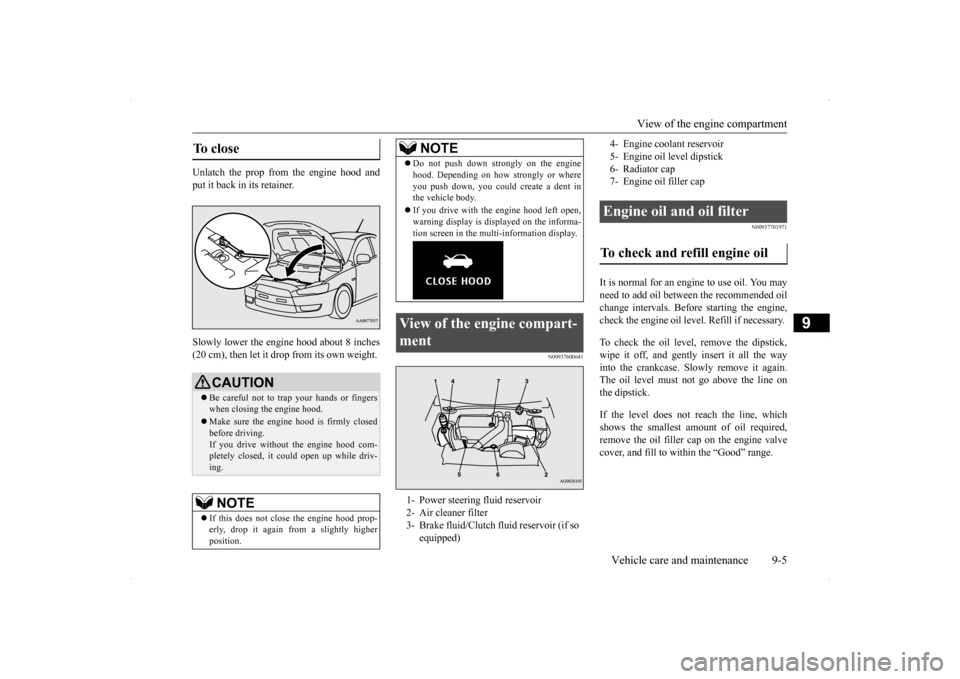
View of the engine compart- ment 1- Power steering fluid reservoir 2- Air cleaner filter 3- Brake fluid/Clutch fluid reservoir (if so
equipped)NOTE
4- Engine coolant reservoir 5- Engine oil level dipstick6- Radiator cap 7- Engine oil filler capEngine oil and oil filter To check and refill engine oil
BK0200800US.bo
ok 5 ページ 2013年2月14日 木曜日 午後2時28分
Page 281 of 338
Washer fluid 9-10 Vehicle care and maintenance
9
N00938600257
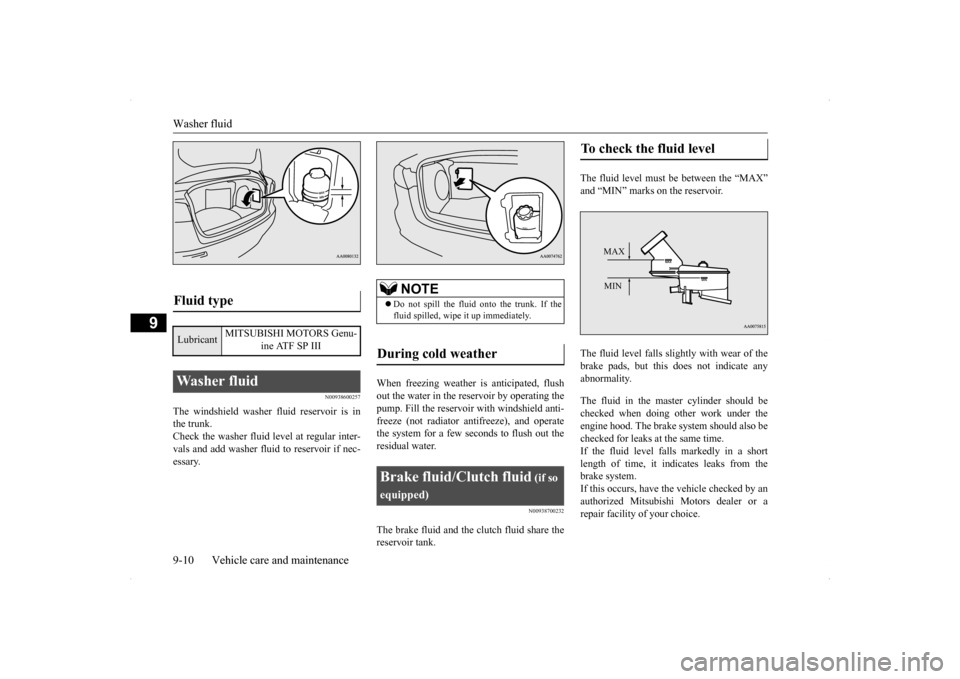
The windshield washer fluid reservoir is in the trunk. Check the washer fluid level at regular inter- vals and add washer fluid to reservoir if nec-essary.
When freezing weather is anticipated, flush out the water in the reservoir by operating the pump. Fill the reservoir with windshield anti-freeze (not radiator antifreeze), and operate the system for a few seconds to flush out the residual water.
N00938700232
The brake fluid and the clutch fluid share thereservoir tank.
The fluid level must be between the “MAX” and “MIN” marks on the reservoir. The fluid level falls slightly with wear of the brake pads, but this does not indicate any abnormality. The fluid in the master cylinder should be checked when doing other work under theengine hood. The brake system should also be checked for leaks at the same time. If the fluid level falls markedly in a shortlength of time, it indicates leaks from the brake system. If this occurs, have the vehicle checked by anauthorized Mitsubishi Motors dealer or a repair facility of your choice.
Fluid type Lubricant
MITSUBISHI MOTORS Genu-
ine ATF SP III
Washer fluid
NOTE
Do not spill the fluid onto the trunk. If the fluid spilled, wipe it up immediately.
During cold weather Brake fluid/Clutch fluid
(if so
equipped)
To check the fluid level
MAX MIN
BK0200800US.bo
ok 10 ページ 2013年2月14日 木曜日 午後2時28分
Page 296 of 338
Fuses
Vehicle care and maintenance 9-25
9
* - Fusible link Some fuses may not be installed on your vehicle, depending on the vehicle modelor specifications. The table above shows the main equip- ment corresponding to each fuse.
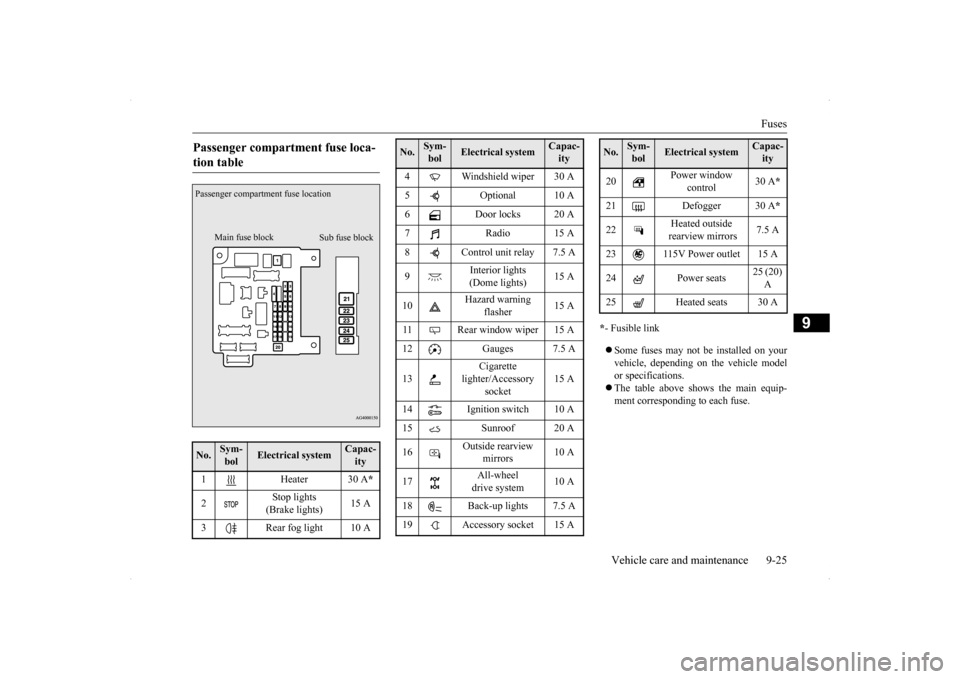
Passenger compartment fuse loca- tion table No.
Sym- bol
Electrical system
Capac-ity
1 Heater 30 A
*
2
Stop lights (Brake lights)
15 A
3 Rear fog light 10 APassenger compartment fuse location
Main fuse block
Sub fuse block
4 Windshield wiper 30 A 5 Optional 10 A 6 Door locks 20 A 7Radio15 A8 Control unit relay 7.5 A 9
Interior lights (Dome lights)
15 A
10
Hazard warning
flasher
15 A
11 Rear window wiper 15 A 12 Gauges 7.5 A 13
Cigarette
lighter/Accessory
socket
15 A
14 Ignition switch 10 A 15 Sunroof 20 A 16
Outside rearview
mirrors
10 A
17
All-wheel drive system
10 A
18 Back-up lights 7.5 A 19 Accessory socket 15 ANo.
Sym- bol
Electrical system
Capac-ity
20
Power window
control
30 A
*
21 Defogger 30 A
*
22
Heated outside rearview mirrors
7.5 A
23 115V Power outlet 15 A24 Power seats
25 (20) A
25 Heated seats 30 ANo.
Sym- bol
Electrical system
Capac-ity
BK0200800US.bo
ok 25 ページ 2013年2月14日 木曜日 午後2時28分
Page 313 of 338
Cleaning the outside of your vehicle 9-42 Vehicle care and maintenance
9
N00945700016
To protect your vehicle’s finish, wash it often and thoroughly. If desired, you may wax your vehicle using a nonabrasive automobile wax.
N00945800017
Industrial pollution, road tar, bird droppings,tree sap, insect remains, sea water and otherforeign matters can damage the finish on your vehicle. Generally, the longer any foreign materialstays on the finish, the worse the damage. Wash your vehicle as soon as possible when- ever the finish gets soiled.
N00945900601
Chemicals contained in the dirt and dustpicked up from air, rain, snow or road sur-faces can damage the paint and body of your vehicle if left on. Frequent washing and waxing is the best wayto protect your vehicle from this damage. Do not wash the vehicle in direct sunlight. Park the vehicle in the shade and spray it withwater to remove dust. Next, using plenty ofclean water and a car washing mitt or sponge, wash the vehicle from top to bottom. Use a mild car washing soap if necessary.Rinse thoroughly and wipe dry with a cham- ois or soft cloth. After washing the vehicle, carefully clean the joints and flanges of thedoors, hood, etc., where dirt is likely to remain.
The genuine leather surface may harden and shrink if it is exposed to the direct sunlight for long hours. When your vehicle is parked, place it in the shade as much as possible. When the temperature of the vehicle interior rises in summer, vinyl products left on the genuine leather seat may deteriorate andstick to the seat.
Cleaning the outside of your vehicle Foreign material
NOTE
Wa s h i n g
CAUTION When washing the underside of your vehicle or the wheels, wear a pair of gloves to pro-tect your hands. This vehicle is equipped with a high perfor- mance brakes. Wash the wheels frequently to remove brake dust. The dust will be difficultto remove if left on the wheels for too long.
If your vehicle has rain sensor wipers, place the wiper switch lever in the “OFF” position to deactivate the rain sensor before washing the vehicle. Otherwise, the wipers will oper- ate in the presence of water spray on thewindshield and become damaged as a result. Never spray or splash water on the electrical parts in the engine compartment. This may damage them. Be careful also when washing the underbody. Do not spray water into theengine compartment. Avoid automatic car washers that use rotat- ing brushes. These brushes may scratch the paint surface and make it dull. Scratches are more noticeable on darker col-ored vehicles. Some hot water washing equipment uses high pressure and heat to clean your vehicle. This heated water may damage your vehi- cle’s resin parts. It can flood the interior ofthe vehicle. Therefore, be sure of the follow- ing:• Keep the washing nozzle at least 20 inches(50 cm) away from the vehicle body.• When washing around the door glass, holdthe nozzle at a distance of more than 20 inches (50 cm) and at
right angles to the
glass surface. CAUTION
BK0200800US.bo
ok 42 ページ 2013年2月14日 木曜日 午後2時28分
Page 315 of 338
Cleaning the outside of your vehicle 9-44 Vehicle care and maintenance
9
cloth in one direction. After polishing, flush the compound from the surface and apply a coat of wax to regain a beautiful luster.
N00946200018
Small cracks and scratches in the paint coatshould be touched up as soon as possible with touch-up paint to prevent corrosion.Check body areas facing the road or the tirescarefully for damage to the paint caused by flying stones, etc. The
paint code number for
your vehicle can be found on the vehicleinformation code plate in the engine compart- ment.
N00946300178
Use a sponge or chamois to clean these parts.If a vehicle wax sticks to a gray or black rough surface of the bumper, molding orlights, the surface may appear white in color. In this case, wipe it off using lukewarm water and a soft cloth or chamois.
N00946400010
To prevent spots and corrosion of chromeparts, wash with water, dry thoroughly, and apply a nonabrasive automotive wax. If the chrome is severely damaged or pitted, use acommercially available chrome polish.
N00946500109
1. Remove dirt using a wet sponge.2. Use a mild detergent on any dirt that can- not be removed easily with water. Rinse off the detergent after washing thewheel. 3. Dry the wheel thoroug
hly using a chamois
leather or a soft cloth.
N00946600012
The window glass can
usually be cleaned
using only a sponge and water. Glass cleanercan be used to remove wax, oil, grease, dead insects, etc. After washing the glass, wipe it dry with a clean, dry, soft cloth.
N00946700084
Use a soft cloth and gl
ass cleaner to remove
grease, dead insects, etc., from the wiperblades. Replace the wiper blades when they no longer clean the windshield properly.
Damaged paint Cleaning plastic parts
CAUTION Do not use a scrubbing brush or other rough scrubber as these may damage the plasticsurface.
Do not use wax containing compounds (pol- ishing powder) which may damage the plas- tic surface. Do not let the plastic parts get soiled with gasoline, oil, brake fluids, engine oils, greases, paint thinner, and sulfuric acid (bat- tery electrolyte). These fluids, etc., maycrack, stain or discolor the plastic parts. If any of these get on the plastic parts, wipe them up with a soft cloth or chamois and amild solution of soap and water. Then rinse them immediately with water.
Chrome parts Aluminum wheels
CAUTION
CAUTION Do not use a brush or other hard implement on the wheels. Doing so could scratch the wheels. Do not use any cleaner that contains an abra- sive substance or is acidic or alkaline. Doing so could cause the coating on the wheels to peel or become discolored or stained. Do not directly apply hot water using a steam cleaner or by any other means. Contact with seawater or road salt used for de-icing can cause corrosion. Rinse off suchsubstances as soon as possible.
Window glass Wiper blades
BK0200800US.bo
ok 44 ページ 2013年2月14日 木曜日 午後2時28分
Page 330 of 338
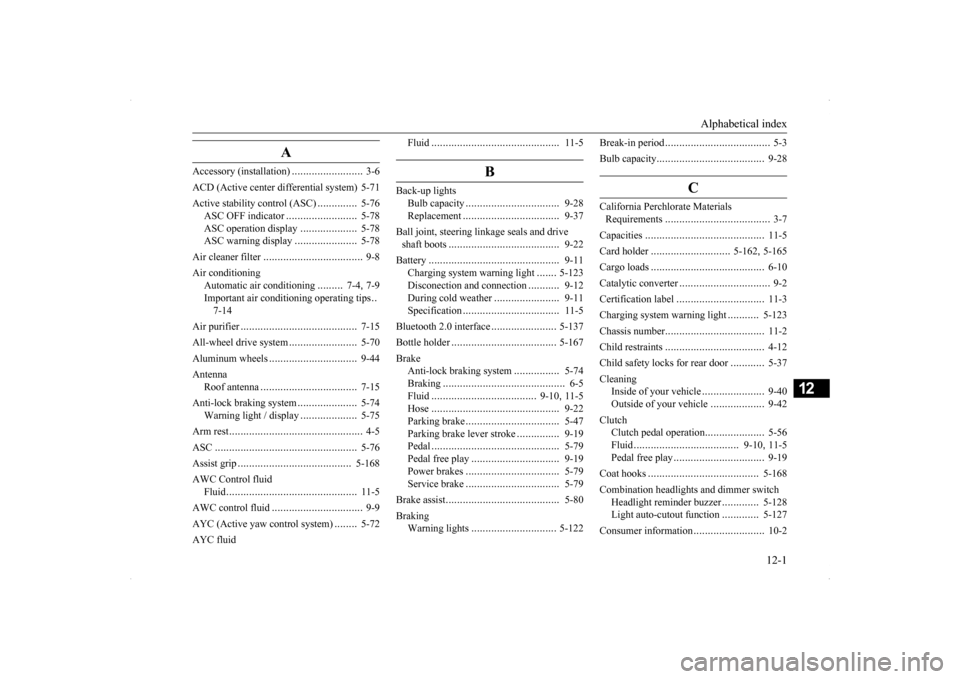
Alphabetical index
12-1
12
A
Accessory (installation)
.........................
3-6
ACD (Active center differential system) 5-71Active stability control (ASC)
..............
5-76
ASC OFF indicator
.........................
5-78
ASC operation display
....................
5-78
ASC warning display
......................
5-78
Air cleaner filter
...................
................
9-8
Air conditioning
Automatic air conditioning
.........
7-4
, 7-9
Important air conditioning operating tips
..
7-14
Air purifier
....................
.....................
7-15
All-wheel drive system
........................
5-70
Aluminum wheels
...............................
9-44
Antenna
Roof antenna
.................
.................
7-15
Anti-lock braking system
.....................
5-74
Warning light / display
....................
5-75
Arm rest
........................
.......................
4-5
ASC
..........................
........................
5-76
Assist grip
.....................
...................
5-168
AWC Control fluid
Fluid
......................
........................
11-5
AWC control fluid
................
................
9-9
AYC (Active yaw control system)
........
5-72
AYC fluid
Fluid
.......................
......................
11-5
B
Back-up lights
Bulb capacity
..................
...............
9-28
Replacement
...................
...............
9-37
Ball joint, steering linkage seals and drive shaft boots
.....................
..................
9-22
Battery
........................
......................
9-11
Charging system warning light
.......
5-123
Disconection and connection
...........
9-12
During cold weather
.......................
9-11
Specification
...................
...............
11-5
Bluetooth 2.0 interface
.......................
5-137
Bottle holder
....................
.................
5-167
Brake
Anti-lock braking system
................
5-74
Braking
.......................
....................
6-5
Fluid
....................
.................
9-10
, 11-5
Hose
.......................
......................
9-22
Parking brake
..................
...............
5-47
Parking brake lever stroke
...............
9-19
Pedal
.......................
......................
5-79
Pedal free play
................
...............
9-19
Power brakes
..................
...............
5-79
Service brake
..................
...............
5-79
Brake assist
......................
..................
5-80
Braking
Warning lights
..............................
5-122
Break-in period
.....................
................
5-3
Bulb capacity
.....................
.................
9-28
C
California Perchlorate Materials Requirements
.....................
................
3-7
Capacities
.....................
.....................
11-5
Card holder
............................
5-162
, 5-165
Cargo loads
...................
.....................
6-10
Catalytic converter
................
................
9-2
Certification label
...............................
11-3
Charging system warning light
...........
5-123
Chassis number
..................
.................
11-2
Child restraints
..................
.................
4-12
Child safety locks for rear door
............
5-37
Cleaning
Inside of your vehicle
......................
9-40
Outside of your vehicle
...................
9-42
Clutch
Clutch pedal operation
.....................
5-56
Fluid
..................
...................
9-10
, 11-5
Pedal free play
...............
.................
9-19
Coat hooks
....................
...................
5-168
Combination headlights and dimmer switch
Headlight reminder buzzer
.............
5-128
Light auto-cutout function
.............
5-127
Consumer information
.........................
10-2
BK0200800US.bo
ok 1 ページ 2013年2月14日 木曜日 午後2時28分
Page 331 of 338

Alphabetical index 12-2
12
Coolant (engine)
..........................
9-7
, 11-5
Cruise control
....................
.................
5-81
Cup holder
....................
...................
5-167
D
Daytime running lights
Bulb capacity
................
.................
9-28
Replacement
.................
.................
9-33
Defogger (rear window)
....................
5-136
Defrosting or defogging (windshield, door windows)
.................
.................
7-8
, 7-13
Dimensions
...................
.....................
11-3
Dimmer (high/low beam change)
.......
5-128
Disc brake pads
.................
.................
9-22
Dome light (Rear)
Bulb capacity
................
.................
9-30
Replacement
.................
.................
9-39
Switch
......................
...................
5-163
Dome light/Reading lights
Bulb capacity
................
.................
9-30
Replacement
.................
.................
9-38
Switch
......................
...................
5-162
Doors
Lock
......................
........................
5-34
Power door locks
............................
5-36
Driving during cold weather
..................
6-4
Driving, alcohol and drugs
.....................
6-2
E
Electric rear window defogger switch
..5-136
Electronic immobilizer (Anti-theft starting system)
.....................
................
5-4
, 5-27
Emission-control system maintenance
...
9-20
Engine
Compartment
..................
.................
9-5
Coolant
...................
................
9-7
, 11-5
Hood
.......................
........................
9-3
Oil and oil filter
.......................
9-5
, 11-5
Overheating
....................
.................
8-4
Serial number
.................
................
11-2
Specifications
.................
................
11-4
Engine coolant temperature display
.......
5-97
Engine malfunction indicator
..............
5-122
Exhaust system
...................
................
9-22
F
Filling the fuel tank
..............................
3-4
Floor console box
..............................
5-166
Floor mat
.........................
....................
6-2
Fluid
AWC control fluid
...................
9-9
, 11-5
AYC fluid
...................
...................
11-5
Brake fluid
............................
9-10
, 11-5
Clutch fluid
...........................
9-10
, 11-5
Engine coolant
.........................
9-7
, 11-5
Power steering fluid
...............
9-11
, 11-5
Twin Clutch SST
............................
11-5
Twin Clutch SST fluid
.............
9-9
, 11-5
Washer fluid
.........................
9-10
, 11-5
Fluid capacities and lubricants
.............
11-5
Fog lights
Bulb capacity
................
.................
9-28
Free-hand advanced security transmitter (F.A.S.T.-key)
.................
.................
5-11
Front console boxes
..........................
5-166
Front console tray
.............................
5-165
Front fog lights
Bulb capacity
................
.................
9-28
Indicators
..................
...................
5-121
Replacement
.................
.................
9-36
Switch
......................
...................
5-131
Front seats
.........................
...................
4-3
Front side-marker and parking light
Bulb capacity
................
.................
9-28
Replacement
.........................
9-33
, 9-34
Front turn signal lights
Bulb capacity
................
.................
9-28
Replacement
.................
.................
9-35
Fuel
Fuel economy
...................
................
6-2
Fuel hoses
.....................
.................
9-21
Modification/alterations to the electrical orfuel systems
...................
................
3-6
Tank capacity
..........................
3-4
, 11-5
Fuel selection
....................
...................
3-2
BK0200800US.bo
ok 2 ページ 2013年2月14日 木曜日 午後2時28分