maintenance MITSUBISHI LANCER EVOLUTION 2014 10.G Workshop Manual
[x] Cancel search | Manufacturer: MITSUBISHI, Model Year: 2014, Model line: LANCER EVOLUTION, Model: MITSUBISHI LANCER EVOLUTION 2014 10.GPages: 338, PDF Size: 40.99 MB
Page 309 of 338
Replacement of light bulbs 9-38 Vehicle care and maintenance
9
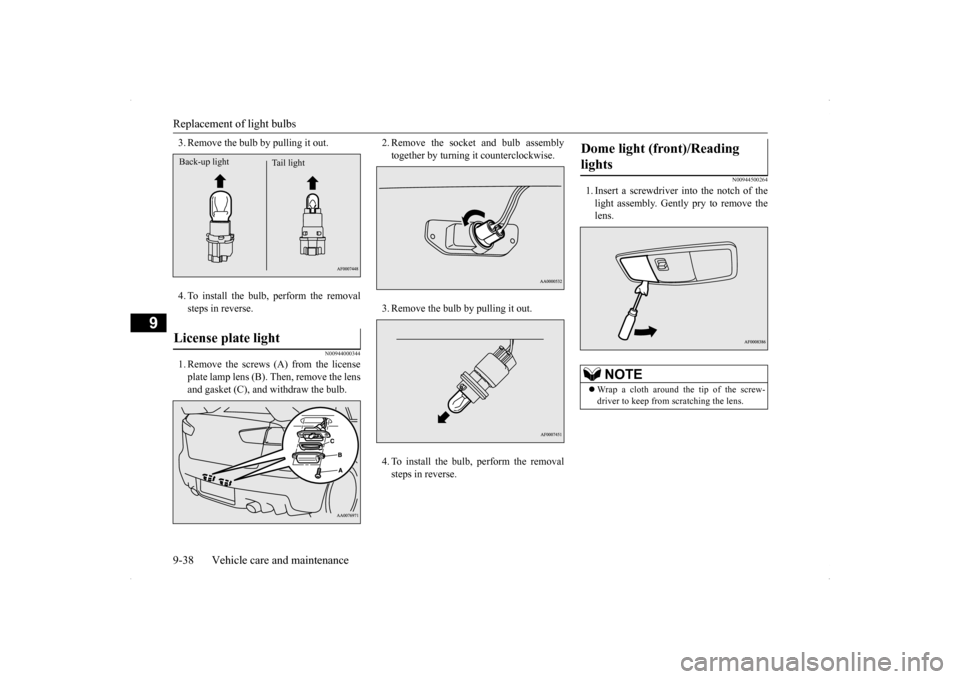
3. Remove the bulb by pulling it out. 4. To install the bulb, perform the removal steps in reverse.
N00944000344
1. Remove the screws (A) from the licenseplate lamp lens (B). Then, remove the lensand gasket (C), and withdraw the bulb.
2. Remove the socket and bulb assembly together by turning it counterclockwise. 3. Remove the bulb by pulling it out.4. To install the bulb, perform the removal steps in reverse.
N00944500264
1. Insert a screwdriver into the notch of thelight assembly. Gently pry to remove the lens.
License plate light
Tail light
Back-up light
Dome light (front)/Reading lights
NOTE
Wrap a cloth around the tip of the screw- driver to keep from scratching the lens.
BK0200800US.bo
ok 38 ページ 2013年2月14日 木曜日 午後2時28分
Page 310 of 338
Replacement of light bulbs
Vehicle care and maintenance 9-39
9
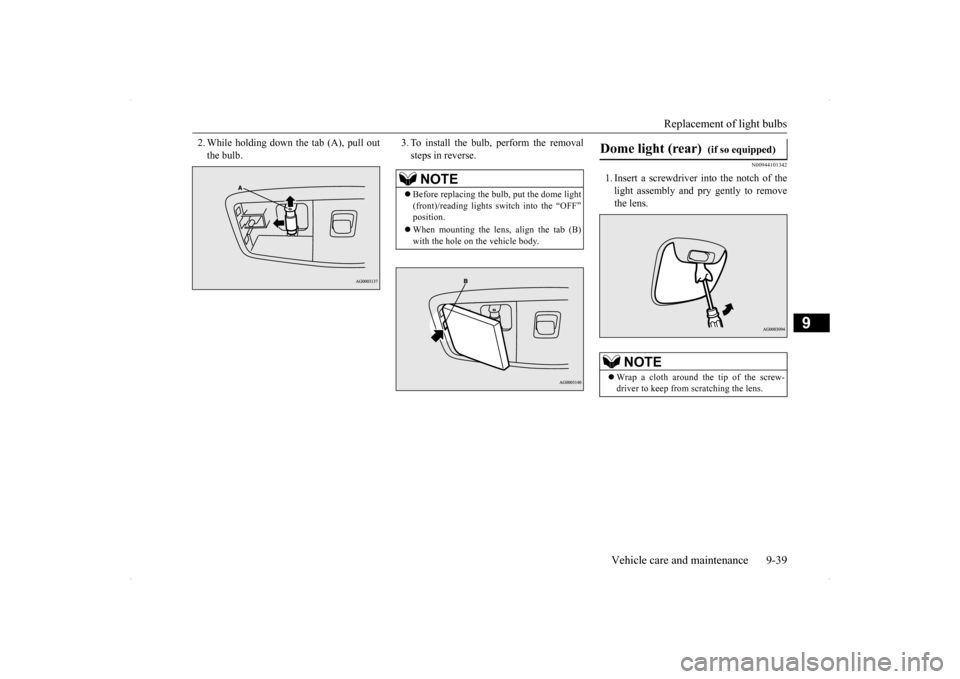
2. While holding down
the tab (A), pull out
the bulb.
3. To install the bulb, perform the removal steps in reverse.
N00944101342
1. Insert a screwdriver into the notch of thelight assembly and pry gently to removethe lens.
NOTE
Before replacing the bulb, put the dome light (front)/reading lights switch into the “OFF”position. When mounting the lens, align the tab (B) with the hole on the vehicle body.
Dome light (rear)
(if so equipped)
NOTE
Wrap a cloth around the tip of the screw- driver to keep from scratching the lens.
BK0200800US.bo
ok 39 ページ 2013年2月14日 木曜日 午後2時28分
Page 311 of 338
Vehicle care precautions 9-40 Vehicle care and maintenance
9
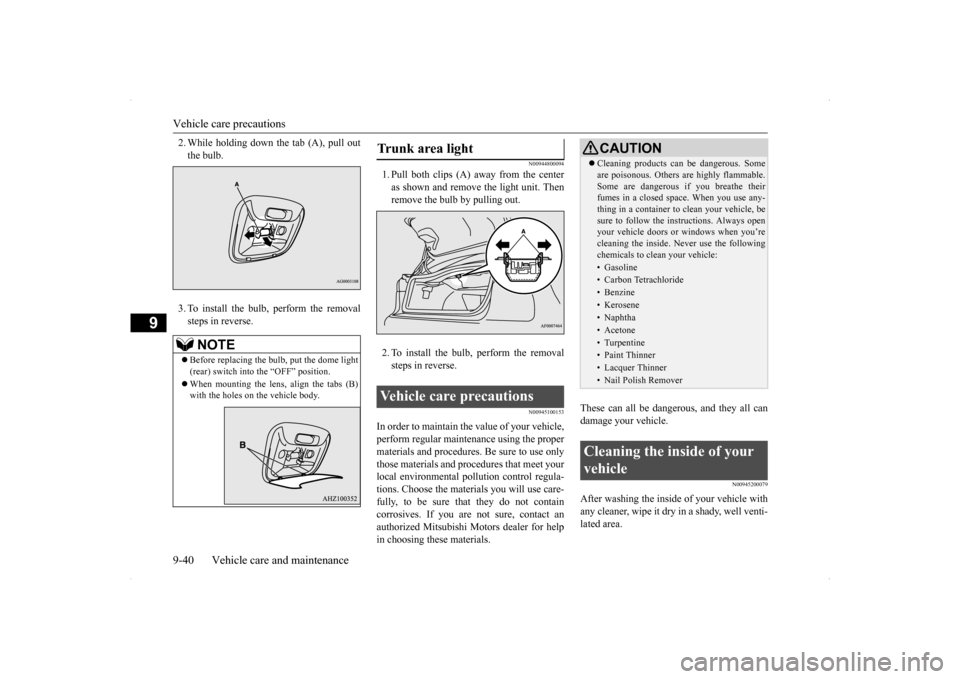
2. While holding down the tab (A), pull out the bulb. 3. To install the bulb, perform the removal steps in reverse.
N00944800094
1. Pull both clips (A) away from the centeras shown and remove the light unit. Thenremove the bulb by pulling out. 2. To install the bulb, perform the removal steps in reverse.
N00945100153
In order to maintain the value of your vehicle, perform regular maintenance using the proper materials and procedures. Be sure to use only those materials and procedures that meet yourlocal environmental pollution control regula- tions. Choose the materials you will use care- fully, to be sure that they do not containcorrosives. If you are not sure, contact an authorized Mitsubishi Motors dealer for help in choosing these materials.
These can all be dangerous, and they all can damage your vehicle.
N00945200079
After washing the inside of your vehicle withany cleaner, wipe it dry in a shady, well venti-lated area.
NOTE
Before replacing the bulb, put the dome light (rear) switch into the “OFF” position. When mounting the lens, align the tabs (B) with the holes on the vehicle body.
Trunk area light Vehicle care precautions
CAUTION Cleaning products can be dangerous. Some are poisonous. Others are highly flammable. Some are dangerous if you breathe their fumes in a closed space. When you use any- thing in a container to clean your vehicle, besure to follow the instructions. Always open your vehicle doors or windows when you’re cleaning the inside. Never use the followingchemicals to clean your vehicle:• Gasoline• Carbon Tetrachloride• Benzine• Kerosene• Naphtha• Acetone• Turpentine• Paint Thinner• Lacquer Thinner• Nail Polish Remover
Cleaning the inside of your vehicle
BK0200800US.bo
ok 40 ページ 2013年2月14日 木曜日 午後2時28分
Page 312 of 338
Cleaning the inside of your vehicle
Vehicle care and maintenance 9-41
9
N00945300184
1. Lightly wipe these off with a soft cloth soaked in a 3 % solution of gentle soapand water. 2. Dip cloth in fresh water and wring out well. Using this cloth, wipe off the deter-gent thoroughly.
N00945500131
1. To maintain the value of your new vehi-cle, maintain the upholstery carefully and keep the interior clean. Use a vacuum cleaner and brush to cleanthe seats. If stained, vinyl and synthetic leather should be cleaned with an appro- priate cleaner. Cloth fabrics can becleaned with either upholstery cleaner or a 3 % solution of gentle soap in lukewarm water. 2. Clean the carpeting with a vacuum cleaner and remove any stains with carpet cleaner. Oil and grease can be removed bylightly dabbing with a clean white cloth and spot remover.
N00945600259
1. To clean, lightly wipe the leather with a soft cloth soaked in a 5 % solution of gen-tle soap and water. 2. To rinse, dip the cloth in fresh water, wring it out well, and wipe off all thesoap. 3. To preserve and protect, use a leather pro- tecting agent on the genuine leather sur-face.
CAUTION Do not use organic substances (solvents, benzine, kerosene, alcohol, gasoline, etc.) or alkaline or acidic solutions. These chemicals can cause discoloring, staining or cracking of the surface.If you use cleaners or polishing agents, make sure their ingredients do not include the sub- stances mentioned above.NOTE
Always read the instructions on the cleaner label.
Plastic, vinyl leather, fabric and flocked parts
NOTE
Do not use cleaners, conditioners, and pro- tectants containing silicones or wax. Such products, when applied to the instru- ment panels or other parts, may cause reflec- tions on the windshield and obscure vision.Also, if such products get on the switches of the electrical accessories, it may lead to fail- ure of these accessories.
Upholstery
NOTE
If fuzzing is difficult to remove from the seat upholstery, draw a suitable defuzzing brush over the surface in one direction.
Genuine leather
(if so equipped)
NOTE
If genuine leather is wet with water, wipe it with a dry, soft cloth. If left damp, mildew may grow. The genuine leather surface can be damaged if brushed with a nylon or synthetic fiber brush. Organic solvents such as benzine, kerosene, alcohol, gasoline, acid or alkaline solvents can discolor the genuine leather surface and should not be used. Genuine leather can mildew if not kept clean. Clean up any oil stains immediately.
BK0200800US.bo
ok 41 ページ 2013年2月14日 木曜日 午後2時28分
Page 313 of 338
Cleaning the outside of your vehicle 9-42 Vehicle care and maintenance
9
N00945700016
To protect your vehicle’s finish, wash it often and thoroughly. If desired, you may wax your vehicle using a nonabrasive automobile wax.
N00945800017
Industrial pollution, road tar, bird droppings,tree sap, insect remains, sea water and otherforeign matters can damage the finish on your vehicle. Generally, the longer any foreign materialstays on the finish, the worse the damage. Wash your vehicle as soon as possible when- ever the finish gets soiled.
N00945900601
Chemicals contained in the dirt and dustpicked up from air, rain, snow or road sur-faces can damage the paint and body of your vehicle if left on. Frequent washing and waxing is the best wayto protect your vehicle from this damage. Do not wash the vehicle in direct sunlight. Park the vehicle in the shade and spray it withwater to remove dust. Next, using plenty ofclean water and a car washing mitt or sponge, wash the vehicle from top to bottom. Use a mild car washing soap if necessary.Rinse thoroughly and wipe dry with a cham- ois or soft cloth. After washing the vehicle, carefully clean the joints and flanges of thedoors, hood, etc., where dirt is likely to remain.
The genuine leather surface may harden and shrink if it is exposed to the direct sunlight for long hours. When your vehicle is parked, place it in the shade as much as possible. When the temperature of the vehicle interior rises in summer, vinyl products left on the genuine leather seat may deteriorate andstick to the seat.
Cleaning the outside of your vehicle Foreign material
NOTE
Wa s h i n g
CAUTION When washing the underside of your vehicle or the wheels, wear a pair of gloves to pro-tect your hands. This vehicle is equipped with a high perfor- mance brakes. Wash the wheels frequently to remove brake dust. The dust will be difficultto remove if left on the wheels for too long.
If your vehicle has rain sensor wipers, place the wiper switch lever in the “OFF” position to deactivate the rain sensor before washing the vehicle. Otherwise, the wipers will oper- ate in the presence of water spray on thewindshield and become damaged as a result. Never spray or splash water on the electrical parts in the engine compartment. This may damage them. Be careful also when washing the underbody. Do not spray water into theengine compartment. Avoid automatic car washers that use rotat- ing brushes. These brushes may scratch the paint surface and make it dull. Scratches are more noticeable on darker col-ored vehicles. Some hot water washing equipment uses high pressure and heat to clean your vehicle. This heated water may damage your vehi- cle’s resin parts. It can flood the interior ofthe vehicle. Therefore, be sure of the follow- ing:• Keep the washing nozzle at least 20 inches(50 cm) away from the vehicle body.• When washing around the door glass, holdthe nozzle at a distance of more than 20 inches (50 cm) and at
right angles to the
glass surface. CAUTION
BK0200800US.bo
ok 42 ページ 2013年2月14日 木曜日 午後2時28分
Page 314 of 338
Cleaning the outside of your vehicle Vehicle care and maintenance 9-43
9
Salt and other chemicals spread on winter roads in some geographical areas can have adetrimental effect on the vehicle underbody. You should flush the underbody with a high pressure hose every time you wash the out-side of your vehicle. Take special care to remove mud or other debris which could trap and hold salt andmoisture.
After washing your vehicle, wipe off all waterdrops from the rubber parts around the doors to prevent the doors from freezing.
N00946000221
Wax your vehicle once or twice a year, or when water does not bead up on the paint.Use a soft cloth to put a small amount of wax on the painted surfaces. After the wax has dried, polish with a dry soft cloth.Do not wax your vehicle in direct sunlight. You should wax when the painted surfaces are cool.
N00946100017
If painted surfaces have been severely dam- aged and lost their original luster and color tone, polish the surface lightly with a finepolishing compound. Avoid limiting your polishing to the damaged surface only; polish a somewhat wider area, moving the polishing
When using high-pressure water to wash a vehicle equipped with the F.A.S.T.-key sys- tem, keep the water from spraying on the open button on the trunk. This could cause the trunk to open and flood the inside of thetrunk. Make sure to do the following when using an automatic car wash, with help from either this manual or the car wash operator, to avoid damaging your vehicle:• Fold the outside rear-view mirrors.• Remove the antenna.• If your vehicle is equipped with rearspoiler, check with the car wash operator before using the car wash.• If your vehicle has rain sensor wipers, placethe wiper switch lever in the “OFF” posi- tion to deactivate the rain sensor.
During cold weather
CAUTION
NOTE
When the door is frozen, opening it by force may tear off or crack the rubber gasket installed around the door. Pour warm water to melt the ice. Be sure to thoroughly wipeoff the water after opening the door. To pre- vent freezing of the weatherstripping on the doors, hood, etc., treat with silicone lubri-cant.
Waxing
CAUTION Waxes containing high abrasive compounds should not be used. These waxes remove rust and stain effectively from the paintwork, but are harmful to the finish
on the paint and the
plate, because they also remove clearcoat.They are also harmful to other glossy sur- faces such as the grille, trim, moldings, etc. Do not use gasoline, kerosene, benzine or paint thinners to remove road tar or other dirt from the vehicle surface. Do not put wax on the areas having black matte coating because it can cause unevendiscoloration, patches, blurs, etc. If these get wax on them, wipe the wax off right away with a soft cloth and warm water. If your vehicle is equipped with a sunroof, be careful not to apply any wax on the weather-strip (black rubber) when waxing the area around the sunroof opening. If stained with wax, the weatherstrip cannotmaintain a weatherproof seal with the sun- roof.
Polishing
BK0200800US.bo
ok 43 ページ 2013年2月14日 木曜日 午後2時28分
Page 315 of 338
Cleaning the outside of your vehicle 9-44 Vehicle care and maintenance
9
cloth in one direction. After polishing, flush the compound from the surface and apply a coat of wax to regain a beautiful luster.
N00946200018
Small cracks and scratches in the paint coatshould be touched up as soon as possible with touch-up paint to prevent corrosion.Check body areas facing the road or the tirescarefully for damage to the paint caused by flying stones, etc. The
paint code number for
your vehicle can be found on the vehicleinformation code plate in the engine compart- ment.
N00946300178
Use a sponge or chamois to clean these parts.If a vehicle wax sticks to a gray or black rough surface of the bumper, molding orlights, the surface may appear white in color. In this case, wipe it off using lukewarm water and a soft cloth or chamois.
N00946400010
To prevent spots and corrosion of chromeparts, wash with water, dry thoroughly, and apply a nonabrasive automotive wax. If the chrome is severely damaged or pitted, use acommercially available chrome polish.
N00946500109
1. Remove dirt using a wet sponge.2. Use a mild detergent on any dirt that can- not be removed easily with water. Rinse off the detergent after washing thewheel. 3. Dry the wheel thoroug
hly using a chamois
leather or a soft cloth.
N00946600012
The window glass can
usually be cleaned
using only a sponge and water. Glass cleanercan be used to remove wax, oil, grease, dead insects, etc. After washing the glass, wipe it dry with a clean, dry, soft cloth.
N00946700084
Use a soft cloth and gl
ass cleaner to remove
grease, dead insects, etc., from the wiperblades. Replace the wiper blades when they no longer clean the windshield properly.
Damaged paint Cleaning plastic parts
CAUTION Do not use a scrubbing brush or other rough scrubber as these may damage the plasticsurface.
Do not use wax containing compounds (pol- ishing powder) which may damage the plas- tic surface. Do not let the plastic parts get soiled with gasoline, oil, brake fluids, engine oils, greases, paint thinner, and sulfuric acid (bat- tery electrolyte). These fluids, etc., maycrack, stain or discolor the plastic parts. If any of these get on the plastic parts, wipe them up with a soft cloth or chamois and amild solution of soap and water. Then rinse them immediately with water.
Chrome parts Aluminum wheels
CAUTION
CAUTION Do not use a brush or other hard implement on the wheels. Doing so could scratch the wheels. Do not use any cleaner that contains an abra- sive substance or is acidic or alkaline. Doing so could cause the coating on the wheels to peel or become discolored or stained. Do not directly apply hot water using a steam cleaner or by any other means. Contact with seawater or road salt used for de-icing can cause corrosion. Rinse off suchsubstances as soon as possible.
Window glass Wiper blades
BK0200800US.bo
ok 44 ページ 2013年2月14日 木曜日 午後2時28分
Page 316 of 338
Cleaning the outside of your vehicle Vehicle care and maintenance 9-45
9
N00946800072
Clean the inside of the sunroof with a soft cloth. Hard deposits should be wiped away with a cloth dipped in warm, neutral deter-gent solution. Wipe away the solution with a sponge dipped in fresh water.
N00947000042
Never spray or splash water on the electricalcomponents in the engine compartment, as this may cause damage.Do not allow any nearby parts (such as plastic parts) come into contact with sulphuric acid (battery electrolyte), which may crack, stain,or discolour them. If this occurs, wipe the parts with a soft cloth saturated with a mild detergent and watersolution. Then immediately rinse the affected parts with plenty of water.Cleaning the sunroof
(if so
equipped)
NOTE
The surface treatment on the inside of the glass may be removed if a hard cloth or organic solvent is used.
Engine compartment
BK0200800US.bo
ok 45 ページ 2013年2月14日 木曜日 午後2時28分
Page 331 of 338
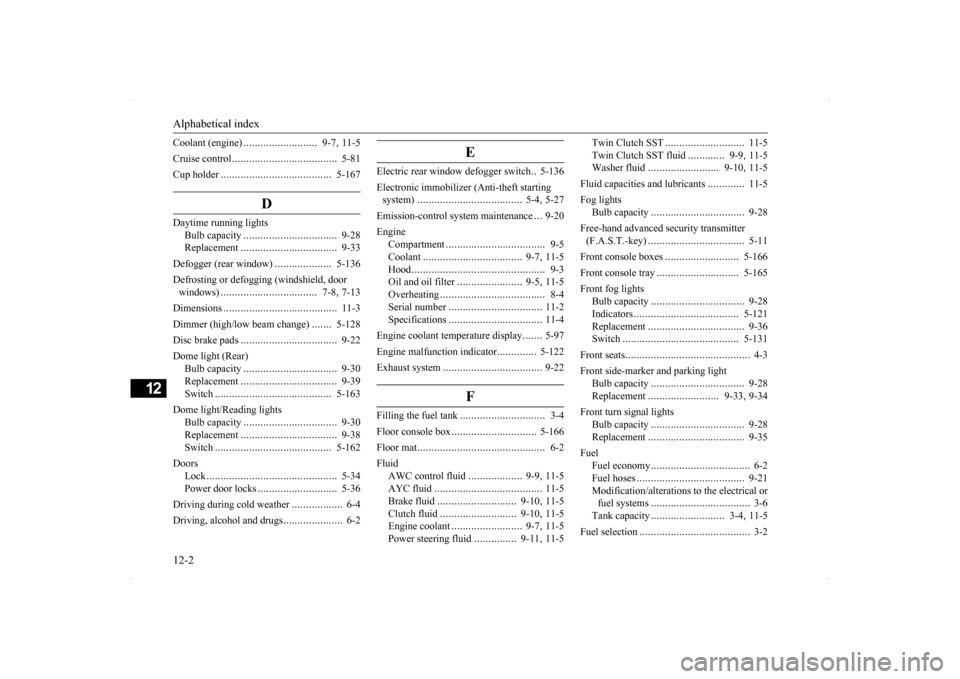
Alphabetical index 12-2
12
Coolant (engine)
..........................
9-7
, 11-5
Cruise control
....................
.................
5-81
Cup holder
....................
...................
5-167
D
Daytime running lights
Bulb capacity
................
.................
9-28
Replacement
.................
.................
9-33
Defogger (rear window)
....................
5-136
Defrosting or defogging (windshield, door windows)
.................
.................
7-8
, 7-13
Dimensions
...................
.....................
11-3
Dimmer (high/low beam change)
.......
5-128
Disc brake pads
.................
.................
9-22
Dome light (Rear)
Bulb capacity
................
.................
9-30
Replacement
.................
.................
9-39
Switch
......................
...................
5-163
Dome light/Reading lights
Bulb capacity
................
.................
9-30
Replacement
.................
.................
9-38
Switch
......................
...................
5-162
Doors
Lock
......................
........................
5-34
Power door locks
............................
5-36
Driving during cold weather
..................
6-4
Driving, alcohol and drugs
.....................
6-2
E
Electric rear window defogger switch
..5-136
Electronic immobilizer (Anti-theft starting system)
.....................
................
5-4
, 5-27
Emission-control system maintenance
...
9-20
Engine
Compartment
..................
.................
9-5
Coolant
...................
................
9-7
, 11-5
Hood
.......................
........................
9-3
Oil and oil filter
.......................
9-5
, 11-5
Overheating
....................
.................
8-4
Serial number
.................
................
11-2
Specifications
.................
................
11-4
Engine coolant temperature display
.......
5-97
Engine malfunction indicator
..............
5-122
Exhaust system
...................
................
9-22
F
Filling the fuel tank
..............................
3-4
Floor console box
..............................
5-166
Floor mat
.........................
....................
6-2
Fluid
AWC control fluid
...................
9-9
, 11-5
AYC fluid
...................
...................
11-5
Brake fluid
............................
9-10
, 11-5
Clutch fluid
...........................
9-10
, 11-5
Engine coolant
.........................
9-7
, 11-5
Power steering fluid
...............
9-11
, 11-5
Twin Clutch SST
............................
11-5
Twin Clutch SST fluid
.............
9-9
, 11-5
Washer fluid
.........................
9-10
, 11-5
Fluid capacities and lubricants
.............
11-5
Fog lights
Bulb capacity
................
.................
9-28
Free-hand advanced security transmitter (F.A.S.T.-key)
.................
.................
5-11
Front console boxes
..........................
5-166
Front console tray
.............................
5-165
Front fog lights
Bulb capacity
................
.................
9-28
Indicators
..................
...................
5-121
Replacement
.................
.................
9-36
Switch
......................
...................
5-131
Front seats
.........................
...................
4-3
Front side-marker and parking light
Bulb capacity
................
.................
9-28
Replacement
.........................
9-33
, 9-34
Front turn signal lights
Bulb capacity
................
.................
9-28
Replacement
.................
.................
9-35
Fuel
Fuel economy
...................
................
6-2
Fuel hoses
.....................
.................
9-21
Modification/alterations to the electrical orfuel systems
...................
................
3-6
Tank capacity
..........................
3-4
, 11-5
Fuel selection
....................
...................
3-2
BK0200800US.bo
ok 2 ページ 2013年2月14日 木曜日 午後2時28分
Page 332 of 338
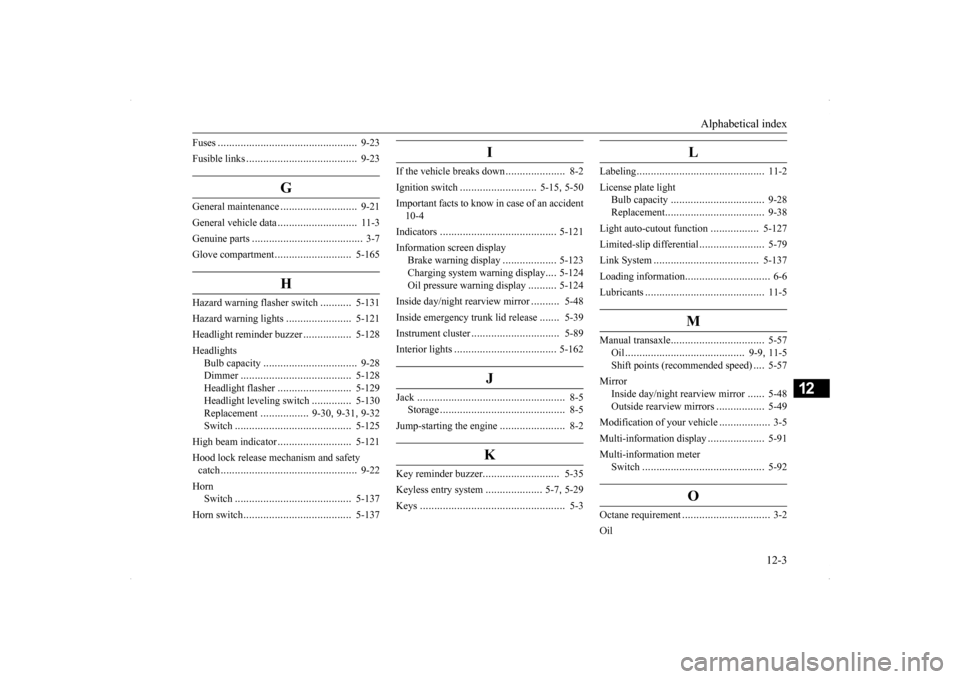
Alphabetical index
12-3
12
Fuses
.........................
........................
9-23
Fusible links
..................
.....................
9-23
G
General maintenance
...........................
9-21
General vehicle data
............................
11-3
Genuine parts
....................
...................
3-7
Glove compartment
...........................
5-165
H
Hazard warning flasher switch
...........
5-131
Hazard warning lights
.......................
5-121
Headlight reminder buzzer
.................
5-128
Headlights
Bulb capacity
................
.................
9-28
Dimmer
....................
...................
5-128
Headlight flasher
..........................
5-129
Headlight leveling switch
..............
5-130
Replacement
.................
9-30
, 9-31
, 9-32
Switch
......................
...................
5-125
High beam indicator
..........................
5-121
Hood lock release mechanism and safety catch
........................
........................
9-22
Horn
Switch
......................
...................
5-137
Horn switch
...................
...................
5-137
I
If the vehicle breaks down
.....................
8-2
Ignition switch
...........................
5-15
, 5-50
Important facts to know in case of an accident 10-4 Indicators
....................
.....................
5-121
Information screen display
Brake warning display
...................
5-123
Charging system warning display
....
5-124
Oil pressure warning display
..........
5-124
Inside day/night rearview mirror
..........
5-48
Inside emergency trunk lid release
.......
5-39
Instrument cluster
................
...............
5-89
Interior lights
...................
.................
5-162
J
Jack
............................
........................
8-5
Storage
........................
....................
8-5
Jump-starting the engine
.......................
8-2
K
Key reminder buzzer
...........................
5-35
Keyless entry system
....................
5-7
, 5-29
Keys
...........................
........................
5-3
L
Labeling
........................
.....................
11-2
License plate light
Bulb capacity
................
.................
9-28
Replacement
..................
.................
9-38
Light auto-cutout function
.................
5-127
Limited-slip differential
.......................
5-79
Link System
..................
...................
5-137
Loading information
..............................
6-6
Lubricants
.....................
.....................
11-5
M
Manual transaxle
................
.................
5-57
Oil
.....................
.....................
9-9
, 11-5
Shift points (recommended speed)
....
5-57
Mirror
Inside day/night rearview mirror
......
5-48
Outside rearview mirrors
.................
5-49
Modification of your vehicle
..................
3-5
Multi-information display
....................
5-91
Multi-information meter
Switch
......................
.....................
5-92
O
Octane requirement
...............
................
3-2
Oil
BK0200800US.bo
ok 3 ページ 2013年2月14日 木曜日 午後2時28分