ESP MITSUBISHI LANCER SPORTBACK 2014 8.G User Guide
[x] Cancel search | Manufacturer: MITSUBISHI, Model Year: 2014, Model line: LANCER SPORTBACK, Model: MITSUBISHI LANCER SPORTBACK 2014 8.GPages: 422, PDF Size: 55.11 MB
Page 103 of 422
Door locks 5-36 Features and controls
5
N00509200521
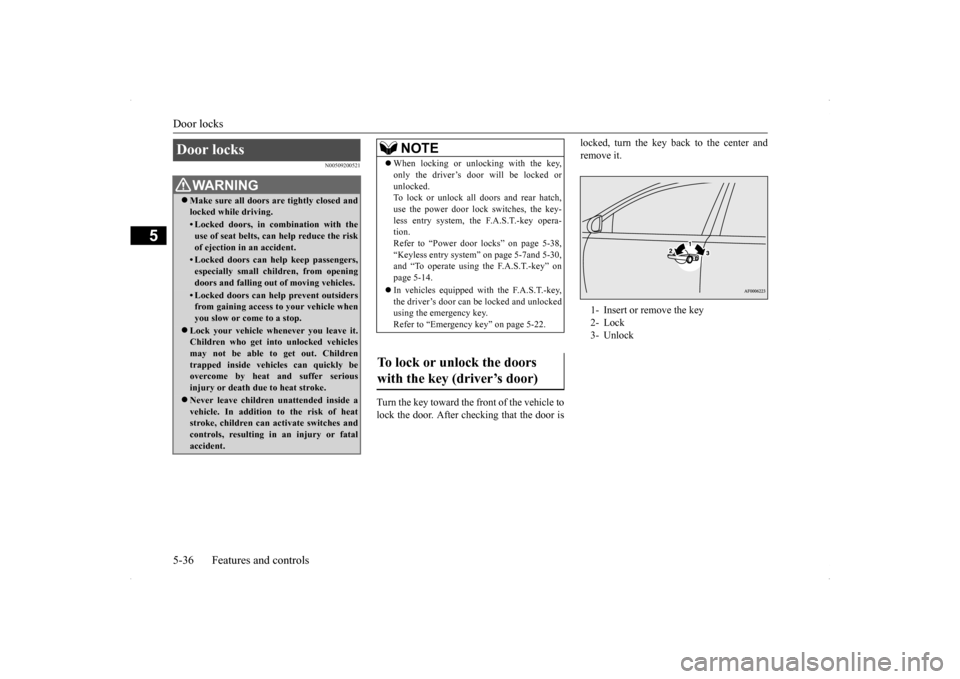
Turn the key toward the front of the vehicle to lock the door. After checking that the door is
locked, turn the key back to the center and remove it.
Door locks
WA R N I N G Make sure all doors are tightly closed and locked while driving.• Locked doors, in combination with theuse of seat belts, can help reduce the risk of ejection in an accident.• Locked doors can help keep passengers,especially small chil
dren, from opening
doors and falling out of moving vehicles.• Locked doors can help prevent outsidersfrom gaining access to your vehicle whenyou slow or come to a stop.
Lock your vehicle whenever you leave it. Children who get into unlocked vehicles may not be able to get out. Children trapped inside vehicles can quickly beovercome by heat and suffer serious injury or death due to heat stroke. Never leave children unattended inside a vehicle. In addition to the risk of heat stroke, children can activate switches andcontrols, resulting in an injury or fatal accident.
NOTE
When locking or unlocking with the key, only the driver’s door will be locked or unlocked. To lock or unlock all doors and rear hatch, use the power door lock switches, the key-less entry system, the F.A.S.T.-key opera- tion. Refer to “Power door locks” on page 5-38,“Keyless entry system” on page 5-7and 5-30, and “To operate using the F.A.S.T.-key” on page 5-14. In vehicles equipped with the F.A.S.T.-key, the driver’s door can be locked and unlockedusing the emergency key. Refer to “Emergency key” on page 5-22.
To lock or unlock the doors with the key (driver’s door)
1- Insert or remove the key 2- Lock 3- Unlock
BK0200700US.bo
ok 36 ページ 2013年2月15日 金曜日 午後12時17分
Page 106 of 422
“Child safety locks” for rear door
Features and controls 5-39
5
N00563401148
All doors and the rear hatch will unlock when the ignition switch is turned to the “LOCK” position. All doors and the rear hatch will unlock when the selector lever (CVT) or the gearshift lever(Twin Clutch SST) is moved to the “P”
(PARK) position with the ignition switch in the “ON” position.
N00509400204
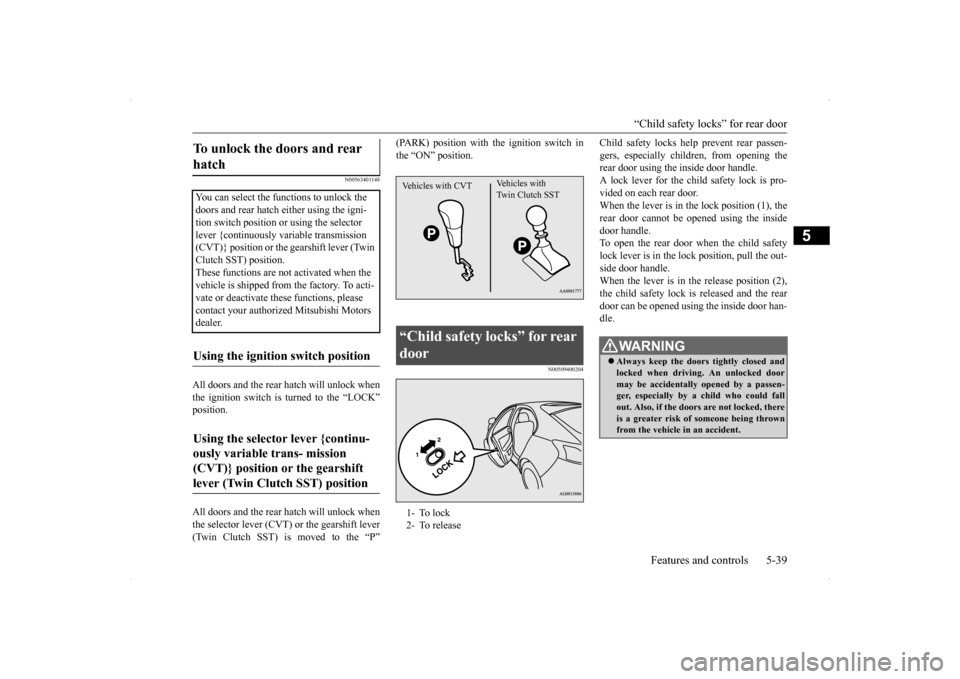
Child safety locks help prevent rear passen-gers, especially children, from opening the rear door using the inside door handle. A lock lever for the chil
d safety lock is pro-
vided on each rear door. When the lever is in the lock position (1), the rear door cannot be opened using the insidedoor handle. To open the rear door when the child safety lock lever is in the lock position, pull the out-side door handle.When the lever is in th
e release position (2),
the child safety lock is released and the rear door can be opened using the inside door han-dle.
To unlock the doors and rear hatch You can select the functions to unlock the doors and rear hatch either using the igni- tion switch position or using the selector lever {continuously variable transmission (CVT)} position or the gearshift lever (Twin Clutch SST) position.These functions are not activated when the vehicle is shipped from the factory. To acti- vate or deactivate these functions, please contact your authorized Mitsubishi Motors dealer.Using the ignition switch position Using the selector lever {continu- ously variable trans- mission (CVT)} position or the gearshift lever (Twin Clutch SST) position
“Child safety locks” for rear door 1- To lock 2- To releaseVehicles with CVT
Vehicles with Twin Clutch SST
WA R N I N G Always keep the doors tightly closed and locked when driving. An unlocked door may be accidentally opened by a passen- ger, especially by a child who could fallout. Also, if the doors are not locked, there is a greater risk of someone being thrown from the vehicle in an accident.
BK0200700US.bo
ok 39 ページ 2013年2月15日 金曜日 午後12時17分
Page 111 of 422
Power windows 5-44 Features and controls
5
N00510601131
Use the following procedure to test the sys- tem:
1. Lower the driver’s window. 2. Arm the system as explained in “Armed stage”. 3. Make sure that the theft-alarm indicatorcomes on and flashes for approximately 20 seconds. 4. Wait a few seconds and then unlock thedriver’s side door by using the inside door lock knob and open the door. 5. Check to be sure that the horn soundsintermittently and the headlights blink onand off when the door is opened. 6. Disarm the system by unlocking all doors and the rear hatch by using the keylessentry system or the F.A.S.T.-key opera- tion.
N00510800325
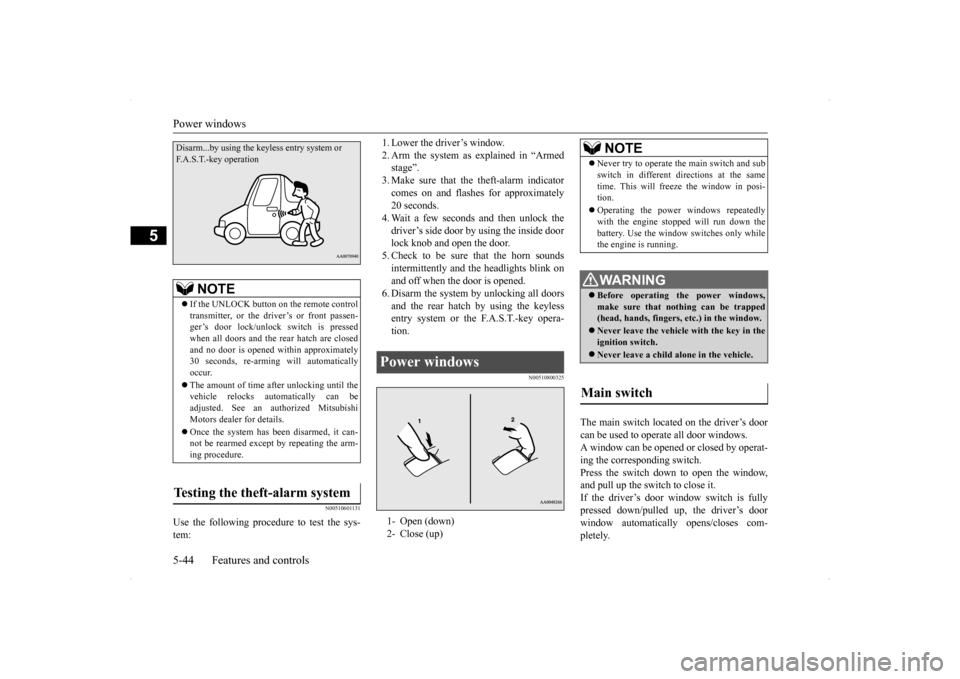
The main switch located on the driver’s door can be used to operate all door windows. A window can be opened or closed by operat- ing the corresponding switch.Press the switch down to open the window, and pull up the switch to close it. If the driver’s door window switch is fullypressed down/pulled up, the driver’s door window automatically opens/closes com- pletely.
NOTE
If the UNLOCK button on the remote control transmitter, or the driver’s or front passen- ger’s door lock/unlock switch is pressedwhen all doors and the rear hatch are closed and no door is opened
within approximately
30 seconds, re-arming will automaticallyoccur. The amount of time after unlocking until the vehicle relocks automatically can be adjusted. See an authorized Mitsubishi Motors dealer for details. Once the system has been disarmed, it can- not be rearmed except by repeating the arm-ing procedure.
Testing the theft-alarm system Disarm...by using the ke
yless entry system or
F.A.S.T.-key operation
Power windows 1- Open (down) 2- Close (up)
NOTE
Never try to operate the main switch and sub switch in different directions at the same time. This will freeze the window in posi- tion. Operating the power windows repeatedly with the engine stopped will run down the battery. Use the window switches only whilethe engine is running. WA R N I N G Before operating the power windows, make sure that nothing can be trapped(head, hands, fingers, etc.) in the window. Never leave the vehicle with the key in the ignition switch. Never leave a child alone in the vehicle.
Main switch
BK0200700US.bo
ok 44 ページ 2013年2月15日 金曜日 午後12時17分
Page 112 of 422
Power windows
Features and controls 5-45
5
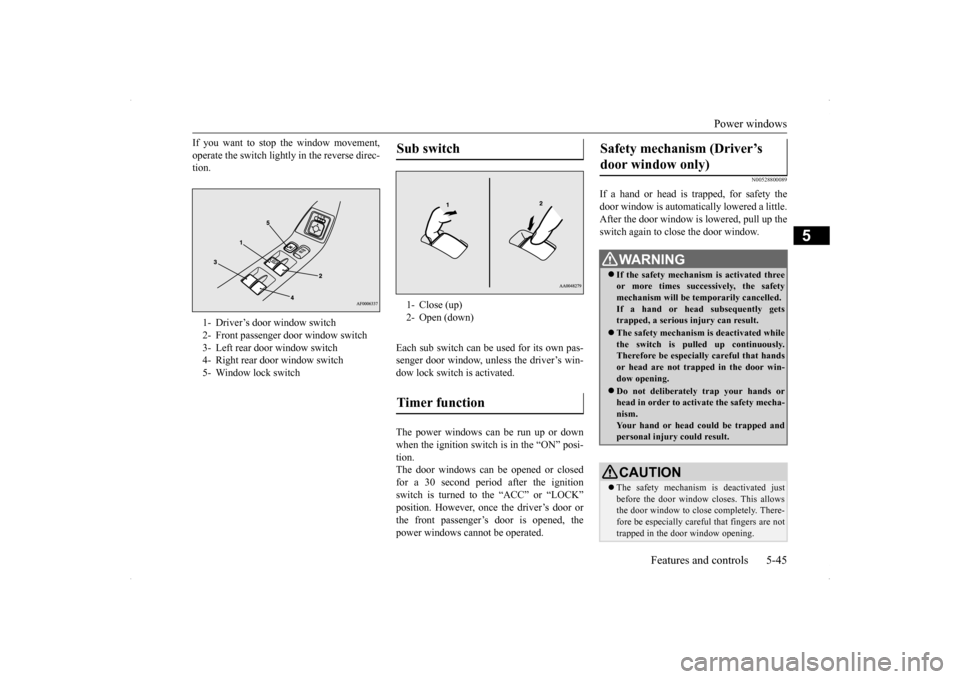
If you want to stop the window movement, operate the switch lightly in the reverse direc- tion.
Each sub switch can be used for its own pas- senger door window, unless the driver’s win-dow lock switch is activated. The power windows can be run up or down when the ignition switch is in the “ON” posi- tion. The door windows can be opened or closedfor a 30 second period after the ignition switch is turned to the “ACC” or “LOCK” position. However, once the driver’s door orthe front passenger’s door is opened, the power windows cannot be operated.
N00528800089
If a hand or head is trapped, for safety the door window is automatically lowered a little. After the door window is lowered, pull up the switch again to close the door window.
1- Driver’s door window switch 2- Front passenger door window switch3- Left rear door window switch 4- Right rear door window switch 5- Window lock switch
Sub switch 1- Close (up)2- Open (down)Timer function
Safety mechanism (Driver’s door window only)
WA R N I N G If the safety mechanism is activated three or more times successively, the safetymechanism will be temporarily cancelled. If a hand or head subsequently gets trapped, a serious injury can result. The safety mechanism is deactivated while the switch is pulled up continuously.Therefore be especially careful that hands or head are not trapped in the door win- dow opening. Do not deliberately trap your hands or head in order to activate the safety mecha-nism. Your hand or head could be trapped and personal injury could result.CAUTION The safety mechanism is deactivated just before the door window closes. This allowsthe door window to close completely. There- fore be especially careful that fingers are not trapped in the door window opening.
BK0200700US.bo
ok 45 ページ 2013年2月15日 金曜日 午後12時17分
Page 114 of 422
Sunroof (if so equipped)
Features and controls 5-47
5
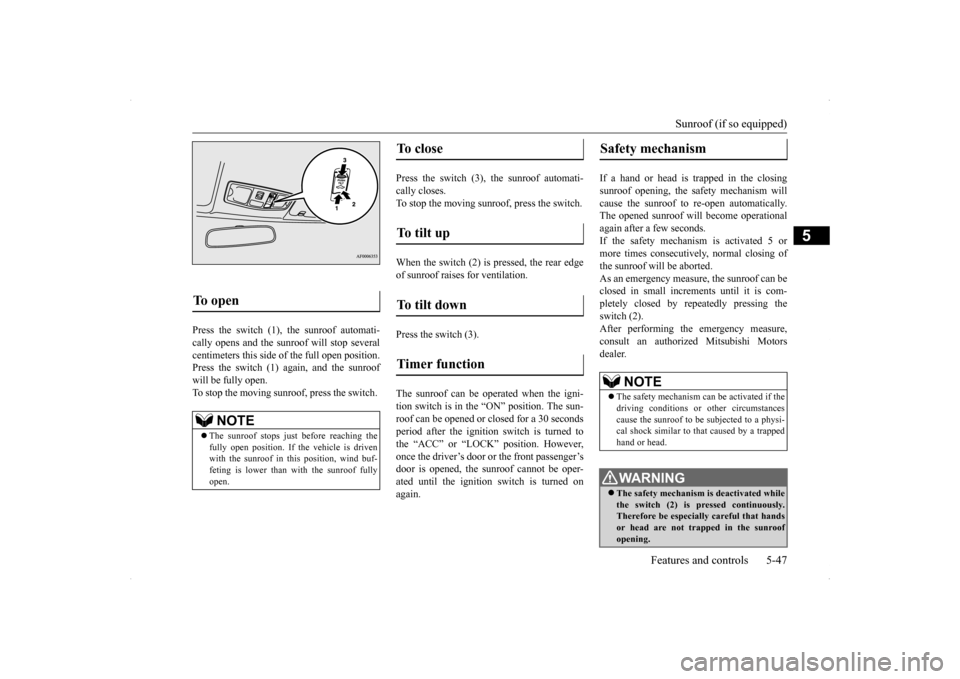
Press the switch (1), the sunroof automati- cally opens and the sunroof will stop several centimeters this side of the full open position. Press the switch (1) again, and the sunroofwill be fully open.To stop the moving sunroo
f, press the switch.
Press the switch (3), the sunroof automati- cally closes.To stop the moving sunroof, press the switch. When the switch (2) is pressed, the rear edge of sunroof raises for ventilation. Press the switch (3). The sunroof can be oper
ated when the igni-
tion switch is in the “ON” position. The sun- roof can be opened or closed for a 30 secondsperiod after the ignition
switch is turned to
the “ACC” or “LOCK” position. However, once the driver’s door or the front passenger’sdoor is opened, the sunroof cannot be oper- ated until the ignition switch is turned on again.
If a hand or head is trapped in the closing sunroof opening, the safety mechanism willcause the sunroof to re-open automatically. The opened sunroof will become operational again after a few seconds.If the safety mechanism is activated 5 or more times consecutively, normal closing of the sunroof will be aborted.As an emergency measure, the sunroof can beclosed in small increments until it is com- pletely closed by repeatedly pressing the switch (2).After performing the emergency measure, consult an authorized Mitsubishi Motors dealer.
To open
NOTE
The sunroof stops just before reaching the fully open position. If the vehicle is driven with the sunroof in this position, wind buf- feting is lower than with the sunroof fullyopen.
To close
To tilt up
To tilt down
Timer function
Safety mechanism
NOTE
The safety mechanism can be activated if the driving conditions or other circumstances cause the sunroof to be subjected to a physi-cal shock similar to that caused by a trapped hand or head.WA R N I N G The safety mechanism is deactivated while the switch (2) is pressed continuously. Therefore be especially careful that handsor head are not trapped in the sunroof opening.
BK0200700US.bo
ok 47 ページ 2013年2月15日 金曜日 午後12時17分
Page 115 of 422
Sunroof (if so equipped) 5-48 Features and controls
5
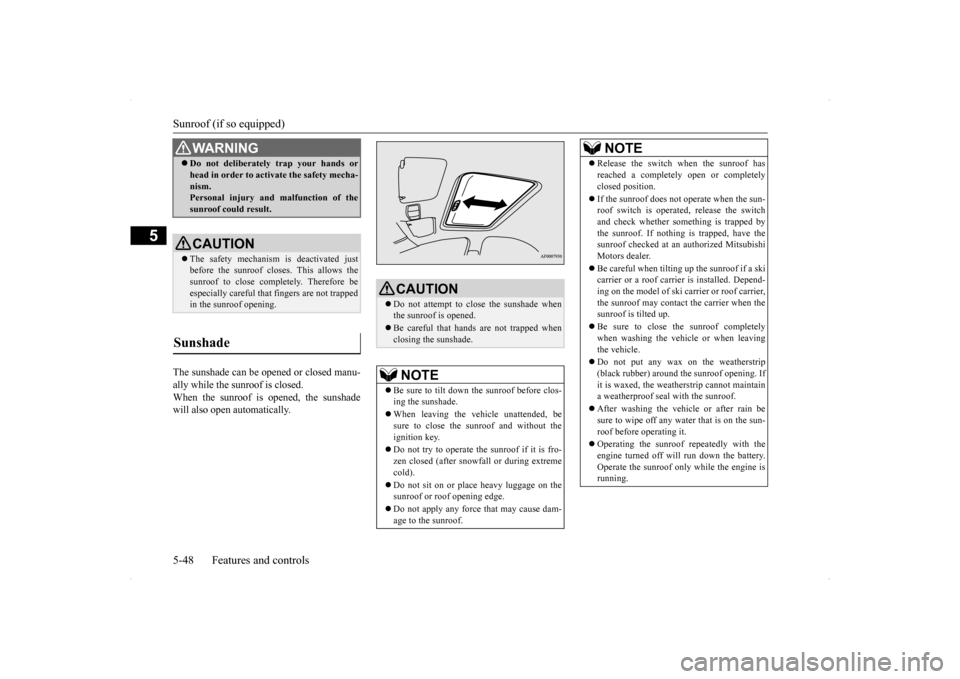
The sunshade can be opened or closed manu- ally while the sunroof is closed.When the sunroof is opened, the sunshade will also open automatically. Do not deliberately trap your hands or head in order to activate the safety mecha- nism. Personal injury and malfunction of the sunroof could result.CAUTION The safety mechanism is deactivated just before the sunroof closes. This allows the sunroof to close completely. Therefore be especially careful that fingers are not trappedin the sunroof opening.
Sunshade
WA R N I N G
CAUTION Do not attempt to close the sunshade when the sunroof is opened. Be careful that hands are not trapped when closing the sunshade.NOTE
Be sure to tilt down the sunroof before clos- ing the sunshade. When leaving the vehicle unattended, be sure to close the sunroof and without theignition key. Do not try to operate the sunroof if it is fro- zen closed (after snowfall or during extreme cold). Do not sit on or place heavy luggage on the sunroof or roof opening edge. Do not apply any force that may cause dam- age to the sunroof.
Release the switch when the sunroof has reached a completely open or completely closed position. If the sunroof does not operate when the sun- roof switch is operated, release the switch and check whether some
thing is trapped by
the sunroof. If nothing
is trapped, have the
sunroof checked at an authorized Mitsubishi Motors dealer. Be careful when tilting up the sunroof if a ski carrier or a roof carrier is installed. Depend- ing on the model of ski car
rier or roof carrier,
the sunroof may contact the carrier when the sunroof is tilted up. Be sure to close the sunroof completely when washing the vehicle or when leaving the vehicle. Do not put any wax on the weatherstrip (black rubber) around the sunroof opening. Ifit is waxed, the weatherstrip cannot maintain a weatherproof seal with the sunroof. After washing the vehicle or after rain be sure to wipe off any water that is on the sun- roof before operating it. Operating the sunroof repeatedly with the engine turned off will run down the battery.Operate the sunroof only while the engine is running.NOTE
BK0200700US.bo
ok 48 ページ 2013年2月15日 金曜日 午後12時17分
Page 136 of 422
Continuously variable transmission (CVT) (if so equipped)
Features and controls 5-69
5
N00514500333
N00514900063
To gain extra acceleration in “D” (DRIVE) position (when passing another vehicle) push the accelerator to the floor
if it is safe to do so
in traffic conditions. The CVT will automati-cally downshift.
N00515000074
For short waiting periods, such as at traffic lights, the vehicle can be left in selector lever position and held stationary with the servicebrake.
For longer waiting periods with the engine running, the selector lever should be placed in the “N” (NEUTRAL) position.
N00515100062
To park the vehicle, first bring it to a com- plete stop, fully engage the parking brake,and then move the selector lever to the “P” (PARK) position. If you are going to leave the vehicle unat-tended, always switch
off the engine and
carry the key.
Operation of the CVT
CAUTION Before selecting a position with the engine running and the vehicle stationary, fully depress the brake pedal to prevent the vehi- cle from creeping.Do not release the brakes until you are ready to drive away. The vehicle will begin to move as soon as the CVT is engaged, espe-cially when the engine speed is high (fast idle or air conditioning on). Depress the brake pedal with the right foot. Using the left foot could cause driver move- ment delay in case of an emergency. To prevent sudden acceleration, never run the engine at high rpms when shifting fromthe “P” (PARK) or “N” (NEUTRAL) posi- tion. Operating the accelerator pedal while the other foot is resting on the brake pedal will affect braking efficiency and may cause pre-mature wear of brake pads. Use the selector lever in the correct shift position in accordance with driving condi- tions. Never coast downhill backward in the driv- ing shift position { “D” (DRIVE), “L” (LOW) or sports mode} or coast forward inthe “R” (REVERSE) position. Engine stopping and increased brake pedal and steering effort could lead to an accident.
Do not rev the engine with the brake pedal pressed when the vehicle is stationary. This can damage the CVT. Also, when you depress the accelerator pedal while holding down the brake pedal with theselector lever in the “D” (DRIVE) position, the engine revolutions may not rise as high as when performing the same operation withthe selector lever in the “N” (NEUTRAL) position.
Passing acceleration
NOTE
In sports mode, downshifts do not take place when the accelerator is depressed all the way to the floor.
Waiting
CAUTION
CAUTION To avoid transmission overheating, never try to keep your vehicle stationary on a hill by using the accelerator pedal. Always apply the parking brake and/or service brake. Unexpected acceleration may occur if the selector lever is in a position other than “P”(PARK) or “N” (NEUTRAL). Before driving off from a stop, make sure that the selector lever is in “D” (DRIVE)position or “Sports mode” position.
Parking
BK0200700US.bo
ok 69 ページ 2013年2月15日 金曜日 午後12時17分
Page 137 of 422
Twin Clutch SST (Sportronic Shif
t Transmission) (if so equipped)
5-70 Features and controls
5
N00515300208
If the CVT does not shift while driving, or your vehicle does not pick up enough speed when starting on an uphill slope, there may be something unusual happening in the transmis-sion, causing a safety device to activate. Have your vehicle checked at an authorized Mit- subishi Motors dealer or a repair facility ofyour choice as soon as possible. 1. If your vehicle has difficulty moving uphill, shift the selector lever into “L” (LOW) position (except for vehicles withsport mode) or 2nd shift range of the sports mode. This method might not work dependingon the type of transmission malfunction.
2. Once the vehicle is moving on a level road, move the selector lever back to “D” (DRIVE) position.
N00539700046
The Twin Clutch SST is a transmission that,through integrated control of the engine and transmission, is able to achieve both thesmooth shifting of an automatic transaxle and the acceleration and fuel economy close to a manual transaxle. In addition, the controlmode can be selected from two types to suit the driving conditions. Together with manual shifting, the transmis-sion is capable of responding to a variety of driving circumstances. Twin Clutch SST control mode
P.5-75
Manual shift
P.5-76
N00539800047
As an additional safety precaution, models equipped with a Twin Clutch SST have ashift-lock device that holds the gearshift lever in the “P” (PARK) position. To move the gearshift lever from the “P” (PARK) positionto another position, follow the steps below. 1. Press and hold the brake pedal down. 2. Move the gearshift lever to the desired position.
The Twin Clutch SST has 6 forward gears and 1 reverse gear. The individual gears are selected automati-cally, depending on the position of the gear- shift lever, the speed of the vehicle and the position of the accelerator pedal.The gearshift lever (A) has 2 gates; the main shift gate (B) and the manual shift gate (C).
NOTE
On a slope, be sure to apply the parking brake before moving the selector lever to the “P” (PARK) position. If you move the selec- tor lever to the “P” (PARK) position before applying the parking brake, it may be diffi-cult to disengage the selector lever from the “P” (PARK) position when next you drive the vehicle, requiring application of a strongforce to the selector lever to move from the “P” (PARK) position.
When the CVT makes no speed change
NOTE
When the warning display or the warning display appears on the information screen in the multi-information display, therecould be a malfunction in the CVT. Refer to “Continuously variable transmission (CVT): Warning display” on page 5-65.
Twin Clutch SST (Spor- tronic Shift Transmission)
(if
so equipped)
Gearshift lever operation
NOTE
The gearshift lever cannot be moved from “P” (PARK) to another position if the igni-tion switch is at the “LOCK” or “ACC” posi- tion, or the key has been removed, or if the brake pedal is not pressed and held down.
BK0200700US.bo
ok 70 ページ 2013年2月15日 金曜日 午後12時17分
Page 148 of 422
Twin Clutch SST (Sportronic Shif
t Transmission) (if so equipped) Features and controls 5-81
5
lever position and held stationary with the service brake. For longer waiting periods with the engine running, place the gearshift lever in the “N”(NEUTRAL) position and apply the parking brake, while holding the vehicle stationary with the service brake.Prior to moving off after having stopped the vehicle, make sure that the gearshift lever is in “D” (DRIVE) position or manual shiftposition.
N00541100018
To park the vehicle, first bring it to a com- plete stop, fully engage the parking brake, and then move the gearshift lever to the “P”(PARK) position.
N00541200051
If there is a problem in the Twin Clutch SST or engine electronic control module, the fol- lowing may occur. Twin Clutch SST does not shift. Vehicle cannot move. Twin Clutch SST acceleration is slow. Vehicle does not creep. “Shift shock” is large. Shifting occurs at higher engine speed. Response is slow.
If any of these occurs, perform the following procedure. The temperature of Twin Clutch SST fluid is high. Refer to “Warning display” on page 5-73 and follow the appropriate measures. There could be a malfunction in the engine electronic control module.
CAUTION Do not rev the engine unnecessarily while the vehicle is stationary. Unexpected acceler- ation may occur if the gearshift lever is in aposition other than “P” (PARK) or “N” (NEUTRAL). Do not keep the vehicle in a stopped position on an uphill slope by depressing the acceler- ator pedal instead of the brake pedal.The transmission may be damaged and an accident may occur due to the following con- ditions.• The Twin Clutch SST fluid temperaturewill rise and can cause transmission dam- age.
• If the vehicle is kept in a stopped positionby depressing the accelerator pedal instead of the brake pedal, the vehicle will vibrate or the warning display will appear on the information screen in the multi-infor- mation display to alert the driver that the Twin Clutch SST fluid temperature hasrisen. After that, if the Twin Clutch SST fluid temperature rises even higher, the transmis-sion protection control will operate. If this occurs, the vehicle may suddenly reverse as if the gearshift lever was in the “N” (NEUTRAL) position and cause an accident. If the warning display appears or the transmission protection control operates, refer to “When warning display is showing” on page 5-73.
Parking
CAUTION
What to do if the following occur with the Twin Clutch SST
When warning display is showing When the engine malfunction indicator (“SERVICE ENGINE SOON” or “Check engine light”) comes on or blinking
BK0200700US.bo
ok 81 ページ 2013年2月15日 金曜日 午後12時17分
Page 150 of 422
ACD (Active center differential system) (if so equipped)
Features and controls 5-83
5
between tires. Refer to “Tire rotation” on page 9-22. Check the tire inflation pressure regularly.
N00538500050
The ACD is a system
that improves accelera-
tion performance and straight-ahead stability by regulating the differential limiting actionand power drive distribution of the center dif- ferential.
N00545400035
Select the control mode from the following three types to suit the driving conditions.
CAUTION Always use tires of the same size, type, and brand that have no wear differences. Using tires of different size, type, brands or degreeof wear, will increase the differential oil tem- perature and result in possible damage to the driving system. Further, the drive train willbe subjected to excessive loading, possibly leading to oil leakage, component seizure, or other serious failures.
To w i n g
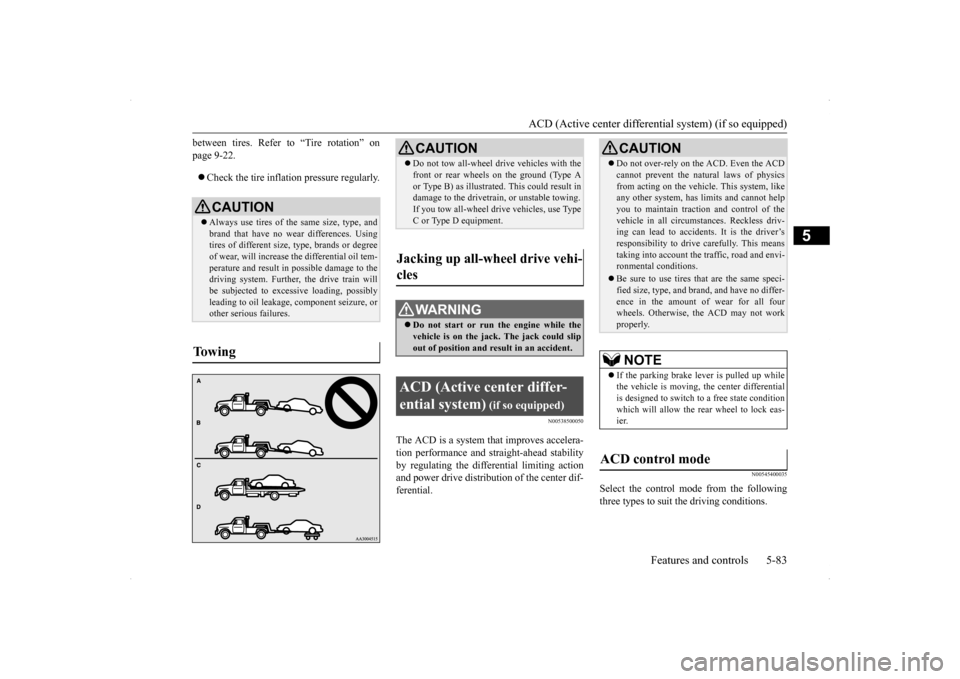
CAUTION Do not tow all-wheel dr
ive vehicles with the
front or rear wheels on the ground (Type A or Type B) as illustrated. This could result in damage to the drivetrain, or unstable towing. If you tow all-wheel drive vehicles, use TypeC or Type D equipment.
Jacking up all-wheel drive vehi- cles
WA R N I N G Do not start or run the engine while the vehicle is on the jack. The jack could slip out of position and result in an accident.
ACD (Active center differ- ential system)
(if so equipped)
CAUTION Do not over-rely on th
e ACD. Even the ACD
cannot prevent the natural laws of physics from acting on the vehicle. This system, like any other system, has limits and cannot help you to maintain traction and control of thevehicle in all circumstances. Reckless driv- ing can lead to accidents. It is the driver’s responsibility to drive carefully. This meanstaking into account the traffic, road and envi- ronmental conditions. Be sure to use tires that are the same speci- fied size, type, and brand, and have no differ- ence in the amount of wear for all fourwheels. Otherwise, the ACD may not work properly.NOTE
If the parking brake lever is pulled up while the vehicle is moving, the center differential is designed to switch to a free state condition which will allow the rear wheel to lock eas-ier.
ACD control mode
BK0200700US.bo
ok 83 ページ 2013年2月15日 金曜日 午後12時17分