ESP MITSUBISHI LANCER SPORTBACK 2014 8.G Workshop Manual
[x] Cancel search | Manufacturer: MITSUBISHI, Model Year: 2014, Model line: LANCER SPORTBACK, Model: MITSUBISHI LANCER SPORTBACK 2014 8.GPages: 422, PDF Size: 55.11 MB
Page 368 of 422
Tires
Vehicle care and maintenance 9-19
9
EXAMPLE: 95H
Maximum load indicates the maxi- mum load this tire is designed to carry.
Maximum Pressure indicates the maximum permissible cold tire infla- tion pressure for this tire. The TIN may be found on one or both sides of the tire but the date code may only be on one side. Look for the TIN on the outboard side of tires as mounted on the vehicle. If the TIN is not found on the outboard sidethen you will find it on the inboard side of the tire.
LT (Light Truck) -metric tiresizing is based on U.S.A. design standards. The size designationfor LT-metric tires is the same as for P-metric tires except for the letters “LT” that are molded intothe sidewall preceding the size designation. Example: LT235/85R16.Temporary spare tires are highpressure compact sparesdesigned for temporary emer- gency use only. Tires designed to this standard have the letter“T” molded into the sidewall preceding the size designation. Example: T145/80D18 103M.
Service Description 95
Load index A numerical code associatedwith the maximum load a tire can carry.NOTE
H
Speed symbol A symbol indicating the range of speeds at which a tire can carry a load corresponding toits load index under certain operating conditions. The maximum speed corre-sponding to the speed symbol should only be achieved under specified operating condi-tions. (i.e. tire pressure, vehi- cle loading, road conditions and posted speed limits)
Maximum Load
WA R N I N GOverloading of your tire is dangerous. Overloading can cause tire failure, affect vehi-cle handling, and increase your stopping distance. Use tires of the recommended loadcapacity for your vehicle. Never overload them.
Maximum Pressure Tire Identification Number (TIN)
BK0200700US.bo
ok 19 ページ 2013年2月15日 金曜日 午後12時17分
Page 369 of 422

Tires 9-20 Vehicle care and maintenance
9
EXAMPLE: DOT MA L9 ABCD 1504
The treadwear grade is a comparative rating based on the wear rate of the tire when tested under controlledconditions on a specified government test course. For example, a tire graded 150 would wear one and one- half (1
1/2) times as well on the gov-
ernment course as a tire graded 100. The relative performance of tiresdepends upon the actual conditions of their use, however, and may depart significantly from the norm due tovariations in driving habits, service practices and differences in road characteristics and climate. The traction grades, from highest to lowest, are AA, A, B and C. Thosegrades represent the tire’s ability to stop on wet pavement as measured
under controlled conditions on speci- fied government test surfaces of asphalt and concrete. A tire marked C may have poor traction perfor- mance. The temperature grades are A (the highest), B and C, representing the tire’s resistance to the generation ofheat and its ability to dissipate heat when tested under controlled condi- tions on a specified indoor laboratorytest wheel. Sustained high tempera- ture can cause the material of the tire to degenerate and reduce tire life, andexcessive temperature can lead to sudden tire failure. The grade C cor- responds to a level of performancewhich all passenger car tires must meet under the Federal Motor Vehi- cle Safety Standard No. 109. Grades B and A represent higher levels of performance on the laboratory testwheel than the minimum required by law.
DOT
Department of Transporta- tion This symbol certifies thatthe tire is in compliance with the U.S. Department of Transportation tire safetystandards, and is approved for highway use.
MA
Code representing the tire manufacturing location. (2 digits)
L9 ABCD
Code representing the tire size. (2 digits)Code used by tire manufac- turer. (1 to 4 digits)
15
Number representing the week in which the tire wasmanufactured. (2 digits)
04
Number representing the year in which the tire was manufactured. (2 digits)
Treadwear, Traction and Temper- ature Grades Treadwear Tr a c t i o n
Temperature
BK0200700US.bo
ok 20 ページ 2013年2月15日 金曜日 午後12時17分
Page 370 of 422
Tires
Vehicle care and maintenance 9-21
9
N00939301900
Proper tire inflation pressure is essential for the safe and satisfactory operation of yourvehicle. The wrong tire pressure will cause problems in three major areas: Safety Too little pressure increases flexing in thetire and can cause tire failure. Too muchpressure can cause a tire to lose its ability to cushion shock. Objects on the road and potholes could then cause tire damage thatmay result in tire failure. Economy The wrong tire pressure can cause unevenwear patterns in the tire tread. These abnormal wear patterns will reduce the tread life, and the tire will have to bereplaced sooner. Too little pressure also makes it harder for the tire to roll, and this uses up more fuel. Ride comfort and vehicle stability The superior riding experience built into your vehicle partly depends on the correcttire pressure. Too much pressure gives an uncomfortable and jarring ride. Too little pressure feels as if your vehicle is slow torespond. Unequal tire pressures can make steering your vehicle uneven and unpredictable.
The correct tire pressure for your vehicle is listed on the placard attached to the driver’s door sill. (Refer to “Tire and loading information plac-ard” on page 11-3.) The recommended inflation pressures should be used for the tires listed below. Tire pressures should be checked, and adjusted if necessary, at least once a month. Pressures should be checked more oftenwhenever weather temperatures change severely, because tire pressures change with outdoor temperatures. The pressures listed onthe placard are always “cold inflation pres- sure”. Cold inflation pressure is measured after thevehicle has been parked for at least three hours or is driven less than 1 mile (1.6 km) after having been parked for three hours.Cold inflation pressure must not go above the maximum values molded into the tire side- wall. After driving several miles, your tire
inflation pressure may increase 14 to 41 KPA, 2 to 6 PSI from the cold inflation pressure. Do not let air out of the tires to get back to the specified cold pressure, or your tire pressurewill be too low. Check your tires each time you refuel. If one tire looks lower than the others, check thepressure for all of them. You should also take the following safety pre- cautions: Keep your tires inflated to the recom- mended pressures. (See the tire and load-ing information placard attached to the driver’s door sill.) Stay within the recommended load limits. Make sure that the weight of any load in your vehicle is evenly distributed. Drive at safe speeds. After filling your tires to the correct pres- sure, check them for damage and air leaks. Be sure to reinstall the caps on thevalve stems.
Tire inflation pressures
Item
Tire size
Front
Rear
Normal tire
P205/60 R16
250 KPA, 36 PSI
250 KPA, 36 PSI
P215/45 R18
240 KPA, 35 PSI
240 KPA, 35 PSI
Compact spare tire
T125/70 D16
420 KPA, 60 PSI
BK0200700US.bo
ok 21 ページ 2013年2月15日 金曜日 午後12時17分
Page 374 of 422
Wiper blades
Vehicle care and maintenance 9-25
9
N00940700170
Check the wiper blades occasionally. Clean them regularly to remove deposits of salt androad film. Use a sponge or cloth and a mild detergent or non-abrasive cleaner to clean the blades and glass areas.Replace the blades if they continue to streak or smear. If the blades are frozen to the windshield or rear window, do not operate the wipers until the ice has melted and the blades are freed,otherwise the wiper motor may be damaged.
N00940800201
Your vehicle is equipped with an emission-control system that meets all the requirements of the U.S. Environmental Protection Agency
and Environment Canada. The emission-con- trol system is made of: a positive crankcase ventilation system an evaporative emission-control system an exhaust emission-control system
The maintenance services listed in the “WARRANTY AND MAINTENANCE MANUAL” must be performed at the times or mileages listed to keep the emission-con-trol system working properly. These, and allthe other “general” maintenance services listed in this manual, need to be performed to keep your vehicle running properly and reli-ably. You may need more frequent maintenance if you drive your vehicle in harsh conditions such as dusty areas or
do a lot of start-and-
stop driving. To be sure the emission-control system works properly, have your vehicle inspected and maintained by an authorized MitsubishiMotors dealer or a repair facility of your choice following the schedule in the “WAR- RANTY AND MAINTENANCE MAN-UAL”. You should also have an inspection and ser- vice any time you suspect a malfunction.
N00940900257
Spark plugs must fire properly for goodengine performance and emission-control.Do not reuse them by cleaning or regapping. Change them at the mileage listed in the “WARRANTY AND MAINTENANCEMANUAL”.
Wiper blades
NOTE
Do not run the wipers on dry glass for a long time. This wears out the rubber and can scratch the glass.
During cold weather Emission-control system maintenance
NOTE
To meet government regulations and pro- mote cleaner air, your vehicle is equipped with an onboard diagnostic system (OBD). The engine electronic control module that controls OBD functions stores various data(especially about the exhaust emissions). This data will be erased if the battery cable is disconnected, which could make a rapiddiagnosis difficult. Do not disconnect the battery cable when the engine malfunction indicator (“SERVICE ENGINE SOON” or“Check engine light”) is on.
Spark plugs
NOTE
Use the spark plugs listed under “Engine specifications” on page 11-5 or plugs that are exactly the same. Other plugs could causeengine damage, performance problems or radio noise.
BK0200700US.bo
ok 25 ページ 2013年2月15日 金曜日 午後12時17分
Page 379 of 422
Fuses 9-30 Vehicle care and maintenance
9
* - Fusible link Some fuses may not be installed on your vehicle, depending on the vehicle model or specifications. The table above shows the main equip- ment corresponding to each fuse.
4 Windshield wiper 30 A 5 Optional 10 A 6 Door locks 20 A 7Radio15 A8 Control unit relay 7.5 A 9
Interior lights (Dome lights)
15 A
10
Hazard warning
flasher
15 A
11 Rear window wiper 15 A 12 Gauges 7.5 A 13
Cigarette
lighter/Accessory
socket
15 A
14 Ignition switch 10 A 15 Sunroof 20 A 16
Outside rearview
mirrors
10 A
17
All-wheel drive sys-
tem
10 A
18 Back-up lights 7.5 A 19 Accessory socket 15 ANo.
Sym- bol
Electrical system
Capac-ity
20
Power window con-
trol
30 A
*
21 Defogger 30 A
*
22
Heated
outside rearview mir-
rors
7.5 A
23 115V Power outlet 15 A 24 Power seats
25 (20) A
25 Heated seats 30 ANo.
Sym- bol
Electrical system
Capac-ity
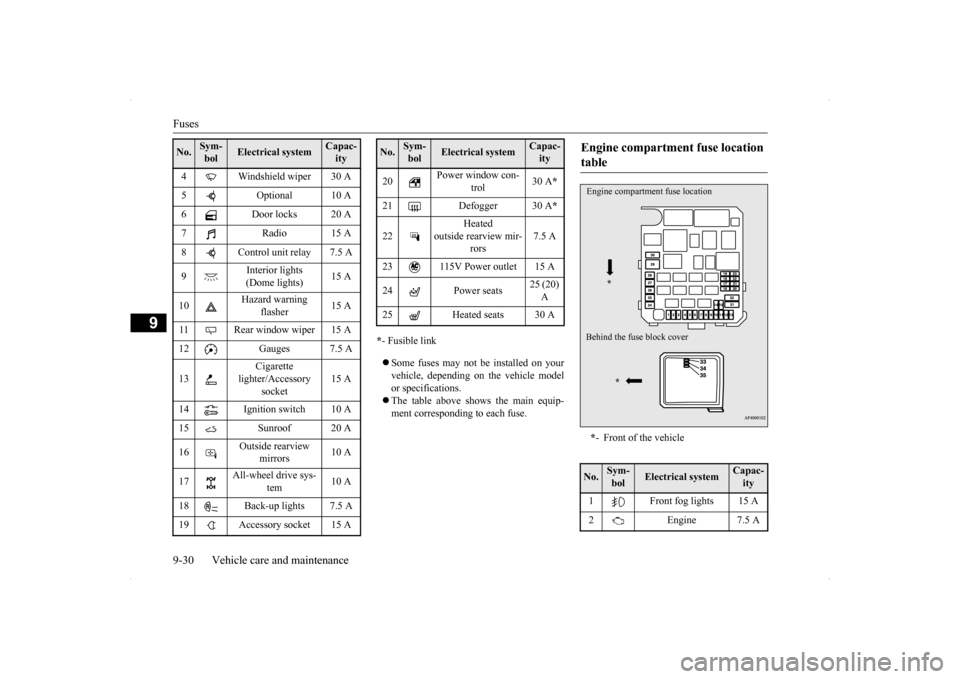
Engine compartment fuse location table * - Front of the vehicle
No.
Sym- bol
Electrical system
Capac-ity
1 Front fog lights 15 A 2 Engine 7.5 AEngine compartment fuse location
*
Behind the fuse
block cover
*
BK0200700US.bo
ok 30 ページ 2013年2月15日 金曜日 午後12時17分
Page 380 of 422
Fuses
Vehicle care and maintenance 9-31
9
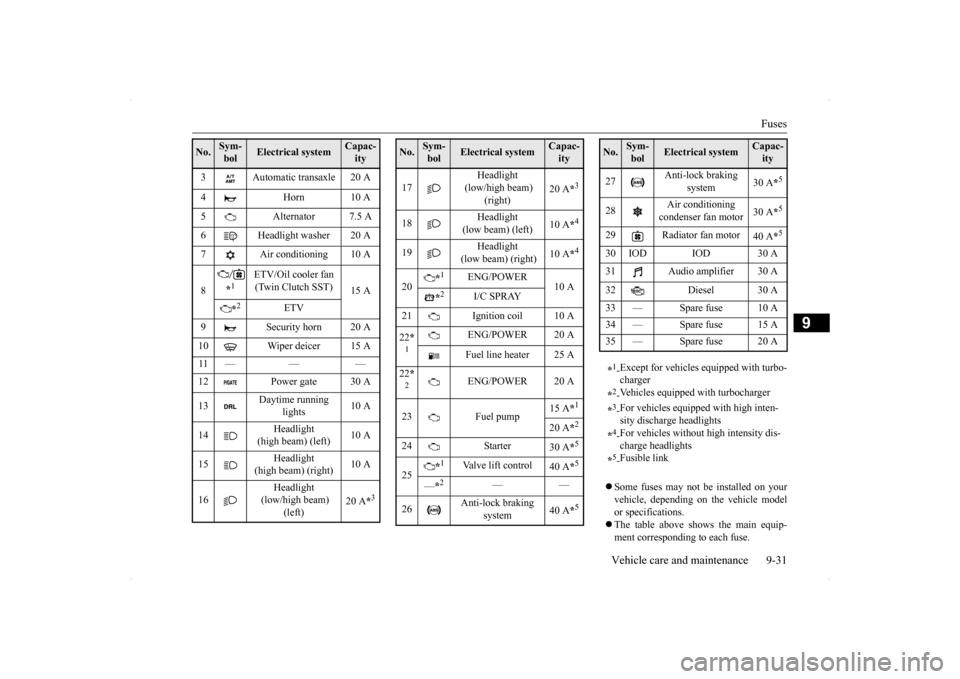
Some fuses may not be installed on your vehicle, depending on the vehicle model or specifications. The table above shows the main equip- ment corresponding to each fuse.
3 Automatic transaxle 20 A 4 Horn 10 A 5 Alternator 7.5 A 6 Headlight washer 20 A 7 Air conditioning 10 A 8
*1
ETV/Oil cooler fan (Twin Clutch SST)
15 A
*2
ETV
9 Security horn 20 A 10 Wiper deicer 15 A 11 — — — 12 Power gate 30 A 13
Daytime running
lights
10 A
14
Headlight
(high beam) (left)
10 A
15
Headlight
(high beam) (right)
10 A
16
Headlight
(low/high beam)
(left)
20 A
*3
No.
Sym- bol
Electrical system
Capac-ity
17
Headlight
(low/high beam)
(right)
20 A
*3
18
Headlight
(low beam) (left)
10 A
*4
19
Headlight
(low beam) (right)
10 A
*4
20
*1
ENG/POWER
10 A
*2
I/C SPRAY
21 Ignition coil 10 A 22 *1
ENG/POWER 20 A Fuel line heater 25 A
22 *2
ENG/POWER 20 A
23 Fuel pump
15 A
*1
20 A
*2
24 Starter
30 A
*5
25
*1
Valve lift control
40 A
*5
—*2
——
26
Anti-lock braking
system
40 A
*5
No.
Sym- bol
Electrical system
Capac-ity
27
Anti-lock braking
system
30 A
*5
28
Air conditioning condenser fan motor
30 A
*5
29 Radiator fan motor
40 A
*5
30 IOD IOD 30 A 31 Audio amplifier 30 A 32 Diesel 30 A 33 — Spare fuse 10 A 34 — Spare fuse 15 A35 — Spare fuse 20 A *1- Except for vehicles equipped with turbo- charger
*2- Vehicles equipped with turbocharger
*3- For vehicles equipped with high inten- sity discharge headlights
*4- For vehicles without high intensity dis- charge headlights
*5- Fusible link
No.
Sym- bol
Electrical system
Capac-ity
BK0200700US.bo
ok 31 ページ 2013年2月15日 金曜日 午後12時17分
Page 385 of 422
Replacement of light bulbs 9-36 Vehicle care and maintenance
9
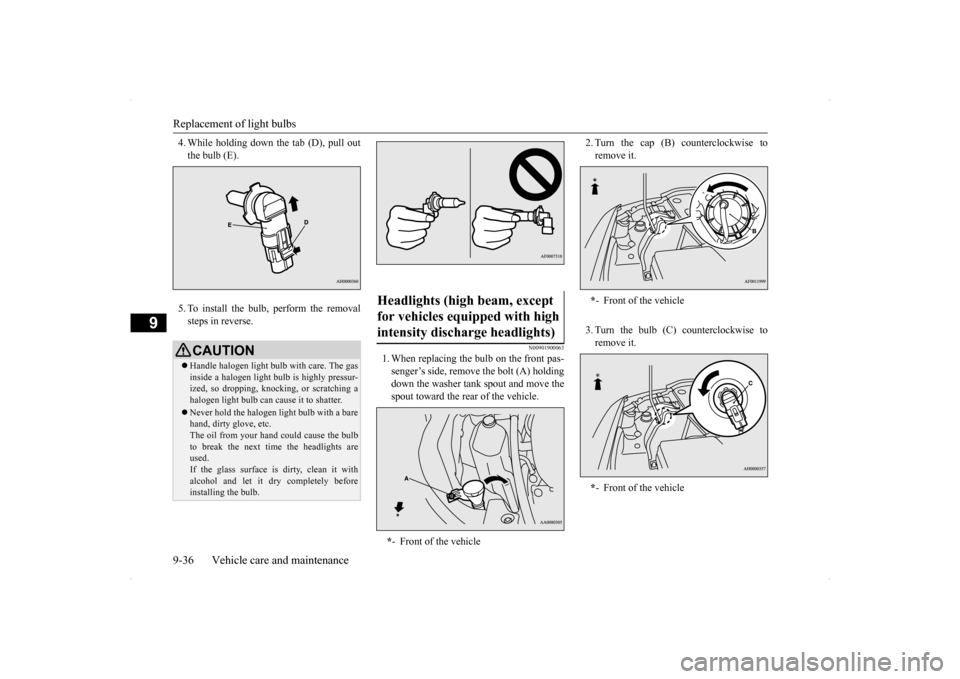
4. While holding down the tab (D), pull out the bulb (E). 5. To install the bulb, perform the removal steps in reverse.
N00901900063
1. When replacing the bulb on the front pas-senger’s side, remove the bolt (A) holdingdown the washer tank spout and move thespout toward the rear of the vehicle.
2. Turn the cap (B) counterclockwise to remove it. 3. Turn the bulb (C) counterclockwise to remove it.
CAUTION Handle halogen light bulb with care. The gas inside a halogen light bulb is highly pressur- ized, so dropping, knocking, or scratching ahalogen light bulb can cause it to shatter. Never hold the halogen light bulb with a bare hand, dirty glove, etc. The oil from your hand could cause the bulb to break the next time the headlights areused. If the glass surface is dirty, clean it with alcohol and let it dry completely beforeinstalling the bulb.
Headlights (high beam, except for vehicles equipped with high intensity discharge headlights) * - Front of the vehicle
*- Front of the vehicle * - Front of the vehicle
BK0200700US.bo
ok 36 ページ 2013年2月15日 金曜日 午後12時17分
Page 386 of 422
Replacement of light bulbs
Vehicle care and maintenance 9-37
9
4. While holding down
the tab (D), pull out
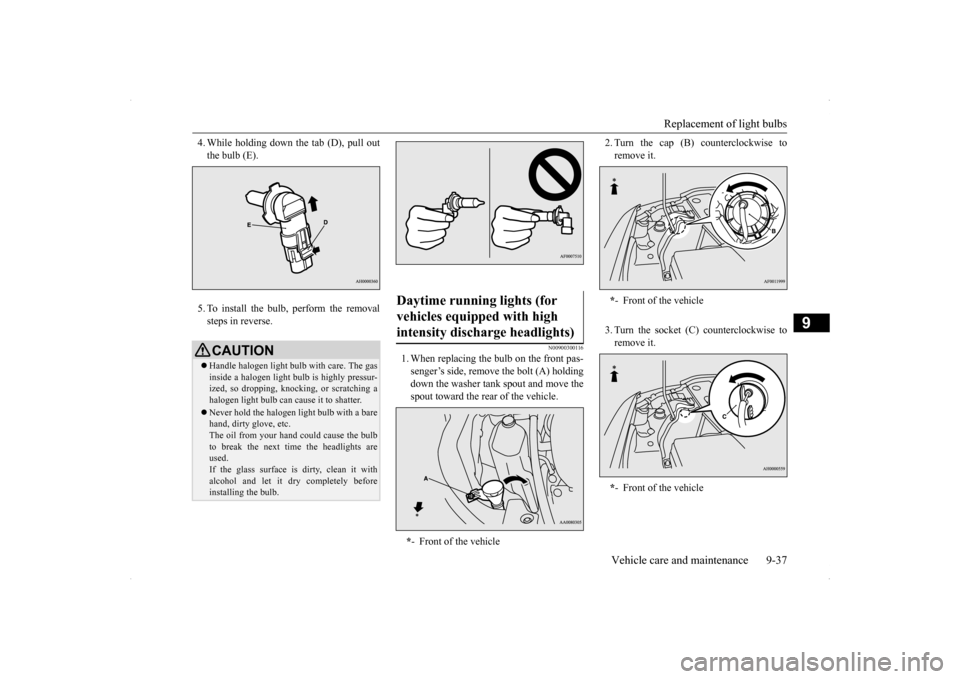
the bulb (E). 5. To install the bulb, perform the removal steps in reverse.
N00900300116
1. When replacing the bulb on the front pas-senger’s side, remove the bolt (A) holdingdown the washer tank spout and move thespout toward the rear of the vehicle.
2. Turn the cap (B) counterclockwise to remove it. 3. Turn the socket (C) counterclockwise to remove it.
CAUTION Handle halogen light bulb with care. The gas inside a halogen light bulb is highly pressur- ized, so dropping, knocking, or scratching ahalogen light bulb can cause it to shatter. Never hold the halogen light bulb with a bare hand, dirty glove, etc. The oil from your hand could cause the bulb to break the next time the headlights areused. If the glass surface is dirty, clean it with alcohol and let it dry completely beforeinstalling the bulb.
Daytime running lights (for vehicles equipped with high intensity discharge headlights) * - Front of the vehicle
*- Front of the vehicle * - Front of the vehicle
BK0200700US.bo
ok 37 ページ 2013年2月15日 金曜日 午後12時17分