lock MITSUBISHI LANCER SPORTBACK 2014 8.G Manual PDF
[x] Cancel search | Manufacturer: MITSUBISHI, Model Year: 2014, Model line: LANCER SPORTBACK, Model: MITSUBISHI LANCER SPORTBACK 2014 8.GPages: 422, PDF Size: 55.11 MB
Page 124 of 422

Starting and stopping the engine Features and controls 5-57
5
6. On vehicles equipped with manual trans- axle, place the gearshift lever in the “N” (Neutral) position. On vehicles equipped with continuouslyvariable transmission (CVT) or Twin Clutch SST, make sure the selector lever (CVT) or the gearshift lever (Twin ClutchSST) is in the “P” (PARK) position. 7. Turn the ignition switch to the “ON” posi- tion and make certain that all warning lights are functioning properly before starting the engine.
8. Turn the ignition switch to the “START” position without pressing the accelerator pedal. Release the key when the engine starts.
After several attempts, you may experience that the engine still does not start. 1. Make sure that all electric devices, such as lights, air conditioning blower and rearwindow defogger, are turned off. 2. While depressing the brake pedal on vehi- cles equipped with continuously variabletransmission (CVT) or the clutch pedal on the vehicles equipped with manual trans- axle, press the accelerator pedal halfwayand hold it there, then crank the engine. Release the accelerator pedal, immedi- ately after the engine starts.
3. If the engine still will not start, the engine could be flooded with too much gasoline. While depressing the brake pedal on vehi- cles equipped with CVT or the clutchpedal on the vehicles equipped with man- ual transaxle, push the accelerator pedal all the way down and hold it there, thencrank the engine for 5 to 6 seconds. Return the ignition switch to the “LOCK” position and release the accelerator pedal.Wait a few seconds, and then crank theengine again for 5 to 6 seconds while depressing the brake pedal or the clutch pedal, but do not push the acceleratorpedal. Release the ignition key if the engine starts. If the engine fails to start, repeat these procedures. If the engine stillwill not start, contact your local Mitsubi- shi Motors dealer or a repair facility of your choice for assistance.
When the ambient temperature is -4 °F (-20 °C) or lower on vehicles equipped with CVT, -22 °F (-30 °C) or lower on vehicles equippedwith Twin Clutch SST, it may not be possible
NOTE
On vehicles equipped with CVT, the starter will not operate unless the selector lever is inthe “P” (PARK) or “N” (NEUTRAL) posi- tion. On vehicles equipped with Twin Clutch SST,the starter will not operate unless the gear- shift lever is in the “P” (PARK) position or the gearshift lever is in the “N” (NEUTRAL)position with the brake pedal depressed. For safety reasons, start the engine in the “P” (PARK) position so that the wheels arelocked.
NOTE
Minor noises may be heard on engine start- up. These will disappear as the engine warms up.
When the engine is hard to start
Startability of continuously vari- able transmission (CVT) vehicles or Twin Clutch SST vehicles at extremely cold ambient tempera- ture
BK0200700US.bo
ok 57 ページ 2013年2月15日 金曜日 午後12時17分
Page 125 of 422

Starting and stopping the engine 5-58 Features and controls
5
to start from a stand-still even with the selec- tor lever (CVT) or the gearshift lever (Twin Clutch SST) in the “D” (DRIVE) position. This phenomenon occurs because the trans-axle has not warmed up sufficiently; it does not indicate a problem. If it occurs, place the selector lever (CVT) or the gearshift lever(Twin Clutch SST) in the “P” (PARK) posi- tion and let the engine idle for at least 10 min- utes.The transaxle will warm up, and you will beable to start normally. Do not leave the vehicle during warm-up operation.
N00547600028
At high altitude locations, the idle speed maybe higher. This is done in order to stabilizethe idle speed when the power steering sys- tem and other systems operate. It does not indicate a malfunction.
N00542300059
1. Bring the vehicle to a complete stop. 2. Fully engage the parking brake whiledepressing the brake pedal.
3. For vehicles equipped with a manual transaxle, turn the ignition switch to the “LOCK” position to stop the engine, and then move the gearshift lever to the 1st(on a uphill) or “R”
(Reverse) (on a down-
hill) position. For vehicles equipped with continuouslyvariable transmission (CVT) or Twin Clutch SST, place the selector lever (CVT) or the gearshift lever (Twin ClutchSST) in the “P” (PARK) position, andthen turn the ignition switch to the “LOCK” position to stop the engine.
Idle speed in high altitude area Stopping the engine
NOTE
For vehicles equipped with Twin Clutch SST, the engine will stop and the vehicle power will turn off approximately 1 second after the ignition switch is turned to the “LOCK” position. The reason for this is that, in the time from when the ignition switch is turned to the“LOCK” position until the engine stops, the gears inside the Twin Clutch SST disengage so that the engine will start smoothly thenext time it is started. Two clutches installed in the Twin Clutch SST alternately engage and disengage toachieve smooth shifting. In addition, the gear on the side with the free clutch is engaged, therefore, quick shifting isperformed. If the engine was stopped with the gear engaged like this, it would provide resistancethe next time the engine is started. Therefore, the gear disengages in the approximately 1- second period until the engine stops. For vehicles equipped with Twin Clutch SST, do not operate the gearshift lever or theaccelerator pedal for approximately 1 second until the engine stops.
BK0200700US.bo
ok 58 ページ 2013年2月15日 金曜日 午後12時17分
Page 129 of 422
Continuously variable transm
ission (CVT) (if so equipped)
5-62 Features and controls
5
driving conditions. This helps achieve smooth driving and excellent fuel efficiency. Also you can manually shift up and shift down the transmission. Refer to “Sportsmode” on page 5-66. The transmission prevents unnecessary upshifts even when the accelerator pedal isreleased and ensures smooth driving. According to the condi
tions, the transmission
will automatically shift to a lower gear ratio to achieve stronger engine braking. This may help reduce your need to use the servicebrake.
N00513800397
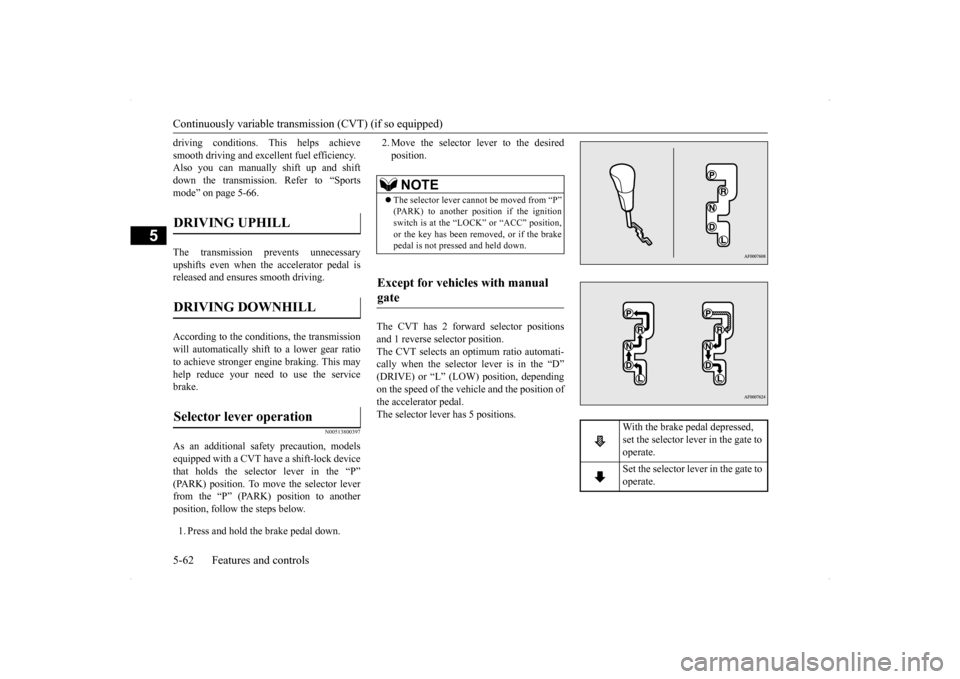
As an additional safety precaution, modelsequipped with a CVT have a shift-lock device that holds the selector lever in the “P” (PARK) position. To move the selector leverfrom the “P” (PARK) position to another position, follow the steps below. 1. Press and hold the brake pedal down.
2. Move the selector lever to the desired position.
The CVT has 2 forward selector positions and 1 reverse selector position. The CVT selects an optimum ratio automati- cally when the selector lever is in the “D”(DRIVE) or “L” (LOW) position, depending on the speed of the vehicle and the position of the accelerator pedal.The selector lever has 5 positions.
DRIVING UPHILL
DRIVING DOWNHILL
Selector lever operation
NOTE
The selector lever cannot be moved from “P” (PARK) to another position if the ignition switch is at the “LOCK” or “ACC” position,or the key has been removed, or if the brake pedal is not pressed and held down.
Except for vehicles with manual gate
With the brake pedal depressed, set the selector lever in the gate to operate. Set the selector lever in the gate to operate.
BK0200700US.bo
ok 62 ページ 2013年2月15日 金曜日 午後12時17分
Page 130 of 422
Continuously variable transmission (CVT) (if so equipped)
Features and controls 5-63
5
The CVT selects an optimum ratio automati- cally when the selector lever is in the “D”
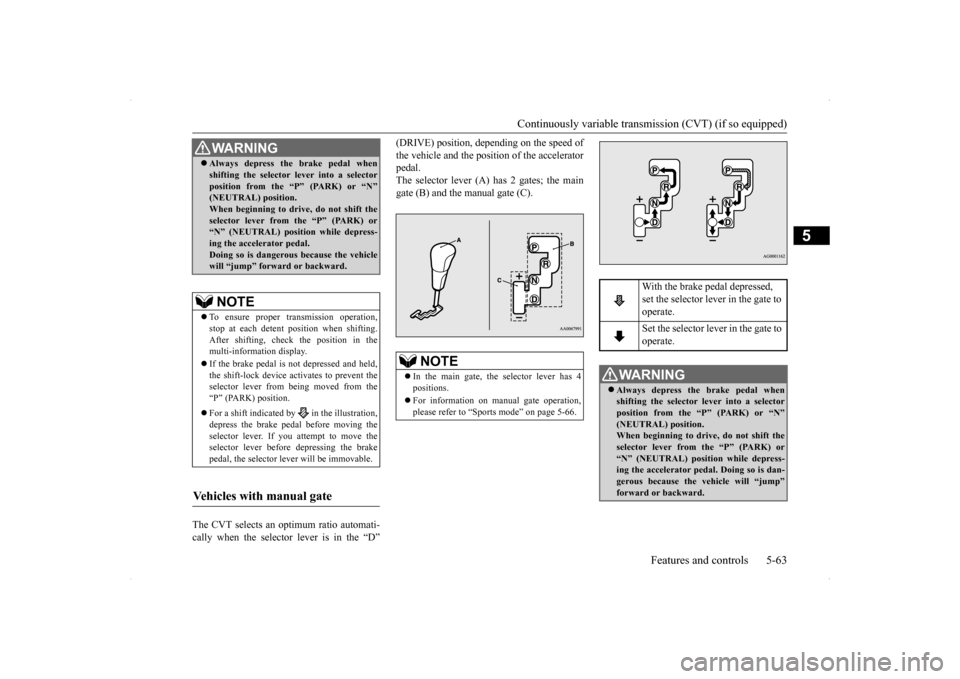
(DRIVE) position, depending on the speed of the vehicle and the position of the accelerator pedal. The selector lever (A) has 2 gates; the maingate (B) and the manual gate (C).
WA R N I N G Always depress the brake pedal when shifting the selector lever into a selector position from the “P” (PARK) or “N” (NEUTRAL) position. When beginning to drive, do not shift theselector lever from the “P” (PARK) or “N” (NEUTRAL) position while depress- ing the accelerator pedal.Doing so is dangerous because the vehicle will “jump” forward or backward.NOTE
To ensure proper transmission operation, stop at each detent position when shifting. After shifting, check the position in the multi-information display. If the brake pedal is not depressed and held, the shift-lock device activates to prevent theselector lever from being moved from the “P” (PARK) position. For a shift indicated by in the illustration, depress the brake pedal before moving the selector lever. If y
ou attempt to move the
selector lever before depressing the brakepedal, the selector lever will be immovable.
Vehicles with manual gate
NOTE
In the main gate, the selector lever has 4 positions. For information on manual gate operation, please refer to “Sports mode” on page 5-66.
With the brake pedal depressed, set the selector lever in the gate to operate. Set the selector lever in the gate to operate.
WA R N I N G Always depress the brake pedal when shifting the selector lever into a selector position from the “P” (PARK) or “N”(NEUTRAL) position. When beginning to drive, do not shift the selector lever from the “P” (PARK) or“N” (NEUTRAL) position while depress- ing the accelerator pedal. Doing so is dan- gerous because the vehicle will “jump”forward or backward.
BK0200700US.bo
ok 63 ページ 2013年2月15日 金曜日 午後12時17分
Page 131 of 422
Continuously variable transm
ission (CVT) (if so equipped)
5-64 Features and controls
5
N00563100021
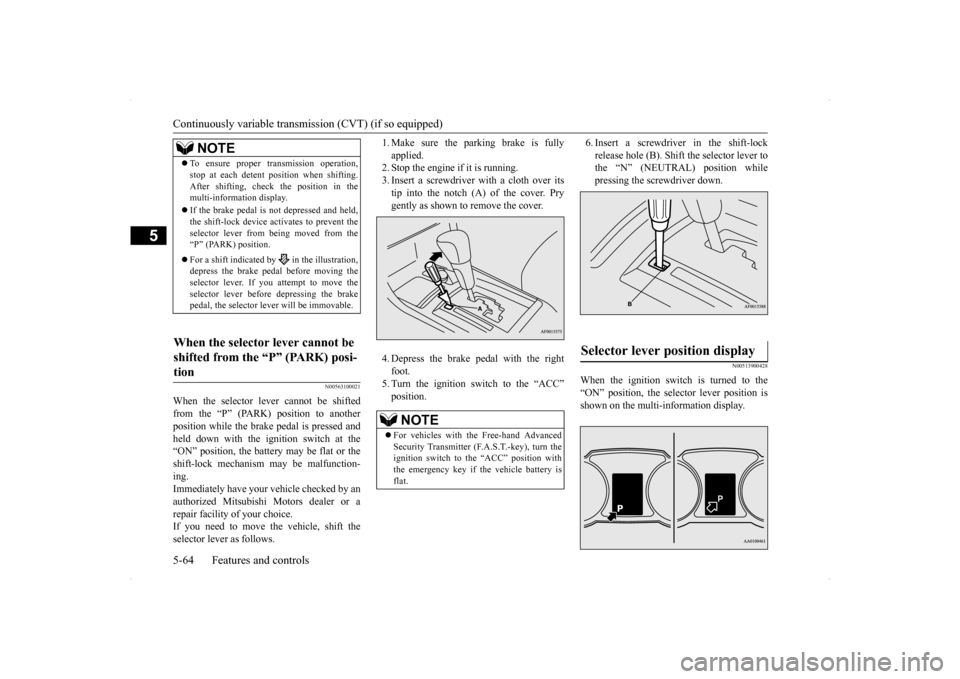
When the selector lever cannot be shifted from the “P” (PARK) position to anotherposition while the brake pedal is pressed andheld down with the ignition switch at the “ON” position, the battery may be flat or the shift-lock mechanism may be malfunction-ing. Immediately have your vehicle checked by an authorized Mitsubishi Motors dealer or arepair facility of your choice. If you need to move the vehicle, shift the selector lever as follows.
1. Make sure the parking brake is fully applied. 2. Stop the engine if it is running. 3. Insert a screwdriver with a cloth over itstip into the notch (A) of the cover. Pry gently as shown to remove the cover. 4. Depress the brake pedal with the right foot.5. Turn the ignition switch to the “ACC”position.
6. Insert a screwdriver in the shift-lock release hole (B). Shift the selector lever to the “N” (NEUTRAL) position while pressing the screwdriver down.
N00513900428
When the ignition switch is turned to the“ON” position, the selector lever position is shown on the multi-information display.
NOTE
To ensure proper transmission operation, stop at each detent position when shifting. After shifting, check the position in the multi-information display. If the brake pedal is not depressed and held, the shift-lock device activates to prevent the selector lever from being moved from the“P” (PARK) position. For a shift indicated by in the illustration, depress the brake pedal before moving the selector lever. If you attempt to move theselector lever before depressing the brake pedal, the selector lever will be immovable.
When the selector lever cannot be shifted from the “P” (PARK) posi-tion
NOTE
For vehicles with the Free-hand Advanced Security Transmitter (F.A.S.T.-key), turn the ignition switch to the “ACC” position withthe emergency key if the vehicle battery is flat.
Selector lever position display
BK0200700US.bo
ok 64 ページ 2013年2月15日 金曜日 午後12時17分
Page 132 of 422
Continuously variable transmission (CVT) (if so equipped)
Features and controls 5-65
5
N00514000240
Type 1
or
Type 2
or
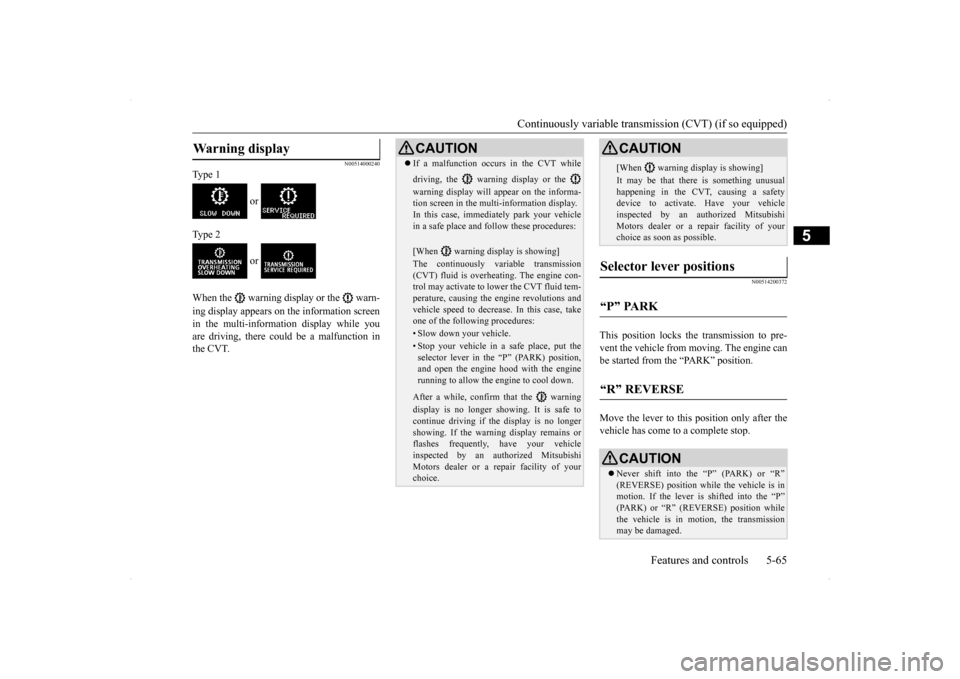
When the warning display or the warn- ing display appears on the information screen in the multi-information display while youare driving, there could be a malfunction in the CVT.
N00514200372
This position locks the transmission to pre- vent the vehicle from moving. The engine canbe started from the “PARK” position. Move the lever to this position only after the vehicle has come to a complete stop.
Warning display
CAUTION If a malfunction occurs in the CVT while driving, the warning display or the warning display will appear on the informa- tion screen in the multi-information display. In this case, immediately park your vehicle in a safe place and follow these procedures: [When warning display is showing] The continuously variable transmission (CVT) fluid is overheating. The engine con- trol may activate to lower the CVT fluid tem-perature, causing the engine revolutions and vehicle speed to decrease. In this case, take one of the following procedures:• Slow down your vehicle.• Stop your vehicle in a safe place, put the selector lever in the “P” (PARK) position, and open the engine hood with the enginerunning to allow the engine to cool down.After a while, confirm that the warning display is no longer showing. It is safe to continue driving if the display is no longer showing. If the warning display remains or flashes frequently, have your vehicleinspected by an authorized Mitsubishi Motors dealer or a repair facility of your choice.
[When warning display is showing] It may be that there is something unusual happening in the CVT, causing a safety device to activate. Have your vehicleinspected by an authorized Mitsubishi Motors dealer or a repair facility of your choice as soon as possible.
Selector lever positions
“P” PARK
“R” REVERSE
CAUTION Never shift into the “P” (PARK) or “R” (REVERSE) position while the vehicle is in motion. If the lever is shifted into the “P”(PARK) or “R” (REVERSE) position while the vehicle is in motion, the transmission may be damaged. CAUTION
BK0200700US.bo
ok 65 ページ 2013年2月15日 金曜日 午後12時17分
Page 137 of 422
Twin Clutch SST (Sportronic Shif
t Transmission) (if so equipped)
5-70 Features and controls
5
N00515300208
If the CVT does not shift while driving, or your vehicle does not pick up enough speed when starting on an uphill slope, there may be something unusual happening in the transmis-sion, causing a safety device to activate. Have your vehicle checked at an authorized Mit- subishi Motors dealer or a repair facility ofyour choice as soon as possible. 1. If your vehicle has difficulty moving uphill, shift the selector lever into “L” (LOW) position (except for vehicles withsport mode) or 2nd shift range of the sports mode. This method might not work dependingon the type of transmission malfunction.
2. Once the vehicle is moving on a level road, move the selector lever back to “D” (DRIVE) position.
N00539700046
The Twin Clutch SST is a transmission that,through integrated control of the engine and transmission, is able to achieve both thesmooth shifting of an automatic transaxle and the acceleration and fuel economy close to a manual transaxle. In addition, the controlmode can be selected from two types to suit the driving conditions. Together with manual shifting, the transmis-sion is capable of responding to a variety of driving circumstances. Twin Clutch SST control mode
P.5-75
Manual shift
P.5-76
N00539800047
As an additional safety precaution, models equipped with a Twin Clutch SST have ashift-lock device that holds the gearshift lever in the “P” (PARK) position. To move the gearshift lever from the “P” (PARK) positionto another position, follow the steps below. 1. Press and hold the brake pedal down. 2. Move the gearshift lever to the desired position.
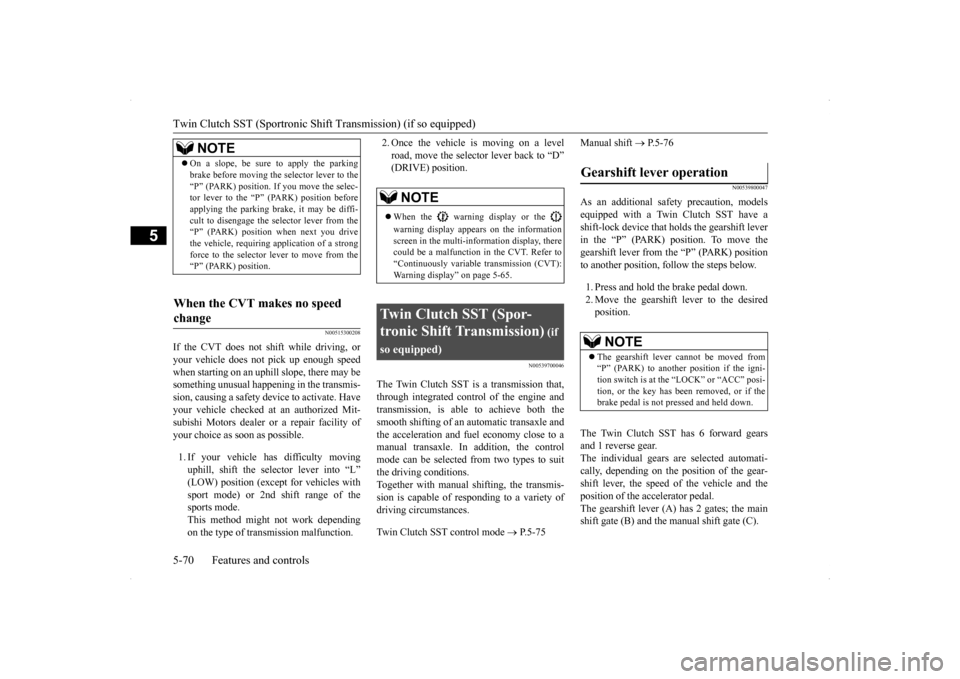
The Twin Clutch SST has 6 forward gears and 1 reverse gear. The individual gears are selected automati-cally, depending on the position of the gear- shift lever, the speed of the vehicle and the position of the accelerator pedal.The gearshift lever (A) has 2 gates; the main shift gate (B) and the manual shift gate (C).
NOTE
On a slope, be sure to apply the parking brake before moving the selector lever to the “P” (PARK) position. If you move the selec- tor lever to the “P” (PARK) position before applying the parking brake, it may be diffi-cult to disengage the selector lever from the “P” (PARK) position when next you drive the vehicle, requiring application of a strongforce to the selector lever to move from the “P” (PARK) position.
When the CVT makes no speed change
NOTE
When the warning display or the warning display appears on the information screen in the multi-information display, therecould be a malfunction in the CVT. Refer to “Continuously variable transmission (CVT): Warning display” on page 5-65.
Twin Clutch SST (Spor- tronic Shift Transmission)
(if
so equipped)
Gearshift lever operation
NOTE
The gearshift lever cannot be moved from “P” (PARK) to another position if the igni-tion switch is at the “LOCK” or “ACC” posi- tion, or the key has been removed, or if the brake pedal is not pressed and held down.
BK0200700US.bo
ok 70 ページ 2013年2月15日 金曜日 午後12時17分
Page 141 of 422
Twin Clutch SST (Sportronic Shif
t Transmission) (if so equipped)
5-74 Features and controls
5
If this occurs, perform the following proce- dure. 1. Park your vehicle in a safe place and stop the engine. 2. Restart the engine. If the warning display goes out, there is no abnormal condition. However, if the warning display remains on or comes on frequently, have the vehicle checked by an authorized Mitsubishi Motorsdealer or a repair facility of your choice as soon as possible.
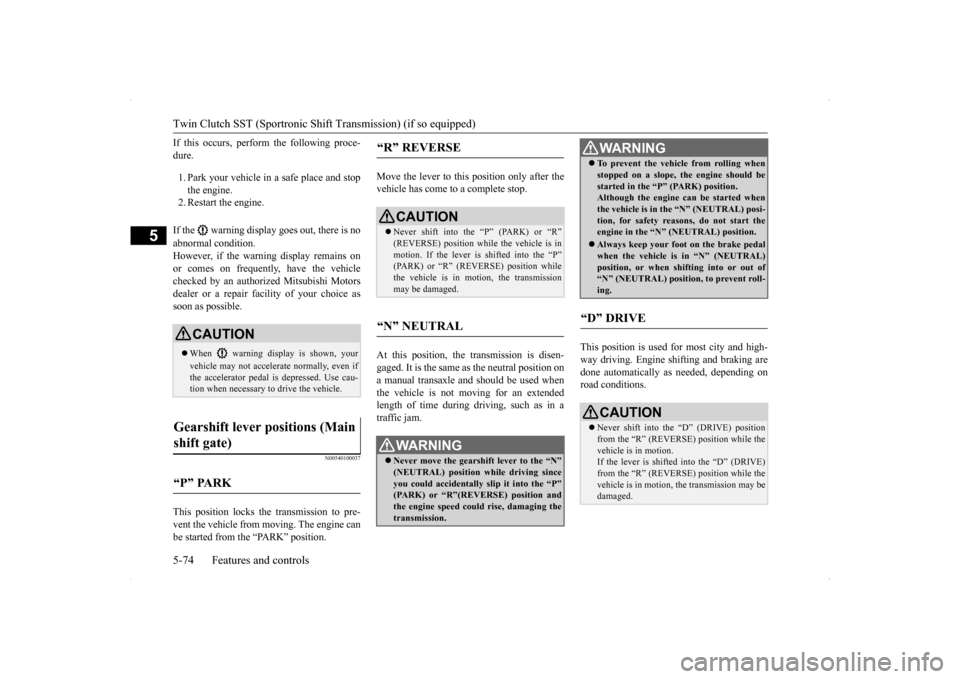
N00540100037
This position locks the transmission to pre- vent the vehicle from moving. The engine canbe started from the “PARK” position.
Move the lever to this position only after the vehicle has come to a complete stop. At this position, the transmission is disen- gaged. It is the same as the neutral position ona manual transaxle and should be used when the vehicle is not moving for an extended length of time during driving, such as in atraffic jam.
This position is used for most city and high- way driving. Engine shifting and braking are done automatically as needed, depending on road conditions.
CAUTION When warning display is shown, your vehicle may not accelerate normally, even if the accelerator pedal is depressed. Use cau-tion when necessary to drive the vehicle.
Gearshift lever positions (Main shift gate)
“P” PARK
“R” REVERSE
CAUTION Never shift into the “P” (PARK) or “R” (REVERSE) position while
the vehicle is in
motion. If the lever is shifted into the “P” (PARK) or “R” (REVERSE) position while the vehicle is in motion, the transmissionmay be damaged.
“N” NEUTRAL
WA R N I N G Never move the gearshift lever to the “N” (NEUTRAL) position while driving since you could accidentally slip it into the “P”(PARK) or “R”(REVERSE) position and the engine speed could rise, damaging the transmission.
To prevent the vehicle from rolling when stopped on a slope, the engine should be started in the “P” (PARK) position. Although the engine can be started when the vehicle is in the “N” (NEUTRAL) posi-tion, for safety reasons, do not start the engine in the “N” (NEUTRAL) position. Always keep your foot on the brake pedal when the vehicle is in “N” (NEUTRAL) position, or when shifting into or out of“N” (NEUTRAL) position, to prevent roll- ing.
“D” DRIVE
CAUTION Never shift into the “D” (DRIVE) position from the “R” (REVERSE) position while the vehicle is in motion. If the lever is shifted into the “D” (DRIVE) from the “R” (REVERSE) position while thevehicle is in motion, the transmission may be damaged.WA R N I N G
BK0200700US.bo
ok 74 ページ 2013年2月15日 金曜日 午後12時17分
Page 143 of 422
Twin Clutch SST (Sportronic Shif
t Transmission) (if so equipped)
5-76 Features and controls
5
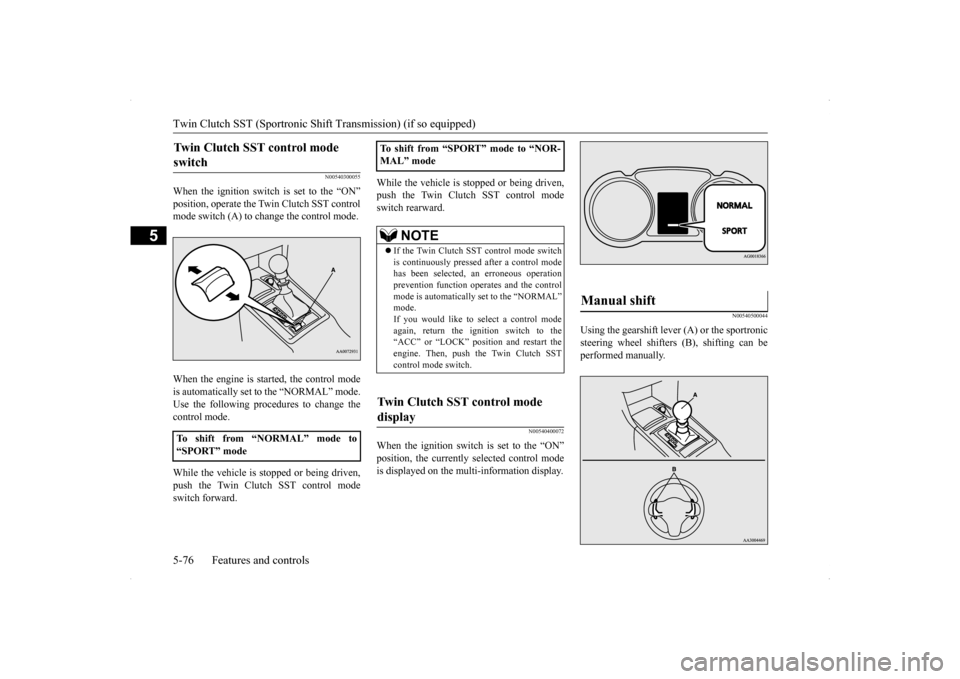
N00540300055
When the ignition switch is set to the “ON” position, operate the Twin Clutch SST control mode switch (A) to change the control mode. When the engine is started, the control mode is automatically set to the “NORMAL” mode. Use the following procedures to change the control mode. While the vehicle is stopped or being driven, push the Twin Clutch SST control modeswitch forward.
While the vehicle is stopped or being driven, push the Twin Clutch SST control mode switch rearward.
N00540400072
When the ignition switch is set to the “ON”position, the currently selected control modeis displayed on the multi-information display.
N00540500044
Using the gearshift lever (A) or the sportronicsteering wheel shifters (B), shifting can beperformed manually.
Twin Clutch SST control mode switch
To shift from “NORMAL” mode to “SPORT” mode
To shift from “SPORT” mode to “NOR- MAL” mode
NOTE
If the Twin Clutch SST control mode switch is continuously pressed after a control modehas been selected, an erroneous operation prevention function operates and the control mode is automatically set to the “NORMAL”mode. If you would like to select a control mode again, return the ignition switch to the“ACC” or “LOCK” position and restart the engine. Then, push the Twin Clutch SST control mode switch.
Twin Clutch SST control mode display
Manual shift
BK0200700US.bo
ok 76 ページ 2013年2月15日 金曜日 午後12時17分
Page 150 of 422
ACD (Active center differential system) (if so equipped)
Features and controls 5-83
5
between tires. Refer to “Tire rotation” on page 9-22. Check the tire inflation pressure regularly.
N00538500050
The ACD is a system
that improves accelera-
tion performance and straight-ahead stability by regulating the differential limiting actionand power drive distribution of the center dif- ferential.
N00545400035
Select the control mode from the following three types to suit the driving conditions.
CAUTION Always use tires of the same size, type, and brand that have no wear differences. Using tires of different size, type, brands or degreeof wear, will increase the differential oil tem- perature and result in possible damage to the driving system. Further, the drive train willbe subjected to excessive loading, possibly leading to oil leakage, component seizure, or other serious failures.
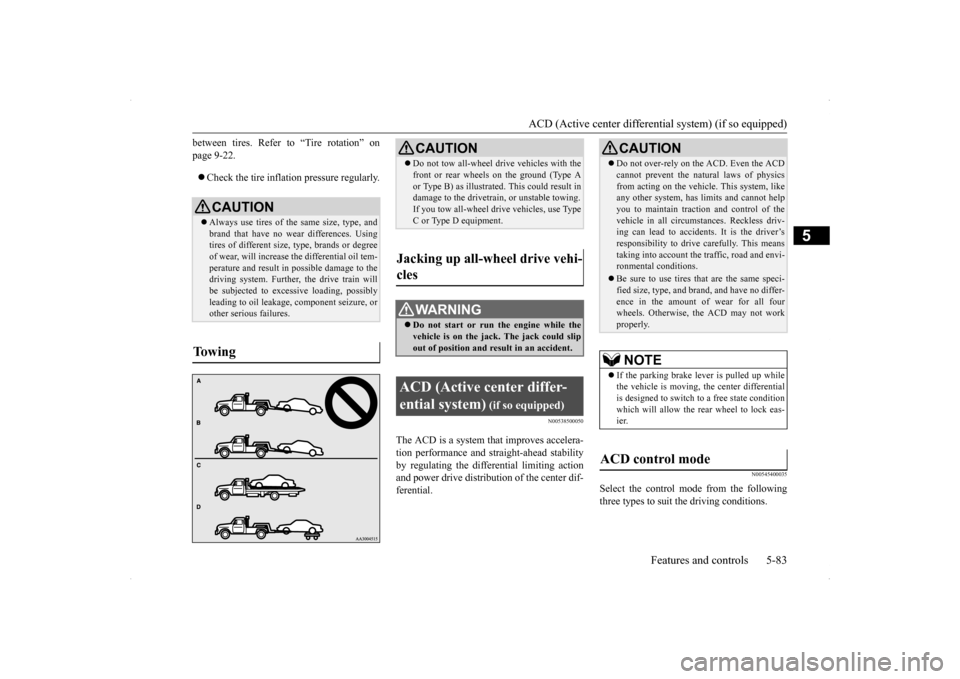
To w i n g
CAUTION Do not tow all-wheel dr
ive vehicles with the
front or rear wheels on the ground (Type A or Type B) as illustrated. This could result in damage to the drivetrain, or unstable towing. If you tow all-wheel drive vehicles, use TypeC or Type D equipment.
Jacking up all-wheel drive vehi- cles
WA R N I N G Do not start or run the engine while the vehicle is on the jack. The jack could slip out of position and result in an accident.
ACD (Active center differ- ential system)
(if so equipped)
CAUTION Do not over-rely on th
e ACD. Even the ACD
cannot prevent the natural laws of physics from acting on the vehicle. This system, like any other system, has limits and cannot help you to maintain traction and control of thevehicle in all circumstances. Reckless driv- ing can lead to accidents. It is the driver’s responsibility to drive carefully. This meanstaking into account the traffic, road and envi- ronmental conditions. Be sure to use tires that are the same speci- fied size, type, and brand, and have no differ- ence in the amount of wear for all fourwheels. Otherwise, the ACD may not work properly.NOTE
If the parking brake lever is pulled up while the vehicle is moving, the center differential is designed to switch to a free state condition which will allow the rear wheel to lock eas-ier.
ACD control mode
BK0200700US.bo
ok 83 ページ 2013年2月15日 金曜日 午後12時17分