ignition MITSUBISHI MIRAGE 2017 6.G Owner's Manual
[x] Cancel search | Manufacturer: MITSUBISHI, Model Year: 2017, Model line: MIRAGE, Model: MITSUBISHI MIRAGE 2017 6.GPages: 305, PDF Size: 8.67 MB
Page 99 of 305
![MITSUBISHI MIRAGE 2017 6.G Owners Manual Starting the engine 5-36 Features and controls
5
N00512601816
[For vehicles equipped with the Free-hand Advanced Security Transmitter (F.A.S.T.- key)]For information on operation for vehicles equipped](/img/19/7514/w960_7514-98.png "MITSUBISHI MIRAGE 2017 6.G Owners Manual Starting the engine 5-36 Features and controls
5
N00512601816
[For vehicles equipped with the Free-hand Advanced Security Transmitter (F.A.S.T.- key)]For information on operation for vehicles equipped")
Starting the engine 5-36 Features and controls
5
N00512601816
[For vehicles equipped with the Free-hand Advanced Security Transmitter (F.A.S.T.- key)]For information on operation for vehicles equipped with the Free-hand Advanced Secu- rity Transmitter (F.A.S.T.-key), refer to“Free-hand Advanced Se
curity Transmitter
(F.A.S.T.-key): Starting and stopping the engine” on page 5-16. [Except for vehicles equipped with the Free-hand Advanced Security Transmit- ter (F.A.S.T.-key)] Do not operate the starter motor continu- ously for longer than 15 seconds as this could run the battery down or damage thestarter motor. If the engine does not start, turn the ignition switch back to the “OFF”
conds, and then try
again. Trying repeatedly with the engine or starter motor still turning will damage the starter mechanism. If the engine will not start because the bat- tery is weak or discharged, refer to “Jump-starting the engine” (on page 8-2)for instructions.
A longer warm up period will only con- sume extra fuel. The engine is warmed upenough for driving when the low coolant temperature indi
cator goes out.
Refer to “Low coolant temperature indi-cator” on page 5-71.
This model is equipped with an electronically controlled fuel injection system. This is a sys- tem that automatically controls fuel injection.
There is usually no need to depress the accel- erator pedal when starting the engine.The starter should not be run for more than 15 seconds at a time. To prevent battery drain, wait a few secondsbetween attempts to restart the engine. 1. Make sure all occupants are properly seated with seat belts fastened. 2. Insert the ignition key.3. Make sure the parking brake is applied. 4. Press and hold the brake pedal down with your right foot. 5. Press and hold the clutch pedal all the way down (manual transaxle). 6. On vehicles equippe
d with manual trans-
axle, place the gearshift lever in the “N” On vehicles equippe
d with continuously
variable transmission (CVT), make surethe selector lever is in the “P” (PARK) position.
Starting the engine Tips for starting
WA R N I N G Never run the engine in
a closed or poorly
ventilated area any longer than is neededto move your vehicle out of the area. Car- bon monoxide gas, which is odorless and extremely poisonous, could build up andcause serious injury or death.CAUTION Do not push-start the vehicle.Do not run the engine at high rpms or drive at high speeds until the engine has had a chance to warm up. Release the ignition sw
itch as soon as the
engine starts. Otherwise, the starter motorwill be damaged.
Starting the engine
NOTE
On vehicles equipped
with manual transaxle,
the starter will not ope
rate unless the clutch
pedal is fully depresse
d (Clutch interlock).
BK0235100US.book 36 ページ 2015年11月20日 金曜日 午後3時12分
Page 100 of 305
Manual transaxle (if so equipped)
Features and controls 5-37
5
7. Turn the ignition switch to the “ON” posi- tion and make certain that all warning lights are functioning properly beforestarting the engine. 8. Turn the ignition switch to the “START”
ng the accelerator
pedal. Release the
key when the engine
starts.
After several attempts, you may experience that the engine still does not start. 1. Make sure that all electric devices, such as lights, air conditio
ning blower and rear
window defogger, are turned off.
2. While depressing the brake pedal {contin- uously variable transmission (CVT)} orthe clutch pedal (manual transaxle), press the accelerator peda
l halfway and hold it
there, then crank th
e engine. Release the
accelerator pedal, immediately after the engine starts. 3. If the engine still will not start, the enginecould be flooded with too much gasoline. While depressing the brake pedal (CVT) or the clutch pedal (manual transaxle), push the accelerator pedal all the way down and hold it there, then crank theengine for 5 to 6 seconds. Return the igni- tion switch to the “OFF” position and release the accelerator pedal. Wait a fewseconds, and then crank the engine again for 5 to 6 seconds while depressing the brake pedal (CVT) or the clutch pedal(manual transaxle), but do not push the accelerator pedal. Re
lease the ignition key
if the engine starts. If the engine fails tostart, repeat these procedures. If the engine still will not
start, contact your
local Mitsubishi Motors dealer or a repairfacility of your choi
ce for assistance.
When the ambient temperature is -4 °F (-20 °C) or lower, it may not be possible to startfrom a standstill even with the selector lever in the
Page 103 of 305
Continuously variable transmission (CVT) (if so equipped) 5-40 Features and controls
5
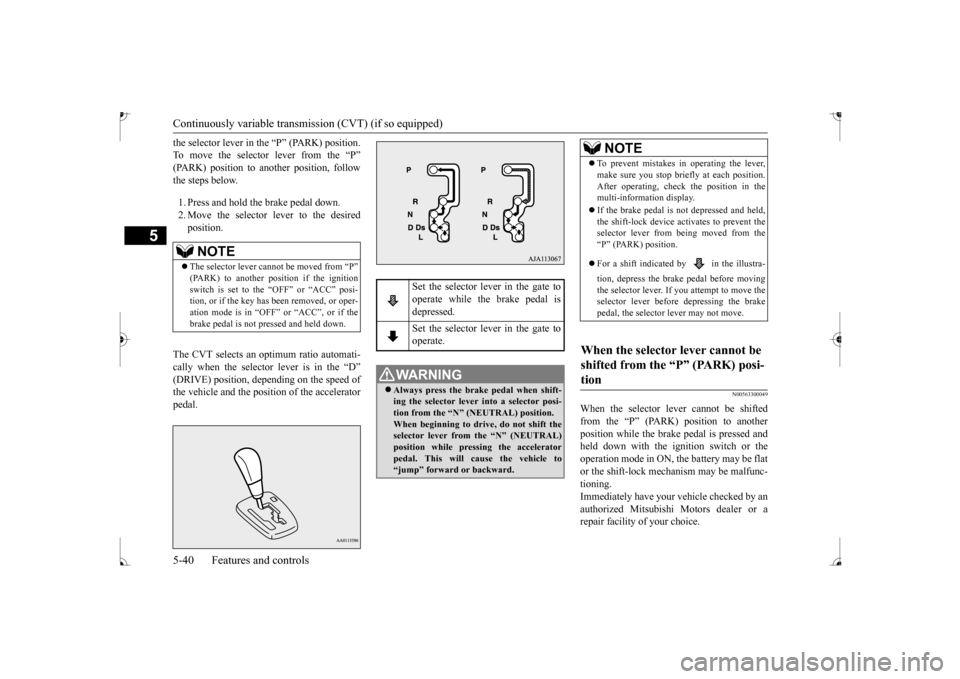
the selector lever in the “P” (PARK) position. To move the selector lever from the “P”
nother position, follow
the steps below. 1. Press and hold the brake pedal down. 2. Move the selector
lever to the desired
position.
The CVT selects an optimum ratio automati- cally when the selector lever is in the “D” the vehicle and the position of the acceleratorpedal.
N00563300049
When the selector lever cannot be shiftedfrom the “P” (PARK) position to another position while the brake pedal is pressed and held down with the ignition switch or theoperation mode in ON, th
e battery may be flat
or the shift-lock mechanism may be malfunc- tioning.Immediately have your
vehicle checked by an
authorized Mitsubishi Motors dealer or a repair facility of your choice.
NOTE
The selector lever cannot
be moved from “P” ition if the ignition
switch is set to the “OFF” or “ACC” posi- tion, or if the key has been removed, or oper-ation mode is in “OFF” brake pedal is not pressed and held down.
Set the selector lever in the gate to operate while the brake pedal is depressed. Set the selector lever in the gate to operate.
WA R N I N G Always press the brake pedal when shift- ing the selector lever into a selector posi- tion from the
Page 104 of 305
Continuously variable transmission (CVT) (if so equipped)
Features and controls 5-41
5
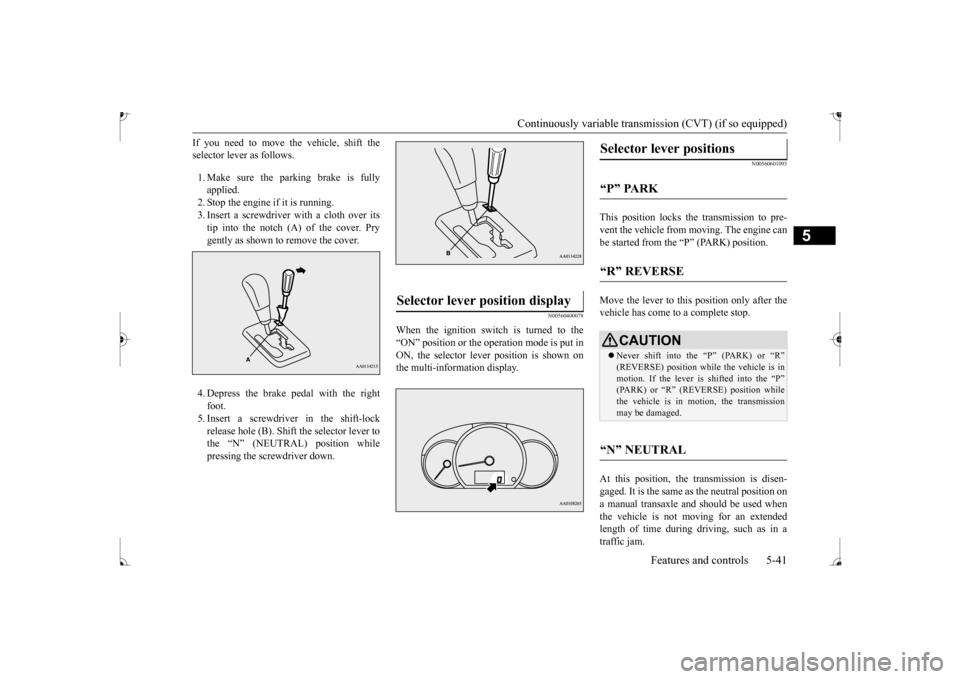
If you need to move the vehicle, shift the selector lever as follows. 1. Make sure the parking brake is fully applied. 2. Stop the engine if it is running. 3. Insert a screwdrive
r with a cloth over its
tip into the notch (A) of the cover. Pry gently as shown to remove the cover. 4. Depress the brake pe
dal with the right
foot. 5. Insert a screwdriver in the shift-lock release hole (B). Shift the selector lever tothe “N” (NEUTRAL) position while pressing the screwdriver down.
N00560400078
When the ignition switch is turned to the “ON” position or the ope
ration mode is put in
ON, the selector leve
r position is shown on
the multi-information display.
N00560601093
This position locks the transmission to pre- vent the vehicle from m
oving. The engine can
be started from the “P” (PARK) position. Move the lever to this position only after the vehicle has come to a complete stop. At this position, the
transmission is disen-
gaged. It is the same
as the neutral position on
a manual transaxle and should be used when the vehicle is not moving for an extended length of time during driving, such as in atraffic jam.
Selector lever position display
Selector lever positions
“P” PARK
“R” REVERSE
CAUTION Never shift into the “P” (PARK) or “R” motion. If the lever is shifted into the “P”the vehicle is in motion, the transmission may be damaged.
“N” NEUTRAL
BK0235100US.book 41 ページ 2015年11月20日 金曜日 午後3時12分
Page 108 of 305
Hill start assist
Features and controls 5-45
5
If the power brake unit or either of the two brake hydraulic systems stops working prop-erly, the rest of the brake system will still work, but the vehicle will not slow down as quickly.You will know this ha
s happened if you find
you need to press the brake down farther, or harder when slowing down or stopping, or ifthe brake warning light and the warning dis- play in the multi-information display comes on. Have the brake system repaired at an authorized Mitsubishi Motors dealer or a repair facility of y
our choice immediately.
N00550700124
The disc brakes have an alarm that makes a metallic squeal when
the brake pads have
worn down enough to need service.If you hear this sound, have the brake pads replaced at an authorized Mitsubishi Motors dealer or a repair facility of your choice.
N00562601114
The hill start assist makes it easy to start offon a steep uphill slope by preventing the vehicle from moving backwards. It keeps the brakes applied for about 2 seconds when youmove your foot from the brake pedal to the accelerator pedal.
N00562701115
1. Stop the vehicle completely using the brake pedal.
WA R N I N G Never coast downhill
with the engine OFF.
Keep the engine running whenever your vehicle is in motion. If you turn off theengine while driving, the power brake booster will stop wo
rking and your brakes
will not work as well. If the power assist is lost or if either brake hydraulic system stop
s working properly,
take your vehicle
to an authorized
Mitsubishi Motors dealer
or a repair facil-
ity of your choice immediately.
Brake pad wear alarm
WA R N I N G Driving with worn brake pads will make it harder to stop, and can cause an accident.
Hill start assist
CAUTION Do not overly rely on the hill start assist to prevent backwards movement of the vehicle.Under certain circumstan
ces, even when hill
start assist is activated, the vehicle may move backwards if the brake pedal is not suf- ficiently depressed, if the vehicle is heavilyloaded, or if the road is very steep or slip- pery. The hill start assist is
not designed to keep
the vehicle stopped in place on uphill slopes for more than 2 seconds. When facing uphill, do not rely on using the hill start assist to
maintain a stopped position
as an alternative to depressing the brake pedal. Doing so could cause an accident. Do not perform the following operation while the hill start assist is operating.[Except for vehicles equipped with the F. A . S . T. - k e y ] Turn the ignition switch to the “OFF” or“ACC” position. [Vehicles equipped with the F.A.S.T.-key] Put the operation mode
in OFF or ACC. The
hill start assist coul
d stop operating, which
could result in an accident.
To operate
BK0235100US.book 45 ページ 2015年11月20日 金曜日 午後3時12分
Page 111 of 305
Anti-lock braking system 5-48 Features and controls
5
N00531600674
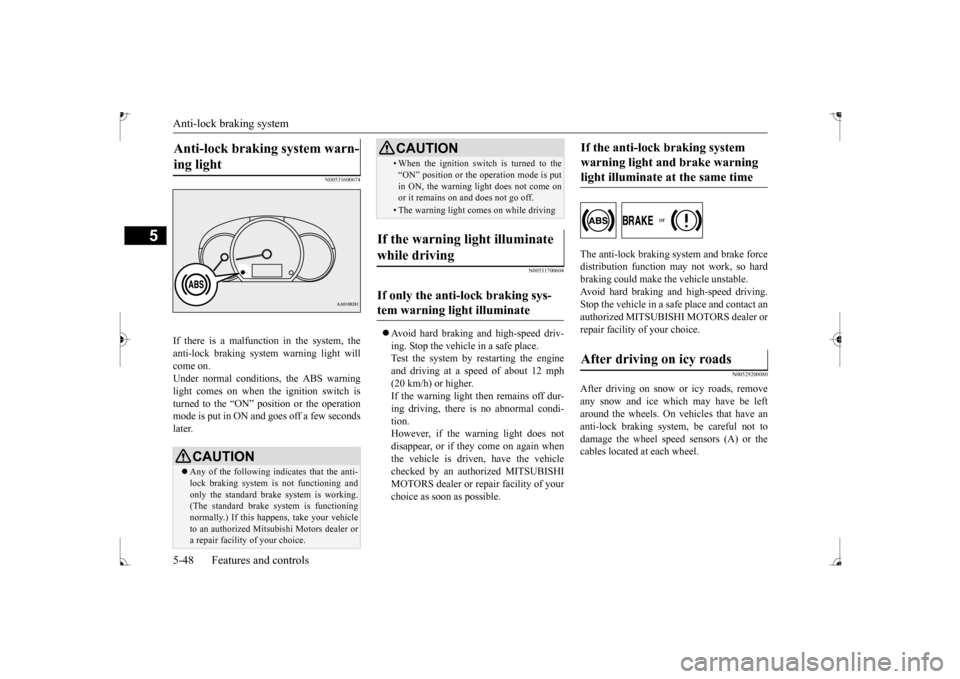
If there is a malfunction in the system, the anti-lock braking system warning light will come on.Under normal conditions, the ABS warning light comes on when the ignition switch is turned to the “ON” position or the operationmode is put in ON and goes off a few seconds later.
N00531700604
Avoid hard braking and high-speed driv- ing. Stop the vehicl
e in a safe place.
Test the system by restarting the engine and driving at a speed of about 12 mph (20 km/h) or higher.If the warning light then remains off dur- ing driving, there is no abnormal condi- tion.However, if the warning light does not disappear, or if they come on again when the vehicle is driven, have the vehiclechecked by an authorized MITSUBISHI MOTORS dealer or repair facility of your choice as soon as possible.
The anti-lock braking system and brake force distribution function ma
y not work, so hard
braking could make the vehicle unstable. Avoid hard braking and high-speed driving.Stop the vehicle in a safe place and contact an authorized MITSUBISHI MOTORS dealer or repair facility of your choice.
N00529200080
After driving on snow
or icy roads, remove
any snow and ice whic
h may have be left
around the wheels. On vehicles that have an anti-lock braking syst
em, be careful not to
damage the wheel spee
d sensors (A) or the
cables located at each wheel.
Anti-lock braking system warn- ing light
CAUTION Any of the following indicates that the anti- lock braking system is not functioning andonly the standard brake system is working. (The standard brake system is functioning normally.) If this happe
ns, take your vehicle
to an authorized Mits
ubishi Motors dealer or
a repair facility of your choice.
• When the ignition switch is turned to the “ON” position or the operation mode is putin ON, the warning li
ght does not come on
or it remains on and does not go off.• The warning light comes on while driving
If the warning light illuminate while driving If only the anti-lock braking sys- tem warning light illuminate
CAUTION
If the anti-lock braking system warning light and brake warning light illuminate at the same time After driving on icy roads
BK0235100US.book 48 ページ 2015年11月20日 金曜日 午後3時12分
Page 112 of 305
Electric power steering system (EPS)
Features and controls 5-49
5
N00568400074
The power steering system operates while the engine is running. It helps reduce the effort needed to turn the steering wheel. The power steering system has mechanicalsteering capability in ca
se the power assist is
lost. If the power assist is lost for some rea- son, you will still be ab
le to steer your vehi-
cle, but you will notice it takes much more effort to steer. If this happens, have your vehi- cle inspected at an authorized MitsubishiMotors dealer or a repair facility of your choice.
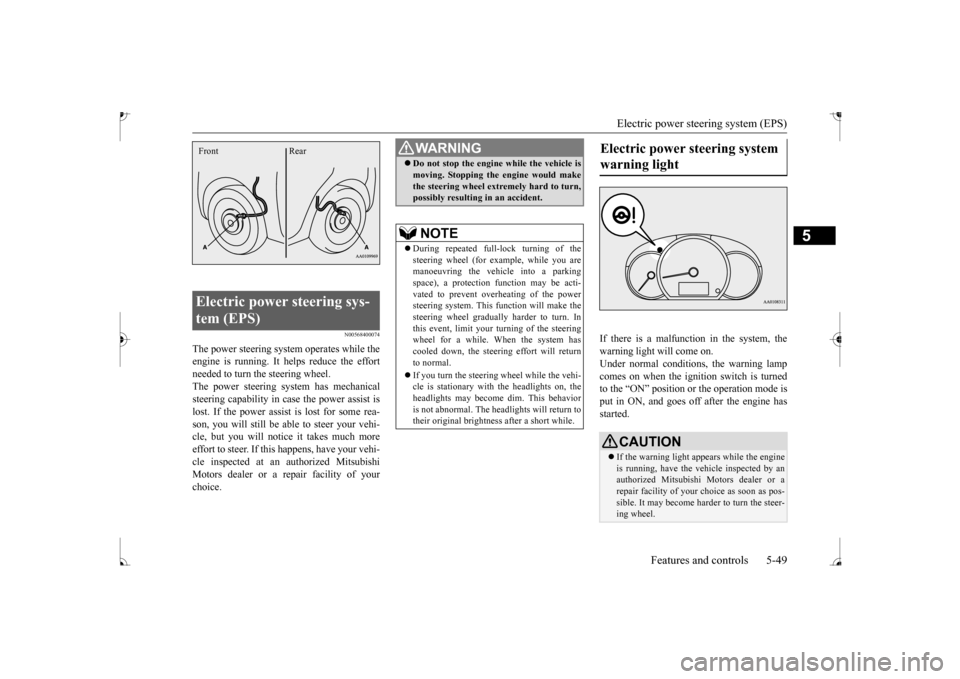
If there is a malfunction in the system, the warning light will come on. Under normal conditions
, the warning lamp
comes on when the ignition switch is turnedto the “ON” position or the operation mode is put in ON, and goes off after the engine has started.
Electric power steering sys- tem (EPS) Front Rear
WA R N I N G Do not stop the engine while the vehicle is moving. Stopping the engine would makethe steering wheel extremely hard to turn,possibly resulting
in an ac
cident.
NOTE
During repeated full-lock turning of the steering wheel (for example, while you are manoeuvring the vehicl
e into a parking
space), a protection
function may be acti-
vated to prevent overheating of the power steering system. This f
unction will make the
steering wheel graduall
y harder to turn. In
this event, limit your turning of the steering wheel for a while. When the system hascooled down, the steeri
ng effort will return
to normal. If you turn the steering wheel while the vehi- cle is stationary with
the headlights on, the
headlights may become
dim. This behavior
is not abnormal. The he
adlights will return to
their original brightne
ss after a short while.
Electric power steering system warning light
CAUTION If the warning light appears while the engine is running, have the vehicle inspected by an authorized Mitsubishi Motors dealer or arepair facility of your choice as soon as pos- sible. It may become ha
rder to turn the steer-
ing wheel.
BK0235100US.book 49 ページ 2015年11月20日 金曜日 午後3時12分
Page 113 of 305
Active stability control (ASC)
5
N00559100176
The Active stability
control (ASC) takes
overall control of the
anti-lock braking sys-
tem, traction control function and skid controlfunction to help maintain the vehicle’s control and traction. Please read
this section in con-
junction with the page on the anti-lock brak-ing system, traction control function and skid control function. Anti-lock braking system
P.5-47
Traction control function
P.5-50
Skid control function
P.5-50
N00559200076
On slippery surfaces, the traction control function prevents the drive wheels from spin-
ning excessive, thus helping the vehicle to start moving from a stopp
ed condition.
It also
provides sufficient driv
ing force and steering
performance as the vehicle turns while press- ing the acceleration pedal.
N00559300051
The skid control function is designed to helpthe driver maintain control of the vehicle onslippery roads or during rapid steering maneuvers. It works by controlling the engine output and the brake on each wheel.
N00559400254
The ASC is automatically activated when theignition switch is turned to the “ON” position or the operation mode is put in ON. You can
Active stability control (ASC)
CAUTION Do not over-rely on the ASC. Even the ASC cannot prevent the natural laws of physicsfrom acting on the vehicle. This system, like any other system, has
limits and cannot help
you to maintain traction and control of thevehicle in all circumstances. Reckless driv- ing can lead to accidents. It is the driver’s responsibillty to drive carefully, This meanstaking into account the tr
affic, road and envi-
ronmental conditions. Be sure to use the same specified type and size of tire on all four wheels. Otherwise, the ASC may not work properly.
Do not install any aftermarket limited slip differential (LSD) on your vehicle. The ASCmay stop functioning properly.NOTE
An operating sound or vibration may be emitted from under the body in the followingsituations. The sound or
vibration is associ-
ated with checking th
e operations of the
ASC. At this time, you may feel a shockfrom under the body and the brake pedal if you depress it. These do
not indicate a mal-
function. • When the ignition switch is turned to the “ON” position or the operation mode is putin ON. • When the vehicle is driven for a while after the engine is turned on.
When the ASC is acti
vated, you may feel a
vibration in the vehicle body or hear a whin- ing sound from the engine compartment. This indicates that the system is operatingnormally. It does not i
ndicate a malfunction.
When the anti-lock braking system warning light is illuminated, the ASC is not active.
Traction control function
CAUTION
CAUTION When driving a vehicle on a snowy or icy road, be sure to install snow tires and drive the vehicle at moderate speeds.
Skid control function
NOTE
The skid control function operates at speeds of about 9 mph (15 km/h) or higher.
ASC OFF switch
BK0235100US.book 50 ページ 2015年11月20日 金曜日 午後3時12分
Page 115 of 305
Cruise control (if so equipped)
5
N00546300031
N00518300573
Cruise control is an
automatic speed control
system that keeps a set speed. It can be acti-vated at speeds from about 25 mph (40 km/h). Cruise control does not work at speeds below about 25 mph (40 km/h).
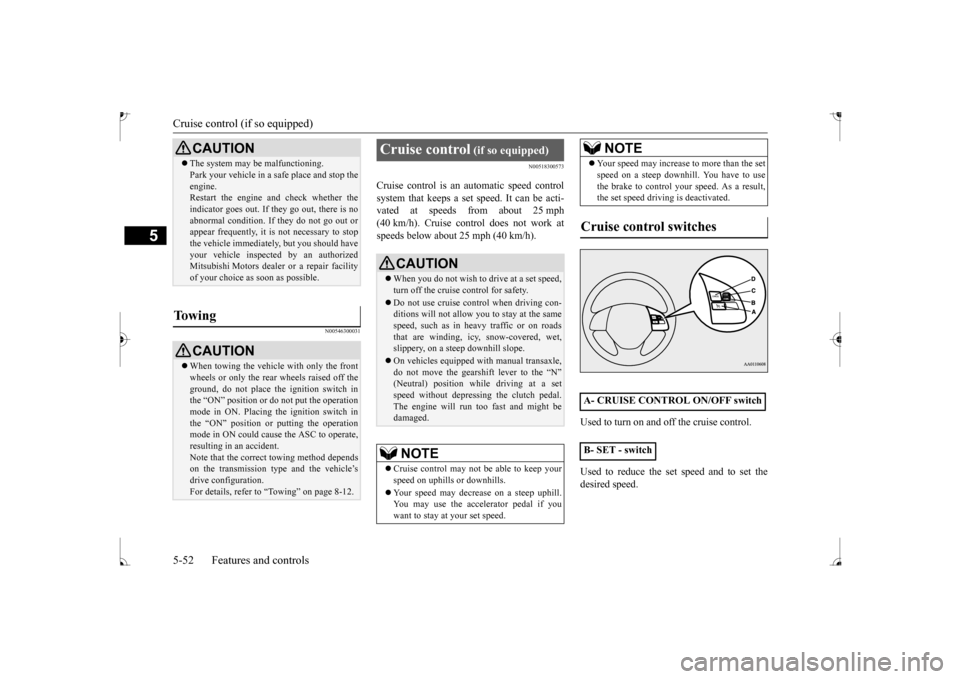
Used to turn on and off the cruise control. Used to reduce the set speed and to set the desired speed.
CAUTION The system may be malfunctioning. Park your vehicle in a
safe place and stop the
engine.Restart the engine and check whether the indicator goes out. If they go out, there is no abnormal condition. If they do not go out orappear frequently, it is
not necessary to stop
the vehicle imme
diately, but you should have
your vehicle inspecte
d by an authorized
Mitsubishi Motors dealer
or a repair facility
of your choice as soon as possible.
To w i n g
CAUTION When towing the vehicle with only the front wheels or only the rear wheels raised off theground, do not place the ignition switch in the “ON” position or do
not put the operation
mode in ON. Placing
the ignition switch in
the “ON” position or
putting the operation
mode in ON could cause the ASC to operate, resulting in an accident.Note that the correct towing method dependson the transmission type and the vehicle’s drive configuration. For details, refer to
“Towing” on page 8-12.
Cruise control
(if so equipped)
CAUTIONWhen you do not wish to drive at a set speed, turn off the cruise control for safety. Do not use cruise cont
rol when driving con-
ditions will not allow you to stay at the same speed, such as in heavy traffic or on roads that are winding, icy, snow-covered, wet,slippery, on a stee
p downhill slope.
On vehicles equipped
with manual transaxle,
do not move the gearshift lever to the “N” (Neutral) position whil
e driving at a set
speed without depressi
ng the clutch pedal.
The engine will run
too fast and might be
damaged.NOTE
Cruise control may not
be able to keep your
speed on uphills or downhills. Your speed may decrease on a steep uphill. You may use the accelerator pedal if you want to stay at your set speed.
Your speed may increase to more than the set speed on a steep downhill. You have to usethe brake to control your speed. As a result,the set speed driving is deactivated.
Cruise control switches
A- CRUISE CONTRO
L ON/OFF switch
B- SET - switch
NOTE
BK0235100US.book 52 ページ 2015年11月20日 金曜日 午後3時12分
Page 116 of 305
Cruise control (if so equipped) Features and controls 5-53
5
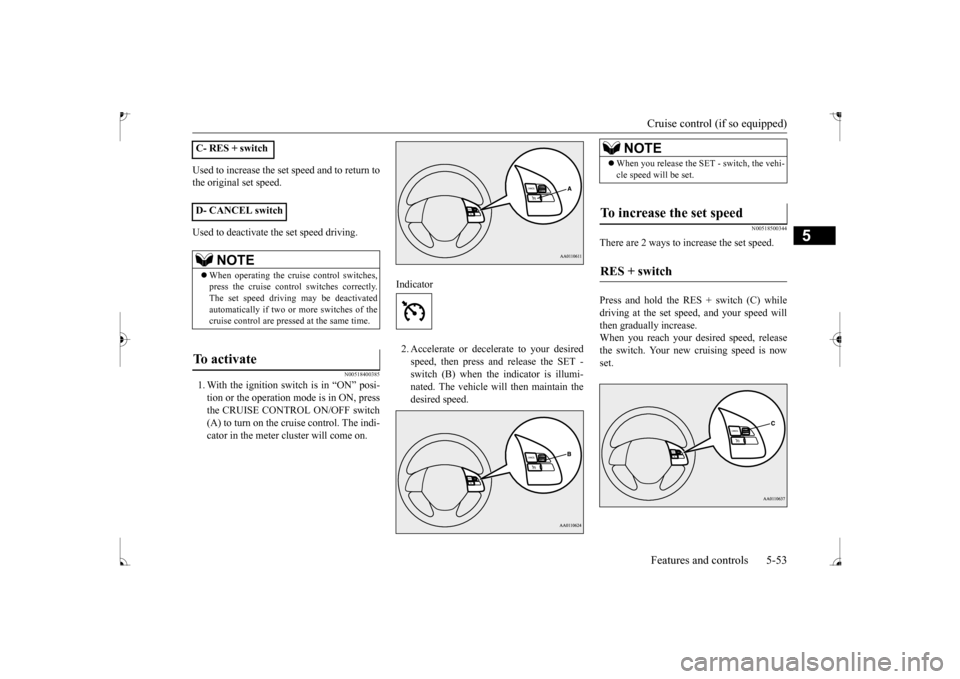
Used to increase the set speed and to return to the original set speed. Used to deactivate the set speed driving.
N00518400385
1. With the ignition switch is in “ON” posi- tion or the operation mode is in ON, press the CRUISE CONTROL ON/OFF switch (A) to turn on the cruise control. The indi-cator in the meter cluster will come on.
2. Accelerate or decele
rate to your desired
speed, then press and release the SET - switch (B) when the indicator is illumi-nated. The vehicle will then maintain the desired speed.
N00518500344
There are 2 ways to increase the set speed. Press and hold the RES + switch (C) while driving at the set speed, and your speed will then gradually increase.When you reach your desired speed, release the switch. Your new cruising speed is now set.
C- RES + switch D- CANCEL switch
NOTE
When operating the crui
se control switches,
press the cruise control switches correctly. The set speed driving may be deactivated automatically if two or
more switches of the
cruise control are pre
ssed at the same time.
To activate
Indicator
NOTE
When you release the SET - switch, the vehi- cle speed will be set.
To increase the set speed
RES + switch
BK0235100US.book 53 ページ 2015年11月20日 金曜日 午後3時12分