ECU MITSUBISHI MIRAGE 2017 6.G Workshop Manual
[x] Cancel search | Manufacturer: MITSUBISHI, Model Year: 2017, Model line: MIRAGE, Model: MITSUBISHI MIRAGE 2017 6.GPages: 307, PDF Size: 9.02 MB
Page 237 of 307
Antenna 7-44 Comfort controls
7
N00734201511
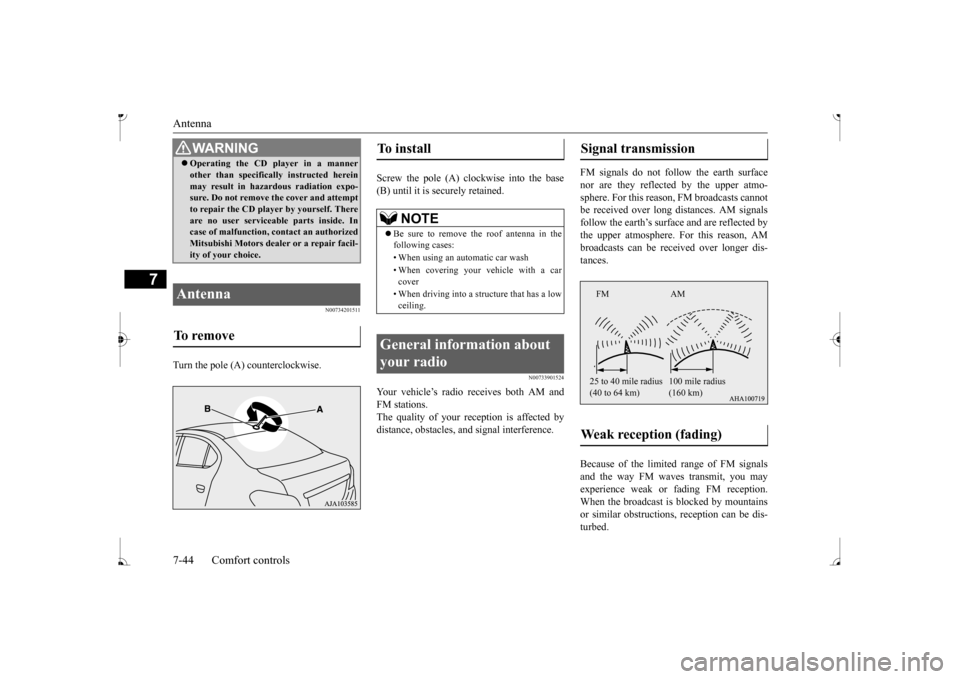
Turn the pole (A) counterclockwise.
Screw the pole (A) clockwise into the base (B) until it is securely retained.
N00733901524
Your vehicle’s radio receives both AM and FM stations. The quality of your reception is affected by distance, obstacles, a
nd signal interference.
FM signals do not foll
ow the earth surface
nor are they reflected by the upper atmo- sphere. For this reason,
FM broadcasts cannot
be received over long di
stances. AM signals
follow the earth’s surfa
ce and are reflected by
the upper atmosphere. For this reason, AM broadcasts can be rece
ived over longer dis-
tances. Because of the limite
d range of FM signals
and the way FM waves transmit, you may experience weak or fading FM reception.When the broadcast is blocked by mountains or similar obstructions,
reception ca
n be dis-
turbed.
WA R N I N G Operating the CD player in a manner other than specifically instructed hereinmay result in hazardous radiation expo-sure. Do not remove the cover and attempt to repair the CD playe
r by yourself. There
are no user serviceable parts inside. Incase of malfunction,
contact an authorized
Mitsubishi Motors dealer or a repair facil- ity of your choice.
Antenna To remove
To install
NOTE
Be sure to remove the roof antenna in the following cases: • When using an automatic car wash • When covering your ve
hicle with a car
cover • When driving into a structure that has a low ceiling.
General information about your radio
Signal transmission Weak reception (fading)
FM AM 25 to 40 mile radius (40 to 64 km)
(160 km)
BK0236100US.book 44 ページ 2016年2月1日 月曜日 午前10時15分
Page 245 of 307
How to change a tire 8-6 For emergencies
8
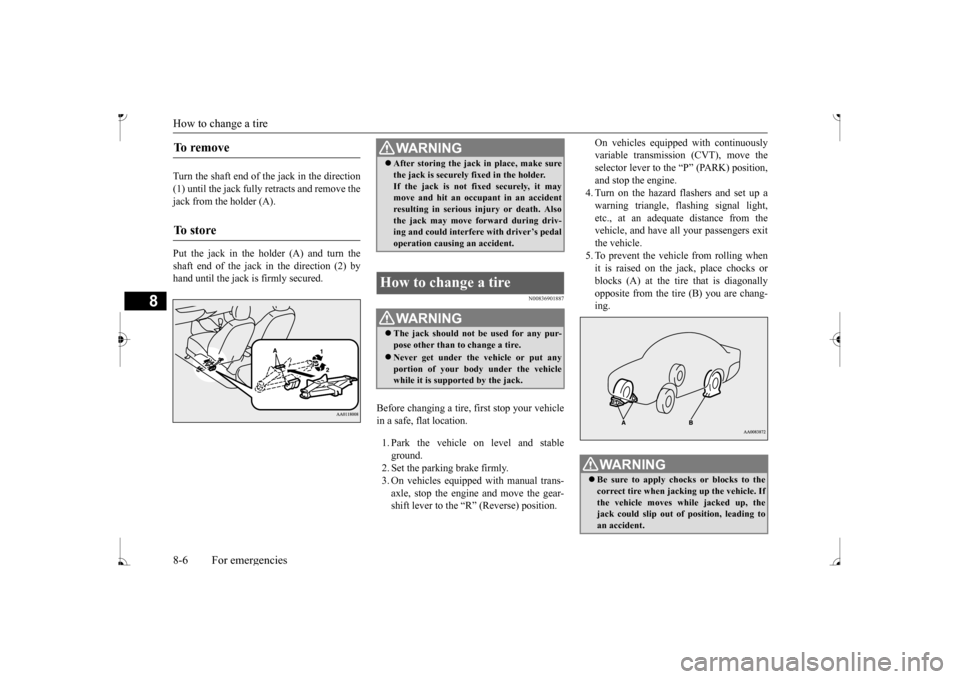
Turn the shaft end of the jack in the direction (1) until the jack fully retracts and remove the jack from the holder (A). Put the jack in the holder (A) and turn the shaft end of the jack in the direction (2) by hand until the jack is firmly secured.
N00836901887
Before changing a tire, first stop your vehiclein a safe, flat location. 1. Park the vehicle on level and stable ground. 2. Set the parking brake firmly.3. On vehicles equipped with manual trans- axle, stop the engine and move the gear- shift lever to the “R” (Reverse) position.
On vehicles equippe
d with continuously
variable transmission (CVT), move theselector lever to the
Page 259 of 307
Engine hood 9-4 Vehicle care and maintenance
9
Stop driving the vehicle if you think the performance is noticeably low, or theengine has a malfunction such as with the ignition, etc. If you are not able to stop driving immediately,
slow down and drive
for only a short time. Have your vehicle checked at an authorized Mitsubishi Motors dealer or a repair facility of yourchoice as soon
as possible.
In unusual situations involving major engine problems, a burning odor may indicate severe a
nd abnormal catalytic
converter overheating.
If this occurs, stop
in a safe place, shut
the engine off and let
the vehicle cool. Once the engine is cool, immediately take your
vehicle to a dealer
or a repair facility of your choice for ser- vice.
N00937501647
Use the engine hood re
lease lever (located
under the instrument panel near the driver’s door) to unlock the engine hood.
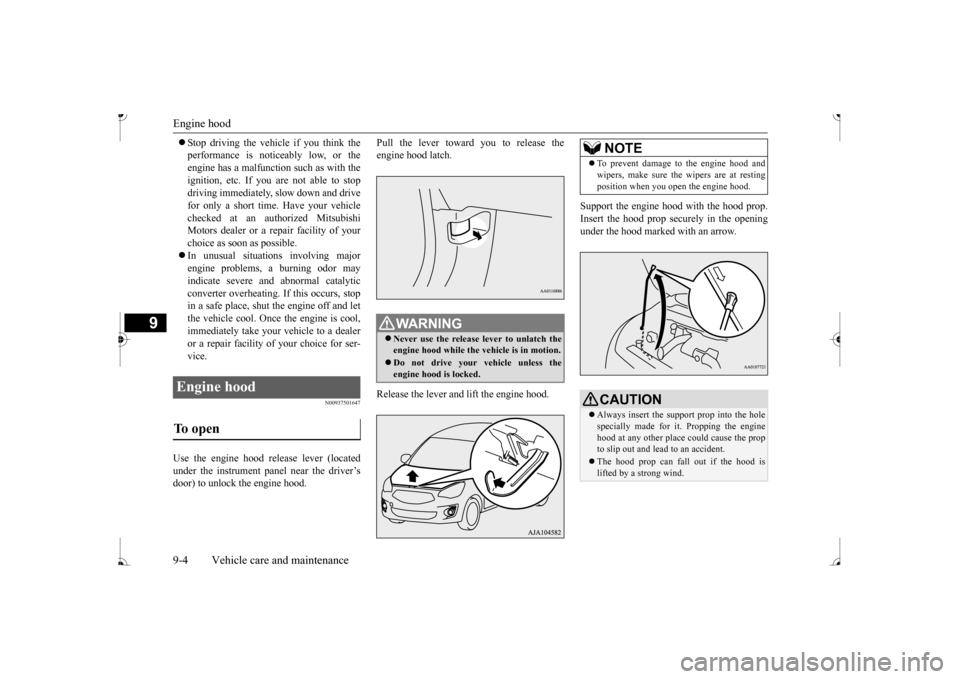
Pull the lever toward you to release the engine hood latch. Release the lever and
lift the engine hood.
Support the engine hood with the hood prop. Insert the hood prop securely in the opening under the hood marked with an arrow.
Engine hood To open
WA R N I N G Never use the release lever to unlatch the engine hood while the
vehicle is in motion.
Do not drive your vehicle unless the engine hood is locked.
NOTE
To prevent damage to the engine hood and wipers, make sure the
wipers are at resting
position when you open the engine hood.CAUTION Always insert the support prop into the hole specially made for
it. Propping the engine
hood at any other place could cause the propto slip out and lead to an accident. The hood prop can fall out if the hood is lifted by a strong wind.
BK0236100US.book 4 ページ 2016年2月1日 月曜日 午前10時15分
Page 266 of 307
Battery
Vehicle care and maintenance 9-11
9
N00901500072
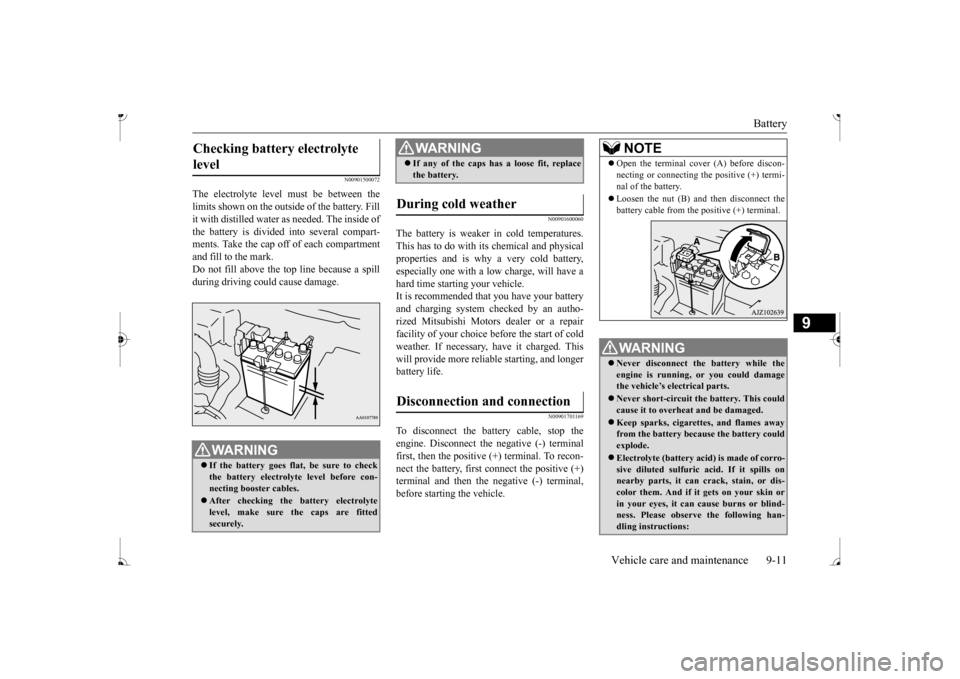
The electrolyte level
must be between the
limits shown on the outside of the battery. Fillit with distilled water as needed. The inside of the battery is divided into several compart- ments. Take the cap off of each compartmentand fill to the mark. Do not fill above the top line because a spill during driving could cause damage.
N00901600060
The battery is weaker in cold temperatures. This has to do with its chemical and physical properties and is why a very cold battery,especially one with a lo
w charge, will have a
hard time starting your vehicle. It is recommended that you have your batteryand charging system checked by an autho- rized Mitsubishi Motors dealer or a repair facility of your choice before the start of coldweather. If necessary, have it charged. This will provide more relia
ble starting, and longer
battery life.
N00901701169
To disconnect the battery cable, stop theengine. Disconnect the
negative (-) terminal
first, then the positive (+) terminal. To recon- nect the battery, first
connect the positive (+)
terminal and then the negative (-) terminal,before starting the vehicle.
Checking battery electrolyte level
WA R N I N G If the battery goes flat, be sure to check the battery electrolyte level before con- necting booster cables. After checking the battery electrolyte level, make sure the caps are fittedsecurely.
If any of the caps has a loose fit, replace the battery.
During cold weather Disconnection and connection
WA R N I N G
NOTE
Open the terminal cover (A) before discon- necting or connecting the positive (+) termi-nal of the battery. Loosen the nut (B) and then disconnect the battery cable from the positive (+) terminal.WA R N I N G Never disconnect the battery while the engine is running,
or you could damage
the vehicle’s electrical parts. Never short-circuit the battery. This could cause it to overhea
t and be damaged.
Keep sparks, cigarettes, and flames away from the battery because the battery couldexplode. Electrolyte (battery acid) is made of corro- sive diluted sulfuric acid. If it spills on nearby parts, it can crack, stain, or dis- color them. And if it
gets on your skin or
in your eyes, it can cause burns or blind- ness. Please observe the following han- dling instructions:
BK0236100US.book 11 ページ 2016年2月1日 月曜日 午前10時15分
Page 267 of 307
Tires 9-12 Vehicle care and maintenance
9
N00939201635
It is important to fami
liarize yourself with the
following terms:
Cold tire pressure: • The measured pressure after the vehiclehas been parked for
at least three hours,
or • The measured pressure when the vehicleis driven less than 1 mile (1.6 km) after having been parked for three hours.
Maximum pressure: the maximum per- missible cold tire inflation pressure for this tire. Recommended inflation pressure: the inflation pressure for optimum tire perfor- mance. Intended outboard sidewall: • The sidewall that
contains a whitewall,
bears white lettering or bears manufac-turer, brand, and/or model name molding that is higher or deeper than the same molding on the other sidewall of the tire,or • The outward facing sidewall of an asym- metrical tire that has a particular sidethat must always face outward when mounted on a vehicle.
Passenger car tire: a tire intended for use on passenger cars,
multipurpose passen-
ger vehicles, and trucks
that have a gross
vehicle weight rating (GVWR) of 10,000pounds or less.
• If electrolyte gets on plastic parts or other nearby parts, wipe it off with a softcloth or chamois soak
ed in a solution of
water and neutral detergent then imme- diately rinse the affected parts with plenty of water.• If electrolyte gets on your hands orclothes, rinse thoroughly with water. Ifelectrolyte gets in
your eyes, flush them
with water immediately and get immedi- ate medical attention.
Open doors and wind
ows in any closed
space where you may be charging orworking with the battery. Always wear protective clothing and gog- gles when working with the battery, or have a skilled automobi
le technician do it.
If you are quick-charging your battery, first disconnect the battery cables. In order to prevent a
short-circuit, be sure
to disconnect the negative (-) terminal first, and reconnect it last. Battery posts, terminals and related acces- sories contain lead
and lead compounds.
Wash hands after handling.NOTE
Check each battery terminal for corrosion. You can stop more corrosion by washingwith a solution of baking soda and water. Grease the posts and cl
amps after cleaning or
tightening them.WA R N I N G
Check to see that the battery is securely installed and cannot be
moved. Also check
each terminal for tightness. If you will not be driv
ing your vehicle for a
long period of time, re
move the battery and
store it in a place where the battery fluid will not freeze. The batter
y only should be stored
with a full charge. Before cleaning the ba
ttery, tighten all the
filler port caps to keep
dirt and moisture out.
Tires
WA R N I N GDriving with tires that are worn, damaged or improperly infl
ated is dangerous.
These type tire conditions will adverselyaffect vehicle performance. These type tire conditions can also cause a tread separation or blowout which mayresult in an accident causing serious injury or death. Tires, including spar
e tire, degrade over
time with age even when they are not being used. It is recommended that tires over 6 yearsgenerally be replaced
even if damage is
not obvious.NOTE
BK0236100US.book 12 ページ 2016年2月1日 月曜日 午前10時15分
Page 275 of 307
General maintenance 9-20 Vehicle care and maintenance
9
N00940900228
Spark plugs must fire properly for good engine performance
and emission-control.
Do not reuse them by cleaning or regapping.Change them at the mileage listed in the “WARRANTY AND MAINTENANCE MANUAL”.
N00941000040
Check the hose surfaces for any heat and mechanical damage, hard and brittle rubber, cracking, tears, cuts and abrasions. Pay spe-cial attention to the hos
es closest to high heat
sources such as the exhaust manifold. Check all the hose connections
, such as clamps and
couplings, to make sure
they are secure and
that there are no leaks. If you see any wear or damage, replace the
hoses immediately.
N00950100050
Have the valve clearance checked at an authorized Mitsubishi Motors dealer at the mileage specified in the “WARRANTY AND MAINTENANCE MANUAL”.If the engine sounds abnormally loud, have adjustments made by an authorized Mitsubishi Motors dealer.
N00941300173
Check these regularly for damage or leaks in the fuel lines and connections. Check the fuel tank filler cap for dama
ge or looseness. Pay
special attention to the fuel lines closest to
high heat sources such
as the exhaust mani-
fold.
N00941400187
If the fuel-vapor vent line is clogged or dam-aged, the fuel-vapor mixture will escape, pol- luting the air. Have the system checked at an authorizedMitsubishi Motors dealer at the mileage spec- ified in the “WARRANTY AND MAINTE- NANCE MANUAL”.
N00941500292
The next pages list th
e maintenance service
recommended by Mitsubishi Motors Corpo-ration. In addition to the general maintenance that needs to be performed at the times listed,
NOTE
To meet government regulations and pro- mote cleaner air, your
vehicle is equipped
with an onboard dia
gnostic system (OBD).
The engine electronic control module that controls OBD functions stores various data (especially about th
e exhaust emissions).
This data will be erased if the battery cable is disconnected, which could make a rapid diagnosis difficult.
Do not disconnect the
battery cable when the engine malfunction indicator (“SERVICE ENGINE SOON” or “Check engine
light”) is ON.
Spark plugs
NOTE
Use the spark plugs listed under “Engine specifications” on page 11
-4 or plugs that are
exactly the same. Other plugs could cause engine damage, performance problems orradio noise.
Fuel hoses Intake valve clearance Fuel system (tank, pipe line and connection, and fuel tank filler cap)
WA R N I N G If you see a fuel leak
or if you smell fuel,
do not run the engine. Any spark (includ- ing from the ignition
), flame or smoking
material could cause an explosion or fire.Call an authorized Mitsubishi Motors dealer or a repair fa
cility of your choice
for assistance.
Evaporative emission control system (except evaporative emission canister) General maintenance
BK0236100US.book 20 ページ 2016年2月1日 月曜日 午前10時15分
Page 281 of 307
Replacement of light bulbs 9-26 Vehicle care and maintenance
9
5. Insert a new fuse
of the same capacity
securely into the appropriate slot.
N00942901362
Before replacing the bulb, be sure the light is off. Do not touch the glass part of the new bulb with your bare fingers; the oil from yourskin will stay on the
glass and dim or destroy
the bulb when it gets hot.
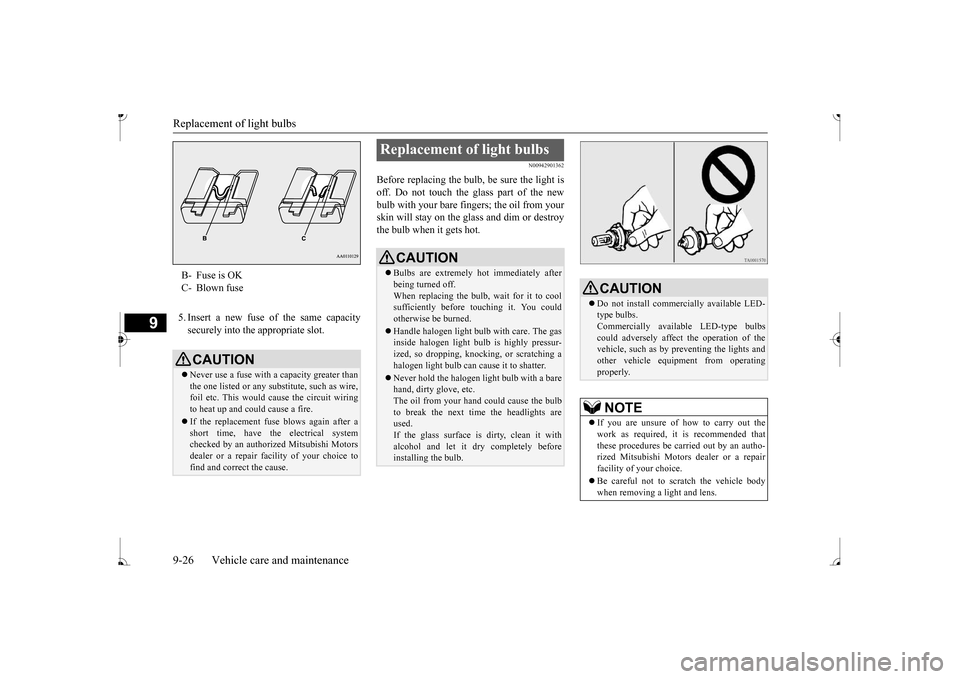
B- Fuse is OK C- Blown fuseCAUTION Never use a fuse with a capacity greater than the one listed or any s
ubstitute, such as wire,
foil etc. This would
cause the circuit wiring
to heat up and could cause a fire. If the replacement fuse blows again after a short time, have the electrical system checked by an authorized Mitsubishi Motors dealer or a repair faci
lity of your choice to
find and correct
the cause.
Replacement of light bulbs
CAUTIONBulbs are extremely hot immediately after being turned off. When replacing the bulb, wait for it to coolsufficiently before
touching it. You could
otherwise be burned. Handle halogen light bul
b with care. The gas
inside halogen light
bulb is highly pressur-
ized, so dropping, knocki
ng, or scratching a
halogen light bulb can
cause it to shatter.
Never hold the halogen
light bulb with a bare
hand, dirty glove, etc. The oil from your hand could cause the bulb to break the next time the headlights areused. If the glass surface is dirty, clean it with alcohol and let it dry completely beforeinstalling the bulb.
CAUTION Do not install commercially available LED- type bulbs. Commercially availa
ble LED-type bulbs
could adversely affect the operation of thevehicle, such as by preventing the lights and other vehicle equi
pment from operating
properly.NOTE
If you are unsure of how to carry out the work as required, it is recommended that these procedures be ca
rried out by an autho-
rized Mitsubishi Motors
dealer or a repair
facility of your choice. Be careful not to scratch the vehicle body when removing a light and lens.
BK0236100US.book 26 ページ 2016年2月1日 月曜日 午前10時15分
Page 303 of 307
Alphabetical index 12-2
12
D
Daytime running lights
Bulb capacity
.................................
9-27
Replacement
..................................
9-28
Defogger (rear window)
......................
5-84
Defrosting or defogging (windshield, door windows)
..........................
7-6
, 7-10
, 7-17
Dimensions
........................................
11-3
Dimmer (high/lo
w beam change)
.........
5-81
Disc brake pads
..................................
9-21
Dome light
Bulb capacity
.................................
9-28
Door-ajar warning buzzer
....................
5-78
Door-ajar warning light
.......................
5-78
Doors
Lock
..............................................
5-24
Power door locks
............................
5-25
Driving during cold weather
..................
6-4
Driving, alcohol and drugs
.....................
6-2
E
Electric power steering system (EPS)
5-51
Electric rear win
dow defogger switch
...
5-84
Electronic immobilizer (Anti-theft starting system)
5-3
, 5-19
Emission-control sy
stem maintenance
..9-19
Engine
Compartment
...................................
9-5
Coolant
...................................
9-7
, 11-5
High coolant temperature warning light
....
5-78Hood
...............................................
9-4
Model
............................................
11-3
Oil and oil filter
.......................
9-5
, 11-5
Overheating
.....................................
8-4
Serial number
.................................
11-3
Specification
...................................
11-4
Engine hood
........................................
9-4
Engine switch
.....................................
5-13
Error codes
.........................................
7-41
Exhaust system
...................................
9-21
F
Floor mat
.............................................
6-2
Fluid
Brake fluid
.....................................
11-5
Continuously variable
transmission (CVT)
......................................
9-9
, 11-5
Engine coolant
.........................
9-7
, 11-5
Manual transaxle
.............................
11-5
Washer fluid
............................
9-9
, 11-5
Fluid capacities and lubricants
..............
11-5
Free-hand advanced security transmitter (F.A.S.T.-key)
...................................
5-9
Front fog lights
Bulb capacity
.................................
9-27
Indicators
.......................................
5-76
Replacement
..................................
9-29
Switch
...........................................
5-82
Front seat adjustment
............................
4-2
Front side-marker lights
Bulb capacity
.................................
9-27
Replacement
..................................
9-29
Front turn signal lights
Bulb capacity
.................................
9-27
Replacement
..................................
9-29
Fuel
Filling the fuel tank
...........................
3-3
Fuel economy
...................................
6-2
Fuel hoses
......................................
9-20
Fuel remaining warning display
.......
5-70
Fuel selection
...................................
3-2
Tank capacity
.................................
11-5
Fuel Pump Shut-off System
.................
8-15
Fuel remaining display
........................
5-70
Fuses
.................................................
9-22
Fusible links
.......................................
9-22
G
General maintenance
Maintenance
...................................
9-20
General vehicle data
............................
11-3
Genuine parts
.......................................
3-6
Glove compartment
...........................
5-117
BK0236100US.book 2 ページ 2016年2月1日 月曜日 午前10時15分