Eco mode MITSUBISHI MIRAGE 2017 6.G Manual PDF
[x] Cancel search | Manufacturer: MITSUBISHI, Model Year: 2017, Model line: MIRAGE, Model: MITSUBISHI MIRAGE 2017 6.GPages: 307, PDF Size: 9.02 MB
Page 231 of 307
To play tracks from a Bluetooth® device
(vehicles with Blue
tooth® 2.0 interface)
7-38 Comfort controls
7
N00765401072
N00765501103
1. Press the PWR switch to turn on the audio system. The system turns on in the last mode used.2. Press the MEDIA button several times to switch to the BT-A (Bluetooth
®) mode.
The input mode changes as follows everytime the MEDIA button is pressed: CD mode
iPod mode
Bluetooth
® mode
(if so equipped)
AUX mode
CD
mode. The BT indicator is illuminated and then the BT-A mode will be activated. 3. Connect your Bluetooth
® device.
Refer to “Connecting the Bluetooth
® 2.0
interface and Bluetooth
® device” on page
5-91.
4. Playback starts automatically.
N00765600035
To stop the playback, press the Stop button. To restart the playback, press the Play/Pausebutton.
N00765700036
To pause the playback, press and hold thePlay/Pause button until you hear a beep.To restart the playback, press the Play/Pause button.
N00703201023
To fast-forward/reverse the current track, press the button or button.
NOTE
Depending on the connect
ed device, opera-
tion of the connected device is limited to itsavailable functions. Depending on the connected device, the device may not ope
rate correctly.
A file protected by c
opyright might not be
able to playback. It is recommended to adjust the equalizer of the connected
device to 0 db or neutral.
The voice operation is not available to access music files on the connected Bluetooth
®
device.
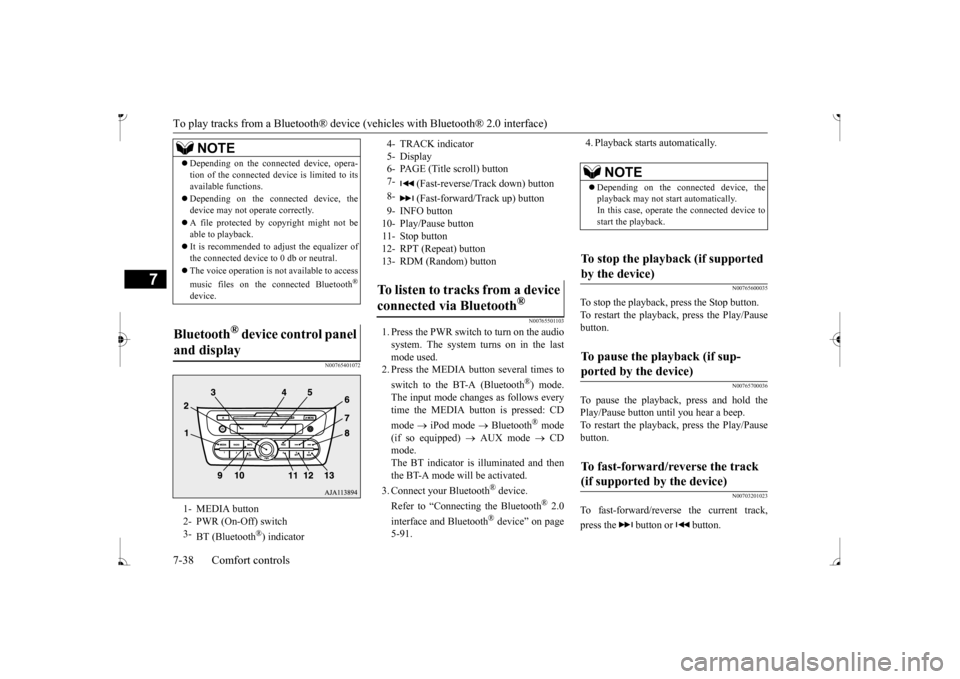
Bluetooth
® device control panel
and display 1- MEDIA button 2- PWR (On-Off) switch 3-
BT (Bluetooth
®) indicator
4- TRACK indicator 5- Display 6- PAGE (Title scroll) button7-
(Fast-reverse/Track down) button
8-
(Fast-forward/Track up) button
9- INFO button 10- Play/Pause button 11- Stop button 12- RPT (Repeat) button 13- RDM (Random) buttonTo listen to tracks from a device connected via Bluetooth
®
NOTE
Depending on the connected device, the playback may not start automatically. In this case, operate
the connected device to
start the playback.
To stop the playback (if supported by the device) To pause the playback (if sup- ported by the device) To fast-forward/reverse the track (if supported by the device)
BK0236100US.book 38 ページ 2016年2月1日 月曜日 午前10時15分
Page 267 of 307
Tires 9-12 Vehicle care and maintenance
9
N00939201635
It is important to fami
liarize yourself with the
following terms:
Cold tire pressure: • The measured pressure after the vehiclehas been parked for
at least three hours,
or • The measured pressure when the vehicleis driven less than 1 mile (1.6 km) after having been parked for three hours.
Maximum pressure: the maximum per- missible cold tire inflation pressure for this tire. Recommended inflation pressure: the inflation pressure for optimum tire perfor- mance. Intended outboard sidewall: • The sidewall that
contains a whitewall,
bears white lettering or bears manufac-turer, brand, and/or model name molding that is higher or deeper than the same molding on the other sidewall of the tire,or • The outward facing sidewall of an asym- metrical tire that has a particular sidethat must always face outward when mounted on a vehicle.
Passenger car tire: a tire intended for use on passenger cars,
multipurpose passen-
ger vehicles, and trucks
that have a gross
vehicle weight rating (GVWR) of 10,000pounds or less.
• If electrolyte gets on plastic parts or other nearby parts, wipe it off with a softcloth or chamois soak
ed in a solution of
water and neutral detergent then imme- diately rinse the affected parts with plenty of water.• If electrolyte gets on your hands orclothes, rinse thoroughly with water. Ifelectrolyte gets in
your eyes, flush them
with water immediately and get immedi- ate medical attention.
Open doors and wind
ows in any closed
space where you may be charging orworking with the battery. Always wear protective clothing and gog- gles when working with the battery, or have a skilled automobi
le technician do it.
If you are quick-charging your battery, first disconnect the battery cables. In order to prevent a
short-circuit, be sure
to disconnect the negative (-) terminal first, and reconnect it last. Battery posts, terminals and related acces- sories contain lead
and lead compounds.
Wash hands after handling.NOTE
Check each battery terminal for corrosion. You can stop more corrosion by washingwith a solution of baking soda and water. Grease the posts and cl
amps after cleaning or
tightening them.WA R N I N G
Check to see that the battery is securely installed and cannot be
moved. Also check
each terminal for tightness. If you will not be driv
ing your vehicle for a
long period of time, re
move the battery and
store it in a place where the battery fluid will not freeze. The batter
y only should be stored
with a full charge. Before cleaning the ba
ttery, tighten all the
filler port caps to keep
dirt and moisture out.
Tires
WA R N I N GDriving with tires that are worn, damaged or improperly infl
ated is dangerous.
These type tire conditions will adverselyaffect vehicle performance. These type tire conditions can also cause a tread separation or blowout which mayresult in an accident causing serious injury or death. Tires, including spar
e tire, degrade over
time with age even when they are not being used. It is recommended that tires over 6 yearsgenerally be replaced
even if damage is
not obvious.NOTE
BK0236100US.book 12 ページ 2016年2月1日 月曜日 午前10時15分
Page 303 of 307
Alphabetical index 12-2
12
D
Daytime running lights
Bulb capacity
.................................
9-27
Replacement
..................................
9-28
Defogger (rear window)
......................
5-84
Defrosting or defogging (windshield, door windows)
..........................
7-6
, 7-10
, 7-17
Dimensions
........................................
11-3
Dimmer (high/lo
w beam change)
.........
5-81
Disc brake pads
..................................
9-21
Dome light
Bulb capacity
.................................
9-28
Door-ajar warning buzzer
....................
5-78
Door-ajar warning light
.......................
5-78
Doors
Lock
..............................................
5-24
Power door locks
............................
5-25
Driving during cold weather
..................
6-4
Driving, alcohol and drugs
.....................
6-2
E
Electric power steering system (EPS)
5-51
Electric rear win
dow defogger switch
...
5-84
Electronic immobilizer (Anti-theft starting system)
5-3
, 5-19
Emission-control sy
stem maintenance
..9-19
Engine
Compartment
...................................
9-5
Coolant
...................................
9-7
, 11-5
High coolant temperature warning light
....
5-78Hood
...............................................
9-4
Model
............................................
11-3
Oil and oil filter
.......................
9-5
, 11-5
Overheating
.....................................
8-4
Serial number
.................................
11-3
Specification
...................................
11-4
Engine hood
........................................
9-4
Engine switch
.....................................
5-13
Error codes
.........................................
7-41
Exhaust system
...................................
9-21
F
Floor mat
.............................................
6-2
Fluid
Brake fluid
.....................................
11-5
Continuously variable
transmission (CVT)
......................................
9-9
, 11-5
Engine coolant
.........................
9-7
, 11-5
Manual transaxle
.............................
11-5
Washer fluid
............................
9-9
, 11-5
Fluid capacities and lubricants
..............
11-5
Free-hand advanced security transmitter (F.A.S.T.-key)
...................................
5-9
Front fog lights
Bulb capacity
.................................
9-27
Indicators
.......................................
5-76
Replacement
..................................
9-29
Switch
...........................................
5-82
Front seat adjustment
............................
4-2
Front side-marker lights
Bulb capacity
.................................
9-27
Replacement
..................................
9-29
Front turn signal lights
Bulb capacity
.................................
9-27
Replacement
..................................
9-29
Fuel
Filling the fuel tank
...........................
3-3
Fuel economy
...................................
6-2
Fuel hoses
......................................
9-20
Fuel remaining warning display
.......
5-70
Fuel selection
...................................
3-2
Tank capacity
.................................
11-5
Fuel Pump Shut-off System
.................
8-15
Fuel remaining display
........................
5-70
Fuses
.................................................
9-22
Fusible links
.......................................
9-22
G
General maintenance
Maintenance
...................................
9-20
General vehicle data
............................
11-3
Genuine parts
.......................................
3-6
Glove compartment
...........................
5-117
BK0236100US.book 2 ページ 2016年2月1日 月曜日 午前10時15分