light MITSUBISHI MIRAGE G4 2018 (in English) User Guide
[x] Cancel search | Manufacturer: MITSUBISHI, Model Year: 2018, Model line: MIRAGE G4, Model: MITSUBISHI MIRAGE G4 2018Pages: 263, PDF Size: 37.9 MB
Page 16 of 263
If this problem occurs...
Quick index 2-7
2
The vehicle is
stuck in sand,
mud or snow
Rock your vehicle back and forth to free it. P. 8-13
WA R N I N G When attempting to rock your vehicle out of
a stuck position, be sure that
no one is near the vehicl
e. The rocking motion may c
ause the vehicle to
suddenly lurch forward or backward, possibly injuring bystanders. Avoid revving the engine or spin
ning the wheels. Prolonged efforts to free a st
uck vehicle may result in
overheating and transa
xle failure.
If the vehicle remains stuck after several rocking attempts, have a towing service pull the vehicle out.
Problem
Do this
Ref. Page
The brakes are not functioning properly after crossing a puddle or stream.
Dry out the brakes by driving slowly while
lightly pressing the brake pedal. P. 6-5
The continuously variable trans- mission (CVT) makes no shift change when accelerating. The initial movement of the vehicle is slow when the vehicle starts moving.(for vehicles with CVT)
There may be a problem in the CVT. Have the vehicle inspected by an
authorized Mitsubishi Motors dealer or a repair facility of
your choice immediately.
P. 5-44
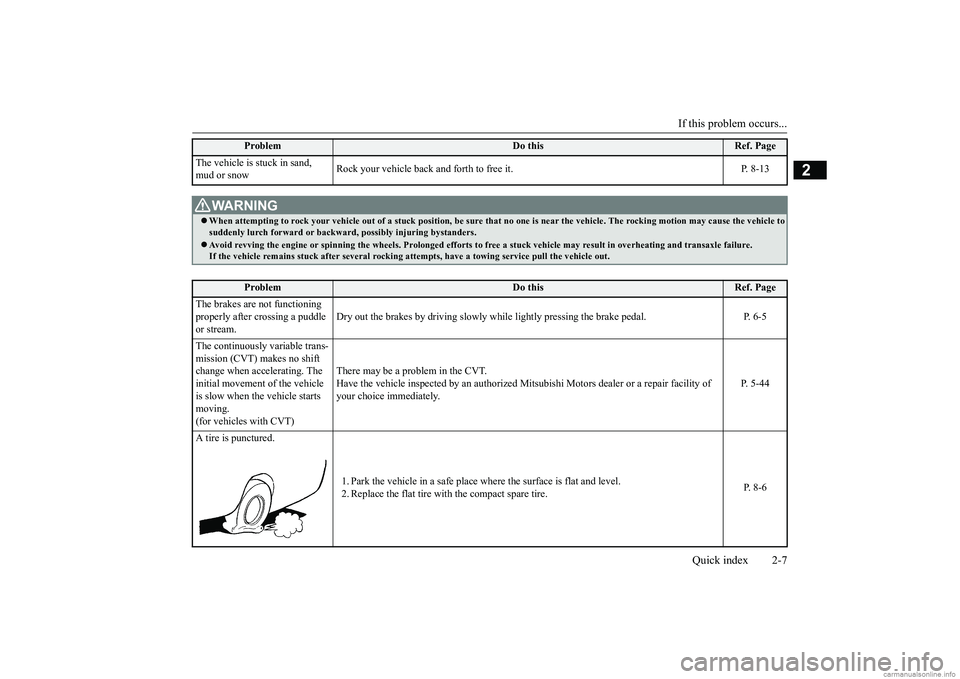
A tire is punctured.
1. Park the vehicle in a safe place where the surface is flat and level. 2. Replace the flat tire with the compact spare tire.
P. 8 - 6
Problem
Do this
Ref. Page
BK0249600US.book 7 ページ 2017年4月20日 木曜日 午後1時36分
Page 20 of 263
Filling the fuel tank
General information 3-3
3
Use of gasolines blended with MMT may adversely affect performance, and cause themalfunction indicator on your instrument panel to come on. If this happens, contact an authorized Mitsubishi Motors dealer or arepair facility of your
choice for assistance.
Your vehicle may have
been designed to sat-
isfy California’s low-emission regulations based on clean-burning low-sulfur gasoline.Gasoline sold in parts of the country other than California is allowed to have a higher sulfur content. Using such gasoline couldadversely affect the ve
hicle’s catalytic con-
verter and cause the e
ngine malfunction indi-
cator (“SERVICE ENGINE SOON” or“Check engine light”) to come on. Illumina- tion of this indicator while using high-sulfur gasoline does not necessarily mean the vehi-cle’s emission-control system is malfunction- ing. Your authorized Mitsubishi Motors dealer may suggest usi
ng a different, lower-
sulfur brand of unleaded gasoline to deter- mine if the problem
is fuel-related.
N00301102005
Sulfur in gasoline
NOTE
Poor-quality gasoline
can cause problems
such as hard starting, stalling during idling,abnormal engine noise
, and poor accelera-
tion. If you experience any of these prob- lems, try using a differ
ent brand of gasoline.
If the engine malfunc
tion indicator (“SER-
VICE ENGINE SOON”
or “Check engine
light”) flashes, have
the vehicle inspected as
soon as possible by the nearest authorizedMitsubishi Motors dealer
or a repair facility
of your choice. Repeatedly driving short distances at low speeds can cause deposits to form in the fuel system and engine, resulting in hard startingand poor acceleration.
If these problems
occur, you are advised to add a detergent additive to the gasoline when you refuel thevehicle. The additive
will remove the depos-
its, thereby returning the engine to a normal condition. Be sure to use a MitsubishiMotors Genuine cleani
ng additive. Using an
unsuitable additive c
ould make an engine
malfunction. For details,
please contact the
nearest authorized Mits
ubishi Motors dealer.
Filling the fuel tank
WA R N I N GWhen handling fuel, comply with the safety regulations displayed by garages and filling stations.
Gasoline is highly flammable and explo- sive. You could be burned, seriouslyinjured or killed when handling it. Whenrefueling your vehicle,
always turn the
engine off and keep
away from flames,
sparks, and smoking materials. Alwayshandle fuel in well-ventilated outdoor areas. Before removing the fuel tank filler cap, be sure to get rid of your body’s static electricity by touching a metal part of thecar or fuel pump. Any
static electricity on
your body could create a spark that ignites fuel vapor. Perform the whole
refueling process
(opening the fuel tank filler door, remov-ing the fuel tank filler cap, etc.) by your- self; do not let any other person near the fuel tank filler. If you allowed a person tohelp you and that person was carrying static electricity,
fuel vapor could be
ignited. Do not move away from the fuel tank filler until refueling is fi
nished. If you moved
away and did something
else (for example,
sitting on a seat) part-way through the refueling process, you could pick up afresh charge of st
atic electricity.
Be careful not to inhale fuel vapor. Fuel contains toxic substances. Keep the doors and wi
ndows closed while
refueling the vehicle. If they were open, fuel vapor could get into the cabin.WA R N I N G
BK0249600US.book 3 ページ 2017年4月20日 木曜日 午後1時36分
Page 22 of 263
Modifications to and racing of your vehicle
General information 3-5
3
7. To close, turn the fuel tank filler cap slowly clockwise un
til you hear clicking
sounds, then gently push the fuel tankfiller door closed.
N00301600194
This vehicle should not be modified withnon-Mitsubishi Motors genuine parts. Mitsubishi Motors designs and manufactures high quality vehicles
with an emphasis on
safety and durability.
Modifications using
non-Mitsubishi Motors genuine parts may affect the performance, safety and/or durabil-ity of your vehicle,
and may violate applica-
ble state and/or fe
deral regulations.
DAMAGE OR PERFORMANCE PROB- LEMS RESULTING FROM MODIFICA-TIONS TO OR RACING OF YOUR
VEHICLE ARE NOT COVERED UNDER WARRANTY. Examples of modifications to your vehicle that can cause damage or performance prob- lems include the following: Failure to use Mits
ubishi Motors genuine
parts Failure to use required fuel and fluids Failure to use proper
size tires and wheels
Modification of the fu
el, intake, exhaust,
emission, suspension,
engine, drive train
or electrical wiring systems Modification of any onboard com- puter/control module, including repro- gramming, or replac
ing/adding chips to
any onboard computer/control module
Review the Warranty
and Maintenance Man-
ual for further details
regarding warranty cov-
erage.
N00301701277
CAUTION To avoid fuel spillage
and overfilling, do not
“top-off” the fuel tank. Spilled fuel coulddiscolor, stain, or cr
ack the vehicle’s paint-
work. If fuel spills on the paintwork, wipe it off with a soft cloth.WA R N I N G Make sure the fuel tank filler cap is securely closed. If the fuel tank filler cap were loose, fuel coul
d leak, resulting in a
fire.CAUTION If you need to replace the fuel tank filler cap, use only the fuel tank filler cap specified for your model vehicle.
NOTE
If the fuel tank filler cap is not tight while driving, the engine
malfunction indicator
(“SERVICE ENGINE SOON” or “Checkengine light”) may come on when the onboard diagnostic (OBD) system performs a self check.Always tighten the fu
el tank filler cap until
you hear at least 3 clicks. The indicator will go of
f after several driving
cycles. If the indicato
r does not go off, con-
tact your authorized
Mitsubishi Motors
dealer or a repair faci
lity of your choice as
soon as possible.
Modifications to and racing of your vehicle
Installation of accessories
CAUTION Before any electrical or electronic accesso- ries are installed,
consult an authorized
Mitsubishi Motors dealer.
BK0249600US.book 5 ページ 2017年4月20日 木曜日 午後1時36分
Page 28 of 263
Front seats
Seat and restraint systems 4-3
4
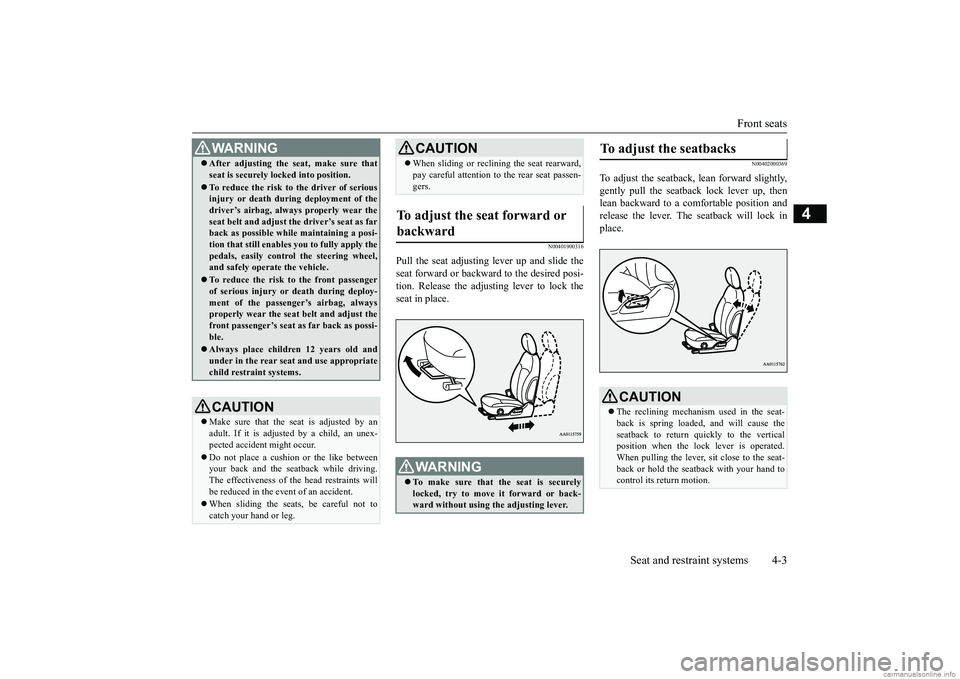
N00401900316
Pull the seat adjusting lever up and slide the seat forward or backward to the desired posi- tion. Release the adjusting lever to lock theseat in place.
N00402000369
To adjust the seatback,
lean forward slightly,
gently pull the seatback lock lever up, then lean backward to a comfortable position andrelease the lever. The seatback will lock in place.
After adjusting the se
at, make sure that
seat is securely locked into position. To reduce the risk to the driver of serious injury or death durin
g deployment of the
driver’s airbag, always
properly wear the
seat belt and adjust th
e driver’s seat as far
back as possible while maintaining a posi- tion that still enables
you to fully apply the
pedals, easily control the steering wheel, and safely operate the vehicle. To reduce the risk to the front passenger of serious injury or
death during deploy-
ment of the passenger’s airbag, alwaysproperly wear the seat
belt and adjust the
front passenger’s seat as far back as possi- ble. Always place childre
n 12 years old and
under in the rear seat
and use appropriate
child restraint systems.CAUTION Make sure that the seat is adjusted by an adult. If it is adjusted by a child, an unex- pected accident
might occur.
Do not place a cushion
or the like between
your back and the seatback while driving. The effectiveness of the head restraints will be reduced in the event of an accident. When sliding the seat
s, be careful not to
catch your hand or leg.WA R N I N G
When sliding or reclining the seat rearward, pay careful attention to
the rear seat passen-
gers.
To adjust the seat forward or backward
WA R N I N G To make sure that the seat is securely locked, try to move
it forward or back-
ward without using
the adjusting lever.
CAUTION
To adjust the seatbacks
CAUTIONThe reclining mechanism used in the seat- back is spring loaded, and will cause theseatback to return quickly to the vertical position when the lock lever is operated. When pulling the lever, sit close to the seat-back or hold the seatback with your hand to control its return motion.
BK0249600US.book 3 ページ 2017年4月20日 木曜日 午後1時36分
Page 29 of 263
Front seats 4-4 Seat and restraint systems
4
N00402100243
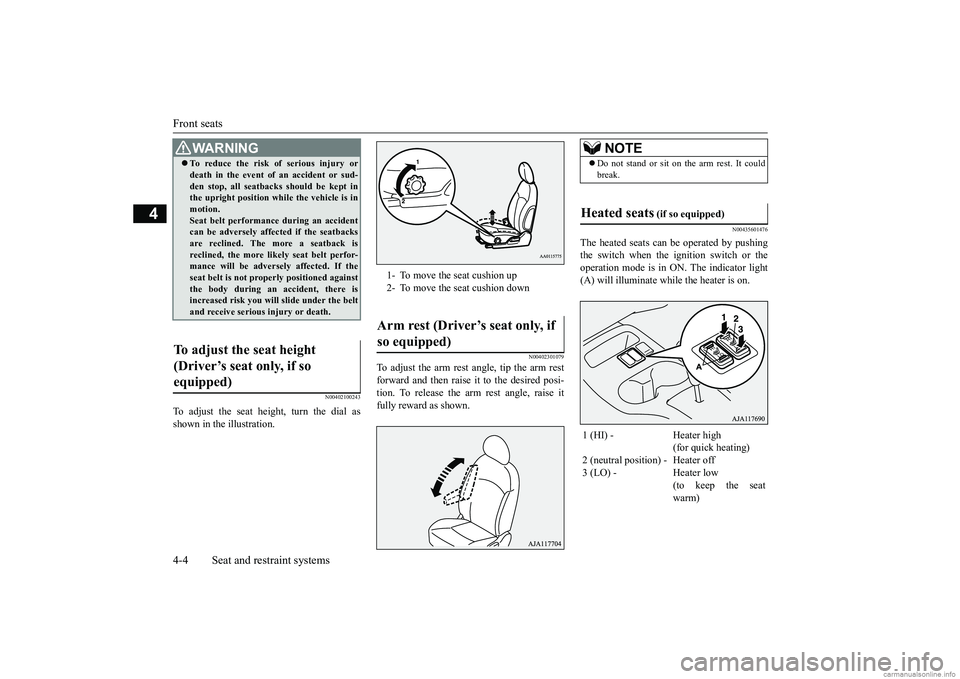
To adjust the seat height, turn the dial as shown in the illustration.
N00402301079
To adjust the arm rest angle, tip the arm rest forward and then raise it to the desired posi- tion. To release the arm rest angle, raise it fully reward as shown.
N00435601476
The heated seats can
be operated by pushing
the switch when the ignition switch or theoperation mode is in ON. The indicator light (A) will illuminate while the heater is on.
WA R N I N G To reduce the risk of serious injury or death in the event of
an accident or sud-
den stop, all seatbacks should be kept inthe upright position while the vehicle is in motion. Seat belt performance during an accidentcan be adversely affect
ed if the seatbacks
are reclined. The more a seatback is reclined, the more likely seat belt perfor-mance will be adversely affected. If the seat belt is not proper
ly positioned against
the body during an accident, there isincreased risk you will slide under the belt and receive serious
injury or death.
To adjust the seat height (Driver’s seat only, if so equipped)
1- To move the seat cushion up 2- To move the seat cushion downArm rest (Driver’s seat only, if so equipped)
NOTE
Do not stand or sit on the arm rest. It could break.
Heated seats
(if so equipped)
1 (HI) - Heater high
(for quick heating)
2 (neutral position) - Heater off 3 (LO) - Heater low
(to keep the seat warm)
BK0249600US.book 4 ページ 2017年4月20日 木曜日 午後1時36分
Page 36 of 263
Seat belts
Seat and restraint systems 4-11
4
N00418400384
A tone and warning light are used to remind the driver to fasten the seat belt. If the ignition switch is turned to the “ON” position or the operation mode is put in ON without the driver’s seat belt being fastened, a warning light will come on and a tone willsound for approximately 6 seconds to remind you to fasten your seat belt. If the vehicle is driven with the seat belt stillunfastened, the warning light will blink and the tone will sound inte
rmittently until the
seat belt is fastened.
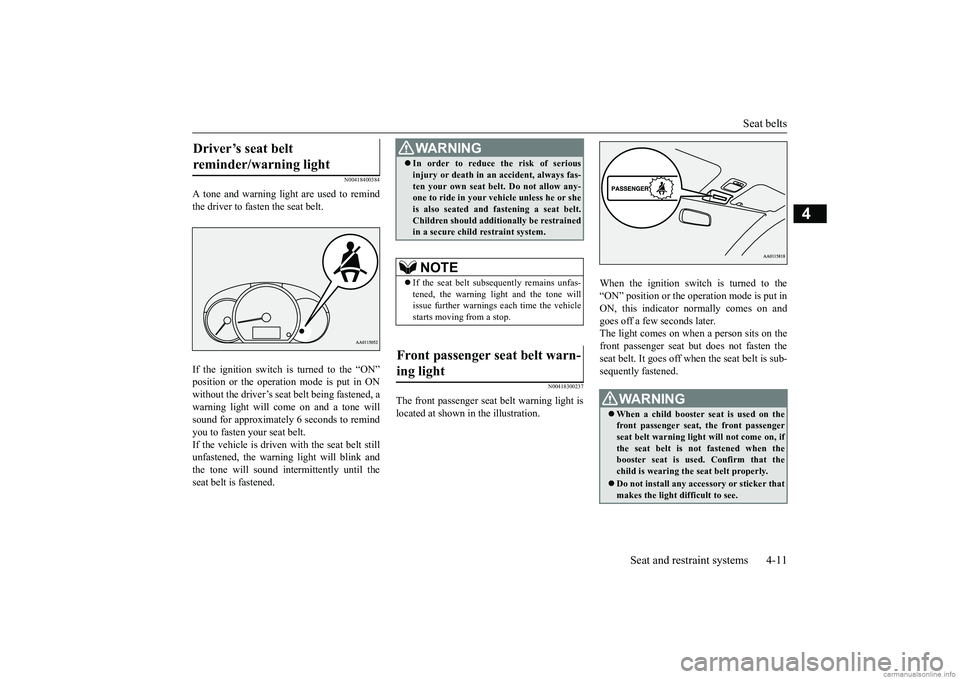
N00418300237
The front passenger seat
belt warning light is
located at shown in the illustration.
When the ignition switch is turned to the “ON” position or the operation mode is put inON, this indicator
normally comes on and
goes off a few seconds later. The light comes on when a person sits on thefront passenger seat bu
t does not fasten the
seat belt. It goes off when the seat belt is sub- sequently fastened.
Driver’s seat belt reminder/warning light
WA R N I N G In order to reduce the risk of serious injury or death in an
accident, always fas-
ten your own seat belt
. Do not allow any-
one to ride in your ve
hicle unless he or she
is also seated and fastening a seat belt. Children should additi
onally be restrained
in a secure child restraint system.NOTE
If the seat belt subse
quently remains unfas-
tened, the warning li
ght and the tone will
issue further warnings
each time the vehicle
starts moving from a stop.
Front passenger seat belt warn- ing light
WA R N I N G When a child booster se
at is used on the
front passenger seat, the front passenger seat belt warning ligh
t will not come on, if
the seat belt is not fastened when the booster seat is used
. Confirm that the
child is wearing the
seat belt properly.
Do not install any acce
ssory or sticker that
makes the light difficult to see.
BK0249600US.book 11 ページ 2017年4月20日 木曜日 午後1時36分
Page 39 of 263
Child restraint systems 4-14 Seat and restraint systems
4
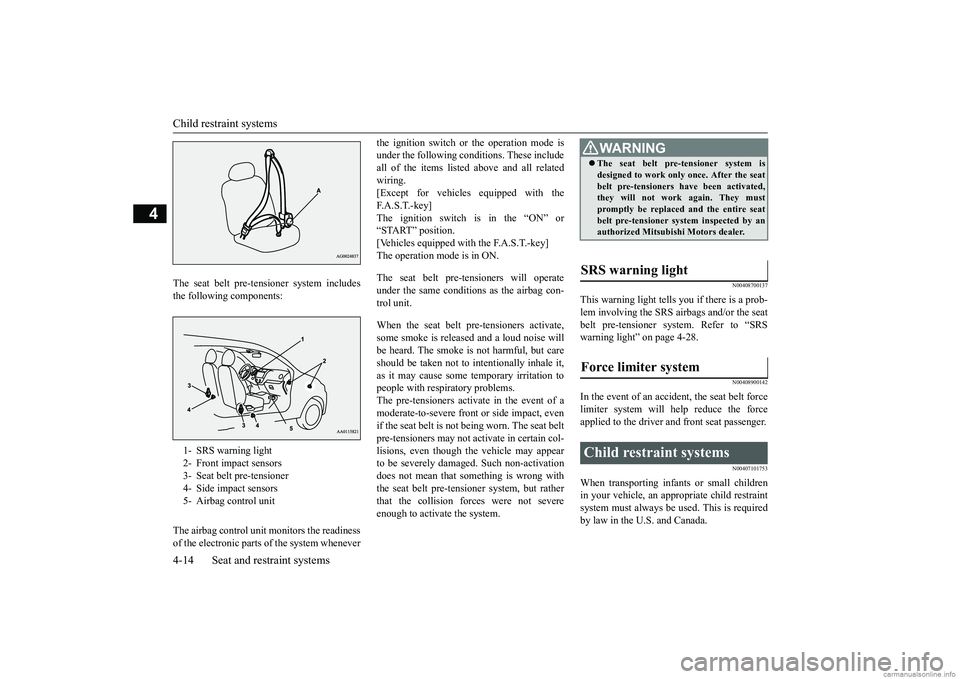
The seat belt pre-tens
ioner system includes
the following components: The airbag control unit monitors the readiness of the electronic parts of the system whenever
the ignition switch or the operation mode is under the following conditions. These includeall of the items listed
above and all related
wiring. [Except for vehicles
equipped with the
F.A.S.T.-key] The ignition switch is in the “ON” or “START” position.[Vehicles equipped with the F.A.S.T.-key] The operation mode is in ON. The seat belt pre-te
nsioners will operate
under the same conditions as the airbag con- trol unit. When the seat belt pr
e-tensioners activate,
some smoke is released and a loud noise willbe heard. The smoke is
not harmful, but care
should be taken not to
intentionally inhale it,
as it may cause some temporary irritation topeople with respiratory problems. The pre-tensioners activate in the event of a moderate-to-severe front or side impact, evenif the seat belt is not
being worn. The seat belt
pre-tensioners may not activate in certain col- lisions, even though the vehicle may appearto be severely damage
d. Such non-activation
does not mean that something is wrong with the seat belt pre-tens
ioner system, but rather
that the collision fo
rces were not severe
enough to activate the system.
N00408700137
This warning light tells you if there is a prob- lem involving the SRS airbags and/or the seat belt pre-tensioner sy
stem. Refer to “SRS
warning light” on page 4-28.
N00408900142
In the event of an accident, the seat belt forcelimiter system will help reduce the forceapplied to the driver and front seat passenger.
N00407101753
When transporting infants or small childrenin your vehicle, an appropriate child restraint system must always be
used. This is required
by law in the U.S. and Canada.
1- SRS warning light 2- Front impact sensors 3- Seat belt pre-tensioner 4- Side impact sensors 5- Airbag control unit
WA R N I N G The seat belt pre-tensioner system is designed to work only
once. After the seat
belt pre-tensioners have been activated,they will not work again. They must promptly be replaced and the entire seat belt pre-tensioner system inspected by anauthorized Mitsubis
hi Motors dealer.
SRS warning light Force limiter system Child restraint systems
BK0249600US.book 14 ページ 2017年4月20日 木曜日 午後1時36分
Page 50 of 263
Supplemental Restraint System (SRS) - airbag
Seat and restraint systems 4-25
4
N00407801587
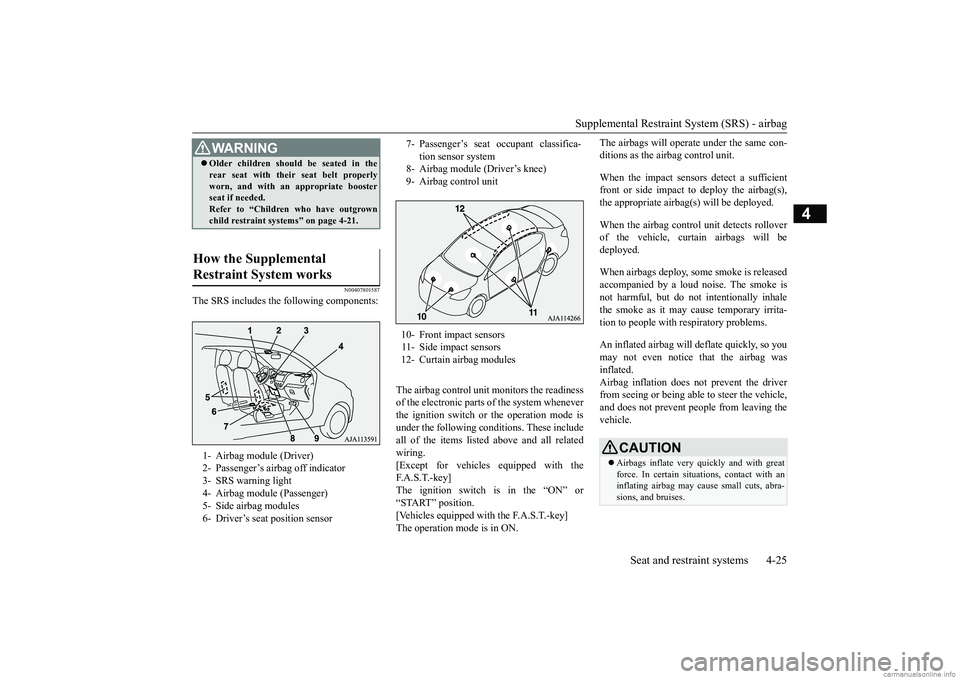
The SRS includes the following components:
The airbag control unit
monitors the readiness
of the electronic parts of the system whenever the ignition switch or the operation mode is under the following conditions. These includeall of the item
s listed above a
nd all related
wiring. [Except for vehicles equipped with theF.A.S.T.-key] The ignition switch is in the “ON” or “START” position.[Vehicles equipped with the F.A.S.T.-key] The operation mode is in ON.
The airbags will operate under the same con- ditions as the airbag control unit. When the impact sensors detect a sufficient front or side impact to deploy the airbag(s), the appropriate airbag
(s) will be deployed.
When the airbag control unit detects rollover of the vehicle, curtain airbags will bedeployed. When airbags deploy, some smoke is released accompanied by a loud noise. The smoke is not harmful, but do not
intentionally inhale
the smoke as it may ca
use temporary irrita-
tion to people with respiratory problems. An inflated airbag will
deflate quickly, so you
may not even notice that the airbag was inflated. Airbag inflation does not prevent the driverfrom seeing or being able
to steer the vehicle,
and does not prevent people from leaving the vehicle.
WA R N I N G Older children should be seated in the rear seat with their seat belt properlyworn, and with an
appropriate booster
seat if needed. Refer to “Children
who have outgrown
child restraint syst
ems” on page 4-21.
How the Supplemental Restraint System works 1- Airbag module (Driver) 2- Passenger’s airb
ag off indicator
3- SRS warning light 4- Airbag module (Passenger)5- Side airbag modules 6- Driver’s seat position sensor
7- Passenger’s seat oc
cupant classifica-
tion sensor system
8- Airbag module (Driver’s knee)9- Airbag control unit 10- Front impact sensors 11- Side impact sensors12- Curtain airbag modules
CAUTION Airbags inflate very quickly and with great force. In certain situations, contact with an inflating airbag may cause small cuts, abra-sions, and bruises.
BK0249600US.book 25 ページ 2017年4月20日 木曜日 午後1時36分
Page 51 of 263
Supplemental Restraint System (SRS) - airbag 4-26 Seat and restraint systems
4
N00418600256
This vehicle is equipped with an event data recorder (EDR). The main purpose of an EDR is to record, incertain crash or near crash-like situations, such as an airbag deployment or hitting a road obstacle, data that
will assist in under-
standing how a vehicle’s systems performed. The EDR is designed to
record data related to
vehicle dynamics and sa
fety systems for a
short period of time,
typically 30 seconds or
less. The EDR in this vehicle is designed to record such data as: How various systems in your vehicle were operating; Whether or not the driver and front pas- senger safety belts
were buckled/fastened;
How far (if at all) the driver was depress- ing the accelerator and/or brake pedal;and, How fast the vehicle was traveling.
These data can help provide a better under- standing of the circumstances in whichcrashes and injuries occur.
To read data recorded
by an EDR, special
equipment is required, a
nd access to the vehi-
cle or the EDR is needed. In addition to the vehicle manufacturer, ot
her parties, such as
law enforcement, that have the special equip-ment, can read the information if they have access to the vehicle or the EDR.
N00417900223
The driver’s seat posit
ion sensor is attached
to the seat rail and provides the airbag control unit with information
on the seat’s fore-aft
position. The airbag control unit controls deployment of the driver’s front airbag in accordance with the information it receivesfrom this sensor. If there is a problem involving the driver’s seat position sensor, th
e SRS warning light in
the instrument panel will come on. Refer to
“SRS warning light” on page 4-28.
N00418000364
The passenger’s seat oc
cupant classification
sensor system is attached to the front passen- ger seat cushion and provides the airbag con- trol unit with inform
ation regarding the
occupant on the front passenger seat. The air- bag control unit controls deployment of the
Event Data Recording
NOTE
EDR data are recorded by your vehicle only if a non-trivial crash situation occurs; no dataare recorded by the EDR under normal driv-ing conditions and no
personal data (e.g.,
name, gender, age, and crash location) are recorded. However, other parties, such aslaw enforcement, could combine the EDR data with the type of personally identifying data routinely acquire
d during a crash inves-
tigation.
Driver’s seat position sensor
WA R N I N G If the SRS warning
light comes on, have
the vehicle inspecte
d by an authorized
Mitsubishi Motors dealer as soon as possi-ble. Please observe the following instructions to ensure that the driver’s seat position sensor can operate correctly.• Adjust the seat to the correct position,and sit well back
against the seatback.
Refer to “Front seats” on page 4-2.• Do not recline the seatback more thannecessary when driving.• Do not place metall
ic objects or luggage
under the front seat.
If the vehicle is involved in a severe impact, have the SRS sensor inspected byan authorized
Mitsubishi Motors dealer as
soon as possible.
Passenger’s seat occupant clas- sification sensor system
BK0249600US.book 26 ページ 2017年4月20日 木曜日 午後1時36分
Page 52 of 263
Supplemental Restraint System (SRS) - airbag
Seat and restraint systems 4-27
4
passenger’s front airbag in accordance with the information it receives from this system.The passenger’s front ai
rbag will not deploy
in an impact when the system senses no occu- pant on the front passenger seat or a child in achild restraint system. In this case, the pas- senger’s airbag off indicator will illuminate. Refer to “Passenger’s ai
rbag off indicator” on
page 4-27. If there is a problem involving the passen- ger’s seat occupant cl
assification sensor sys-
tem, the SRS warning light in the instrument panel will come on.Refer to “SRS warning light” page 4-28.
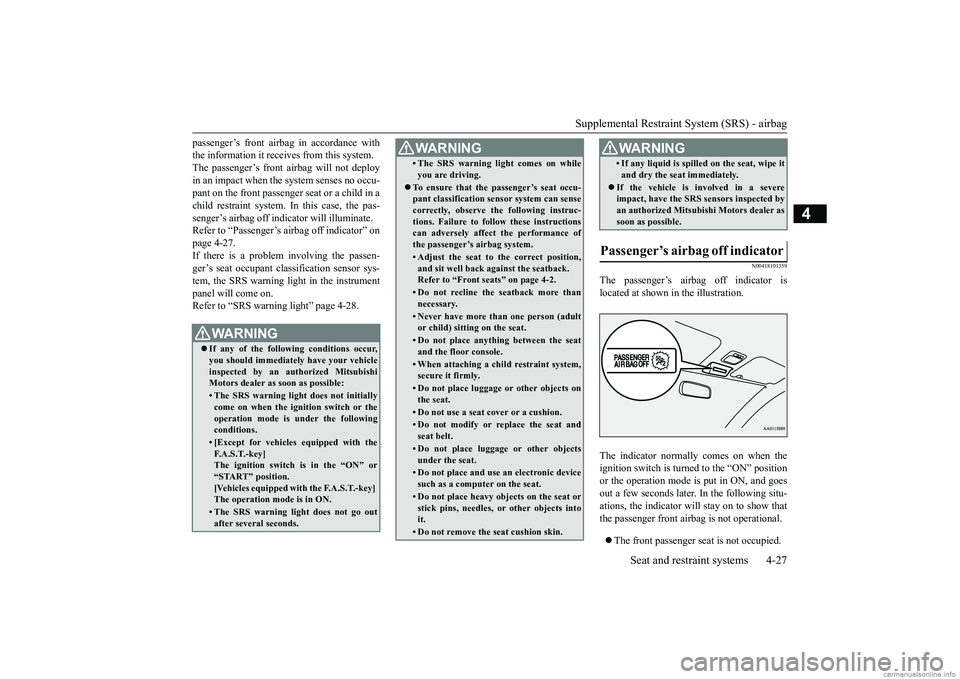
N00418101359
The passenger’s airbag off indicator islocated at shown in the illustration. The indicator normall
y comes on when the
ignition switch is turned to the “ON” position or the operation mode is put in ON, and goes out a few seconds later. In the following situ-ations, the indicator will stay on to show that the passenger front airb
ag is not operational.
The front passenger seat is not occupied.
WA R N I N GIf any of the following conditions occur, you should immediatel
y have your vehicle
inspected by an au
thorized Mitsubishi
Motors dealer as
soon as possible:
• The SRS warning light does not initially come on when the ignition switch or theoperation mode is under the following conditions.• [Except for vehicles equipped with theF. A . S . T. - k e y ] The ignition switch is in the “ON” or“START” position. [Vehicles equipped with the F.A.S.T.-key] The operation mode is in ON.• The SRS warning light does not go outafter several seconds.
• The SRS warning li
ght comes on while
you are driving.
To ensure that the passenger’s seat occu- pant classification sensor system can sense correctly, observe the following instruc-tions. Failure to follow these instructions can adversely affect
the performance of
the passenger’s airbag system.• Adjust the seat to the correct position,and sit well back
against the seatback.
Refer to “Front seats” on page 4-2.• Do not recline the seatback more thannecessary.• Never have more than one person (adultor child) sitting
on the seat.
• Do not place anything between the seat and the floor console.• When attaching a chil
d restraint system,
secure it firmly.• Do not place luggage
or other objects on
the seat.• Do not use a seat cover or a cushion.• Do not modify or replace the seat andseat belt.• Do not place luggage or other objectsunder the seat.• Do not place and use
an electronic device
such as a computer on the seat.• Do not place heavy objects on the seat orstick pins, needles, or other objects intoit.• Do not remove the seat cushion skin.WA R N I N G
• If any liquid is spilled on the seat, wipe itand dry the seat
immediately.
If the vehicle is involved in a severe impact, have the SRS sensors inspected by an authorized
Mitsubishi Motors dealer as
soon as possible.
Passenger’s airbag off indicator
WA R N I N G
BK0249600US.book 27 ページ 2017年4月20日 木曜日 午後1時36分