lock MITSUBISHI MIRAGE G4 2018 (in English) Service Manual
[x] Cancel search | Manufacturer: MITSUBISHI, Model Year: 2018, Model line: MIRAGE G4, Model: MITSUBISHI MIRAGE G4 2018Pages: 263, PDF Size: 37.9 MB
Page 91 of 263
Inside emergency trunk lid release 5-28 Features and controls
5
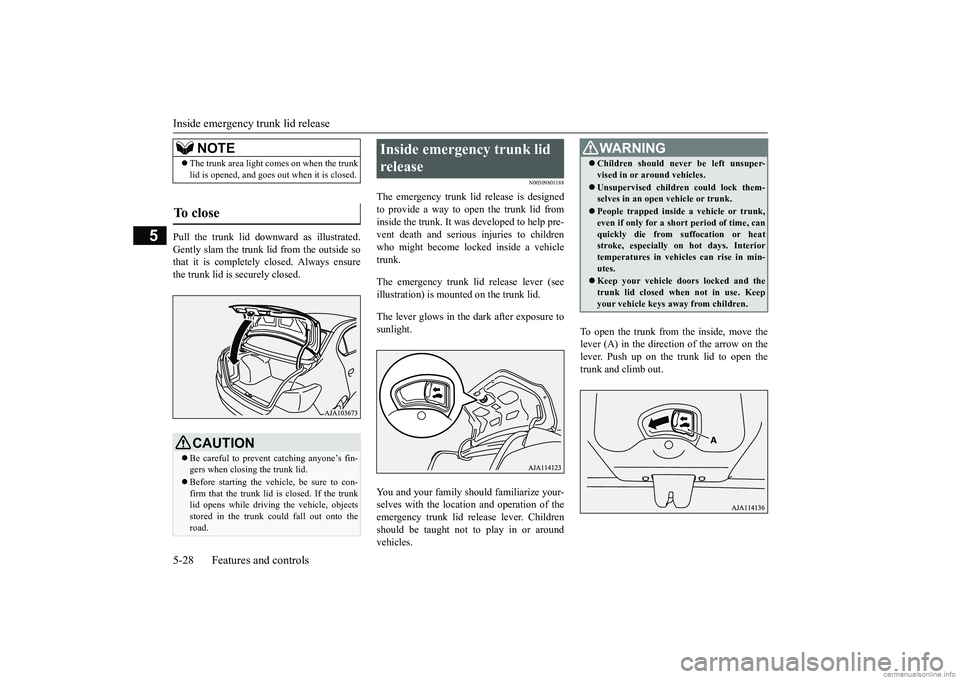
Pull the trunk lid downward as illustrated. Gently slam the trunk lid from the outside so that it is completely closed. Always ensurethe trunk lid is securely closed.
N00509801188
The emergency trunk lid release is designed to provide a way to open the trunk lid from inside the trunk. It was developed to help pre-vent death and serious
injuries to children
who might become locked inside a vehicle trunk. The emergency trunk lid release lever (see illustration) is mounted on the trunk lid. The lever glows in the dark after exposure to sunlight. You and your family should familiarize your- selves with the location and operation of theemergency trunk lid release lever. Children should be taught not to play in or around vehicles.
To open the trunk from the inside, move the lever (A) in the direction of the arrow on thelever. Push up on the trunk lid to open the trunk and climb out.
NOTE
The trunk area light comes on when the trunk lid is opened, and goes out
when it is closed.
To close
CAUTIONBe careful to preven
t catching anyone’s fin-
gers when closing the trunk lid. Before starting the vehi
cle, be sure to con-
firm that the trunk lid is closed. If the trunk lid opens while driving the vehicle, objects stored in the trunk could fall out onto theroad.
Inside emergency trunk lid release
WA R N I N G Children should never be left unsuper- vised in or ar
ound vehicles.
Unsupervised children could lock them- selves in an open vehicle or trunk. People trapped inside a vehicle or trunk, even if only for a short period of time, can quickly die from suffocation or heatstroke, especially on
hot days. Interior
temperatures in vehicles can rise in min- utes. Keep your vehicle d
oors locked and the
trunk lid closed when not in use. Keepyour vehicle keys aw
ay from children.
BK0249600US.book 28 ページ 2017年4月20日 木曜日 午後1時36分
Page 93 of 263
Power window control 5-30 Features and controls
5
N00548800098
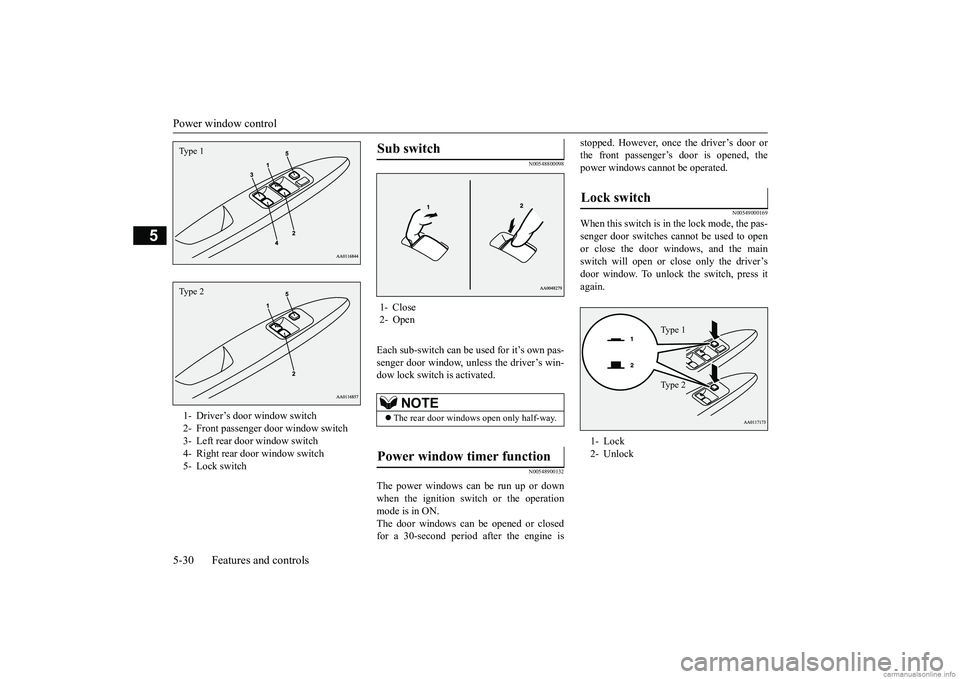
Each sub-switch can be used for it’s own pas- senger door window, unless the driver’s win-dow lock switch is activated.
N00548900132
The power windows can be run up or downwhen the ignition switch or the operationmode is in ON. The door windows can be opened or closed for a 30-second period after the engine is
stopped. However, once the driver’s door or the front passenger’s door is opened, thepower windows cannot be operated.
N00549000169
When this switch is in the lock mode, the pas-senger door switches cannot be used to open or close the door windows, and the main switch will open or
close only the driver’s
door window. To unlock the switch, press it again.
1- Driver’s door window switch 2- Front passenger door window switch3- Left rear door window switch 4- Right rear door window switch 5- Lock switchType 1Type 2
Sub switch 1- Close2- Open
NOTE
The rear door windows open only half-way.
Power window timer function
Lock switch 1- Lock 2- Unlock
Ty p e 1 Ty p e 2
BK0249600US.book 30 ページ 2017年4月20日 木曜日 午後1時36分
Page 94 of 263
Power window control
Features and controls 5-31
5
N00528801161
If a hand or head is trapped, for safety the door window is automati
cally lowered a little.
After the door window is
lowered, clear the
obstruction, then pull
up the switch again to
close the door window.
N00551400043
Wind buffeting can be described as the per-ception of pressure on the ears or a booming or rumbling sound. Your vehicle may exhibit wind buffeting when driving with one or bothrear door windows down or partially opened. This is a normal occurrence that can be mini- mized. If the buffeting
occurs with the rear
door windows open, open the front door win- dows as well as the rear door windows to minimize the condition.
WA R N I N G Before driving with a child in the vehicle, be sure to lock the window switch to makeit inoperative. Children tampering withthe switch could easily trap their hands or heads in the window.
Safety mechanism (Driver’s door window of Type 1 only)
WA R N I N G If the battery terminals are disconnected or the fuse for electric window is replaced, the safety mechanism will be cancelled. If a hand or head got
trapped, a serious
injury could result.CAUTION The safety mechanism is deactivated just before the door window closes. This allows the door window to close completely. There- fore be especially care
ful that fingers are not
trapped in the door window opening.
The safety mechanism is deactivated while the switch is pulled up.
Therefore be espe-
cially careful that fi
ngers are not trapped in
the door window opening. Do not deliberately trap your hands or head in order to activate the safety mechanism. Your hand or head coul
d be trapped and per-
sonal injury could result.NOTE
The safety mechanism can be activated if the driving conditions or
other circumstances
cause the door window to be subjected to a physical shock similar to that caused by trapped hand or head. If the safety mechanism is activated 5 or more times in a row, the safety mechanismwill be cancelled a
nd the door window will
not close correctly. In such a case, the
following procedure
should be implemented to rectify this situa- tion. If the window is open,
repeatedly raise the
driver’s door window switch until that win-dow has been fully closed. Following this, release the switch, raise the switch once again and hold it in this condition for atleast1 second, then release it. You should now be able to operate in the normal fashion.CAUTION
If the battery termin
als are disc
onnected or
the fuse for electric
window is replaced, the
safety mechanism will
be cancelled and the
door window will not
automatically
open/close completely. If the window is open, repeatedly raise thedriver’s door window sw
itch until the win-
dow has been fully closed. Following this, release the switch, raise the switch onceagain and hold it in this
condition for at least
1 second, then release it. You should now be able to operate the driver’s door window inthe normal fashion.
What to do if you hear wind buffeting when driving
NOTE
BK0249600US.book 31 ページ 2017年4月20日 木曜日 午後1時36分
Page 96 of 263
Steering wheel height adjustment
Features and controls 5-33
5
N00511500231
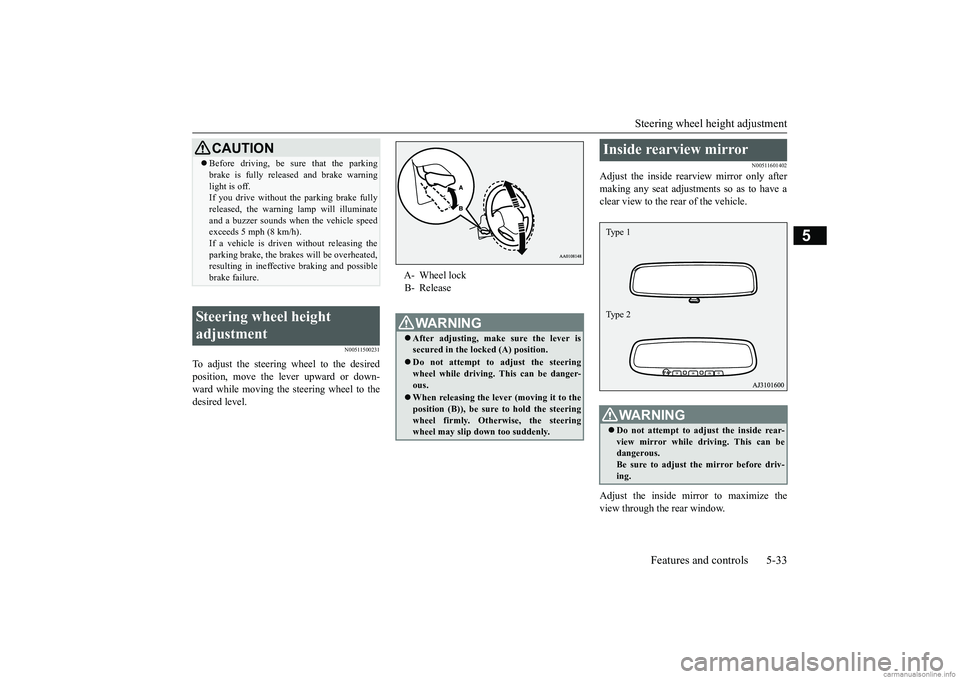
To adjust the steering wheel to the desired position, move the lever upward or down-ward while moving the steering wheel to the desired level.
N00511601402
Adjust the inside rearview mirror only aftermaking any seat adjustme
nts so as to have a
clear view to the rear of the vehicle. Adjust the inside mirror to maximize the view through the rear window.
CAUTION Before driving, be sure that the parking brake is fully released and brake warninglight is off.If you drive without the parking brake fully released, the warning lamp will illuminate and a buzzer sounds when the vehicle speedexceeds 5 mph (8 km/h). If a vehicle is driven without releasing the parking brake, the brakes will be overheated,resulting in ineffectiv
e braking and possible
brake failure.
Steering wheel height adjustment
A- Wheel lock B- ReleaseWA R N I N G After adjusting, make sure the lever is secured in the locked (A) position. Do not attempt to adjust the steering wheel while driving. This can be danger-ous. When releasing the leve
r (moving it to the
position (B)), be sure to hold the steering wheel firmly. Otherwise, the steering wheel may slip down too suddenly.
Inside rearview mirror
WA R N I N G Do not attempt to adjust the inside rear- view mirror while driving. This can bedangerous. Be sure to adjust the mirror before driv- ing.Type 1 Type 2
BK0249600US.book 33 ページ 2017年4月20日 木曜日 午後1時36分
Page 98 of 263

Outside rearview mirrors
Features and controls 5-35
5
When the headlights of the vehicles behind you are very bright, the reflection factor ofthe rearview mirror is automatically changed to reduce the glare. Normally, use the automatic mode. When the ignition switch is turn
ed to the “ON” position
or the operation mode is put in ON, the greenindicator (1) illuminat
es and the reflection
factor of the mirror is
automatically changed.
N00512200206
Adjust the outside rearview mirrors only after making any seat adjustme
nts so as to have a
clear view to the rear of the vehicle.
N00549100144
The outside rearview mi
rrors can be adjusted
when the ignition switch or the operation mode is in ON or ACC.Move the lever (A) to the same side as the mirror you wish to adjust. Press the switch (B) to adjust the mirror posi- tion.
Ty p e 2
NOTE
Do not hang items on,
or spray glass cleaner
on the sensors (2), as
reduced sensitivity
could result.
If you want to stop automatic mode, press the switch (3) and the indicator (1) will gooff.To return to automatic mode, press the switch again. Or turn the ignition switch to the “ON” position or put the operation modein ON, after turning the ignition switch to the “LOCK” position or
putting the operation
mode in OFF.
Outside rearview mirrors
WA R N I N G Do not attempt to adjust the outside rear- view mirrors while driving. This can bedangerous. Be sure to adjust the mirrors before driv- ing. Your passenger’s side mirror is convex. The objects you see in
the mirror will look
smaller and farthe
r away than they
appear in a regular flat mirror. Do not use this mirror to estimate the dis- tance of vehicles
following you when
changing lanes.NOTE
To adjust the mirror position L- Left outside mirror adjustment R- Right outside mirror adjustment 1- Up 2- Down 3- Right 4- Left
BK0249600US.book 35 ページ 2017年4月20日 木曜日 午後1時36分
Page 101 of 263
Starting the engine 5-38 Features and controls
5
This model is equipped with an electronically controlled fuel injection system. This is a sys-tem that automatically controls fuel injection. There is usually no need to depress the accel- erator pedal when starting the engine.The starter should not be run for more than 15 seconds at a time. To prevent battery drain, wait a few secondsbetween attempts to restart the engine. 1. Make sure all occupants are properly seated with seat belts fastened.
2. Insert the ignition key. 3. Make sure the parking brake is applied.4. Press and hold the brake pedal down firmly with your right foot. 5. Press and hold the clut
ch pedal all the way
down (manual transaxle). 6. On vehicles equipped with manual trans- axle, place the gearshift lever in the “N” (Neutral) position.On vehicles equippe
d with continuously
variable transmission (CVT), make sure the selector lever is in the “P” (PARK)position.
7. Turn the ignition switch to the “ON” posi- tion and make certain that all warninglights are functioning properly before starting the engine. 8. Turn the ignition switch to the “START”position without pre
ssing the accelerator
pedal. Release the key when the engine starts.
After several attempts
, you may experience
that the engine still does not start. 1. Make sure that all electric devices, such as lights, air conditi
oning blower and rear
window defogger, are turned off. 2. While depressing the brake pedal {contin- uously variable transmission (CVT)} orthe clutch pedal (manual transaxle), press the accelerator peda
l halfway and hold it
there, then crank th
e engine. Release the
accelerator pedal, immediately after the engine starts.
WA R N I N G Never run the engine in
a closed or poorly
ventilated area any lo
nger than is needed
to move your vehicle
out of the area. Car-
bon monoxide gas, wh
ich is odorless and
extremely poisonous, could build up and cause serious injury or death.CAUTION Do not push-start the vehicle.Do not run the engine at high rpms or drive at high speeds until
the engine has had a
chance to warm up. Release the ignition sw
itch as soon as the
engine starts. Otherwis
e, the starter motor
will be damaged.
Starting the engine
NOTE
On vehicles equipped
with manual transaxle,
the starter will not ope
rate unless the clutch
pedal is fully depresse
d (Clutch interlock).
NOTE
On vehicles equipped with CVT, the starter will not operate unless th
e selector lever is in
the “P” (PARK) or “N” (NEUTRAL) posi-tion.For safety reasons, start the engine in the “P” (PARK) position so that the wheels are locked.
NOTE
Minor noises may be he
ard on engine start-
up. These will disappear
as the engine warms
up.
When the engine is hard to start
BK0249600US.book 38 ページ 2017年4月20日 木曜日 午後1時36分
Page 105 of 263
Continuously variable transmission (CVT) (if so equipped) 5-42 Features and controls
5
N00563300049
When the selector lever cannot be shifted from the “P” (PARK) position to anotherposition while the brake
pedal is pressed and
held down with the ignition switch or the operation mode in ON, the battery may be flator the shift-lock mechanism may be malfunc- tioning. Immediately have your
vehicle checked by an
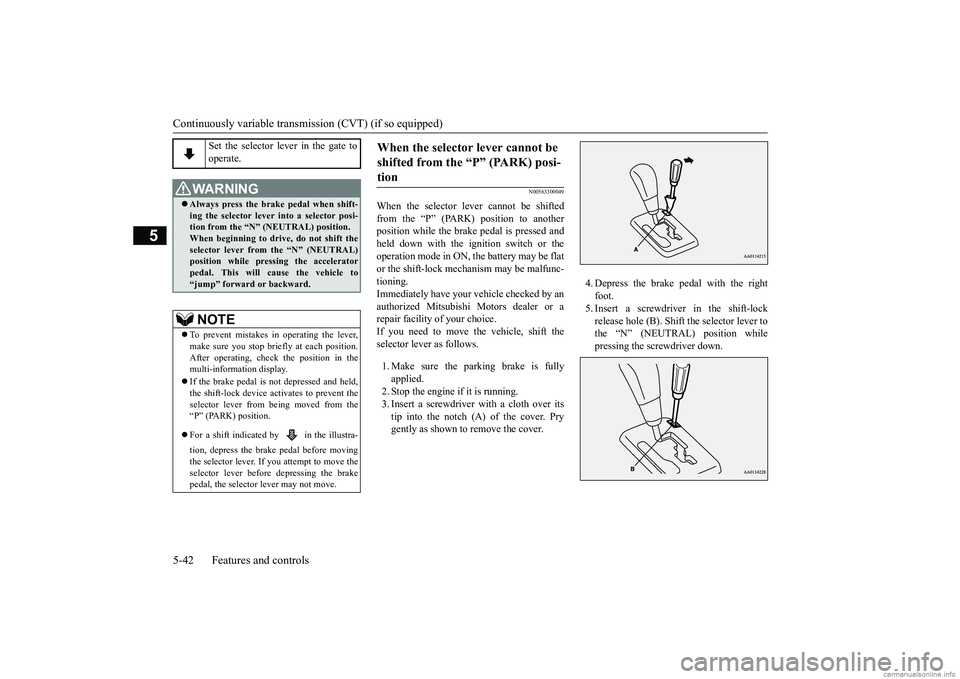
authorized Mitsubishi Motors dealer or a repair facility of your choice.If you need to move the vehicle, shift the selector lever as follows. 1. Make sure the parking brake is fully applied.2. Stop the engine if it is running. 3. Insert a screwdrive
r with a cloth over its
tip into the notch (A) of the cover. Prygently as shown to remove the cover.
4. Depress the brake pedal with the right foot.5. Insert a screwdriver in the shift-lock release hole (B). Shift the selector lever to the “N” (NEUTRAL) position whilepressing the screwdriver down.
Set the selector lever in the gate to operate.
WA R N I N G Always press the brake pedal when shift- ing the selector lever into a selector posi- tion from the “N” (NEUTRAL) position. When beginning to drive, do not shift theselector lever from
the “N” (NEUTRAL)
position while pressing the accelerator pedal. This will cause the vehicle to“jump” forward or backward.NOTE
To prevent mistakes in operating the lever, make sure you stop brie
fly at each position.
After operating, check the position in the multi-information display. If the brake pedal is not
depressed and held,
the shift-lock device activates to prevent theselector lever from being moved from the “P” (PARK) position. For a shift indicated by in the illustra- tion, depress the brake pedal before moving the selector lever. If
you attempt to move the
selector lever before
depressing the brake
pedal, the selector
lever may not move.
When the selector lever cannot be shifted from the “P” (PARK) posi-tion
BK0249600US.book 42 ページ 2017年4月20日 木曜日 午後1時36分
Page 106 of 263
Continuously variable transmission (CVT) (if so equipped)
Features and controls 5-43
5
N00560400078
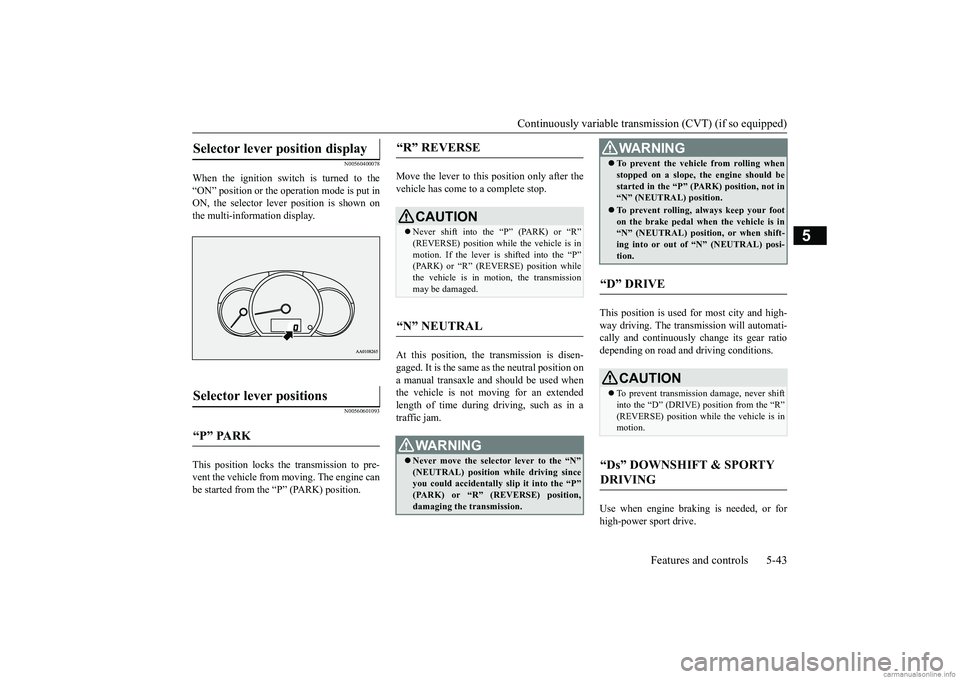
When the ignition switch is turned to the “ON” position or the operation mode is put in ON, the selector lever position is shown onthe multi-information display.
N00560601093
This position locks the transmission to pre-vent the vehicle from m
oving. The engine can
be started from the “P” (PARK) position.
Move the lever to this position only after the vehicle has come to a complete stop. At this position, the transmission is disen- gaged. It is the same
as the neutral position on
a manual transaxle and should be used whenthe vehicle is not m
oving for an extended
length of time during driving, such as in a traffic jam.
This position is used fo
r most city and high-
way driving. The transmission will automati-cally and continuously ch
ange its gear ratio
depending on road and driving conditions. Use when engine braking is needed, or for high-power sport drive.
Selector lever position display
Selector lever positions
“P” PARK
“R” REVERSE
CAUTION Never shift into the “P” (PARK) or “R” (REVERSE) position while the vehicle is in motion. If the lever is shifted into the “P”(PARK) or “R” (REVERSE) position while the vehicle is in motion, the transmission may be damaged.
“N” NEUTRAL
WA R N I N G Never move the selector lever to the “N” (NEUTRAL) position while driving since you could accidentally slip it into the “P” (PARK) or “R” (REVERSE) position,damaging the transmission.
To prevent the vehicle from rolling when stopped on a slope,
the engine should be
started in the “P” (PARK) position, not in“N” (NEUTRAL) position. To prevent rolling, always keep your foot on the brake pedal when the vehicle is in “N” (NEUTRAL) positi
on, or when shift-
ing into or out of “N” (NEUTRAL) posi-tion.
“D” DRIVE
CAUTION To prevent transmission damage, never shift into the “D” (DRIVE) position from the “R”(REVERSE) position while the vehicle is in motion.
“Ds” DOWNSHIFT & SPORTY DRIVING
WA R N I N G
BK0249600US.book 43 ページ 2017年4月20日 木曜日 午後1時36分
Page 111 of 263
Brake assist system 5-48 Features and controls
5
N00562800092
If an abnormal condition occurs in the sys- tem, the following i
ndicator will turn on.
N00567301116
The brake assist system
is a device assisting
drivers who cannot depress the brake pedalfirmly such as in em
ergency stop situations
and provides greater braking force.
If the brake pedal is depressed suddenly, the brakes will be applied
with more force than
usual.
• On vehicles with ma
nual transaxle, the
gearshift lever is in the following position.[When starting an uphi
ll slope forwards.]
The gearshift lever is in any position other than “R” (Reverse). (The hill start assist will operate, even if thegearshift lever is in the “N” (Neutral) posi- tion.) [When starting an uphill
slope backwards.]
The gearshift lever is in the “R” (Reverse) position. (The hill start assist
will not operate when
the gearshift lever is in the “N” (Neutral) position.) • On vehicles with CVT,
the selector lever is
in any position other than “P” (PARK) or “N” (NEUTRAL). • The vehicle is comple
tely stationary, with
the brake pedal depressed. • The parking brake is released. The hill start assist wi
ll not operate if the
accelerator pedal is
depressed before the
brake pedal is released. The hill start assist also operates when reversing on an uphill slope. When the hill start a
ssist is activated, you
may feel the operating sound or vibrationfrom under the body. This is a normal result of the hill start assist operation, and does not indicate a problem.NOTE
Warning indicator
-
ASC indicator
CAUTION If the warning is displayed, the hill start assist will not
operate. Start off carefully.
Park your vehicle in a
safe place and stop the
engine.Restart the engine and check whether the indicator goes out, in wh
ich case the hill start
assist is again working normally. If they remain displayed or reappear fre- quently, it is not necessa
ry to stop the vehicle
immediately, but th
e vehicle should be
inspected by an authorized Mitsubishi Motors dealer or a repair facility of your choice as s
oon as possible.
Brake assist system
CAUTIONThe brake assist system is not a device designed to exercise
braking force greater
than its capacity. Make
sure to always keep a
sufficient distance be
tween your vehicle and
a vehicle in front of you without relying toomuch on the brake assist system.NOTE
Once the brake assist system is operational, it maintains great braking force even if the brake pedal is lightly released.To stop its operation, completely remove your foot from the brake pedal. When the brake assist system is in use while driving, you may feel as if the depressed brake pedal is soft, the pedal moves in smallmotions in conjunction with the operation noise, or the vehicle body and the steering wheel vibrate. This occurs when the brakeassist system is ope
rating normally and does
not indicate faulty
operation. Continue to
depress the brake pedal. When the anti-lock brake system warning light is illuminated, th
e brake assist system is
not functioning.
BK0249600US.book 48 ページ 2017年4月20日 木曜日 午後1時36分
Page 112 of 263
Anti-lock braking system
Features and controls 5-49
5
N00517900338
The anti-lock braking
system helps prevent
the wheels from locking up when braking. This helps maintain vehicle drivability andsteering wheel handling. When using the anti-lock brakes (sudden braking), steering is slightly different from normal driving conditions. Use the steering wheel carefully. Always keep a safe distance from the vehicle in front of you. Even if your vehi- cle is equipped with
the anti-lock braking
system, leave a greater braking distance when: • Driving on gravel or snow-coveredroads. • Driving on uneven road surfaces. Operation of anti-lock braking system is not restricted situations where brakes are applied suddenly. Th
is system may also
prevent the wheels from locking whenyou drive over manholes, steel roadwork plates, road markings
, or any uneven road
surface.
When the anti-lock braking system is in use, you may feel the brake pedal vibrat-ing and hear a unique
sound. It may also
feel as if the pedal
resists being pressed.
In this situation, simply hold the brakepedal down firmly. Do not pump the brake, which will result in reduced braking performance.
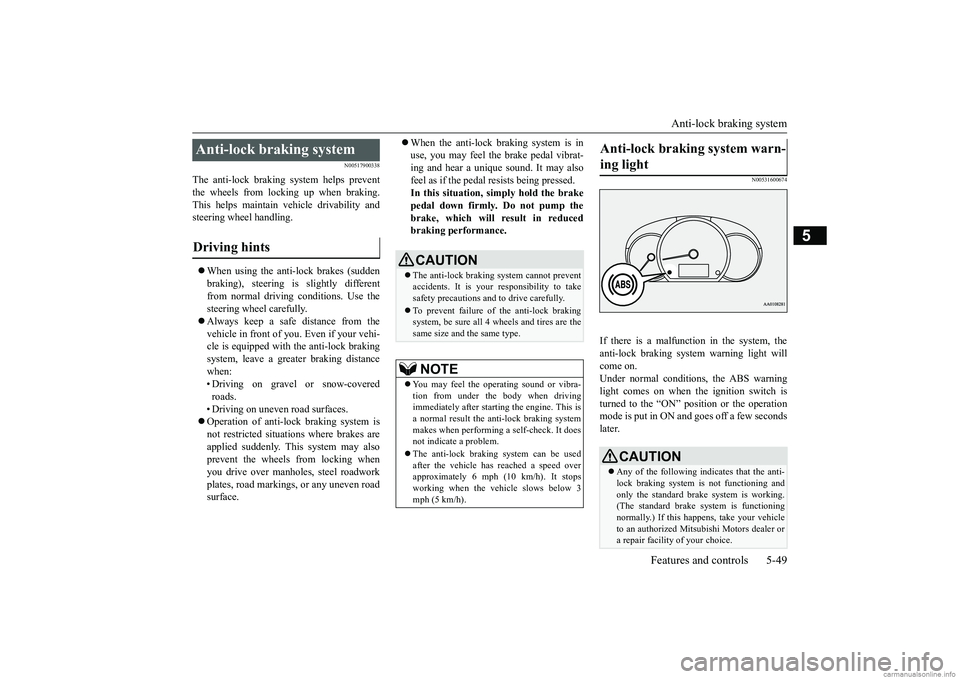
N00531600674
If there is a malfunction in the system, the anti-lock braking system warning light will come on.Under normal conditions, the ABS warning light comes on when the ignition switch is turned to the “ON” position or the operationmode is put in ON and goes off a few seconds later.
Anti-lock braking system Driving hints
CAUTION The anti-lock braking system cannot prevent accidents. It is your
responsibility to take
safety precautions a
nd to drive carefully.
To prevent failure of the anti-lock braking system, be sure all 4 wheels and tires are the same size and the same type.NOTE
You may feel the ope
rating sound or vibra-
tion from under the body when driving immediately after starti
ng the engine. This is
a normal result the an
ti-lock braking system
makes when performing a self-check. It does not indicate a problem. The anti-lock braking system can be used after the vehicle has
reached a speed over
approximately 6 mph (10 km/h). It stops working when the vehicle slows below 3mph (5 km/h).
Anti-lock braking system warn- ing light
CAUTION Any of the following i
ndicates that the anti-
lock braking system is not functioning andonly the standard brake system is working. (The standard brake
system is functioning
normally.) If this happens, take your vehicleto an authorized Mitsubishi Motors dealer or a repair facility
of your choice.
BK0249600US.book 49 ページ 2017年4月20日 木曜日 午後1時36分