battery MITSUBISHI MONTERO 1987 1.G Repair Manual
[x] Cancel search | Manufacturer: MITSUBISHI, Model Year: 1987, Model line: MONTERO, Model: MITSUBISHI MONTERO 1987 1.GPages: 284, PDF Size: 14.74 MB
Page 200 of 284
WIPER AND WASHER SYSTEM - Headlight Washer
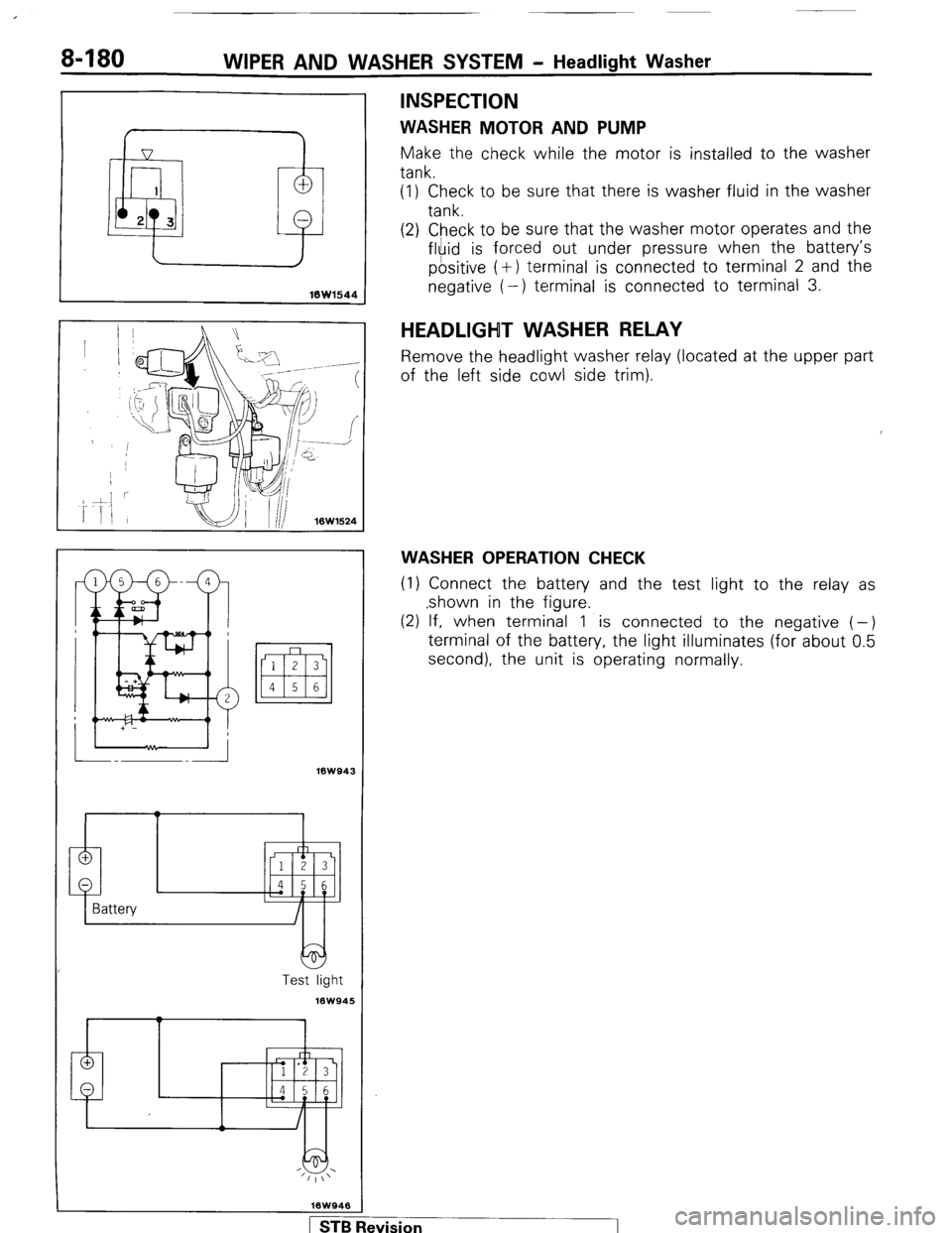
INSPECTION
WASHER MOTOR AND PUMP
Make the check while the motor is installed to the washer
tank.
(1) Check to be sure that there is washer fluid in the washer
tank.
16Wl544
(2) Check to be sure that the washer motor operates and the
fluid is forced out under pressure when the battery’s
positive (+) terminal is connected to terminal 2 and the
negative (-) terminal is connected to terminal 3.
18W943
Test light
16W945
HEADLIGHT WASHER RELAY
Remove the headlight washer relay (located a
of the left side cowl side trim). It the upper part
WASHER OPERATION CHECK
(1) Connect the battery and the test light to the relay as
,shown in the figure.
(2) If, when terminal 1 is connected to the negative (-)
terminal of the battery, the light illuminates (for about 0.5
second), the unit is operating normally.
1 STB Revision -1
Page 206 of 284
8486 HORN - Horn
HORN
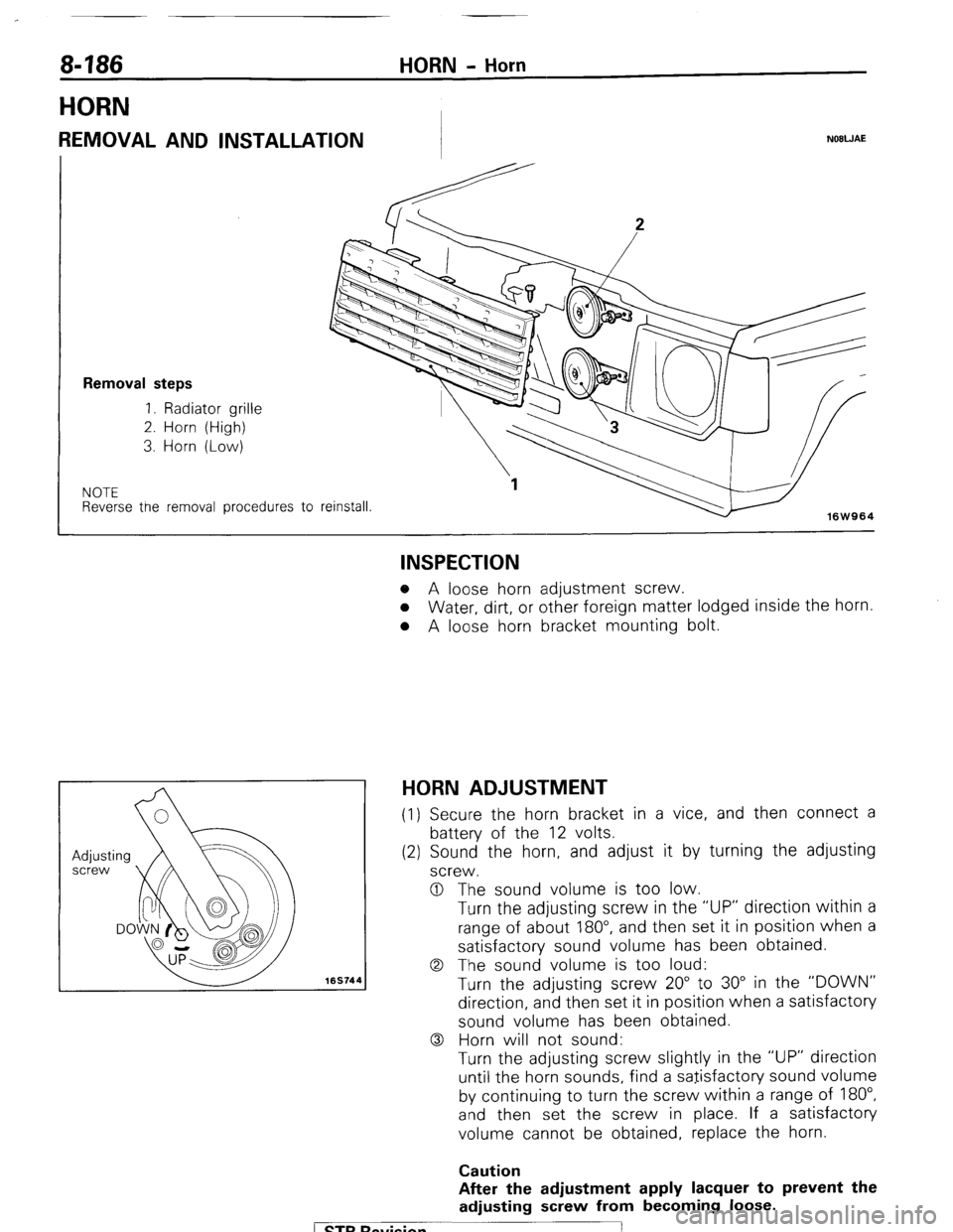
REMOVAL AND INSTALLATION NOBWAE
Removal steps
1. Radiator grille
2. Horn (High)
3. Horn (Low)
NOTE Reverse tne removal procedures to
reinstall.
16W964
169744
INSPECTION o A loose horn adjustment screw.
o Water, dirt, or other foreign matter lodged inside the horn.
l A loose horn bracket mounting bolt.
HORN ADJUSTMENT (1) Secure the horn bracket in a vice, and then connect a
battery of the 12 volts.
(2) Sound the horn, and adjust it by turning the adjusting
screw.
0 The sound volume is too low.
Turn the adjusting screw in the “UP” direction within a
range of about 180”, and then set it in position when a
satisfactory sound volume has been obtained.
0 The sound volume is too loud:
Turn the adjusting screw 20” to 30” in the “DOWN”
direction, and then set it in position when a satisfactory
sound volume has been obtained.
0 Horn will not sound:
Turn the adjusting screw slightly in the “UP” direction
until the horn sounds, find a satisfactory sound volume
by continuing to turn the screw within a range of 180”,
and then set the screw in place. If a satisfactory
volume cannot be obtained, replace the horn.
Caution
After the adjustment apply lacquer to prevent the
adjusting screw from becoming loose.
1 ST6 Revision
Page 214 of 284
8-194 AUDIO SYSTEM - Circuit Diagram
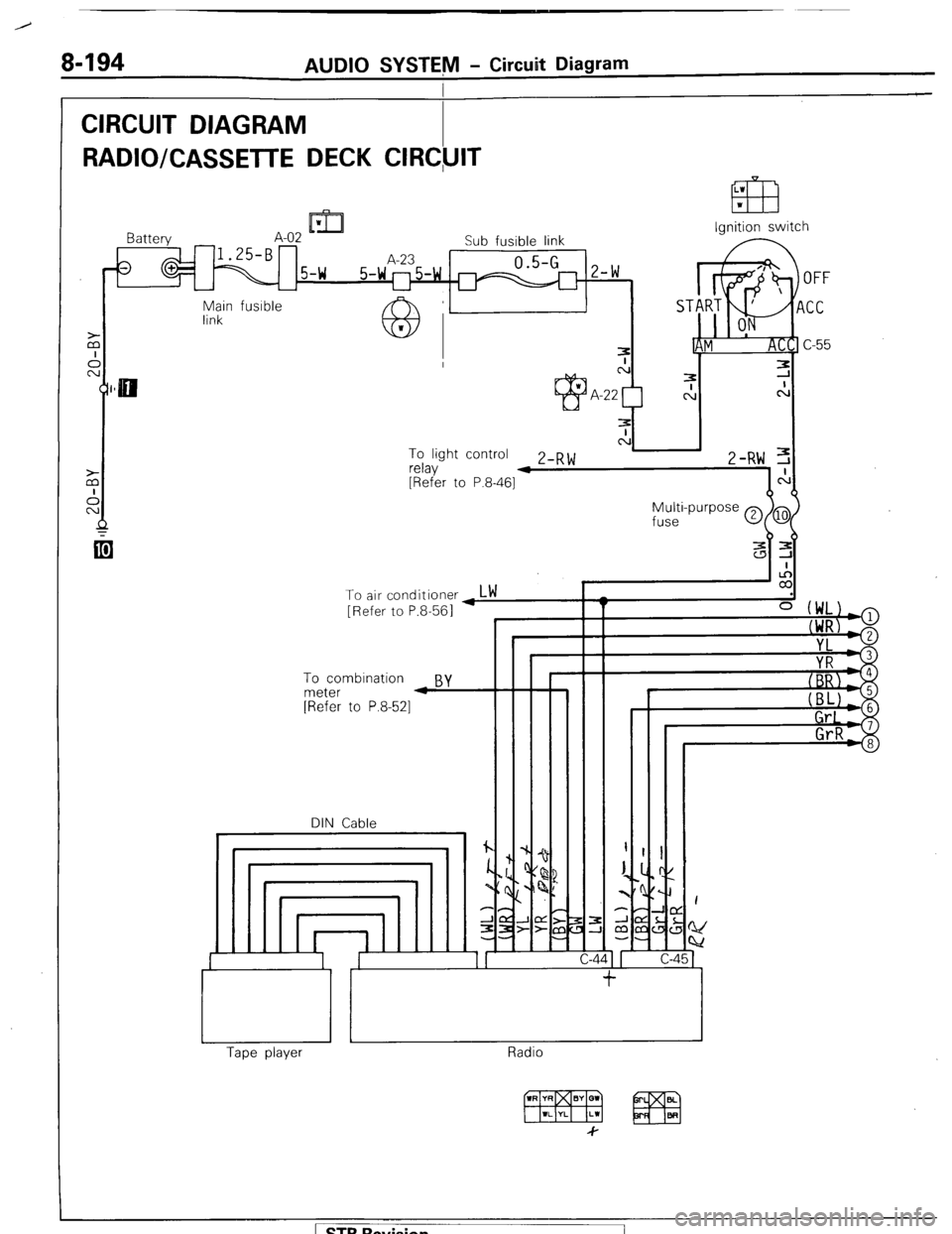
CIRCUIT DIAGRAM
I
RADIO/CASSETTE DECK CIRC,UIT
LW
033 w
Ignition switch
Battery A-02 IL-
Sub fusible link
0 1.25-B A-23 0.5-G 2 w
1 5-w 5-w ll5-w m -
u
Main fusible
link
N To light control
relav Z-RW 3 4
[Refer to P.8-461
Z-RW,,:
To air conditioner,LW
[Refer to P.8-561
To combination
By meter 4
[Refer to P.8-521
DIN Cable
I
/
J
I Y
=z
I
c- 45 -
It, /II
1 L
Radio Tape player
[ STB Revision
Page 227 of 284

BACK DOOR WINDOW DEFOGGER - Printed Heater Lines B-207
Normal characteristic curve
Voltage
I;\
Positive
terminal Printed heater line Negative
terminal
Abnormal characteristic curve
Voltage
IZV
6V
ov :-
Tf I Open-circuit
I point
I
i
!
Positive Printed heater line Negative
terminal terminal
161332
Alignme.nt holes
Masking tape
16FfiSCl
PRINTED HEATER LINES
INSPECTION N08PKAA
1. The printed heater lines should be tested while the engine
is running at 2,000 rpm and the battery is being charged.
2. Turn the defogger switch to the “ON” position, and use
voltmeter to measure the voltage of each printed heater
line at the back door window glass center point “A”.
3. If all of the heater lines indicate approximately 6V, the back
door window printed heater lines are functioning properly.
4. If a voltage of 12V is indicated at point “A”, the heater line
is broken between point “A” and the negative (-) terminal.
Move the test probe gradually toward the negative (-)
terminal, and search for the place where there is a sudden
change in the voltage (to 0 V).
5. This place where the voltage suddenly changes indicates
the location of the broken heater line.
6. If OV is indicated at point “A”, the heater line is broken
between point “A” and the positive (+) terminal. Find the
point where there is a sudden change in the voltage (to
12V). as described in step 4. above.
REPAIR
I. Prepare the following items:
e Conductive paint
@ Paint thinner
e Masking tape, decal, etc.
a, Unleaded gasoline
@ Thin brush
Wipe the glass adjacent to the broken heater line, clean
with unleaded gasoline, and bond a decal or masking tape
as shown.
2. Shake the electroconductive paint container well, and
remove the amount of paint needed. Dilute it with a small
quantity of paint thinner, and apply three coats with the
brush at intervals of about 15 minutes.
3. Remove the tape or decal and leave the repaired defogger
unused for a while before supplying power.
4. For a better finish, scrape away excess deposits with a
knife after drying is complete (one day later).
Caution
After repair, clean the glass with a soft dry shop towel
or wipe along the printed heater line with a slightly
moistened shop towel.
1 STB Revision
Page 230 of 284
8-210 AUTOMATIC FREE-WHEELING HUB INDICATOR SYSTEM - General Information
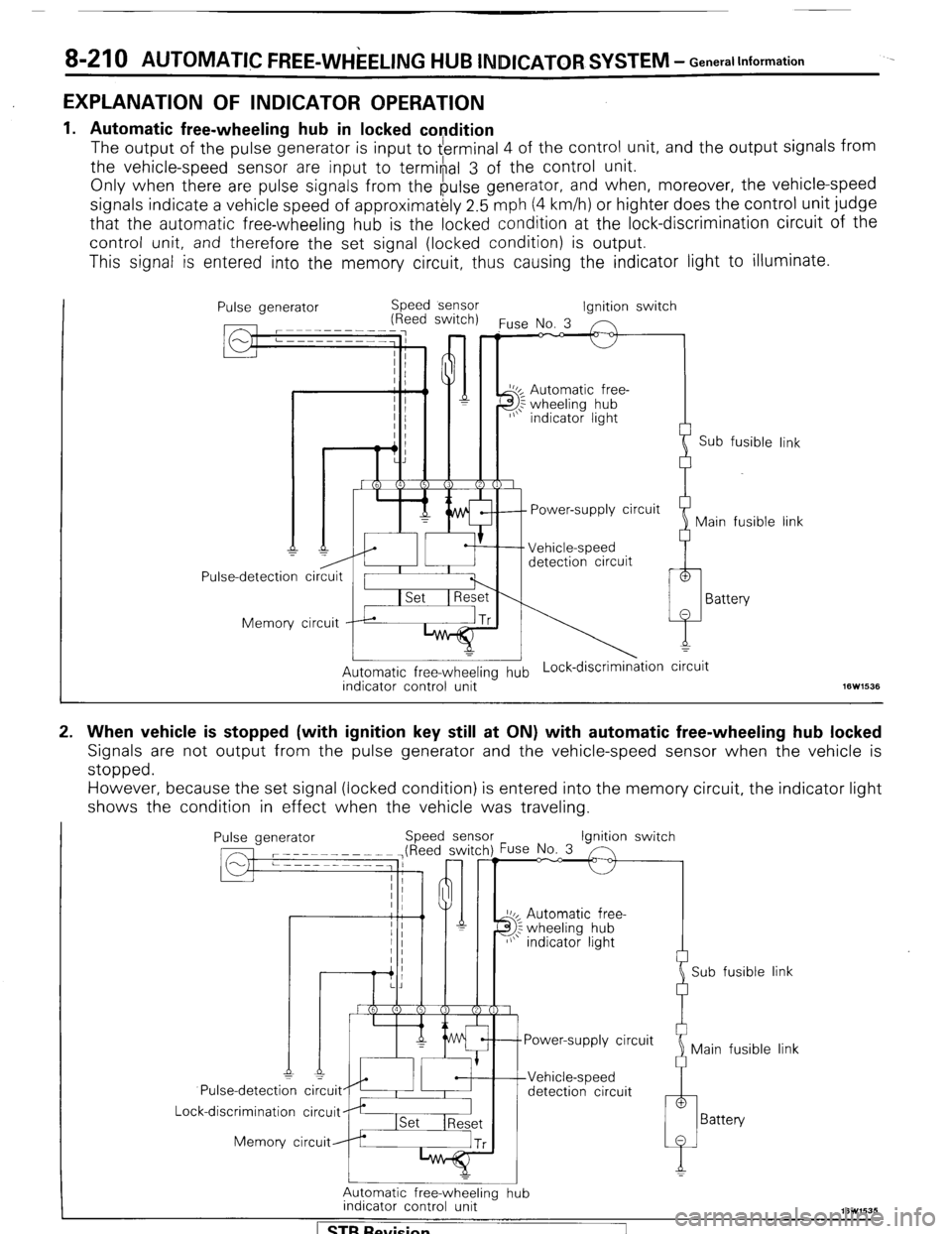
EXPLANATION OF INDICATOR OPERATION
.
1.
2. Automatic free-wheeling hub in locked condition
The
output of the pulse generator is input to $ertninal 4 of the control unit, and the output signals from
the vehicle-speed sensor are input
to termi#al 3 of the control unit.
Only when there are pulse signals from the pulse generator, and when, moreover, the vehicle-speed
signals indicate a vehicle speed of approximatkly 2.5 mph (4 km/h) or highter does the control unit judge
that the automatic free-wheeling hub is the locked condition at the lock-discrimination circuit of the
control unit, and therefore the set signal (locked condition) is output.
This signal is entered into the memory circuit, thus causing the indicator light to illuminate.
Pulse generator Speed sensor
(Reed switch)
Pulse-detection circuit / I I
Memory circuit rp*
I
Automatic free-wheeling hub Lock-discrimin&ion circuit
indicator control unit 16W1535 Ignition switch
‘use No. 3 n
J 2
I_
Power-supply circuit
Vehicle-speed
detection circuit 1
Sub fusible link 1
Main fusible link 1
)
1
Battery
When vehicle is stopped (with ignition key still at ON) with automatic free-wheeling hub locked
Signals are not output from the pulse generator and the vehicle-speed sensor when the vehicle is
stopped.
However, because the set signal (locked condition) is entered into the memory circuit, the indicator light
shows the condition in effect when the vehicle was traveling.
Pulse generator Speed sense
Pulse-detecti: ci~uit~~I~ #
Lock-discrimination circuit
Memory circuit ‘use No. 3 Ignition switch
10~ Automatic free-
3; wheeling hub
I/\’ indicator light
Sub fusible link
Power-supply circuit
Main fusible link
detection circuit
Automatic free-wheeling hub
indicator control unit
[ STB Revision
Page 234 of 284
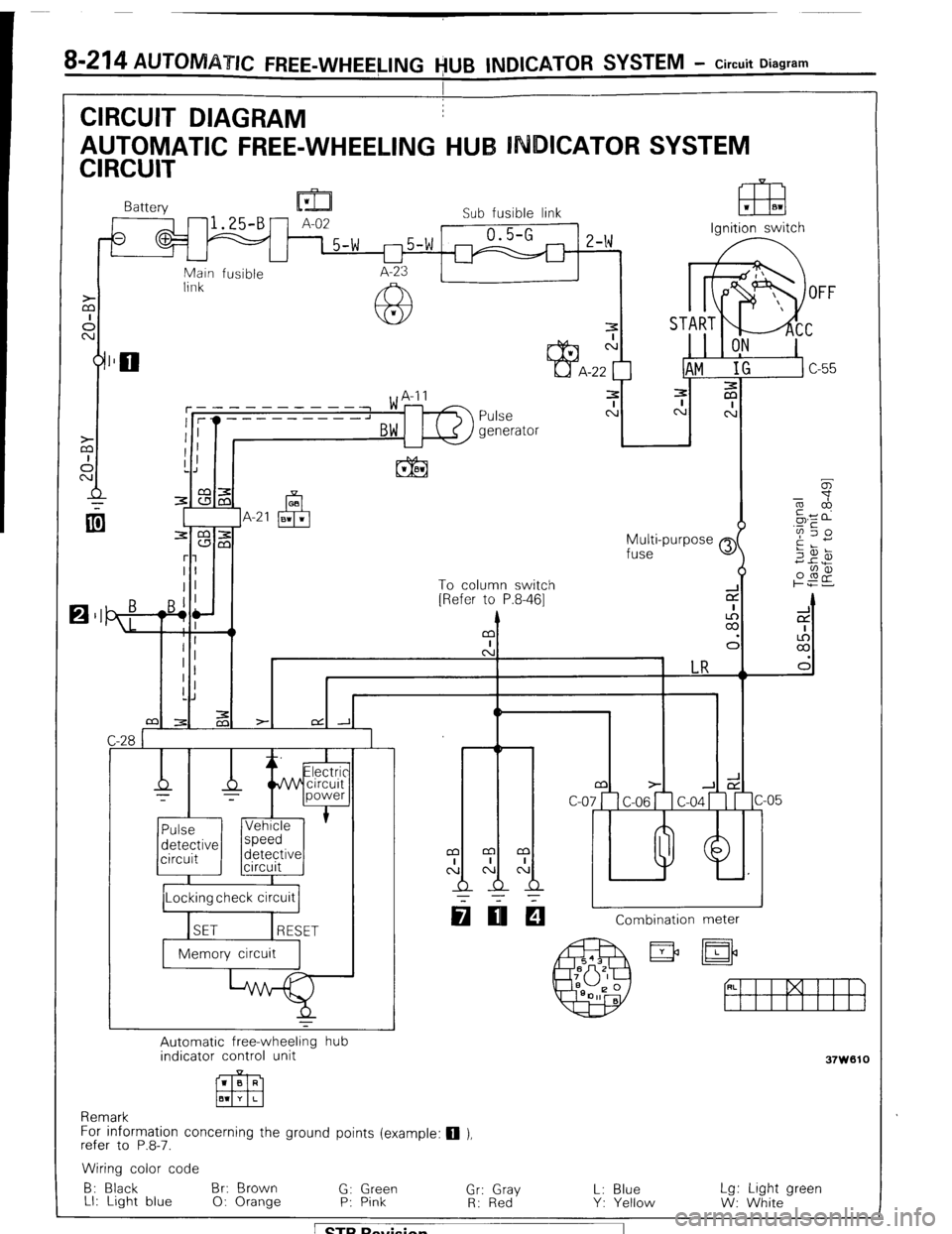
8-214 AUTOM TIC FREE-WHEELING VU6 INDICATOR SYSTEM - Circuit Diagram
I
m I IA-21 m
v?~
r:
BI I To column switch
2
[Refer to P.8-461 CT
= 9’i A I
I
m z
I ’
c: d
I ’
LR
!J
I I 1
CIRCUIT DIAGRAM
AUTOMATIC FREE-WHEELING HUB INDICATOR SYSTEM
CIRCUIT
F==e=%
Battery lu-!
A-02 Sub fusible link
- 15-w r-)5-w 0.5-G
2-w
I I I I
Main fusible
link
7
N
-22
3
Pulse c:
generator
h Ignition switch
I /Locking check circuit 1
q IIEI Combination meter
Automatic free-wheeling hub
indicator control unit
1 B R
Em El1 Y L
Remark
For information concerning the ground points (example: q ),
refer to P.8-7.
37W610
Wiring color code
B: Black Br: Brown
G: Green L: Blue
LI: Light blue Lg: Light green
0: Orange P: Pink “,r: RG,‘d”Y
Y: Yellow
W: White
1 STB Revision
Page 240 of 284
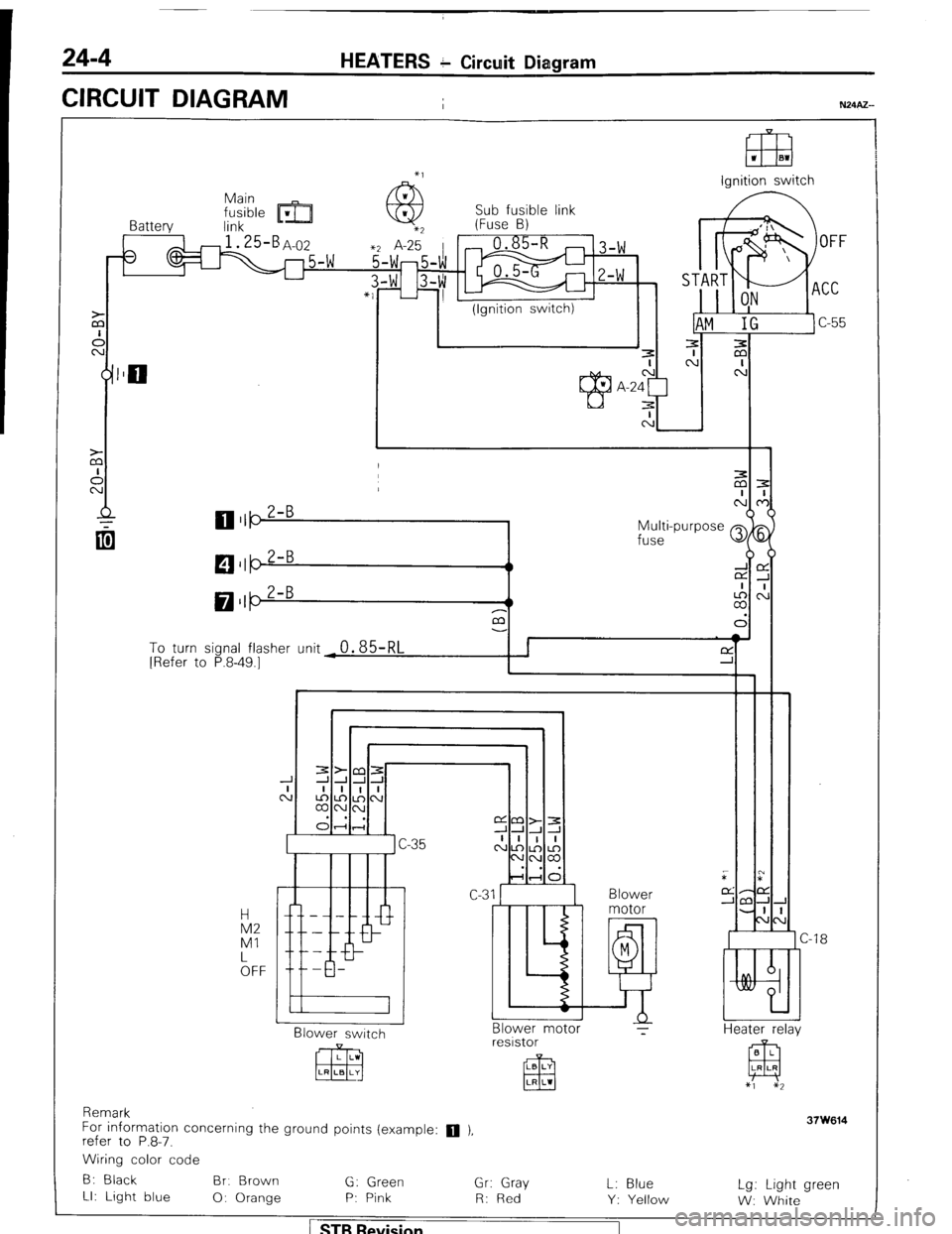
24-4 HEATERS c Circuit Diagram
CIRCUIT DIAGRAM
I
El3 1 El1
lanition switch
Sub fusible link
Battery link m- (Fuse B)
3
1 I (Ignition switch)
Multi-purpose Q
fuse
M $5
LA,:
a3
To turn sional flasher (Init
0.85RI I I f-Y ’ I [Refer to P.8-49.7- - - ‘d -r i
I Blower
Blower switch
CJ -18
Heater r&v Blower motor ?
resistor
Remark
For information concerning the ground points (example:
q ),
refer to P.8-7.
Wiring color code
B: Black Br. Brown
G: Green
Gr: Gray
LI: Light blue
0: Orange P: Pink
R: Red L: Blue
Y: Yellow Lg: Light green
W: White
1 STB Revision
Page 251 of 284
HEATERS - Blower Assembly 24-15
--I
Front wirina harness
d
!
2OW537
2OW768
2OW779
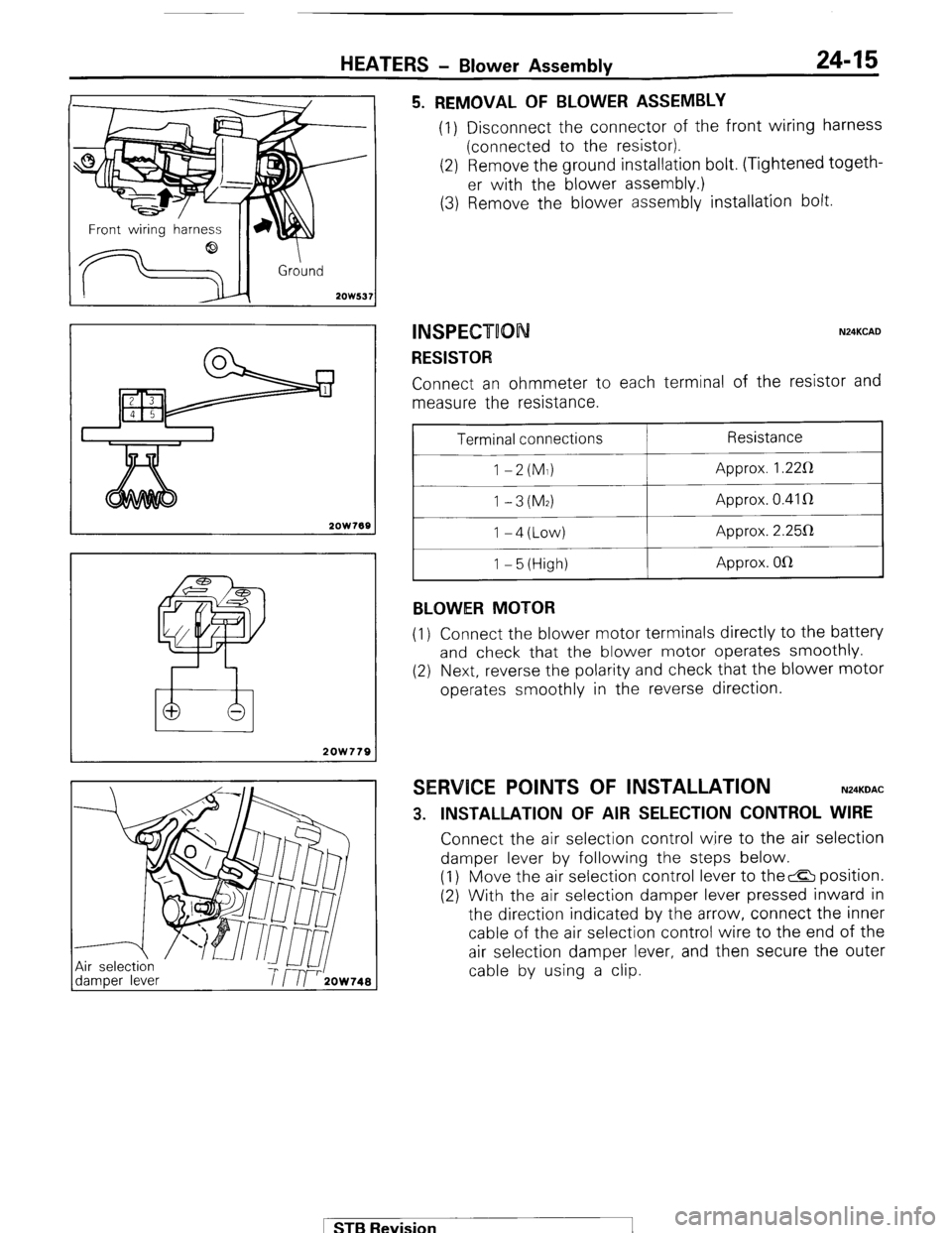
5. REMOVAL OF BLOWER ASSEMBLY (1) Disconnect the connector of the front wiring harness
(connected to the resistor).
(2) Remove the ground installation bolt. (Tightened togeth-
er with the blower assembly.)
(3) Remove the blower assembly installation bolt.
INSPECT00 N24KCAD
RESISTOR Connect an ohmmeter to each terminal of the resistor and
measure the resistance.
Terminal connections
1 -2(M1)
1 -3(M2) I-4(Low)
1 - 5 (High)
BLOWER MOTOR Resistance
Approx. 1.22R
Approx. 0.41 R
Approx. 2.25112
Approx. OlR
(1) Connect the blower motor terminals directly to the battery
and check that the blower motor operates smoothly.
(2) Next, reverse the polarity and check that the blower motor
operates smoothly in the reverse direction.
SERVICE POINTS OF INSTALLATION N24KDAC
3. INSTALLATION OF AIR SELECTION CONTROL WIRE Connect the air selection control wire to the air selection
damper lever by following the steps below.
(1) Move the air selection control lever to the& position.
(2) With the air selection damper lever pressed inward in
the direction indicated by the arrow, connect the inner
cable of the air selection control wire to the end of the
air selection damper lever, and then secure the outer
cable by using a clip.
1 STB Revision
Page 262 of 284
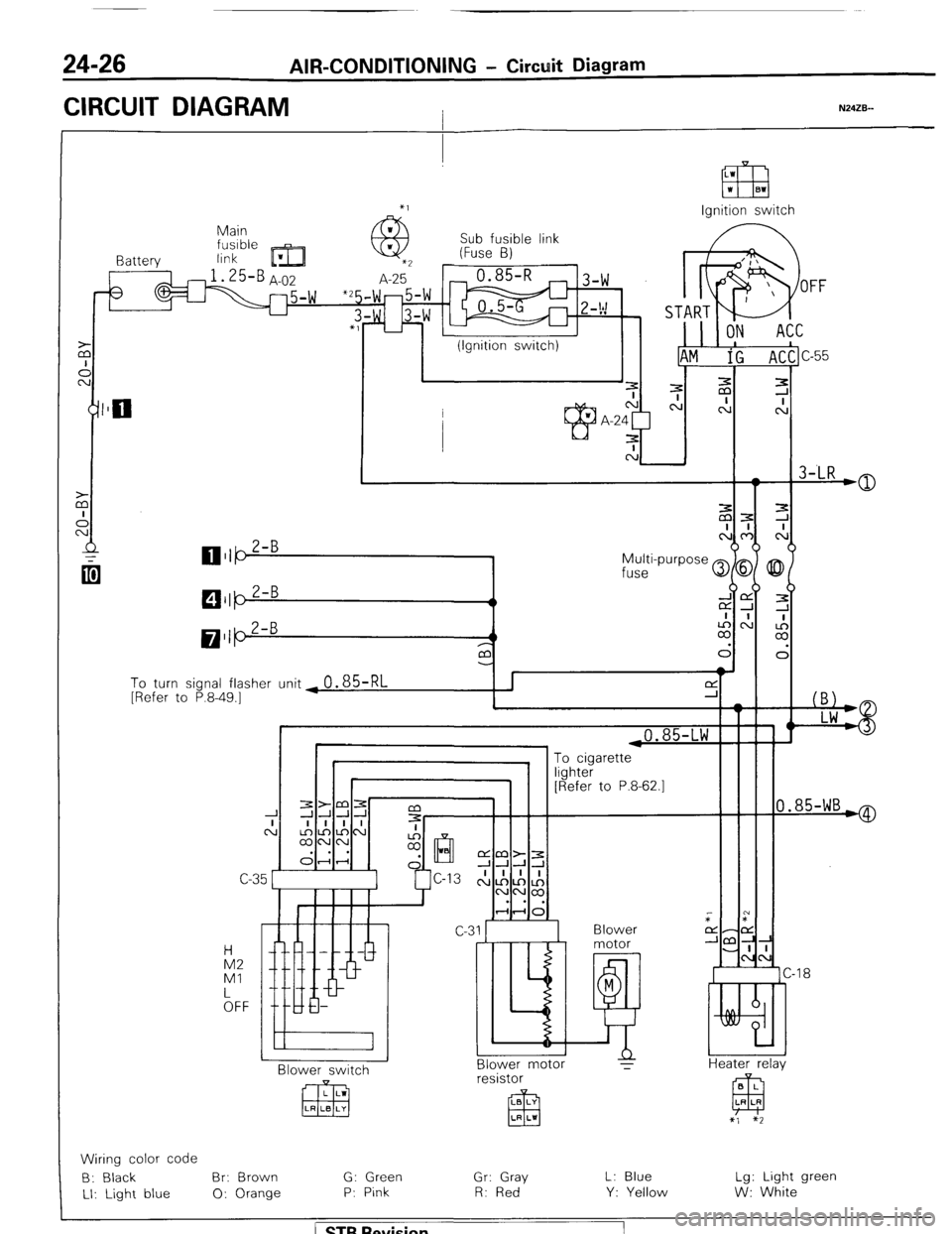
24-26 AIR-CONDITIONING - Circuit Diagram
CIRCUIT DIAGRAM I N24ZB--
Ignition switch
Main
link Sub fusible link
(Fuse B)
I Battery
3
To turn signal flasher unit ~
0.85-RL [Refer to P.8-49.1
i
I 1 ,0.85-LW F
0.85-WB*
“yl lLG1 [Refer to P.8-62.1
C-C
Blower
motor
M
E!! Blower motor
T IA2
Ml
kFF -18
Heater relav N BI ower switch B L
EEJ LR LR resistor
LB LY
El3 LR LI
x’, $2
Wiring color code
B: Black Br: Brown G: Green
Gr: Gray L: Blue Lg: Light green
LI: Light blue 0: Orange P: Pink R: Red
Y: Yellow W: White
/ ST6 Revision
Page 268 of 284
24-32 AIR-CONDITIONING-Service Adjustment Procedures
i--
9 >
@
r
2ouo319
- 2OW627 I
Suction gauge Discharge w-w
/ I
Suction
ww Discharge
w-w
2OUO306
Suction
w-w Discharge
gauge
2OUO307
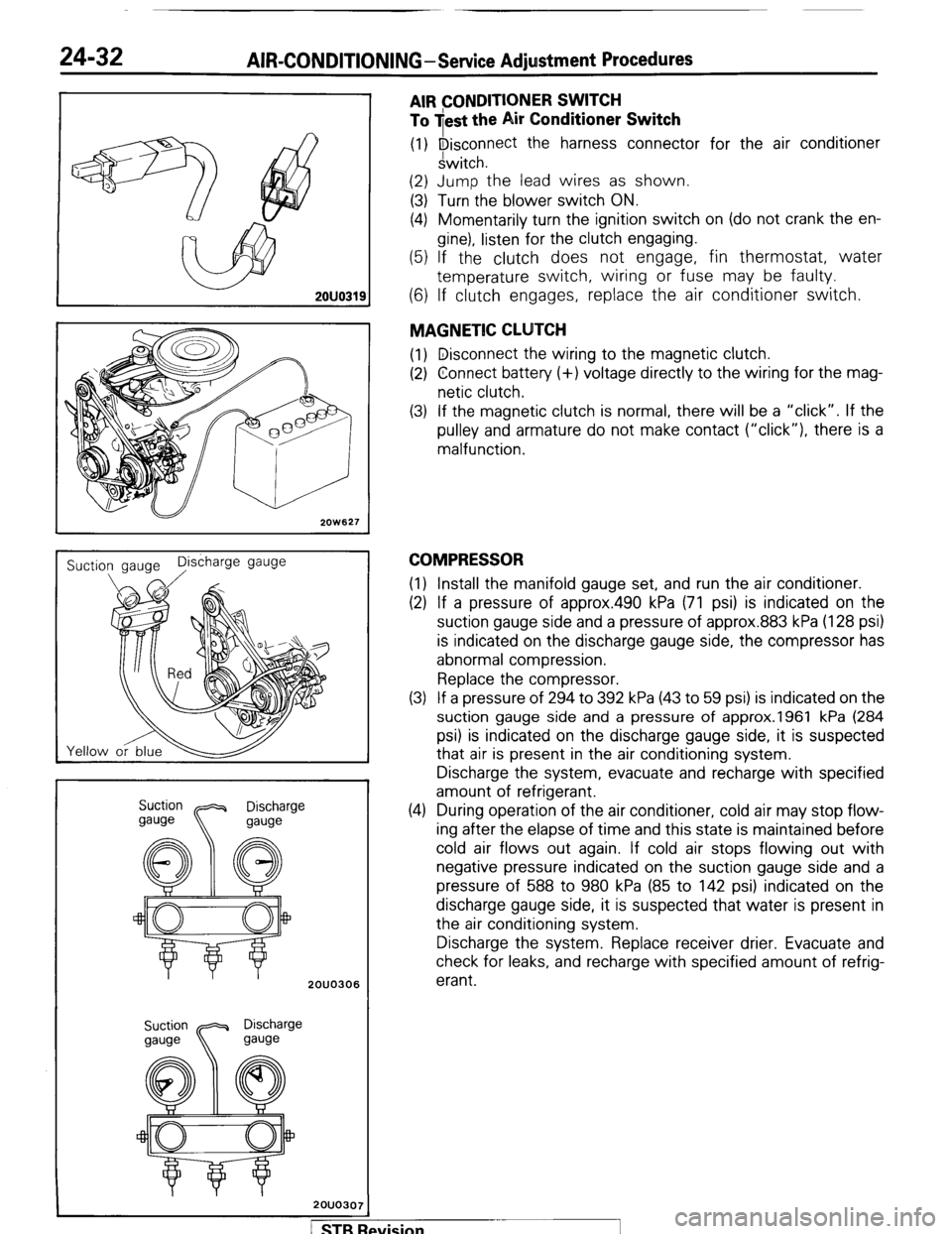
AIR CONDITIONER SWITCH
To jest the Air Conditioner Switch
(1) Disconnect the harness connector for the air conditioner
switch.
(2) Jump the lead wires as shown.
(3) Turn the blower switch ON.
(4) Momentarily turn the ignition switch on (do not crank the en-
gine), listen for the clutch engaging.
(5) If the clutch does not engage, fin thermostat, water
temperature switch, wiring or fuse may be faulty.
(6) If clutch engages, replace the air conditioner switch.
MAGNETIC CLUTCH
(1) Disconnect the wiring to the magnetic clutch.
(2) Connect battery (+) voltage directly to the wiring for the mag-
netic clutch.
(3) If the magnetic clutch is normal, there will be a “click”. If the
pulley and armature do not make contact (“click”), there is a
malfunction.
COMPRESSOR
(1) Install the manifold gauge set, and run the air conditioner.
(2) If a pressure of approx.490 kPa (71 psi) is indicated on the
suction gauge side and a pressure of approx.883 kPa (128 psi)
is indicated on the discharge gauge side, the compressor has
abnormal compression.
Replace the compressor.
(3) If a pressure of 294 to 392 kPa (43 to 59 psi) is indicated on the
suction gauge side and a pressure of approx.1961 kPa (284
psi) is indicated on the discharge gauge side, it is suspected
that air is present in the air conditioning system.
Discharge the system, evacuate and recharge with specified
amount of refrigerant.
(4) During operation of the air conditioner, cold air may stop flow-
ing after the elapse of time and this state is maintained before
cold air flows out again. If cold air stops flowing out with
negative pressure indicated on the suction gauge side and a
pressure of 588 to 980 kPa (85 to 142 psi) indicated on the
discharge gauge side, it is suspected that water is present in
the air conditioning system.
Discharge the system. Replace receiver drier. Evacuate and
check for leaks, and recharge with specified amount of refrig-
erant.
/ STB Revision