brake rotor MITSUBISHI MONTERO 2000 Service Repair Manual
[x] Cancel search | Manufacturer: MITSUBISHI, Model Year: 2000, Model line: MONTERO, Model: MITSUBISHI MONTERO 2000Pages: 1839, PDF Size: 29.19 MB
Page 1210 of 1839

35A-2
BASIC BRAKE
SYSTEM
CONTENTS
GENERAL INFORMATION 3..................
SERVICE SPECIFICATIONS 5.................
LUBRICANTS 6..............................
SPECIAL TOOLS 6..........................
TROUBLESHOOTING
ON-VEHICLE SERVICE 19...................
Brake Pedal Check and Adjustment 19..........
Hydraulic Brake Booster (HBB) Operation Check
HBB Check
HBB Motor Relay Continuity Check
Brake Booster Operating Test
Check Valve Operation Check
Load Sensing Spring Length Check and
Adjustment
Load Sensing Proportioning Valve Function
Test
Bleeding
Brake Fluid Level Sensor Check 30.............
Brake Booster Vacuum Switch Check
Disc Brake Pad Check and Replacement 31.....
Disc Brake Rotor Check 32.....................
Brake Disc Thickness Check 32.................
Brake Disc Run-out Check and Correction 33....
BRAKE PEDAL 34..........................
HYDRAULIC BRAKE BOOSTER (HBB)
HBB BUZZER
MASTER CYLINDER AND BRAKE
BOOSTER
Master Cylinder 43.............................
FRONT DISC BRAKE 44....................
REAR DISC BRAKE 49......................
LOAD SENSING PROPORTIONING
VALVE
www.WorkshopManuals.co.uk
Purchased from www.WorkshopManuals.co.uk
Page 1265 of 1839

ABS <4WD> -General Information35B-2
GENERAL INFORMATION
ABS has been adopted as standard equipment
in all vehicles to maintain directional stability and
steering performance during sudden braking.
The ABS control method used is a 4-sensor,
4-channel method (previous models: 4-sensor,
3- channel method
)which allows the brake
pressures for all four wheels to be controlled
independently of each other. The system has the
following features.
DEBD
*(Electronic Brake force Distribution
system) control has been added to provide the
ideal braking force for the rear wheels.DThe hydraulic unit function has been integrated
with the hydraulic brake booster (HBB).
DSelect solenoid valves (two valves for FL and
FR) have been adopted in order to reduce the
pedal kickback and improve the operation
feeling when the ABS is operating.
DIndependent 4-wheel control is carried out wile
the vehicle is turning in order to increase the
braking force.
NOTE
*EBD: Electronic Brake-force Distribution
EBD CONTROL
In ABS, electronic control method is used whereby
the rear wheel brake hydraulic pressure during
braking is regulated by rear wheel control solenoid
valves in accordance with the vehicle’s rate of
deceleration and the front and rear wheel slippage
which are calculated from the signals received from
the various wheel sensors. EBD control is a control
system which provides a high level of control for
both vehicle braking force and vehicle stability. The
system has the following features.
DBecause the system provides the optimum rear
wheel braking force regardless of the vehicle
laden condition and the condition of the road
surface, the system reduces the required pedal
depression force, particularly when the vehicle
is heavily laden or driving on road surfaces
with high frictional coefficients.DBecause the duty placed on the front brakes
has been reduced, the increases in pad
temperature can be controlled during front
brakes applying to improve the wear resistance
characteristics of the pad.
DControl valves such as the proportioning valve
are no longer required.
SPECIFICATIONS
ItemSpecifications
ABS control method4-sensor, 4-channel
No. of ABS rotor teethFront50
Rear50
ABS speed sensorTypeMagnet coil type
Gap between sensor and rotor mm0.9 (non-adjustable type)
www.WorkshopManuals.co.uk
Purchased from www.WorkshopManuals.co.uk
Page 1284 of 1839
ABS <4WD> -Troubleshooting35B-21
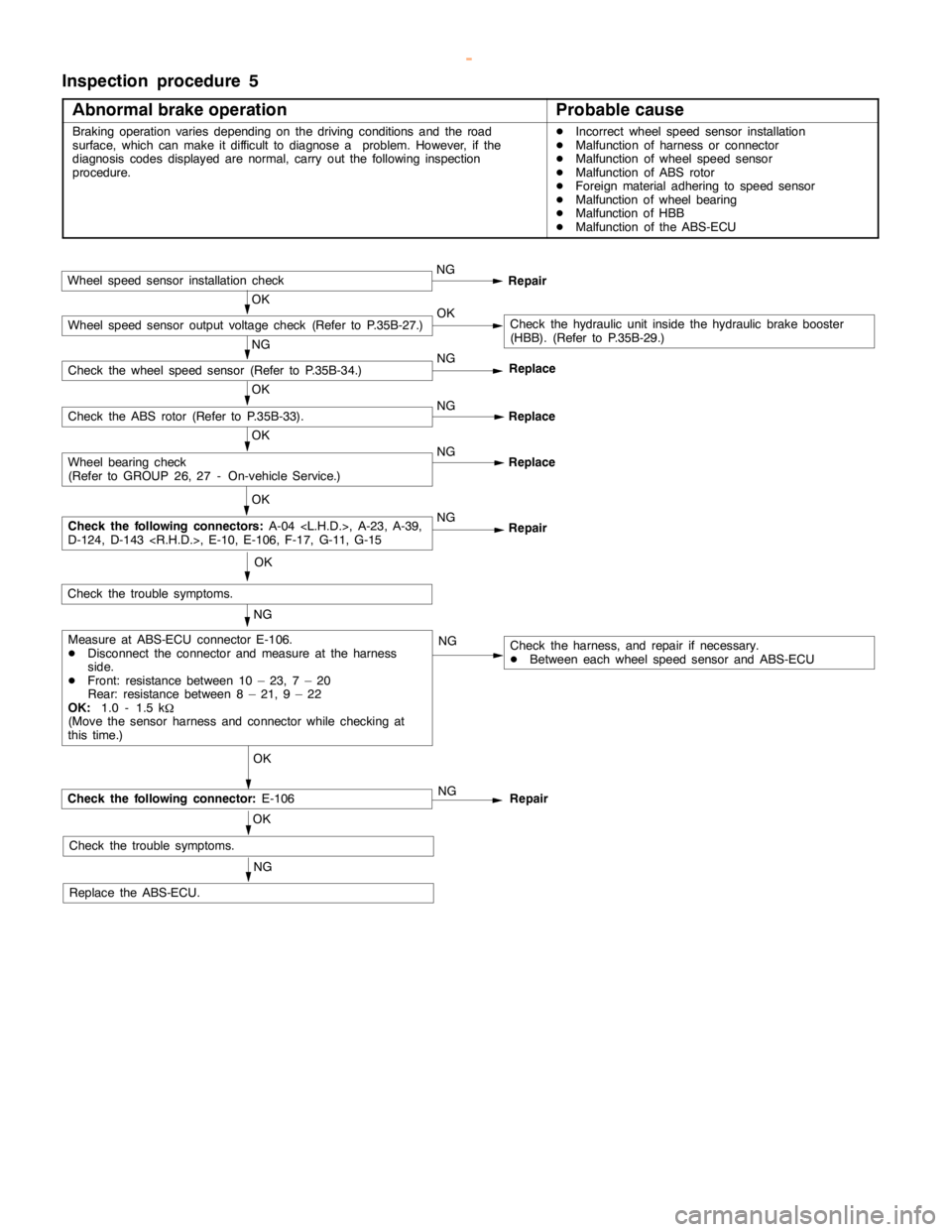
Inspection procedure 5
Abnormal brake operation
Probable cause
Braking operation variesdepending on the driving conditions and the road
surface, which can make it difficult to diagnose a problem. However, if the
diagnosis codes displayed are normal, carry out the following inspection
procedure.DIncorrect wheel speed sensor installation
DMalfunction of harness or connector
DMalfunction of wheel speed sensor
DMalfunction of ABS rotor
DForeign material adhering to speed sensor
DMalfunction of wheel bearing
DMalfunction of HBB
DMalfunction of the ABS-ECU
Wheel speed sensor installation checkNG
Repair
OKCheck the hydraulic unit inside the hydraulic brake booster
(HBB). (Refer to P.35B-29.)
NG
Check the wheel speed sensor (Refer to P.35B-34.)NG
OK
Check the ABS rotor (Refer to P.35B-33).NG
Replace
OK
NG
Replace
OK
NG
Repair
OK
NG
NG
OK
Check the following connector:E-106
OK
Check the trouble symptoms.
NG
Replace the ABS-ECU.NG
Repair
Check the harness, and repair if necessary.
DBetween each wheel speed sensor and ABS-ECU ReplaceMeasure at ABS-ECU connector E-106.
DDisconnect the connector and measure at the harness
side.
DFront: resistance between 10 – 23, 7 – 20
Rear: resistance between 8 – 21, 9 – 22
OK:1.0 - 1.5 k
W
(Move the sensor harness and connector while checking at
this time.)
Check the following connectors:A-04
D-124, D-143
Wheel bearing check
(Refer to GROUP 26, 27 - On-vehicle Service.)
Check the trouble symptoms.
Wheel speed sensor output voltage check (Refer to P.35B-27.)OK
www.WorkshopManuals.co.uk
Purchased from www.WorkshopManuals.co.uk