torque MITSUBISHI MONTERO 2000 Service Repair Manual
[x] Cancel search | Manufacturer: MITSUBISHI, Model Year: 2000, Model line: MONTERO, Model: MITSUBISHI MONTERO 2000Pages: 1839, PDF Size: 29.19 MB
Page 2 of 1839

00-1
GENERAL
CONTENTS
HOW TO USE THIS MANUAL 2..............
Scope of Maintenance, Repair and Servicing
Explanations 2.................................
Definition of Terms 2...........................
Indication of Tightening Torque 2................
Model Indications 3............................
Explanation of Manual Contents 4...............
HOW TO USE
TROUBLESHOOTING/INSPECTION SERVICE
POINTS 6....................................
Troubleshooting Contents 6.....................
Diagnosis Function 7...........................
How to Use the Inspection Procedures 10.......
Connector Measurement Service Points 11.......
Connector Inspection 12........................
Inspection Service Points for a Blown Fuse 13...
Points to Note for Intermittent Malfunctions 13....
TREATMENT BEFORE/AFTER THE FORDING
A STREAM 14..............................
Inspection and Service before Fording a Stream
14 ............................................
Inspection and Service after Fording a Stream
15 ............................................
VEHICLE IDENTIFICATION 16...............
Vehicle Information Code Plate 16...............
Models 16.....................................
Model Code 18................................
Chassis Number 19............................
Engine Model Number 20.......................
Theft Protection
MAJOR SPECIFICATIONS 23................
PRECAUTIONS BEFORE SERVICE 29.......
SUPPLEMENTAL RESTRAINT SYSTEM
(SRS) 33....................................
SUPPORT LOCATIONS FOR LIFTING AND
JACKING 37................................
Support Positions for a Garage Jack 37.........
Support Positions for axle stands and a
Single-Post Lift or Double-Post Lift 38...........
STANDARD PARTS-TIGHTENING-TORQUE
TABLE 39..................................
www.WorkshopManuals.co.uk
Purchased from www.WorkshopManuals.co.uk
Page 3 of 1839

GENERAL -How to Use This Manual00-2
HOW TO USE THIS MANUAL
SCOPE OF MAINTENANCE, REPAIR
AND SERVICING EXPLANATIONS
This manual provides explanations, etc. concerning
procedures for the inspection, maintenance, repair
and servicing of the subject model. Note, however,
that for engine and transmission-related component
parts, this manual covers only on-vehicle
inspections, adjustments, and the removal and
installation procedures for major components.
For detailed information concerning the inspection,
checking, adjustment, disassembly and reassembly
of the engine, transmission and major components
after they have been removed from the vehicle,
please refer to separate manuals covering the
engine and the transmission.
ON-VEHICLE SERVICE
“On-vehicle Service” is procedures for performing
inspections and adjustments of particularly
important locations with regard to the construction
and for maintenance and servicing, but other
inspection (for looseness, play, cracking, damage,
etc.) must also be performed.
INSPECTION
Under this title are presented inspection and
checking procedures to be performed by using
special tools and measuring instruments and by
feeling, but, for actual maintenance and servicing
procedures, visual inspections should always be
performed as well.
DEFINITION OF TERMS
STANDARD VALUE
Indicates the value used as the standard for judging
the quality of a part or assembly on inspection
or the value to which the part or assembly is
corrected and adjusted. It is given by tolerance.
LIMIT
Shows the standard for judging the quality of a
part or assembly on inspection and means the
maximum or minimum value within which the part
or assembly must be kept functionally or in strength.
It is a value established outside the range of
standard value.
REFERENCE VALUE
Indicates the adjustment value prior to starting the
work (presented in order to facilitate assembly and
adjustment procedures, and so they can be
completed in a shorter time).
CAUTION
Indicates the presentation of information particularly
vital to the worker during the performance of
maintenance and servicing procedures in order to
avoid the possibility of injury to the worker, or
damage to component parts, or a reduction of
component or vehicle function or performance, etc.
INDICATION OF TIGHTENING TORQUE
Tightening torques (units: N×m) are set to take into
account the central value and the allowable
tolerance. The central value is the target value,
and the allowable tolerance provides the checking
range for tightening torques. If bolts and nuts are
not provided with tightening torques, refer to
P.00-39.
www.WorkshopManuals.co.uk
Purchased from www.WorkshopManuals.co.uk
Page 40 of 1839

GENERAL -Standard Part/Tightening-Torque Table00-39
STANDARD PART/TIGHTENING-TORQUE TABLE
Each torque value in the table is a standard value
for tightening under the following conditions.
(1) Bolts, nuts and washers are all made of steel
and plated with zinc.
(2) The threads and bearing surface of bolts and
nuts are all in dry condition.The values in the table are not applicable:
(1) If toothed washers are inserted.
(2) If plastic parts are fastened.
(3) If bolts are tightened to plastic or die-cast
inserted nuts.
(4) If self-tapping screws or self-locking nuts are
used.
Standard bolt and nut tightening torque
Thread sizeTorque N×
m
Bolt nominal
diameter (mm)Pitch (mm)Head mark “4”Head mark “7”Head mark “8”
M50.82.5±
0.55.0±
1.06.0±
1.0
M61.05.0±
1.09.0±
2.010±
2
M81.2512±
222±
425±
4
M101.2524±
444±
1053±
7
M121.2541±
883±
1298±
12
M141.573±
12140±
20155±
25
M161.511 0±
20210±
30235±
35
M181.5165±
25300±
40340±
50
M201.5225±
35410±
60480±
70
M221.5300±
40555±
85645±
95
M241.5395±
55735±
105855±
125
Flange bolt and nut tightening torque
Thread sizeTorque N×
m
Bolt nominal
diameter (mm)Pitch (mm)Head mark “4”Head mark “7”Head mark “8”
M61.05.0±
1.010±
212±
2
M81.2513±
224±
427±
5
M101.2526±
449±
958±
7
M101.524±
445±
855±
10
M121.2546±
895±
15105±
15
M121.7543±
883±
1298±
12
NOTE
1. Be sure to use only the specified bolts and nuts, and always tighten them to the specified torques.
2. Bolts marked with indications such as 4T or 7T are reinforced bolts. The larger the number, the
greater the bolt strength.
www.WorkshopManuals.co.uk
Purchased from www.WorkshopManuals.co.uk
Page 57 of 1839

ENGINE <6G7> -General Information/Service Specifications11A-3
GENERAL INFORMATION
Items6G74-GDI
Total displacement ml3,497
Bore´Stroke mm93´85.8
Compression ratio10.4
Combustion chamberPentroof + ball-in-piston
Camshaft arrangementDOHC
Number of valveIntake12
Exhaust12
Valve timingIntakeOpeningBTDC 8_
ClosingABDC 56_
ExhaustOpeningBBDC 48_
ClosingATDC 16_
Fuel systemElectronically controlled multipoint fuel injection
Rocker armRoller type
Auto-lash adjusterEquipped
SERVICE SPECIFICATIONS
ItemsStandard valueLimit
Basic ignition timing5_BTDC±3_-
Ignition timingApprox. 20_BTDC*1-
Idle speed r/min600±100*1-
CO contents %0.5 or less-
HC contents ppm100 or less-
Compression pressure (at engine speed of 280 r/min) kPa1,275980
Compression pressure difference of all cylinders kPa-Max. 98
Intake manifold vacuum kPa-Min. 56*2
Auto tensioner rod depth (mm)Within 1-
Timing belt tension torque N×m4.4-
Auto-tensioner rod protrusion amount mm3.8 - 5.0-
NOTE
*1: Indicates the value measured within 4 minutes since the engine was started.
*2: Indicates the value when more than 4 minutes have passed since the engine was started.
www.WorkshopManuals.co.uk
Purchased from www.WorkshopManuals.co.uk
Page 125 of 1839

ENGINE <4D5> -General/General Information/Service Specifications/Sealant11B-2
GENERAL
OUTLINE OF CHANGES
Some service procedures have been revised as the following changes have been made to comply to
the Emission Regulation StepIII.
DInjection timing and idle speed check and adjustment have bee changed as the electronic-controlled
fuel injection pump has been introduced.
DThe oil pan has a cover in order to reduce noise due to an enhanced engine output.
DA crank angle sensor and crankshaft sensing blade have been added due to the introduction of
an electronic-controlled fuel injection pump. Due to this change, the timing belt front lower cover
has been reshaped.
DThe tightening torque of the cylinder head bolts and the cylinder head gasket have been changed.
GENERAL INFORMATION
Items4D56
Total displacement mL2,477
Bore x Stroke mm91.1 x 95.0
Compression ratio21
Combustion chamberVortex chamber type
Camshaft arrangementSOHC
Number of valveIntake4
Exhaust4
Valve timingIntakeOpeningBTDC 20_
ExhaustClosingABDC 49_
IntakeOpeningBBDC 55_
ExhaustClosingATDC 22_
Fuel systemElectronically controlled type injection pump
Rocker armRoller type
Adjusting screwElephant foot type
SERVICE SPECIFICATIONS
ItemsStandard value
Idle speed r/min750±30
Timing belt tension mm4-5
Timing belt B tension mm4-5
SEALANT
ItemsSpecified sealantRemarks
Oil panMITSUBISHI GENUINE PART
MD970389 or equivalentSemi-drying sealant
www.WorkshopManuals.co.uk
Purchased from www.WorkshopManuals.co.uk
Page 607 of 1839

MITSUBISHI SC-Troubleshooting/On-vehicle Service13E-18
Terminal No.Signal nameNormal condition
Between terminal 13 and body earthEarthContinuity
Between terminal 26 and body earthEarth
Between terminal 31 and body earthEarth
ON-VEHICLE SERVICE
OPERATION TEST OF MITSUBISHI SC
1. Connect the MUT-
IIto the 16-pin diagnosis connector.
Caution
Turn the ignition switch to the LOCK (OFF) position
when connecting and disconnecting the MUT-
II.
2. Move the shift lever to the neutral
lever to the P range.
3. Start the engine.
4. Use the MUT-
IIto activate the Actuator Test (item No.05)
while depressing the accelerator pedal fully. Check that
the engine speed should decrease gradually.
Caution
Activate the Actuator Test for three seconds.
Release the accelerator pedal immediately after the
Actuator Test is complete, or the engine speed will
rise.
NOTE
During the Actuator Test, the SC-ECU transmits the signal,
which requests no torque and wide open throttle, to the
engine-ECU or engine-A/T-ECU for three seconds.
WHEEL SPEED SENSOR (FR) CHECK
Refer to Basic Manual GROUP 35B - On-vehicle service.
VEHICLE SPEED SENSOR CHECK
Refer to Basic Manual GROUP 54A - Combination Meter.
www.WorkshopManuals.co.uk
Purchased from www.WorkshopManuals.co.uk
Page 902 of 1839

Page 945 of 1839
Page 950 of 1839
Page 952 of 1839
AUTOMATIC TRANSMISSION -Troubleshooting AUTOMATIC TRANSMISSION -Troubleshooting 23-51
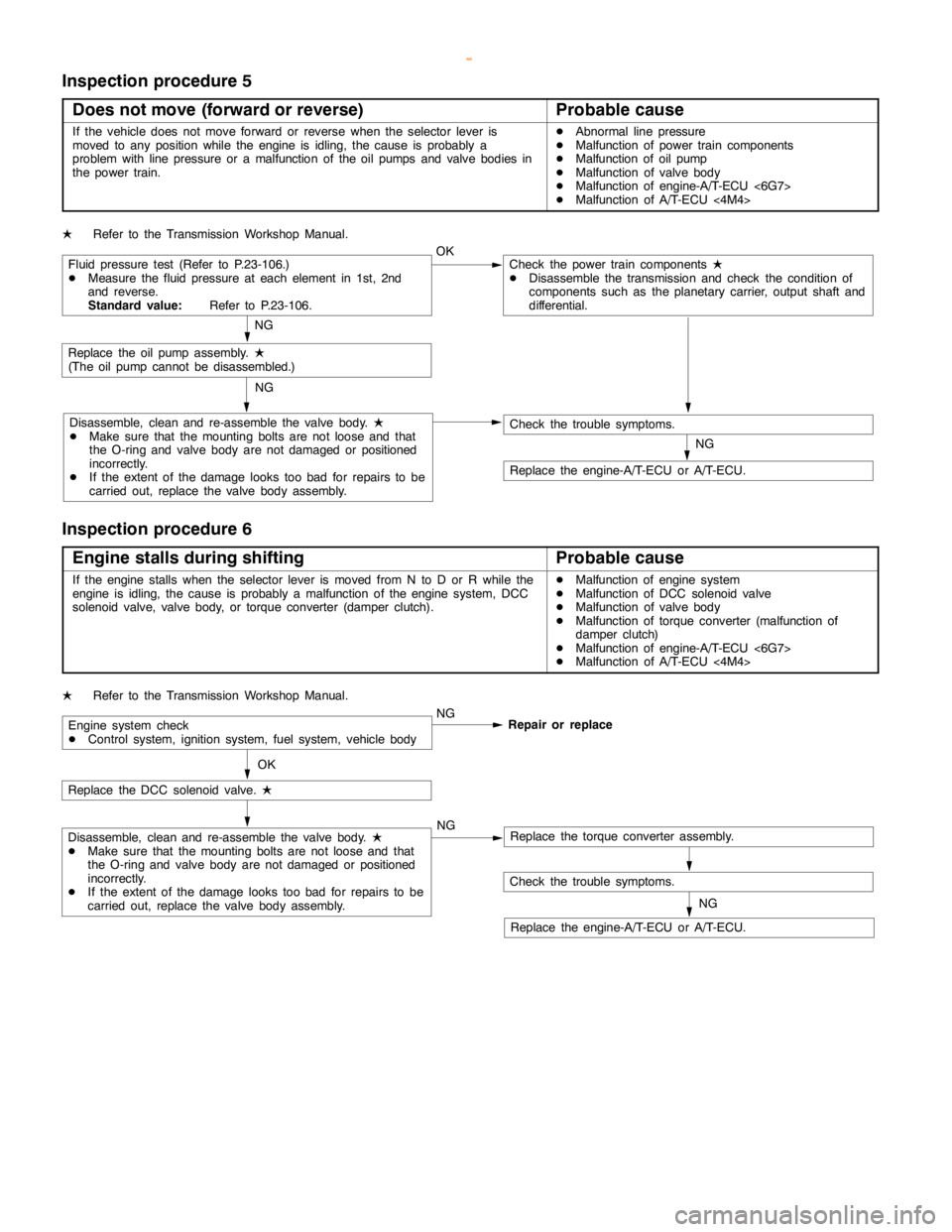
Inspection procedure 5
Does not move (forward or reverse)
Probable cause
If the vehicle does not move forward or reverse when the selector lever is
moved to any position while the engine is idling, thecause is probably a
problem with line pressure or a malfunction of the oil pumps and valve bodies in
the power train.DAbnormal line pressure
DMalfunction of power train components
DMalfunction of oil pump
DMalfunction of valve body
DMalfunction of engine-A/T-ECU <6G7>
DMalfunction of A/T-ECU<4M4>
LRefer to the Transmission Workshop Manual.
Fluid pressure test (Refer to P.23-106.)
DMeasure the fluid pressure at each element in 1st, 2nd
and reverse.
Standard value:Refer to P.23-106.OKCheck the power train components
L
DDisassemble the transmission and check the condition of
components such as the planetary carrier, output shaft and
differential.
NG
Replace the oil pumpassembly.
L
(The oilpump cannot be disassembled.)
Disassemble, clean and re-assemble the valve body.
L
DMake sure that the mounting bolts are not loose and that
the O-ring and valve body are notdamaged or positioned
incorrectly.
DIf the extent of thedamagelooks too bad for repairs to be
carried out, replace the valve body assembly.NG
NG
Check the trouble symptoms.
Replace the engine-A/T-ECU or A/T-ECU.
Inspection procedure 6
Engine stalls during shifting
Probable cause
If the enginestalls when the selector lever is moved from N to D or R while the
engine is idling, thecause is probably a malfunction of theenginesystem, DCC
solenoid valve, valve body, or torque converter (damper clutch).DMalfunction of enginesystem
DMalfunction of DCC solenoid valve
DMalfunction of valve body
DMalfunction of torque converter (malfunction of
damper clutch)
DMalfunction of engine-A/T-ECU <6G7>
DMalfunction of A/T-ECU<4M4>
LRefer to the Transmission Workshop Manual.
Engine system check
DControl system, ignition system, fuel system, vehicle bodyNG
Repair or replace
OK
Replace the DCC solenoid valve.
L
Disassemble, clean and re-assemble the valve body.
L
DMake sure that the mounting bolts are not loose and that
the O-ring and valve body are notdamaged or positioned
incorrectly.
DIf the extent of thedamagelooks too bad for repairs to be
carried out, replace the valve body assembly.NGReplace the torque converter assembly.
Check the trouble symptoms.
Replace the engine-A/T-ECU or A/T-ECU.NG
www.WorkshopManuals.co.uk
Purchased from www.WorkshopManuals.co.uk