weight MITSUBISHI MONTERO 2000 Service Repair Manual
[x] Cancel search | Manufacturer: MITSUBISHI, Model Year: 2000, Model line: MONTERO, Model: MITSUBISHI MONTERO 2000Pages: 1839, PDF Size: 29.19 MB
Page 25 of 1839

GENERAL -Major Specifications00-24
ItemsV68WV65W
MYHFL6MNXFL6,
MNXFR6MYXFL6,
MYXFR6MNHCL6,
MNHCR6MYHCL6,
MYHCR6
VehicleOverall length14,2604,280
dimensionsOverall width21,8451,8751,845mm
Overall height (unladen)31,845,1,875*1
Wheelbase42,545
Track-front51,560
Track-rear61,560
Overhang-front7710
Overhang-rear81,005*2, 1,025*3
Ground clearance
(unladen)9225235
Angle of approach
degrees1042*
Angle of departure
degrees1133.5*
VehicleKerb weight1,9802,0001,915
weight kgMax. gross vehicle weight2,510
Max. axle weight rating-front1,1651,1701.075
Max. axle weight rating-rear1,3451,3401,435
Seating capacity5
EngineModel No.4M41-DOHC Intercooler Turbo6G74GDI
Total displacement mL3,2003,496
Transmis-Model No.V5A51V5M31V5A51V5M31V5A51
sionType5-speed
automatic5-speed
manual5-speed
automa-
tic5-speed
manual5-speed
automatic
Fuel systemFuel supply systemElectronically-controlled high
pressure fuel distributionGDI
NOTE:
*1: Vehicles with roof rails
*2: Vehicles with 235/80R16 Tyre
*3: Vehicles with 265/70R16 Tyre
www.WorkshopManuals.co.uk
Purchased from www.WorkshopManuals.co.uk
Page 26 of 1839

GENERAL -Major Specifications00-25
ItemsV65W
MNXCL6,
MNXCR6MYXCL6,
MYXCR6
VehicleOverall length14,280
dimensionsOverall width21,875mm
Overall height (unladen)31,845,1,875*1
Wheelbase42,545
Track-front51,560
Track-rear61,560
Overhang-front7710
Overhang-rear81,005*2, 1,025*3
Ground clearance
(unladen)9235
Angle of approach
degrees1042*
Angle of departure
degrees1133.5*
VehicleKerb weight1,935
weight kgMax. gross vehicle weight2,510
Max. axle weight rating-front1,080
Max. axle weight rating-rear1,430
Seating capacity5
EngineModel No.6G74GDI
Total displacement mL3,496
Transmis-Model No.V5M31V5A51
sionType5-speed
manual5-speed
automatic
Fuel systemFuel supply systemGDI
NOTE:
*1: Vehicles with roof rails
*2: Vehicles with 235/80R16 Tyre
*3: Vehicles with 265/70R16 Tyre
www.WorkshopManuals.co.uk
Purchased from www.WorkshopManuals.co.uk
Page 28 of 1839

GENERAL -Major Specifications00-27
ItemsV78WV75W
LYHFL6,
LYHFR6LNXFL6,
LNXFR6LYXFL6,
LYXFR6LNHCL6,
LNHCR6LYHCL6,
LYHCR6
VehicleOverall length14,7754,795
dimensionsOverall width21,8451,8751,845mm
Overall height (unladen)31,855,1,885*1
Wheelbase42,780
Track-front51,560
Track-rear61,560
Overhang-front7710
Overhang-rear81,285*2, 1,305*3
Ground clearance
(unladen)9225235
Angle of approach
degrees1042*
Angle of departure
degrees1124*
VehicleKerb weight2,1252,1552,060
weight kgMax. gross vehicle weight2,7602,8002,760
Max. axle weight rating-front1,1601,110
Max. axle weight rating-rear1,6001,650
Seating capacity7
EngineModel No.4M41-DOHC Intercooler Turbo6G74GDI
Total displacement mL3,2003,496
Transmis-Model No.V5A51V5M31V5A51V5M31V5A51
sionType5-speed
automatic5-speed
manual5-speed
auto-
matic5-speed
manual5-speed
automatic
Fuel systemFuel supply systemElectronically-controlled high
pressure fuel distributionGDI
NOTE:
*1: Vehicles with roof rails
*2: Vehicles with 235/80R16 Tyre
*3: Vehicles with 265/70R16 Tyre
www.WorkshopManuals.co.uk
Purchased from www.WorkshopManuals.co.uk
Page 29 of 1839

GENERAL -Major Specifications00-28
ItemsV75W
LNXCL6,
LNXCR6LYXCL6,
LYXCR6
VehicleOverall length14,795
dimensionsOverall width21,875mm
Overall height (unladen)31,855,1,885*1
Wheelbase42,780
Track-front51,560
Track-rear61,560
Overhang-front7710
Overhang-rear81,285*2, 1,305*3
Ground clearance
(unladen)9235
Angle of approach
degree1042*
Angle of departure
degree)1124*
VehicleKerb weight2,095
weight kgMax. gross vehicle weight2,760
Max. axle weight rating-front1,110
Max. axle weight rating-rear1,650
Seating capacity7
EngineModel No.6G74GDI
Total displacement mL3,496
Transmis-Model No.V5M31V5A51
sionType5-speed
manual5-speed
automatic
Fuel systemFuel supply systemGDI
NOTE:
*1: Vehicles with roof rails
*2: Vehicles with 235/80R16 Tyre
*3: Vehicles with 265/70R16 Tyre
www.WorkshopManuals.co.uk
Purchased from www.WorkshopManuals.co.uk
Page 52 of 1839

GENERAL -Major Specifications00-4
MAJOR SPECIFICATIONS
The items other than listed below are the same as before.
ItemsV64W
MNDFL6MNHFL6,
MNHFR6MNXFL6,
MNXFR6
Vehicle
ihtk
Kerb weight1,8751,9101,930
weight kgMax. gross vehicle weight2,510
Max. axle weight rating-front1,200
Max. axle weight rating-rear1,600
ItemsV74W
LNDFL6LNHFL6LNXFL6
Vehicle
ihtk
Kerb weight2,0252,0652,100
weight kgMax. gross vehicle weight2,760
Max. axle weight rating-front1,200
Max. axle weight rating-rear1,650
ItemsV78W
LNDFL6LNHFL6,
LNHFR6LYHFL6,
LYHFR6LNXFL6,
LNXFR6LYXFL6,
LYXFR6
Vehicle
ihtk
Max. gross vehicle weight2,810
weight kgMax. axle weight rating-front1,200
Max. axle weight rating-rear1,650
www.WorkshopManuals.co.uk
Purchased from www.WorkshopManuals.co.uk
Page 1148 of 1839

WHEEL AND TYRE -Troubleshooting31-5
DIf the imbalance is 5 g or less, the zero
calibration is OK. Rebalance the wheel, then
go to Step 4 to check static balance.
DIf the imbalance is more than 5 g, go to Step
3.
3. Loosen the balancer wing nut, rotate the wheel
1/4 turn (90
°), and retighten the nut. Recheck
the wheel balance.
DIf the imbalance is 5 g or less, the wheel may
not be centered on the balancer, or the
balancing cones, the cup, and/or wing nut are
damaged, dirty, or inappropriate for the wheel.
You may need to refer to the balancer
manufacturer’s instructions to verify the correct
attachments. after making the necessary
corrections, recheck the wheel balance. If OK,
then go to Step 4.
DIf the imbalance is more than 5 g, the balancer
requires calibration. Contact the balancer
manufacturer for calibration by their repair
representative.
4.
Attach a 5-g weight to the outer rim. Recheck
the balancer. The balancer should detect 5
±2
g of imbalance 170
°to 190
°away from both the
inner and outer 5-g weights.DIf the imbalance is within specification, the static
balance calibration is correct. Go to Step 5
to check the dynamic balance.
DIf the imbalance is out of specification, the
balancer requires calibration. Contact the
balancer manufacturer for calibration by their
repair representative.
5.
Attach a 5-g weight to the inner rim at 180
°
opposite the 5-g weight that was added in step
4. Recheck the balance. The balancer should
detect 5
±2g of imbalance 170
°to 190
°away
from both the inner and outer 5-g weights.
DIf the imbalance is within specification, the
dynamic balance calibration is correct. The
balancer calibration checks are complete.
DIf the imbalance is out of specification, the
balancer requires calibration. Contact the
balancer manufacturer for calibration by their
repair representative.
www.WorkshopManuals.co.uk
Purchased from www.WorkshopManuals.co.uk
Page 1149 of 1839
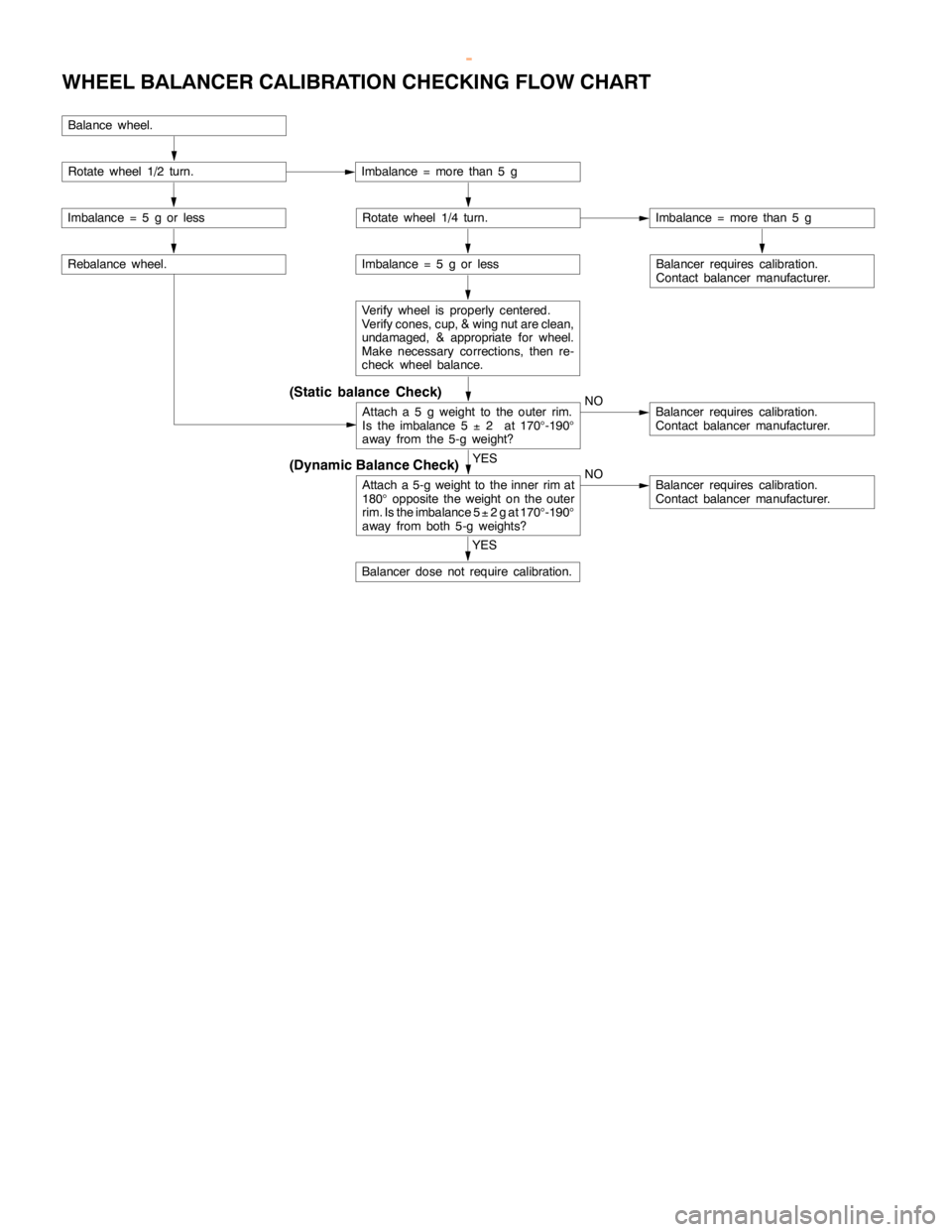
WHEEL AND TYRE -Troubleshooting31-6
WHEEL BALANCER CALIBRATION CHECKING FLOW CHART
(Dynamic Balance Check)
(Static balance Check)
Balance wheel.
Rotate wheel 1/2 turn.Imbalance = more than 5 g
Imbalance = 5 g or lessRotate wheel 1/4 turn.Imbalance = more than 5 g
Imbalance = 5 g or less
Verify wheel is properly centered.
Verify cones, cup, & wing nut are clean,
undamaged, & appropriate for wheel.
Make necessary corrections, then re-
check wheel balance.
Attacha 5 g weight to the outer rim.
Is the imbalance 5
±2 at 170
°-190
°
away from the 5-g weight?NOBalancer requires calibration.
Contact balancer manufacturer.
Balancer requires calibration.
Contact balancer manufacturer.
YES
Attach a 5-g weight to the inner rim at
180
°opposite the weight on the outer
rim. Is the imbalance 5
±2 g at 170
°-190
°
away from both 5-g weights?NOBalancer requires calibration.
Contact balancer manufacturer.
Rebalance wheel.
YES
Balancer dose not require calibration.
www.WorkshopManuals.co.uk
Purchased from www.WorkshopManuals.co.uk
Page 1156 of 1839

4
11.
Checking for calibration.
Check your balancer’s calibration approximately every 100 balances. Your whee balancer’s instruction
manual should include calibration procedures. If the calibration procedures specifically for your balancer
are missing, use following steps for zero calibration, static balance, and dynamic balance checks. Th
wheel balancer calibration checks are also described in the flowchart on next page.
a.
Mount an undamaged original-equipment alloy rim and tire assembly (wheel) onto your off-the-car
wheel balancer. Balance the wheel.
b.
Zero Calibration Check. Loosen the balancer wing nut, rotate the wheel a half-turn (180°), and
retighten the nut. Recheck the balance.
i)
If the imbalance is 5 grams or less, the zero calibration is OK. Rebalance the wheel, then g
to Step d to check the static balance.
ii)
If the imbalance is more than 5 grams, go to Step c.
c.
Loosen th balancer wing nut, rotate the wheel ¼ turn (90°), and retighten the nut. Recheck th
wheel balance
i)
If the imbalance is 5 grams or less, the wheel may not be centered on th balancer, or the
balancing cones, the cup, and/or wing nut are damaged, dirty, or inappropriate for the wheel.
You may need to refer to th balancer manufacturer’s instructions to verify the correct
attachments. After making the necessary correction, recheck the wheel balance. If OK, then
go to Step d.
ii)
If the imbalance is more than 5 grams, th balancer requires calibration, Contact th balancer
manufacturer for calibration by their repair representative.
d.
Static Balance Check. Attach a 5-gram weight to the outer rim. Recheck the balancer. The
balancer should detect 5±2 grams of imbalance 170° to190° away from the 5-gram weight.
i)
If the imbalance is within specification, the static balance calibration is correct, Go to Step e
to check the dynamic balance.
ii)
If the imbalance is out of specification, th balancer requires calibration. Contact th balancer
manufacturer for calibration by their repair representative.
e.
Dynamic Balance Check. Attach a 5-gram weight to the inner rim at 180° opposite the 5-gram
weight that was added in Step d. Recheck the balance. Th balancer should detect 5±2 grams of
imbalance 170° to 190° away from both the inner and outer 5-gram weights.
i)
If the imbalance is within specification, the dynamic balance calibration is correct. Th
balancer calibration checks are complete.
ii)
If the imbalance is out of specification, th balancer requires calibration. Contact th balancer
manufacturer for calibration by their repair representative.
www.WorkshopManuals.co.uk
Purchased from www.WorkshopManuals.co.uk
Page 1157 of 1839

5 Balance Wheel
Rotate wheel ½ turn(Zero Calibration Check)
Imbalance is 5 grams or less Imbalance = more than 5 grams
Rebalance wheel
Rotate wheel ¼ turn
Imbalance = 5 grams or less Imbalance = more than 5 grams
Verify wheel is properly centered. Verify
cones, cup & wing nut are clean, undamaged &
appropriate for wheel. Make necessary
corrections, then recheck wheel balance
Attach a 5-gram weight to the rim.
Is the imbalance 5 ± 2 grams at 170-190
degrees away from the 5-gram weight?(static balance Check)
YES NO
Attach a 5 gram weight to the inner rim
180 degrees opposite the weight on the
outer rim. Is the imbalance 5± 2 grams at
170-190 degrees away from both 5-gram
weights?(Dynamic Balance Check)
YES NO
Balancer does not
require calibration.Balancer requires calibration.
Contact balancer manufacturer.
WHEEL BALANCER CALIBRATION CHECKS
www.WorkshopManuals.co.uk
Purchased from www.WorkshopManuals.co.uk
Page 1165 of 1839

POWER PLANT MOUNT - No.1 Crossmember32-7
No.1 CROSSMEMBER
REMOVAL AND INSTALLATION
Caution
1. Before removing the steering wheel and airbag module assembly, always refer to GROUP 52B
- Service Precautions, Airbag Module and Clock Spring. Also, set the front wheels so that
they are facing straight forward, and remove the ignition key. If you fail to do this, the SRS
clock spring will be damaged, causing the SRS airbag to be inoperative and serious injury.
2. *: Indicates parts which should be initially tightened, and then fully tightened after placing
the vehicle horizontally and loading the full weight of the engine on the vehicle body.
Pre-removal Operation
DUnder Cover Removal
DDrive Shaft Removal
(Refer to GROUP 26.)
DDifferential Carrier and No.2 Crossmember
Assembly Removal (Refer to GROUP 26 -
Freewheel Assembly and Differential Carrier.)
DUpper Arm Removal
(Refer to GROUP 33A.)
DLower Arm Removal
(Refer to GROUP 33A.)
DStabilizer Bar Removal
(Refer to GROUP 33A.)
DEngine Oil Cooler Removal<6G7>
(Refer to GROUP 12.)
DAir Cleaner Removal<4M4>
(Refer to GROUP 15.)
DIntercooler Removal<4M4>
(Refer to GROUP 15.)
DEngine Cover Removal
(Refer to GROUP 11A - Timing Belt.)
DRadiator Removal
(Refer to GROUP 14.)
DPower Steering Fluid Draining
(Refer to GROUP 37A - On - vehicle Service.)Post - installation Operations
DDifferential Carrier and No.2 Crossmember
Assembly Installation (Refer to GROUP 26 -
Freewheel Assembly and Differential Carrier.)
DDrive Shaft Installation
(Refer to GROUP 26.)
DLower Arm Installation
(Refer to GROUP 33A.)
DUpper Arm Installation
(Refer to GROUP 33A.)
DStabilizer Bar Installation
(Refer to GROUP 33A.)
DAir Cleaner Installation<4M4>
(Refer to GROUP 15.)
DIntercooler Installation<4M4>
(Refer to GROUP 15.)
DRadiator Installation
(Refer to GROUP 14.)
DEngine Oil Cooler Installation
(Refer to GROUP 12.)
DPower Steering Fluid Supplying
(Refer to GROUP 37A - On - vehicle Service.)
DPower Steering Fluid Line Bleeding
(Refer to GROUP 37A - On - vehicle Service.)
DPress the dust cover with a finger tocheck whether
the dust cover is cracked or damaged.
DChecking Steering Wheel Position with Wheels
StraightAhead
DFront Wheel AlignmentCheck and Adjustment
(Refer to GROUP 37A - On - vehicle Service.)
DUnder Cover Installation
DEngine Cover Installation
(Refer to GROUP 11A - Timing Belt.)
www.WorkshopManuals.co.uk
Purchased from www.WorkshopManuals.co.uk