lock MITSUBISHI OUTLANDER 2014 3.G Owners Manual
[x] Cancel search | Manufacturer: MITSUBISHI, Model Year: 2014, Model line: OUTLANDER, Model: MITSUBISHI OUTLANDER 2014 3.GPages: 451, PDF Size: 49.08 MB
Page 372 of 451
How to change a tire 8-6 For emergencies
8
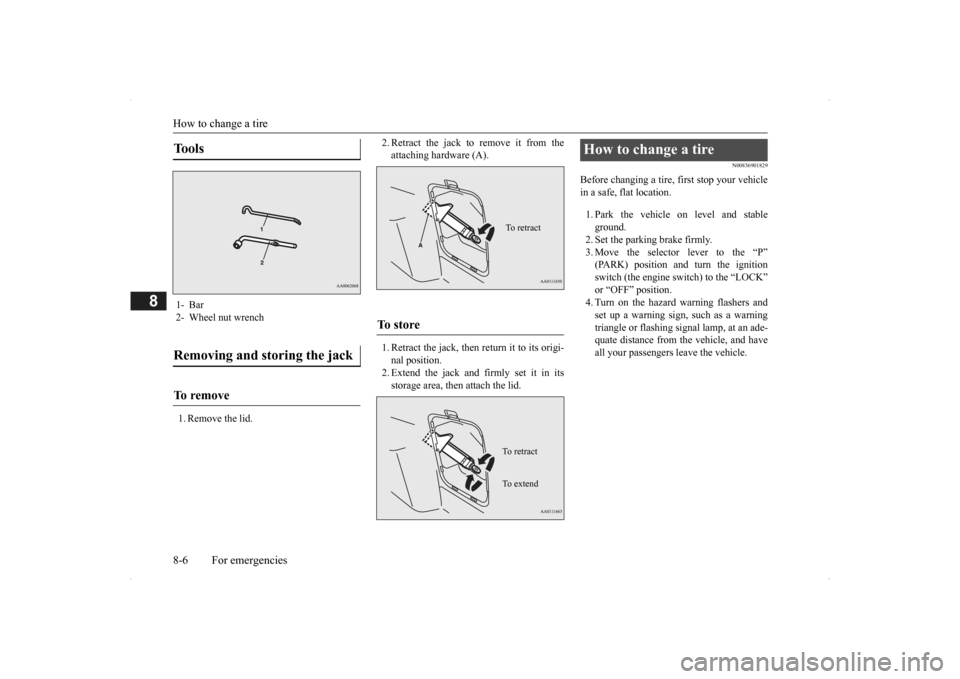
1. Remove the lid.
2. Retract the jack to remove it from the attaching hardware (A). 1. Retract the jack, then return it to its origi- nal position. 2. Extend the jack and firmly set it in itsstorage area, then attach the lid.
N00836901829
Before changing a tire, first stop your vehicle in a safe, flat location. 1. Park the vehicle on level and stable ground.2. Set the parking brake firmly. 3. Move the selector
lever to the “P”
(PARK) position and turn the ignition switch (the engine switch) to the “LOCK” or “OFF” position.4. Turn on the hazard warning flashers and set up a warning sign, such as a warning triangle or flashing signal lamp, at an ade-quate distance from the vehicle, and have all your passengers leave the vehicle.
Tools 1- Bar2- Wheel nut wrenchRemoving and storing the jack To r e m o v e
To s t o r e
To retractTo r e t r a c t To e x t e n d
How to change a tire
BK0200500US.book 6 ページ 2013年2月12日 火曜日 午前9時46分
Page 373 of 451
How to change a tire
For emergencies 8-7
8
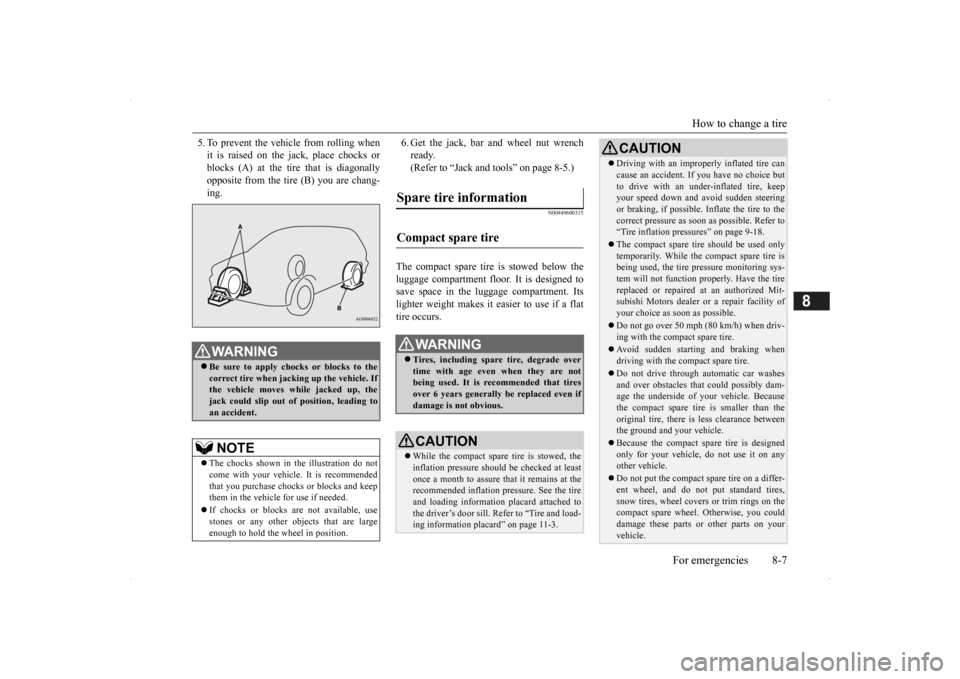
5. To prevent the vehicle from rolling when it is raised on the jack, place chocks orblocks (A) at the tire that is diagonally opposite from the tire (B) you are chang- ing.
6. Get the jack, bar and wheel nut wrench ready.(Refer to “Jack and tools” on page 8-5.)
N00849600315
The compact spare tire is stowed below the luggage compartment fl
oor. It is designed to
save space in the luggage compartment. Itslighter weight makes it easier to use if a flat tire occurs.
WA R N I N G Be sure to apply choc
ks or blocks to the
correct tire when jacking up the vehicle. If the vehicle moves while jacked up, the jack could slip out of
position, leading to
an accident.NOTE
The chocks shown in the illustration do not come with your vehicl
e. It is recommended
that you purchase chocks or blocks and keep them in the vehicle for use if needed. If chocks or blocks
are not available, use
stones or any other obj
ects that are large
enough to hold the wheel in position.
Spare tire information Compact spare tire
WA R N I N G Tires, including spar
e tire, degrade over
time with age even when they are notbeing used. It is recommended that tires over 6 years generally
be replaced even if
damage is not obvious.CAUTION While the compact spare tire is stowed, the inflation pressure shoul
d be checked at least
once a month to assure that it remains at the recommended inflation pressure. See the tire and loading informati
on placard attached to
the driver’s door sill. Refer to “Tire and load- ing information placard” on page 11-3.
Driving with an imprope
rly inflated tire can
cause an accident. If
you have no choice but
to drive with an under-inflated tire, keepyour speed down and avoid sudden steering or braking, if possible. Inflate the tire to the correct pressure as s
oon as possible. Refer to
“Tire inflation pressures” on page 9-18. The compact spare tire should be used only temporarily. While the compact spare tire is being used, the tire pr
essure monitoring sys-
tem will not function pr
operly. Have the tire
replaced or repaired at an authorized Mit- subishi Motors dealer or
a repair facility of
your choice as soon as possible. Do not go over 50 mph (80 km/h) when driv- ing with the compact spare tire. Avoid sudden starting and braking when driving with the compact spare tire. Do not drive through automatic car washes and over obstacles that
could possibly dam-
age the underside of your vehicle. Because the compact spare tire is smaller than the original tire, there is less clearance betweenthe ground and your vehicle. Because the compact spare tire is designed only for your vehicle, do not use it on any other vehicle. Do not put the compact spare tire on a differ- ent wheel, and do not put standard tires, snow tires, wheel covers
or trim rings on the
compact spare wheel. Otherwise, you could damage these parts or other parts on your vehicle.CAUTION
BK0200500US.book 7 ページ 2013年2月12日 火曜日 午前9時46分
Page 374 of 451
How to change a tire 8-8 For emergencies
8
N00849701296
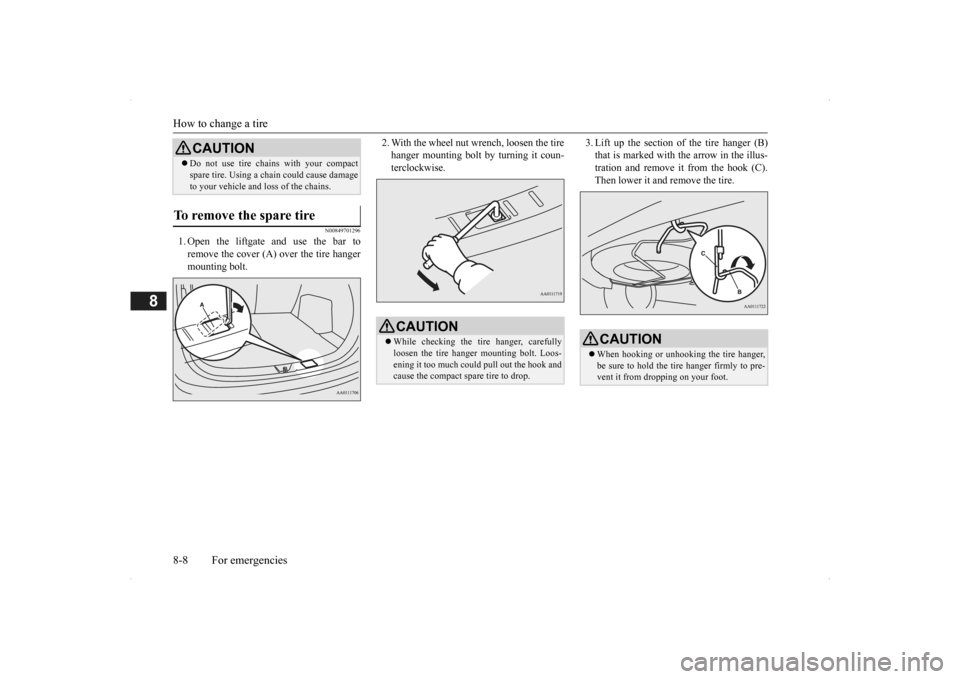
1. Open the liftgate and use the bar to remove the cover (A)
over the tire hanger
mounting bolt.
2. With the wheel nut wrench, loosen the tire hanger mounting bolt by turning it coun-terclockwise.
3. Lift up the section of the tire hanger (B) that is marked with the arrow in the illus-tration and remove it from the hook (C). Then lower it and remove the tire.
Do not use tire chains with your compact spare tire. Using a ch
ain could cause damage
to your vehicle and loss of the chains.
To remove the spare tire
CAUTION
CAUTION While checking the tir
e hanger, carefully
loosen the tire hanger mounting bolt. Loos-ening it too much could pull out the hook and cause the compact spare tire to drop.
CAUTION When hooking or unhooking the tire hanger, be sure to hold the tire hanger firmly to pre- vent it from dropping on your foot.
BK0200500US.book 8 ページ 2013年2月12日 火曜日 午前9時46分
Page 377 of 451
![MITSUBISHI OUTLANDER 2014 3.G Owners Manual How to change a tire
For emergencies 8-11
8
7. Turn the wheel nut clockwise by hand to initially tighten them. [Type 1: On vehicles
with steel wheels]
Temporarily tighten the wheel nuts by hand un](/img/19/7531/w960_7531-376.png "MITSUBISHI OUTLANDER 2014 3.G Owners Manual How to change a tire
For emergencies 8-11
8
7. Turn the wheel nut clockwise by hand to initially tighten them. [Type 1: On vehicles
with steel wheels]
Temporarily tighten the wheel nuts by hand un")
How to change a tire
For emergencies 8-11
8
7. Turn the wheel nut clockwise by hand to initially tighten them. [Type 1: On vehicles
with steel wheels]
Temporarily tighten the wheel nuts by hand until the tapered parts of the wheel nuts make light contac
t with the seats of
the wheel holes and the wheel is not loose. [Type 2: On vehicles with aluminiumwheels] Temporarily tighten the wheel nuts by hand until the flange parts of the wheelnuts make light contact with the wheel and the wheel is not loose.
8. Lower the vehicle slowly until the tire touches the ground, by rotating the wheel nut wrench counterclockwise.
NOTE
Flange nuts can be te
mporarily used on the
compact spare wheel as shown in the illustra- tion, but return to the original wheel and tire as soon as possible.CAUTION Never apply oil to either the wheel bolts or the nuts or they will tighten too much.
Type 1 Type 2
NOTE
If all 4 aluminum wheels are changed to steel wheels, use tapered nuts.
BK0200500US.book 11 ページ 2013年2月12日 火曜日 午前9時46分
Page 379 of 451
How to change a tire
For emergencies 8-13
8
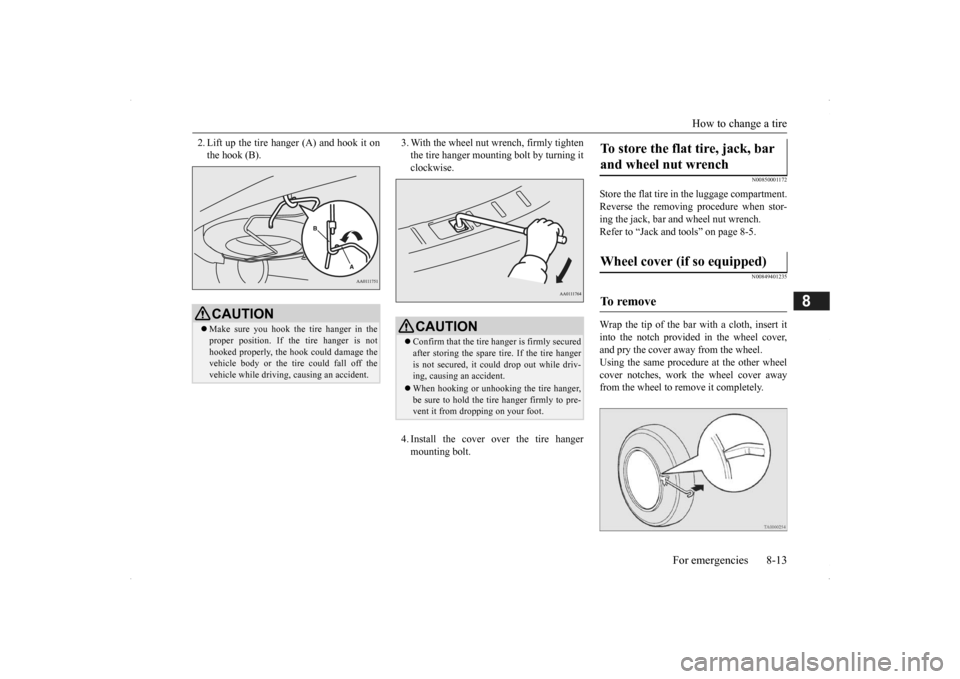
2. Lift up the tire hanger (A) and hook it on the hook (B).
3. With the wheel nut wrench, firmly tighten the tire hanger mounting bolt by turning itclockwise. 4. Install the cover over the tire hanger mounting bolt.
N00850001172
Store the flat tire in the luggage compartment. Reverse the removing procedure when stor-ing the jack, bar and wheel nut wrench. Refer to “Jack and tools” on page 8-5.
N00849401235
Wrap the tip of the bar with a cloth, insert itinto the notch provided in the wheel cover, and pry the cover away from the wheel.Using the same procedur
e at the other wheel
cover notches, work the wheel cover away from the wheel to remove it completely.
CAUTION Make sure you hook the tire hanger in the proper position. If the tire hanger is not hooked properly, the hook could damage the vehicle body or the tire
could fall off the
vehicle while driving,
causing an accident.
CAUTIONConfirm that the tire hanger is firmly secured after storing the spare
tire. If the tire hanger
is not secured, it coul
d drop out while driv-
ing, causing an accident. When hooking or unhooking the tire hanger, be sure to hold the tire hanger firmly to pre- vent it from dropping on your foot.
To store the flat tire, jack, bar and wheel nut wrench Wheel cover (if so equipped) To remove
BK0200500US.book 13 ページ 2013年2月12日 火曜日 午前9時46分
Page 381 of 451
Towing
For emergencies 8-15
8
There may be local re
gulations concerning
towing in your area. Obey the regulations of the area where youare driving your vehicle.
CAUTION Do not attempt to be
towed by another vehi-
cle with a rope.NOTE
Your vehicle cannot to
w any other vehicle.
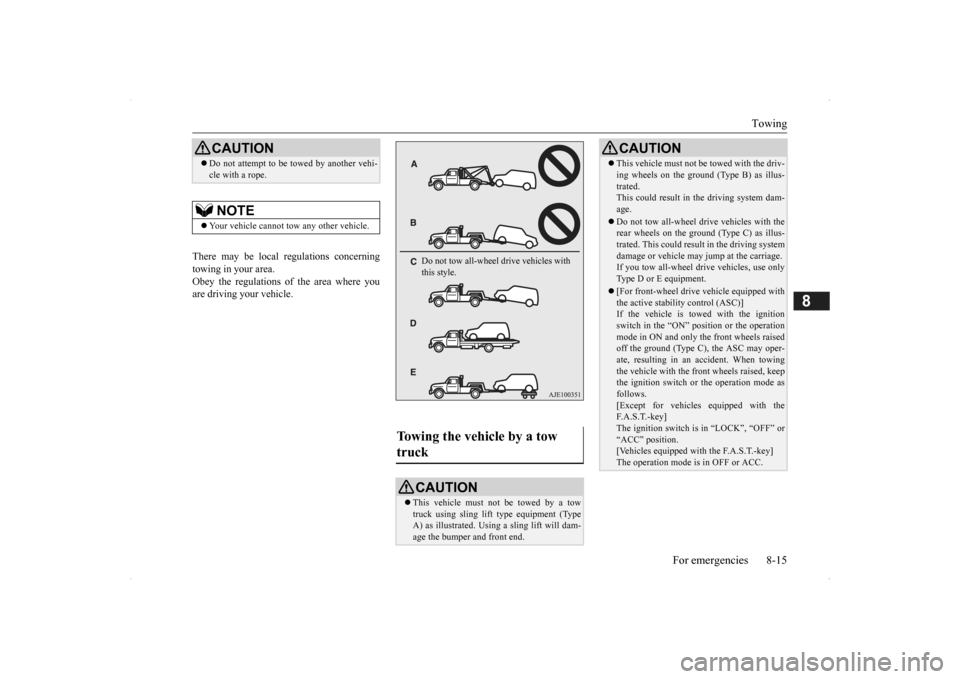
Towing the vehicle by a tow truck
CAUTION This vehicle must not be towed by a tow truck using sling lift
type equipment (Type
A) as illustrated. Usi
ng a sling lift will dam-
age the bumper and front end.Do not tow all-wheel drive vehicles with this style.
This vehicle must not be towed with the driv- ing wheels on the ground (Type B) as illus-trated.This could result in the driving system dam- age. Do not tow all-wheel dr
ive vehicles with the
rear wheels on the ground (Type C) as illus- trated. This could result in the driving systemdamage or vehicle may
jump at the carriage.
If you tow all-wheel drive vehicles, use only Type D or E equipment. [For front-wheel driv
e vehicle equipped with
the active stability control (ASC)]If the vehicle is towed with the ignition switch in the “ON” pos
ition or the operation
mode in ON and only
the front wheels raised
off the ground (Type C), the ASC may oper- ate, resulting in an accident. When towing the vehicle with the front wheels raised, keepthe ignition switch or
the operation mode as
follows. [Except for vehicles equipped with theF. A . S . T. - k e y ] The ignition switch is in “LOCK”, “OFF” or “ACC” position.[Vehicles equipped with the F.A.S.T.-key] The operation mode is in OFF or ACC.CAUTION
BK0200500US.book 15 ページ 2013年2月12日 火曜日 午前9時46分
Page 382 of 451
Operation under adverse driving conditions 8-16 For emergencies
8
Release the parking brake. Set the selector lever to the “N” (NEUTRAL)position.
N00837201760
If your vehicle becomes
stuck in snow, sand,
or mud, it can often be moved by a rockingmotion. Rock your vehicle back and forth to free it. Do not rev the engine or spin the wheels.Constant efforts to free a stuck vehicle can cause overheating and tr
ansaxle failure. Let
the engine idle for a few minutes to cool thetransaxle before trying again. If your vehicle is still
stuck after several rock-
ing attempts, call for a commercial tow truckservice.
When driving on a road covered with snow or ice, use s
now tires. Tire chains
cannot be used on your vehicle. There may be state or local regulations aboutusing snow tires. Always check the regu- lations in your local area before using them. Refer to “Snow tires” on page 9-20and “Tire chains” on page 9-21. Drive slowly. Do not make sudden starts or stops, sharp turns, or slam on the brakes. Allow extra distance between your vehi- cle and the vehicle in front of you, and avoid sudden braking. If a skid occurs when the accelerator pedal is depressed, take your foot off the pedal. Steer gently in the direction of the skid. Your vehicle is equipped with an anti-lock braking system (ABS). Hold the brake pedal down firmly and keep it depressed.Do not pump the brake pedal which will result in reduced braking performance.
Towing a front-wheel drive vehi- cle with front wheels off the ground (Type C) Operation under adverse driving conditions If your vehicle becomes stuck in sand, mud or snow
WA R N I N G When trying to rock
your vehicle out of a
stuck position, make sure that there are nopeople nearby. The
rocking motion can
make your vehicle suddenly lurch forward or backward, and inju
re any bystanders.
On wet roads
CAUTIONAvoid flooded roads. Water is often deeper than it looks, and you could be seriously hurtby driving into flood water. When driving in rain, on water-covered roads, or through a car
wash, water could get
into the brake discs and make them fail tem- porarily. In such cases, lightly press thebrake pedal to see if they are working prop- erly. If they are not, press the pedal lightly several times while driving to dry the brakepads or linings, then check them again. When driving in rain, a layer of water may form between the tires and the road surface (hydroplaning). This loosens your tires’ grip on the road, making it difficult to steer orbrake properly. When driving on a wet road:• Drive your vehicle at a safe speed.• Do not drive on worn tires.• Always keep the tires at the correct infla-tion pressures.
On snowy or icy roads
BK0200500US.book 16 ページ 2013年2月12日 火曜日 午前9時46分
Page 386 of 451
Service precautions 9-2 Vehicle care and maintenance
9
N00937301384
Taking regular care of your vehicle will pre- serve its value and appe
arance as long as pos-
sible. You can do some of the maintenance work yourself, and the rest should only be per- formed by an authorized Mitsubishi Motors dealer or a repair facility of your choice. If you discover a malfunction or other prob- lem, have it corrected by an authorized Mit-subishi Motors dealer or a repair facility of your choice. This section descri
bes the maintenance
inspections that you can do yourself, if you so desire. Follow the instructions and precau- tions for each procedure.
Have you purchased the Mitsubishi Motors Diamond Care Protection Plan? The Plansupplements your new
vehicle warranties.
See your authorized Mitsubishi Motors dealer for details.
N00937401457
The catalytic converter requires you to useunleaded fuel only. Leaded gasoline willdestroy the emission-control effectiveness of the converter. Normally, the
catalytic converter does not
require maintenance. Ho
wever, it is important
to keep the engine properly tuned for the con- verter to continue to work properly.
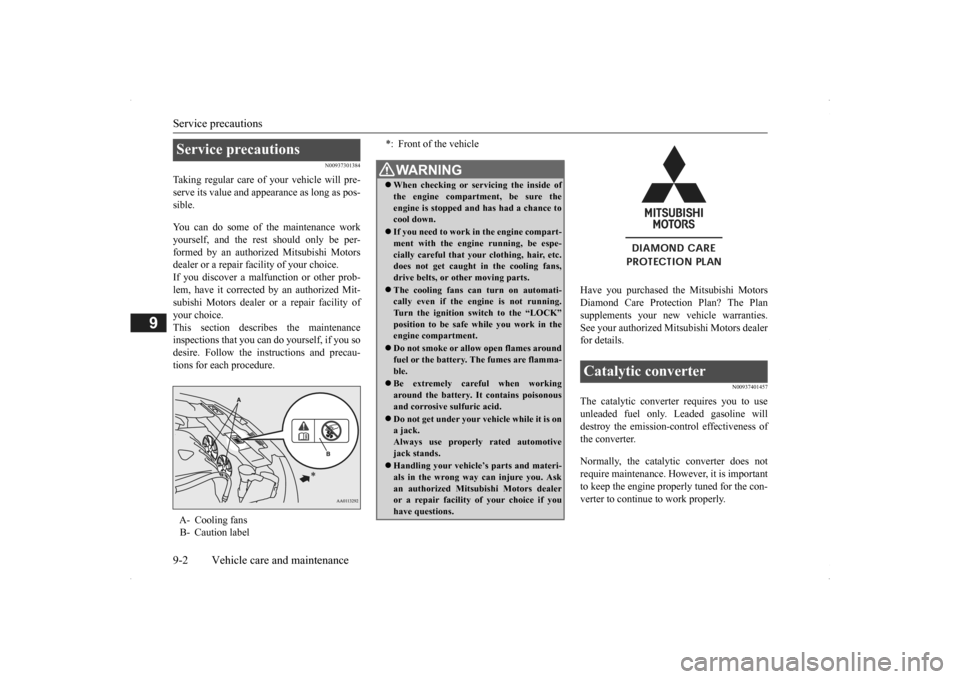
Service precautions A- Cooling fans B- Caution label
*: Front of the vehicleWA R N I N G When checking or servicing the inside of the engine compartment, be sure theengine is stopped and has had a chance to cool down. If you need to work
in the engine compart-
ment with the engine running, be espe- cially careful that your clothing, hair, etc.does not get caught in the cooling fans, drive belts, or other moving parts. The cooling fans can turn on automati- cally even if the engine is not running. Turn the ignition switch to the “LOCK”position to be safe while you work in the engine compartment. Do not smoke or allow open flames around fuel or the battery. The fumes are flamma- ble. Be extremely careful when working around the battery. It
contains poisonous
and corrosive sulfuric acid. Do not get under your ve
hicle while it is on
a jack. Always use properly rated automotive jack stands. Handling your vehicle’s parts and materi- als in the wrong way can injure you. Askan authorized Mitsub
ishi Motors dealer
or a repair facility of your choice if you have questions.
Catalytic converter
BK0200500US.book 2 ページ 2013年2月12日 火曜日 午前9時46分
Page 387 of 451
Engine hood
Vehicle care and maintenance 9-3
9
To reduce the possibili
ty of catalytic con-
verter damage: Use UNLEADED GASOLINE ONLY of the type of recommended in the “Fuel selection”. Do not drive with an extremely low fuel level. Running out of gas could damage the catalytic converter. Do not try to start the engine by pushing or towing the vehicle. If the battery is weak or run down, use jumper cables toproperly start the engine.
Do not idle the engine with any spark plug wires disconnected or removed, such aswhen performing
diagnosti
c tests.
Do not idle the engine
for a long time if it
is idling roughly or otherwise obviouslymalfunctioning. To prevent the catalytic converter from being damaged from unburned gas, do notrace the engine when turning off the igni- tion switch. Stop driving the vehicle if you think the performance is noticeably low, or the engine has a malfunction such as with theignition, etc. If you are not able to stop driving immediately,
slow down and drive
for only a short time. Have your vehiclechecked at an authorized Mitsubishi Motors dealer or a repair facility of your choice as soon
as possible.
In unusual situations involving major engine problems, a burning odor may indicate severe and abnormal catalyticconverter overheating.
If this occurs, stop
in a safe place, shut the engine off and let the vehicle cool. Once
the engine is cool,
immediately take your
vehicle to a dealer
or a repair facility of your choice for ser- vice.
N00937501559
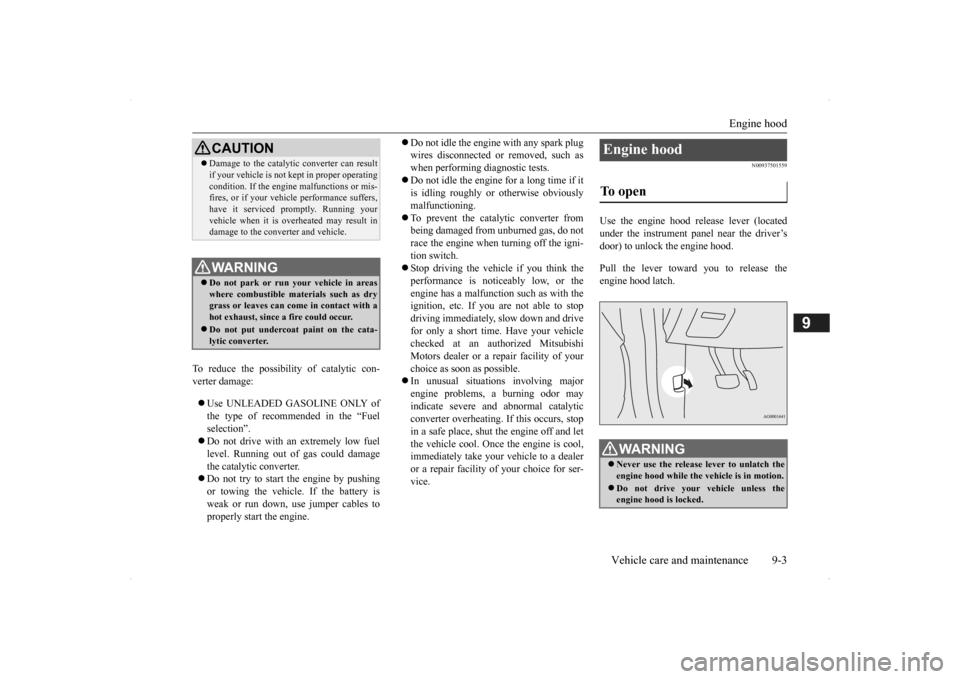
Use the engine hood release lever (located under the instrument panel near the driver’s door) to unlock the engine hood. Pull the lever toward you to release the engine hood latch.
CAUTION Damage to the catalyti
c converter can result
if your vehicle is not
kept in proper operating
condition. If the engine
malfunctions or mis-
fires, or if your vehi
cle performance suffers,
have it serviced promptly. Running your vehicle when it is
overheated may result in
damage to the converter and vehicle.WA R N I N G Do not park or run your vehicle in areas where combustible materials such as dry grass or leaves can come
in contact with a
hot exhaust, since a fire could occur. Do not put undercoat paint on the cata- lytic converter.
Engine hood To open
WA R N I N G Never use the release lever to unlatch the engine hood while the
vehicle is in motion.
Do not drive your vehicle unless the engine hood is locked.
BK0200500US.book 3 ページ 2013年2月12日 火曜日 午前9時46分
Page 408 of 451
For cold and snowy weather 9-24 Vehicle care and maintenance
9
N00942201118
The best way to keep carbon monoxide gas from entering inside your
vehicle is to have
the engine exhaust syst
em properly serviced.
Have a competent mechanic inspect the com- plete exhaust system
and nearby body areas
for broken, damaged, deteriorated, or mispo- sitioned parts if you no
tice any of the follow-
ing: A change in the sound of the exhaust sys- tem The smell of exhaust fumes inside the vehicle The underside or rear of the vehicle is damaged
Also check the exhaust system each time the vehicle is raised for l
ubrication, oil changes,
or required service. A
ny open seams or loose
connections could le
t dangerous exhaust
fumes seep into the
luggage and passenger
compartments.
Check for holes or exhaust gas leaks caused by corrosion or damage. Check the joints and connections for looseness or exhaust gas leaks. Check the rubber hangers and brackets for damage.
N00942300079
The timing belt should be replaced with a new one at the mileage listed in the “WAR- RANTY AND MAINTENANCE MAN-UAL”.
N00942501124
The hood lock release mechanism and hood safety catch should be
checked, cleaned, and
oiled when needed for easy movement and toprevent rust and wear. Use Multipurpose Grease NLGI Grade 2 sp
aringly for all sliding
parts of the hood latc
h and release lever.
Work the grease into the hood lock mecha- nism until all the mo
vable surfaces are cov-
ered.
Also, put a light coat
of the same grease on
the safety catch wherever moving parts touch.
N00942600102
The ventilation slots in
front of the wind-
shield should be brushed clear after a heavy snowfall so that the operation of the heating and ventilation
systems will not be impaired.
To prevent freezing of the weatherstripping on the doors, engine hood, etc., they shouldbe treated with silicone grease. It is a good idea to carry a shovel or a short- handled spade in the vehicle during the win-ter so that you can clear away snow if you get stranded. A small hand-brush for sweeping snow off the vehicle a
nd a plastic scraper for
Exhaust system
WA R N I N GCarbon monoxide gas
from your vehicle’s
exhaust is poisonous. Breathing thesefumes can cause unconsciousness or death.
Check for any of the following conditions: Timing belt Hood lock release mechanism and safety catch
For cold and snowy weather Ventilation slots Weatherstripping Additional equipment (For regions where snow is encoun- tered)
BK0200500US.book 24 ページ 2013年2月12日 火曜日 午前9時46分