lock MITSUBISHI OUTLANDER 2014 3.G User Guide
[x] Cancel search | Manufacturer: MITSUBISHI, Model Year: 2014, Model line: OUTLANDER, Model: MITSUBISHI OUTLANDER 2014 3.GPages: 451, PDF Size: 49.08 MB
Page 36 of 451
Second row seats
Seat and restraint systems 4-9
4
N00403001318
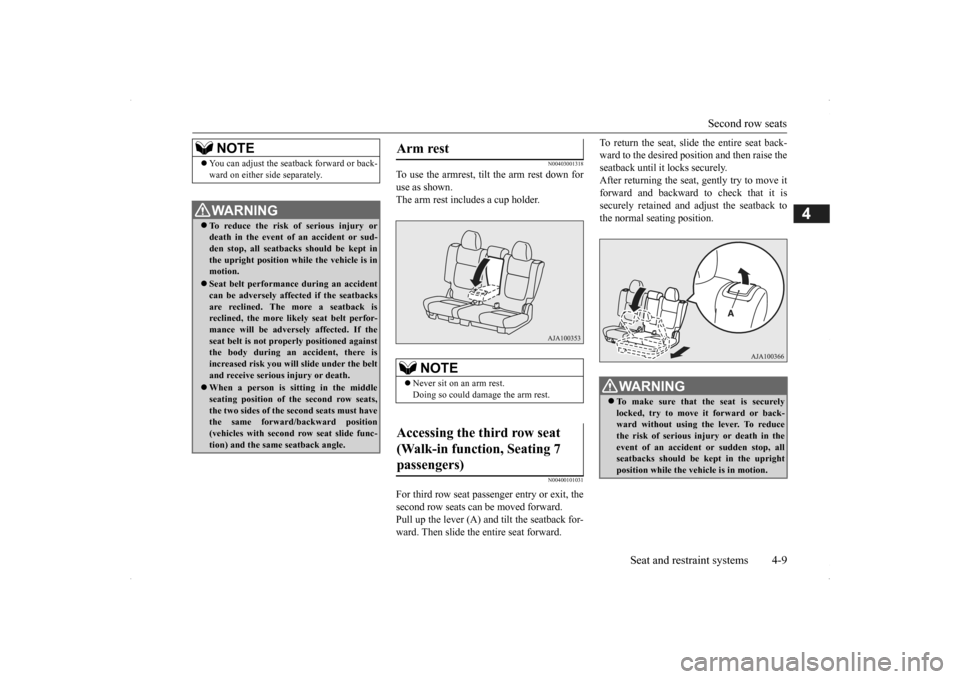
To use the armrest, tilt the arm rest down for use as shown. The arm rest includes a cup holder.
N00400101031
For third row seat passenger entry or exit, thesecond row seats can be moved forward.Pull up the lever (A) and tilt the seatback for- ward. Then slide the entire seat forward.
To return the seat, slide the entire seat back- ward to the desired position and then raise theseatback until it locks securely. After returning the seat, gently try to move it forward and backward to check that it issecurely retained and adjust the seatback to the normal seating position.
NOTE
You can adjust the seatback forward or back- ward on either side separately.WA R N I N G To reduce the risk of serious injury or death in the event of
an accident or sud-
den stop, all seatbacks should be kept in the upright position wh
ile the vehicle is in
motion. Seat belt performance during an accident can be adversely affect
ed if the seatbacks
are reclined. The more a seatback is reclined, the more likely seat belt perfor- mance will be advers
ely affected. If the
seat belt is not prop
erly positioned against
the body during an accident, there is increased risk you will slide under the beltand receive serious
injury or death.
When a person is sitting in the middle seating position of the second row seats, the two sides of the second seats must have the same forward/backward position(vehicles with second row seat slide func- tion) and the same seatback angle.
Arm rest
NOTE
Never sit on an arm rest. Doing so could damage the arm rest.
Accessing the third row seat (Walk-in function, Seating 7 passengers)
WA R N I N G To make sure that the seat is securely locked, try to move
it forward or back-
ward without using the lever. To reduce the risk of serious in
jury or death in the
event of an accident
or sudden stop, all
seatbacks should be kept in the upright position while the ve
hicle is in motion.
BK0200500US.book 9 ページ 2013年2月12日 火曜日 午前9時46分
Page 38 of 451
Head restraints
Seat and restraint systems 4-11
4
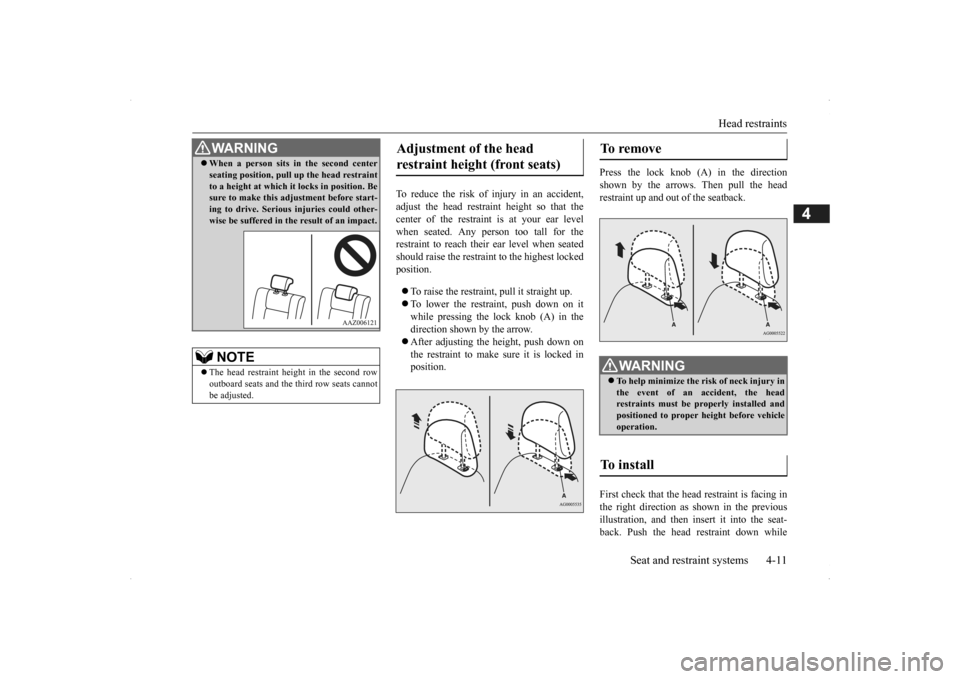
To reduce the risk of injury in an accident, adjust the head restraint height so that thecenter of the restraint is at your ear level when seated. Any person too tall for the restraint to reach their ear level when seatedshould raise the restraint to the highest locked position. To raise the restraint, pull it straight up. To lower the restraint, push down on it while pressing the lock knob (A) in the direction shown by the arrow. After adjusting the height, push down on the restraint to make sure it is locked in position.
Press the lock knob (A) in the direction shown by the arrows. Then pull the head restraint up and out of the seatback. First check that the head restraint is facing in the right direction as shown in the previousillustration, and then insert it into the seat- back. Push the head
restraint down while
When a person sits in the second center seating position, pull up
the head restraint
to a height at which it locks in position. Besure to make this adjustment before start- ing to drive. Serious injuries could other- wise be suffered in the result of an impact.NOTE
The head restraint height in the second row outboard seats and the third row seats cannot be adjusted.WA R N I N G
Adjustment of the head restraint height (front seats)
To remove
WA R N I N G To help minimize the risk of neck injury in the event of an accident, the headrestraints must be properly installed and positioned to proper height before vehicle operation.
To install
BK0200500US.book 11 ページ 2013年2月12日 火曜日 午前9時46分
Page 39 of 451
Making a cargo area 4-12 Seat and restraint systems
4
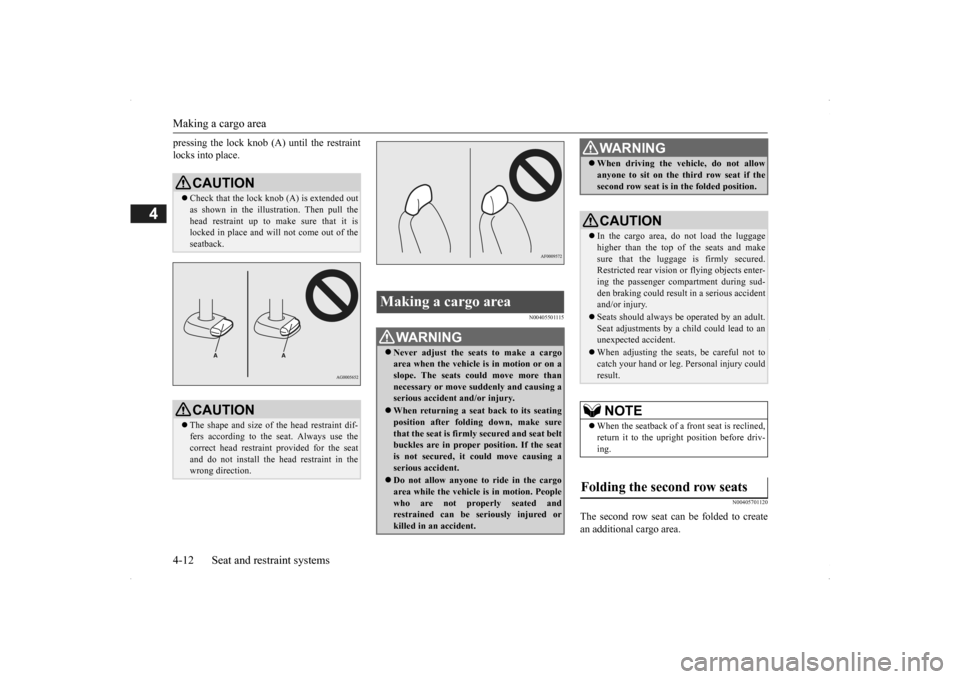
pressing the lock knob (A) until the restraint locks into place.
N00405501115
N00405701120
The second row seat can be folded to create an additional cargo area.
CAUTION Check that the lock knob (A) is extended out as shown in the illustration. Then pull the head restraint up to make sure that it is locked in place and will
not come out of the
seatback.CAUTION The shape and size of the head restraint dif- fers according to the seat. Always use the correct head restraint provided for the seatand do not install the he
ad restraint in the
wrong direction.
Making a cargo area
WA R N I N G Never adjust the seats to make a cargo area when the vehicle is in motion or on a slope. The seats co
uld move more than
necessary or move su
ddenly and causing a
serious accident
and/or injury.
When returning a seat back to its seating position after fold
ing down, make sure
that the seat is firmly secured and seat beltbuckles are in proper
position. If the seat
is not secured, it could move causing a serious accident. Do not allow anyone to ride in the cargo area while the vehicle
is in motion. People
who are not properly seated and restrained can be seriously injured or killed in an accident.
When driving the vehicle, do not allow anyone to sit on the third row seat if thesecond row seat is in the folded position.CAUTION In the cargo area, do not load the luggage higher than the top of the seats and makesure that the luggage is firmly secured. Restricted rear vision or
flying objects enter-
ing the passenger compartment during sud-den braking could result
in a serious accident
and/or injury. Seats should always be
operated by an adult.
Seat adjustments by a child could lead to an unexpected accident. When adjusting the seats, be careful not to catch your hand or leg.
Personal injury could
result.NOTE
When the seatback of a front seat is reclined, return it to the upright
position before driv-
ing.
Folding the second row seats
WA R N I N G
BK0200500US.book 12 ページ 2013年2月12日 火曜日 午前9時46分
Page 41 of 451
Making a cargo area 4-14 Seat and restraint systems
4
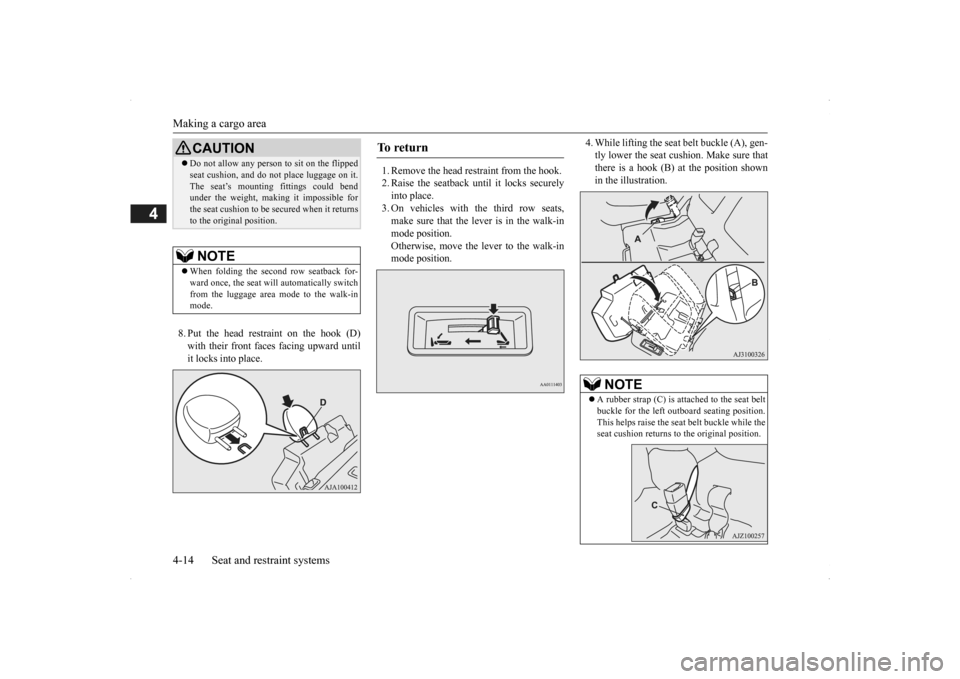
8. Put the head restraint on the hook (D) with their front fa
ces facing upward until
it locks into place.
1. Remove the head restraint from the hook. 2. Raise the seatback until it locks securely into place. 3. On vehicles with the third row seats,make sure that the lever is in the walk-in mode position. Otherwise, move the lever to the walk-inmode position.
4. While lifting the seat
belt buckle (A), gen-
tly lower the seat cushion. Make sure thatthere is a hook (B) at the position shown in the illustration.
CAUTION Do not allow any person to sit on the flipped seat cushion, and do
not place luggage on it.
The seat’s mounting
fittings could bend
under the weight, making it impossible for the seat cushion to be secured when it returns to the original position.NOTE
When folding the second row seatback for- ward once, the seat will automatically switch from the luggage area
mode to the walk-in
mode.
To r e t u r n
NOTE
A rubber strap (C) is atta
ched to the seat belt
buckle for the left out
board seating position.
This helps raise the seat
belt buckle while the
seat cushion returns to the original position.
BK0200500US.book 14 ページ 2013年2月12日 火曜日 午前9時46分
Page 42 of 451
Making a cargo area
Seat and restraint systems 4-15
4
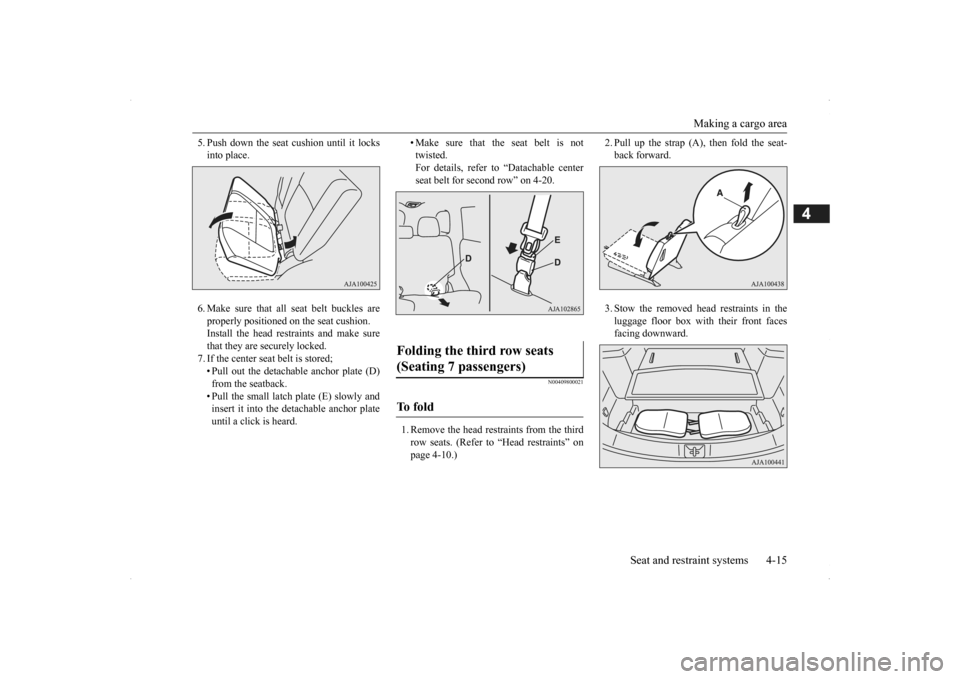
5. Push down the seat cushion until it locks into place. 6. Make sure that all
seat belt buckles are
properly positioned on the seat cushion. Install the head restraints and make surethat they are securely locked. 7. If the center seat
belt is stored;
• Pull out the detachable anchor plate (D)from the seatback. • Pull the small latch plate (E) slowly and insert it into the detachable anchor plateuntil a click is heard.
• Make sure that the seat belt is not twisted.For details, refer to “Datachable center seat belt for second row” on 4-20.
N00409800021
1. Remove the head restraints from the thirdrow seats. (Refer to
“Head restraints” on
page 4-10.)
2. Pull up the strap (A), then fold the seat- back forward. 3. Stow the removed head restraints in the luggage floor box with their front faces facing downward.
Folding the third row seats (Seating 7 passengers) To f o l d
BK0200500US.book 15 ページ 2013年2月12日 火曜日 午前9時46分
Page 43 of 451
Making a flat seat 4-16 Seat and restraint systems
4
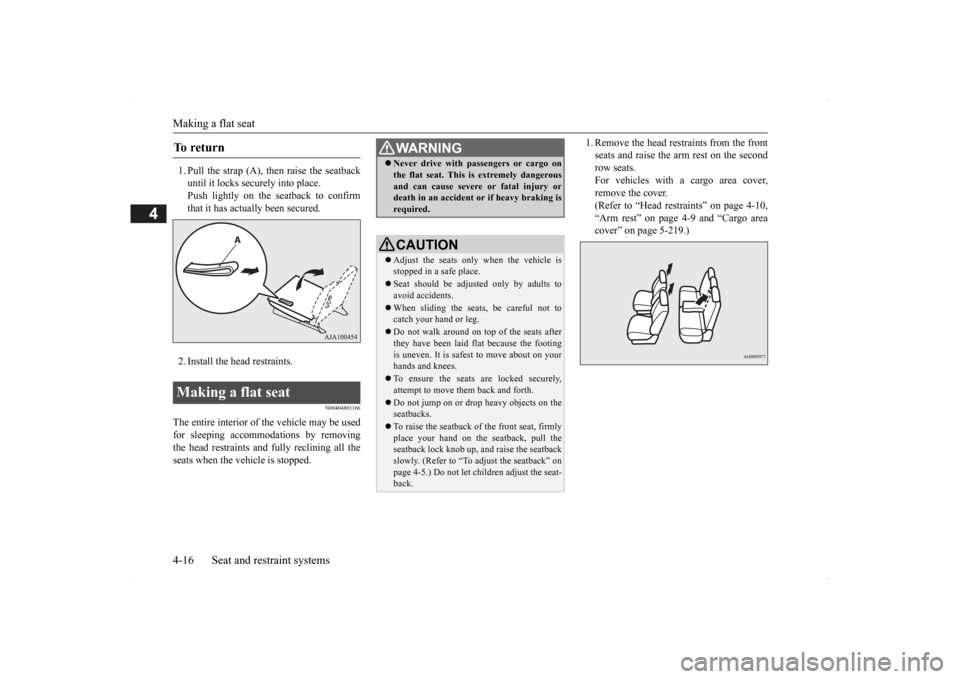
1. Pull the strap (A), then raise the seatback until it locks securely into place. Push lightly on the seatback to confirm that it has actually been secured. 2. Install the head restraints.
N00404801166
The entire interior of the vehicle may be used for sleeping accomm
odations by removing
the head restraints and fully reclining all the seats when the vehicle is stopped.
1. Remove the head re
straints from the front
seats and raise the arm rest on the secondrow seats. For vehicles with a cargo area cover, remove the cover.(Refer to “Head restraints” on page 4-10, “Arm rest” on page 4-9 and “Cargo area cover” on page 5-219.)
To r e t u r n Making a flat seat
WA R N I N G Never drive with passengers or cargo on the flat seat. This is extremely dangerousand can cause severe or fatal injury ordeath in an accident
or if heavy braking is
required.CAUTION Adjust the seats only
when the vehicle is
stopped in a safe place. Seat should be adjusted only by adults to avoid accidents. When sliding the seat
s, be careful not to
catch your hand or leg. Do not walk around on t
op of the seats after
they have been laid fl
at because the footing
is uneven. It is safe
st to move about on your
hands and knees. To ensure the seats are locked securely, attempt to move them back and forth. Do not jump on or drop heavy objects on the seatbacks. To raise the seatback of the front seat, firmly place your hand on the
seatback, pull the
seatback lock knob up,
and raise the seatback
slowly. (Refer to “To adjust the seatback” onpage 4-5.) Do not let children adjust the seat- back.
BK0200500US.book 16 ページ 2013年2月12日 火曜日 午前9時46分
Page 45 of 451
Seat belts 4-18 Seat and restraint systems
4
N00406201467
All seats are equipped with a seat belt which uses one combined lap-and-shoulder belt with an emergency locking retractor. This system is designed to provide both com- fort and safety. It perm
its full extension and
automatic retraction of the belts during nor- mal vehicle operation.
A sensing device
inside the belt retractor is designed to lock the retractor in the event of a sudden change inthe vehicle’s motion.
To reduce the risk to the driver of serious injury or death duri
ng deployment of the
driver’s airbag, always
properly wear the
seat belt and adjust th
e driver’s seat as far
back as possible while maintaining a posi- tion that still enables
you to fully apply the
pedals, easily control the steering wheel, and safely operate the vehicle. To reduce the risk to a front seat passen- ger of serious injury or death from a deploying airbag, make sure the passengeralways wears the seat belt properly, remains seated all the way back and upright in their seat,
and moves the seat as
far back as possible. Refer to “Supplemen- tal Restraint System (SRS) - airbag” on page 4-33 for additional information. Never hold an infant
or child in your arms
or on your lap when ri
ding in this vehicle
even when you are we
aring your seat belt.
Never place any part of the seat belt you are wearing around an infant or child.Failure to follow these simple instructions creates a risk of serious injury or death to your child in the even
t of an accident or
sudden stop.WA R N I N G
Children 12 years ol
d and under should
always ride in the re
ar seat and be prop-
erly restrained. This reduces their risk ofserious injury or de
ath in an accident,
especially due to a deploying front passen- ger airbag. Refe
r to “Child restraint sys-
tems” on page 4-25 for additional information. Any child who is t
oo small to properly
wear a seat belt must be properly restrained in an
appropriate child
restraint system. Infants MUST be placed in a rear-facing child safety seat and
positioned in the rear
seat. In the event of an ac
cident, all seat belt
assemblies, including retractors and attachment hardware, should be inspectedby an authorized Mitsubishi Motors dealer to determine whether replacement is necessary.
Seat belt instructions
WA R N I N G
NOTE
For instructions on inst
alling a child restraint
system using a seat belt
, refer to “Installing a
child restraint system using the seat belt” on page 4-30.
BK0200500US.book 18 ページ 2013年2月12日 火曜日 午前9時46分
Page 46 of 451
Seat belts
Seat and restraint systems 4-19
4
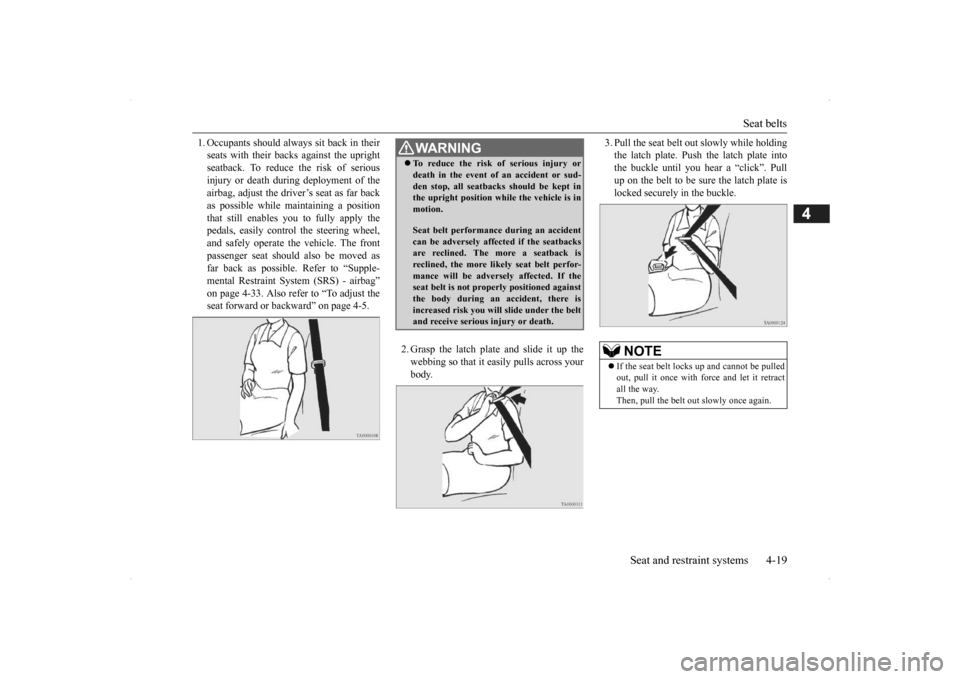
1. Occupants shoul
d always sit back in their
seats with their backs against the uprightseatback. To reduce the risk of serious injury or death during deployment of the airbag, adjust the driver’s seat as far backas possible while ma
intaining a position
that still enables you to fully apply the pedals, easily contro
l the steering wheel,
and safely operate the vehicle. The front passenger seat should
also be moved as
far back as possible. Refer to “Supple- mental Restraint Syst
em (SRS) - airbag”
on page 4-33. Also refe
r to “To adjust the
seat forward or backward” on page 4-5.
2. Grasp the latch plate and slide it up the webbing so that it ea
sily pulls across your
body.
3. Pull the seat belt out
slowly while holding
the latch plate. Push the latch plate intothe buckle until you he
ar a “click”. Pull
up on the belt to be sure the latch plate is locked securely in the buckle.
WA R N I N G To reduce the risk of serious injury or death in the event of
an accident or sud-
den stop, all seatbacks should be kept inthe upright position while the vehicle is in motion. Seat belt performance during an accident can be adversely affect
ed if the seatbacks
are reclined. The more a seatback isreclined, the more likely seat belt perfor- mance will be advers
ely affected. If the
seat belt is not proper
ly positioned against
the body during an accident, there is increased risk you will slide under the belt and receive serious
injury or death.
NOTE
If the seat belt lock
s up and cannot be pulled
out, pull it once with fo
rce and let it retract
all the way. Then, pull the belt out
slowly once again.
BK0200500US.book 19 ページ 2013年2月12日 火曜日 午前9時46分
Page 47 of 451
Seat belts 4-20 Seat and restraint systems
4
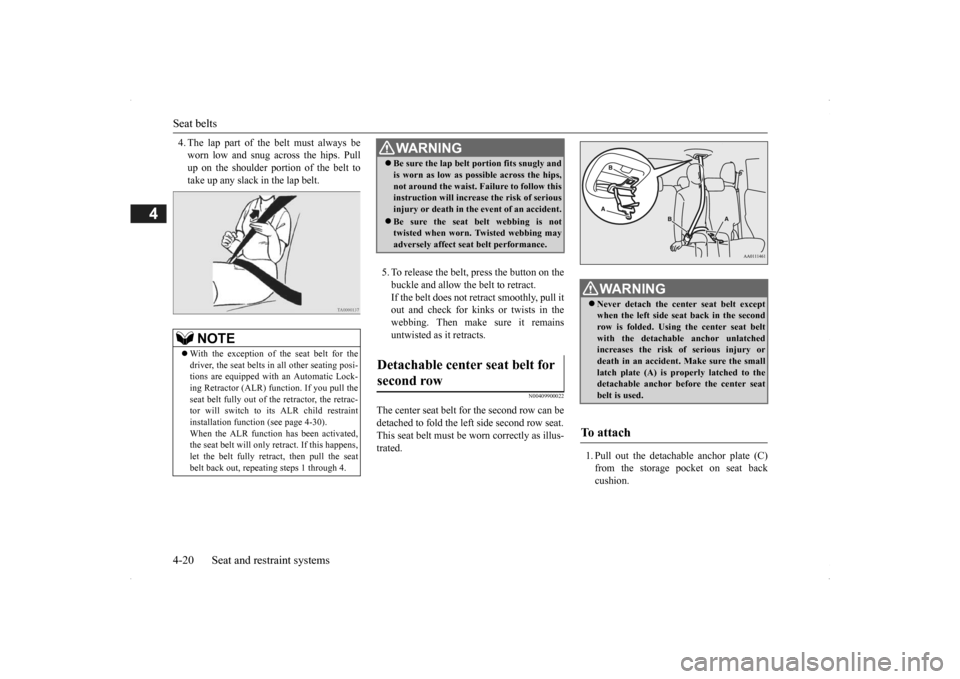
4. The lap part of the belt must always be worn low and snug across the hips. Pullup on the shoulder portion of the belt to take up any slack in the lap belt.
5. To release the belt,
press the button on the
buckle and allow the belt to retract. If the belt does not retract smoothly, pull it out and check for kinks or twists in thewebbing. Then make sure it remains untwisted as it retracts.
N00409900022
The center seat belt for the second row can be detached to fold the le
ft side second row seat.
This seat belt must be worn correctly as illus- trated.
1. Pull out the detachable anchor plate (C) from the storage pocket on seat back cushion.
NOTE
With the exception of the seat belt for the driver, the seat belts in all other seating posi-tions are equipped with an Automatic Lock- ing Retractor (ALR) func
tion. If you pull the
seat belt fully out of th
e retractor, the retrac-
tor will switch to its ALR child restraint installation function (see page 4-30). When the ALR function has been activated,the seat belt will only
retract. If this happens,
let the belt fully retract, then pull the seat belt back out, repeating steps 1 through 4.
WA R N I N G Be sure the lap belt portion fits snugly and is worn as low as possible across the hips,not around the waist. Failure to follow thisinstruction will increase the risk of serious injury or death in the
event of an accident.
Be sure the seat belt webbing is not twisted when worn. Twisted webbing may adversely affect seat belt performance.
Detachable center seat belt for second row
WA R N I N G Never detach the center seat belt except when the left side seat back in the secondrow is folded. Using the center seat belt with the detachable
anchor unlatched
increases the risk of serious injury ordeath in an accident. Make sure the small latch plate (A) is properly latched to the detachable anchor be
fore the center seat
belt is used.
To attach
BK0200500US.book 20 ページ 2013年2月12日 火曜日 午前9時46分
Page 48 of 451
Seat belts
Seat and restraint systems 4-21
4
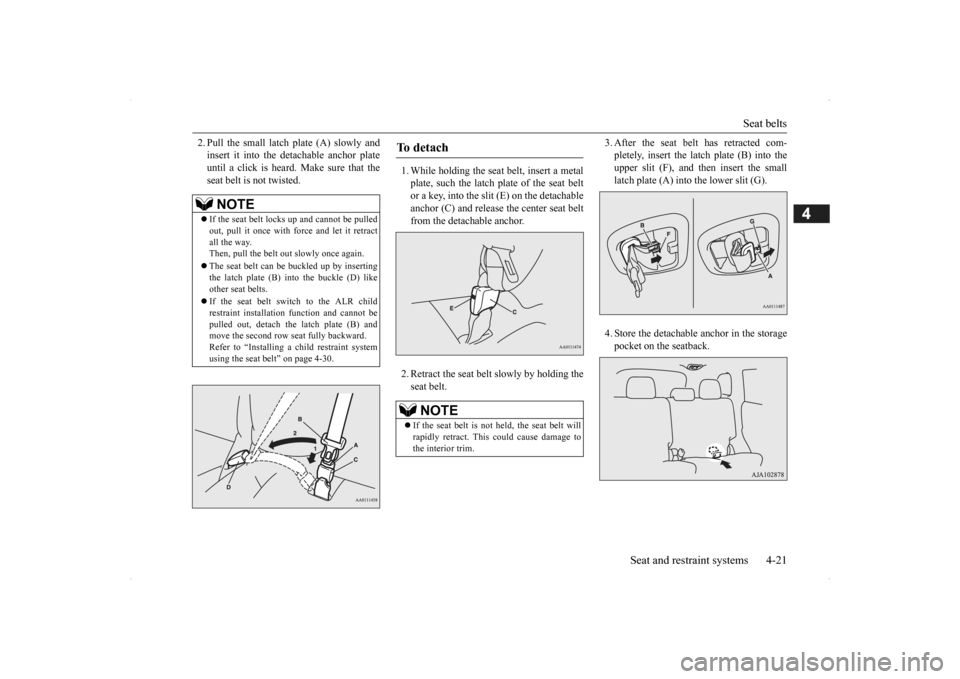
2. Pull the small latch plate (A) slowly and insert it into the detachable anchor plateuntil a click is heard. Make sure that the seat belt is not twisted.
1. While holding the seat
belt, insert a metal
plate, such the latch plate of the seat belt or a key, into the slit (E) on the detachable anchor (C) and release the center seat beltfrom the detachable anchor. 2. Retract the seat belt slowly by holding the seat belt.
3. After the seat belt has retracted com- pletely, insert the latch plate (B) into theupper slit (F), and th
en insert the small
latch plate (A) into the lower slit (G). 4. Store the detachable anchor in the storage pocket on the seatback.
NOTE
If the seat belt lock
s up and cannot be pulled
out, pull it once with fo
rce and let it retract
all the way. Then, pull the belt out
slowly once again.
The seat belt can be
buckled up by inserting
the latch plate (B) into the buckle (D) like other seat belts. If the seat belt switch to the ALR child restraint installation
function and cannot be
pulled out, detach the latch plate (B) and move the second row seat fully backward. Refer to “Installing a child restraint systemusing the seat be
lt” on page 4-30.
To d e t a c h
NOTE
If the seat belt is not held, the seat belt will rapidly retract. This
could cause damage to
the interior trim.
BK0200500US.book 21 ページ 2013年2月12日 火曜日 午前9時46分