wheel MITSUBISHI OUTLANDER 2014 3.G User Guide
[x] Cancel search | Manufacturer: MITSUBISHI, Model Year: 2014, Model line: OUTLANDER, Model: MITSUBISHI OUTLANDER 2014 3.GPages: 451, PDF Size: 49.08 MB
Page 46 of 451
Seat belts
Seat and restraint systems 4-19
4
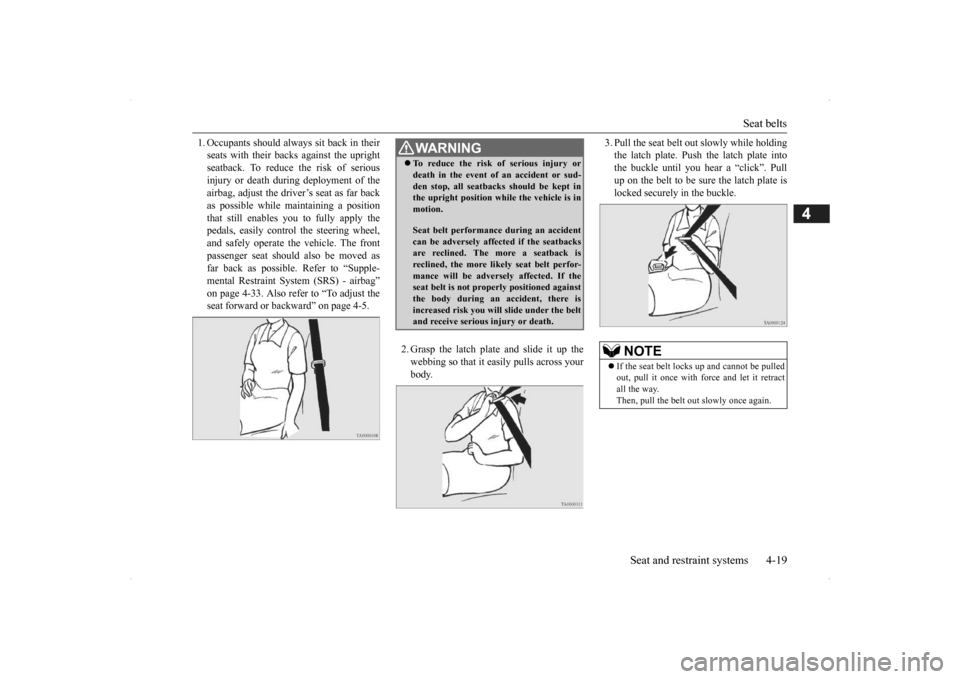
1. Occupants shoul
d always sit back in their
seats with their backs against the uprightseatback. To reduce the risk of serious injury or death during deployment of the airbag, adjust the driver’s seat as far backas possible while ma
intaining a position
that still enables you to fully apply the pedals, easily contro
l the steering wheel,
and safely operate the vehicle. The front passenger seat should
also be moved as
far back as possible. Refer to “Supple- mental Restraint Syst
em (SRS) - airbag”
on page 4-33. Also refe
r to “To adjust the
seat forward or backward” on page 4-5.
2. Grasp the latch plate and slide it up the webbing so that it ea
sily pulls across your
body.
3. Pull the seat belt out
slowly while holding
the latch plate. Push the latch plate intothe buckle until you he
ar a “click”. Pull
up on the belt to be sure the latch plate is locked securely in the buckle.
WA R N I N G To reduce the risk of serious injury or death in the event of
an accident or sud-
den stop, all seatbacks should be kept inthe upright position while the vehicle is in motion. Seat belt performance during an accident can be adversely affect
ed if the seatbacks
are reclined. The more a seatback isreclined, the more likely seat belt perfor- mance will be advers
ely affected. If the
seat belt is not proper
ly positioned against
the body during an accident, there is increased risk you will slide under the belt and receive serious
injury or death.
NOTE
If the seat belt lock
s up and cannot be pulled
out, pull it once with fo
rce and let it retract
all the way. Then, pull the belt out
slowly once again.
BK0200500US.book 19 ページ 2013年2月12日 火曜日 午前9時46分
Page 62 of 451
Supplemental Restraint System (SRS) - airbag 4-34 Seat and restraint systems
4
WA R N I N G IT IS VERY IMPORTANT TO ALWAYS WEAR YOUR SEAT BELT PROPERLYEVEN WITH AN AIRBAG.• Seat belts help keep the driver and pas-sengers properly positioned. Thisreduces the risk of injury in all collisions, and reduces the risk of serious injuries or death when the airbags inflate.During sudden brakin
g just before a col-
lision, an unrestra
ined or improperly
restrained driver or front passenger canmove forward into di
rect contact with, or
within close proximity to, the airbag when it begins to inflate.The beginning stage of
airbag inflation is
the most forceful and can cause serious injuries or death if the occupant comes incontact with the ai
rbag at this time.
• Seat belts reduce the risk of injury in rear impact collisions, and in lower- speed frontal collisions because the air- bags are not designed
to inflate in those
situations.• Seat belts reduce the risk of beingthrown from your vehi
cle in a collision or
rollover.WA R N I N G IT IS VERY IMPORTANT TO BE PROP- ERLY SEATED.
• A driver or front passenger sitting too close to the steering wheel or instrumentpanel during airbag deployment can beseriously injure
d or killed.
• Airbags inflate ve
ry quickly and with
great force. If the driver and front pas- senger are not properly seated and restrained, the airbag may not providethe proper protection, and can cause serious injuries or death when it inflates.• To reduce the risk to the driver of seriousinjury or death due to a deploying driver’s airbag, al
ways properly wear
your seat belt and ad
just the driver’s seat
as far back as possible, maintaining a position that still
allows the driver to
have good control of the steering wheel, brake, accelerator,
and other vehicle con-
trols.• To reduce the risk to the front passengerof serious injury or death from a deploy-ing passenger’s airbag, make sure the passenger always we
ars the seat belt
properly, remains seat
ed upright and all
the way back in the seat, and positions the seat as far back as possible.• Seat all infants and children in the rearseat, properly restrain
ed in an appropri-
ate child restraint system.WA R N I N G
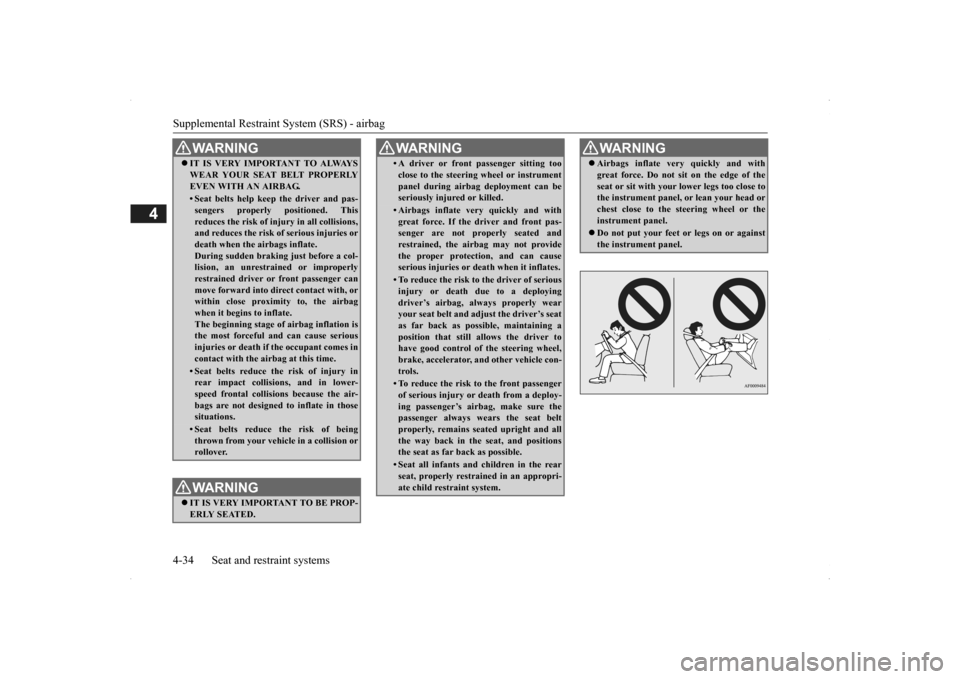
WA R N I N G Airbags inflate very
quickly and with
great force. Do not sit on the edge of theseat or sit with your
lower legs too close to
the instrument panel,
or lean your head or
chest close to the steering wheel or the instrument panel. Do not put your feet or
legs on or against
the instrument panel.
BK0200500US.book 34 ページ 2013年2月12日 火曜日 午前9時46分
Page 68 of 451
Supplemental Restraint System (SRS) - airbag 4-40 Seat and restraint systems
4
N00407901331
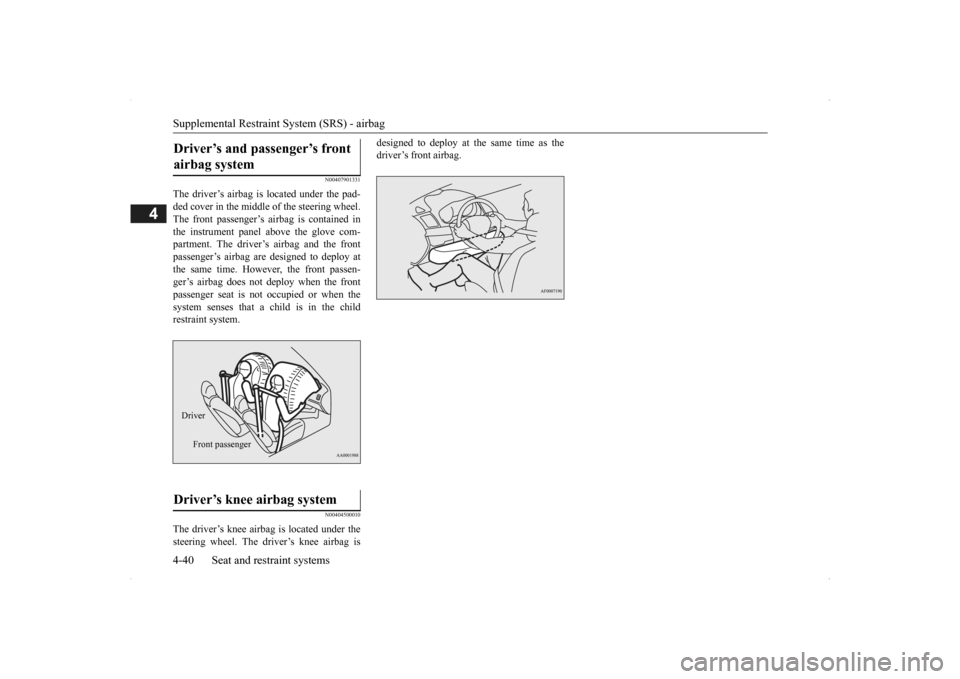
The driver’s airbag is located under the pad- ded cover in the middle of the steering wheel.The front passenger’s ai
rbag is contained in
the instrument panel above the glove com- partment. The driver’s airbag and the frontpassenger’s airbag are designed to deploy at the same time. However, the front passen- ger’s airbag does not deploy when the front passenger seat is not occupied or when the system senses that a child is in the childrestraint system.
N00404500010
The driver’s knee airbag is located under the steering wheel. The driver’s knee airbag is
designed to deploy at
the same time as the
driver’s front airbag.
Driver’s and passenger’s front airbag system Driver’s knee airbag system Driver
Front passenger
BK0200500US.book 40 ページ 2013年2月12日 火曜日 午前9時46分
Page 71 of 451
Supplemental Restraint System (SRS) - airbag
Seat and restraint systems 4-43
4
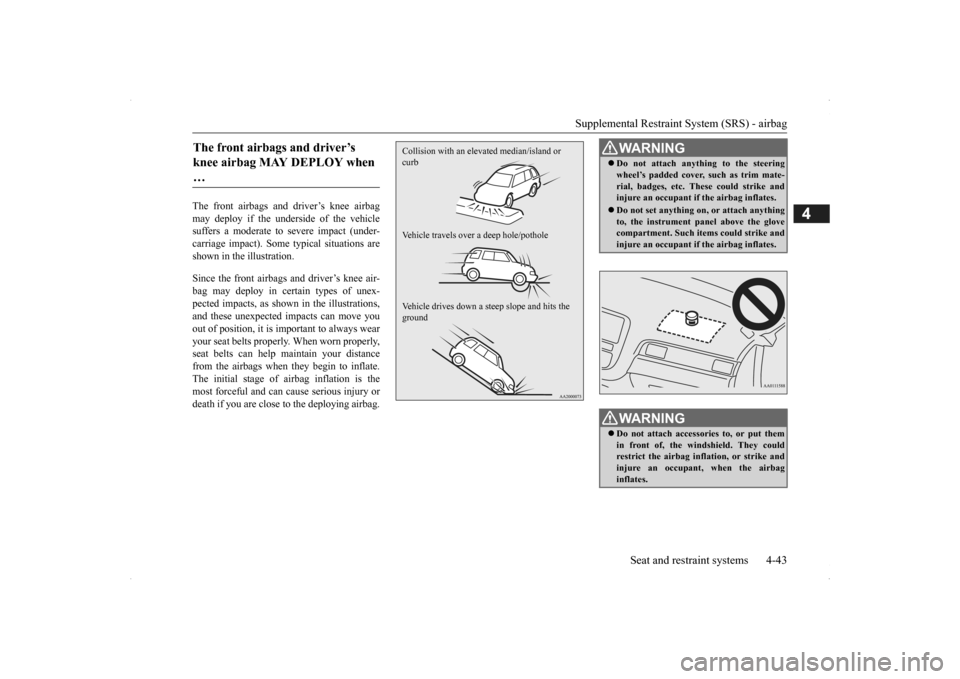
The front airbags and driver’s knee airbag may deploy if the underside of the vehiclesuffers a moderate to
severe impact (under-
carriage impact). Some typical situations are shown in the illustration. Since the front airbags and driver’s knee air- bag may deploy in ce
rtain types of unex-
pected impacts, as show
n in the illustrations,
and these unexpected impacts can move you out of position, it is
important to always wear
your seat belts properly. When worn properly,seat belts can help maintain your distance from the airbags when they begin to inflate. The initial stage of airbag inflation is themost forceful and can cause serious injury or death if you are close to the deploying airbag.The front airbags and driver’s knee airbag MAY DEPLOY when …
Collision with an elevat
ed median/island or
curb Vehicle travels over a deep hole/pothole Vehicle drives down a steep slope and hits the ground
WA R N I N G Do not attach anything to the steering wheel’s padded cover, such as trim mate-rial, badges, etc. These could strike andinjure an occupant if
the airbag inflates.
Do not set anything on, or attach anything to, the instrument
panel above the glove
compartment. Such items could strike and injure an occupant if
the airbag inflates.
WA R N I N GDo not attach accessories to, or put them in front of, the wind
shield. They could
restrict the airbag infl
ation, or strike and
injure an occupant, when the airbag inflates.
BK0200500US.book 43 ページ 2013年2月12日 火曜日 午前9時46分
Page 76 of 451
Supplemental Restraint System (SRS) - airbag 4-48 Seat and restraint systems
4
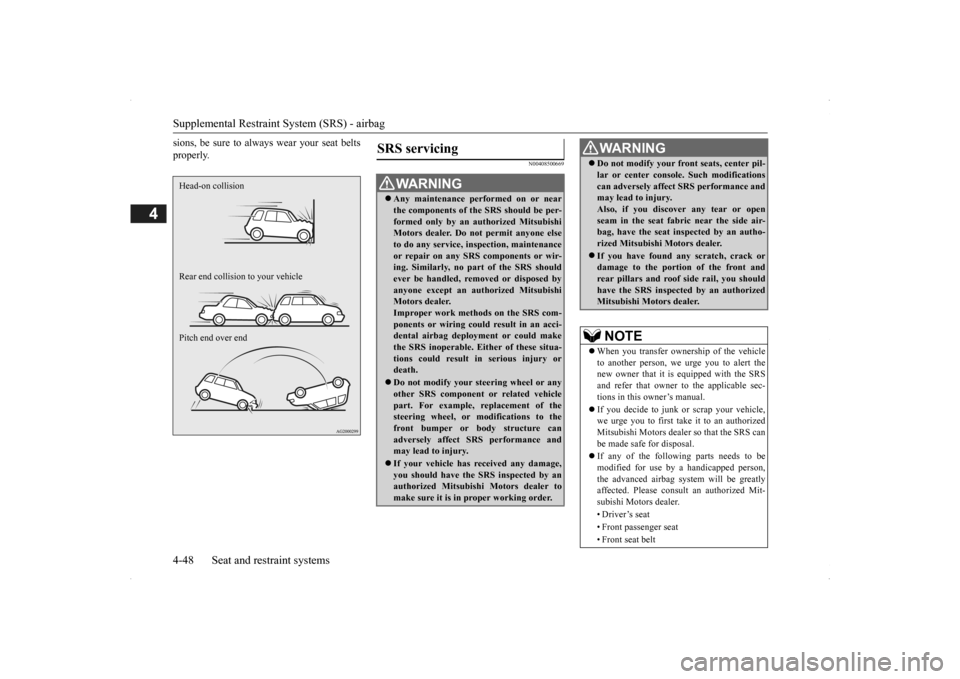
sions, be sure to always
wear your seat belts
properly.
N00408500669
Head-on collision Rear end collision to your vehicle Pitch end over end
SRS servicing
WA R N I N G Any maintenance performed on or near the components of the SRS should be per-formed only by an
authorized Mitsubishi
Motors dealer. Do not permit anyone else to do any service, inspection, maintenanceor repair on any SR
S components or wir-
ing. Similarly, no part of the SRS should ever be handled, removed or disposed byanyone except an au
thorized Mitsubishi
Motors dealer. Improper work meth
ods on the SRS com-
ponents or wiring could result in an acci- dental airbag deployment or could make the SRS inoperable. Ei
ther of these situa-
tions could result in serious injury or death. Do not modify your steering wheel or any other SRS component or related vehicle part. For example, replacement of thesteering wheel, or modifications to the front bumper or body structure can adversely affect SR
S performance and
may lead to injury. If your vehicle has received any damage, you should have the
SRS inspected by an
authorized Mitsubishi
Motors dealer to
make sure it is in proper working order.
Do not modify your front seats, center pil- lar or center console. Such modificationscan adversely affect
SRS performance and
may lead to injury. Also, if you discove
r any tear or open
seam in the seat fabr
ic near the side air-
bag, have the seat in
spected by an autho-
rized Mitsubishi Motors dealer. If you have found an
y scratch, crack or
damage to the portion of the front and rear pillars and roof
side rail, you should
have the SRS inspected by an authorized Mitsubishi Motors dealer.NOTE
When you transfer ownership of the vehicle to another person, we
urge you to alert the
new owner that it is
equipped with the SRS
and refer that owner to the applicable sec- tions in this owner’s manual. If you decide to junk or
scrap your vehicle,
we urge you to first take it to an authorized Mitsubishi Motors dealer so that the SRS canbe made safe for disposal. If any of the following parts needs to be modified for use by a handicapped person,the advanced airbag system will be greatly affected. Please consult an authorized Mit- subishi Motors dealer. • Driver’s seat • Front passenger seat • Front seat beltWA R N I N G
BK0200500US.book 48 ページ 2013年2月12日 火曜日 午前9時46分
Page 77 of 451
![MITSUBISHI OUTLANDER 2014 3.G User Guide Supplemental Restraint System (SRS) - airbag
Seat and restraint systems 4-49
4
• Steering wheel • Instrument panel[For vehicles so
ld in U.S.A.]
To contact Mitsubi
shi Motors North
America, I](/img/19/7531/w960_7531-76.png "MITSUBISHI OUTLANDER 2014 3.G User Guide Supplemental Restraint System (SRS) - airbag
Seat and restraint systems 4-49
4
• Steering wheel • Instrument panel[For vehicles so
ld in U.S.A.]
To contact Mitsubi
shi Motors North
America, I")
Supplemental Restraint System (SRS) - airbag
Seat and restraint systems 4-49
4
• Steering wheel • Instrument panel[For vehicles so
ld in U.S.A.]
To contact Mitsubi
shi Motors North
America, Inc. call 1-888-648-7820 or write to: Mitsubishi Motors North America, Inc.Customer Relations Department P.O. Box 6400 Cypress, CA 90630-0064 [For vehicles so
ld in Canada]
To contact Mitsubishi Motor Sales ofCanada, Inc. call 1-888-576-4878 or write to: Mitsubishi Motor Sales of Canada, Inc.Customer Relations Department P.O. Box 41009 4141 Dixie RoadMississauga, ON L4W 5C9NOTE
[For vehicles sold in Puerto Rico]To contact Mitsubishi Motor Sales ofCaribbean, Inc. call 1-787-251-8715 or write to: Mitsubishi Motor Sales of Caribbean,Inc. Customer Service Department P.O. Box 192216SAN JUAN PR 00919-2216 [For vehicles
sold in Guam]
To contact Triple J Enterprises Inc. call (671) 649-3673 or write to:Triple J Enterprises, Inc. P.O. Box 6066 TAMUNINGGUAM 96931 [For vehicles so
ld in Saipan]
To contact Triple J Motors call (670) 234-7133 or write to: Triple J MotorsP.O. Box 500487 SAIPAN, MP96950-0487
[For vehicles sold
in American Samoa]
To contact Pacific Marketing Inc.call 684 (699) 9140 or write to: Pacific Marketing, Inc. P.O. Box 698PA G O PA G O , AMERICAN SAMOA AS, 96799
BK0200500US.book 49 ページ 2013年2月12日 火曜日 午前9時46分
Page 79 of 451
5
Features and controlsBreak-in recommendations ...............................................................5-3 Keys ..................................................................................................5-3 Electronic immobilizer (Anti-theft starting system) .........................5-4Keyless entry system (if so equipped) ..............................................5-7 Free-hand Advanced Security Tr
ansmitter (F.A.S.T.-key) (if so
equipped).....................................................................................5-12Door locks.......................................................................................5-32 Power door locks .......
...........
...........
...........
...........
...........
.........
.....5-34
Child safety locks for rear door ...........
...........
.........
.........
.........
.....5-35
Liftgate (except for vehi
cles equipped with the
power liftgate) .....5-35
Power liftgate (if so equipped) .......................................................5-37 Inside liftgate release .....................................................................5-43Theft-alarm system .........................................................................5-44 Power window control ....................................................................5-48 Sunroof (if so equipped) .................................................................5-50Parking brake ..................................................................................5-52 Steering wheel height and reach adjustment...................................5-53 Inside rearview mirror ....................................................................5-54Outside rearview mirrors ................................................................5-55 Ignition switch ................................................................................5-56 Steering wheel lock (if so equipped) ..............................................5-58Starting the engine ..........................................................................5-58 Automatic transaxle (if so equipped)..............................................5-60 Continuously variable transmission
(CVT) (if so equipped)..........5-68
Electronically controlled
4WD system (if so equipped).................5-75
S-AWC (Super-All Wheel Control) (if
so equipped) .....................5-78
4-wheel drive operation ..................................................................5-81Inspection and maintenance followi
ng rough road operation.........5-83
Cautions on the handling of 4-wheel dr
ive vehicles ...................... 5-83
Service brake .................................................................................. 5-84 Hill start assist (if so equipped) ...................................................... 5-85Brake assist system ......................................................................... 5-86 Anti-lock braking system ............................................................... 5-87 Electric power steering system (EPS) ............................................ 5-89Active stability control (ASC) ........................................................ 5-90 Cruise control ................................................................................. 5-92 Adaptive Cruise Control System (ACC) (if so equipped) .............. 5-96Forward Collision Mitigation System
(FCM) (if so equipped) .... 5-107
Lane Departure Warning System (LDW
) (if so equipped)........... 5-111
Tire pressure monitoring system .................................................. 5-114Rear-view camera (if so equipped)............................................... 5-118 Instrument cluster ......................................................................... 5-120 Multi Information display - Type 1 .............................................. 5-121Multi Information display - Type 2 .............................................. 5-140 Indicator light, warning light, and
information screen display list
(multi information display - Type 1) ....................................... 5-148Indicator and warning light package
(multi information display - Type
2) ............................................................................................... 5-165 Indicators ...................................................................................... 5-166Warning lights............................................................................... 5-167 Information screen display (Vehicle equipped with the multi informa- tion display - Type 1) ............................................................... 5-169Combination headlights and dimmer switch ............................... 5-171 Headlight leveling switch (if so equipped)................................... 5-176 Turn signal lever ........................................................................... 5-176Hazard warning flasher switch ..................................................... 5-177
BK0200500US.book 1 ページ 2013年2月12日 火曜日 午前9時46分
Page 100 of 451
Free-hand Advanced
Security Transmitter (F.A.S
.T.-key) (if so equipped)
5-22 Features and controls
5
N00514301080
After pressing the e
ngine switch and opera-
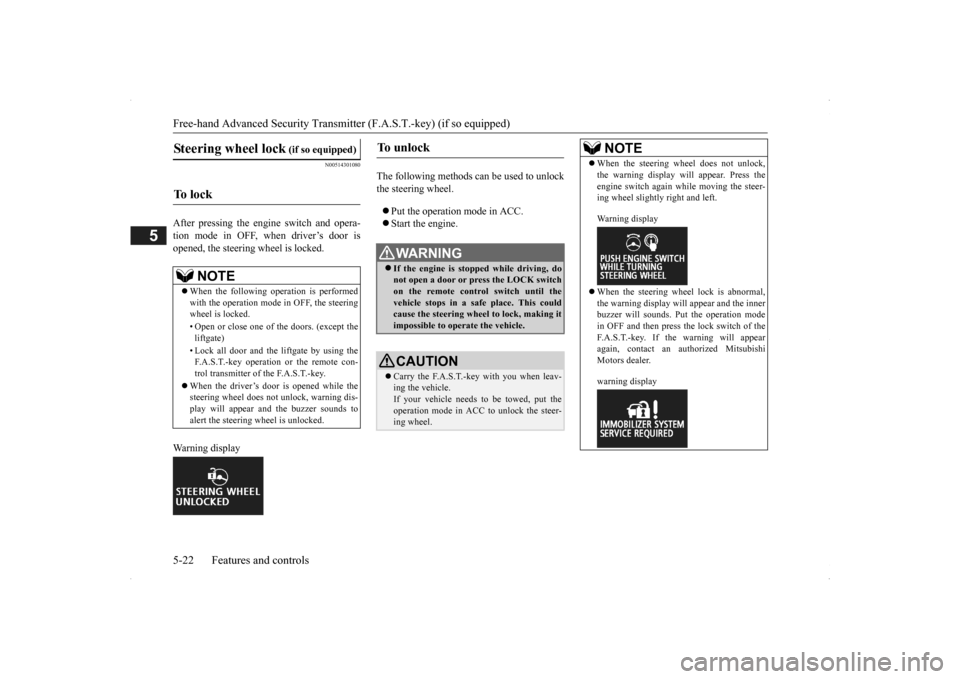
tion mode in OFF, when driver’s door isopened, the steering wheel is locked. Warning display
The following methods ca
n be used to unlock
the steering wheel. Put the operation mode in ACC. Start the engine.
Steering wheel lock
(if so equipped)
To l o c k
NOTE
When the following ope
ration is performed
with the operation mode
in OFF, the steering
wheel is locked. • Open or close one of the doors. (except the liftgate) • Lock all door and the liftgate by using the F.A.S.T.-key operation or the remote con- trol transmitter of the F.A.S.T.-key.
When the driver’s door is opened while the steering wheel does not
unlock, warning dis-
play will appear and the buzzer sounds toalert the steering wheel is unlocked.
To u n l o c k
WA R N I N G If the engine is stopped while driving, do not open a door or press the LOCK switch on the remote control switch until the vehicle stops in a safe
place. This could
cause the steering wheel to lock, making it impossible to operate the vehicle.CAUTION Carry the F.A.S.T.-key with you when leav- ing the vehicle.If your vehicle needs to
be towed, put the
operation mode in ACC to unlock the steer- ing wheel.
NOTE
When the steering wheel does not unlock, the warning display wi
ll appear. Press the
engine switch again wh
ile moving the steer-
ing wheel slightly right and left. Warning display When the steering wheel lock is abnormal, the warning display will
appear and the inner
buzzer will sounds. Put the operation mode in OFF and then press the lock switch of theF.A.S.T.-key. If the warning will appear again, contact an authorized Mitsubishi Motors dealer. warning display
BK0200500US.book 22 ページ 2013年2月12日 火曜日 午前9時46分
Page 101 of 451
Free-hand Advanced Securi
ty Transmitter (F.A.S.T.-key) (if so equipped)
Features and controls 5-23
5
N00514601285
The operation mode can be in any mode to start the engine.
The starter motor will be turning for up to approximately 15 seconds if the engineswitch is released at once. Pressing the engine switch again while the starter motor is still turning will stop the startermotor. The starter motor will be turning for up to approximately 30 se
conds while the
engine switch is pressed. If the engine does not start, wait for a while and then attempt to start the engine again. Trying repeatedly with the engine or starter motor still turning will damagethe starter mechanism. If the engine will not start because the bat- tery is weak or discharged, refer to“Jump-starting the engine” on page 8-2 for instructions. A longer warm up period will only con- sume extra fuel. The engine is warmed up enough for driv- ing when the bar graph of engine coolanttemperature display starts to move or the low coolant temperature indicator goes out. Refer to “Engine
coolant temperature
display” on page 5-128 or “Low coolant temperature indica
tor” on page 5-166.
Your vehicle is equipped with an electroni- cally controlled fuel injection system. This system automatically controls fuel injection.There is no need to depress the accelerator pedal when starting the engine. To prevent battery drai
n, wait a few seconds
between attempts to restart the engine. 1. Make sure all occupants are properly seated with seat belts fastened. 2. Make sure the parking brake is applied.3. Press and hold the brake pedal down with your right foot.
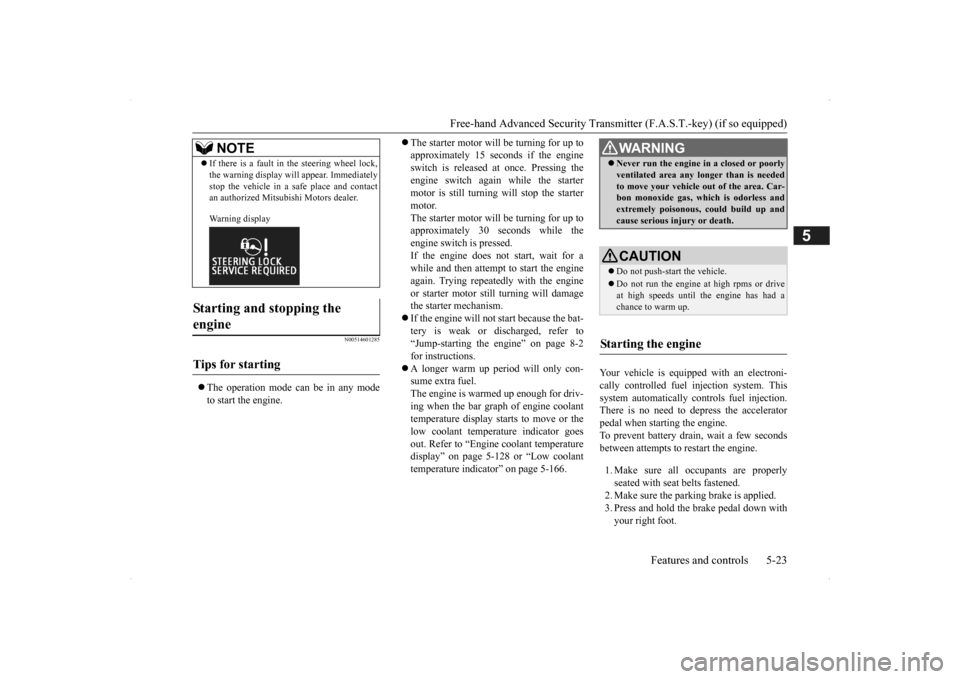
If there is a fault in the steering wheel lock, the warning display will
appear. Immediately
stop the vehicle in a sa
fe place and contact
an authorized Mitsubishi Motors dealer. Warning display
Starting and stopping the engine
Tips for starting
NOTE
WA R N I N G Never run the engine in
a closed or poorly
ventilated area any lo
nger than is needed
to move your vehicle out of the area. Car-bon monoxide gas, whic
h is odorless and
extremely poisonous, could build up and cause serious injury or death.CAUTION Do not push-start the vehicle.Do not run the engine at high rpms or drive at high speeds until the engine has had achance to warm up.
Starting the engine
BK0200500US.book 23 ページ 2013年2月12日 火曜日 午前9時46分
Page 102 of 451

Free-hand Advanced
Security Transmitter (F.A.S
.T.-key) (if so equipped)
5-24 Features and controls
5
4. Make sure the selector
lever is in the “P”
(PARK) position. 5. Press the engine switch. 6. Confirm that all warning lights and warn-ing displays are functioning properly.
After several attempts
, you may experience
that the engine still does not start. 1. Make sure that all electric devices, such as lights, air conditi
oning blower and rear
window defogger, are turned off.
2. While depressing the brake pedal, press the accelerator peda
l halfway and hold it
there, then crank th
e engine. Release the
accelerator pedal, immediately after the engine starts.3. If the engine still wi
ll not start, the engine
could be flooded with too much gasoline. While depressing the brake pedal, pushthe accelerator pedal all the way down and hold it there, then press the engine switch to crank the engine. If the engine does not start after 5 to 6 seconds, push the engine switch to stop cranking theengine, and release th
e accelerator pedal.
Put the operation mode in OFF. Wait a few seconds, and then press the engineswitch to crank the engine again while depressing the brake pedal, but do not push the accelerator pedal. If the enginefails to start, repeat these procedures. If the engine still will
not start, contact your
local Mitsubishi Motors dealer or a repairfacility of your choi
ce for assistance.
Startability of the en
gine with an ambient
temperature of -22 °F (-30 °C) or lower When the ambient temperature is -22 °F (-30°C) or lower, it may not be possible to start from a standstill even wi
th the selector lever
in the “D” (DRIVE) position.This phenomenon occurs because the trans- axle has not warmed up sufficiently; it does
not indicate a problem.
If this occurs, place
the selector lever in the “P” (PARK) positionand let the engine idle
for at least 10 minutes.
The transaxle will wa
rm up, and you will be
able to start normally.Do not leave the vehicle during warm-up operation. The MIVEC engine automatically switches its intake-valve contro
l between a low-speed
mode and a high-speed mode in accordancewith driving conditions for maximum engine performance.
NOTE
The engine can only be started when the selector lever is in the “P” (PARK) or “N” (NEUTRAL) position.For safety reasons,
the engine should be
started when the selector lever is in the “P” (PARK) position in which the driving wheelslock.NOTE
Minor noises may be he
ard on engine start-
up. These will disappear
as the engine warms
up.
When the engine is hard to start
Using the MIVEC engine
NOTE
To protect the engine, the high-speed mode may not be selected wh
ile the engine coolant
temperature is low. In such a case, the engine revolutions do not rise to over 5,000 rpm even if the accelerator pedal is depressed.
BK0200500US.book 24 ページ 2013年2月12日 火曜日 午前9時46分