light MITSUBISHI OUTLANDER 2014 3.G Owner's Manual
[x] Cancel search | Manufacturer: MITSUBISHI, Model Year: 2014, Model line: OUTLANDER, Model: MITSUBISHI OUTLANDER 2014 3.GPages: 451, PDF Size: 49.08 MB
Page 52 of 451
Child restraint systems
Seat and restraint systems 4-25
4
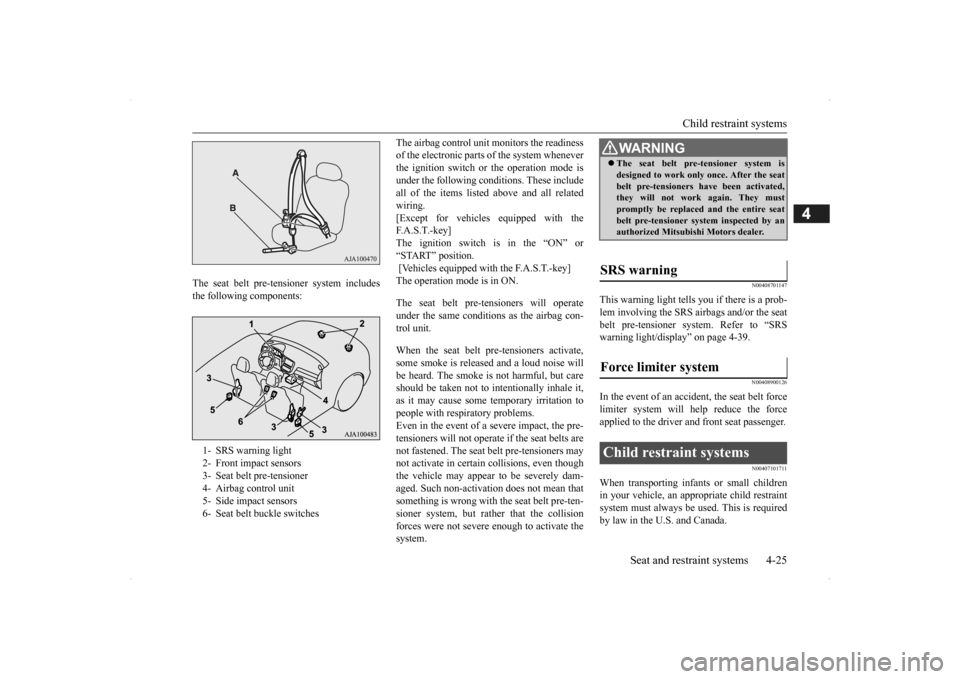
The seat belt pre-tensioner system includes the following components:
The airbag control unit
monitors the readiness
of the electronic parts of the system wheneverthe ignition switch or the operation mode is under the following conditions. These include all of the item
s listed above a
nd all related
wiring. [Except for vehicles equipped with the F. A . S . T. - k e y ]The ignition switch is in the “ON” or “START” position. [Vehicles equipped with the F.A.S.T.-key] The operation mode is in ON. The seat belt pre-tens
ioners will operate
under the same conditions
as the airbag con-
trol unit. When the seat belt pre-tensioners activate, some smoke is released
and a loud noise will
be heard. The smoke is
not harmful, but care
should be taken not to in
tentionally inhale it,
as it may cause some
temporary irritation to
people with respiratory problems.Even in the event of a severe impact, the pre- tensioners will
not operate if the seat belts are
not fastened. The seat be
lt pre-tensioners may
not activate in certai
n collisions, even though
the vehicle may appear
to be severely dam-
aged. Such non-activation does not mean thatsomething is wrong with the seat belt pre-ten- sioner system, but rather that the collision forces were not severe
enough to activate the
system.
N00408701147
This warning light tells you if there is a prob-lem involving the SRS airbags and/or the seat belt pre-tensioner system. Refer to “SRS warning light/display” on page 4-39.
N00408900126
In the event of an accident, the seat belt forcelimiter system will help reduce the forceapplied to the driver a
nd front seat passenger.
N00407101711
When transporting infants or small children in your vehicle, an appr
opriate child restraint
system must always be
used. This is required
by law in the U.S. and Canada.
1- SRS warning light 2- Front impact sensors 3- Seat belt
pre-tensioner
4- Airbag control unit 5- Side impact sensors 6- Seat belt
buckle switches
WA R N I N GThe seat belt pre-tensioner system is designed to work only
once. After the seat
belt pre-tensioners have been activated,they will not work again. They must promptly be replaced and the entire seat belt pre-tensioner system inspected by anauthorized Mitsubis
hi Motors dealer.
SRS warning Force limiter system Child restraint systems
BK0200500US.book 25 ページ 2013年2月12日 火曜日 午前9時46分
Page 64 of 451
Supplemental Restraint System (SRS) - airbag 4-36 Seat and restraint systems
4
N00407801532
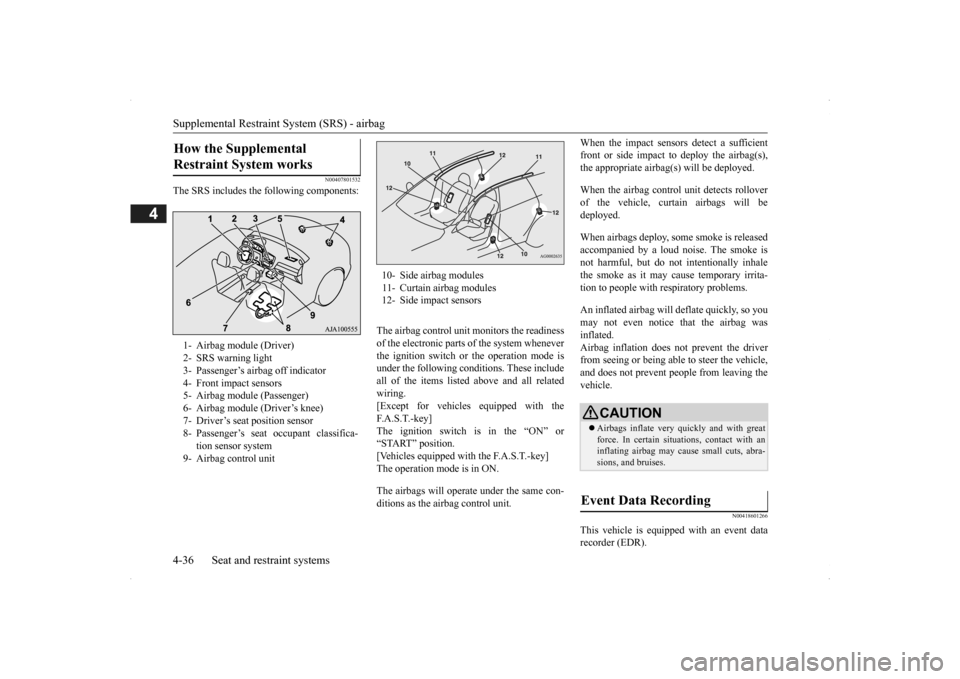
The SRS includes the following components:
The airbag control unit monitors the readiness of the electronic parts of the system whenever the ignition switch or the operation mode is under the following conditions. These include all of the items listed
above and all related
wiring.[Except for vehicles
equipped with the
F. A . S . T. - k e y ] The ignition switch is in the “ON” or“START” position. [Vehicles equipped with the F.A.S.T.-key] The operation mode is in ON. The airbags will opera
te under the same con-
ditions as the airbag control unit.
When the impact sensors detect a sufficient front or side impact to deploy the airbag(s),the appropriate airbag
(s) will be deployed.
When the airbag control unit detects rollover of the vehicle, curtain airbags will be deployed. When airbags deploy, so
me smoke is released
accompanied by a loud noise. The smoke is not harmful, but do not intentionally inhale the smoke as it may ca
use temporary irrita-
tion to people with respiratory problems. An inflated airbag will deflate quickly, so you may not even notice that the airbag wasinflated. Airbag inflation does not prevent the driver from seeing or being able to steer the vehicle,and does not prevent people from leaving the vehicle.
N00418601266
This vehicle is equipped with an event data recorder (EDR).
How the Supplemental Restraint System works 1- Airbag module (Driver) 2- SRS warning light 3- Passenger’s airbag off indicator 4- Front impact sensors5- Airbag module (Passenger) 6- Airbag module (Driver’s knee) 7- Driver’s seat position sensor8- Passenger’s seat oc
cupant classifica-
tion sensor system
9- Airbag control unit
10- Side airbag modules11- Curtain airbag modules12- Side impact sensors
CAUTION Airbags inflate very quickly and with great force. In certain situ
ations, contact with an
inflating airbag may cause small cuts, abra- sions, and bruises.
Event Data Recording
BK0200500US.book 36 ページ 2013年2月12日 火曜日 午前9時46分
Page 65 of 451
Supplemental Restraint System (SRS) - airbag
Seat and restraint systems 4-37
4
The main purpose of an EDR is to record, in certain crash or near
crash-like situations,
such as an airbag deployment or hitting a road obstacle, data that
will assist in under-
standing how a vehicl
e’s systems performed.
The EDR is designed to record data related to vehicle dynamics and safety systems for a short period of time,
typically 30 seconds or
less. The EDR in this vehicle is designed to record such data as: How various systems
in your vehicle were
operating; Whether or not the driver and front pas- senger safety belts we
re buckled/fastened;
How far (if at all) the driver was depress- ing the accelerator and/or brake pedal; and, How fast the vehicle was traveling.
These data can help provide a better under- standing of the circumstances in which crashes and injuries occur.
To read data recorded by an EDR, special equipment is required, and access to the vehi- cle or the EDR is needed. In addition to thevehicle manufacturer, ot
her parties, such as
law enforcement, that have the special equip- ment, can read the information if they haveaccess to the vehicle or the EDR.
N00417900177
The driver’s seat position sensor is attachedto the seat rail and provides the airbag control unit with information on the seat’s fore-aft position. The airbag control unit controlsdeployment of the driver’s front airbag in accordance with the information it receives from this sensor.If there is a problem involving the driver’s seat position sensor, the SRS warning light in
the instrument panel will come on. Refer to “SRS warning light/dis
play” on page 4-39.
N00418001374
The passenger’s seat oc
cupant classification
sensor system is attach
ed to the front passen-
ger seat cushion and provides the airbag con-trol unit with information regarding the occupant on the front passenger seat. The air-
NOTE
EDR data are recorded by your vehicle only if a non-trivial crash si
tuation occurs; no data
are recorded by the EDR under normal driv-ing conditions and no personal data (e.g., name, gender, age, a
nd crash location) are
recorded. However, ot
her parties, such as
law enforcement, could combine the EDR data with the type of
personally identifying
data routinely acquire
d during a crash inves-
tigation.
Driver’s seat position sensor
WA R N I N G If the SRS warning light or warning dis- play comes on, have the vehicle inspected by an authorized Mitsubishi Motors dealer as soon as possible. Please observe the following instructions to ensure that the driver’s seat positionsensor can operate correctly.• Adjust the seat to the correct position,and sit well back
against the seatback.
Refer to “Front seats” on page 4-4.• Do not recline the seatback more thannecessary when driving.• Do not place metallic objects or luggageunder the front seat.
If the vehicle is involved in a severe impact, have the SRS sensors inspected by an authorized
Mitsubishi Motors dealer as
soon as possible.
Passenger’s seat occupant clas- sification sensor system
BK0200500US.book 37 ページ 2013年2月12日 火曜日 午前9時46分
Page 66 of 451
Supplemental Restraint System (SRS) - airbag 4-38 Seat and restraint systems
4
bag control unit controls deployment of the passenger’s front airbag in accordance withthe information it receives from this system. The passenger’s front airbag will not deploy in an impact when the system senses no occu-pant on the front passenger’s seat or a child in a child restraint system. In this case, the pas- senger airbag off indi
cator will come on.
Refer to “Passenger’s ai
rbag off indicator” on
page 4-38. If there is a problem involving the passen- ger’s seat occupant cl
assification sensor sys-
tem, the SRS warning light in the instrumentpanel will come on. Refer to “SRS warning light/display” on page 4-39.
N00418101333
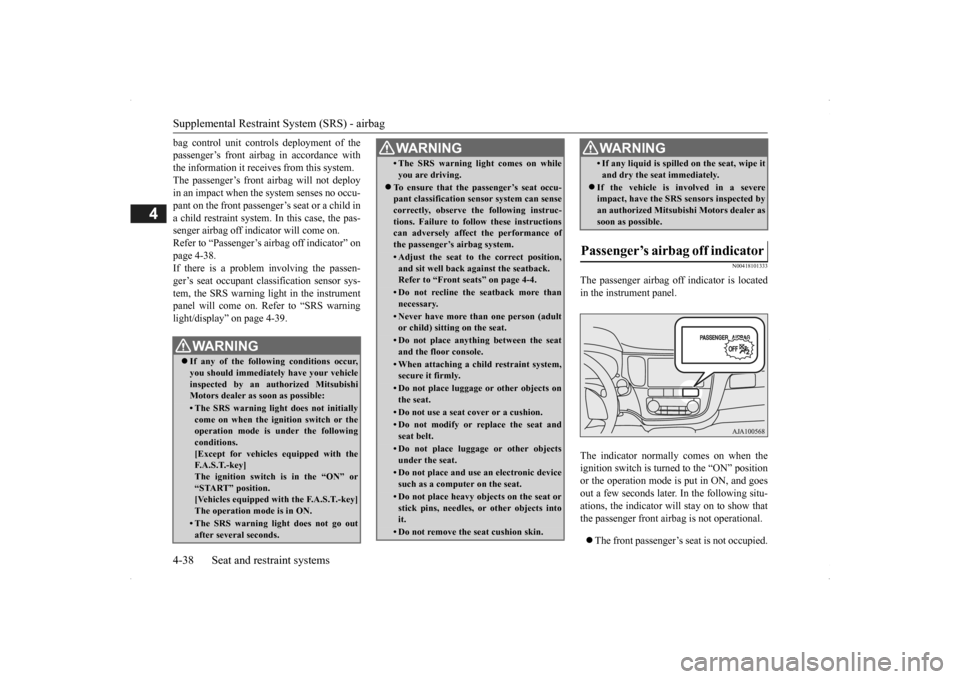
The passenger airbag off indicator is located in the instrument panel. The indicator normally comes on when the ignition switch is turned to the “ON” position or the operation mode is put in ON, and goes out a few seconds later.
In the following situ-
ations, the indicator will stay on to show that the passenger front airb
ag is not operational.
The front passenger’s seat is not occupied.
WA R N I N GIf any of the follow
ing conditions occur,
you should immediatel
y have your vehicle
inspected by an au
thorized Mitsubishi
Motors dealer as soon as possible:• The SRS warning light does not initiallycome on when the ignition switch or the operation mode is under the followingconditions. [Except for vehicles equipped with the F. A . S . T. - k e y ]The ignition switch is in the “ON” or “START” position. [Vehicles equipped with the F.A.S.T.-key]The operation mode is in ON.• The SRS warning light does not go outafter several seconds.
• The SRS warning li
ght comes on while
you are driving.
To ensure that the passenger’s seat occu- pant classification sensor system can sense correctly, observe the following instruc-tions. Failure to follow these instructions can adversely affect
the performance of
the passenger’s airbag system.• Adjust the seat to the correct position,and sit well back
against the seatback.
Refer to “Front seats” on page 4-4.• Do not recline the seatback more thannecessary.• Never have more th
an one person (adult
or child) sitting on the seat.• Do not place anything between the seatand the floor console.• When attaching a child restraint system,secure it firmly.• Do not place luggage or other objects onthe seat.• Do not use a seat cover or a cushion.• Do not modify or re
place the seat and
seat belt.• Do not place luggage or other objectsunder the seat.• Do not place and use
an electronic device
such as a computer on the seat.• Do not place heavy obje
cts on the seat or
stick pins, needles, or other objects intoit.• Do not remove the seat cushion skin.WA R N I N G
• If any liquid is spilled on the seat, wipe itand dry the seat immediately.
If the vehicle is involved in a severe impact, have the SRS sensors inspected by an authorized
Mitsubishi Motors dealer as
soon as possible.
Passenger’s airbag off indicator
WA R N I N G
BK0200500US.book 38 ページ 2013年2月12日 火曜日 午前9時46分
Page 67 of 451
Supplemental Restraint System (SRS) - airbag
Seat and restraint systems 4-39
4
The system senses that a child is using a child restraint system
on the front passen-
ger’s seat.
When the passenger’s se
at occupant classifi-
cation sensor system sense there is a person seated in the front passenger’s seat, the indi-cator goes out to show that the passenger’s front airbag is operational.
N00408301589
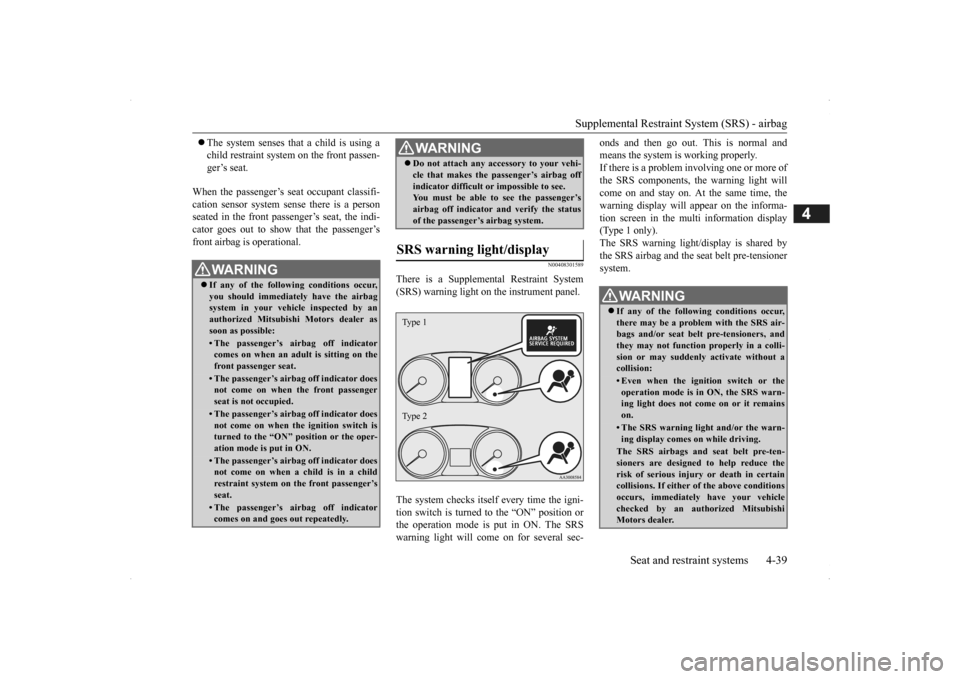
There is a Supplemen
tal Restraint System
(SRS) warning light on the instrument panel. The system checks itself every time the igni- tion switch is turned to the “ON” position orthe operation mode is put in ON. The SRS warning light will come on for several sec-
onds and then go out. This is normal and means the system is working properly.If there is a problem
involving one or more of
the SRS components, the warning light will come on and stay on. At
the same time, the
warning display will appear on the informa- tion screen in the multi information display (Type 1 only).The SRS warning light/display is shared by the SRS airbag and the se
at belt pre-tensioner
system.
WA R N I N G If any of the following conditions occur, you should immediat
ely have the airbag
system in your vehicle inspected by anauthorized Mitsubishi
Motors dealer as
soon as possible:• The passenger’s airbag off indicatorcomes on when an adul
t is sitting on the
front passenger seat.• The passenger’s airbag off indicator doesnot come on when the front passengerseat is not occupied.• The passenger’s airbag off indicator doesnot come on when the ignition switch is turned to the “ON” position or the oper- ation mode is put in ON.• The passenger’s airbag off indicator doesnot come on when a
child is in a child
restraint system on the front passenger’s seat.• The passenger’s airbag off indicatorcomes on and goes out repeatedly.
Do not attach any accessory to your vehi- cle that makes the passenger’s airbag offindicator difficult or
impossible to see.
You must be able to see the passenger’s airbag off indicator an
d verify the status
of the passenger’s airbag system.
SRS warning light/display
WA R N I N G
Type 1 Type 2
WA R N I N G If any of the following conditions occur, there may be a problem with the SRS air- bags and/or seat belt
pre-tensioners, and
they may not function
properly in a colli-
sion or may suddenly
activate without a
collision:•Even when the igniti
on switch or the
operation mode is in ON, the SRS warn- ing light does not come on or it remainson.• The SRS warning light and/or the warn-ing display comes
on while driving.
The SRS airbags and
seat belt pre-ten-
sioners are designed to help reduce the risk of serious injury
or death in certain
collisions. If either of the above conditionsoccurs, immediately
have your vehicle
checked by an auth
orized Mitsubishi
Motors dealer.
BK0200500US.book 39 ページ 2013年2月12日 火曜日 午前9時46分
Page 79 of 451
5
Features and controlsBreak-in recommendations ...............................................................5-3 Keys ..................................................................................................5-3 Electronic immobilizer (Anti-theft starting system) .........................5-4Keyless entry system (if so equipped) ..............................................5-7 Free-hand Advanced Security Tr
ansmitter (F.A.S.T.-key) (if so
equipped).....................................................................................5-12Door locks.......................................................................................5-32 Power door locks .......
...........
...........
...........
...........
...........
.........
.....5-34
Child safety locks for rear door ...........
...........
.........
.........
.........
.....5-35
Liftgate (except for vehi
cles equipped with the
power liftgate) .....5-35
Power liftgate (if so equipped) .......................................................5-37 Inside liftgate release .....................................................................5-43Theft-alarm system .........................................................................5-44 Power window control ....................................................................5-48 Sunroof (if so equipped) .................................................................5-50Parking brake ..................................................................................5-52 Steering wheel height and reach adjustment...................................5-53 Inside rearview mirror ....................................................................5-54Outside rearview mirrors ................................................................5-55 Ignition switch ................................................................................5-56 Steering wheel lock (if so equipped) ..............................................5-58Starting the engine ..........................................................................5-58 Automatic transaxle (if so equipped)..............................................5-60 Continuously variable transmission
(CVT) (if so equipped)..........5-68
Electronically controlled
4WD system (if so equipped).................5-75
S-AWC (Super-All Wheel Control) (if
so equipped) .....................5-78
4-wheel drive operation ..................................................................5-81Inspection and maintenance followi
ng rough road operation.........5-83
Cautions on the handling of 4-wheel dr
ive vehicles ...................... 5-83
Service brake .................................................................................. 5-84 Hill start assist (if so equipped) ...................................................... 5-85Brake assist system ......................................................................... 5-86 Anti-lock braking system ............................................................... 5-87 Electric power steering system (EPS) ............................................ 5-89Active stability control (ASC) ........................................................ 5-90 Cruise control ................................................................................. 5-92 Adaptive Cruise Control System (ACC) (if so equipped) .............. 5-96Forward Collision Mitigation System
(FCM) (if so equipped) .... 5-107
Lane Departure Warning System (LDW
) (if so equipped)........... 5-111
Tire pressure monitoring system .................................................. 5-114Rear-view camera (if so equipped)............................................... 5-118 Instrument cluster ......................................................................... 5-120 Multi Information display - Type 1 .............................................. 5-121Multi Information display - Type 2 .............................................. 5-140 Indicator light, warning light, and
information screen display list
(multi information display - Type 1) ....................................... 5-148Indicator and warning light package
(multi information display - Type
2) ............................................................................................... 5-165 Indicators ...................................................................................... 5-166Warning lights............................................................................... 5-167 Information screen display (Vehicle equipped with the multi informa- tion display - Type 1) ............................................................... 5-169Combination headlights and dimmer switch ............................... 5-171 Headlight leveling switch (if so equipped)................................... 5-176 Turn signal lever ........................................................................... 5-176Hazard warning flasher switch ..................................................... 5-177
BK0200500US.book 1 ページ 2013年2月12日 火曜日 午前9時46分
Page 80 of 451
5
Features and controlsECO mode switch......................................................................... 5-178 Front fog light switch (if so equipped) ......................................... 5-178 Wiper and washer switch ............................................................ 5-179Electric rear window def
ogger switch.........
...........
.........
............. 5-184
Horn switch .................................................................................. 5-184 Link System (if so equipped) ....................................................... 5-185 Bluetooth
® 2.0 interface (if so equipped) .................................... 5-185
USB input terminal (if so equipped) ............................................ 5-207 Sun visors ..................................................................................... 5-21012 V power outlets ....................................................................... 5-211 Interior lights ................................................................................ 5-212 Storage spaces .............................................................................. 5-215Cup holders .................................................................................. 5-218 Bottle holders ............................................................................... 5-219 Cargo area cover (if so equipped) ................................................ 5-219Assist grips ................................................................................... 5-221 Coat hooks .................................................................................... 5-222 Luggage hooks ............................................................................. 5-222BK0200500US.book 2 ページ 2013年2月12日 火曜日 午前9時46分
Page 81 of 451
Break-in recommendations
Features and controls 5-3
5
N00508701353
Advanced automobile
manufacturing tech-
niques permit you to operate your new vehi- cle without requiring a long break-in periodof low-speed driving. However, you can add to the future perfor- mance and economy of your vehicle byobserving the following precautions during the first 300 miles (500 km). Drive your vehicle at m
oderate speeds during
the break-in period. Avoid revving the engine. Avoid rough driving such as sudden starts, sudden accelerati
on, prolonged high-
speed driving and sudden braking. These actions would have a detrimental effect onthe engine and lead to increased fuel and oil consumption; th
is could ultimately
result in the malfunction of engine com-ponents. Be particularly careful to avoid full acceleration while in low shift posi- tion (low gears). Do not overload the vehicle. Stay within the seating capacity. (Refer to “Cargo load precautions” on page 6-10.)Do not overload the vehicle. Stay within the seating capacity. (Refer to “Cargo load precautions” on page 6-11.)
Refrain from towing a trailer or other vehicle (Refer to “Trailer towing” on page6-11).
N00508801628
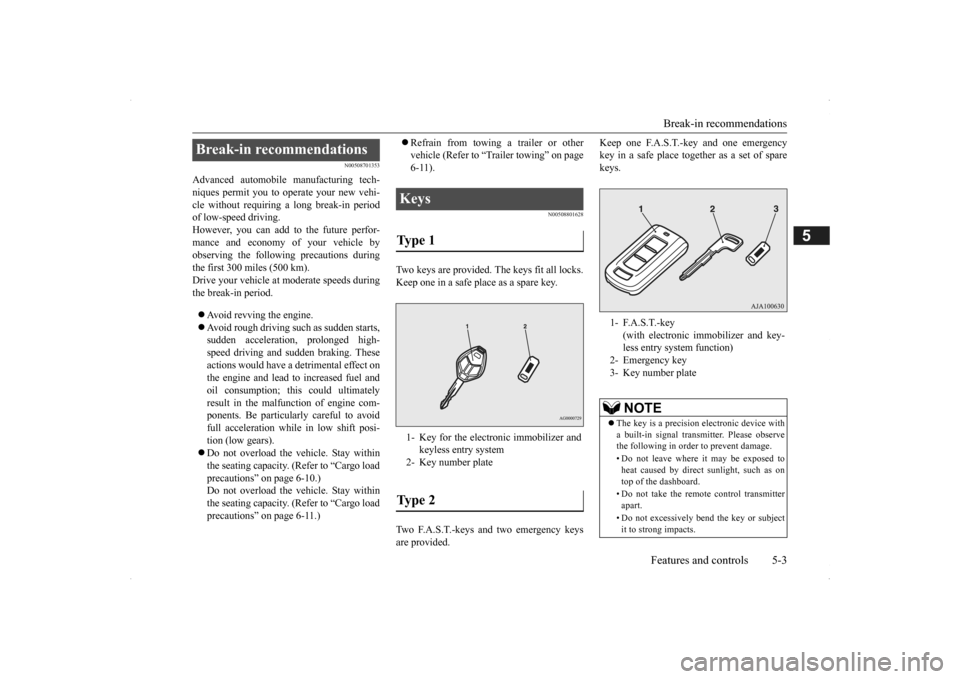
Two keys are provided. The keys fit all locks. Keep one in a safe place as a spare key. Two F.A.S.T.-keys and two emergency keys are provided.
Keep one F.A.S.T.-key and one emergency key in a safe pl
ace together as a set of spare
keys.
Break-in recommendations
Keys Ty p e 1 1- Key for the electronic immobilizer and
keyless entry system
2- Key number plateTy p e 2
1- F.A.S.T.-key
(with electronic im
mobilizer and key-
less entry system function)
2- Emergency key 3- Key number plate
NOTE
The key is a precision
electronic device with
a built-in signal transm
itter. Please observe
the following in order to prevent damage. • Do not leave where it may be exposed to heat caused by direct
sunlight, such as on
top of the dashboard. • Do not take the remote
control transmitter
apart. • Do not excessively bend the key or subject it to strong impacts.
BK0200500US.book 3 ページ 2013年2月12日 火曜日 午前9時46分
Page 85 of 451
Keyless entry system (if so equipped)
Features and controls 5-7
5
N00562301094
Your electronic immo
bilizer operates on a
radio frequency subject to Federal Communi- cations Commission (FCC)
Rules (For vehi-
cles sold in U.S.A.
) and Industry Canada
Rules (For vehicles so
ld in Canada). This
device complies with part 15 of FCC Rulesand Industry Canada
licence-exempt RSS
standard(s). Operation is subject to the following two con- ditions. This device may not
cause harmful inter-
ference. This device must ac
cept any interference
received, including interference that may cause undesired operation.
N00509001920
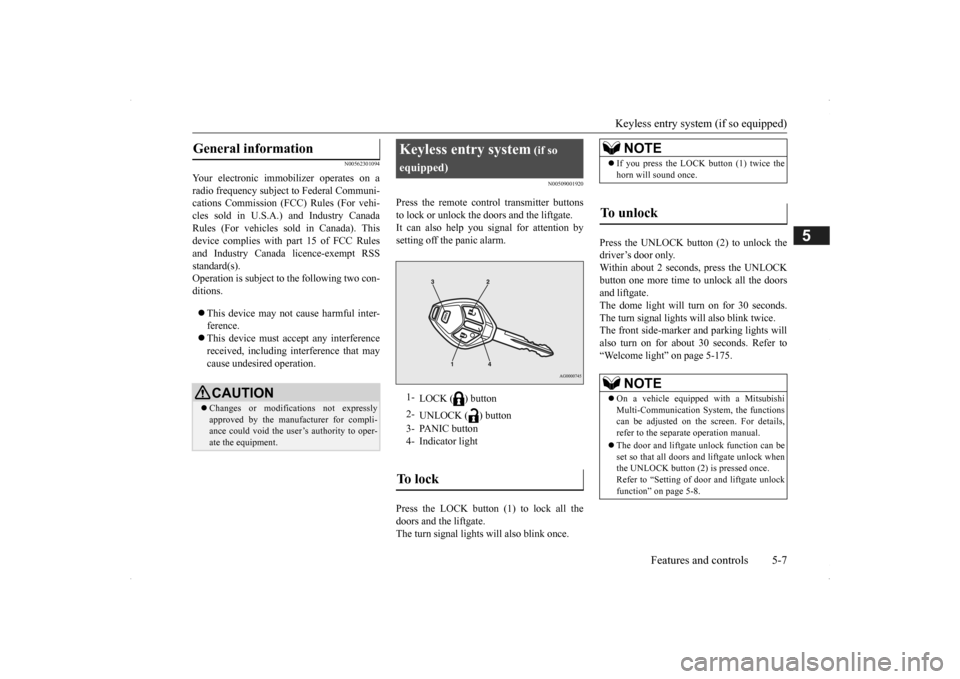
Press the remote control transmitter buttonsto lock or unlock the doors and the liftgate.It can also help you signal for attention by setting off the panic alarm. Press the LOCK button (1) to lock all the doors and the liftgate. The turn signal lights will also blink once.
Press the UNLOCK button (2) to unlock the driver’s door only.Within about 2 seconds, press the UNLOCK button one more time to unlock all the doors and liftgate.The dome light will turn on for 30 seconds. The turn signal lights will also blink twice. The front side-marker
and parking lights will
also turn on for about 30 seconds. Refer to “Welcome light” on page 5-175.
General information
CAUTION Changes or modifica
tions not expressly
approved by the manufacturer for compli- ance could void the user’s authority to oper-ate the equipment.
Keyless entry system
(if so
equipped)1-
LOCK ( ) button
2-
UNLOCK ( ) button
3- PANIC button 4- Indicator lightTo l o c k
NOTE
If you press the LOCK button (1) twice the horn will sound once.
To unlock
NOTE
On a vehicle equipped with a Mitsubishi Multi-Communication System, the functionscan be adjusted on the screen. For details, refer to the separa
te operation manual.
The door and liftgate unlock function can be set so that all doors and liftgate unlock when the UNLOCK button (2) is pressed once. Refer to “Setting of door
and liftgate unlock
function” on page 5-8.
BK0200500US.book 7 ページ 2013年2月12日 火曜日 午前9時46分
Page 86 of 451
Keyless entry system (if so equipped) 5-8 Features and controls
5
The horn and turn signal lights of the keyless entry system answerback function can be changed as required. This is done with thekey removed from the ignition switch. The answerback function can be set in the following three ways. Each time the answerba
ck function is set, a
chime will sound to tell you the condition of the answerback function. 1. Remove the key from
the ignition switch.
2. Open the driver’s door and turn the com-bination headlights and dimmer switch to the “OFF” position.
3. Press the LOCK button (1) for 4 to 10 sec- onds and press the UNLOCK button (2)during this time. 4. Release in sequence the UNLOCK and LOCK buttons within 5 seconds of press-ing the UNLOCK button in step 3.
The answerback function can be turned ON or OFF separately. 1. Remove the key from the ignition switch. 2. Open the driver’s door and turn the com- bination headlights and dimmer switch tothe “OFF” position. 3. Press the UNLOCK button (2) for 4 to 10 seconds and press the LOCK button (1)during this time.
4. Release in sequence the UNLOCK and LOCK buttons within 5 seconds of press-ing the LOCK button in step 3.
N00543601115
The door and liftgate
unlock function can be
set to the following two conditions. Each time the door and
liftgate unlock func-
tion is set, a chime wi
ll sound to tell you the
Answerback function
NOTE
The answerback functi
on will not operate if
any of the doors are open.
Horn deactivation/reactivation
One chime: The horn will not sound. Two chimes: The horn will sound. Four chimes: The hor
n will sound if the
LOCK button is pressed twice within 1 second.
NOTE
On a vehicle equippe
d with a Mitsubishi
Multi-Communication System, the functions can be adjusted on the screen. For details, refer to the separa
te operation manual.
Turn signal lights deactiva- tion/reactivation
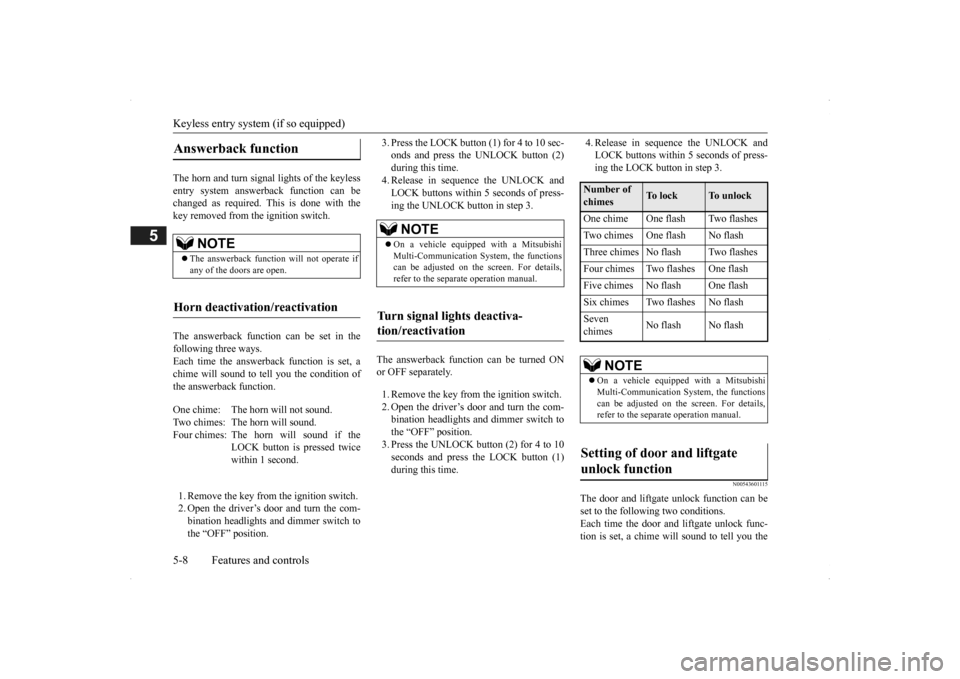
Number of chimes
To l o c k
To u n l o c k
One chime One flash Two flashes Two chimes One flash No flash Three chimes No flash Two flashes Four chimes Two flashes One flash Five chimes No flash One flash Six chimes Two flashes No flash Seven chimes
No flash No flash
NOTE
On a vehicle equippe
d with a Mitsubishi
Multi-Communication System, the functionscan be adjusted on the screen. For details, refer to the separate operation manual.
Setting of door and liftgate unlock function
BK0200500US.book 8 ページ 2013年2月12日 火曜日 午前9時46分