fuel MITSUBISHI OUTLANDER 2014 3.G Workshop Manual
[x] Cancel search | Manufacturer: MITSUBISHI, Model Year: 2014, Model line: OUTLANDER, Model: MITSUBISHI OUTLANDER 2014 3.GPages: 451, PDF Size: 49.08 MB
Page 391 of 451

Engine oil and oil filter
Vehicle care and maintenance 9-7
9
Mitsubishi Motors re
commends using only
engine oils with the ILSAC certification sym- bol on the front of the container. If you cannot find oils
with the ILSAC certi-
fication symbol, use an
API classification SN
oil with the following label. This mark appears on the top of the oil con-tainer and tells you two important things about the oil.
Use engine oil with the proper thickness for the outdoor temperatures where you will bedriving.
SAE 0W-20 engine oil is strongly recom- mended for optimum fuel economy and coldstarting. If SAE 0W-20 is not available, the ILSAC certification oil of othe
r viscosity grades can
be temporarily used. The oil filter should be replaced at the time or mileage specified in the “WARRANTY AND MAINTENANCE MANUAL”. Only use high quality replacement filters onthis vehicle. The manufacturer’s specifica- tions for Mitsubishi Mo
tors Genuine oil fil-
ters require that the
filter can withstand a
pressure of 256 psi (1.8 MPa). A Mitsubishi Motors Genuine oil filter is the best replace- ment filter.
Engine oil identification mark ILSAC certification symbol
1- The upper part indi
cates the quality of
the oil.
2- The center part i
ndicates the SAE grade
of the oil viscosity.
Recommended engine oil vis- cosity API service symbol
To replace the oil filter
BK0200500US.book 7 ページ 2013年2月12日 火曜日 午前9時46分
Page 402 of 451
Tires 9-18 Vehicle care and maintenance
9
The temperature grades are A (the highest), B and C, representing the tire’s resistance to thegeneration of heat and
its ability to dissipate
heat when tested under controlled conditions on a specified indoor la
boratory test wheel.
Sustained high temper
ature can cause the
material of the tire to
degenerate and reduce
tire life, and excessive temperature can leadto sudden tire failure. The grade C corre- sponds to a level of performance which all passenger car tires must meet under the Fed- eral Motor Vehicle Safety Standard No. 109. Grades B and A represent higher levels ofperformance on the labora
tory test wheel than
the minimum required by law.
N00939300815
Proper tire inflation pres
sure is essential for
the safe and satisfactory operation of your vehicle. The wrong tire
pressure will cause
problems in three major areas: Safety Too little pressure increases flexing in the tire and can cause tire failure. Too muchpressure can cause a tire to lose its ability to cushion shock. Objects on the road and potholes could then cause tire damage thatmay result in tire failure.
Economy The wrong tire pressu
re can cause uneven
wear patterns in the tire tread. These abnormal wear patter
ns will reduce the
tread life, and the tire will have to bereplaced sooner. Too little pressure also
makes it harder for
the tire to roll, and this uses up more fuel. Ride comfort and vehicle stability The superior riding e
xperience built into
your vehicle partly depends on the correct tire pressure. Too much pressure gives an uncomfortable and ja
rring ride. Too little
pressure feels as if
your vehicle is slow to
respond. Unequal tire pressure
s can make steering
your vehicle uneven and unpredictable.
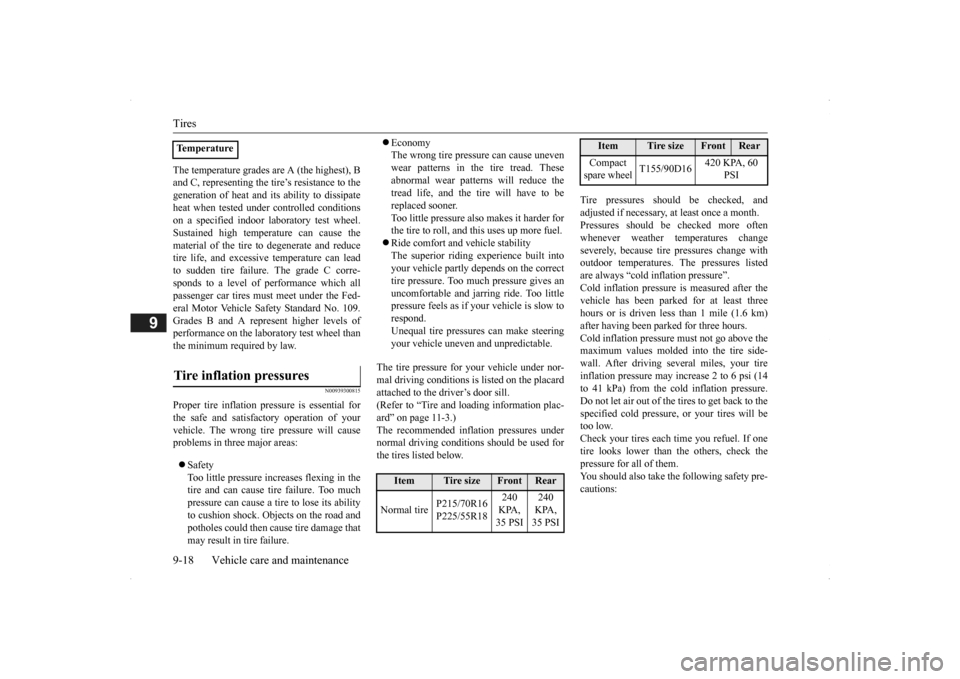
The tire pressure for your vehicle under nor- mal driving conditions is listed on the placard attached to the driver’s door sill.(Refer to “Tire and loading information plac- ard” on page 11-3.) The recommended infl
ation pressures under
normal driving conditions should be used for the tires listed below.
Tire pressures should be checked, and adjusted if necessary, at least once a month.Pressures should be checked more often whenever weather temperatures change severely, becaus
e tire pressures change with
outdoor temperatures. The pressures listed are always “cold in
flation pressure”.
Cold inflation pressure is measured after thevehicle has been parked
for at least three
hours or is driven less than 1 mile (1.6 km) after having been parked for three hours. Cold inflation pressure must not go above the maximum values molded into the tire side-wall. After driving seve
ral miles, your tire
inflation pressure may increase 2 to 6 psi (14 to 41 kPa) from the cold inflation pressure.Do not let air out of the tires to get back to the specified cold pressure, or your tires will be too low.Check your tires each time you refuel. If one tire looks lower than the others, check the pressure for all of them.You should also take the following safety pre- cautions:
TemperatureTire inflation pressures
Item
Tire size
Front
Rear
Normal tire
P215/70R16 P225/55R18
240 KPA, 35 PSI
240 KPA, 35 PSI
Compact spare wheel
T155/90D16
420 KPA, 60
PSI
Item
Tire size
Front
Rear
BK0200500US.book 18 ページ 2013年2月12日 火曜日 午前9時46分
Page 406 of 451
Emission-control system maintenance 9-22 Vehicle care and maintenance
9
detergent or non-abrasive
cleaner to clean the
blades and glass areas.Replace the blades if th
ey continue to streak
or smear. If the blades are frozen to the windshield or rear window, do not operate the wipers until the ice has melted and the blades are freed,otherwise the wiper mo
tor may be damaged.
N00940800328
Your vehicle is equi
pped with an emission-
control system that me
ets all the requirements
of the U.S. Environmental Protection Agency and Environment Cana
da. The emission-con-
trol system is made of: a positive crankcase ventilation system an evaporative emission-control system an exhaust emission-control system
To be sure the emissi
on-control system works
properly, have your ve
hicle inspected and
maintained by an authorized Mitsubishi Motors dealer or a repair facility of your choice. This should be done at the time ormileage specified in the “WARRANTY AND MAINTENANCE MANUAL”. These, and all the other “general” mainte-nance services listed in this manual, need to be performed to keep
your vehicle running
properly and reliably. You should also have
an inspection and ser-
vice any time you suspect a malfunction.
N00940900231
Spark plugs must fire properly to ensure proper engine perfo
rmance and emission-
control.Do not reuse spark plugs by cleaning or regapping. Spark plugs sh
ould be replaced at
the mileage specified in the “WARRANTYAND MAINTENANCE MANUAL”.
N00941000040
Check the hose surfaces for any heat and mechanical damage, ha
rd and brittle rubber,
cracking, tears, cuts and abrasions. Pay spe-cial attention to the hos
es closest to high heat
sources such as the exhaust manifold. Check all the hose connections, such as clamps andcouplings, to make sure they are secure and that there are no leaks. If you see any wear or damage, replace the hoses immediately.
NOTE
Do not run the wipers on dry glass for a long time. This wears out
the rubber and can
scratch the glass.
During cold weather Emission-control system maintenance
NOTE
To meet government
regulations and pro-
mote cleaner air, your
vehicle is equipped
with an onboard diagnostic system (OBD).The engine electroni
c control module that
controls OBD functions
stores various data
(especially about th
e exhaust emissions).
This data will be erased if the battery cable is disconnected, which c
ould make a rapid
diagnosis difficult.
Do not disconnect the
battery cable when the engine malfunction indicator (“SERVIC
E ENGINE SOON” or
“Check engine light”) is ON.
Spark plugs
NOTE
Use the recommended or
equivalent spark
plugs listed under “Engine specifications” onpage 11-6. Use of other plugs could cause engine damage, loss of
performance or radio
noise.
Fuel hoses
BK0200500US.book 22 ページ 2013年2月12日 火曜日 午前9時46分
Page 407 of 451
General maintenance
Vehicle care and maintenance 9-23
9
N00950100050
Have the valve clea
rance checked at an
authorized Mitsubishi Motors dealer at the mileage specified in the “WARRANTY ANDMAINTENANCE MANUAL”. If the engine sounds abnormally loud, have adjustments made by an authorizedMitsubishi Motors dealer.
N00941300173
Check these regularly for damage or leaks inthe fuel lines and connections. Check the fuel tank filler cap for dama
ge or looseness. Pay
special attention to the fuel lines closest tohigh heat sources such
as the exhaust mani-
fold.
N00941400187
If the fuel-vapor vent line is clogged or dam- aged, the fuel-vapor mixture will escape, pol- luting the air. Have the system checked at an authorizedMitsubishi Motors dealer at the mileage spec- ified in the “WARRANTY AND MAINTE- NANCE MANUAL”.
N00941501299
The next pages list th
e maintenance service
recommended by Mitsubishi Motors Corpo- ration. In addition to the general maintenance that needs to be performed at the times listed,there are other parts which do not usually need regular maintenance. But, if any of these parts stops working prop-erly, your vehicle performance could suffer. Have these items checked if you notice a problem with them. If you have any questions, see your autho- rized Mitsubishi Motors
dealer for assistance.
N00941600059
Good brakes are essential for safe driving. Check the brake pads for wear. For good braking performance, replace the brake padswith the same type pa
ds as the originals.
N00941700076
Brake hoses and tubing should be checked for: Severe surface cracki
ng, scuffing or worn
spots. If the fabric casing of the hose isshowing through any cracks or worn spots in the rubber hose cover, the hose should be replaced. The brakes can fail if thehose wears through. Improper installation may cause twisting, or wheel, tire or
chassis interference.
N00941800093
Check the following parts for damage and grease leaks: Ball joint boots of the suspension and steering linkage Bellows on both ends of the drive shaft
Intake valve clearance Fuel system (tank, pipe line and connection, and fuel tank filler cap)
WA R N I N G If you see a fuel leak
or if you smell fuel,
do not run the engine. Any spark (includ-ing from the ignition
), flame or smoking
material could cause an explosion or fire. Call an authorized Mitsubishi Motorsdealer or a repair fa
cility of your choice
for assistance.
Evaporative emission control system (except evaporative emission canister) General maintenance
Disc brake pads Brake hoses Ball joint, steering linkage seals, drive shaft boots
BK0200500US.book 23 ページ 2013年2月12日 火曜日 午前9時46分
Page 411 of 451
Fuses
Vehicle care and maintenance 9-27
9
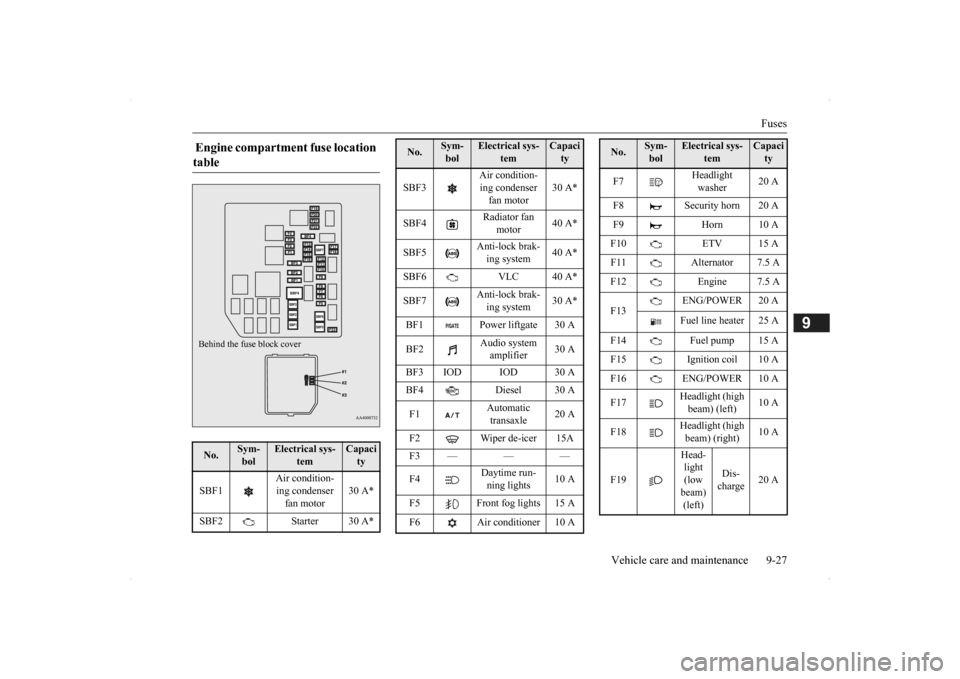
Engine compartment fuse location table No.
Sym- bol
Electrical sys-
tem
Capacity
SBF1
Air condition- ing condenser fan motor
30 A*
SBF2 Starter 30 A*Behind the fuse block cover
SBF3
Air condition- ing condenser fan motor
30 A*
SBF4
Radiator fan
motor
40 A*
SBF5
Anti-lock brak- ing system
40 A*
SBF6 VLC 40 A* SBF7
Anti-lock brak- ing system
30 A*
BF1 Power liftgate 30 A BF2
Audio system amplifier
30 A
BF3 IOD IOD 30 A BF4 Diesel 30 A F1
Automatic transaxle
20 A
F2 Wiper de-icer 15A F3 — — — F4
Daytime run- ning lights
10 A
F5 Front fog lights 15 A F6 Air conditioner 10 ANo.
Sym- bol
Electrical sys-
tem
Capacity
F7
Headlight washer
20 A
F8 Security horn 20 A F9 Horn 10 AF10 ETV 15 A F11 Alternator 7.5 A F12 Engine 7.5 A F13
ENG/POWER 20 A Fuel line heater 25 A
F14 Fuel pump 15 A F15 Ignition coil 10 A F16 ENG/POWER 10 A F17
Headlight (high beam) (left)
10 A
F18
Headlight (high beam) (right)
10 A
F19
Head- light (low beam) (left)
Dis- charge
20 A
No.
Sym- bol
Electrical sys-
tem
Capacity
BK0200500US.book 27 ページ 2013年2月12日 火曜日 午前9時46分
Page 441 of 451

Tires and wheels
Specifications 11-7
11
N01147901744
PCD: Pitch Circle
Diameter (ins
tallation holes)
N01148002068
Tires and wheels Tire P215/70R16 99H P225/55R18 97HWheel
Size 16 x 6 1/2JJ 16 x 6 1/2J 18 x 7JPCD 4.5 in (114.3 mm)Offset 1.5 in (38 mm)
NOTE
Contact an authorized Mitsubishi
Motors dealer for de
tails on the combinati
on used on your vehicle.
These tires satisfy vehicle loading condi
tions described in
this owner’s manual.
Capacity
Item
Capacity
Lubricants
Fuel (approximate)
Front-wheel drive ve
hicles 16.6 gal (63 L)
Refer to “Fuel selection” on page 3-2
All-wheel drive vehicles 15.8 gal (60 L)
Engine oil
2.4 liter models
Oil pan 4.5 qt (4.3 L)
Engine oils displayi
ng the ILSAC certification mark (“star-
burst” symbol) on the container. If these oils are not available,
and API classification SN can be
used.
Oil filter .32 qt (0.3 L)
3.0 liter models
Oil pan 4.2 qt (4.0 L)Oil filter .32 qt (0.3 L)
Automatic transaxle 8.7 qt (8.2 L)
Mitsubishi Motors Genuine ATF - J3
Continuously variable transmissi
on (CVT) 7.5 qt (7.1 L) Mitsubishi Motors Genuine CVTF - J4
BK0200500US.book 7 ページ 2013年2月12日 火曜日 午前9時46分
Page 445 of 451
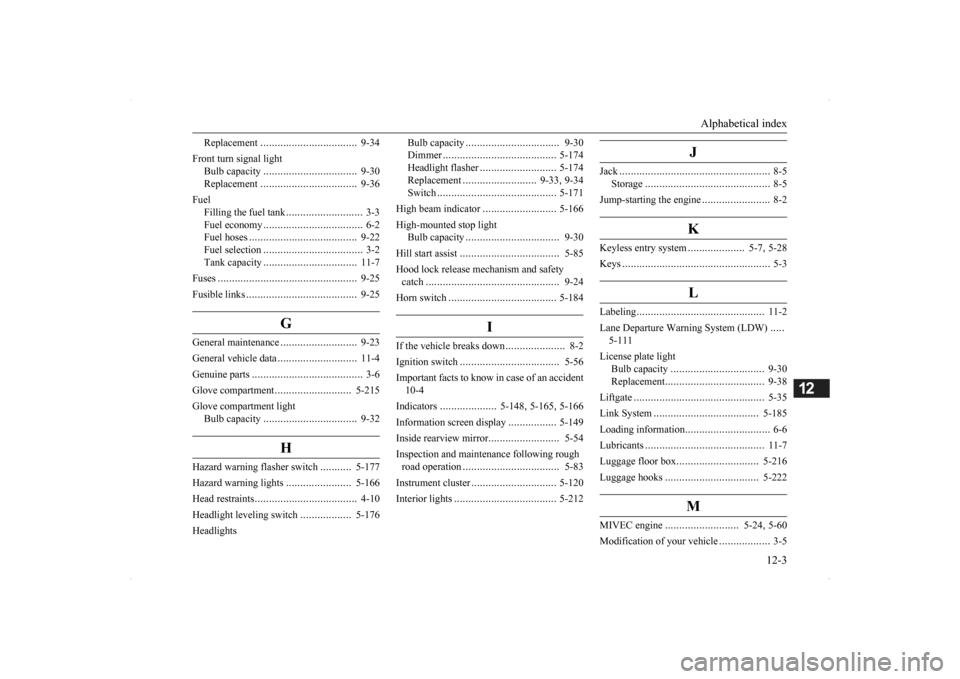
Alphabetical index
12-3
12
Replacement
..................................
9-34
Front turn signal light
Bulb capacity
.................................
9-30
Replacement
..................................
9-36
Fuel
Filling the fuel tank
...........................
3-3
Fuel economy
...................................
6-2
Fuel hoses
......................................
9-22
Fuel selection
...................................
3-2
Tank capacity
.................................
11-7
Fuses
.................................................
9-25
Fusible links
.......................................
9-25
G
General maintenance
...........................
9-23
General vehicle data
............................
11-4
Genuine parts
.......................................
3-6
Glove compartment
...........................
5-215
Glove compartment light
Bulb capacity
.................................
9-32
H
Hazard warning
flasher switch
...........
5-177
Hazard warning lights
.......................
5-166
Head restraints
....................................
4-10
Headlight leveling switch
..................
5-176
Headlights
Bulb capacity
.................................
9-30
Dimmer
........................................
5-174
Headlight flasher
...........................
5-174
Replacement
..........................
9-33
, 9-34
Switch
..........................................
5-171
High beam indicator
..........................
5-166
High-mounted stop light
Bulb capacity
.................................
9-30
Hill start assist
...................................
5-85
Hood lock release me
chanism and safety
catch
...............................................
9-24
Horn switch
......................................
5-184
I
If the vehicle breaks down
.....................
8-2
Ignition switch
...................................
5-56
Important facts to know in
case of an accident
10-4 Indicators
....................
5-148
, 5-165
, 5-166
Information screen display
.................
5-149
Inside rearview mirror
.........................
5-54
Inspection and maintena
nce following rough
road operation
..................................
5-83
Instrument cluster
..............................
5-120
Interior lights
....................................
5-212
J
Jack
.....................................................
8-5
Storage
............................................
8-5
Jump-starting the engine
........................
8-2
K
Keyless entry system
....................
5-7
, 5-28
Keys
....................................................
5-3
L
Labeling
.............................................
11-2
Lane Departure Warning System (LDW)
.....
5-111 License plate light
Bulb capacity
.................................
9-30
Replacement
...................................
9-38
Liftgate
..............................................
5-35
Link System
.....................................
5-185
Loading information
..............................
6-6
Lubricants
..........................................
11-7
Luggage floor box
.............................
5-216
Luggage hooks
.................................
5-222
M
MIVEC engine
..........................
5-24
, 5-60
Modification of your vehicle
..................
3-5
BK0200500US.book 3 ページ 2013年2月12日 火曜日 午前9時46分
Page 450 of 451
How to calculate your gasoline mileage
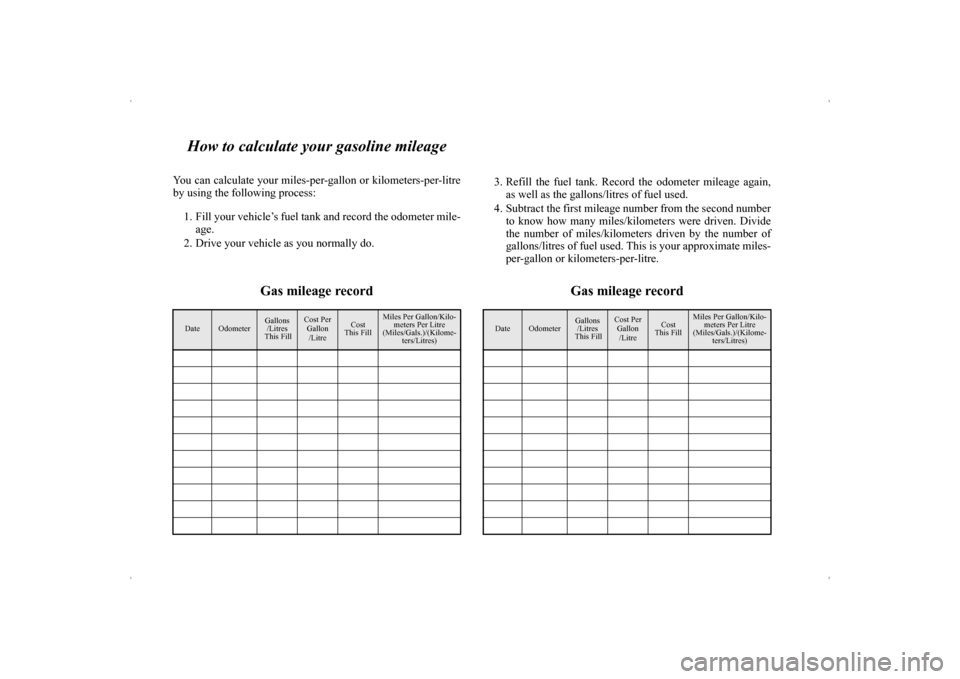
You can calculate your miles-per-gallon or kilometers-per-litre
by using the following process:
1. Fill your vehicle’s fuel tank and record the odometer mile-
age.
2. Drive your vehicle as you normally do.3. Refill the fuel tank. Record the odometer mileage again,
as well as the gallons/litres of fuel used.
4. Subtract the first mileage number from the second number
to know how many miles/kilometers were driven. Divide
the number of miles/kilometers driven by the number of
gallons/litres of fuel used. This is your approximate miles-
per-gallon or kilometers-per-litre.
Gas mileage record Gas mileage record
Date
Odometer
Gallons
/Litres
This Fill
Cost Per
Gallon
/Litre
Cost
This Fill
Miles Per Gallon/Kilo-
meters Per Litre
(Miles/Gals.)/(Kilome-
ters/Litres)
Date
Odometer
Gallons
/Litres
This Fill
Cost Per
Gallon
/Litre
Cost
This Fill
Miles Per Gallon/Kilo-
meters Per Litre
(Miles/Gals.)/(Kilome-
ters/Litres)
MMNA_LastPage.fm 1 ページ 2013年2月12日 火曜日 午前10時54分