airbag MITSUBISHI OUTLANDER 2014 3.G Owners Manual
[x] Cancel search | Manufacturer: MITSUBISHI, Model Year: 2014, Model line: OUTLANDER, Model: MITSUBISHI OUTLANDER 2014 3.GPages: 451, PDF Size: 49.08 MB
Page 3 of 451
Instruments and controls 1-1
1
Overview
N00100202557
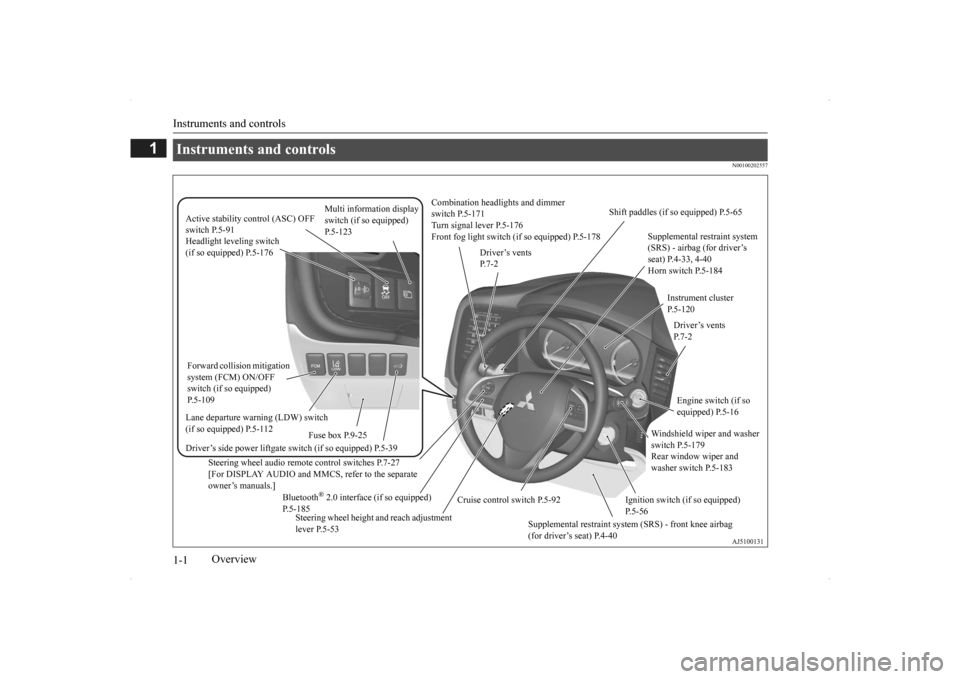
Instruments and controls
Combination headlights and dimmer switch P.5-171 Turn signal lever P.5-176 Front fog light switch (if so equipped) P.5-178
Steering wheel audio remote control switches P.7-27 [For DISPLAY AUDIO and MMCS, refer to the separateowner’s manuals.]
Active stability control (ASC) OFF switch P.5-91
Supplemental restraint system (SRS) - airbag (for driver’s seat) P.4-33, 4-40 Horn switch P.5-184
Instrument cluster P.5-120
Windshield wiper and washer switch P.5-179 Rear window wiper and washer switch P.5-183
Cruise control switch P.5-92
Steering wheel height and reach adjustment lever P.5-53
Engine switch (if so equipped) P.5-16
Bluetooth
® 2.0 interface (if so equipped)
P.5-185
Driver’s vents P. 7 - 2
Shift paddles (if so equipped) P.5-65
Driver’s vents P. 7 - 2
Multi information display switch (if so equipped) P.5-123
Headlight leveling switch (if so equipped) P.5-176 Driver’s side power liftgate switch (if so equipped) P.5-39
Fuse box P.9-25
Lane departure warning (LDW) switch (if so equipped) P.5-112 Forward collision mitigation system (FCM) ON/OFF switch (if so equipped) P.5-109
Supplemental restraint system (SRS) - front knee airbag (for driver’s seat) P.4-40
Ignition switch (if so equipped) P.5-56
BK0200500US.book 1 ページ 2013年2月12日 火曜日 午前9時46分
Page 5 of 451
Interior 1-3 Overview
1
N00100302284
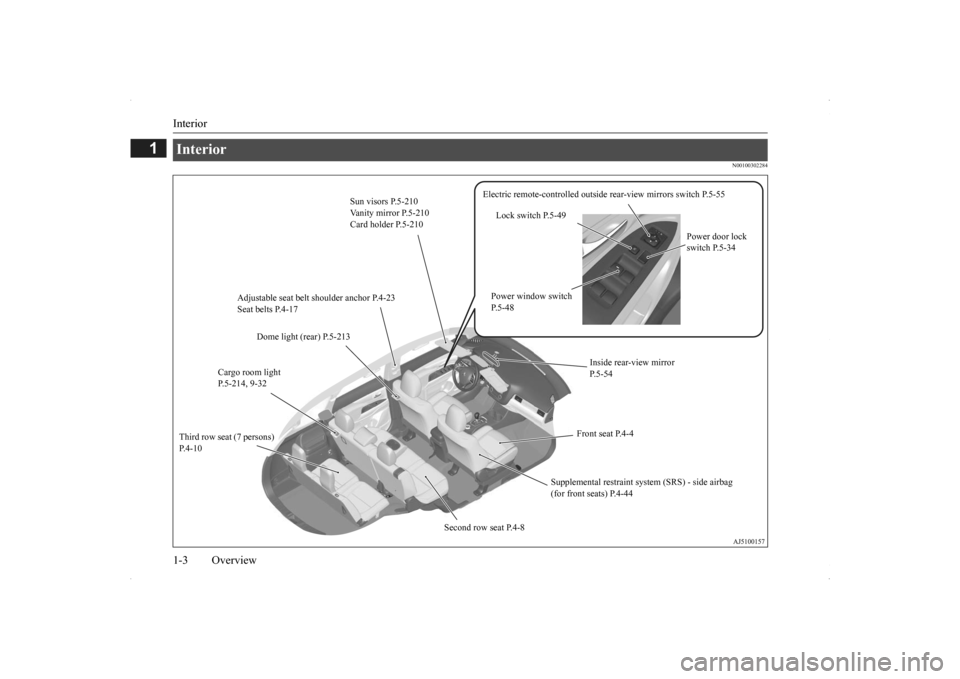
Interior
Sun visors P.5-210 Vanity mirror P.5-210Card holder P.5-210
Supplemental restraint system (SRS) - side airbag (for front seats) P.4-44
Front seat P.4-4
Adjustable seat belt shoulder anchor P.4-23 Seat belts P.4-17
Cargo room light P.5-214, 9-32
Electric remote-controlled outside rear-view mirrors switch P.5-55
Lock switch P.5-49
Power door lock switch P.5-34
Power window switch P.5-48
Second row seat P.4-8
Third row seat (7 persons) P. 4 - 1 0
Dome light (rear) P.5-213
Inside rear-view mirror P.5-54
BK0200500US.book 3 ページ 2013年2月12日 火曜日 午前9時46分
Page 6 of 451
Interior
Overview 1-4
1
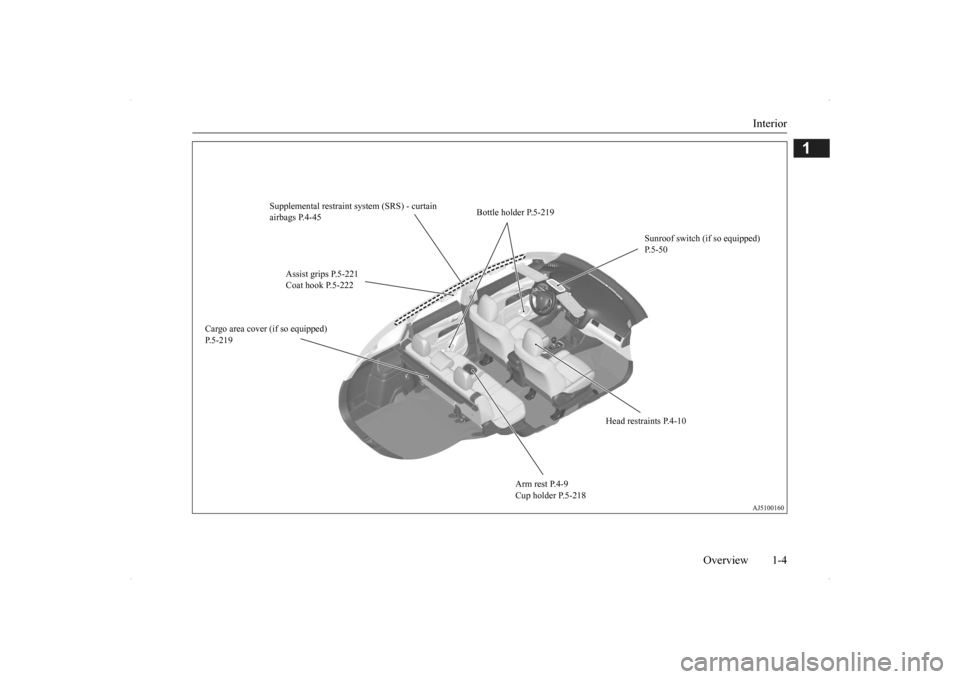
Assist grips P.5-221 Coat hook P.5-222
Bottle holder P.5-219
Sunroof switch (if so equipped) P.5-50
Head restraints P.4-10
Arm rest P.4-9 Cup holder P.5-218
Cargo area cover (if so equipped) P.5-219
Supplemental restraint system (SRS) - curtain airbags P.4-45
BK0200500US.book 4 ページ 2013年2月12日 火曜日 午前9時46分
Page 12 of 451
If this warning light comes on or
flashes while you’re driving...
Quick index 2-3
2
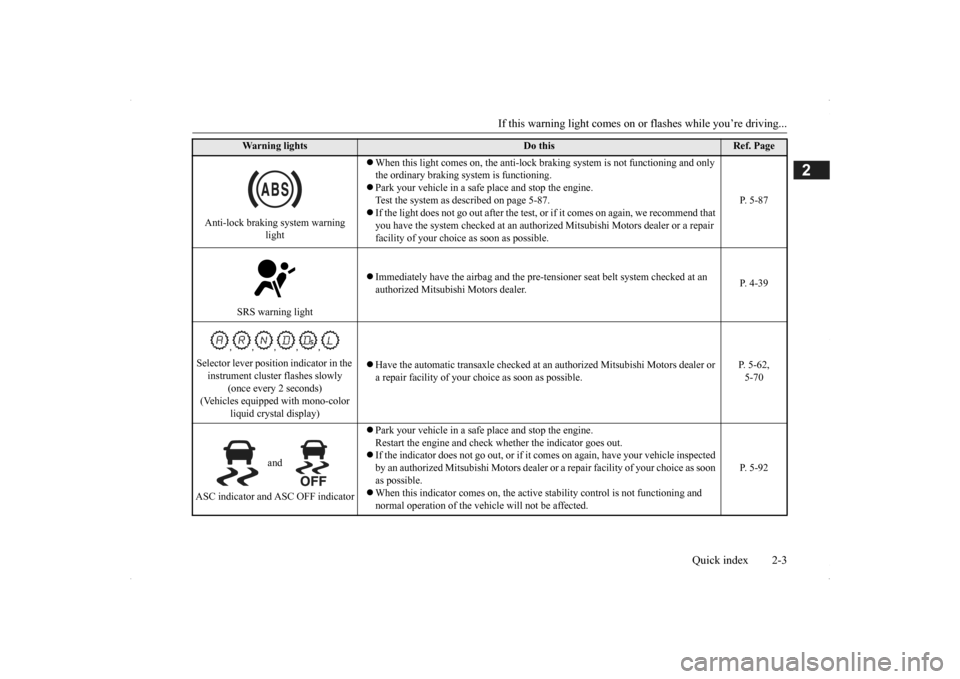
Anti-lock braking system warning
light
When this light comes on,
the anti-lock braking system
is not functioning and only
the ordinary braking system is functioning. Park your vehicle in a safe
place and stop the engine.
Test the system as described on page 5-87. If the light does not go out after the test, or
if it comes on again, we recommend that
you have the system checked at an authorized
Mitsubishi Motors dealer or a repair
facility of your choice
as soon as possible.
P. 5-87
SRS warning light
Immediately have the airbag and the pre-te
nsioner seat belt sy
stem checked at an
authorized Mitsubishi Motors dealer.
P. 4-39
Selector lever position indicator in the instrument cluste
r flashes slowly
(once every 2 seconds)
(Vehicles equipped with mono-color
liquid crystal display)
Have the automatic transaxle checked at an
authorized Mitsubishi Motors dealer or
a repair facility of your c
hoice as soon as possible.
P. 5-62, 5-70
and
ASC indicator and ASC OFF indicator
Park your vehicle in a safe
place and stop the engine.
Restart the engine and check
whether the indicator goes out.
If the indicator does not go out, or if it co
mes on again, have your vehicle inspected
by an authorized Mitsubishi Motors dealer or
a repair facility of your choice as soon
as possible. When this indicator comes on, the active
stability control is
not functioning and
normal operation of the vehicl
e will not be affected.
P. 5-92
Wa rn in g l ig h t s
Do this
Ref. Page
BK0200500US.book 3 ページ 2013年2月12日 火曜日 午前9時46分
Page 26 of 451
California Perchlorate Materials Requirements
General information 3-7
3
N00300100017
Certain components of this vehicle, such as airbag modules, seat belt pretensioners, and button cell batteries, ma
y contain perchlorate
materials. Special handling may apply. For additional information, see www.d
tsc.ca.gov/hazardous-
waste/perchlorate.California Perchlorate Materials Requirements
BK0200500US.book 7 ページ 2013年2月12日 火曜日 午前9時46分
Page 28 of 451
4
Seat and restraint systemsSeats ..................................................................................................4-2 Seat arrangement ..............................................................................4-3 Seats and restraint systems ...............................................................4-4Front seats .........................................................................................4-4 Second row seats..........
...........
...........
...........
...........
...........
.........
.....4-8
Third row seat (Seating 7 passengers) ............................................4-10Head restraints ................................................................................4-10 Making a cargo area........................................................................4-12 Making a flat seat............................................................................4-16Seat belts .........................................................................................4-17 Seat belt use during pregnancy .......................................................4-24 Seat belt pre-tensioner and force limiter systems ...........................4-24Child restraint systems....................................................................4-25 Maintenance and inspection of seat belts .......................................4-33 Supplemental Restraint Syst
em (SRS) - airbag .......
.........
.........
.....4-33
BK0200500US.book 1 ページ 2013年2月12日 火曜日 午前9時46分
Page 31 of 451
Seats and restraint systems 4-4 Seat and restraint systems
4
N00401601219
Your vehicle has seat
belts and other safety
features that help protect you and your pas- sengers in an accident.Seat belts are the most important safety device. When worn properly, seat belts can reduce the chance of serious injury or deathin various types of crashes. For added protec- tion during a severe fr
ontal collision, your
vehicle has a Supplemental Restraint System (SRS) with airbags for the driver and passen- gers. The seats, head restraints, and doorlocks also are safety equipment, which must be used correctly. Always check the following before you drive: That everyone in your vehicle is properly wearing their seat belt. That infants and small children are prop- erly secured in an appropriate child restraint system in the rear seat. That all doors are fully closed and locked. That seatbacks are upright, with head restraints properly adjusted.
Safety equipment cannot prevent injury or death in all motor ve
hicle accidents. How-
ever, you can help reduce the risk of injury or death, by following the instructions in thismanual.
N00401801413
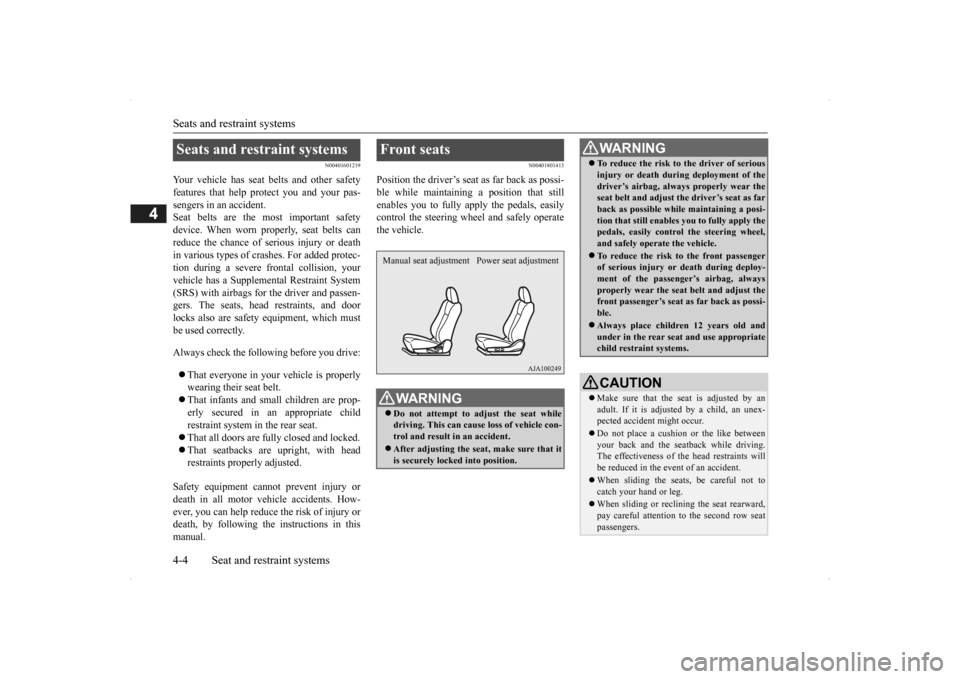
Position the driver’s seat
as far back as possi-
ble while maintaining a position that still enables you to fully apply the pedals, easilycontrol the steering wh
eel and safely operate
the vehicle.
Seats and restraint systems
Front seats
WA R N I N G Do not attempt to adjust the seat while driving. This can cause loss of vehicle con-trol and result
in an accident.
After adjusting the seat, make sure that it is securely locked into position.Manual seat adjustment Power seat adjustment
To reduce the risk to the driver of serious injury or death duri
ng deployment of the
driver’s airbag, always
properly wear the
seat belt and adjust th
e driver’s seat as far
back as possible while maintaining a posi- tion that still enables
you to fully apply the
pedals, easily control the steering wheel, and safely operate the vehicle. To reduce the risk to the front passenger of serious injury or
death during deploy-
ment of the passeng
er’s airbag, always
properly wear the seat
belt and adjust the
front passenger’s seat as far back as possi- ble. Always place childr
en 12 years old and
under in the rear seat
and use appropriate
child restraint systems.CAUTION Make sure that the seat is adjusted by an adult. If it is adjusted by a child, an unex- pected accident might occur. Do not place a cushion
or the like between
your back and the seatback while driving. The effectiveness of the head restraints willbe reduced in the event of an accident. When sliding the seat
s, be careful not to
catch your hand or leg. When sliding or reclin
ing the seat rearward,
pay careful attention
to the second row seat
passengers.WA R N I N G
BK0200500US.book 4 ページ 2013年2月12日 火曜日 午前9時46分
Page 45 of 451
Seat belts 4-18 Seat and restraint systems
4
N00406201467
All seats are equipped with a seat belt which uses one combined lap-and-shoulder belt with an emergency locking retractor. This system is designed to provide both com- fort and safety. It perm
its full extension and
automatic retraction of the belts during nor- mal vehicle operation.
A sensing device
inside the belt retractor is designed to lock the retractor in the event of a sudden change inthe vehicle’s motion.
To reduce the risk to the driver of serious injury or death duri
ng deployment of the
driver’s airbag, always
properly wear the
seat belt and adjust th
e driver’s seat as far
back as possible while maintaining a posi- tion that still enables
you to fully apply the
pedals, easily control the steering wheel, and safely operate the vehicle. To reduce the risk to a front seat passen- ger of serious injury or death from a deploying airbag, make sure the passengeralways wears the seat belt properly, remains seated all the way back and upright in their seat,
and moves the seat as
far back as possible. Refer to “Supplemen- tal Restraint System (SRS) - airbag” on page 4-33 for additional information. Never hold an infant
or child in your arms
or on your lap when ri
ding in this vehicle
even when you are we
aring your seat belt.
Never place any part of the seat belt you are wearing around an infant or child.Failure to follow these simple instructions creates a risk of serious injury or death to your child in the even
t of an accident or
sudden stop.WA R N I N G
Children 12 years ol
d and under should
always ride in the re
ar seat and be prop-
erly restrained. This reduces their risk ofserious injury or de
ath in an accident,
especially due to a deploying front passen- ger airbag. Refe
r to “Child restraint sys-
tems” on page 4-25 for additional information. Any child who is t
oo small to properly
wear a seat belt must be properly restrained in an
appropriate child
restraint system. Infants MUST be placed in a rear-facing child safety seat and
positioned in the rear
seat. In the event of an ac
cident, all seat belt
assemblies, including retractors and attachment hardware, should be inspectedby an authorized Mitsubishi Motors dealer to determine whether replacement is necessary.
Seat belt instructions
WA R N I N G
NOTE
For instructions on inst
alling a child restraint
system using a seat belt
, refer to “Installing a
child restraint system using the seat belt” on page 4-30.
BK0200500US.book 18 ページ 2013年2月12日 火曜日 午前9時46分
Page 46 of 451
Seat belts
Seat and restraint systems 4-19
4
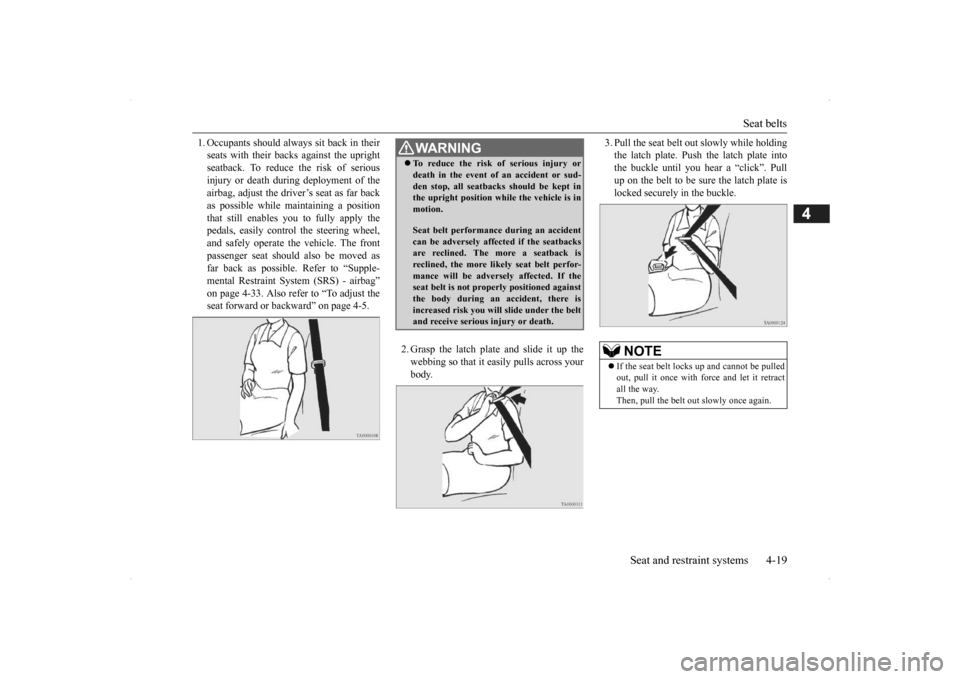
1. Occupants shoul
d always sit back in their
seats with their backs against the uprightseatback. To reduce the risk of serious injury or death during deployment of the airbag, adjust the driver’s seat as far backas possible while ma
intaining a position
that still enables you to fully apply the pedals, easily contro
l the steering wheel,
and safely operate the vehicle. The front passenger seat should
also be moved as
far back as possible. Refer to “Supple- mental Restraint Syst
em (SRS) - airbag”
on page 4-33. Also refe
r to “To adjust the
seat forward or backward” on page 4-5.
2. Grasp the latch plate and slide it up the webbing so that it ea
sily pulls across your
body.
3. Pull the seat belt out
slowly while holding
the latch plate. Push the latch plate intothe buckle until you he
ar a “click”. Pull
up on the belt to be sure the latch plate is locked securely in the buckle.
WA R N I N G To reduce the risk of serious injury or death in the event of
an accident or sud-
den stop, all seatbacks should be kept inthe upright position while the vehicle is in motion. Seat belt performance during an accident can be adversely affect
ed if the seatbacks
are reclined. The more a seatback isreclined, the more likely seat belt perfor- mance will be advers
ely affected. If the
seat belt is not proper
ly positioned against
the body during an accident, there is increased risk you will slide under the belt and receive serious
injury or death.
NOTE
If the seat belt lock
s up and cannot be pulled
out, pull it once with fo
rce and let it retract
all the way. Then, pull the belt out
slowly once again.
BK0200500US.book 19 ページ 2013年2月12日 火曜日 午前9時46分
Page 51 of 451
Seat belt use during pregnancy 4-24 Seat and restraint systems
4
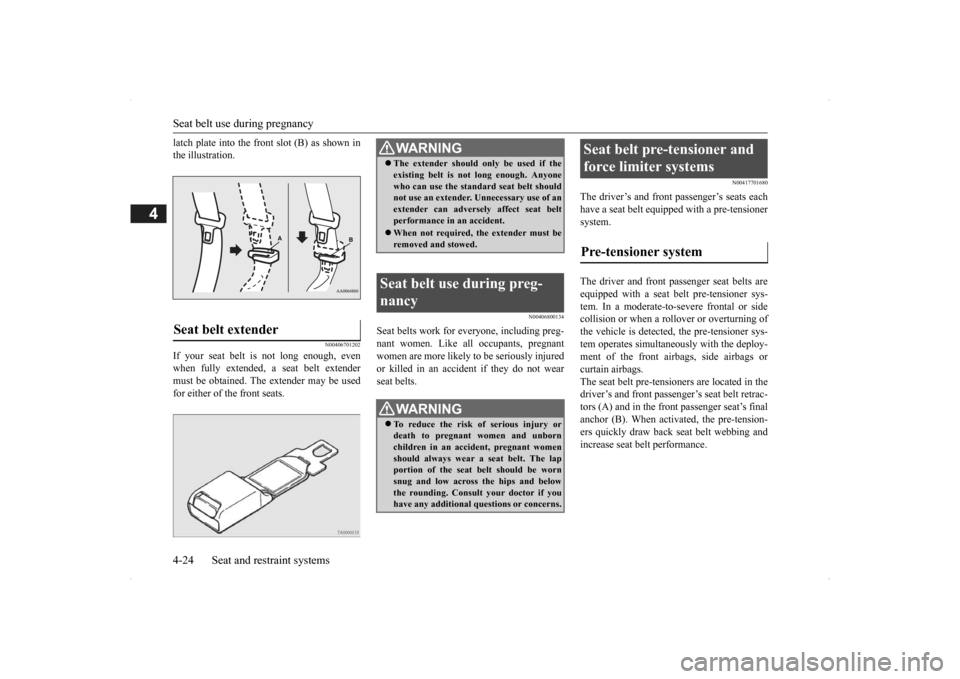
latch plate into the front slot (B) as shown in the illustration.
N00406701202
If your seat belt is not long enough, evenwhen fully extended, a seat belt extender must be obtained. The extender may be used for either of the front seats.
N00406800134
Seat belts work for everyone, including preg- nant women. Like al
l occupants, pregnant
women are more likely to be seriously injuredor killed in an accide
nt if they do not wear
seat belts.
N00417701680
The driver’s and front passenger’s seats eachhave a seat belt equippe
d with a pre-tensioner
system. The driver and front pa
ssenger seat belts are
equipped with a seat belt pre-tensioner sys- tem. In a moderate-to-severe frontal or side collision or when a rollover or overturning ofthe vehicle is detected, the pre-tensioner sys- tem operates simultaneous
ly with the deploy-
ment of the front airb
ags, side airbags or
curtain airbags. The seat belt pre-tensi
oners are located in the
driver’s and front passenge
r’s seat belt retrac-
tors (A) and in the front
passenger seat’s final
anchor (B). When activated, the pre-tension- ers quickly draw back seat belt webbing andincrease seat belt performance.
Seat belt extender
WA R N I N G The extender should only be used if the existing belt is not long enough. Anyonewho can use the standard seat belt shouldnot use an extender.
Unnecessary use of an
extender can adversel
y affect seat belt
performance in an accident. When not required, the extender must be removed and stowed.
Seat belt use during preg- nancy
WA R N I N G To reduce the risk of serious injury or death to pregnant women and unbornchildren in an accident, pregnant womenshould always wear
a seat belt. The lap
portion of the seat belt should be worn snug and low across the hips and belowthe rounding. Consult your doctor if you have any additional qu
estions or concerns.
Seat belt pre-tensioner and force limiter systems Pre-tensioner system
BK0200500US.book 24 ページ 2013年2月12日 火曜日 午前9時46分