Check MITSUBISHI OUTLANDER 2015 3.G User Guide
[x] Cancel search | Manufacturer: MITSUBISHI, Model Year: 2015, Model line: OUTLANDER, Model: MITSUBISHI OUTLANDER 2015 3.GPages: 446, PDF Size: 59.52 MB
Page 31 of 446
Seats and restraint systems 4-4 Seat and restraint systems
4
N00401601219
Your vehicle has seat
belts and other safety
features that help protect you and your pas- sengers in an accident.Seat belts are the most important safety device. When worn properly, seat belts can reduce the chance of serious injury or deathin various types of crashes. For added protec- tion during a severe fr
ontal collision, your
vehicle has a Supplemental Restraint System (SRS) with airbags for the driver and passen- gers. The seats, head restraints, and doorlocks also are safety equipment, which must be used correctly. Always check the following before you drive: That everyone in your vehicle is properly wearing their seat belt. That infants and small children are prop- erly secured in an appropriate child restraint system in the rear seat. That all doors are fully closed and locked. That seatbacks are upright, with head restraints properly adjusted.
Safety equipment cannot prevent injury or death in all motor ve
hicle accidents. How-
ever, you can help reduce the risk of injury or death, by following the instructions in thismanual.
N00401801426
Position the driver’s seat
as far back as possi-
ble while maintaining a position that still enables you to fully apply the pedals, easilycontrol the steering wh
eel and safely operate
the vehicle.
Seats and restraint systems
Front seats
WA R N I N G Do not attempt to adjust the seat while driving. This can cause loss of vehicle con-trol and result
in an accident.
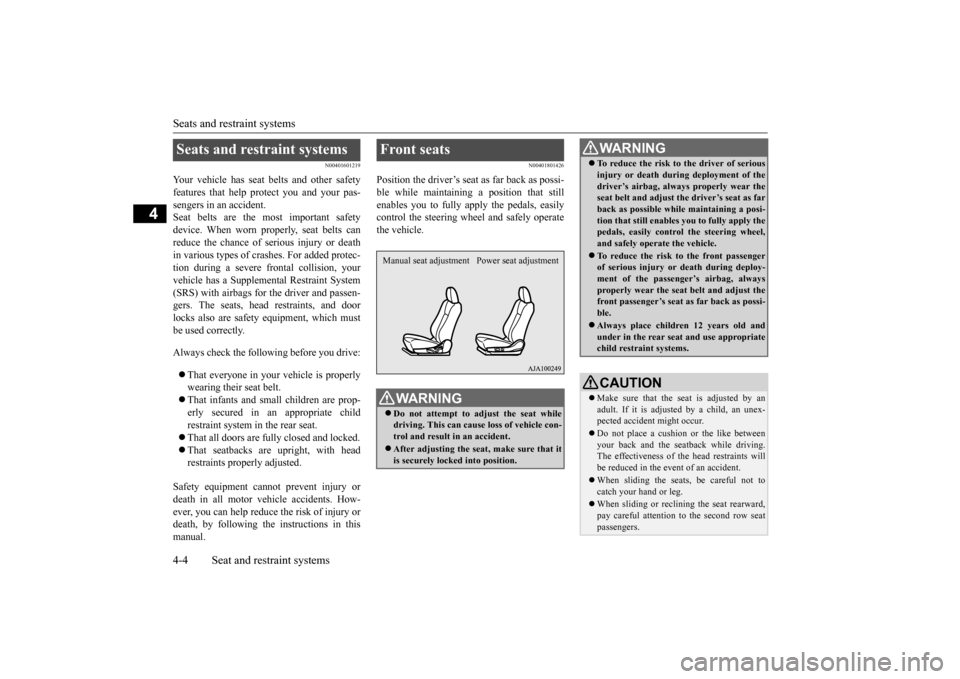
After adjusting the seat, make sure that it is securely locked into position.Manual seat adjustment Power seat adjustment
To reduce the risk to the driver of serious injury or death duri
ng deployment of the
driver’s airbag, always
properly wear the
seat belt and adjust th
e driver’s seat as far
back as possible while maintaining a posi- tion that still enables
you to fully apply the
pedals, easily control the steering wheel, and safely operate the vehicle. To reduce the risk to the front passenger of serious injury or
death during deploy-
ment of the passeng
er’s airbag, always
properly wear the seat
belt and adjust the
front passenger’s seat as far back as possi- ble. Always place childr
en 12 years old and
under in the rear seat
and use appropriate
child restraint systems.CAUTION Make sure that the seat is adjusted by an adult. If it is adjusted by a child, an unex- pected accident might occur. Do not place a cushion
or the like between
your back and the seatback while driving. The effectiveness of the head restraints willbe reduced in the event of an accident. When sliding the seat
s, be careful not to
catch your hand or leg. When sliding or reclin
ing the seat rearward,
pay careful attention
to the second row seat
passengers.WA R N I N G
BK0211800US.book 4 ページ 2014年3月12日 水曜日 午後2時42分
Page 37 of 446
Third row seat (Seating 7 passengers) 4-10 Seat and restraint systems
4
To return the seat, slide the entire seat back- ward to the desired position and then raise theseatback until it locks securely. After returning the seat, gently try to move it forward and backward to check that it issecurely retained and adjust the seatback to the normal seating position.
N00419501073
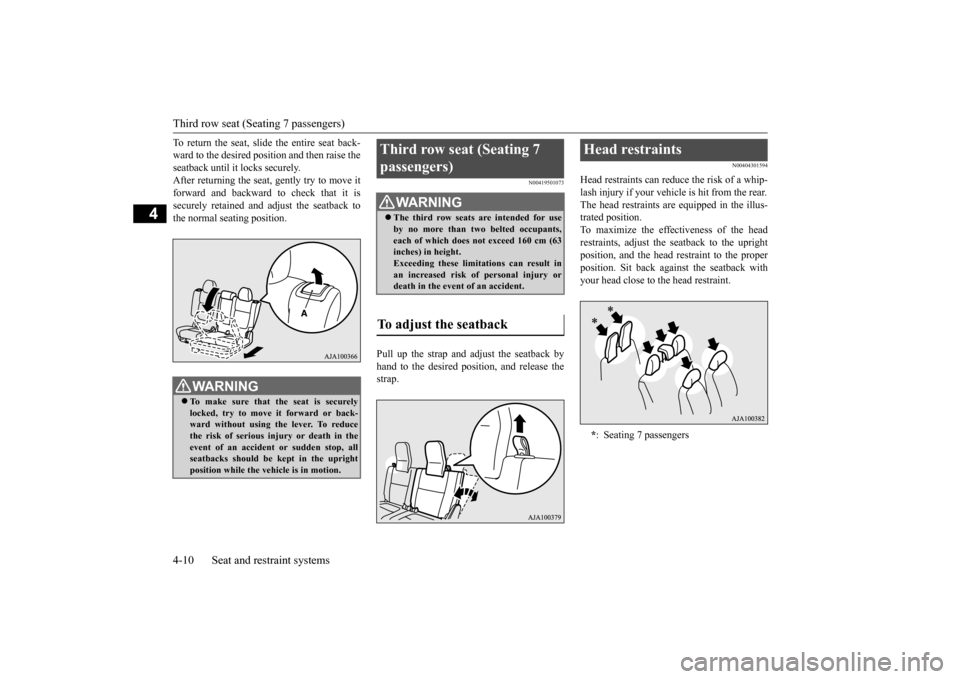
Pull up the strap and adjust the seatback by hand to the desired posit
ion, and release the
strap.
N00404301594
Head restraints can reduce the risk of a whip- lash injury if your vehicle is hit from the rear. The head restraints ar
e equipped in the illus-
trated position. To maximize the effectiveness of the head restraints, adjust the seatback to the uprightposition, and the head restraint to the proper position. Sit back against the seatback with your head close to the head restraint.
WA R N I N G To make sure that the seat is securely locked, try to move it forward or back-ward without using the lever. To reduce the risk of serious in
jury or death in the
event of an accident
or sudden stop, all
seatbacks should be kept in the upright position while the vehicle is in motion.
Third row seat (Seating 7 passengers)
WA R N I N G The third row seats are intended for use by no more than two belted occupants,each of which does not exceed 160 cm (63 inches) in height. Exceeding these limitations can result inan increased risk of
personal injury or
death in the event of an accident.
To adjust the seatback
Head restraints * : Seating 7 passengers
BK0211800US.book 10 ページ 2014年3月12日 水曜日 午後2時42分
Page 39 of 446
Making a cargo area 4-12 Seat and restraint systems
4
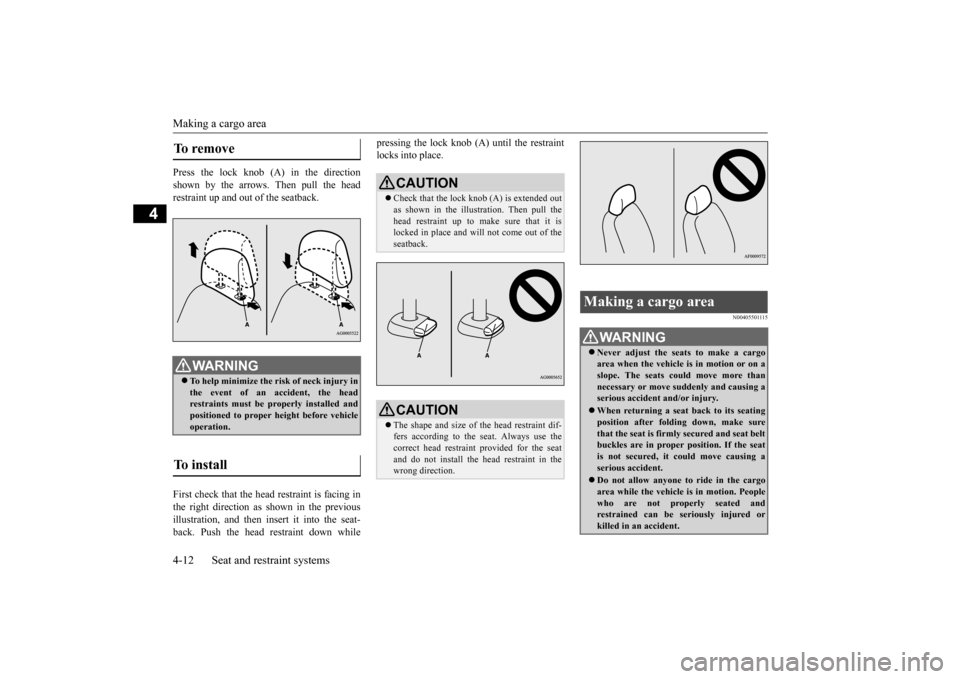
Press the lock knob (A) in the direction shown by the arrows. Then pull the head restraint up and out of the seatback. First check that the head restraint is facing in the right direction as
shown in the previous
illustration, and then insert it into the seat- back. Push the head restraint down while
pressing the lock knob (A) until the restraint locks into place.
N00405501115
To remove
WA R N I N G To help minimize the risk of neck injury in the event of an
accident, the head
restraints must be properly installed and positioned to proper height before vehicle operation.
To install
CAUTION Check that the lock knob (A) is extended out as shown in the illustration. Then pull the head restraint up to make sure that it is locked in place and will
not come out of the
seatback.CAUTION The shape and size of the head restraint dif- fers according to the seat. Always use the correct head restrain
t provided for the seat
and do not install the he
ad restraint in the
wrong direction.
Making a cargo area
WA R N I N G Never adjust the seats to make a cargo area when the vehicle is
in motion or on a
slope. The seats could move more thannecessary or move suddenly and causing a serious accident
and/or injury.
When returning a seat back to its seating position after folding down, make sure that the seat is firmly secured and seat beltbuckles are in proper position. If the seat is not secured, it could move causing a serious accident. Do not allow anyone to ride in the cargo area while the vehicle
is in motion. People
who are not properly seated and restrained can be seriously injured or killed in an accident.
BK0211800US.book 12 ページ 2014年3月12日 水曜日 午後2時42分
Page 47 of 446
Seat belts 4-20 Seat and restraint systems
4
5. To release the belt,
press the button on the
buckle and allow the belt to retract.If the belt does not retract smoothly, pull it out and check for kinks or twists in the webbing. Then make sure it remainsuntwisted as it retracts.
N00409900022
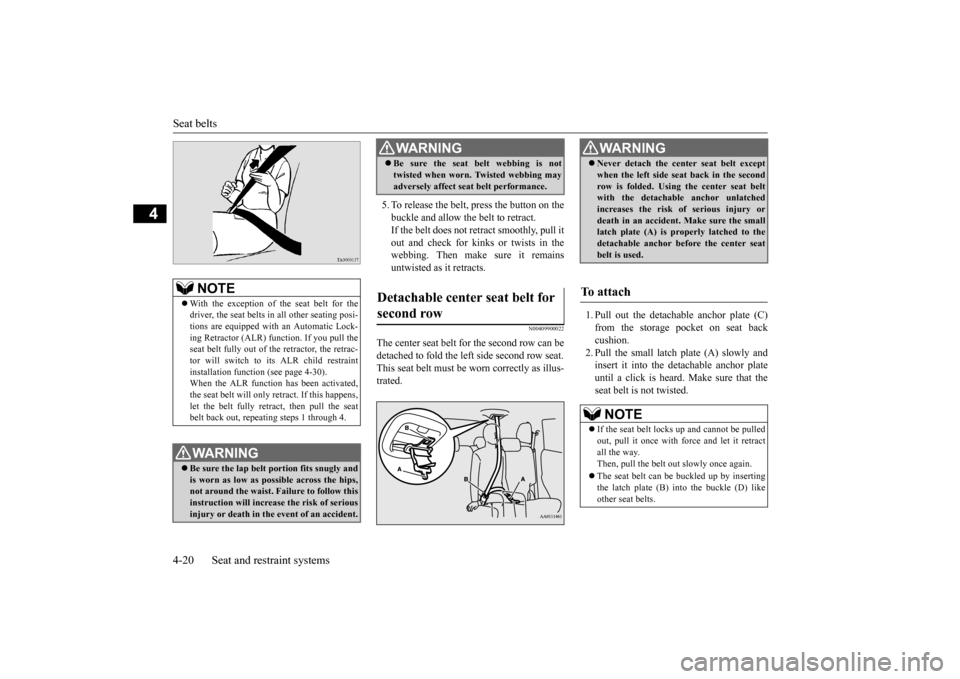
The center seat belt for the second row can be detached to fold the le
ft side second row seat.
This seat belt must be worn correctly as illus-trated.
1. Pull out the detachable anchor plate (C) from the storage pocket on seat back cushion. 2. Pull the small latch plate (A) slowly andinsert it into the detachable anchor plate until a click is heard. Make sure that the seat belt is not twisted.
NOTE
With the exception of the seat belt for the driver, the seat belts in all other seating posi- tions are equipped with an Automatic Lock- ing Retractor (ALR) func
tion. If you pull the
seat belt fully out of th
e retractor, the retrac-
tor will switch to its ALR child restraint installation function (see page 4-30).When the ALR function has been activated, the seat belt will only
retract. If this happens,
let the belt fully retract, then pull the seatbelt back out, repeating steps 1 through 4.WA R N I N G Be sure the lap belt portion fits snugly and is worn as low as possible across the hips, not around the waist. Failure to follow thisinstruction will increase the risk of serious injury or death in the
event of an accident.
Be sure the seat belt webbing is not twisted when worn. Twisted webbing mayadversely affect seat belt performance.
Detachable center seat belt for second row
WA R N I N G
WA R N I N G Never detach the center seat belt except when the left side seat back in the secondrow is folded. Using the center seat beltwith the detachable
anchor unlatched
increases the risk of serious injury or death in an accident. Make sure the smalllatch plate (A) is properly latched to the detachable anchor be
fore the center seat
belt is used.
To attach
NOTE
If the seat belt locks
up and cannot be pulled
out, pull it once with force and let it retractall the way.Then, pull the belt out
slowly once again.
The seat belt can be
buckled up by inserting
the latch plate (B) in
to the buckle (D) like
other seat belts.
BK0211800US.book 20 ページ 2014年3月12日 水曜日 午後2時42分
Page 53 of 446
Child restraint systems 4-26 Seat and restraint systems
4
Child restraint systems specifically designed for infants and small children are offered byseveral manufacturers
. Choose only a child
restraint system with a label certifying that it complies with Federal Motor Vehicle SafetyStandard 213 (FMVSS 213) or Motor Vehicle Restraint Systems and Booster Seats Safety Regulations (RSSR). Look for the manufac-turer’s statement of compliance on the box and child restraint system itself. The child restraint system should be appropri- ate for your child’s we
ight and height, and
should properly fit you
r vehicle’s seat.
For detailed information,
refer to the instruc-
tion manual accompanying the child restraint system. All children should be
properly restrained in
a restraint device that
offers the maximum
protection for their size and age. Be sure to check local, state, or provincial requirements for child size and age that mayvary from the recommendations listed below.
Children less than 1 year old and who weigh 22 pounds (10 kg) or less MUSTride in a rear-facing ch
ild safety seat that
MUST ONLY be used in the second row seat. Children older than 1 year of age and who weigh less than 40 pounds (18 kg) or who are less than 40 inches (100 cm) tall mustbe in a forward-facing restraint used only in the rear seat. Children who weigh more than 40 pounds (18 kg) or who are more than 40 inches (100 cm) tall, regardless of age, shoulduse a suitable child seat or a booster seat in the rear seat until the vehicle’s lap-and- shoulder belt fits
them properly.
Guidelines for child restraint system selection
WA R N I N G All children must be seated in the rear seat, and properly restrained. Accident statistics
show that children of
all sizes and ages are safer when properly restrained in the rear seat, rather than in the front seat. Be sure to select a child restraint system that is appropriate not only for the child’ssize and age but also for your vehicle. Some child restraint systems may not fit your vehicle properly.
Any child who is too large to use a child restraint system should ride in the rearseat and wear the la
p-and-shoulder belt
properly. The shoulder belt must be posi- tioned over the shou
lder and across the
chest, not across their neck, and with thelap belt positioned low on the child’s hips, not across their stomach. If necessary, a booster seat should be used to help achievea proper seat belt fi
t. Follow the booster
seat manufacturer’s instructions. Only use a booster seat that is certified as comply-ing with Federal Motor Vehicle Safety Standards or Motor Vehicle Restraint Sys- tems and Booster Seats Safety Regula-tions. WA R N I N G
BK0211800US.book 26 ページ 2014年3月12日 水曜日 午後2時42分
Page 60 of 446
Supplemental Restraint System (SRS) - airbag
Seat and restraint systems 4-33
4
Regularly check your se
at belt buckles and
their release mechanisms
for positive engage-
ment and release of the
latch plate. Check the
retractors for automatic locking when in the Automatic Locking Retractor function. The entire seat belt assembly should be replaced if the webbing shows any obvious cuts, tears, increase in thickness in any sec- tion of the webbing from broken fibers, orsevere fading from sunlig
ht. All of these con-
ditions indicate a weakening of the belt, which may adversely affe
ct seat belt perfor-
mance in an accident.
N00407701788
This vehicle is equippe
d with a Supplemental
Restraint System (SRS), which includes air- bags for the driver and passengers.
The SRS front airbags are designed to supple- ment the primary protection of the driver andfront passenger seat belt systems by provid- ing those occupants w
ith protection against
head and chest injuries
in certain moderate to
severe frontal collisi
ons. The SRS front air-
bags, together with sensors at the front of the vehicle and sensors attached to the frontseats, form an advanced airbag system. The SRS side airbags and the curtain airbags are also designed to supp
lement the seat belts.
The SRS side airbags provide the driver and front passenger with pr
otection against chest
injuries by deploying the bag on the sideimpacted in moderate
to severe side impact
collisions. The SRS curtain airbags provide the driver and the passengers on the front seatand the second row outboard seats with pro- tection against head injuries by deploying the curtain airbag on the side impacted in moder-ate to severe side im
pact collisions and by
deploying both curtain airbags when a roll- over is detected. The curtain airbags are alsodesigned to help reduce the risk of complete and partial ejection from the vehicle through side windows in both side impact and roll-over type
accidents.
The SRS airbags are NOT a substitute for use of the seat belts. For maximum protection in all types of accident
s, seat belts must
ALWAYS be worn by everyone who drives or
rides in this vehicle
(with infants and small
children in an appropriate child restraint sys-tem in the rear seat, and older children buck- led in the rear seat). Refer to “Child restraint systems” on page 4-25.
WA R N I N G Do not attempt to repair or replace any part of the seat belt assemblies. This workshould be done
by an authorized
Mitsubishi Motors dealer. Failure to have an authorized Mitsub
ishi Motors dealer
perform the work could reduce the effec- tiveness of the belts and could result in a serious injury or de
ath in an accident.
Supplemental Restraint Sys- tem (SRS) - airbag
WA R N I N G IT IS VERY IMPORTANT TO ALWAYS WEAR YOUR SEAT BELT PROPERLY EVEN WITH AN AIRBAG.• Seat belts help keep the driver and pas-sengers properly positioned. This reduces the risk of injury in all collisions,and reduces the risk of serious injuries or death when the
airbags inflate.
During sudden braking just before a col-lision, an unrestra
ined or
improperly
restrained driver or front passenger can move forward into direct contact with, orwithin close proximi
ty to, the airbag
when it begins to inflate. The beginning stage of
airbag inflation is
the most forceful and can cause serious injuries or death if the occupant comes in contact with the airbag at this time.• Seat belts reduce the risk of injury inrear impact collisions, and in lower-speed frontal collisions because the air- bags are not designed to inflate in those situations.• Seat belts reduce the risk of beingthrown from your vehi
cle in a collision or
rollover.
BK0211800US.book 33 ページ 2014年3月12日 水曜日 午後2時42分
Page 66 of 446
Supplemental Restraint System (SRS) - airbag
Seat and restraint systems 4-39
4
N00408301589
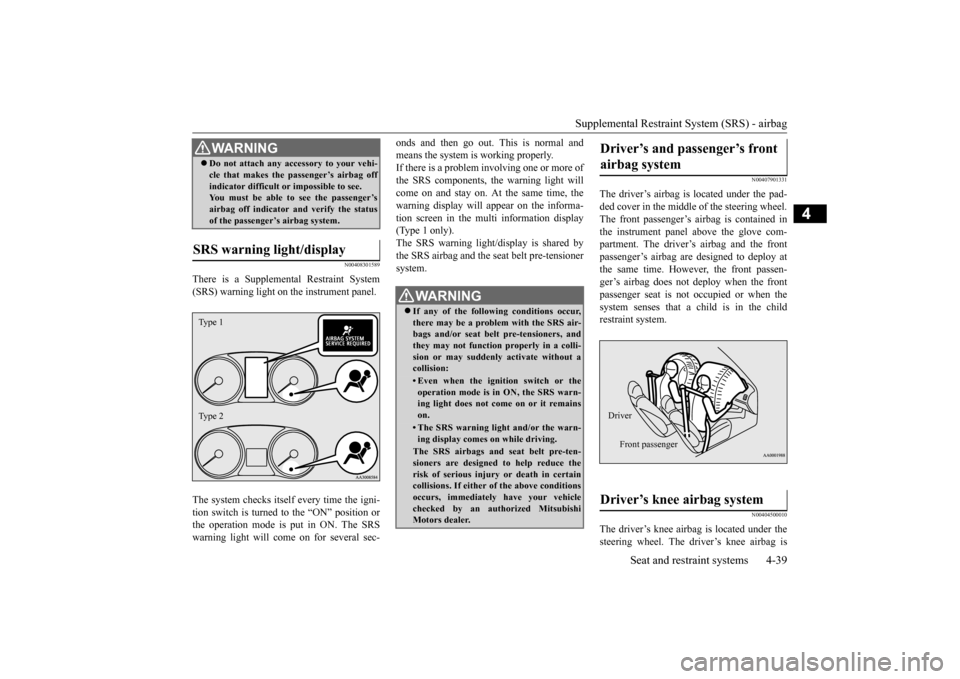
There is a Supplemental Restraint System (SRS) warning light on
the instrument panel.
The system checks itself every time the igni- tion switch is turned
to the “ON” position or
the operation mode is put in ON. The SRS warning light will co
me on for several sec-
onds and then go out. This is normal and means the system is working properly.If there is a problem involving one or more of the SRS components, the warning light will come on and stay on. At the same time, thewarning display will
appear on the informa-
tion screen in the multi information display (Type 1 only).The SRS warning light/display is shared by the SRS airbag and the seat belt pre-tensioner system.
N00407901331
The driver’s airbag is located under the pad-ded cover in the middle of the steering wheel.The front passenger’s airbag is contained in the instrument panel above the glove com- partment. The driver’s airbag and the frontpassenger’s airbag ar
e designed to deploy at
the same time. However, the front passen- ger’s airbag does not deploy when the front passenger seat is not
occupied or when the
system senses that a child is in the childrestraint system.
N00404500010
The driver’s knee airbag is located under the steering wheel. The driver’s knee airbag is
Do not attach any ac
cessory to your vehi-
cle that makes the passenger’s airbag offindicator difficult or impossible to see.You must be able to see the passenger’s airbag off indicator and verify the status of the passenger’s airbag system.
SRS warning light/display
WA R N I N G
Type 1 Type 2
WA R N I N G If any of the follow
ing conditions occur,
there may be a proble
m with the SRS air-
bags and/or seat belt pre-tensioners, and they may not function properly in a colli-sion or may suddenly
activate without a
collision:• Even when the ignition switch or theoperation mode is in ON, the SRS warn- ing light does not come on or it remainson.• The SRS warning light and/or the warn-ing display comes on while driving.The SRS airbags and seat belt pre-ten-sioners are designed to help reduce the risk of serious injury
or death in certain
collisions. If either of the above conditionsoccurs, immediately
have your vehicle
checked by an authorized Mitsubishi Motors dealer.
Driver’s and passenger’s front airbag system Driver’s knee airbag system Driver
Front passenger
BK0211800US.book 39 ページ 2014年3月12日 水曜日 午後2時42分
Page 89 of 446
Free-hand Advanced
Security Transmitter (F.A.S
.T.-key) (if so equipped)
5-12 Features and controls
5
8. Check the keyless entry system to see that it works.
N00503101121
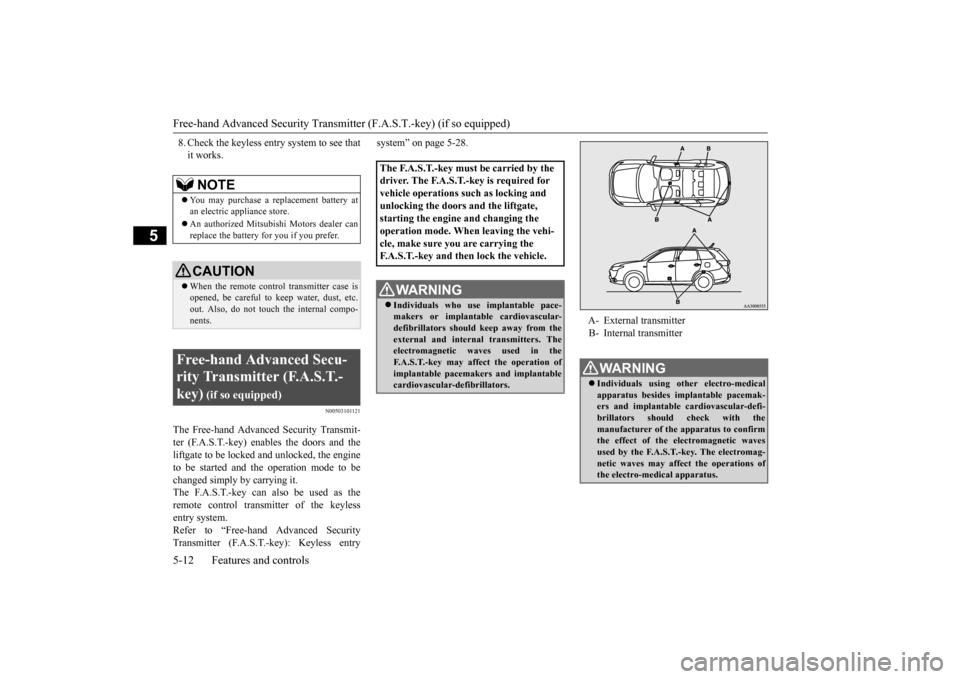
The Free-hand Advanced Security Transmit-ter (F.A.S.T.-key) enables the doors and theliftgate to be locked and unlocked, the engine to be started and the operation mode to be changed simply by carrying it.The F.A.S.T.-key can also be used as the remote control transmitter of the keyless entry system.Refer to “Free-hand Advanced Security Transmitter (F.A.S.T.-key): Keyless entry
system” on page 5-28.
NOTE
You may purchase a re
placement battery at
an electric appliance store. An authorized Mitsubishi Motors dealer can replace the battery for you if you prefer.CAUTION When the remote control transmitter case is opened, be careful to
keep water, dust, etc.
out. Also, do not touch the internal compo-nents.
Free-hand Advanced Secu- rity Transmitter (F.A.S.T.-key)
(if so equipped)
The F.A.S.T.-key must be carried by the driver. The F.A.S.T.-key is required for vehicle operations su
ch as locking and
unlocking the doors and the liftgate, starting the engine
and changing the
operation mode. When leaving the vehi- cle, make sure you are carrying the F.A.S.T.-key and then lock the vehicle.
WA R N I N G Individuals who use
implantable pace-
makers or implanta
ble cardiovascular-
defibrillators
should keep away from the
external and internal
transmitters. The
electromagnetic waves used in the F.A.S.T.-key may affect the operation of implantable pacemakers and implantablecardiovascular-defibrillators.
A- External transmitter B- Internal transmitterWA R N I N G Individuals using ot
her electro-medical
apparatus besides implantable pacemak- ers and implantable
cardiovascular-defi-
brillators should check with themanufacturer of the apparatus to confirm the effect of the electromagnetic waves used by the F.A.S.T.-key. The electromag-netic waves may affect
the operations of
the electro-medical apparatus.
BK0211800US.book 12 ページ 2014年3月12日 水曜日 午後2時42分
Page 95 of 446
Free-hand Advanced
Security Transmitter (F.A.S
.T.-key) (if so equipped)
5-18 Features and controls
5
N00568101023
After approximately 30
minutes has elapsed
with the operation mode in ACC, the function automatically cuts out the power for the audiosystem and other electr
ic devices that can be
operated with that mode. When the engine switch is pressed while theoperation mode is in ACC, the power is sup- plied again to
those devices.
N00503501213
With the F.A.S.T.-key, warnings are given through buzzers and di
splays on the information screen in the multi information displ
ay in order to pre-
vent mistaken operati
ons or vehicle theft.
When a warning operates, be sure to check the vehicle and the F.
A.S.T.-key. A warning is also di
splayed if there is a problem i
n the F.A.S.T.-key.
CAUTIONWhen the engine is not running, put the oper- ation mode in OFF. Leaving the operationmode in ON or ACC for a long time whenthe engine is not running may cause the bat- tery to be discharged
, making it impossible
to start the engine. When the battery is disconnected, the current operation mode is memorized. After recon-necting the battery, the memorized mode is selected auto
matically. Before disconnect-
ing the battery for repair or replacement,make sure to put the operation mode in OFF. Be careful if you are not sure which opera- tion mode the vehicle is in when the batteryis run down. The operation mode cannot be changed from OFF to ACC or ON if the F.A.S.T.-key is not detected to be in the vehicle. Refer to “Oper- ating range for starting the engine andchanging the operation mode” on page 5-14.
ACC power auto-cutout function
NOTE
It is possible to modify functions as follows: • The time until the power cuts out can be changed to approxi
mately 60 minutes.
• The ACC power auto
-cutout function can
be deactivated.
For details, we recommend you to consult anauthorized Mitsubishi Motors dealer.On vehicles equippe
d with Mitsubishi
Motors Multi-Communication System, screen operations can be
used to make the
adjustment.Refer to the separate Mitsubishi Multi-Com- munications System manual for details.NOTE
Warning activation
BK0211800US.book 18 ページ 2014年3月12日 水曜日 午後2時42分
Page 103 of 446
Free-hand Advanced
Security Transmitter (F.A.S
.T.-key) (if so equipped)
5-26 Features and controls
5
When the F.A.S.T.-key cannot be used, such as when the battery of the F.A.S.T.-key or thevehicle has run down, the emergency key can be used to lock and unlock the driver’s door. To use the emergency key (A), unlock the lock knob (B) and remove it from theF.A.S.T.-key (C). Turn the emergency key toward the front of the vehicle to lock the door. After checking
that the door is locked, turn the emergency key back to the center and remove it.
N00529600055
The electronic immobilize
r is designed to sig-
nificantly reduce the
possibility of vehicle
theft. The purpose of the system is to immo- bilize the vehicle if an invalid start is attempted. A valid start attempt can only beachieved (subject to ce
rtain conditions) using
a F.A.S.T.-Key “registered” to the immobi- lizer system.
All of the keys provided with your new vehi- cle have been program
med to the vehicle’s
electronics.
N00561000042
Only the F.A.S.T.-keys that have been pro-grammed to the vehicl
e’s electronics can be
used to start the vehicle. If you lose the F.A.S.T.-key, you can order a F.A.S.T.-key from your authorized Mitsubishi Motors dealer by refe
rring to the key number.
To prevent vehicle theft, take your vehicleand the remaining F.A.S.T.-keys to an autho- rized Mitsubishi Motors
dealer to have the ID
codes reprogrammed.
N00561100014
To add a F.A.S.T.-key, you must already have2 registered F.A.S.T.-keys. You need to regis-ter the ID code to the vehicle. Registering the ID code can be done by your authorized Mitsubishi
Motors dealer. Or it
can be done by yourself (except for vehicles sold in Canada). For you to register the ID code yourself, fol-low the “Customer F.A.S.T.-key program- ming” procedure below.
NOTE
Only use the emergency key in an emer- gency. When the battery of the F.A.S.T.-key has run down, replace
the battery as soon as
possible and use it as a F.A.S.T.-key again. After using the emerge
ncy key, be sure to
reinsert it into the F.A.S.T.-key.
Locking and unlocking the driver’s door
1- Insert or remove
the emergency key
2- Lock 3- UnlockElectronic immobilizer (Anti- theft starting system)
Replacement F.A.S.T.-keys
Additional F.A.S.T.-keys
BK0211800US.book 26 ページ 2014年3月12日 水曜日 午後2時42分