trailer MITSUBISHI OUTLANDER 2015 3.G User Guide
[x] Cancel search | Manufacturer: MITSUBISHI, Model Year: 2015, Model line: OUTLANDER, Model: MITSUBISHI OUTLANDER 2015 3.GPages: 446, PDF Size: 59.52 MB
Page 313 of 446
Trailer towing 6-14 Driving safety
6
cle’s electrical system
and affect your vehicle
warranty. Many states and Canadi
an provinces require
special outside mirrors when towing a trailer.Even if not required,
you should install spe-
cial mirrors if you ca
nnot clearly see behind
you, or if the trailer
creates a blind spot.
Ask your trailer sales or
rental agency if any
other items are recomm
ended or required for
your towing situation.
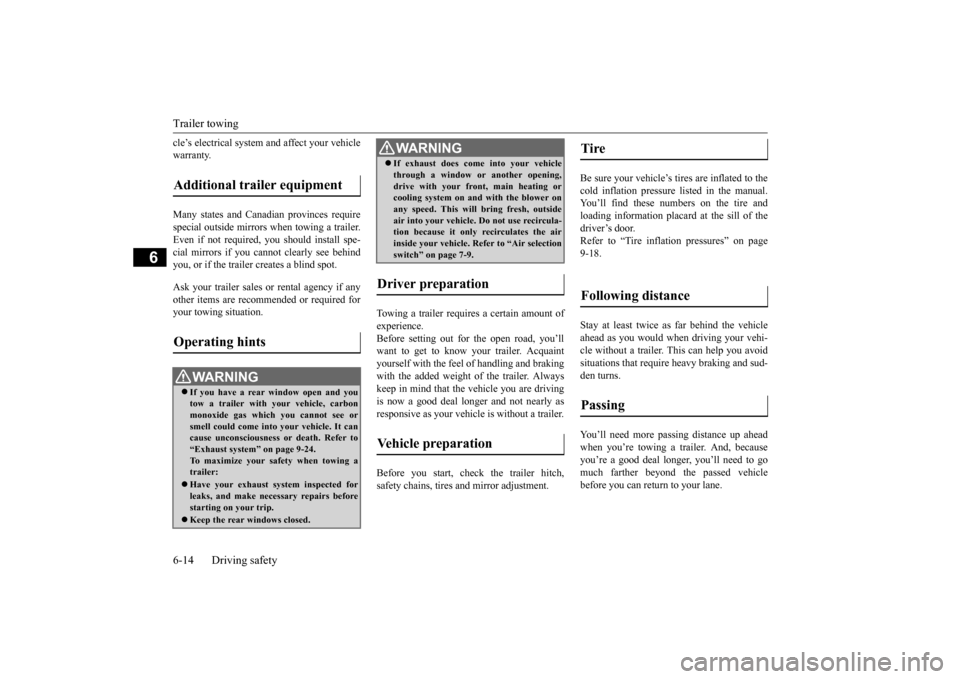
Towing a trailer requires a certain amount of experience. Before setting out for the open road, you’ll want to get to know your trailer. Acquaintyourself with the feel of handling and braking with the added weight of the trailer. Always keep in mind that the vehicle you are drivingis now a good deal longer and not nearly as responsive as your vehicle is without a trailer. Before you start, check the trailer hitch, safety chains, tires and mirror adjustment.
Be sure your vehicle’s ti
res are inflated to the
cold inflation pressure listed in the manual. You’ll find these numbe
rs on the tire and
loading information placard at the sill of the driver’s door. Refer to “Tire inflati
on pressures” on page
9-18. Stay at least twice as far behind the vehicle ahead as you would when driving your vehi-cle without a trailer.
This can help you avoid
situations that require
heavy braking and sud-
den turns. You’ll need more passing distance up ahead when you’re towing a trailer. And, becauseyou’re a good deal longer, you’ll need to go much farther beyond the passed vehicle before you can return to your lane.
Additional trailer equipment Operating hints
WA R N I N G If you have a rear
window open and you
tow a trailer with yo
ur vehicle, carbon
monoxide gas which
you cannot see or
smell could come into your vehicle. It can cause unconsciousness or death. Refer to“Exhaust system” on page 9-24. To maximize your safety when towing a trailer: Have your exhaust system inspected for leaks, and make necessary repairs beforestarting on your trip. Keep the rear
windows closed.
If exhaust does come into your vehicle through a window or
another opening,
drive with your front, main heating orcooling system on an
d with the blower on
any speed. This will
bring fresh, outside
air into your vehicle. Do not use recircula-tion because it only recirculates the air inside your vehicle. Refer to “Air selection switch” on page 7-9.
Driver preparation Vehicle preparation
WA R N I N G
Tire Following distance Passing
BK0211800US.book 14 ページ 2014年3月12日 水曜日 午後2時42分
Page 314 of 446
Trailer towing
Driving safety 6-15
6
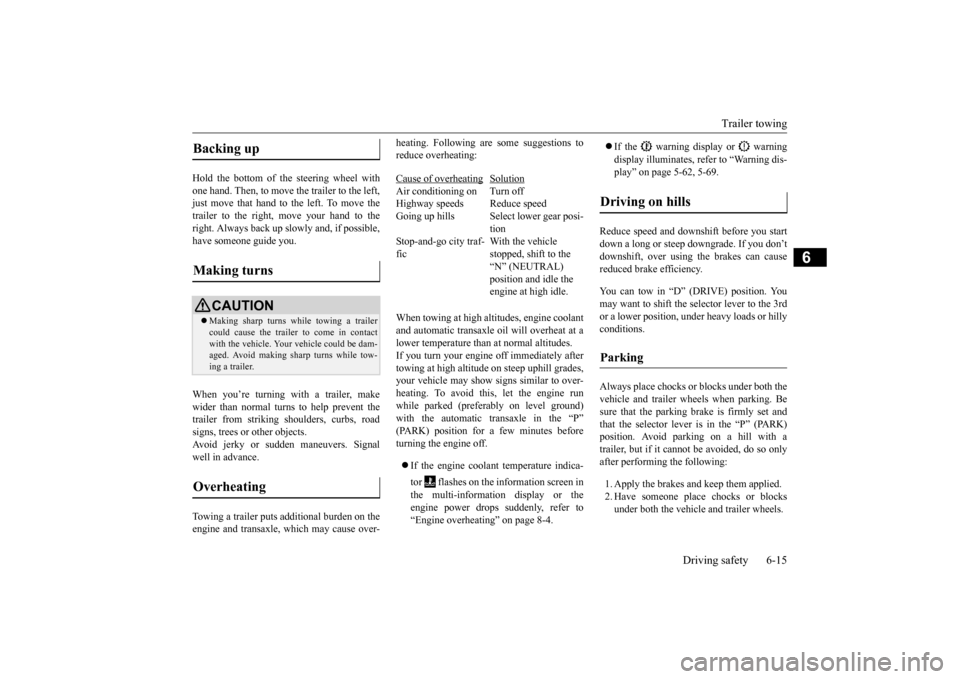
Hold the bottom of the steering wheel with one hand. Then, to move the trailer to the left, just move that hand to the left. To move thetrailer to the right, move your hand to the right. Always back up sl
owly and, if possible,
have someone guide you. When you’re turning with a trailer, make wider than normal turns to help prevent the trailer from striking shoulders, curbs, roadsigns, trees or other objects. Avoid jerky or sudde
n maneuvers. Signal
well in advance. Towing a trailer puts a
dditional burden on the
engine and transaxle,
which may cause over-
heating. Following ar
e some suggestions to
reduce overheating: When towing at high al
titudes, engine coolant
and automatic transaxle oil will overheat at a lower temperature than at normal altitudes.If you turn your engine off immediately after towing at high altitude
on steep uphill grades,
your vehicle may show
signs similar to over-
heating. To avoid this
, let the engine run
while parked (preferably on level ground) with the automatic transaxle in the “P”(PARK) position for a few minutes before turning the engine off. If the engine coolant temperature indica- tor flashes on the in
formation screen in
the multi-information display or the engine power drops suddenly, refer to “Engine overheating” on page 8-4.
If the warning display or warning display illuminates, re
fer to “Warning dis-
play” on page 5-62, 5-69.
Reduce speed and downshift before you start down a long or steep downgrade. If you don’t downshift, over using the brakes can cause reduced brake efficiency. You can tow in “D” (DRIVE) position. You may want to shift the selector lever to the 3rd or a lower position, under heavy loads or hillyconditions. Always place chocks or blocks under both the vehicle and trailer wheels when parking. Be sure that the parking brake is firmly set and that the selector lever is in the “P” (PARK)position. Avoid parki
ng on a hill with a
trailer, but if it cannot be avoided, do so only after performing the following: 1. Apply the brakes and keep them applied. 2. Have someone plac
e chocks or blocks
under both the vehicle
and trailer wheels.
Backing up Making turns
CAUTION Making sharp turns while towing a trailer could cause the
trailer to come in contact
with the vehicle. Your
vehicle could be dam-
aged. Avoid making sharp turns while tow- ing a trailer.
Overheating
Cause of overheating
Solution
Air conditioning on Turn off Highway speeds Reduce speed Going up hills Select lower gear posi-
tion
Stop-and-go city traf- fic
With the vehicle stopped, shift to the “N” (NEUTRAL) position and idle the engine at high idle.
Driving on hills Parking
BK0211800US.book 15 ページ 2014年3月12日 水曜日 午後2時42分
Page 315 of 446

Trailer towing 6-16 Driving safety
6
3. When the chocks or blocks are in place, release your brakes slowly until thechocks or blocks absorb the load. 4. Apply the parking brake firmly. 5. Set the selector lever to the “P” (PARK)position and turn off the engine.
When restarting out after parking on a hill: 1. Check that the selector lever is set to the “P” (PARK) position. 2. Start the engine. Be sure to keep the brake pedal depressed. 3. Set the selector lever to the “D” (DRIVE)position or “R” (REVERSE) position. 4. Release the parking brake and brake pedal and slowly pull or back away from thechocks or blocks. Stop and apply your brakes. 5. Have someone retrieve the chocks orblocks.
BK0211800US.book 16 ページ 2014年3月12日 水曜日 午後2時42分
Page 436 of 446
Vehicle weights
Specifications 11-5
11
N01147601927
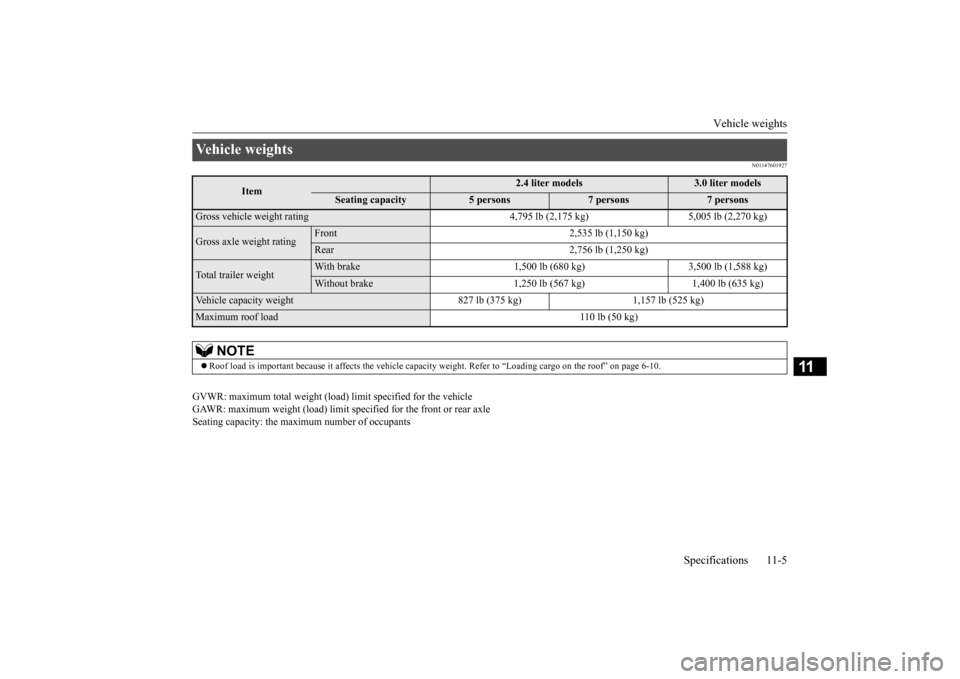
GVWR: maximum total weight (load) limit specified for the vehicle GAWR: maximum weight (load) limit specified for the front or rear axle Seating capacity: the maxi
mum number of occupants
Vehicle weights
Item
2.4 liter models
3.0 liter models
Seating capacity
5 persons
7 persons
7 persons
Gross vehicle weight
rating 4,795 lb (2,175 kg) 5,005 lb (2,270 kg)
Gross axle weight rating
Front 2,535 lb (1,150 kg)Rear 2,756 lb (1,250 kg)
Total trailer weight
With brake 1,500 lb (680 kg) 3,500 lb (1,588 kg)Without brake 1,250 lb (567 kg) 1,400 lb (635 kg)
Vehicle capacity weight 827 lb (375 kg) 1,157 lb (525 kg)Maximum roof load 110 lb (50 kg)
NOTE
Roof load is important becaus
e it affects the vehicle capacity weight. Refe
r to “Loading cargo on the roof” on page 6-10.
BK0211800US.book 5 ページ 2014年3月12日 水曜日 午後2時42分
Page 444 of 446
Alphabetical index
12-5
12
5-53 Wheel lock
............................
5-22
, 5-57
Stop lights
Bulb capacity
.................................
9-30
Replacement
..................................
9-36
Storage spaces
..................................
5-213
Sun visors
........................................
5-209
Sunroof
..............................................
5-50
Super-all wheel control (S-AWC)
S-AWC control mode display
..........
5-79
S-AWC control mode switch
...........
5-78
S-AWC operation display
................
5-79
Supplemental Re
straint System
............
4-33
How the Supplemental Restraint System works
..........................................
4-35
Maintenance service
........................
4-47
T
Tail light
Bulb capacity
.................................
9-30
Replacement
..................................
9-36
Tank capacity
.....................................
11-7
Theft-alarm system
.............................
5-44
Time Setting
.......................................
7-44
Timing belt
........................................
9-24
Tire
...................................................
9-14
Inflation pressure
............................
9-18
Maintenance
...................................
9-19
Quality grading
...............................
10-2
Replacing tires and wheels
..............
9-19
Rotation
........................................
9-20
Size (tire and wheel)
.......................
11-7
Snow tires
.....................................
9-20
Tire and loading information placard 11-3Tire chains
.....................................
9-21
To change a tire
................................
8-6
Tread wear indicator
.......................
9-19
Tire pressure monitoring system
.........
5-114
Tools
...................................................
8-6
Storage
............................................
8-5
Towing
..............................................
8-14
Trailer towing
....................................
6-11
Transfer oil
................................
9-11
, 11-7
Turn signal light
Indicators
.....................................
5-166
Lever
...........................................
5-176
U
USB input terminal
............................
5-206
How to connect a USB memory device
....
5-206 How to connect an iPod
.................
5-207
V
Vanity mirror
....................................
5-209
Vanity mirror lights
Bulb capacity
.................................
9-32
Vehicle care precautions
.....................
9-39
Vehicle dimensions
.............................
11-4
Vehicle labeling
..................................
11-2
Vehicle preparation before driving
..........
6-4
Vehicle weights
..................................
11-5
Vents
...................................................
7-2
W
Warning lights
..................................
5-167
Washer
Fluid
.....................................
9-12
, 11-7
Rear window washer
.....................
5-182
Switch
.........................................
5-182
Washing
.............................................
9-40
Waxing
..............................................
9-41
Weights
.............................................
11-5
Wheel
Covers
...........................................
8-13
Specification
..................................
11-7
Wiper
Rear window wiper
.......................
5-182
Switch
.........................................
5-178
Wiper blades
..................................
9-21
BK0211800US.book 5 ページ 2014年3月12日 水曜日 午後2時42分