display MITSUBISHI OUTLANDER 2016 3.G Owner's Guide
[x] Cancel search | Manufacturer: MITSUBISHI, Model Year: 2016, Model line: OUTLANDER, Model: MITSUBISHI OUTLANDER 2016 3.GPages: 464, PDF Size: 60.77 MB
Page 145 of 464
Automatic transaxle (if so equipped)
Features and controls 5-69
5
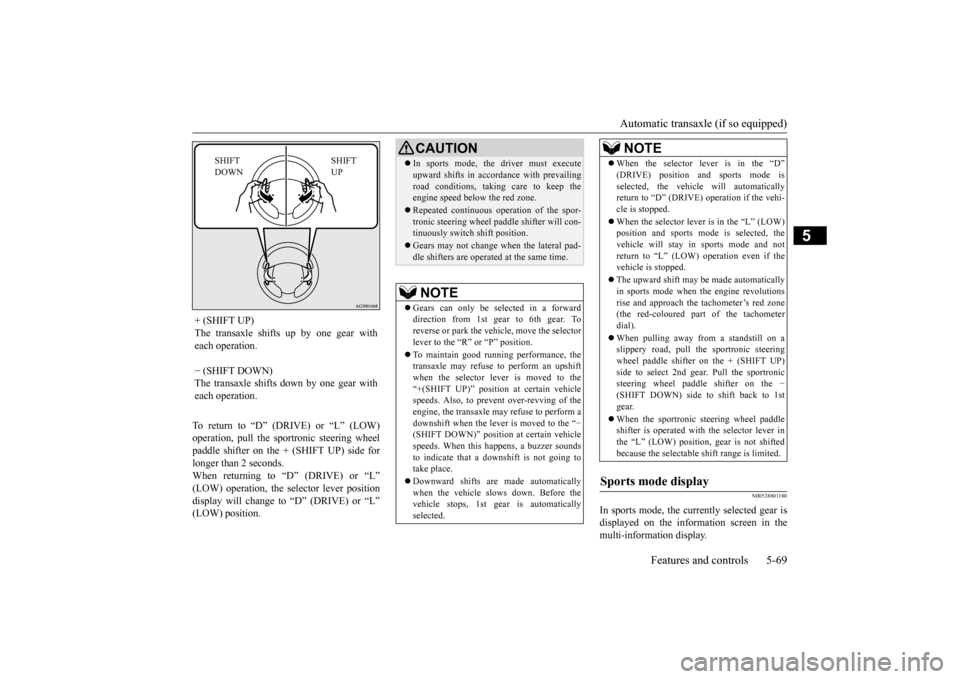
To return to “D” (DRIVE) or “L” (LOW) operation, pull the sportronic steering wheelpaddle shifter on the + (SHIFT UP) side for longer than 2 seconds. When returning to “D” (DRIVE) or “L”(LOW) operation, the selector lever position display will change to “D” (DRIVE) or “L” (LOW) position.
N00538801180
In sports mode, the curre
ntly selected gear is
displayed on the information screen in the multi-information display.
+ (SHIFT UP) The transaxle shifts up by one gear with each operation. − (SHIFT DOWN) The transaxle shifts down by one gear witheach operation.
SHIFT UP
SHIFT DOWN
CAUTION In sports mode, the driver must execute upward shifts in accordance with prevailingroad conditions, taking care to keep theengine speed below the red zone. Repeated continuous ope
ration of the spor-
tronic steering wheel pa
ddle shifter will con-
tinuously switch shift position. Gears may not change when the lateral pad- dle shifters are operated at the same time. NOTE
Gears can only be selected in a forward direction from 1st gear to 6th gear. Toreverse or park the vehi
cle, move the selector
lever to the “R” or “P” position. To maintain good running performance, the transaxle may refuse to perform an upshift when the selector lever is moved to the“+(SHIFT UP)” positi
on at certain vehicle
speeds. Also, to prevent over-revving of the engine, the transaxle may refuse to perform adownshift when the lever is moved to the “
−
(SHIFT DOWN)” position
at certain vehicle
speeds. When this happens, a buzzer soundsto indicate that a dow
nshift is not going to
take place. Downward shifts are made automatically when the vehicle slows down. Before the vehicle stops, 1st ge
ar is automatically
selected.
When the selector lever is in the “D” (DRIVE) position and sports mode isselected, the vehicle will automaticallyreturn to “D” (DRIVE)
operation if the vehi-
cle is stopped. When the selector lever is in the “L” (LOW) position and sports mode is selected, the vehicle will stay in
sports mode and not
return to “L” (LOW) operation even if the vehicle is stopped. The upward shift may be
made automatically
in sports mode when the engine revolutions rise and approach the tachometer’s red zone(the red-coloured part of the tachometer dial). When pulling away from a standstill on a slippery road, pull the sportronic steering wheel paddle shifter on the + (SHIFT UP)side to select 2nd gear
. Pull the sportronic
steering wheel paddle shifter on the
−
(SHIFT DOWN) side to shift back to 1stgear. When the sportronic steering wheel paddle shifter is operated with the selector lever in the “L” (LOW) position, gear is not shifted because the selectable shift range is limited.
Sports mode display
NOTE
BK0223400US.book 69 ページ 2015年2月13日 金曜日 午後12時15分
Page 146 of 464
Automatic transaxle (if so equipped) 5-70 Features and controls
5
N00514501369
To gain extra acceleration in “D” (DRIVE) position (when passing an
other vehicle) push
the accelerator to the floor. The automatictransaxle will automatically downshift.
NOTE
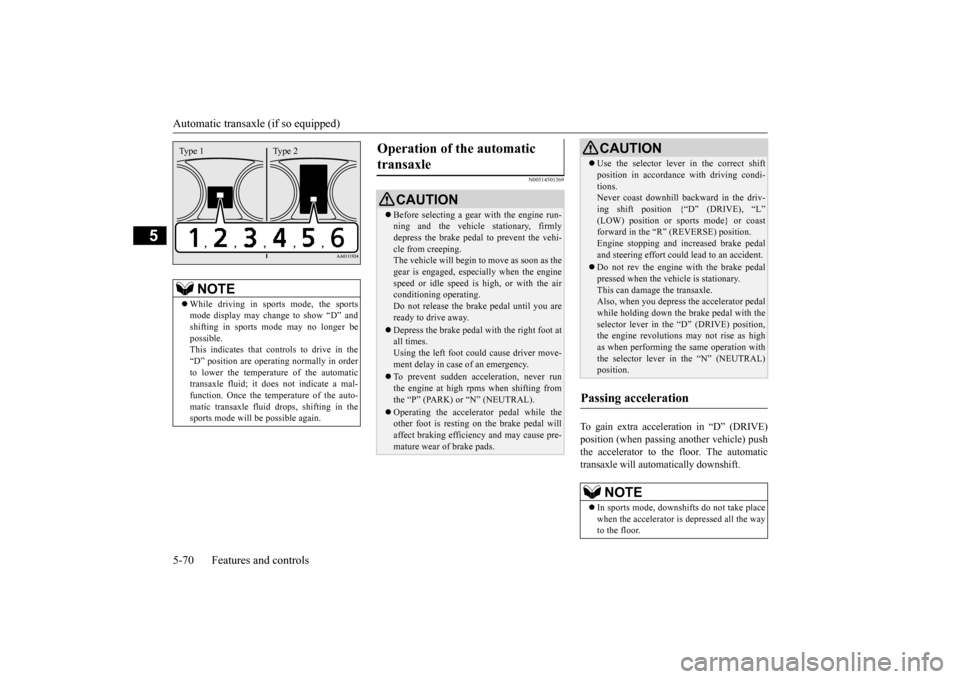
While driving in sports mode, the sports mode display may change to show “D” andshifting in sports
mode may no longer be
possible. This indicates that controls to drive in the“D” position are operati
ng normally in order
to lower the temperature of the automatic transaxle fluid; it doe
s not indicate a mal-
function. Once the temperature of the auto- matic transaxle fluid
drops, shifting in the
sports mode will be possible again.Type 1 Type 2
Operation of the automatic transaxle
CAUTION Before selecting a gear
with the engine run-
ning and the vehicle stationary, firmly depress the brake pedal to prevent the vehi-cle from creeping. The vehicle will begin to move as soon as the gear is engaged, espe
cially when the engine
speed or idle speed is
high, or with the air
conditioning operating. Do not release the brak
e pedal until you are
ready to drive away. Depress the brake pedal with the right foot at all times. Using the left foot c
ould cause driver move-
ment delay in case of an emergency. To prevent sudden acce
leration, never run
the engine at high rpms when shifting fromthe “P” (PARK) or “N” (NEUTRAL). Operating the accelerator pedal while the other foot is resting on the brake pedal will affect braking efficiency and may cause pre- mature wear of brake pads.
Use the selector lever in the correct shift position in accordance
with driving condi-
tions.Never coast downhill backward in the driv- ing shift position {“D” (DRIVE), “L” (LOW) position or sports mode} or coastforward in the “R” (REVERSE) position. Engine stopping and in
creased brake pedal
and steering effort could
lead to an accident.
Do not rev the engine
with the brake pedal
pressed when the vehi
cle is stationary.
This can damage the transaxle. Also, when you depress
the accelera
tor pedal
while holding down the brake pedal with theselector lever in the “D” (DRIVE) position, the engine revolutions
may not rise as high
as when performing the same operation withthe selector lever in the “N” (NEUTRAL) position.
Passing acceleration
NOTE
In sports mode, downshi
fts do not take place
when the accelerator is depressed all the wayto the floor.CAUTION
BK0223400US.book 70 ページ 2015年2月13日 金曜日 午後12時15分
Page 147 of 464
Continuously variable transmission (CVT) (if so equipped)
Features and controls 5-71
5
For short waiting periods, such as at traffic lights, the vehicle can be
left in gear and held
stationary with the service brake.For longer waiting periods with the engine running, place th
e selector lever in the “N”
(NEUTRAL) position and apply the parkingbrake, while holding th
e vehicle stationary
with the service brake. Prior to moving off after having stopped the vehicle, make sure that the selector lever is in “D” (DRIVE) position or Sports mode posi-tion. To park the vehicle, fi
rst bring it to a com-
plete stop, fully engage the parking brake,
and then move the selector lever to the “P” (PARK) position. If the transaxle does not change gears while driving, or your vehicle does not pick up enough speed when starting on an uphillslope, it may be that there is something unusual happening in the transaxle, causing a safety device to acti
vate. Have your vehicle
checked at an authoriz
ed Mitsubishi Motors
dealer or a repair facility of your choice assoon as possible.
N00560201060
The CVT will automatically and continuouslychange its gear ratio depending on road anddriving conditions. This helps achieve smooth driving and excellent fuel efficiency. If your vehicle is equipped with the spor- tronic steering wheel paddle shifter, you can manually shift up and shift down the trans-mission. Refer to “Sports mode” on page 5-76. The transmission prevents unnecessary upshifts even when the accelerator pedal is released and ensures smooth driving. According to the conditions, the transmission will automatically shift to a lower gear ratioto achieve stronger engine braking. This may help reduce your need
to use the service
brake.
Waiting
CAUTION To avoid transaxle overheating, never try to keep your vehicle stationary on a hill by using the accelerator
pedal. Always apply
the parking brake and/or service brake. Do not rev the engine unnecessarily while the vehicle is stationary. Unexpected acceler-ation may occur if the se
lector lever is in a
position other than “P” (PARK) or “N” (NEUTRAL).
Parking
When the automatic transaxle makes no gear change
NOTE
When the warning display and “SLOW DOWN” or the wa
rning display and
“SERVICE REQUIRED” appear on the information screen in the multi-information display, there could be
a malfunction in the
automatic transaxle. Refer to “Automatic transaxle: Warning di
splay” on page 5-66.
Continuously variable transmission (CVT)
(if so
equipped)DRIVING UPHILL
DRIVING DOWNHILL
BK0223400US.book 71 ページ 2015年2月13日 金曜日 午後12時15分
Page 148 of 464
Continuously variable transmission (CVT) (if so equipped) 5-72 Features and controls
5
N00560301074
As an additional safe
ty precaution, models
equipped with a conti
nuously variable trans-
mission have a shift-lo
ck device that holds
the selector lever in the “P” (PARK) position. To move the selector lever from the “P” (PARK) position to a
nother position, follow
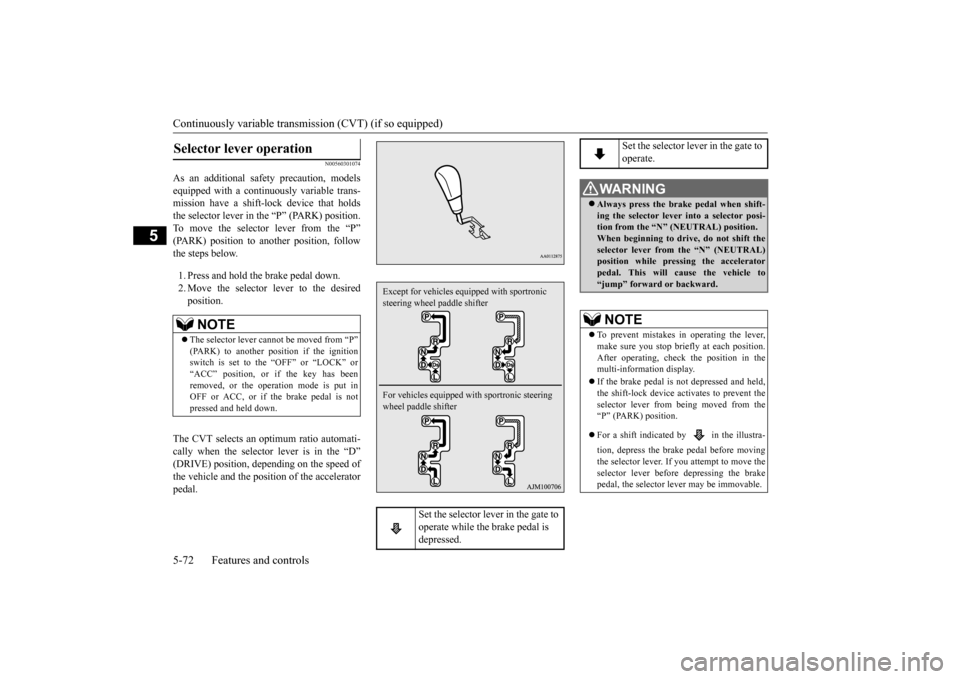
the steps below. 1. Press and hold the brake pedal down. 2. Move the selector
lever to the desired
position.
The CVT selects an optimum ratio automati- cally when the selector lever is in the “D” (DRIVE) position, depending on the speed ofthe vehicle and the position of the accelerator pedal.Selector lever operation
NOTE
The selector lever cannot
be moved from “P”
(PARK) to another pos
ition if the ignition
switch is set to the “OFF” or “LOCK” or“ACC” position, or
if the key has been
removed, or the operation mode is put in OFF or ACC, or if the brake pedal is notpressed and held down.
Set the selector lever in the gate to operate while the brake pedal is depressed.
Except for vehicles equipped with sportronic steering wheel paddle shifter For vehicles equipped with sportronic steering wheel paddle shifter
Set the selector lever in the gate to operate.
WA R N I N G Always press the brake pedal when shift- ing the selector lever into a selector posi- tion from the “N”
(NEUTRAL) position.
When beginning to drive, do not shift theselector lever from
the “N” (NEUTRAL)
position while pressing the accelerator pedal. This will cause the vehicle to“jump” forward or backward.NOTE
To prevent mistakes in operating the lever, make sure you stop brie
fly at each position.
After operating, check the position in the multi-information display. If the brake pedal is not
depressed and held,
the shift-lock device activates to prevent theselector lever from being moved from the “P” (PARK) position. For a shift indicated by in the illustra- tion, depress the brake pedal before moving the selector lever. If you attempt to move theselector lever before
depressing the brake
pedal, the selector le
ver may be immovable.
BK0223400US.book 72 ページ 2015年2月13日 金曜日 午後12時15分
Page 149 of 464
Continuously variable transmission (CVT) (if so equipped)
Features and controls 5-73
5
N00563301059
When the selector lever cannot be shifted from the “P” (PARK) position to anotherposition while the brake
pedal is pressed and
held down with the i
gnition switch at the
“ON” position or the operation mode in ON,the battery may be flat or the shift-lock mech- anism may be malfunctioning. Immediately have your
vehicle checked by an
authorized Mitsubishi Motors dealer or a repair facility
of your choice.
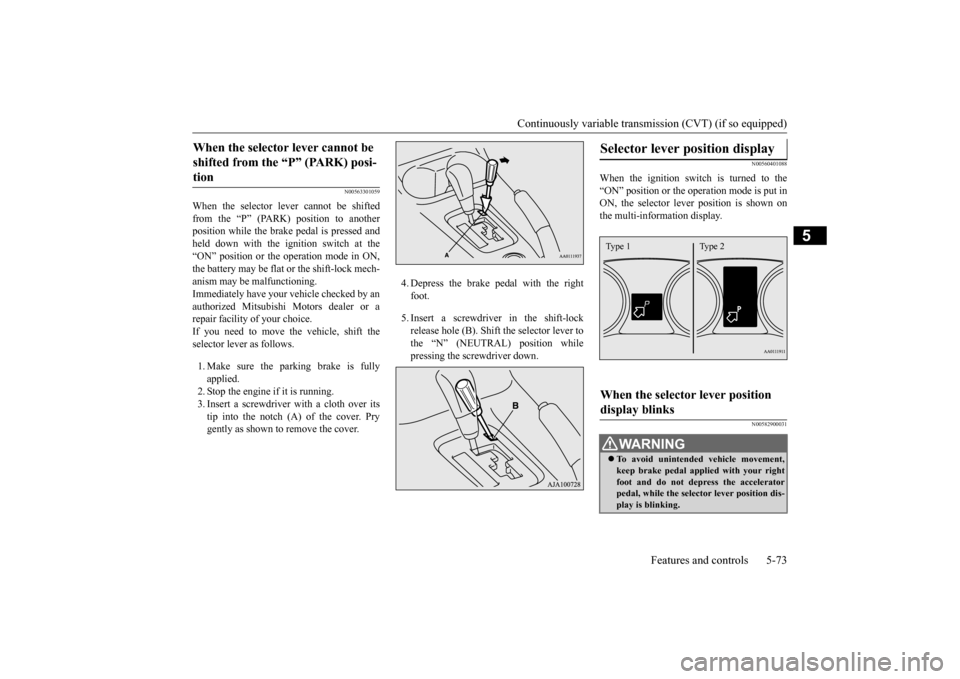
If you need to move the vehicle, shift the selector lever as follows. 1. Make sure the parking brake is fully applied.2. Stop the engine if it is running. 3. Insert a screwdrive
r with a cloth over its
tip into the notch (A) of the cover. Prygently as shown to remove the cover.
4. Depress the brake pedal with the right foot. 5. Insert a screwdriver in the shift-lock release hole (B). Shift the selector lever to the “N” (NEUTRAL) position while pressing the screwdriver down.
N00560401088
When the ignition switch is turned to the “ON” position or the operation mode is put in ON, the selector lever position is shown onthe multi-information display.
N00582900031
When the selector lever cannot be shifted from the “P” (PARK) posi-tion
Selector lever position display
When the selector lever position display blinks
WA R N I N G To avoid unintended
vehicle mo
vement,
keep brake pedal applied with your right foot and do not depress the accelerator pedal, while the selector lever position dis-play is blinking.Type 1 Type 2
BK0223400US.book 73 ページ 2015年2月13日 金曜日 午後12時15分
Page 150 of 464
Continuously variable transmission (CVT) (if so equipped) 5-74 Features and controls
5
If the ambient temperature is low, the selector lever position display
on the multi informa-
tion display may blink when the selector lever is placed in the “D” (DRIVE), “Ds” (DOWNSHIFT & SPORTY DRIVING), “L”(LOW) or “R” (REVERSE) position immedi- ately after the engine has been started. This indicates that the transmission requires warm-ing up. While the display is blinking, the vehicle will not move,
because the transmis-
sion keeps disengaging
until the warm up is
completed even if the selector lever is placed in the “D”, “Ds”, “L” or “R” position. When the selector lever position display is blinking, perform the following procedure: 1. Depress the brake pedal with your right foot and place the selector lever in the “N” (NEUTRAL) posi
tion for several
seconds. 2. Keep depressing the brake pedal and then place the selector lever in the “D”(DRIVE), “Ds” (DOWNSHIFT & SPORTY DRIVING), “L” (LOW) or “R” (REVERSE) position. If
the selector lever
position display stop
s blinking, the warm
up is completed and the transmission will function normally.3. If the display is still
blinking, repeat steps
1 and 2 above.
N00560501076
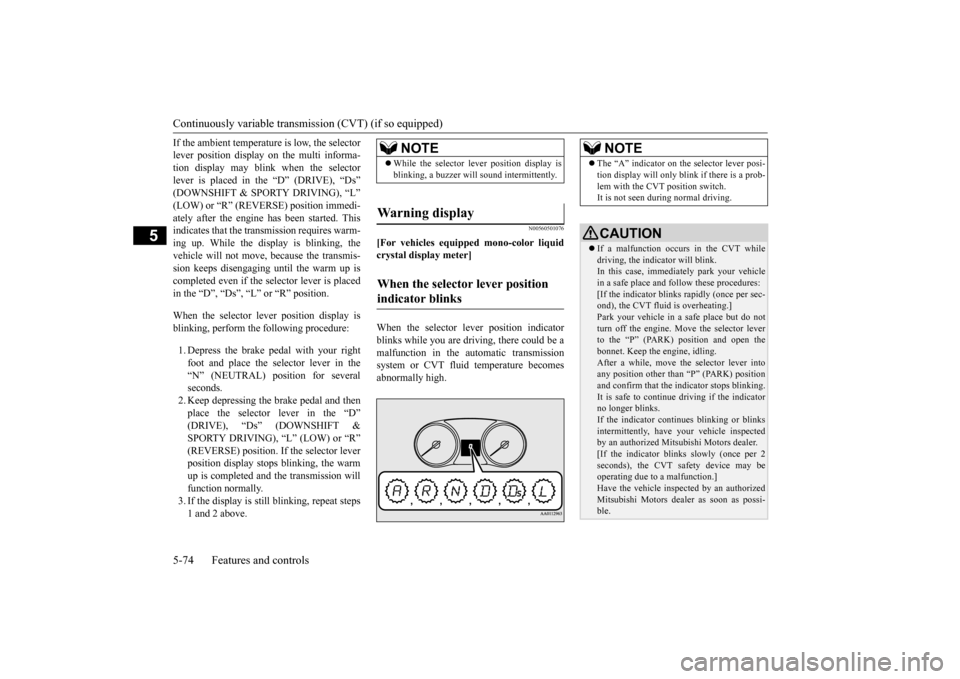
[For vehicles equipped mono-color liquid crystal display meter] When the selector le
ver position indicator
blinks while you are driv
ing, there could be a
malfunction in the automatic transmissionsystem or CVT fluid
temperature becomes
abnormally high.
NOTE
While the selector le
ver position display is
blinking, a buzzer will
sound intermittently.
Wa r n i n g d i s p l a y
When the selector lever position indicator blinks
NOTE
The “A” indicator on th
e selector lever posi-
tion display will only blink if there is a prob-lem with the CVT position switch.It is not seen during normal driving.CAUTION If a malfunction occurs in the CVT while driving, the indicator will blink. In this case, immediat
ely park your vehicle
in a safe place and fo
llow these procedures:
[If the indicator blinks
rapidly (once per sec-
ond), the CVT fluid is overheating.]Park your vehicle in a safe place but do not turn off the engine. M
ove the selector lever
to the “P” (PARK) position and open thebonnet. Keep the engine, idling. After a while, move the selector lever into any position other than “P” (PARK) positionand confirm that the i
ndicator stops blinking.
It is safe to continue driving if the indicator no longer blinks.If the indicator conti
nues blinking or blinks
intermittently, have
your vehicle inspected
by an authorized Mitsubishi Motors dealer.[If the indicator blinks slowly (once per 2seconds), the CVT sa
fety device may be
operating due to a malfunction.] Have the vehicle inspected by an authorizedMitsubishi Motors deal
er as soon as possi-
ble.
BK0223400US.book 74 ページ 2015年2月13日 金曜日 午後12時15分
Page 151 of 464
![MITSUBISHI OUTLANDER 2016 3.G Owners Guide Continuously variable transmission (CVT) (if so equipped)
Features and controls 5-75
5
[For vehicles equipped with color liquid crystal display meter]
or
When the warning display or the warn-](/img/19/7535/w960_7535-150.png "MITSUBISHI OUTLANDER 2016 3.G Owners Guide Continuously variable transmission (CVT) (if so equipped)
Features and controls 5-75
5
[For vehicles equipped with color liquid crystal display meter]
or
When the warning display or the warn-")
Continuously variable transmission (CVT) (if so equipped)
Features and controls 5-75
5
[For vehicles equipped with color liquid crystal display meter]
or
When the warning display or the warn- ing display appears on
the information screen
in the multi-information display while you are driving, there could be a malfunction inthe CVT.
N00560601080
This position locks the transmission to pre- vent the vehicle from moving. The engine can be started from the “P” (PARK) position. Move the lever to this position only after the vehicle has come to a complete stop.
At this position, the
transmission is disen-
gaged. It is the same
as the neutral position on
a manual transaxle and should be used whenthe vehicle is not moving for an extended length of time during driving, such as in a traffic jam.
CAUTION If a malfunction occurs in the CVT while driving, the warning display or the warning display will appear on the informa- tion screen in the multi-information display. In this case, follow
these procedures:
[When warning di
splay is showing]
The continuously variable transmission (CVT) fluid is overhea
ting. The engine con-
trol may activate to
lower the CVT fluid tem-
perature, causing the e
ngine revolutions and
vehicle speed to decrea
se, In this case, take
one of the following procedures.• Slow down your vehicle.• Stop your vehicle in a
safe place, put the
selector lever in the “P” (PARK) position,and open the engine hood with the engine running to allow the engine to cool down.
After a while, confirm that the warning display is no longer showing. It is safe to continue driving if the display is no longer showing. If the warning display remains or flashes frequently,
have your vehicle
inspected by an authorized Mitsubishi Motors dealer or a repair facility of your choice. [When warning display is showing] It may be that there is something unusual happening in the CVT, causing a safety device to activate.
Have your vehicle
inspected by an authorized MitsubishiMotors dealer or a repair facility of your choice as soon as possible.
Selector lever positions
“P” PARK
“R” REVERSE
CAUTION
CAUTION Never shift into the “P” (PARK) or “R” (REVERSE) position while the vehicle is inmotion. If the lever is shifted into the “P”(PARK) or “R” (REVERSE) position while the vehicle is in motion, the transmission may be damaged.
“N” NEUTRAL
WA R N I N G Never move the select
or lever to the “N”
(NEUTRAL) position while driving since you could accidentally
slip it into the “P”
(PARK) or “R” (REVERSE) position, damaging the transmission. To prevent the vehicle from rolling when stopped on a slope,
the engine should be
started in the “P” (PARK) position, not in “N” (NEUTRAL) position.
BK0223400US.book 75 ページ 2015年2月13日 金曜日 午後12時15分
Page 153 of 464
Continuously variable transmission (CVT) (if so equipped)
Features and controls 5-77
5
When returning to “D” (DRIVE) operation, the selector lever posi
tion display will change
to “D” (DRIVE) position.
N00560901067
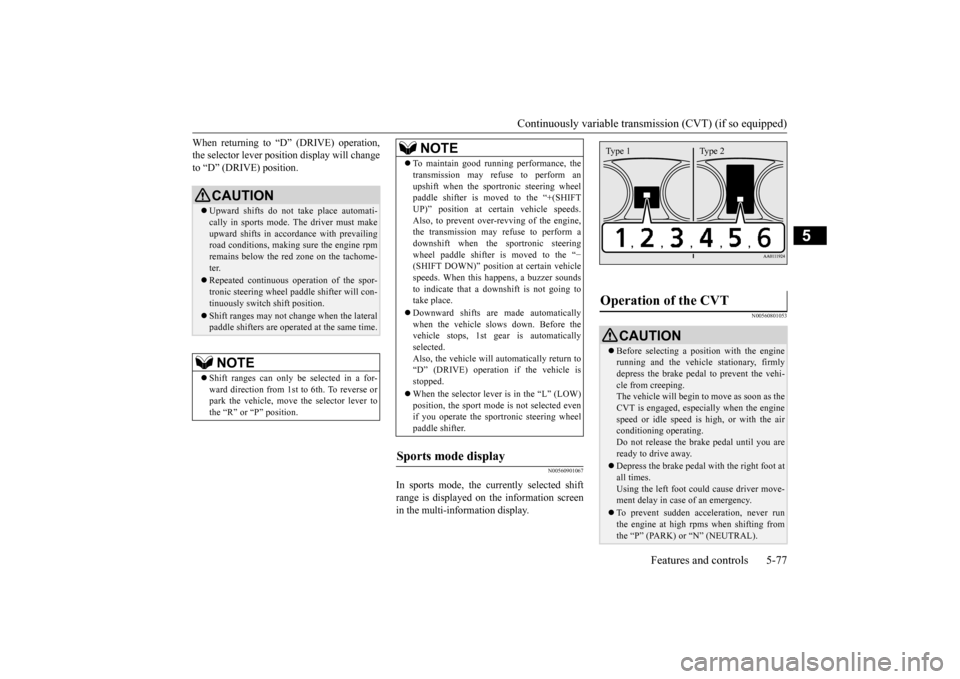
In sports mode, the currently selected shift range is displayed on the information screen in the multi-information display.
N00560801053
CAUTION Upward shifts do not
take place automati-
cally in sports mode. The driver must makeupward shifts in accordance with prevailing road conditions, making sure the engine rpm remains below the red zone on the tachome-ter. Repeated continuous ope
ration of the spor-
tronic steering wheel pa
ddle shifter will con-
tinuously switch shift position. Shift ranges may not cha
nge when the lateral
paddle shifters are opera
ted at the same time.
NOTE
Shift ranges can only be
selected in a for-
ward direction from 1st to 6th. To reverse orpark the vehicle, move
the selector lever to
the “R” or “P” position.
To maintain good running performance, the transmission may refuse to perform anupshift when the sportronic steering wheelpaddle shifter is moved to the “+(SHIFT UP)” position at cert
ain vehicle speeds.
Also, to prevent over-revving of the engine,the transmission may refuse to perform a downshift when the
sportronic steering
wheel paddle shifter is moved to the “
−
(SHIFT DOWN)” position
at certain vehicle
speeds. When this happens, a buzzer sounds to indicate that a dow
nshift is not going to
take place. Downward shifts are made automatically when the vehicle slows down. Before the vehicle stops, 1st ge
ar is automatically
selected.Also, the vehicle will automatically return to “D” (DRIVE) operation
if the vehicle is
stopped. When the selector lever is in the “L” (LOW) position, the sport mode
is not selected even
if you operate the spor
tronic steering wheel
paddle shifter.
Sports mode display
NOTE
Operation of the CVT
CAUTION Before selecting a pos
ition with the engine
running and the vehicl
e stationary, firmly
depress the brake pedal to prevent the vehi-cle from creeping. The vehicle will begin to move as soon as the CVT is engaged, especi
ally when the engine
speed or idle speed is
high, or with the air
conditioning operating. Do not release the brak
e pedal until you are
ready to drive away. Depress the brake pedal
with the right foot at
all times. Using the left foot could cause driver move- ment delay in case of an emergency. To prevent sudden acce
leration, never run
the engine at high rpms when shifting fromthe “P” (PARK) or “N” (NEUTRAL).Type 1 Type 2
BK0223400US.book 77 ページ 2015年2月13日 金曜日 午後12時15分
Page 155 of 464
Electronically controlled 4WD system (if so equipped)
Features and controls 5-79
5
N00548301032
The electronically controlled 4WD system helps improve accelerati
on and vehicle stabil-
ity by controlling the front-rear distribution ofdriving torque using the electronic control coupling in the rear differential assembly.
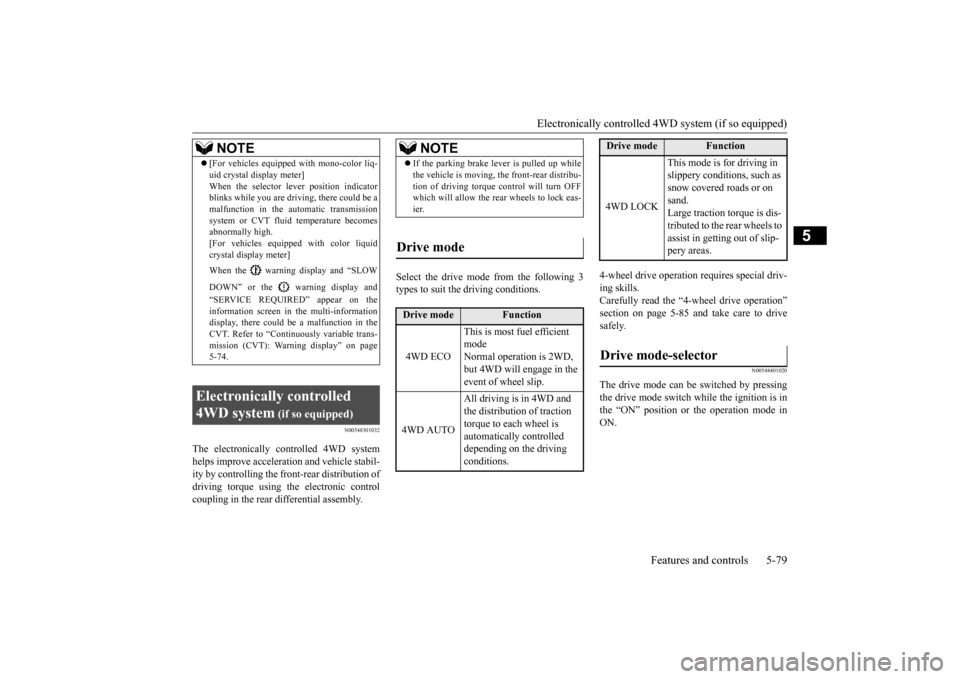
Select the drive mode from the following 3 types to suit the driving conditions.
4-wheel drive operation requires special driv- ing skills.Carefully read the “4-wheel drive operation” section on page 5-85 and take care to drive safely.
N00548401020
The drive mode can be switched by pressingthe drive mode switch while the ignition is in the “ON” position or the operation mode in ON.
NOTE
[For vehicles equipped with mono-color liq- uid crystal display meter]When the selector le
ver position indicator
blinks while you are driving, there could be a malfunction in the automatic transmission system or CVT fluid temperature becomesabnormally high. [For vehicles equippe
d with color liquid
crystal display meter] When the warning display and “SLOW DOWN” or the warning display and “SERVICE REQUIRED” appear on the information screen in
the multi-information
display, there could be
a malfunction in the
CVT. Refer to “Continuously variable trans- mission (CVT): Warning display” on page5-74.
Electronically controlled 4WD system
(if so equipped)
NOTE
If the parking brake le
ver is pulled up while
the vehicle is moving,
the front-rear distribu-
tion of driving torque control will turn OFFwhich will allow the rear wheels to lock eas- ier.
Drive mode
Drive mode
Function
4WD ECO
This is most fuel efficient modeNormal operation is 2WD, but 4WD will engage in the event of wheel slip.
4WD AUTO
All driving is in 4WD and the distribution of traction torque to each wheel is automatically controlled depending on the driving conditions.
4WD LOCK
This mode is for driving in slippery conditions, such as snow covered roads or on sand. Large traction torque is dis-tributed to the rear wheels to assist in getting out of slip- pery areas.
Drive mode-selector
Drive mode
Function
BK0223400US.book 79 ページ 2015年2月13日 金曜日 午後12時15分
Page 156 of 464
Electronically controlled 4W
D system (if so equipped)
5-80 Features and controls
5
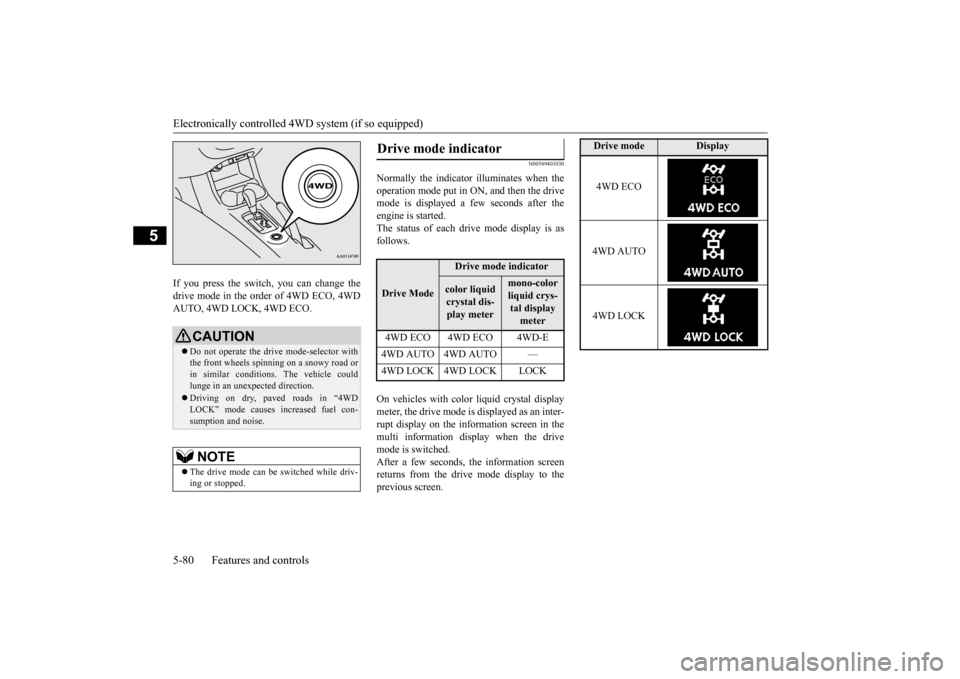
If you press the switch, you can change the drive mode in the order of 4WD ECO, 4WDAUTO, 4WD LOCK, 4WD ECO.
N00549401030
Normally the indicator illuminates when the operation mode put in ON, and then the drive mode is displayed a
few seconds after the
engine is started. The status of each dr
ive mode display is as
follows. On vehicles with color liquid crystal display meter, the drive mode is displayed as an inter- rupt display on the information screen in themulti information display when the drive mode is switched. After a few seconds, the information screenreturns from the drive mode display to the previous screen.
CAUTION Do not operate the dr
ive mode-selector with
the front wheels spinning on a snowy road or in similar conditions
. The vehicle could
lunge in an unexpected direction. Driving on dry, paved roads in “4WD LOCK” mode causes increased fuel con-sumption and noise.NOTE
The drive mode can be
switched while driv-
ing or stopped.
Drive mode indicator
Drive Mode
Drive mode indicatorcolor liquid crystal dis-play meter
mono-color liquid crys- tal display meter
4WD ECO 4WD ECO 4WD-E 4WD AUTO 4WD AUTO — 4WD LOCK 4WD LOCK LOCK
Drive mode
Display
4WD ECO 4WD AUTO 4WD LOCK
BK0223400US.book 80 ページ 2015年2月13日 金曜日 午後12時15分