tow MITSUBISHI OUTLANDER III 2017 Workshop Manual
[x] Cancel search | Manufacturer: MITSUBISHI, Model Year: 2017, Model line: OUTLANDER III, Model: MITSUBISHI OUTLANDER III 2017Pages: 521, PDF Size: 14.95 MB
Page 437 of 521
If the vehicle breaks down 8-2 For emergencies
8
N00836301230
If your vehicle breaks down on the road, move to the shoulder and turn on the hazard warning flashers. If there is no shoulder, orthe shoulder is not safe, drive in the right lane slowly with the hazard
lights flashing, until
you come to a safe stopping place. Keep theflashers flashing. If the engine stops, there will be no power assist to the steering and brakes, making these difficult to use. The brake booster will not work, so the brakes will not grip well. The brake pedal will be harder to press than usual. Since there is no power steering assist, the steering wheel will be hard to turn.
Get help from your passengers, bystanders, etc. to push the vehicle
and move it to a safe
area.
N00836401778
If the engine cannot be started because the battery is weak or de
ad, you can start it with
the battery from anothe
r vehicle using jumper
cables. 1. Take off any metal jewelry such as watch bands or bracelets th
at might create an
accidental electrical contact. 2. Position the vehi
cles close enough
together so that the jumper cables canreach, but be sure the vehicles aren’t touching each other.
3. Set the parking brake firmly on your vehi- cle and move the selector lever into the “P” (PARK) position. 4. Set the parking brake firmly on the othervehicle. Put the automatic transaxle in “P”5. Turn the ignition switch (the engine switch) on each vehicle to the “LOCK” or “OFF” position. 6. Make sure your battery electrolyte is at the proper level. (Refer to “Battery” on page 9-13.)
If the vehicle breaks down If the engine stops/fails When the engine fails at the intersection
Jump-starting the engine
WA R N I N G To reduce the risk of igniting flammable gas that may be emitted from the battery,carefully read this section before jump- starting the vehicle. Do not try to start you
r vehicle by pushing
or towing. This can cause an accident resulting in serious
injury or death and
can damage the vehicle.NOTE
Do not use jumper cables if they have dam- age or corrosion.
CAUTION Check the other vehicle.
It must have a 12-
volt battery. If the other system isn’t 12-volt,both systems can be damaged.NOTE
Turn off all lights, heat
er, and othe
r electrical
loads. This will avoid sparks and help saveboth batteries.
BK0239700US.book 2 ページ 2016年6月16日 木曜日 午前10時58分
Page 440 of 521
Jack and tools
For emergencies 8-5
8
6. When you do not see any more steam or spray, open the hood. Look for obviousleaks, such as a split radiator hose. Be careful as components will be hot. Any leak source must be repaired.7. If there is no obvious leak source, check the coolant level in the engine coolant reserve tank. If there is
none, or if it is too
low, slowly add coolant. 8. If the engine coolant reserve tank needs coolant, you will probably also need toadd coolant to the radiator. Do not loosen or remove the radiator cap until the engine has cooled down.
9. Start the engine, a
nd slowly add coolant,
up to the bottom of the filler neck. Use plain water if you have to (and replace itwith the right coolant as soon as possible).
10. Replace the radiator cap and tighten it
fully. Check the engine coolant tempera-ture display on the mu
lti information dis-
play (Color liquid crystal display type) or the high coolant temperature warninglight (Mono-color liqui
d crystal display
type). You can start driving again when the high coolant temperature warningdoes not come on.
11. Have the system inspected by your autho-
rized Mitsubishi Motors
dealer or a repair
facility of your choice.
N00836601389
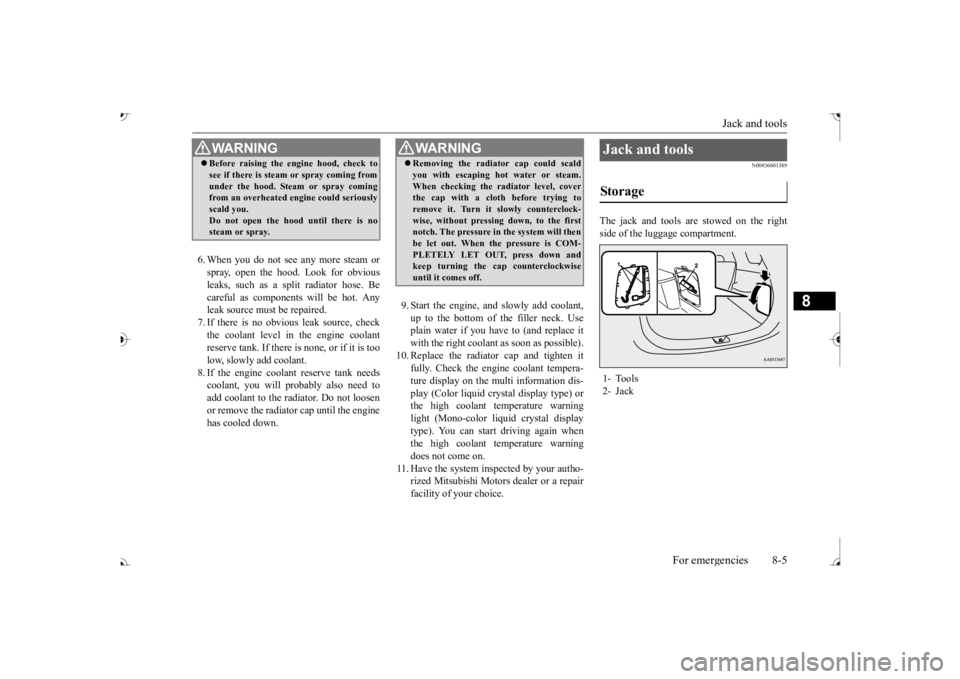
The jack and tools are stowed on the right side of the luggage compartment.
WA R N I N G Before raising the en
gine hood, check to
see if there is steam or spray coming fromunder the hood. Steam or spray comingfrom an overheated en
gine could seriously
scald you. Do not open the hood until there is nosteam or spray.
WA R N I N G Removing the radiat
or cap could scald
you with escaping hot water or steam.When checking the radiator level, coverthe cap with a cloth before trying to remove it. Turn it slowly counterclock- wise, without pressing down, to the firstnotch. The pressure in the system will then be let out. When the pressure is COM- PLETELY LET OUT, press down andkeep turning the cap counterclockwise until it comes off.
Jack and tools Storage 1- Tools 2- Jack
BK0239700US.book 5 ページ 2016年6月16日 木曜日 午前10時58分
Page 442 of 521
How to change a tire
For emergencies 8-7
8
6. Get the jack, bar and wheel nut wrench ready.(Refer to “Jack and t
ools” on page 8-5.)
N00849600315
The compact spare tire is stowed below the luggage compartment fl
oor. It is designed to
save space in the luggage compartment. Itslighter weight makes it easier to use if a flat tire occurs.
WA R N I N G Be sure to apply choc
ks or blocks to the
correct tire when jacking up the vehicle. Ifthe vehicle moves while jacked up, the jack could slip out of
position, leading to
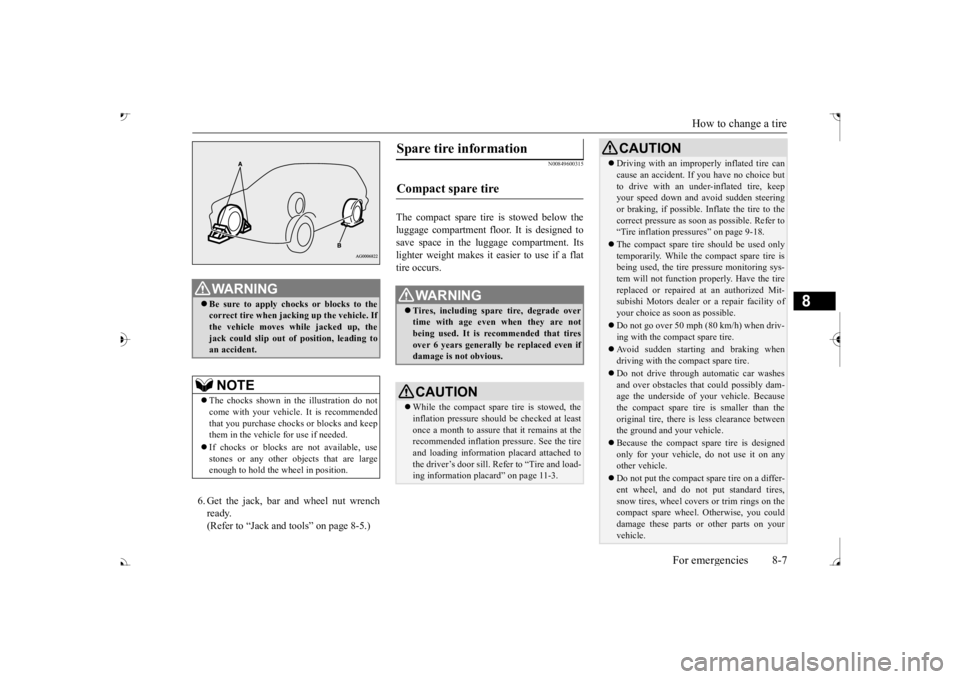
an accident.NOTE
The chocks shown in the illustration do not come with your vehicl
e. It is recommended
that you purchase chocks or blocks and keep them in the vehicle for use if needed. If chocks or blocks
are not available, use
stones or any other obj
ects that are large
enough to hold the wheel in position.
Spare tire information Compact spare tire
WA R N I N G Tires, including spar
e tire, degrade over
time with age even when they are not being used. It is recommended that tiresover 6 years generally
be replaced even if
damage is not obvious.CAUTION While the compact spare tire is stowed, the inflation pressure shoul
d be checked at least
once a month to assure that it remains at the recommended inflation pressure. See the tire and loading informati
on placard attached to
the driver’s door sill. Refer to “Tire and load-ing information placard” on page 11-3.
Driving with an imprope
rly inflated tire can
cause an accident. If
you have no choice but
to drive with an under-inflated tire, keepyour speed down and avoid sudden steering or braking, if possible. Inflate the tire to the correct pressure as s
oon as possible. Refer to
“Tire inflation pressures” on page 9-18. The compact spare tire should be used only temporarily. While the compact spare tire is being used, the tire pr
essure monitoring sys-
tem will not function pr
operly. Have the tire
replaced or repaired at an authorized Mit- subishi Motors dealer or
a repair facility of
your choice as soon as possible. Do not go over 50 mph (80 km/h) when driv- ing with the compact spare tire. Avoid sudden starting and braking when driving with the compact spare tire. Do not drive through automatic car washes and over obstacles that
could possibly dam-
age the underside of your vehicle. Because the compact spare tire is smaller than the original tire, there is less clearance betweenthe ground and your vehicle. Because the compact spare tire is designed only for your vehicle, do not use it on any other vehicle. Do not put the compact spare tire on a differ- ent wheel, and do not put standard tires, snow tires, wheel covers
or trim rings on the
compact spare wheel. Otherwise, you could damage these parts or other parts on your vehicle.CAUTION
BK0239700US.book 7 ページ 2016年6月16日 木曜日 午前10時58分
Page 449 of 521
Towing 8-14 For emergencies
8
N00837001898
If towing is necessary,
we recommend you to
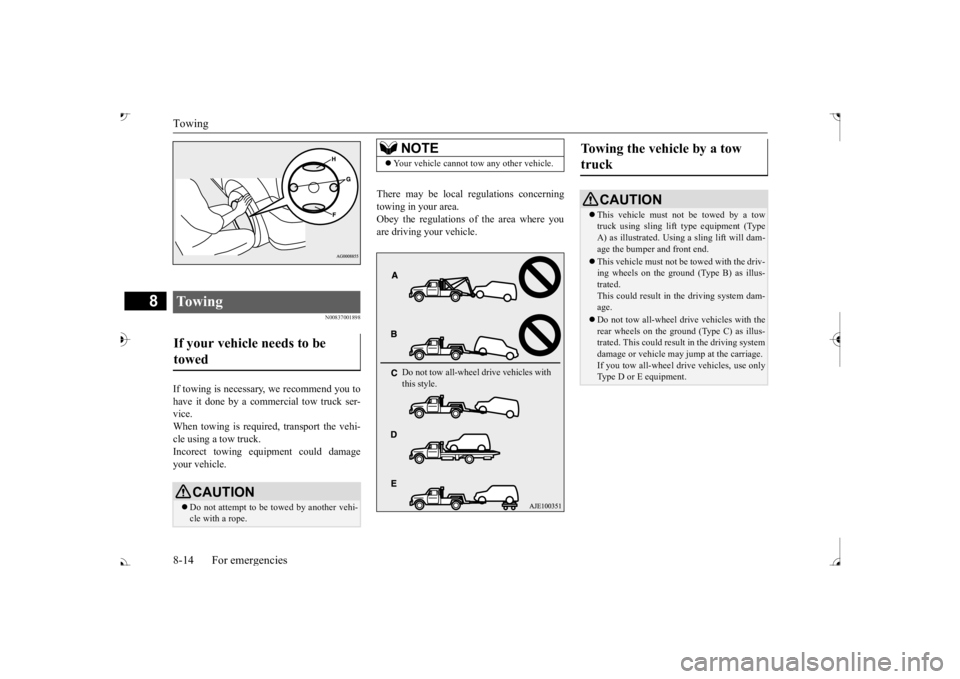
have it done by a commercial tow truck ser- vice.When towing is required, transport the vehi- cle using a tow truck. Incorect towing equipment could damageyour vehicle.
There may be local re
gulations concerning
towing in your area. Obey the regulations of the area where youare driving your vehicle.
To w i n g If your vehicle needs to be towed
CAUTION Do not attempt to be
towed by another vehi-
cle with a rope.
NOTE
Your vehicle cannot to
w any other vehicle.
Do not tow all-wheel drive vehicles with this style.
Towing the vehicle by a tow truck
CAUTION This vehicle must not be towed by a tow truck using sling lift
type equipment (Type
A) as illustrated. Usi
ng a sling lift will dam-
age the bumper and front end. This vehicle must not be towed with the driv- ing wheels on the ground (Type B) as illus- trated. This could result in the driving system dam-age. Do not tow all-wheel drive vehicles with the rear wheels on the ground (Type C) as illus- trated. This could result in the driving system damage or vehicle may
jump at the carriage.
If you tow all-wheel driv
e vehicles, use only
Type D or E equipment.
BK0239700US.book 14 ページ 2016年6月16日 木曜日 午前10時58分
Page 456 of 521
Engine hood
Vehicle care and maintenance 9-3
9
Normally, the catalyti
c converter does not
require maintenance. However, it is importantto keep the engine properly tuned for the con- verter to continue to work properly. To reduce the possibili
ty of catalytic con-
verter damage: Use UNLEADED GASOLINE ONLY of the type of recommended in the “Fuel selection”. Do not drive with an extremely low fuel level. Running out of gas could damage the catalytic converter.
Do not try to start the engine by pushing or towing the vehicle. If the battery isweak or run down, use jumper cables to properly start the engine. Do not idle the engine with any spark plug wires disconnected or removed, such as when performing
diagnosti
c tests.
Do not idle the engine
for a long time if it
is idling roughly or otherwise obviously malfunctioning. To prevent the catalytic converter from being damaged from unburned gas, do not race the engine when turning off the igni-tion switch. Stop driving the vehicle if you think the performance is noticeably low, or theengine has a malfunction such as with the ignition, etc. If you are not able to stop driving immediately,
slow down and drive
for only a short time. Have your vehicle checked at an authorized Mitsubishi Motors dealer or a repair facility of yourchoice as soon
as possible.
In unusual situations involving major engine problems, a burning odor mayindicate severe and abnormal catalytic converter overheating.
If this occurs, stop
in a safe place, shut the engine off and letthe vehicle cool. Once
the engine is cool,
immediately take
your vehicle to an
authorized Mitsubishi
Motors dealer or a
repair facility of your choice for service.
N00937501588
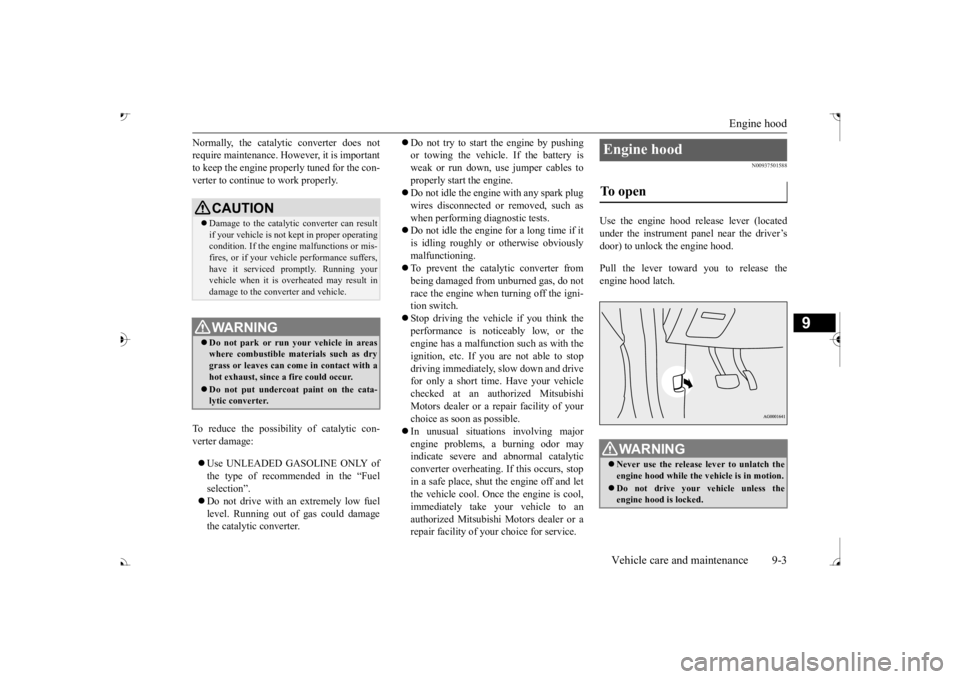
Use the engine hood release lever (located under the instrument panel near the driver’s door) to unlock the engine hood. Pull the lever toward you to release the engine hood latch.
CAUTION Damage to the catalyti
c converter can result
if your vehicle is not
kept in proper operating
condition. If the engine
malfunctions or mis-
fires, or if your vehi
cle performance suffers,
have it serviced promptly. Running your vehicle when it is
overheated may result in
damage to the converter and vehicle.WA R N I N G Do not park or run your vehicle in areas where combustible materials such as dry grass or leaves can come
in contact with a
hot exhaust, since a fire could occur. Do not put undercoat paint on the cata- lytic converter.
Engine hood To open
WA R N I N G Never use the release lever to unlatch the engine hood while the
vehicle is in motion.
Do not drive your vehicle unless the engine hood is locked.
BK0239700US.book 3 ページ 2016年6月16日 木曜日 午前10時58分
Page 487 of 521
Replacement of light bulbs 9-34 Vehicle care and maintenance
9
N00901801216
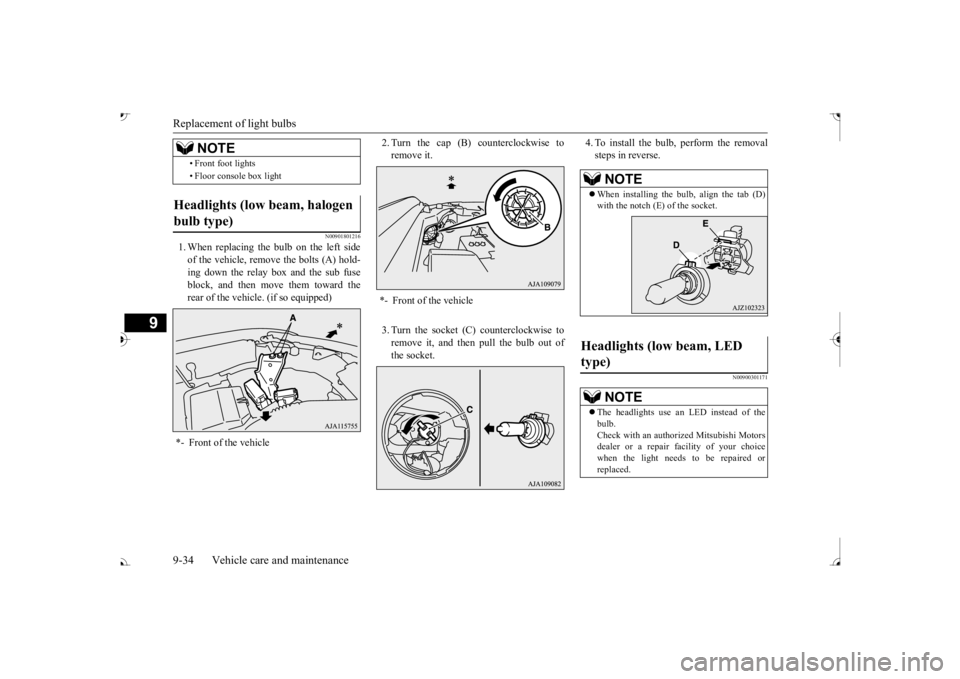
1. When replacing the bulb on the left side of the vehicle, remove the bolts (A) hold- ing down the relay box and the sub fuseblock, and then move them toward the rear of the vehicle. (if so equipped)
2. Turn the cap (B) counterclockwise to remove it. 3. Turn the socket (C) counterclockwise to remove it, and then pull the bulb out of the socket.
4. To install the bulb, perform the removal steps in reverse.
N00900301171
• Front foot lights • Floor console box light
Headlights (low beam, halogen bulb type) *- Front of the vehicle
NOTE
*- Front of the vehicle
NOTE
When installing the bulb, align the tab (D) with the notch (E) of the socket.
Headlights (low beam, LED type)
NOTE
The headlights use an LED instead of the bulb.Check with an authorized Mitsubishi Motors dealer or a repair fa
cility of your choice
when the light needs to be repaired orreplaced.
BK0239700US.book 34 ページ 2016年6月16日 木曜日 午前10時58分
Page 488 of 521
Replacement of light bulbs
Vehicle care and maintenance 9-35
9
N00901901132
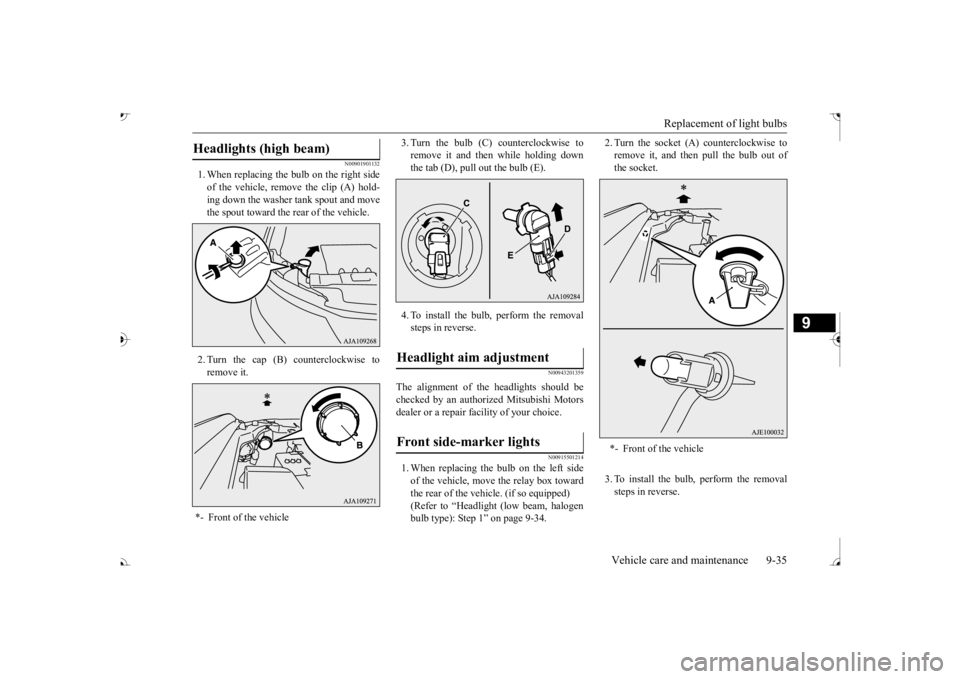
1. When replacing the bulb on the right side of the vehicle, rem
ove the clip (A) hold-
ing down the washer tank spout and movethe spout toward the rear of the vehicle. 2. Turn the cap (B) counterclockwise to remove it.
3. Turn the bulb (C) counterclockwise to remove it and then while holding downthe tab (D), pull out the bulb (E). 4. To install the bulb, perform the removal steps in reverse.
N00943201359
The alignment of th
e headlights should be
checked by an authorized Mitsubishi Motors dealer or a repair facility of your choice.
N00915501214
1. When replacing the bulb on the left sideof the vehicle, move the relay box towardthe rear of the vehi
cle. (if so equipped)
(Refer to “Headlight
(low beam, halogen
bulb type): Step 1” on page 9-34.
2. Turn the socket (A
) counterclockwise to
remove it, and then pull the bulb out ofthe socket. 3. To install the bulb, perform the removal steps in reverse.
Headlights (high beam) *- Front of the vehicle
Headlight aim adjustment Front side-marker lights
*- Front of the vehicle
BK0239700US.book 35 ページ 2016年6月16日 木曜日 午前10時58分
Page 490 of 521
Replacement of light bulbs
Vehicle care and maintenance 9-37
9
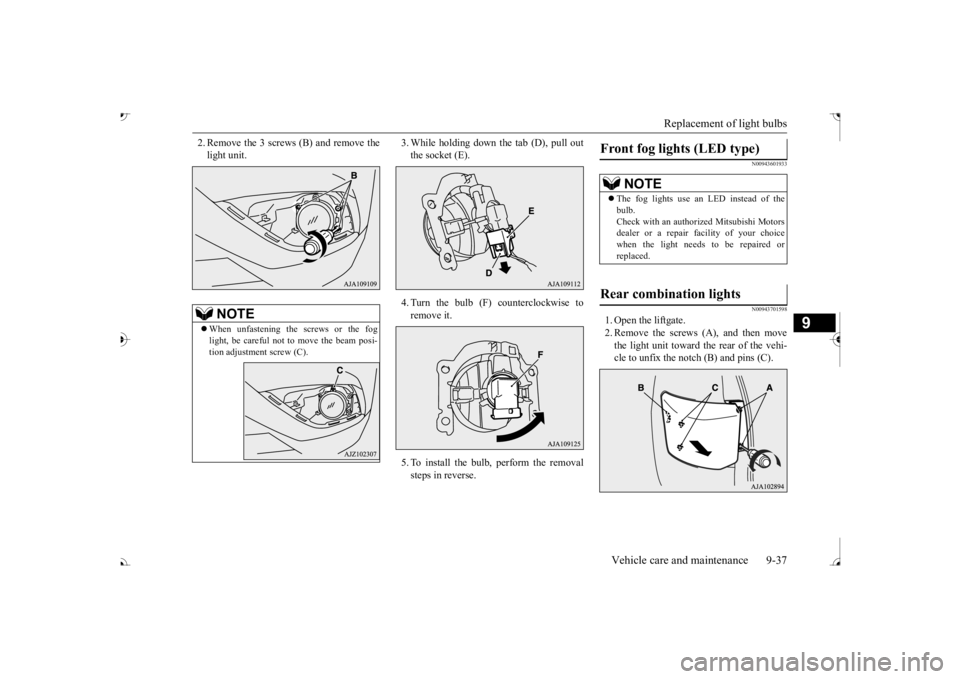
2. Remove the 3 screws
(B) and remove the
light unit.
3. While holding down the tab (D), pull out the socket (E). 4. Turn the bulb (F) counterclockwise to remove it. 5. To install the bulb, perform the removal steps in reverse.
N00943601933 N00943701598
1. Open the liftgate. 2. Remove the screws (A), and then move the light unit toward the rear of the vehi- cle to unfix the notch (B) and pins (C).
NOTE
When unfastening the screws or the fog light, be careful not to move the beam posi- tion adjustment screw (C).
Front fog lights (LED type)
NOTE
The fog lights use an
LED instead of the
bulb.Check with an authorized Mitsubishi Motors dealer or a repair fa
cility of your choice
when the light needs to be repaired orreplaced.
Rear combination lights
BK0239700US.book 37 ページ 2016年6月16日 木曜日 午前10時58分
Page 492 of 521
Vehicle care precautions
Vehicle care and maintenance 9-39
9
N00944000360
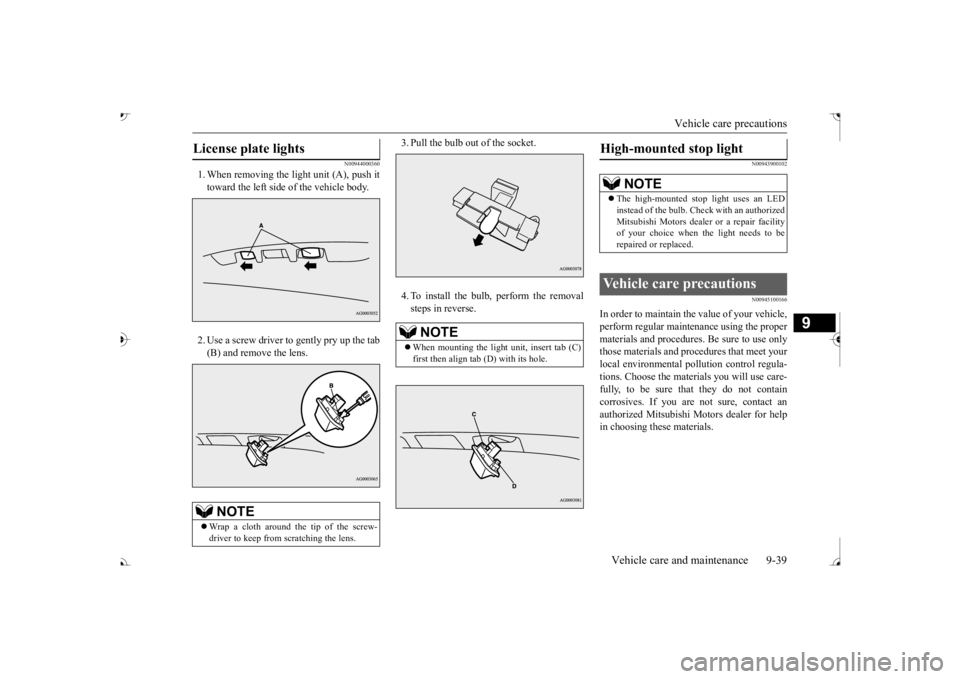
1. When removing the light unit (A), push it toward the left side of the vehicle body. 2. Use a screw driver to gently pry up the tab (B) and remove the lens.
3. Pull the bulb out of the socket. 4. To install the bulb, perform the removal steps in reverse.
N00943900102 N00945100166
In order to maintain the value of your vehicle, perform regular mainte
nance using the proper
materials and procedures
. Be sure to use only
those materials and proc
edures that meet your
local environmental pollution control regula- tions. Choose the materials you will use care-fully, to be sure that they do not contain corrosives. If you are
not sure, contact an
authorized Mitsubishi Motors dealer for helpin choosing these materials.
License plate lights
NOTE
Wrap a cloth around the tip of the screw- driver to keep from scratching the lens.
NOTE
When mounting the light unit, insert tab (C) first then align tab (D) with its hole.
High-mounted stop light
NOTE
The high-mounted stop light uses an LED instead of the bulb. Check with an authorizedMitsubishi Motors dealer or a repair facility of your choice when the light needs to be repaired or replaced.
Vehicle care precautions
BK0239700US.book 39 ページ 2016年6月16日 木曜日 午前10時58分
Page 518 of 521
Alphabetical index
12-5
12
Side turn-signal light
Bulb capacity
.................................
9-32
Snow tires
..........................................
9-21
Spark plugs
........................................
9-23
Starting the engine
.....................
5-25
, 5-66
Steering
Steering wheel height
and reach adjustment
5-57Wheel lock
............................
5-24
, 5-65
Stop lights
Bulb capacity
.................................
9-32
Storage spaces
..................................
5-276
Sun visors
........................................
5-266
Sunglasses holder
.............................
5-279
Sunroof
..............................................
5-51
Super-all wheel control (S-AWC)
S-AWC drive mode display
.............
5-87
S-AWC drive mode-selector
............
5-86
S-AWC operation display
................
5-87
Supplemental Re
straint System
............
4-34
How the Supplemental Restraint System works
..........................................
4-37
Maintenance service
........................
4-49
T
Tail light
Bulb capacity
.................................
9-32
Tank capacity
.....................................
11-7
Theft-alarm system
.............................
5-46
Time Setting
......................................
7-46
Timing belt
........................................
9-24
Tire
...................................................
9-15
Inflation pressure
............................
9-18
Maintenance
..................................
9-19
Quality grading
..............................
10-2
Replacing tires and wheels
..............
9-19
Rotation
........................................
9-20
Size (tire and wheel)
.......................
11-7
Snow tires
.....................................
9-21
Tire and loading information placard 11-3 Tire chains
.....................................
9-21
To change a tire
................................
8-6
Tread wear indicator
.......................
9-20
Tire pressure monitoring system
.........
5-142
Tools
...................................................
8-6
Storage
............................................
8-5
Towing
..............................................
8-14
Trailer towing
....................................
6-11
Transfer oil
................................
9-12
, 11-7
Turn signal light
Indicators
.....................................
5-215
Lever
...........................................
5-230
U
Ultrasonic misacceleration Mitigation System 5-127 USB input terminal
............................
5-263
How to connect a USB memory device
....
5-263How to connect an iPod
.................
5-264
V
Vanity mirror
....................................
5-266
Vanity mirror lights
Bulb capacity
.................................
9-33
Vehicle care precautions
......................
9-39
Vehicle dimensions
.............................
11-4
Vehicle labeling
..................................
11-2
Vehicle preparation before driving
..........
6-4
Vehicle weights
..................................
11-5
Vents
...................................................
7-2
W
Warning lights
..................................
5-216
Washer
Fluid
.....................................
9-12
, 11-7
Rear window washer
.....................
5-236
Switch
.........................................
5-235
Washing
.............................................
9-41
Waxing
..............................................
9-42
Weights
.............................................
11-5
Wheel
Covers
...........................................
8-13
Specification
..................................
11-7
BK0239700US.book 5 ページ 2016年6月16日 木曜日 午前10時58分