weight MITSUBISHI OUTLANDER III 2018 User Guide
[x] Cancel search | Manufacturer: MITSUBISHI, Model Year: 2018, Model line: OUTLANDER III, Model: MITSUBISHI OUTLANDER III 2018Pages: 441, PDF Size: 13.71 MB
Page 327 of 441
Assist grips5-246 Features and controls
5
N00559001084
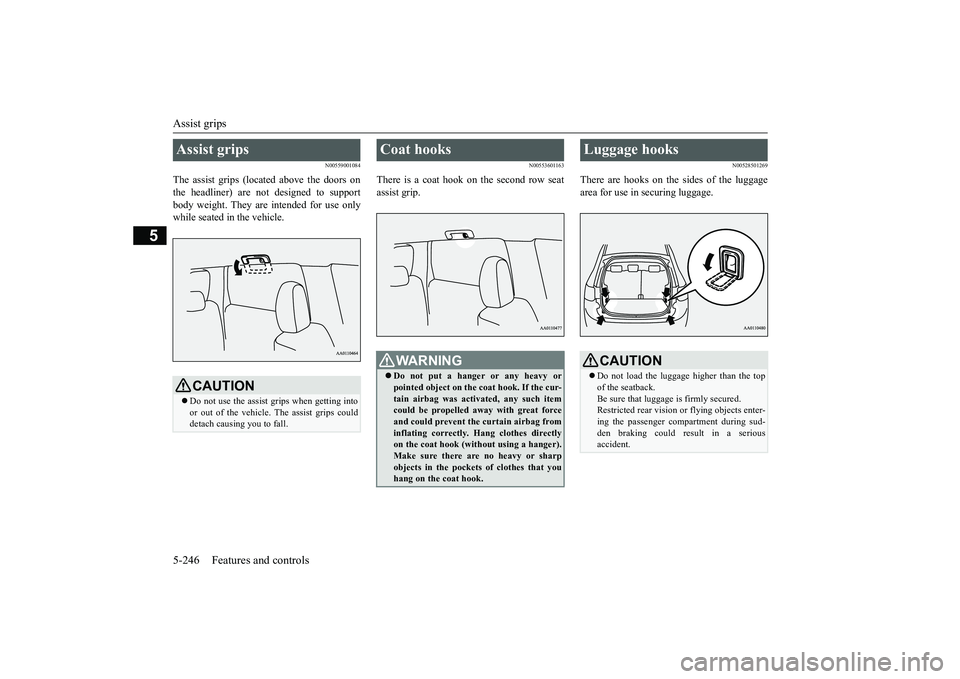
The assist grips (located above the doors onthe headliner) are not designed to supportbody weight. They are intended for use onlywhile seated in the vehicle.
N00553601163
There is a coat hook on the second row seatassist grip.
N00528501269
There are hooks on the sides of the luggagearea for use in securing luggage.
Assist grips
CAUTIONDo not use the assist grips when getting intoor out of the vehicle.
The assist grips could
detach causing you to fall.
Coat hooks
WA R N I N GDo not put a hanger or any heavy orpointed object on the
coat hook. If the cur-
tain airbag was activated, any such itemcould be propelled away with great forceand could prevent the curtain airbag frominflating correctly.
Hang clothes directly
on the coat hook (without using a hanger).Make sure there ar
e no heavy or sharp
objects in the pocket
s of clothes that you
hang on the coat hook.
Luggage hooks
CAUTIONDo not load the luggage higher than the topof the seatback.Be sure that luggage
is firmly secured.
Restricted rear vision or
flying objects enter-
ing the passenger compartment during sud-den braking could result in a seriousaccident.
BK0249100US.book 246 ページ 2017年5月10日 水曜日 午前8時49分
Page 335 of 441
Parking6-6 Driving safety
6
On snowy roads, ice can form on the brakingsystem, making the brakes less effective.While driving in such conditions, pay closeattention to surrounding
vehicles and to the
condition of the road surface. From time totime, lightly depress the brake pedal andcheck how effective the brakes are.It is important to take
advantage of the engine
braking by downshifting while driving onsteep downhill roads in order to prevent thebrakes from overheating.
N00629601385
When parking on a hill, set the parking brake,and turn the front wheels toward the curb on adownhill, or away from
the curb on an uphill.
If necessary, apply chocks to the wheels.Be sure that the parki
ng brake is firmly set
when parked and that the selector lever is inthe “P” (PARK) position.
When parking on a hill, it is important to setthe parking brake befo
re moving the selector
lever to the “P” (PARK) position. This pre-vents loading the parking brake against thetransaxle. When this ha
ppens, it is difficult to
move the selector lever out of the “P”Never leave the engine running while youtake a short nap or rest. Also, never leave theengine running in a closed or poorly venti-lated place.Your front bumper can be damaged if youscrape it over curbs or parking stop blocks.Be careful when traveling up or down steepslopes where your bumper can scrape theroad.
Always carry the key and lock all doors andthe liftgate when leaving the vehicle unat-tended.Always try to park your vehicle in a well litarea.Move effort could be required to turn thesteering wheel.Refer to “Electric power steering system(EPS)” on page 5-99.
N00629901434
It is very important to know how muchweight your vehicle can carry. This weight iscalled the vehicle ca
pacity weight and
includes the weight of
all occupants, cargo
(including the roof load), non-factory-
When driving in cold weather When driving downhill Parking Parking on a hill
Parking with the engine run-ning
WA R N I N GLeaving the engine ru
nning risks injury or
death from accidentally moving the selec-tor lever or the accumulation of toxicexhaust fumes in the passenger compart-ment.
Where you park
WA R N I N GDo not park your vehicle in areas wherecombustible materials
such as dry grass or
leaves can come in contact with a hotexhaust, since a fire could occur.
When leaving the vehicle Do not keep the steering wheel fully turned for a long time Loading information
BK0249100US.book 6 ページ 2017年5月10日 水曜日 午前8時49分
Page 336 of 441
Loading informationDriving safety 6-7
6
installed options, and
the tongue weight of
the trailer, if any, being towed. The tire andloading information placard located on thedriver’s door sill of your vehicle will showhow much weight it may properly carry.It is important to famil
iarize yourself with the
following terms before loading your vehicle:Vehicle maximum load on the tire: loadon an individual tire that is determined bydistributing to each axle its share of themaximum loaded vehicle weight anddividing by two.Vehicle normal load on the tire: load on anindividual tire that is determined by dis-tributing to each axle its share of the curbweight, accessory weight, and normaloccupant weight and dividing by two.Maximum loaded vehicle weight: the sumof -(a) Curb weight;(b) Accessory weight;(c) Vehicle capacity weight; and(d) Production options weight.
Curb weight: the weight of a motor vehi-cle with standard equipment including themaximum capacity of
fuel, oil, and cool-
ant.Accessory weight: the combined weight(in excess of those st
andard items which
may be replaced) of automatic transaxle,power steering, power brakes, power win-dows, power seats, radio, and heater, tothe extent that these items are available asfactory- installed equipment (whetherinstalled or not).Vehicle capacity weight: the rated cargoand luggage load plus 150 lbs (68 kg)*times the vehicle’s designated seatingcapacity.Production options weight: the combinedweight of those installed regular produc-tion options weighing over 5 lbs (2.3 kg)in excess of those standard items whichthey replace, not prev
iously considered in
curb weight or accessory weight, includ-ing heavy duty brakes,
ride levelers, roof
rack, heavy duty battery, and special trim.Normal occupant weight: 150 lbs (68 kg)*times the number of
specified occupants
(3 in the case of your vehicle)Occupant distribution:
Occupant distribu-
tion within the passenger compartment (Inyour vehicle the distribution is 2 in front,1 in second row seat)
N00630101407
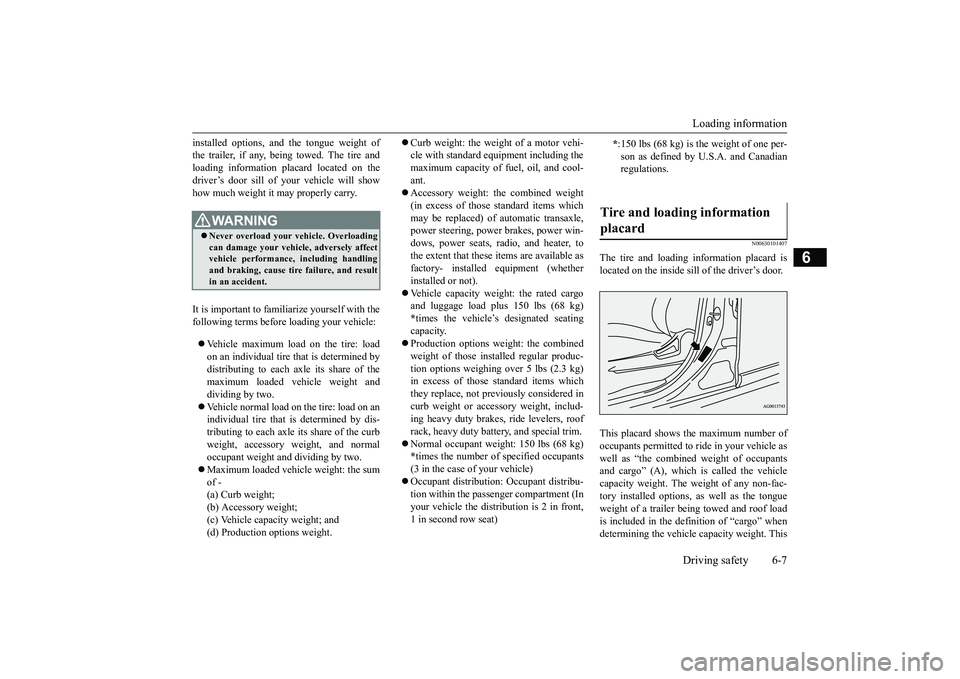
The tire and loading information placard islocated on the inside sill of the driver’s door.This placard shows the maximum number ofoccupants permitted to
ride in your vehicle as
well as “the combined
weight of occupants
and cargo” (A), which
is called the vehicle
capacity weight. The weight of any non-fac-tory installed options, as well as the tongueweight of a trailer being towed and roof loadis included in the defi
nition of “cargo” when
determining the vehicle
capacity weight. This
WA R N I N GNever overload your ve
hicle. Overloading
can damage your vehicl
e, adversely affect
vehicle performance, including handlingand braking, cause tire failure, and resultin an accident.
*:150 lbs (68 kg) is the weight of one per-son as defined by U.
S.A. and Canadian
regulations.
Tire and loading information placard
BK0249100US.book 7 ページ 2017年5月10日 水曜日 午前8時49分
Page 337 of 441
Loading information6-8 Driving safety
6
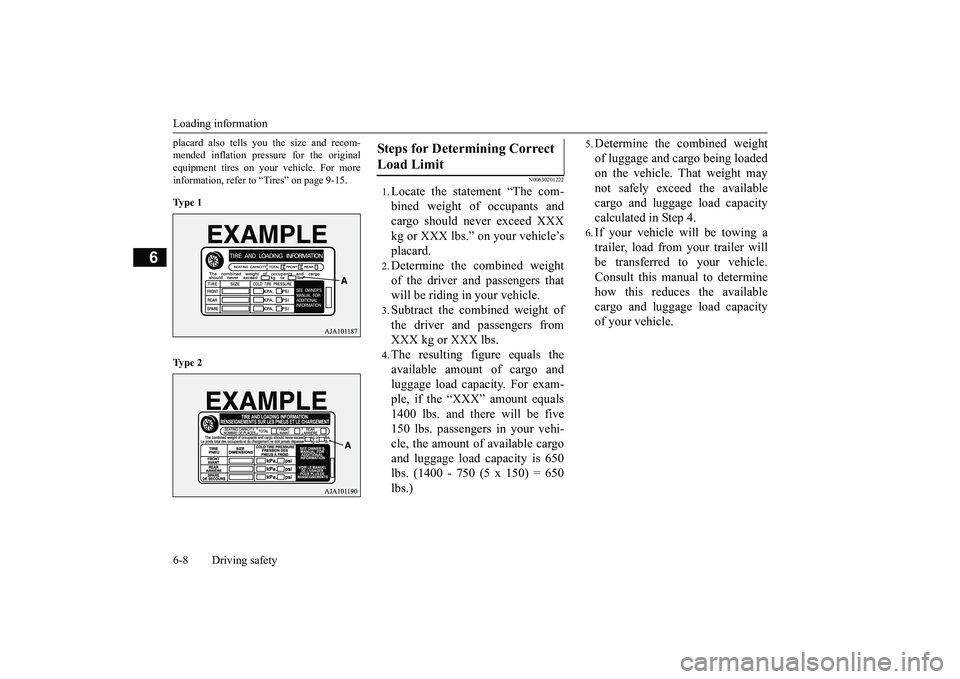
placard also tells you the size and recom-mended inflation pressure for the originalequipment tires on your vehicle. For moreinformation, refer to “Tires” on page 9-15.Ty p e 1Ty p e 2
N00630201222
1.Locate the statement “The com-bined weight of occupants andcargo should never exceed XXXkg or XXX lbs.” on your vehicle’splacard.2.Determine the combined weightof the driver and passengers thatwill be riding in your vehicle.3.Subtract the combined weight ofthe driver and passengers fromXXX kg or XXX lbs.4.The resulting figure equals theavailable amount of cargo andluggage load capacity. For exam-ple, if the “XXX” amount equals1400 lbs. and there will be five150 lbs. passengers in your vehi-cle, the amount of available cargoand luggage load
capacity is 650
lbs. (1400 - 750 (5 x 150) = 650lbs.)
5.Determine the combined weightof luggage and cargo being loadedon the vehicle. That weight maynot safely exceed the availablecargo and luggage load capacitycalculated in Step 4.6.If your vehicle will be towing atrailer, load from your trailer willbe transferred to your vehicle.Consult this manual to determinehow this reduces the availablecargo and luggage load capacityof your vehicle.
Steps for Determining Correct Load Limit
BK0249100US.book 8 ページ 2017年5月10日 水曜日 午前8時49分
Page 338 of 441

Loading informationDriving safety 6-9
6
NOTE
The following table shows examples on how to
calculate tota
l load, cargo/luggage and towing capa
cities of your vehicle with var
ying seating configura-
tions and number and size of occ
upants. This table is for illu
stration purposes only and may not
be accurate for the seating an
d load carry capacity of your
vehicle.For the following example the combined weight of oc
cupants and cargo should ne
ver exceed 865 lbs (392 kg).
Under a maximum loaded vehicle c
ondition, gross axle weight ratings (GAWR’s) for
the front and rear axles must not be exceeded.
For further information
on GAWR’s, vehicle loading and tr
ailer towing, see the “Specifica
tions” section of this manual.
BK0249100US.book 9 ページ 2017年5月10日 水曜日 午前8時49分
Page 339 of 441
Cargo loads6-10 Driving safety
6
N00629700435N00630301092
To determine the cargo load capacity for yourvehicle, subtract the
weight of all vehicle
occupants from the vehi
cle capacity weight.
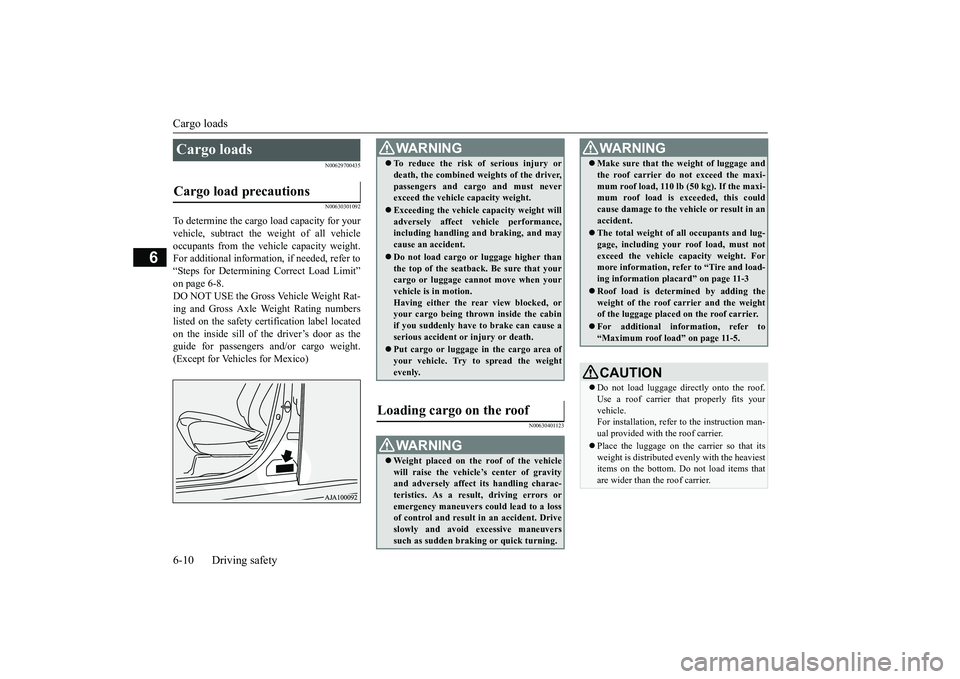
For additional information, if needed, refer to“Steps for Determining Correct Load Limit”on page 6-8.DO NOT USE the Gross Vehicle Weight Rat-ing and Gross Axle Weight Rating numberslisted on the safety certification label locatedon the inside sill of the driver’s door as theguide for passengers and/or cargo weight.(Except for Vehicles for Mexico)
N00630401123
Cargo loads Cargo load precautions
WA R N I N GTo reduce the risk of serious injury ordeath, the combined weights of the driver,passengers and cargo and must neverexceed the vehicle capacity weight.Exceeding the vehicle capacity weight willadversely affect ve
hicle performance,
including handling and braking, and maycause an accident.Do not load cargo or luggage higher thanthe top of the seatback. Be sure that yourcargo or luggage cann
ot move when your
vehicle is in motion.Having either the re
ar view blocked, or
your cargo being thrown
inside the cabin
if you suddenly have to brake can cause aserious accident or
injury or death.
Put cargo or luggage in the cargo area ofyour vehicle. Try to spread the weightevenly.
Loading cargo on the roof
WA R N I N GWeight placed on the
roof of the vehicle
will raise the vehicle’and adversely affect
its handling charac-
teristics. As a result, driving errors oremergency maneuvers could lead to a lossof control and result in an accident. Driveslowly and avoid excessive maneuverssuch as sudden brak
ing or quick turning.
Make sure that the
weight of luggage and
the roof carrier do not exceed the maxi-mum roof load, 110 lb (50 kg). If the maxi-mum roof load is ex
ceeded, this could
cause damage to the ve
hicle or result in an
accident.The total weight of all occupants and lug-gage, including your r
oof load, must not
exceed the vehicle capacity weight. Formore information, refer to “Tire and load-ing information placard” on page 11-3Roof load is determined by adding theweight of the roof
carrier and the weight
of the luggage placed
on the roof carrier.
For additional information, refer to“Maximum roof load” on page 11-5.CAUTIONDo not load luggage directly onto the roof.Use a roof carrier that properly fits yourvehicle.For installation, refer to the instruction man-ual provided with the roof carrier.Place the luggage on the carrier so that itsweight is distri
buted evenly with the heaviest
items on the bottom. Do not load items thatare wider than the roof carrier.WA R N I N G
BK0249100US.book 10 ページ 2017年5月10日 水曜日 午前8時49分
Page 341 of 441
Trailer towing6-12 Driving safety
6
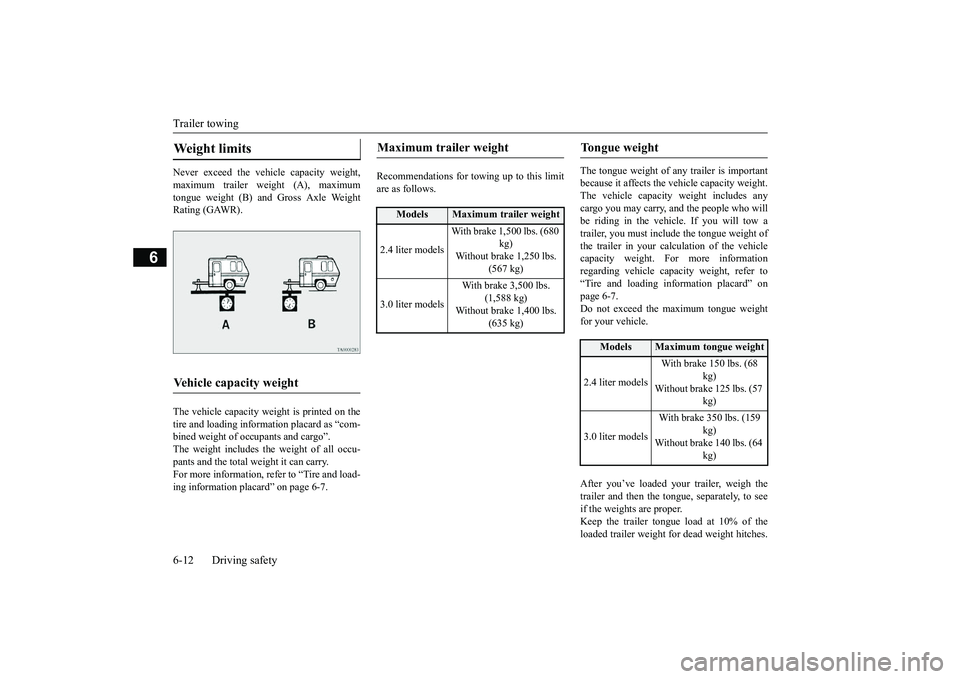
Never exceed the vehicle capacity weight,maximum trailer weight (A), maximumtongue weight (B) and Gross Axle WeightRating (GAWR).The vehicle capacity weight is printed on thetire and loading inform
ation placard as “com-
bined weight of oc
cupants and cargo”.
The weight includes the weight of all occu-pants and the total weight it can carry.For more information, refer to “Tire and load-ing information plac
ard” on page 6-7.
Recommendations for to
wing up to this limit
are as follows.
The tongue weight of a
ny trailer is important
because it affects the ve
hicle capacity weight.
The vehicle capacity weight includes anycargo you may carry, a
nd the people who will
be riding in the vehi
cle. If you will tow a
trailer, you must include the tongue weight ofthe trailer in your calculation of the vehiclecapacity weight. For more informationregarding vehicle capa
city weight, refer to
“Tire and loading information placard” onpage 6-7.Do not exceed the maximum tongue weightfor your vehicle.After you’ve loaded your trailer, weigh thetrailer and then the to
ngue, separately, to see
if the weights are proper.Keep the trailer tongue load at 10% of theloaded trailer weight fo
r dead weight hitches.
Weight limits Vehicle capacity weight
Maximum trailer weight
Models
Maximum trailer weight
2.4 liter models
With brake 1,500 lbs. (680
kg)
Without brake 1,250 lbs.
(567 kg)
3.0 liter models
With brake 3,500 lbs.
(1,588 kg)
Without brake 1,400 lbs.
(635 kg)
Tongue weight
Models
Maximum tongue weight
2.4 liter models
With brake 150 lbs. (68
kg)
Without brake 125 lbs. (57
kg)
3.0 liter models
With brake 350 lbs. (159
kg)
Without brake 140 lbs. (64
kg)
BK0249100US.book 12 ページ 2017年5月10日 水曜日 午前8時49分
Page 342 of 441
Trailer towing
Driving safety 6-13
6
Tongue loads can be adjusted by proper dis-tribution of the load in the trailer. This can bechecked by separately
weighing the loaded
trailer and then the tongue.The GAWRs are printed on the certificationlabel which is riveted on the door sill on thedriver’s side.Refer to “Vehicle labeling” on page 11-2.Choose a proper hitch and ball, and makesure it is installed at a height that is compati-ble with the trailer.Use a good equalizing hitch which uniformlydistributes the trailer tongue load throughoutthe frame.
A safety chain must al
ways be used between
the towing vehicle and the trailer. Leave suf-ficient slack in the chain for turns. The chainshould cross under the trailer tongue to pre-vent the tongue from dropping to the groundin case it becomes damaged or separated.For correct safety chai
n procedures, consult
your authorized Mitsub
ishi Motors dealer.
Your vehicle will need service more oftenwhen you’re towing a trailer. Refer to “WAR-RANTY AND MAINTENANCE MAN-UAL”. Especially important in traileroperation are automatic transaxle fluid,engine oil, rear axle
oil, belt, c
ooling system
and brake system. Each
of these is covered in
this manual.For details, please refer to the “Vehicle careand maintenance” section.Check periodically to see that all hitch nutsand bolts are tight.Mitsubishi Motors recommends that anytrailer having a total we
ight of 1,250 lbs (567
kg) or more (2400 models), 1,400 lbs (635kg) or more (3000 mode
ls) be equipped with
its own electric or surge-type brakes.If you choose electric br
akes, be sure they are
electrically actuated. Do not attempt to tapinto your vehicle’s hydraulic system. No mat-ter how successful it
may seem, any attempt
to attach trailer brakes to your vehicle’shydraulic system will lower braking effec-tiveness and create a potential hazard.
Gross axle weight rating (GAWR) Trailer hitches
WA R N I N GIf you make any holes in the body of yourvehicle for installing
a trailer hitch, be
sure to seal the holes later when youremove the hitch. If
you don’t seal them,
deadly carbon monoxide (CO) from yourexhaust can enter your vehicle. Refer to“Exhaust system” on page 9-24.
NOTE
Mitsubishi Motors recommends that swaycontrol be used whenever you are towing, toimprove towing stability.For further informati
on, please contact your
authorized Mitsubishi Motors dealer.
Safety chains
CAUTIONNever tow a trailer wi
thout using a safety
chain securely attached to both the trailerand the vehicle. If the
coupling unit or hitch
ball experiences a probl
em, the trailer may
separate from
your vehicle.
Maintenance when trailer tow-ing Trailer brakes
BK0249100US.book 13 ページ 2017年5月10日 水曜日 午前8時49分
Page 343 of 441
Trailer towing6-14 Driving safety
6
Trailer lights and equipment must complywith federal, state,
and local regulations.
Check with your loca
l recreational vehicle
dealer for the requirements in your area, anduse only equipment designed for your vehi-cle.Since lighting and wiring
vary by trailer type
and brand, you should have a qualified tech-nician install a suitable connector between thevehicle and the trailer.
Improper equipment or
installation can cause da
mage to your vehi-
cle’s electrical system
and affect your vehicle
warranty.Many states and Canadi
an provinces require
special outside mirrors when towing a trailer.Even if not required,
you should install spe-
cial mirrors if you ca
nnot clearly see behind
you, or if the trailer
creates a blind spot.
Ask your trailer sales or
rental agency if any
other items are recomm
ended or required for
your towing situation.
Towing a trailer requires a certain amount ofexperience.Before setting out for the open road, you’llwant to get to know your trailer. Acquaint
yourself with the feel of handling and brakingwith the added weight of the trailer. Alwayskeep in mind that the vehicle you are drivingis now a good deal longer and not nearly asresponsive as your vehicl
e is without a trailer.
Before you start, check the trailer hitch,safety chains, tires
and mirror adjustment.
Be sure your vehicle’s ti
res are inflated to the
cold inflation pressure listed in the manual.You’ll find these numbe
rs on the tire and
loading information placard at the sill of thedriver’s door.Refer to “Tire inflati
on pressures” on page
9-19.Stay at least twice as far behind the vehicleahead as you would when driving your vehi-cle without a trailer.
This can help you avoid
situations that require
heavy braking and sud-
den turns.
Trailer lights Additional trailer equipment
Operating hints
WA R N I N GIf you have a rear window open and youtow a trailer with
your vehicle, carbon
monoxide gas which
you cannot see or
smell could come into your vehicle. It cancause unconsciousness or death. Refer to“Exhaust system” on page 9-24.To maximize your safe
ty when towing a
trailer:Have your exhaust system inspected forleaks, and make necessary repairs beforestarting on your trip.Keep the rear windows closed.If exhaust does come into your vehiclethrough a window or
another opening,
drive with your front, main heating orcooling system on an
d with the blower on
any speed. This will
bring fresh, outside
air into your vehicle. Do not use recircula-tion because it only recirculates the airinside your vehicle. Refer to “Air selectionswitch” on page 7-9.
Driver preparation
Vehicle preparation Tire Following distance
BK0249100US.book 14 ページ 2017年5月10日 水曜日 午前8時49分
Page 368 of 441
How to change a tire
For emergencies 8-7
8
6. Get the jack, bar and wheel nut wrenchready.(Refer to “Jack and t
ools” on page 8-5.)
N00849600315
The compact spare tire is stowed below theluggage compartment fl
oor. It is designed to
save space in the luggage compartment. Itslighter weight makes it easier to use if a flattire occurs.
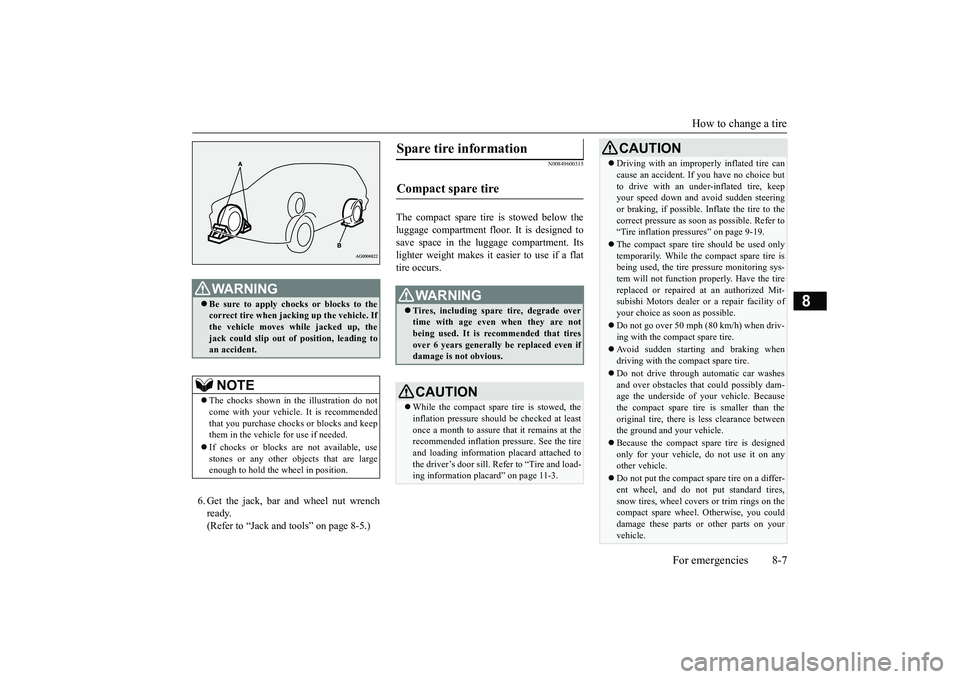
WA R N I N GBe sure to apply choc
ks or blocks to the
correct tire when jacking up the vehicle. Ifthe vehicle moves while jacked up, thejack could slip out of
position, leading to
an accident.NOTE
The chocks shown in the illustration do notcome with your vehicl
e. It is recommended
that you purchase chocks or blocks and keepthem in the vehicle for use if needed.If chocks or blocks
are not available, use
stones or any other obj
ects that are large
enough to hold the wheel in position.
Spare tire information Compact spare tire
WA R N I N GTires, including spar
e tire, degrade over
time with age even when they are notbeing used. It is recommended that tiresover 6 years generally
be replaced even if
damage is not obvious.CAUTIONWhile the compact spare tire is stowed, theinflation pressure shoul
d be checked at least
once a month to assure that it remains at therecommended inflation pressure. See the tireand loading informati
on placard attached to
the driver’s door sill. Refer to “Tire and load-ing information placard” on page 11-3.
Driving with an imprope
rly inflated tire can
cause an accident. If
you have no choice but
to drive with an under-inflated tire, keepyour speed down and avoid sudden steeringor braking, if possible. Inflate the tire to thecorrect pressure as s
oon as possible. Refer to
“Tire inflation pressures” on page 9-19.The compact spare tire should be used onlytemporarily. While the compact spare tire isbeing used, the tire pr
essure monitoring sys-
tem will not function pr
operly. Have the tire
replaced or repaired at an authorized Mit-subishi Motors dealer or
a repair facility of
your choice as soon as possible.Do not go over 50 mph (80 km/h) when driv-ing with the compact spare tire.Avoid sudden starting and braking whendriving with the compact spare tire.Do not drive through automatic car washesand over obstacles that
could possibly dam-
age the underside of your vehicle. Becausethe compact spare tire is smaller than theoriginal tire, there is less clearance betweenthe ground and your vehicle.Because the compact spare tire is designedonly for your vehicle, do not use it on anyother vehicle.Do not put the compact spare tire on a differ-ent wheel, and do not put standard tires,snow tires, wheel covers
or trim rings on the
compact spare wheel. Otherwise, you coulddamage these parts or other parts on yourvehicle.CAUTION
BK0249100US.book 7 ページ 2017年5月10日 水曜日 午前8時49分