battery MITSUBISHI OUTLANDER III 2018 Owner's Manual
[x] Cancel search | Manufacturer: MITSUBISHI, Model Year: 2018, Model line: OUTLANDER III, Model: MITSUBISHI OUTLANDER III 2018Pages: 441, PDF Size: 13.71 MB
Page 134 of 441
Parking brake
Features and controls 5-53
5
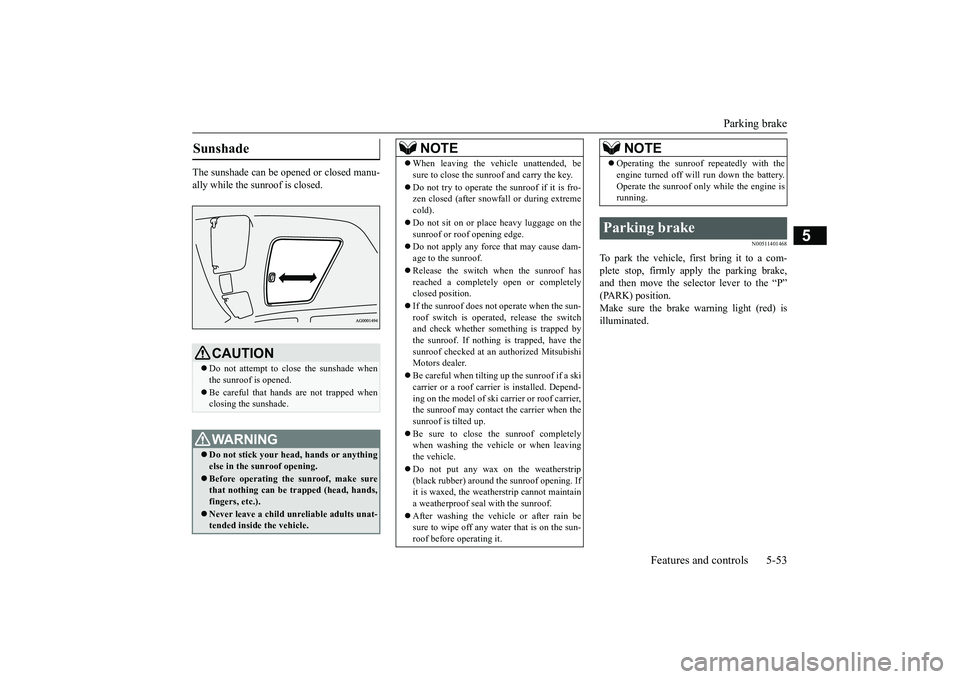
The sunshade can be opened or closed manu-ally while the sunroof is closed.
N00511401468
To park the vehicle, fi
rst bring it to a com-
plete stop, firmly apply the parking brake,and then move the selector lever to the “P”Make sure the brake warning light (red) isilluminated.
Sunshade
CAUTIONDo not attempt to close the sunshade whenthe sunroof is opened.Be careful that hands are not trapped whenclosing the sunshade.WA R N I N GDo not stick your head
, hands or anything
else in the su
nroof opening.
Before operating the sunroof, make surethat nothing can be trapped (head, hands,fingers, etc.).Never leave a child unr
eliable adults unat-
tended inside the vehicle.
NOTE
When leaving the vehicle unattended, besure to close the sunroof and carry the key.Do not try to operate the sunroof if it is fro-zen closed (after snowfall or during extremecold).Do not sit on or plac
e heavy luggage on the
sunroof or roof opening edge.Do not apply any forc
e that may cause dam-
age to the sunroof.Release the switch when the sunroof hasreached a completely open or completelyclosed position.If the sunroof does not operate when the sun-roof switch is operated, release the switchand check whether something is trapped bythe sunroof. If nothing is trapped, have thesunroof checked at an authorized MitsubishiMotors dealer.Be careful when tilting up the sunroof if a skicarrier or a roof carrie
r is installed. Depend-
ing on the model of ski carrier or roof carrier,the sunroof may contact
the carrier when the
sunroof is tilted up.Be sure to close the sunroof completelywhen washing the vehicle or when leavingthe vehicle.Do not put any wax on the weatherstrip(black rubber) around the sunroof opening. Ifit is waxed, the weat
herstrip cannot maintain
a weatherproof seal with the sunroof.After washing the vehicle or after rain besure to wipe off any water that is on the sun-roof before operating it.
Operating the sunroof repeatedly with theengine turned off will run down the battery.Operate the sunroof only while the engine isrunning.
Parking brake
NOTE
BK0249100US.book 53 ページ 2017年5月10日 水曜日 午前8時49分
Page 136 of 441
Parking brake
Features and controls 5-55
5
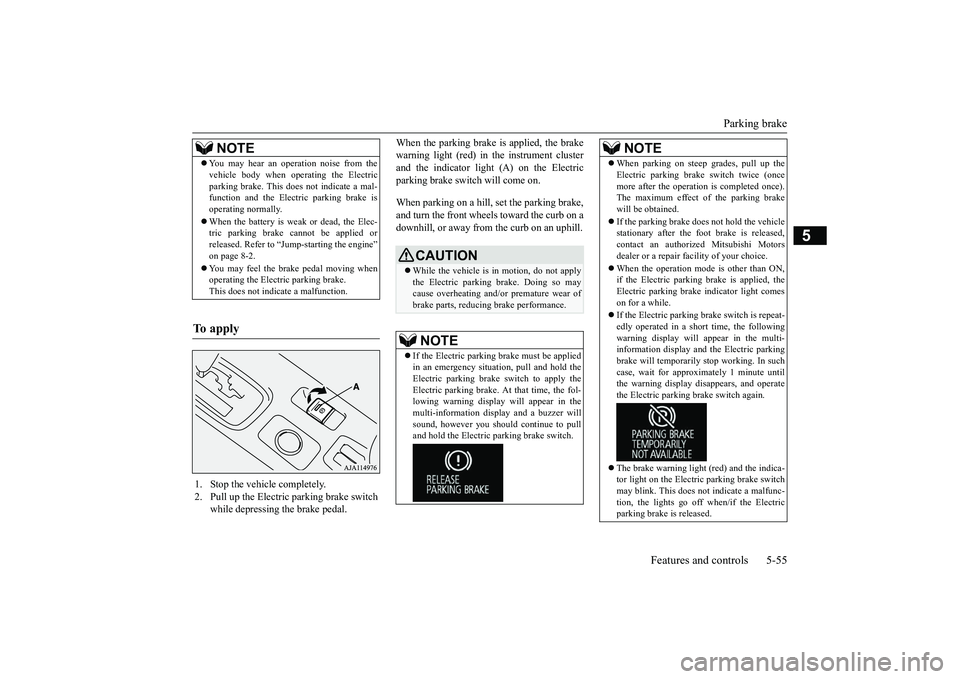
When the parking brake is applied, the brakewarning light (red) in
the instrument cluster
and the indicator light (A) on the Electricparking brake switch will come on.When parking on a hill, set the parking brake,and turn the front wheels toward the curb on adownhill, or away from
the curb on an uphill.
NOTE
You may hear an operation noise from thevehicle body when operating the Electricparking brake. This do
es not indicate a mal-
function and the Elec
tric parking brake is
operating normally.When the battery is weak or dead, the Elec-tric parking brake cannot be applied orreleased. Refer to “Jum
p-starting the engine”
on page 8-2.You may feel the brake pedal moving whenoperating the Electr
ic parking brake.
This does not indi
cate a malfunction.
To apply
1. Stop the vehicle completely.2. Pull up the Electric parking brake switch
while depressing the brake pedal.
CAUTIONWhile the vehicle is in motion, do not applythe Electric parking
brake. Doing so may
cause overheating and/or
premature wear of
brake parts, reducing brake performance. NOTE
If the Electric parking
brake must be applied
in an emergency situa
tion, pull and hold the
Electric parking brake
switch to apply the
Electric parking brake. At that time, the fol-lowing warning display
will appear in the
multi-information disp
lay and a buzzer will
sound, however you should continue to pulland hold the Electric
parking brake switch.
When parking on stee
p grades, pull up the
Electric parking brak
e switch twice (once
more after the operati
on is completed once).
The maximum effect of the parking brakewill be obtained.If the parking brake does not hold the vehiclestationary after the f
oot brake is released,
contact an authorized Mitsubishi Motorsdealer or a repair fa
cility of your choice.
When the operation mode is other than ON,if the Electric parking brake is applied, theElectric parking brake
indicator light comes
on for a while.If the Electric parking brake switch is repeat-edly operated in a short time, the followingwarning display will appear in the multi-information display and the Electric parkingbrake will temporarily stop working. In suchcase, wait for approxima
tely 1 minute until
the warning display di
sappears, and operate
the Electric parking
brake switch again.
The brake warning light (red) and the indica-tor light on the Electric
parking brake switch
may blink. This does no
t indicate a malfunc-
tion, the lights go off when/if the Electricparking brake is released.NOTE
BK0249100US.book 55 ページ 2017年5月10日 水曜日 午前8時49分
Page 146 of 441
Steering wheel lock (if so equipped)
Features and controls 5-65
5
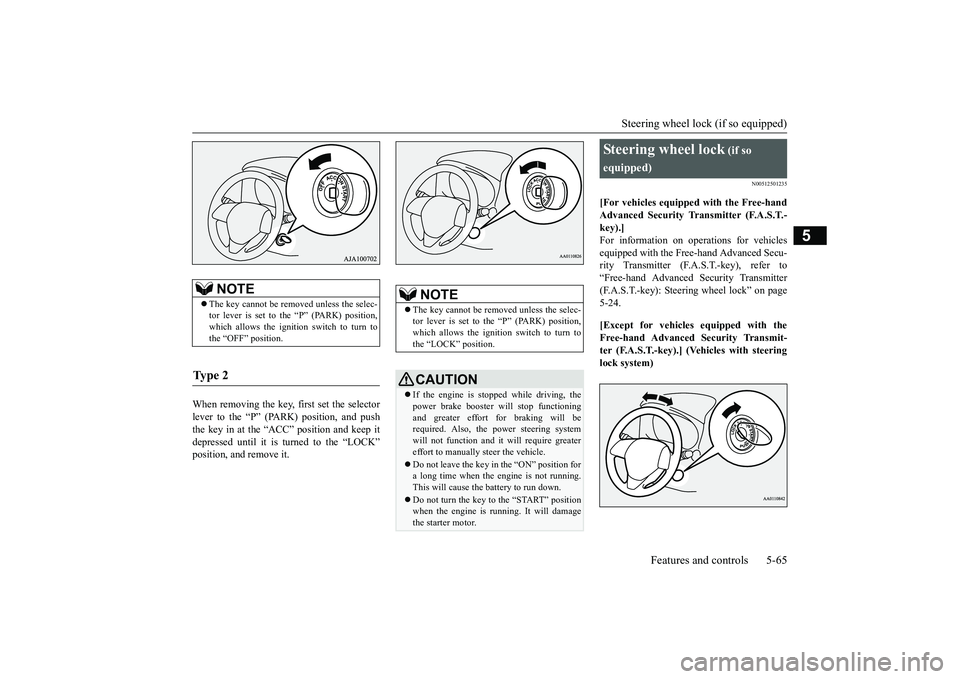
When removing the key, first set the selectorlever to the “P” (PARK) position, and pushthe key in at the “ACC” position and keep itdepressed until it is turned to the “LOCK”position, and remove it.
N00512501235
[For vehicles equipped with the Free-handAdvanced Security Tr
ansmitter (F.A.S.T.-
key).]For information on operations for vehiclesequipped with the Free-hand Advanced Secu-rity Transmitter (F.A
.S.T.-key), refer to
“Free-hand Advanced
Security Transmitter
(F.A.S.T.-key): Steering wheel lock” on page5-24.[Except for vehicles equipped with theFree-hand Advanced Security Transmit-ter (F.A.S.T.-key).] (Vehicles with steeringlock system)
NOTE
The key cannot be rem
oved unless the selec-
tor lever is set to the “P” (PARK) position,which allows the ignition switch to turn tothe “OFF” position.
Ty p e 2
NOTE
The key cannot be rem
oved unless the selec-
tor lever is set to the “P” (PARK) position,which allows the ignition switch to turn tothe “LOCK” position.CAUTIONIf the engine is stoppe
d while driving, the
power brake booster will stop functioningand greater effort for braking will berequired. Also, the power steering systemwill not function and it
will require greater
effort to manually steer the vehicle.Do not leave the key in
the “ON” position for
a long time when the engine is not running.This will cause the battery to run down.Do not turn the key to the “START” positionwhen the engine is ru
nning. It will damage
the starter motor.
Steering wheel lock
(if so
equipped)
BK0249100US.book 65 ページ 2017年5月10日 水曜日 午前8時49分
Page 147 of 441
Starting the engine5-66 Features and controls
5
Remove the key at
the “LOCK” position.
Turn the steering wheel until it is locked.Turn the key to the “ACC” position whilemoving the steering
wheel slightly.
N00512601858
[For vehicles equipped with the Free-handAdvanced Security Transmitter (F.A.S.T.-key).]For information on operation for vehiclesequipped with the Free-hand Advanced Secu-rity Transmitter (F.A.S.T.-key), refer to
“Free-hand Advanced
Security Transmitter
(F.A.S.T.-key): Starting” on page 5-13.[Except for vehicles equipped with theFree-hand Advanced Se
curity Transmit-
ter (F.A.S.T.-key).]Do not operate the starter motor continu-ously for longer than 15 seconds as thiscould run the battery
down or damage the
starter motor. If the engine does not start,turn the ignition switch back to the “OFF”or “LOCK” position, wait a few seconds,and then try again. Trying repeatedly withthe engine or starter motor still turningwill damage the starter mechanism.If the engine will not
start because the bat-
tery is weak or discharged, refer to“Jump-starting the engine” (on page 8-2)for instructions.A longer warm up period will only con-sume extra fuel. The engine is warmed upenough for driving when the bar graph ofengine coolant temper
ature display starts
to move or the low coolant temperatureindicator goes out. Refer to “Engine cool-ant temperature display” on page 5-161 or“Low coolant temper
ature indicator” on
page 5-202.
This model is equipped with an electronicallycontrolled fuel injection system. This is a sys-tem that automatically controls fuel injection.There is usually no need to depress the accel-erator pedal when starting the engine.The starter should not be run for more than 15seconds at a time.To prevent battery drain, wait a few secondsbetween attempts to restart the engine.1. Make sure all occupants are properlyseated with seat belts fastened.
To l o c k
To u n l o c k
CAUTIONRemove the key when leaving the vehicle.NOTE
If the front wheels are turned, the anti-theftlock may sometimes make it difficult to turnthe key from “LOCK” to “ACC”. Firmlyturn the steering wheel to the left or to theright as you turn the key.
Starting the engine
Tips for starting
WA R N I N GNever run the engine in
a closed or poorly
ventilated area any longer than is neededto move your vehicle
out of the area. Car-
bon monoxide gas, wh
ich is odorless and
extremely poisonous, could build up andcause serious injury or death.CAUTIONDo not push-start the vehicle.Do not run the engine at high rpms or driveat high speeds until
the engine has had a
chance to warm up.Release the ignition sw
itch as soon as the
engine starts. Otherwis
e, the starter motor
will be damaged
Starting the engine
BK0249100US.book 66 ページ 2017年5月10日 水曜日 午前8時49分
Page 149 of 441
Automatic transaxle (if so equipped)5-68 Features and controls
5
N00513200216
Automatic transaxle will automaticallychange its gear depe
nding on road and driv-
ing conditions. This
helps achieve smooth
driving and excellent fuel efficiency.Also you can manually shift up and shiftdown the transaxle. Refer to “Sports mode”The transaxle prevents
unnecessary upshifts
even when the accelerator pedal is releasedand ensures smooth driving.According to the condi
tions, the transaxle
will automatically shift to a lower gear toachieve stronger engine braking. This mayhelp reduce your need to use the servicebrake.
N00513801424
As an additional safe
ty precaution, models
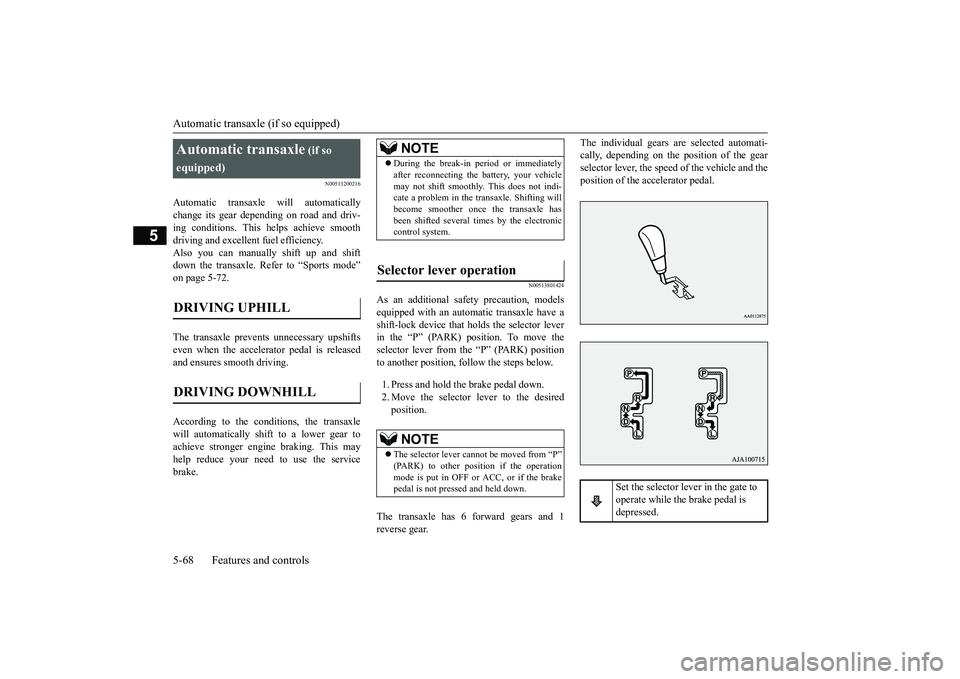
equipped with an automatic transaxle have ashift-lock device that holds the selector leverin the “P” (PARK) position. To move theselector lever from the “P” (PARK) positionto another position, follow the steps below.1. Press and hold the brake pedal down.2. Move the selector lever to the desiredposition.
The transaxle has 6 forward gears and 1reverse gear.
The individual gears are selected automati-cally, depending on the position of the gearselector lever, the speed of the vehicle and theposition of the ac
celerator pedal.
Automatic transaxle
(if so
equipped)
DRIVING DOWNHILL
NOTE
During the break-in pe
riod or immediately
after reconnecting the
battery, your vehicle
may not shift smoothly.
This does not indi-
cate a problem in the transaxle. Shifting willbecome smoother once the transaxle hasbeen shifted several
times by the electronic
control system.
Selector lever operation
NOTE
The selector lever cannot
be moved from “P”
mode is put in OFF or ACC, or if the brakepedal is not pressed and held down.
Set the selector lever in the gate to operate while the brake pedal is depressed.
BK0249100US.book 68 ページ 2017年5月10日 水曜日 午前8時49分
Page 150 of 441
Automatic transaxle (if so equipped)
Features and controls 5-69
5
N00563101086
When the selector lever cannot be shiftedfrom the “P” (PARK) position to anotherposition while the brake pedal is pressed andheld down with the operation mode in ON,the battery may be flat or the shift-lock mech-anism may be malfunctioning.Immediately have your
vehicle checked by an
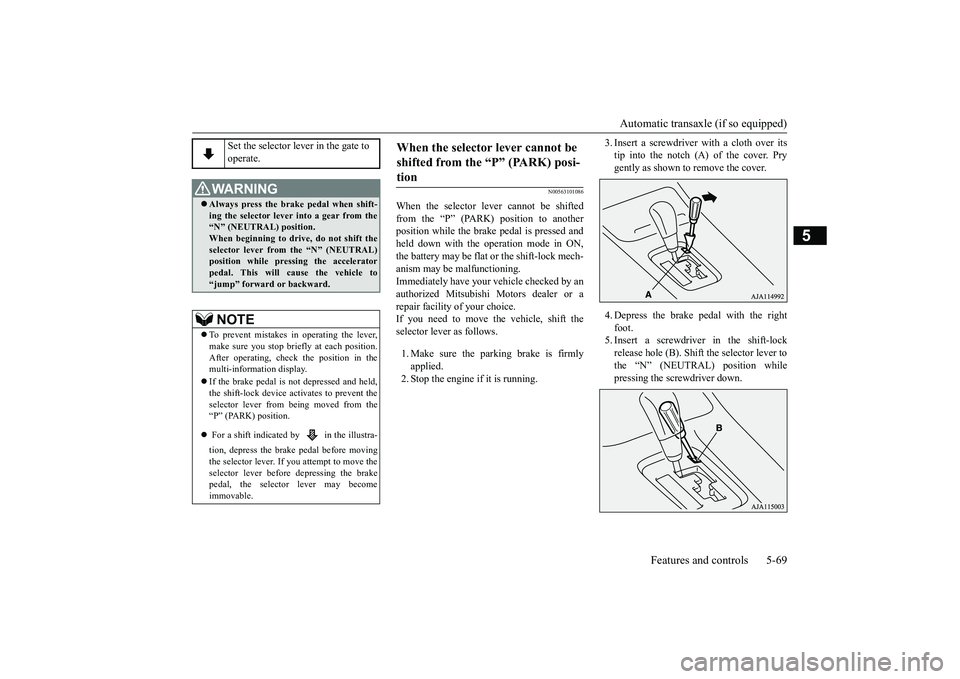
authorized Mitsubishi Motors dealer or arepair facility of your choice.If you need to move the vehicle, shift theselector lever as follows.1. Make sure the parking brake is firmlyapplied.2. Stop the engine if it is running.
3. Insert a screwdrive
r with a cloth over its
tip into the notch (A) of the cover. Prygently as shown to remove the cover.4. Depress the brake
pedal with the right
foot.5. Insert a screwdriver in the shift-lockrelease hole (B). Shift the selector lever tothe “N” (NEUTRAL) position whilepressing the screwdriver down.
Set the selector lever in the gate to operate.
WA R N I N GAlways press the brake pedal when shift-ing the selector
lever into a gear from the
“N” (NEUTRAL) position. When beginning to drive, do not shift theselector lever from
the “N” (NEUTRAL)
position while pressing the acceleratorpedal. This will cause the vehicle to“jump” forward or backward.NOTE
To prevent mistakes in operating the lever,make sure you stop brie
fly at each position.
After operating, chec
k the position in the
multi-information display.If the brake pedal is not depressed and held,the shift-lock device ac
tivates to prevent the
selector lever from being moved from the“P” (PARK) position. For a shift indicated by in the illustra-tion, depress the brake pedal before movingthe selector lever. If you attempt to move theselector lever before depressing the brakepedal, the selector lever may becomeimmovable.
When the selector lever cannot be shifted from the “P” (PARK) posi-tion
BK0249100US.book 69 ページ 2017年5月10日 水曜日 午前8時49分
Page 157 of 441
Continuously variable transmission (CVT) (if so equipped)5-76 Features and controls
5
N00563301062
When the selector lever cannot be shiftedfrom the “P” (PARK) position to anotherposition while the brake pedal is pressed andheld down with the ignition switch at the“ON” position or the operation mode in ON,the battery may be flat or the shift-lock mech-anism may be malfunctioning.Immediately have your
vehicle checked by an
authorized Mitsubishi Motors dealer or arepair facility of your choice.If you need to move the vehicle, shift theselector lever as follows.1. Make sure the parking brake is firmlyapplied.2. Stop the engine if it is running.
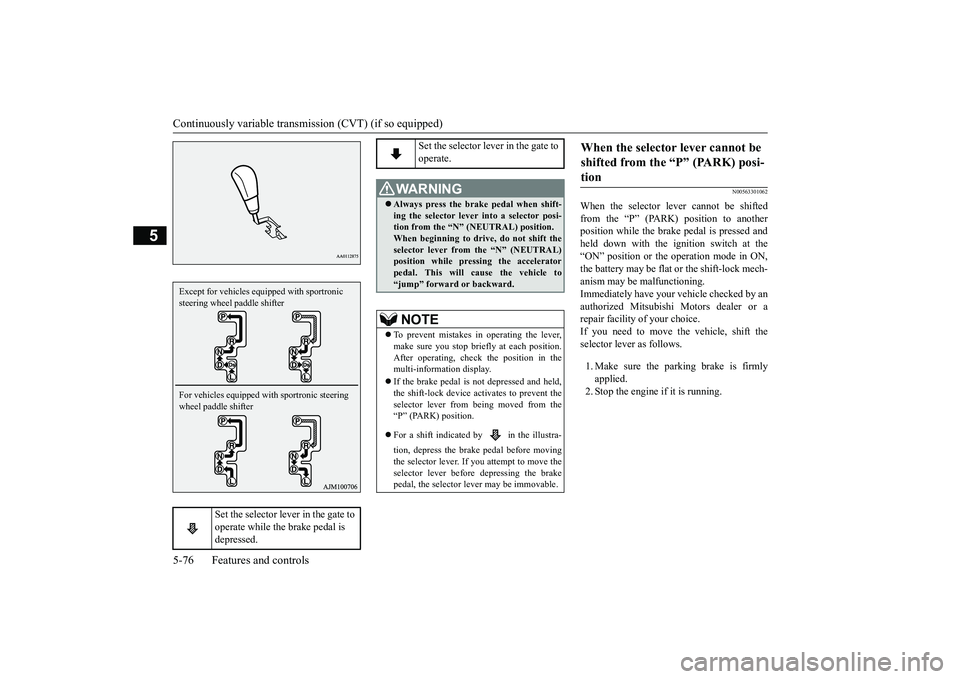
Set the selector lever in the gate to operate while the brake pedal is depressed.
Except for vehicles equipped with sportronic steering wheel paddle shifterFor vehicles equipped with sportronic steering wheel paddle shifter
Set the selector lever in the gate to operate.
WA R N I N GAlways press the brake pedal when shift-ing the selector lever into a selector posi-tion from the
Page 183 of 441
Active stability control (ASC)
5
N00546601129
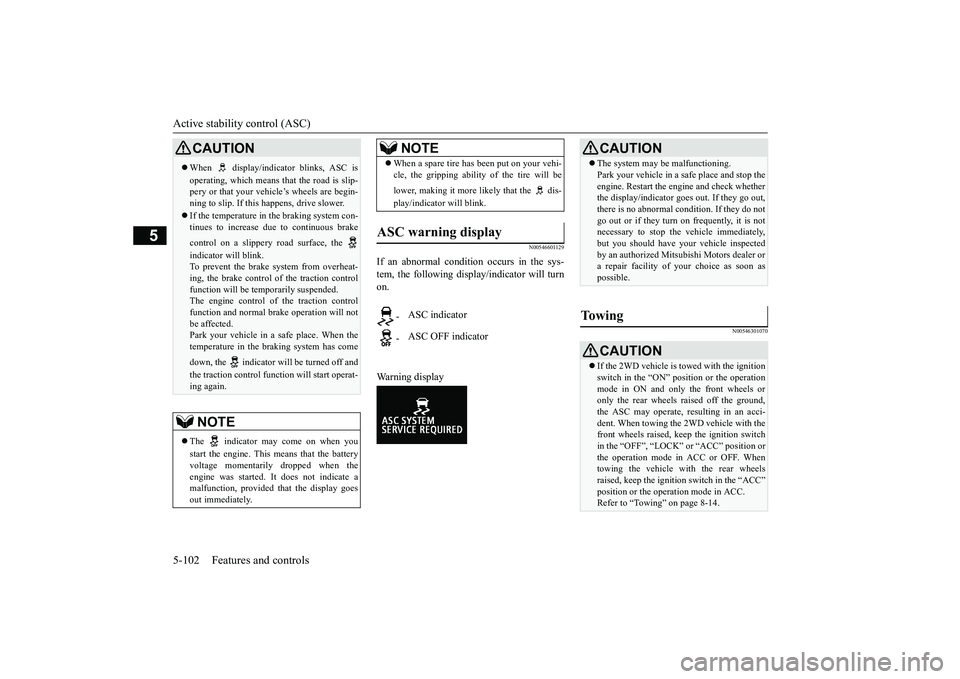
If an abnormal condition occurs in the sys-tem, the following disp
lay/indicator will turn
on.Warning display
N00546301070
CAUTIONWhen display/indicator blinks, ASC isoperating, which means that the road is slip-pery or that your vehi
cle’s wheels are begin-
ning to slip. If this happens, drive slower.If the temperature in the braking system con-tinues to increase due
to continuous brake
control on a slippery
road surface, the
indicator will blink.To prevent the brake system from overheat-ing, the brake control
of the traction control
function will be tem
porarily suspended.
The engine control of the traction controlfunction and normal brake operation will notbe affected.Park your vehicle in a safe place. When thetemperature in the braking system has comedown, the indicator will be turned off andthe traction control func
tion will start operat-
ing again.NOTE
The indicator may come on when youstart the engine. This means that the batteryvoltage momentarily dropped when theengine was started. It
does not indicate a
malfunction, provided th
at the display goes
out immediately.
When a spare tire has been put on your vehi-cle, the gripping ability of the tire will belower, making it more likely that the dis-play/indicator will blink.
ASC warning display
-
ASC indicator
-
ASC OFF indicatorNOTE
CAUTIONThe system may be malfunctioning.Park your vehicle in a
safe place and stop the
engine. Restart the engi
ne and check whether
the display/indicator goe
s out. If they go out,
there is no abnormal condition. If they do notgo out or if they turn on frequently, it is notnecessary to stop the
vehicle immediately,
but you should have your vehicle inspectedby an authorized Mitsubishi Motors dealer ora repair facility of
your choice as soon as
possible.
To w i n g
CAUTIONIf the 2WD vehicle is to
wed with the ignition
switch in the “ON” pos
ition or the operation
mode in ON and only the front wheels oronly the rear wheels raised off the ground,the ASC may operate, resulting in an acci-dent. When towing the 2WD vehicle with thefront wheels raised, keep the ignition switchin the “OFF”, “LOCK” or “ACC” position orthe operation mode in ACC or OFF. Whentowing the vehicle with the rear wheelsraised, keep the ignition switch in the “ACC”Refer to “Towing” on page 8-14.
BK0249100US.book 102 ページ 2017年5月10日 水曜日 午前8時49分
Page 202 of 441
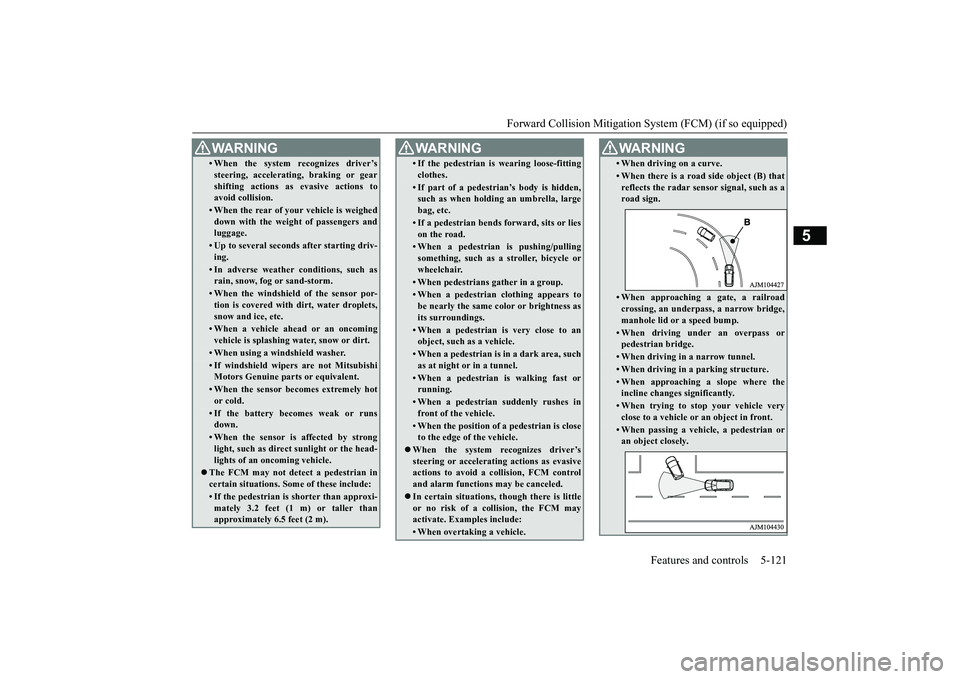
Forward Collision Mitigation System (FCM) (if so equipped)
Features and controls 5-121
5
• When the system recognizes driver’ssteering, accelerati
ng, braking or gear
shifting actions as
evasive actions to
avoid collision.• When the rear of your vehicle is weigheddown with the weight of passengers andluggage.• Up to several seconds after starting driv-ing.• In adverse weather conditions, such asrain, snow, fog or sand-storm.• When the windshield of the sensor por-tion is covered with dirt, water droplets,snow and ice, etc.• When a vehicle ahea
d or an oncoming
vehicle is splashing wa
ter, snow or dirt.
• When using a windshield washer.• If windshield wipers are not MitsubishiMotors Genuine parts or equivalent. • When the sensor becomes extremely hotor cold.• If the battery becomes weak or runsdown.• When the sensor is affected by stronglight, such as direct
sunlight or the head-
lights of an oncoming vehicle.
The FCM may not detect a pedestrian incertain situations. Some of these include:• If the pedestrian is
shorter than approxi-
mately 3.2 feet (1 m) or taller thanapproximately 6.5 feet (2 m).WA R N I N G
• If the pedestrian is wearing loose-fittingclothes.• If part of a pedestrian’s body is hidden,such as when holding an umbrella, largebag, etc.• If a pedestrian bends forward, sits or lieson the road.• When a pedestrian is pushing/pullingsomething, such as a stroller, bicycle orwheelchair.• When pedestrians gather in a group.• When a pedestrian
clothing appears to
be nearly the same color or brightness asits surroundings.• When a pedestrian is very close to anobject, such as a vehicle.• When a pedestrian is in a dark area, suchas at night or in a tunnel.• When a pedestrian is walking fast orrunning.• When a pedestrian suddenly rushes infront of the vehicle.• When the position of
a pedestrian is close
to the edge of the vehicle.
When the system recognizes driver’ssteering or accelerati
ng actions as evasive
actions to avoid a collision, FCM controland alarm functions
may be canceled.
In certain situations, though there is littleor no risk of a collision, the FCM mayactivate. Examples include: • When overtaking a vehicle.WA R N I N G
• When driving on a curve.
Page 221 of 441
Tire pressure monitoring system5-140 Features and controls
5
allow the TPMS to cont
inue to function prop-
erly.
N00532801511
1. If the tire pressure monitoring systemwarning light illuminates, avoiding hardbraking, sharp steering maneuvers andhigh speeds. You should stop and adjustthe tires to the proper inflation pressure assoon as possible. Adjust the spare tire atthe same time. Refer to “Tires” on page9-15.
2. If the tire pressure monitoring systemwarning light remain
s illuminated after
you have been driving for about 20 min-utes after you adjust the tire inflation pres-sure, one or more of the tires may have apuncture. Inspect the tire and if it has apuncture, have it repaired by an autho-rized Mitsubishi Motors dealer as soon aspossible.
The tire pressure monitoring system may notwork normally in the following circum-stances:A wireless facility
or device using the
same frequency is near the vehicle.Snow or ice is stuck inside the fendersand/or on the wheels.The tire inflation pressure sensor’s batteryis dead.Wheels other than Mitsubishi genuinewheels are being used.Wheels that are not fitted with tire infla-tion pressure sensors are being used.Wheels whose ID codes are not memo-rized by the vehicle are used.Compact spare tire is fitted as a roadwheel.
If the warning light / display illuminates while driving
NOTE
In addition, the warni
ng display is displayed
on the information screen in the multi-infor-mation display.When inspecting or adjusting the tire pres-sure, do not apply excessive force to thevalve stem to
avoid breakage.
After inspecting or adjusting the tire pres-sure, always reinstall the valve cap on thevalve stem.Without the valve cap, di
rt or moisture could
get into the valve, resulting in damage to thetire inflation pressure sensor.Do not use metal valve caps, which maycause a metal reaction,
resulting in corrosion
and damage of the tire
inflation pressure sen-
sors.
Once adjustments have
been made, the warn-
ing light will go off after a few minutes ofdriving.WA R N I N GIf the warning light
/ display illuminates
while you are driving, avoid hard braking,sharp steering maneuvers and highspeeds.Driving with an under-inflated tireadversely affects vehi
cle performance and
can result in an accident.CAUTIONIf a tire has a puncture, replace that tire withthe spare tire. Driving on a punctured tirecould lead to an accident.The warning light / di
splay may not illumi-
nate immediately in the
event of a tire blow-
out or rapid leak.NOTE
NOTE
To avoid the risk of damage to the tire infla-tion pressure sensors, have any puncturedtire repaired by an authorized MitsubishiMotors dealer. If the tire repair is not done byan authorized Mitsubishi Motors dealer, it isnot covered by your warranty.Do not use an aerosol puncture-repair sprayon any tire.Such a spray could dama
ge the tire inflation
pressure sensors.Have any puncture repa
ired by an authorized
Mitsubishi Motors dealer.
BK0249100US.book 140 ページ 2017年5月10日 水曜日 午前8時49分