battery MITSUBISHI OUTLANDER III 2018 Service Manual
[x] Cancel search | Manufacturer: MITSUBISHI, Model Year: 2018, Model line: OUTLANDER III, Model: MITSUBISHI OUTLANDER III 2018Pages: 441, PDF Size: 13.71 MB
Page 299 of 441
Hazard warning flasher switch5-218 Features and controls
5
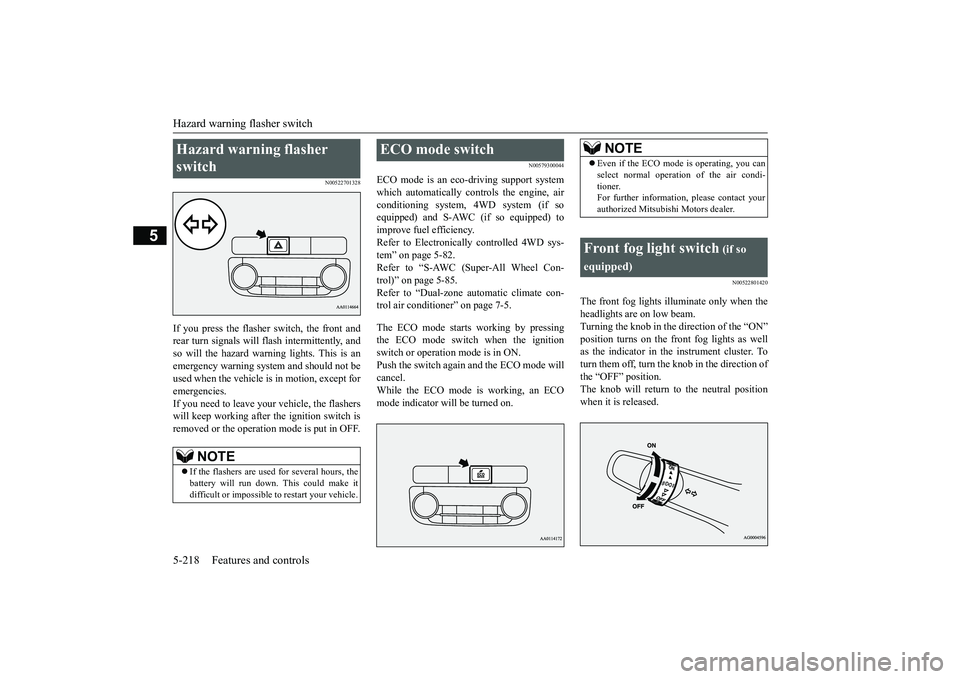
N00522701328
If you press the flasher switch, the front andrear turn signals will flash intermittently, andso will the hazard warn
ing lights. This is an
emergency warning syst
em and should not be
used when the vehicle is in motion, except foremergencies.If you need to leave your vehicle, the flasherswill keep working afte
r the ignition switch is
removed or the operation mode is put in OFF.
N00579300044
ECO mode is an eco-driving support systemwhich automatically cont
rols the engine, air
conditioning system,
4WD system (if so
equipped) and S-AWC (if so equipped) toimprove fuel efficiency.Refer to Electronically
controlled 4WD sys-
tem” on page 5-82.Refer to “S-AWC (Super-All Wheel Con-trol)” on page 5-85.Refer to “Dual-zone automatic climate con-trol air conditioner” on page 7-5.The ECO mode starts
working by pressing
the ECO mode switch when the ignitionswitch or operation mode is in ON.Push the switch again and the ECO mode willcancel.While the ECO mode is working, an ECOmode indicator will be turned on.
N00522801420
The front fog lights illuminate only when theheadlights are on low beam.Turning the knob in the direction of the “ON”position turns on the front fog lights as wellas the indicator in the instrument cluster. Toturn them off, turn the knob in the direction ofthe “OFF” position.The knob will return to the neutral positionwhen it is released.
Hazard warning flasher switch
NOTE
If the flashers are used for several hours, thebattery will run down.
This could make it
difficult or impossible
to restart your vehicle.
ECO mode switch
NOTE
Even if the ECO mode is operating, you canselect normal operati
on of the air condi-
tioner.For further information, please contact yourauthorized Mitsubishi Motors dealer.
Front fog light switch
(if so
equipped)
BK0249100US.book 218 ページ 2017年5月10日 水曜日 午前8時49分
Page 306 of 441
Electric rear window defogger switch
Features and controls 5-225
5
When the front wipers have frozen to thewindshield at the parked
positions, turning on
this switch will heat the windshield to makethe wipers operable. Pr
ess the electric rear
window defogger switch and the deicer willoperate.
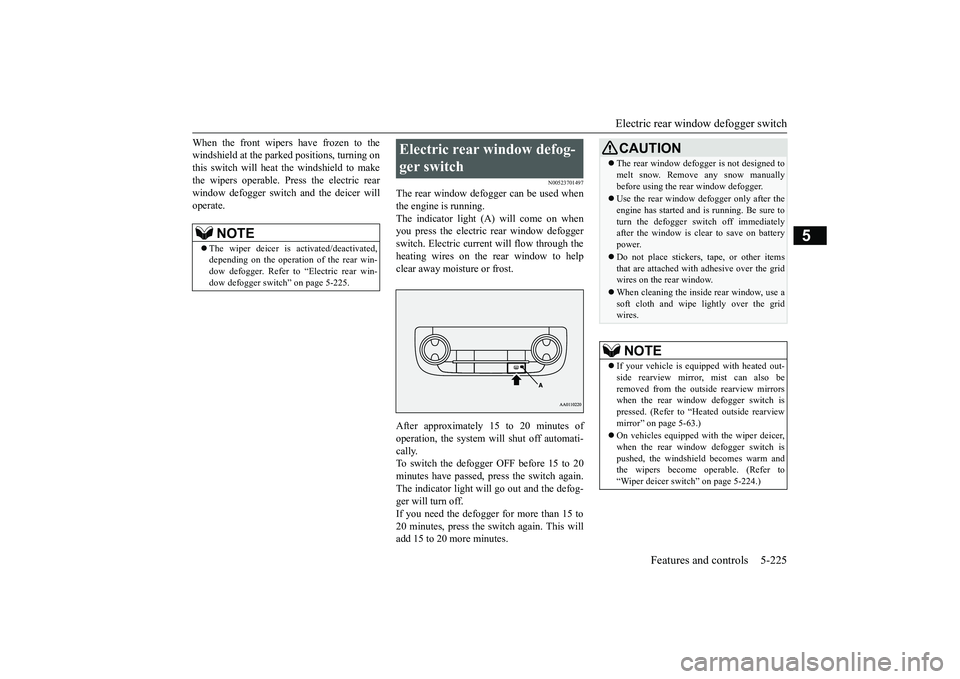
N00523701497
The rear window defogger can be used whenthe engine is running.The indicator light (A) will come on whenyou press the electric rear window defoggerswitch. Electric current will flow through theheating wires on the rear window to helpclear away moisture or frost.After approximately 15 to 20 minutes ofoperation, the system wi
ll shut off automati-
cally.To switch the defogger OFF before 15 to 20minutes have passed,
press the switch again.
The indicator light will
go out and the defog-
ger will turn off.If you need the defogger for more than 15 to20 minutes, press the switch again. This willadd 15 to 20 more minutes.
NOTE
The wiper deicer is
activated/de
activated,
depending on the operation of the rear win-dow defogger. Refer to
“Electric rear win-
dow defogger switch
” on page 5-225.
Electric rear window defog-ger switch
CAUTIONThe rear window defogge
r is not designed to
melt snow. Remove
any snow manually
before using the rear window defogger.Use the rear window de
fogger only after the
engine has started and
is running. Be sure to
turn the defogger swit
ch off immediately
after the window is cl
ear to save on battery
power.Do not place stickers,
tape, or other items
that are attached with adhesive over the gridwires on the rear window.When cleaning the inside
rear window, use a
soft cloth and wipe lightly over the gridwires.NOTE
If your vehicle is equi
pped with heated out-
side rearview mirror, mist can also beremoved from the outside rearview mirrorswhen the rear window defogger switch ispressed. (Refer to “Hmirror” on page 5-63.)On vehicles equipped w
ith the wiper deicer,
when the rear window defogger switch ispushed, the windshield
becomes warm and
the wipers become operable. (Refer to“Wiper deicer switch” on page 5-224.)
BK0249100US.book 225 ページ 2017年5月10日 水曜日 午前8時49分
Page 310 of 441
Sun visors
Features and controls 5-229
5
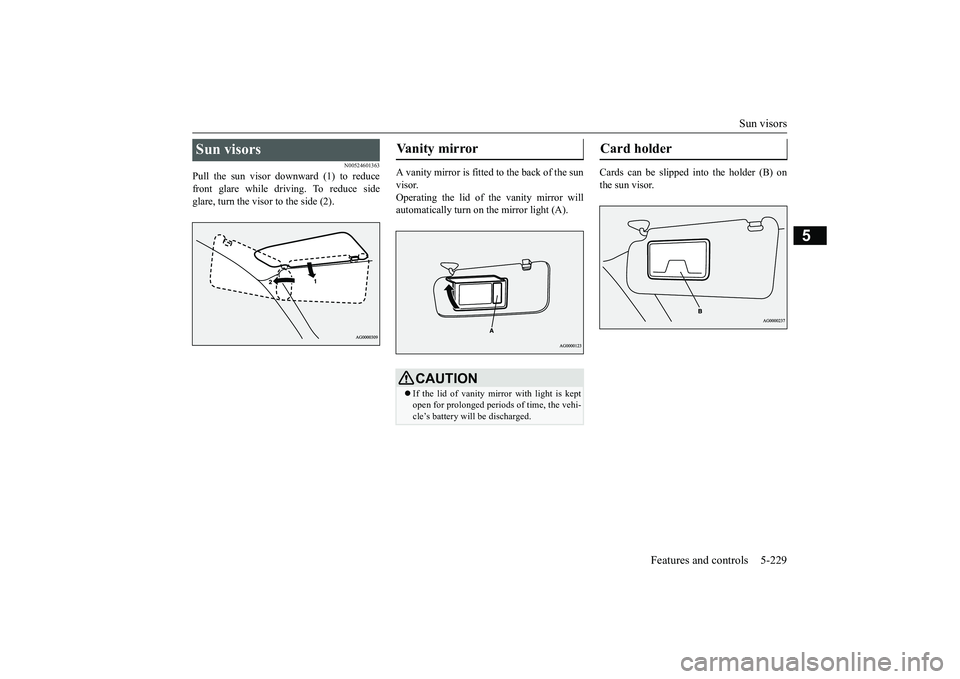
N00524601363
Pull the sun visor downward (1) to reducefront glare while driving. To reduce sideglare, turn the visor to the side (2).
A vanity mirror is fitted to the back of the sunvisor.Operating the lid of the vanity mirror willautomatically turn on the mirror light (A).
Cards can be slipped into the holder (B) onthe sun visor.
Sun visors
Vanity mirror
CAUTIONIf the lid of vanity mirror with light is keptopen for prolonged periods
of time, the vehi-
cle’s battery will be discharged.
Card holder
BK0249100US.book 229 ページ 2017年5月10日 水曜日 午前8時49分
Page 311 of 441
12 V power outlets5-230 Features and controls
5
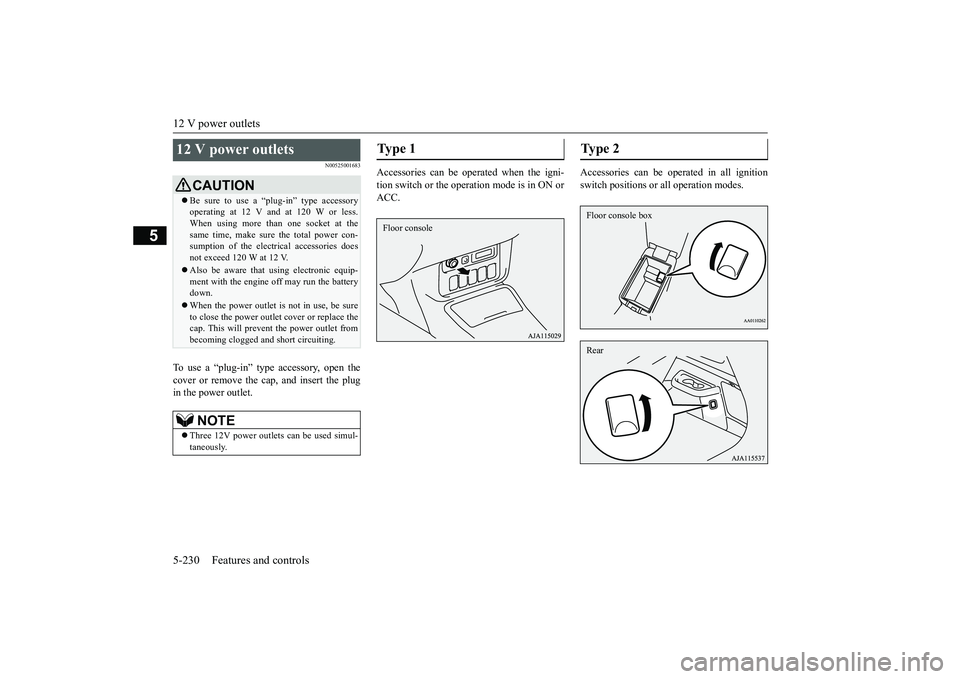
N00525001683
To use a “plug-in” type
accessory, open the
cover or remove the ca
p, and insert the plug
in the power outlet.
Accessories can be operated when the igni-tion switch or the operation mode is in ON orACC.
Accessories can be oper
ated in all ignition
switch positions or all operation modes.
12 V power outlets
CAUTIONBe sure to use a “plug-in” type accessoryoperating at 12 V and at 120 W or less.When using more than one socket at thesame time, make sure the total power con-sumption of the electrical accessories doesnot exceed 120 W at 12 V.Also be aware that
using electronic equip-
ment with the engine
off may run the battery
down.When the power outlet is not in use, be sureto close the power outle
t cover or replace the
cap. This will prevent the power outlet frombecoming clogged and short circuiting.NOTE
Three 12V power
outlets can be used simul-
taneously.
Type 1 Floor console
Ty p e 2 Floor console boxRear
BK0249100US.book 230 ページ 2017年5月10日 水曜日 午前8時49分
Page 312 of 441
HomeLink® Wireless Control System (if so equipped)
Features and controls 5-231
5
N00554301040
HomeLink
® Wireless Control System is a
registered trademark of Gentex Corporation.HomeLink
® provides a convenient way to
replace up to 3 hand-held radio-frequency(RF) transmitters used
to activate devices
such as gate operators, garage door openers,entry door locks, securi
ty systems, even home
lighting. Addi
tional HomeLink
® information
can be found at www.homelink.com,www.youtube.com/HomeL
inkGentex, or by
calling the toll-free HomeLink
®-Hotline at 1-
800-355-3515.
N00584600029
Some garage door openers manufacturedafter 1995 have “rollin
g code protection”.
To program a garage door openerequipped with “rolli
ng code protection”;
you will need to access the garage dooropener motor to press the motor’s “Learn”a ladder and another person to assist you.It is recommended that a new battery beplaced in the hand-held transmitter of thedevice being programmed to HomeLink
®
for quicker training and accurate trans-mission of the radio-frequency signal.
HomeLink
® Wireless Con-
trol System
(if so equipped)
Do not use HomeLink
® with any garage
door opener that lacks safety stop andreverse features as re
quired by U.S. Fed-
eral Regulations.
A garage door opener
which cannot detect an object in the pathof a closing garage d
oor and then auto-
matically stop and reverse, does not meetcurrent U.S. Federal Regulations. Using agarage door opener wi
thout these features
increases the risk of serious injury ordeath.
During programming, your garage dooror gate may open or cl
ose. Make sure that
people and ob
jects are clear of the garage
door or gate that you are programming.NOTE
Once HomeLink
® is programmed, retain the
original transmitter for future programmingprocedures (for exam
ple, new vehicle pur-
chases). Upon sale of the vehicle, the pro-grammed HomeLink
® buttons should be
erased for security purposes. Refer to“Cleaning the programmed information” onpage 5-235.You can program a maximum of 3 devices.To change or replace any of the 3 devicesafter it has been in
itially programmed, you
must first erase the current settings.See “Cleaning the programmed information”on page 5-235 or “Reprogramming a singleHomeLink
® button” on page 5-235.
WA R N I N G
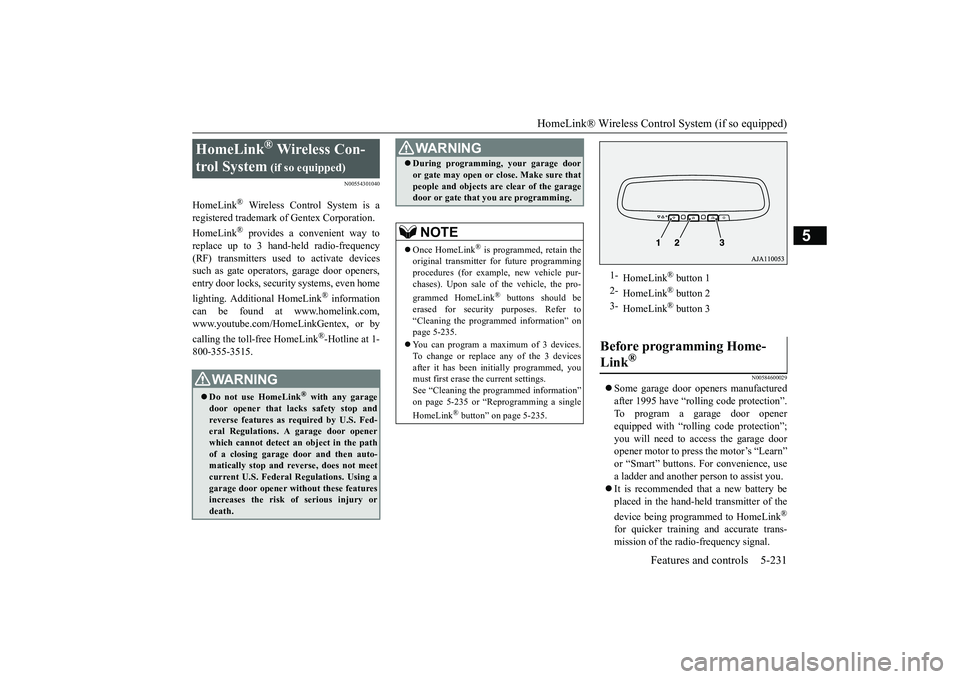
1-
HomeLink
® button 1
2-
HomeLink
® button 2
3-
HomeLink
® button 3
Before programming Home-Link
®
BK0249100US.book 231 ページ 2017年5月10日 水曜日 午前8時49分
Page 317 of 441
Interior lights5-236 Features and controls
5
This equipment complies with FCC radiationexposure limits set forth for an uncontrolledenvironment. End Users must follow the spe-cific operating instruc
tions for satisfying RF
exposure compliance. This transmitter mustbe at least 12 inches (20 cm) from the userand must not be co-located or operating inconjunction with any other antenna or trans-mitter.The term “IC:” before the certification/regis-tration number only signi
fies that Industry
Canada technical spec
ifications were met.
N00525301660
N00525401531
CAUTIONThe transmitter has been tested and complieswith FCC and IC rules.Changes or modifica
tions not expressly
approved by the party responsible for com-pliance could void the
user’s authority to
operate the device.
Interior lights
NOTE
Be aware that leaving the light illuminatedwith the engine off may run the batterydown.Never leave the vehi
cle without checking
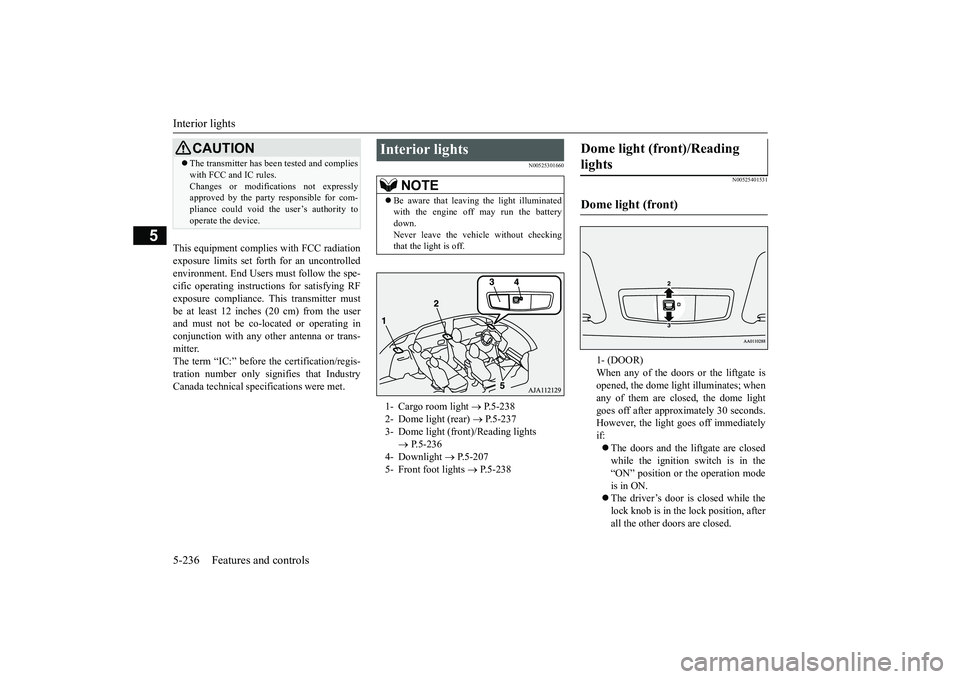
that the light is off.1- Cargo room light
P.5-238
2- Dome light (rear)
P.5-237
3- Dome light (front)/Reading lights
P.5-236
4- Downlight
P.5-207
5- Front foot lights
P.5-238
Dome light (front)/Reading lights Dome light (front)
1- (DOOR)When any of the doors or the liftgate isopened, the dome light illuminates; whenany of them are closed, the dome lightgoes off after approx
imately 30 seconds.
However, the light
goes off immediately
if:The doors and the liftgate are closedwhile the ignition switch is in the“ON” position or the operation modeis in ON.The driver’s door is closed while thelock knob is in the lock position, afterall the other doors are closed.
BK0249100US.book 236 ページ 2017年5月10日 水曜日 午前8時49分
Page 334 of 441
Driving during cold weather
Driving safety 6-5
6
you give extra attention to the followingareas, you can better protect yourself andyour passengers:Drive defensively. Be aware of traffic,road and weather c
onditions. Leave plenty
of stopping distance
between your vehicle
and the vehicle ahead.Before changing lanes, check your mir-rors, blind spots, a
nd use your turn-signal
light.While driving, watch the behavior ofother drivers, bicycl
ists, and pedestrians.
Always obey applicab
le laws and regula-
tions. Be a polite and alert driver. Alwaysleave room for unexpected events, such assudden braking.If you plan to drive in another country,obey their vehicle re
gistration laws and
make sure you will be able to get the rightfuel.
N00629400445
Check the battery. At the same time,check the terminals and wiring. Duringextremely cold weather, the battery willnot be as strong. Also, the battery powerlevel may drop beca
use more power is
used for cold starting and driving.
Before driving the vehicle, check to see ifthe engine runs at the proper speed and ifthe headlights are as bright as normally.Charge or replace the battery if necessary.During extreme cold weather, it is possi-ble that a very low battery could freeze.Warm the engine sufficiently. After start-ing the engine, allow a short warm-uptime to distribute oil to all cylinders. Thendrive your vehicle slowly.Stay at low speeds at first so that thetransaxle, transfer case and rear axle oilhave time to spread to all lubricationpoints.Check the engine antifreeze.If there is not enough coolant because of aleak or from engine
overheating, add Mit-
subishi Motors Genuine Super Long LifeCoolant Premium or equivalent.Please read this section in conjunctionwith the “Engine coolant” on page 9-8.
N00629501528
All the parts of the brake system are criticalto safety. Have the
vehicle serviced by an
authorized Mitsubishi Motors dealer or arepair facility of your
choice at regular inter-
vals according to the “WARRANTY ANDMAINTENANCE MANUAL”.Check the brake system while driving at alow speed immediately
after starting, espe-
cially when the brakes are wet, to confirmthey work normally.A film of water can be formed on the brakediscs and prevent normal braking after driv-ing in heavy rain or through large puddles, orafter the vehicle is washed. If this occurs, drythe brakes out by drivi
ng slowly while lightly
depressing the brake pedal.
Driving during cold weather
WA R N I N GThe battery gives off explosive hydrogengas. Any spark or flame can cause the bat-tery to explode, which could cause seriousinjury or death.Always wear protecti
ve clothes and a face
mask when working with your battery, orlet a skilled mechanic do it.
WA R N I N GNever open the radiator cap when theradiator is hot. You could be seriouslyburned.
Braking When brakes are wet
BK0249100US.book 5 ページ 2017年5月10日 水曜日 午前8時49分
Page 336 of 441
Loading informationDriving safety 6-7
6
installed options, and
the tongue weight of
the trailer, if any, being towed. The tire andloading information placard located on thedriver’s door sill of your vehicle will showhow much weight it may properly carry.It is important to famil
iarize yourself with the
following terms before loading your vehicle:Vehicle maximum load on the tire: loadon an individual tire that is determined bydistributing to each axle its share of themaximum loaded vehicle weight anddividing by two.Vehicle normal load on the tire: load on anindividual tire that is determined by dis-tributing to each axle its share of the curbweight, accessory weight, and normaloccupant weight and dividing by two.Maximum loaded vehicle weight: the sumof -(a) Curb weight;(b) Accessory weight;(c) Vehicle capacity weight; and(d) Production options weight.
Curb weight: the weight of a motor vehi-cle with standard equipment including themaximum capacity of
fuel, oil, and cool-
ant.Accessory weight: the combined weight(in excess of those st
andard items which
may be replaced) of automatic transaxle,power steering, power brakes, power win-dows, power seats, radio, and heater, tothe extent that these items are available asfactory- installed equipment (whetherinstalled or not).Vehicle capacity weight: the rated cargoand luggage load plus 150 lbs (68 kg)*times the vehicle’s designated seatingcapacity.Production options weight: the combinedweight of those installed regular produc-tion options weighing over 5 lbs (2.3 kg)in excess of those standard items whichthey replace, not prev
iously considered in
curb weight or accessory weight, includ-ing heavy duty brakes,
ride levelers, roof
rack, heavy duty battery, and special trim.Normal occupant weight: 150 lbs (68 kg)*times the number of
specified occupants
(3 in the case of your vehicle)Occupant distribution:
Occupant distribu-
tion within the passenger compartment (Inyour vehicle the distribution is 2 in front,1 in second row seat)
N00630101407
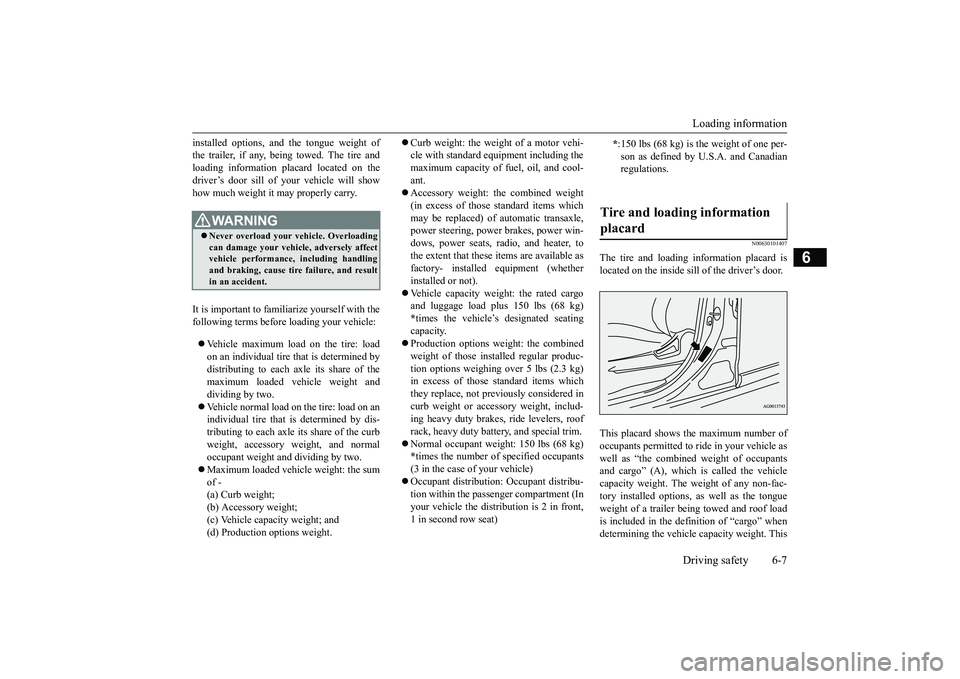
The tire and loading information placard islocated on the inside sill of the driver’s door.This placard shows the maximum number ofoccupants permitted to
ride in your vehicle as
well as “the combined
weight of occupants
and cargo” (A), which
is called the vehicle
capacity weight. The weight of any non-fac-tory installed options, as well as the tongueweight of a trailer being towed and roof loadis included in the defi
nition of “cargo” when
determining the vehicle
capacity weight. This
WA R N I N GNever overload your ve
hicle. Overloading
can damage your vehicl
e, adversely affect
vehicle performance, including handlingand braking, cause tire failure, and resultin an accident.
*:150 lbs (68 kg) is the weight of one per-son as defined by U.
S.A. and Canadian
regulations.
Tire and loading information placard
BK0249100US.book 7 ページ 2017年5月10日 水曜日 午前8時49分
Page 363 of 441
If the vehicle breaks down8-2 For emergencies
8
N00836301230
If your vehicle breaks down on the road,move to the shoulder and turn on the hazardwarning flashers. If there is no shoulder, orthe shoulder is not safe, drive in the right laneslowly with the hazard
lights flashing, until
you come to a safe stopping place. Keep theflashers flashing.If the engine stops, there will be no powerassist to the steering and brakes, making thesedifficult to use.The brake booster will not work, so thebrakes will not grip well. The brake pedalwill be harder to press than usual.Since there is no power steering assist, thesteering wheel will be hard to turn.
Get help from your passengers, bystanders,etc. to push the vehicle
and move it to a safe
area.
N00836401778
If the engine cannot be started because thebattery is weak or de
ad, you can start it with
the battery from anothe
r vehicle using jumper
cables.1. Take off any metal jewelry such as watchbands or bracelets th
at might create an
accidental electrical contact.2. Position the vehi
cles close enough
together so that the jumper cables canreach, but be sure the vehicles aren’ttouching each other.
3. Set the parking brake firmly on your vehi-cle and move the selector lever into the“P” (PARK) position.4. Set the parking brake firmly on the othervehicle. Put the automatic transaxle in “P”5. Turn the ignition switch (the engineswitch) on each vehicle to the “LOCK” or“OFF” position.6. Make sure your battery electrolyte is atthe proper level. (Refer to “Battery” onpage 9-13.)
If the vehicle breaks down If the engine stops/fails When the engine fails at the intersection
Jump-starting the engine
WA R N I N GTo reduce the risk of igniting flammablegas that may be emitted from the battery,carefully read this section before jump-starting the vehicle.Do not try to start you
r vehicle by pushing
or towing. This can cause an accidentresulting in serious
injury or death and
can damage the vehicle.NOTE
Do not use jumper cables if they have dam-age or corrosion.
CAUTIONCheck the other vehicle.
It must have a 12-
volt battery. If the other system isn’t 12-volt,both systems can be damaged.NOTE
Turn off all lights, heat
er, and othe
r electrical
loads. This will avoid sparks and help saveboth batteries.
BK0249100US.book 2 ページ 2017年5月10日 水曜日 午前8時49分
Page 364 of 441
Jump-starting the engineFor emergencies 8-3
8
7. Connect one end of one jumper cable to the positive (+) terminal of the dis-charged battery (A),
and then connect the
other end to the positive (+) terminalof the booster battery (B).
2.4 liter models
3.0 liter models
8. Connect one end of the other jumper cable
to the negative (-) terminal of thebooster battery (B), a
nd then connect the
other end to the designated groundlocation of the vehicl
e with the discharged
battery (A) at the point farthest from thebattery.9. Start the engine in the vehicle providingthe boost. Let the engine idle a few min-utes, then start the engine in the vehiclewith the discharged battery.
10. After the engine is
started, disconnect the
cables in the reverse order from the wayyou connected them.
WA R N I N GIf the electrolyte flui
d is not visible, or
looks frozen, DO NOT ATTEMPT JUMPSTARTING!!The battery might split open or explode ifthe temperature is below the freezingpoint or if it is not filled to the properlevel.
WA R N I N GMake sure that the jumper cables andyour clothing are clear of the cooling fansand drive belts. Entanglement with thefans or belts can ca
use serious personal
injury.NOTE
Open the terminal cover before connectingthe jumper cable to the positive terminal ofthe battery.(Refer to “Battery” on page 9-13.)Use the proper cables suitable for the batterysize.Otherwise heat damage
to the cables could
result.
WA R N I N GBe sure to follow the proper order whenconnecting the batteries, of:
Make sure that the connection is madeto the correct designated location (asshown in the illustration) properly. If theconnection is directly made to the negative(-) terminal of the battery, the flammablegases from inside the battery might catchfire and explode, caus
ing personal injury.
When connecting the jumper cable, do notconnect the positive (+) cable to the nega-tive (-) terminal. Sparks can make the bat-tery explode.
BK0249100US.book 3 ページ 2017年5月10日 水曜日 午前8時49分