service MITSUBISHI OUTLANDER III 2018 Service Manual
[x] Cancel search | Manufacturer: MITSUBISHI, Model Year: 2018, Model line: OUTLANDER III, Model: MITSUBISHI OUTLANDER III 2018Pages: 441, PDF Size: 13.71 MB
Page 394 of 441
Tires
Vehicle care and maintenance 9-17
9
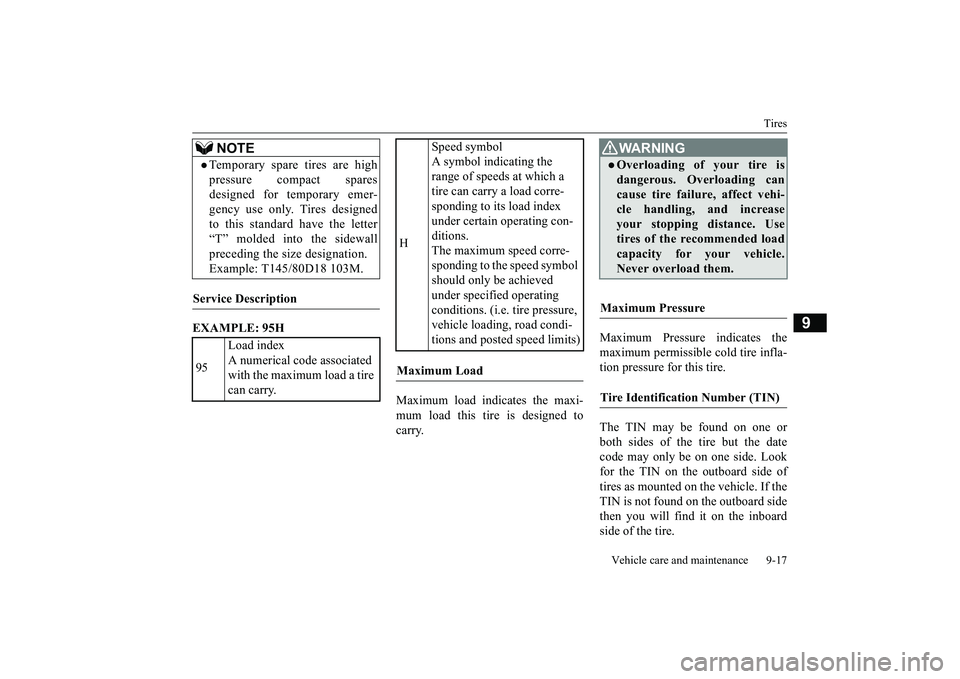
EXAMPLE: 95H
Maximum load indicates the maxi-mum load this tire is designed tocarry.
Maximum Pressure indicates themaximum permissible cold tire infla-tion pressure for this tire.The TIN may be found on one orboth sides of the tire but the datecode may only be on one side. Lookfor the TIN on the outboard side oftires as mounted on the vehicle. If theTIN is not found on the outboard sidethen you will find it on the inboardside of the tire.
Temporary spare tires are highpressure compact sparesdesigned for temporary emer-gency use only. Tires designedto this standard have the letter“T” molded into the sidewallpreceding the size
designation.
Example: T145/80D18 103M.
Service Description 95
Load indexA numerical code associated with the maximum load a tire can carry.NOTE
H
Speed symbolA symbol indicating the range of speeds at which a tire can carry a load corre-sponding to its load index under certain operating con-ditions.The maximum speed corre-sponding to the speed symbol should only be achieved under specified operating conditions. (i.e. tire pressure, vehicle loading, road condi-tions and posted speed limits)
Maximum Load
WA R N I N GOverloading of your tire isdangerous. Overloading cancause tire failure, affect vehi-cle handling, and increaseyour stopping distance. Usetires of the recommended loadcapacity for your vehicle.Never overload them.
Maximum Pressure Tire Identification Number (TIN)
BK0249100US.book 17 ページ 2017年5月10日 水曜日 午前8時49分
Page 395 of 441
Tires9-18 Vehicle care and maintenance
9
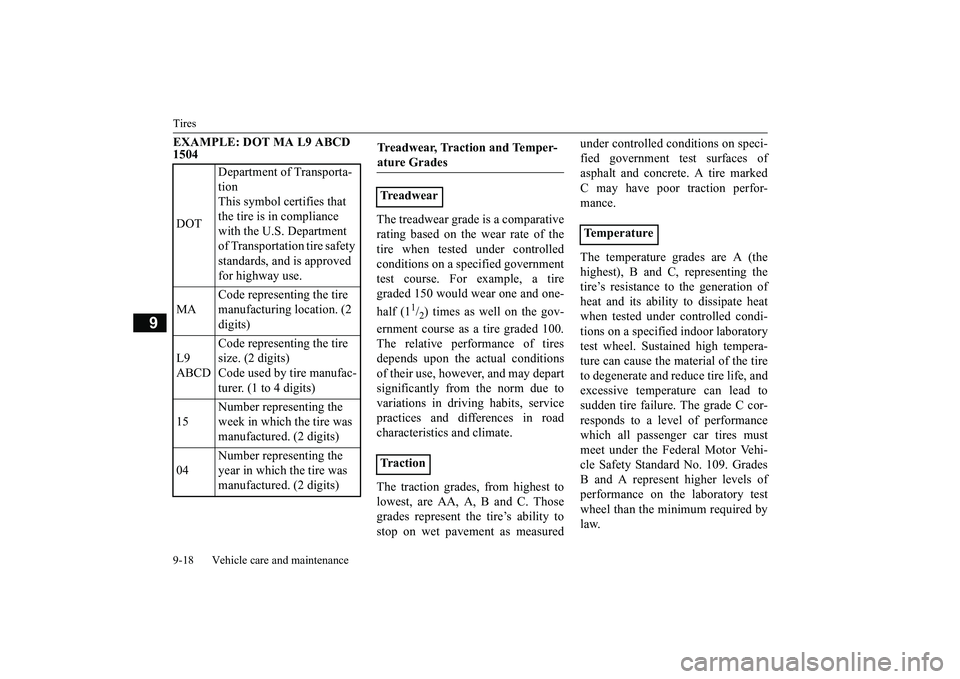
EXAMPLE: DOT MA L9 ABCD 1504
The treadwear grade is a comparativerating based on the wear rate of thetire when tested under controlledconditions on a specified governmenttest course. For example, a tiregraded 150 would wear one and one-half (1
1/2) times as well on the gov-
ernment course as a tire graded 100.The relative performance of tiresdepends upon the
actual conditions
of their use, however, and may departsignificantly from the norm due tovariations in driv
ing habits, service
practices and differences in roadcharacteristics and climate.The traction grades, from highest tolowest, are AA, A, B and C. Thosegrades represent the tire’s ability tostop on wet pavement as measured
under controlled co
nditions on speci-
fied government test surfaces ofasphalt and concrete. A tire markedC may have poor traction perfor-mance.The temperature grades are A (thehighest), B and C, representing thetire’s resistance to the generation ofheat and its ability to dissipate heatwhen tested under controlled condi-tions on a specified indoor laboratorytest wheel. Sustained high tempera-ture can cause the material of the tireto degenerate and reduce tire life, andexcessive temperature can lead tosudden tire failure. The grade C cor-responds to a level of performancewhich all passenger car tires mustmeet under the Federal Motor Vehi-cle Safety Standard No. 109. GradesB and A represent higher levels ofperformance on the laboratory testwheel than the minimum required bylaw.
DOT
Department of Transporta-tionThis symbol certifies that the tire is in compliance with the U.S. Department of Transportation tire safety standards, and is approved for highway use.
MA
Code representing the tire manufacturing location. (2 digits)
L9ABCD
Code representing the tire size. (2 digits)turer. (1 to 4 digits)
15
Number representing the week in which the tire was manufactured. (2 digits)
04
Number representing the year in which the tire was manufactured. (2 digits)
Treadwear, Traction and Temper-ature Grades Tr e a d w e a rTr a c t i o n
Te m p e r a t u r e
BK0249100US.book 18 ページ 2017年5月10日 水曜日 午前8時49分
Page 400 of 441
Emission-control system maintenanceVehicle care and maintenance 9-23
9
N00940800328
Your vehicle is equi
pped with an emission-
control system that meets all the requirementsof the U.S. Environm
ental Protection Agency
and Environment Cana
da. The emission-con-
trol system is made of:a positive crankcase
ventilation system
an evaporative emis
sion-control system
an exhaust emission-control system
To be sure the emissi
on-control system works
properly, have your vehicle inspected andmaintained by an authorized MitsubishiMotors dealer or a repair facility of yourchoice. This should be done at the time ormileage specified in the “WARRANTY ANDMAINTENANCE MANUAL”.These, and all the other “general” mainte-nance services listed in this manual, need tobe performed to keep
your vehicle running
properly and reliably.You should also have an inspection and ser-vice any time you suspect a malfunction.
N00940900231
Spark plugs must fire properly to ensureproper engine perfo
rmance and emission-
control.Do not reuse spark plugs by cleaning orregapping. Spark plugs should be replaced atthe mileage specified in the “WARRANTYAND MAINTENANCE MANUAL”.
Check the hose surfaces for any heat andmechanical damage, hard and brittle rubber,cracking, tears, cuts and abrasions. Pay spe-cial attention to the hos
es closest to high heat
sources such as the exhaust manifold. Checkall the hose connections
, such as clamps and
couplings, to make sure
they are secure and
that there are no leaks. If you see any wear ordamage, replace the
hoses immediately.
N00950100050
Have the valve clea
rance checked at an
authorized Mitsubishi Motors dealer at themileage specified in the “WARRANTY ANDMAINTENANCE MANUAL”.If the engine sounds abnormally loud, haveadjustments made by an authorizedMitsubishi Motors dealer.
N00941300173
Check these regularly for damage or leaks inthe fuel lines and connections. Check the fueltank filler cap for dama
ge or looseness. Pay
special attention to the fuel lines closest to
Emission-control system maintenance
NOTE
To meet government regulations and pro-mote cleaner air, your
vehicle is equipped
with an onboard dia
gnostic system (OBD).
The engine electronic control module thatcontrols OBD functions stores various data(especially a
bout the exhaust emissions).
This data will be erased if the battery cable isdisconnected, which c
ould make a rapid
diagnosis difficult.
Do not disconnect the
battery cable when the engine malfunctionindicator (“SERVICE ENGINE SOON” or“Check engine
light”) is ON.
Spark plugs
NOTE
Use the recommended or equivalent sparkplugs listed under “Engin
e specifications” on
page 11-6. Use of other plugs could causeengine damage, loss of performance or radionoise.
Fuel hoses Intake valve clearance Fuel system (tank, pipe line and connection, and fuel tank filler cap)
BK0249100US.book 23 ページ 2017年5月10日 水曜日 午前8時49分
Page 401 of 441
General maintenance9-24 Vehicle care and maintenance
9
high heat sources such
as the exhaust mani-
fold.
N00941400187
If the fuel-vapor vent line is clogged or dam-aged, the fuel-vapor mixture will escape, pol-luting the air.Have the system checked at an authorizedMitsubishi Motors dealer at the mileage spec-ified in the “WARRANTY AND MAINTE-NANCE MANUAL”.
N00941501299
The next pages list th
e maintenance service
recommended by Mitsubishi Motors Corpo-ration. In addition to the general maintenancethat needs to be performed at the times listed,
there are other parts which do not usuallyneed regular maintenance.But, if any of these parts stops working prop-erly, your vehicle performance could suffer.Have these items checked if you notice aproblem with them.If you have any questions, see your autho-rized Mitsubishi Motors
dealer for assistance.
N00941600059
Good brakes are essential for safe driving.Check the brake pads for wear. For goodbraking performance, replace the brake padswith the same type pa
ds as the originals.
N00941700076
Brake hoses and tubing should be checkedfor:Severe surface cracking, scuffing or wornspots. If the fabric casing of the hose isshowing through any cracks or worn spotsin the rubber hose cover, the hose shouldbe replaced. The brakes can fail if thehose wears through.Improper installati
on may cause twisting,
or wheel, tire or
chassis interference.
N00941800093
Check the following parts for damage andgrease leaks:Ball joint boots of the suspension andsteering linkageBellows on both ends of the drive shaft
N00942201118
The best way to keep carbon monoxide gasfrom entering inside your
vehicle is to have
the engine exhaust syst
em properly serviced.
Have a competent mechanic inspect the com-plete exhaust system
and nearby body areas
for broken, damaged, deteriorated, or mispo-sitioned parts if you no
tice any of the follow-
ing:A change in the sound of the exhaust sys-temThe smell of exhaust fumes inside thevehicle
WA R N I N GIf you see a fuel leak
or if you smell fuel,
do not run the engine. Any spark (includ-ing from the ignition
), flame or smoking
material could cause an explosion or fire.Call an authorized
Mitsubishi Motors
dealer or a repair fa
cility of your choice
for assistance.
Evaporative emission control system (except evaporative emission canister) General maintenance
Disc brake pads Brake hoses
Ball joint, steering linkage seals, drive shaft boots Exhaust system
WA R N I N GCarbon monoxide gas
from your vehicle’s
exhaust is poisonous. Breathing thesefumes can cause unconsciousness or death.
BK0249100US.book 24 ページ 2017年5月10日 水曜日 午前8時49分
Page 402 of 441
For cold and snowy weather
Vehicle care and maintenance 9-25
9
The underside or rear of the vehicle isdamaged
Also check the exhaust system each time thevehicle is raised for l
ubrication, oil changes,
or required service. A
ny open seams or loose
connections could le
t dangerous exhaust
fumes seep into the luggage and passengercompartments.Check for holes or exhaust gas leakscaused by corrosion or damage.Check the joints and connections forlooseness or exhaust gas leaks.Check the rubber hangers and brackets fordamage.
N00942300079
The timing belt should be replaced with anew one at the mileage listed in the “WAR-RANTY AND MAINTENANCE MAN-UAL”.
N00942501124
The hood lock release mechanism and hoodsafety catch should be checked, cleaned, andoiled when needed for easy movement and toprevent rust and wear. Use MultipurposeGrease NLGI Grade 2 sparingly for all slidingparts of the hood latch and release lever.Work the grease into the hood lock mecha-nism until all the movable surfaces are cov-ered.Also, put a light coat
of the same grease on
the safety catch wherever moving parts touch.
N00942600102
The ventilation slots in
front of the wind-
shield should be brushed clear after a heavysnowfall so that the operation of the heatingand ventilation systems will not be impaired.
To prevent freezing of the weatherstrippingon the doors, engine hood, etc., they shouldbe treated with
silicone grease.
It is a good idea to carry a shovel or a short-handled spade in the vehicle during the win-ter so that you can clear away snow if you getstranded. A small hand-brush for sweepingsnow off the vehicle a
nd a plastic scraper for
the windshield, side a
nd rear window are also
useful.
N00942700291
The fusible links will melt to prevent a fire ifa large current attempts to flow through cer-tain electrical systems.In case of a melted fusible link, see yourauthorized Mitsubishi Motors dealer or arepair facility of your choice for inspectionand replacement.For the fusible links, please refer to “Fuseload capacities” on page 9-27.
Check for any of the following conditions: Timing belt
Hood lock release mechanism and safety catch For cold and snowy weather Ventilation slots
Weatherstripping Additional equipment (For regions where snow is encoun-tered) Fusible links
BK0249100US.book 25 ページ 2017年5月10日 水曜日 午前8時49分
Page 423 of 441
Consumer information (For vehicles sold in U.S.A.)10-2 Customer assistance/Re
porting Safety Defects
10
N01047100171
This information is provided in compliancewith the requirements of the National High-way Traffic Safety Ad
ministration, Depart-
ment of Transportation. It provides thepurchasers and/or prospective purchaserswith information on repor
ting safety defects.
DOT quality grades - Al
l passenger vehicle
tires must conform to
Federal Safety Require-
ments in addition to these grades. The spe-cific grade rating in each grade category isshown on the side wall of the tires on yourvehicle. The treadwear grade is a comparative ratingbased on the wear rate of
the tire when tested
under controlled conditions on a specifiedgovernment test course
. For example, a tire
graded 150 would wear one and one-half(11/2) times as well on the government course
as a tire graded 100.
The relative performance
of tires depends upon the actual conditions of
their use, however, and may depart signifi-cantly from the norm due to variations indriving habits, service practices and differ-ences in road characteristics and climate. The traction grades, from highest to lowest,are AA, A, B and C. Those grades representthe tire’s ability to
stop on wet pavement as
measured under controlled conditions onspecified government te
st surfaces of asphalt
and concrete. A tire marked C may have poortraction performance. The temperature grades are A (the highest), Band C, representing the ti
re’s resistance to the
generation of heat and it
s ability to dissipate
heat when tested un
der controlled conditions
on a specified indoor
laboratory test wheel.
Sustained high temperature can cause the
material of the tire to
degenerate and reduce
tire life, and excessive temperature can leadto sudden tire failure. The grade C corre-sponds to a level of performance which allpassenger car tires must meet under the Fed-eral Motor Vehicle Safety Standard No. 109.Grades B and A represent higher levels ofperformance on the labora
tory test wheel than
the minimum required by law.
N01047201498
If you believe that your vehicle has adefect which could cause a crash orcould cause injury or death, youshould immediately inform theNational Highway Traffic SafetyAdministration (NHTSA) in addi-tion to notifying Mitsubishi MotorsCorporation.
Consumer information (For vehicles sold in U.S.A.) Uniform tire quality grading Treadwear
Traction AA, A, B, C
WA R N I N GThe traction grade assi
gned to this tire is
based on straight-ahead braking tractiontests, and does not include acceleration,cornering, hydroplani
ng, or peak traction
characteristics.
Temperature A, B, C
WA R N I N GThe temperature grade for this tire isestablished for a tire that is properlyinflated and not overloaded. Excessivespeed, underinflation
, or excessive load-
ing, either separately
or in combination,
can cause heat buildup and possible tirefailure.
Reporting Safety Defects
BK0249100US.book 2 ページ 2017年5月10日 水曜日 午前8時49分
Page 424 of 441
Reporting Safety Defects
Customer assistance/Reporting Safety Defects 10-3
10
If NHTSA receives similar com-plaints, it may open an investigation,and if it finds that a safety defectexists in a group of vehicles, it mayorder a recall and remedy campaign.However, NHTSA cannot becomeinvolved in individual problemsbetween you, your dealer, or Mit-subishi Motors Corporation.To contact NHTSA, you may call theVehicle Safety Hotline toll-free at 1-888-327-4236 (TTY: 1-800-424-9153); go tohttp://www.safercar.gov; or write to:You can also obtain other informa-tion about motor vehicle safety fromhttp://www.safercar.gov.
To contact Mitsubishi Motors NorthAmerica, Inc. call 1-888-648-7820 orwrite to:If you live in Canada, and youbelieve that your vehicle has a safetydefect, you should immediatelynotify Transport Canada, in additionto notifying Mitsubishi Motor Salesof Canada, Inc. You may write to:
To contact Mitsubishi Motor Sales ofCanada, Inc. call 1-888-576-4878 orwrite to:To contact Mitsubishi Motor Sales ofCaribbean, Inc.call 1-787-251-8715 or write to:To contact Triple J Enterprises Inc.
NHTSA Headquarters 1200 New Jersey Avenue, SEWest BuildingWashington, DC 20590
For vehicles sold in U.S.A. Mitsubishi Motors North Amer-ica, Inc.Customer Relations DepartmentP.O. Box 6400Cypress, CA 90630-0064For vehicles sold in Canada Transport Canada330 Sparks StreetTo w e r COttawa, Ontario K1A 0N5
Mitsubishi Motor Sales of Can-ada, Inc.Customer Relations DepartmentP.O. Box 410094141 Dixie RoadMississauga, ON L4W 5C9For vehicles sold in Puerto Rico Mitsubishi Motor Sales of Carib-bean, Inc.Customer Service DepartmentP.O. Box 192216SAN JUAN PR 00919-2216For vehicles sold in Guam
BK0249100US.book 3 ページ 2017年5月10日 水曜日 午前8時49分
Page 436 of 441
Alphabetical index
12-1
12
Numerics
12 V power outlets
............................
5-230
4-wheel drive operation
.......................
5-88
A
Accessory (installation)
.........................
3-6
Active stability control (ASC)
............
5-100
Adaptive Cruise C
ontrol System (ACC)
.......
5-107Air cleaner filter
...................................
9-9
Air conditioner
Dual-zone automatic climate control airconditioner
.....................................
7-5
Important air condi
tioning operating tips
..
7-13
Air purifier
.........................................
7-14
Airbag
...............................................
4-35
All-wheel drive operation
....................
5-88
Aluminum wheels
...............................
9-43
Anti-lock braking system
.....................
5-97
Arm rest
.............................................
4-10
Assist grip
........................................
5-246
Automatic high beam system
.............
5-211
Automatic transaxle
............................
5-68
Fluid
.....................................
9-11
, 11-7
Selector lever operation
...................
5-68
Selector lever positions
...................
5-71
Sports mode
...................................
5-72
B
Back-up light
Bulb capacity
.................................
9-32
Replacement
..................................
9-38
Ball joint, steering linka
ge seals, drive shaft
boots
...............................................
9-24
Battery
..............................................
9-13
Charging system warning light
.......
5-204
Checking battery
electrolyte level
....
9-13
Disconnection and connection
.........
9-14
During cold weather
.......................
9-14
Specification
..................................
11-6
Blind Spot Warning (BSW)
................
5-126
Bottle holders
....................................
5-243
Brake
Fluid
.....................................
9-13
, 11-7
Brake assist
........................................
5-96
Braking
Anti-lock braking system
................
5-97
Braking
...........................................
6-5
Hose
.............................................
9-24
Pad wear alarm
..............................
5-93
Parking brake
.................................
5-53
Pedal
.............................................
5-92
Pedal free play
...............................
9-22
Power brakes
.................................
5-92
Service brake
.................................
5-92
Warning lights and buzzer
.............
5-203
Break-in recommendations
....................
5-3
Bulb capacity
......................................
9-32
C
California Perchl
orate Materials
Requirements
.....................................
3-7
Capacities
..........................................
11-7
Card holder
............................
5-229
, 5-240
Cargo area cover
...............................
5-244
Cargo loads
........................................
6-10
Cargo room light
...............................
5-238
Bulb capacity
.................................
9-33
Catalytic converter
................................
9-2
Cautions on the handling of all-wheel drive vehicles
............................................
5-91
Certification label
...............................
11-3
Charging system warning light
...........
5-204
Child restraint systems
........................
4-27
Child safety locks for rear door
............
5-37
Cleaning
Inside of your vehicle
......................
9-40
Outside of your vehicle
...................
9-41
Coat hook
.........................................
5-246
Consumer information
.........................
10-2
Continuously variable transmission (CVT)
...
5-75
BK0249100US.book 1 ページ 2017年5月10日 水曜日 午前8時49分
Page 439 of 441
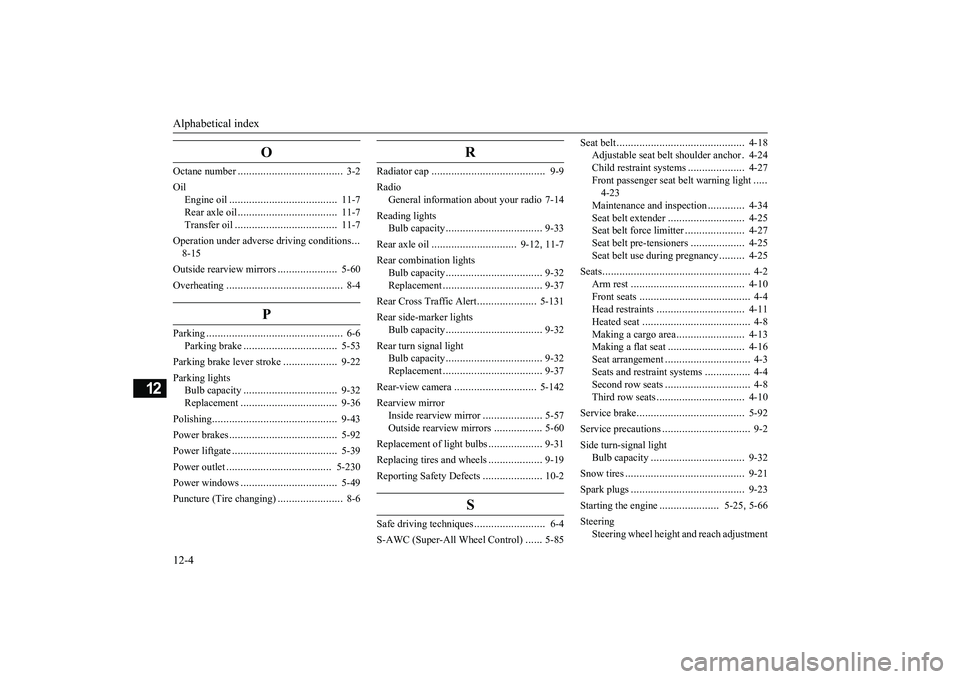
Alphabetical index12-4
12
O
Octane number
.....................................
3-2
Oil
Engine oil
......................................
11-7
Rear axle oil
...................................
11-7
Transfer oil
....................................
11-7
Operation under adverse driving conditions
...
8-15Outside rearview mirrors
.....................
5-60
Overheating
.........................................
8-4
P
Parking
................................................
6-6
Parking brake
.................................
5-53
Parking brake lever stroke
...................
9-22
Parking lights
Bulb capacity
.................................
9-32
Replacement
..................................
9-36
Polishing
............................................
9-43
Power brakes
......................................
5-92
Power liftgate
.....................................
5-39
Power outlet
.....................................
5-230
Power windows
..................................
5-49
Puncture (Tire changing)
.......................
8-6
R
Radiator cap
........................................
9-9
Radio
General information
about your radio 7-14
Reading lights
Bulb capacity
..................................
9-33
Rear axle oil
..............................
9-12
, 11-7
Rear combination lights
Bulb capacity
..................................
9-32
Replacement
...................................
9-37
Rear Cross Traffic Alert
.....................
5-131
Rear side-marker lights
Bulb capacity
..................................
9-32
Rear turn signal light
Bulb capacity
..................................
9-32
Replacement
...................................
9-37
Rear-view camera
.............................
5-142
Rearview mirror
Inside rearview mirror
.....................
5-57
Outside rearview mirrors
.................
5-60
Replacement of light bulbs
...................
9-31
Replacing tires and wheels
...................
9-19
Reporting Safety Defects
.....................
10-2
S
Safe driving techniques
.........................
6-4
S-AWC (Super-All Wheel Control)
......
5-85
Seat belt
.............................................
4-18
Adjustable seat belt shoulder anchor
.4-24
Child restraint systems
....................
4-27
Front passenger seat belt warning light
.....
4-23Maintenance and inspection
.............
4-34
Seat belt extender
...........................
4-25
Seat belt force limitter
.....................
4-27
Seat belt pr
e-tensioners
...................
4-25
Seat belt use
during pregnancy
.........
4-25
Seats
....................................................
4-2
Arm rest
........................................
4-10
Front seats
.......................................
4-4
Head restraints
...............................
4-11
Heated seat
......................................
4-8
Making a cargo area
........................
4-13
Making a flat seat
...........................
4-16
Seat arrangement
..............................
4-3
Seats and restraint systems
................
4-4
Second row seats
..............................
4-8
Third row seats
...............................
4-10
Service brake
......................................
5-92
Service precautions
...............................
9-2
Side turn-signal light
Bulb capacity
.................................
9-32
Snow tires
..........................................
9-21
Spark plugs
........................................
9-23
Starting the engine
.....................
5-25
, 5-66
Steering
Steering wheel height and reach adjustment
BK0249100US.book 4 ページ 2017年5月10日 水曜日 午前8時49分
Page 440 of 441
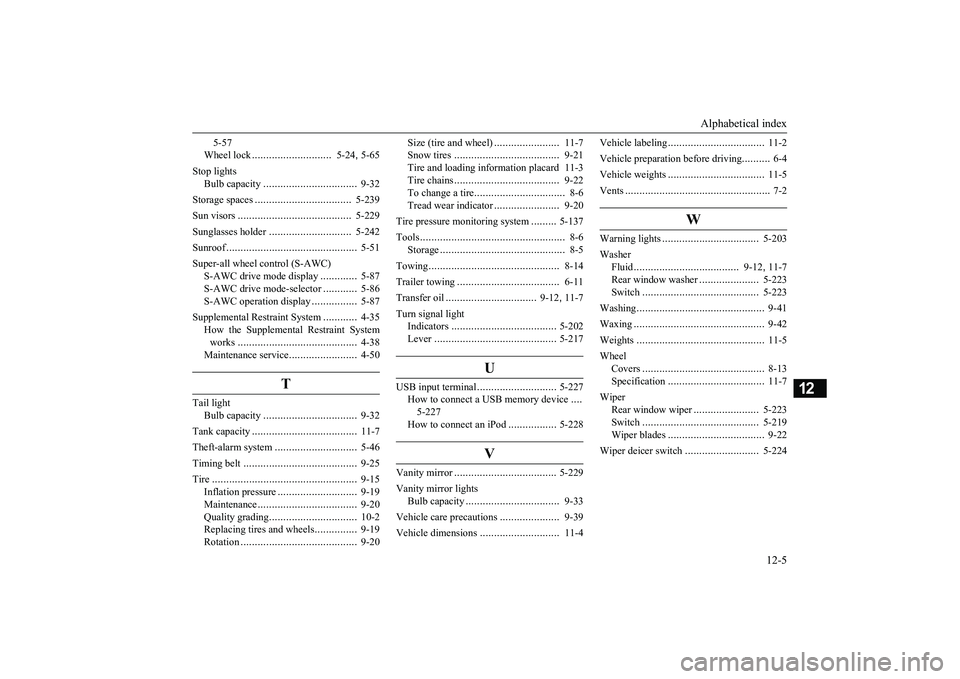
Alphabetical index
12-5
12
5-57Wheel lock
............................
5-24
, 5-65
Stop lights
Bulb capacity
.................................
9-32
Storage spaces
..................................
5-239
Sun visors
........................................
5-229
Sunglasses holder
.............................
5-242
Sunroof
..............................................
5-51
Super-all wheel control (S-AWC)
S-AWC drive mode display
.............
5-87
S-AWC drive mode-selector
............
5-86
S-AWC operation display
................
5-87
Supplemental Re
straint System
............
4-35
How the Supplemental Restraint Systemworks
..........................................
4-38
Maintenance service
........................
4-50
T
Tail light
Bulb capacity
.................................
9-32
Tank capacity
.....................................
11-7
Theft-alarm system
.............................
5-46
Timing belt
........................................
9-25
Tire
...................................................
9-15
Inflation pressure
............................
9-19
Maintenance
...................................
9-20
Quality grading
...............................
10-2
Replacing tires and wheels
...............
9-19
Rotation
.........................................
9-20
Size (tire and wheel)
.......................
11-7
Snow tires
.....................................
9-21
Tire and loading information placard 11-3Tire chains
.....................................
9-22
To change a tire
................................
8-6
Tread wear indicator
.......................
9-20
Tire pressure monitoring system
.........
5-137
Tools
...................................................
8-6
Storage
............................................
8-5
Towing
..............................................
8-14
Trailer towing
....................................
6-11
Transfer oil
................................
9-12
, 11-7
Turn signal light
Indicators
.....................................
5-202
Lever
...........................................
5-217
U
USB input terminal
............................
5-227
How to connect a USB memory device
....
5-227How to connect an iPod
.................
5-228
V
Vanity mirror
....................................
5-229
Vanity mirror lights
Bulb capacity
.................................
9-33
Vehicle care precautions
.....................
9-39
Vehicle dimensions
............................
11-4
Vehicle labeling
..................................
11-2
Vehicle preparation before driving
..........
6-4
Vehicle weights
..................................
11-5
Vents
...................................................
7-2
W
Warning lights
..................................
5-203
Washer
Fluid
.....................................
9-12
, 11-7
Rear window washer
.....................
5-223
Switch
.........................................
5-223
Washing
.............................................
9-41
Waxing
..............................................
9-42
Weights
.............................................
11-5
Wheel
Covers
...........................................
8-13
Specification
..................................
11-7
Wiper
Rear window wiper
.......................
5-223
Switch
.........................................
5-219
Wiper blades
..................................
9-22
Wiper deicer switch
..........................
5-224
BK0249100US.book 5 ページ 2017年5月10日 水曜日 午前8時49分