differential MITSUBISHI OUTLANDER PHEV 2017 Owner's Manual (in English)
[x] Cancel search | Manufacturer: MITSUBISHI, Model Year: 2017, Model line: OUTLANDER PHEV, Model: MITSUBISHI OUTLANDER PHEV 2017Pages: 548, PDF Size: 25.5 MB
Page 241 of 548
CAUTIONlControl of the braking force does not en-
hance the stopping performance of the vehi-
cle, therefore, pay careful attention to the safety of your surroundings when driving.
Left-right differential limiting
function
The left-right differential limiting function is
a function that enhances driving performance and vehicle stability by preventing idle spin-
ning of a wheel when driving on a slippery road or when the road surfaces of left andright wheels are different.
Yaw control function
The yaw control function is a function thatenhances vehicle cornering performance and vehicle stability with management of vehicle
turning power (yaw moment) by controlling the brake force when the vehicle does not
turn in response to steering input, such as
when the steering wheel is turned quickly or when driving on a slippery road.
4WD lock switch
E00637000063
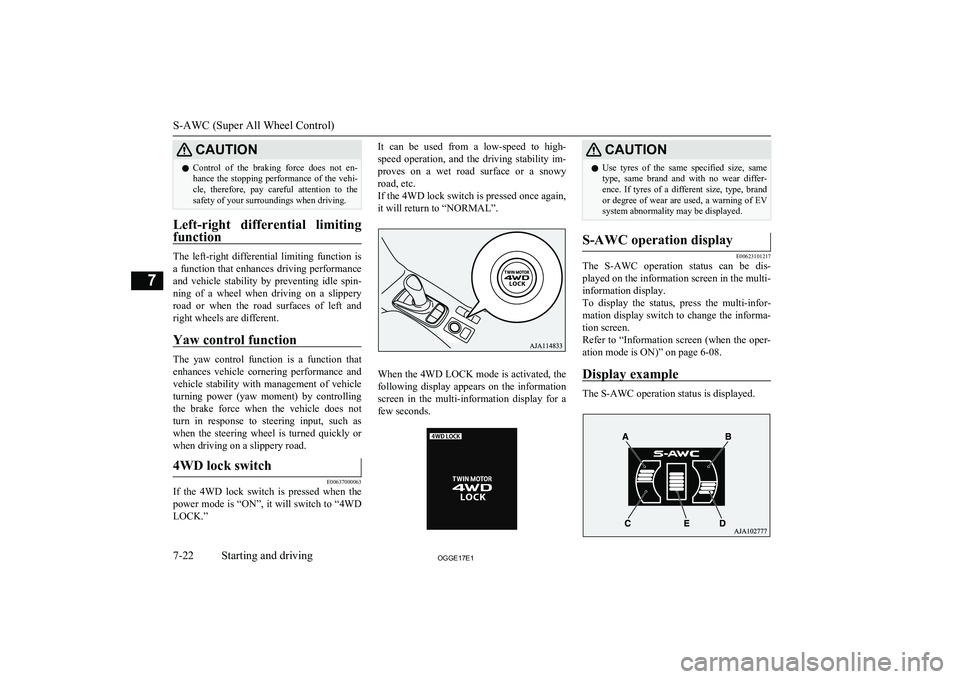
If the 4WD lock switch is pressed when the
power mode is “ON”, it will switch to “4WD LOCK.”
It can be used from a low-speed to high-
speed operation, and the driving stability im- proves on a wet road surface or a snowyroad, etc.
If the 4WD lock switch is pressed once again, it will return to “NORMAL”.
When the 4WD LOCK mode is activated, the
following display appears on the information
screen in the multi-information display for a few seconds.
CAUTIONl Use tyres of the same specified size, same
type, same brand and with no wear differ- ence. If tyres of a different size, type, brandor degree of wear are used, a warning of EVsystem abnormality may be displayed.S-AWC operation display
E00623101217
The S-AWC operation status can be dis-
played on the information screen in the multi-
information display.
To display the status, press the multi-infor-
mation display switch to change the informa- tion screen.
Refer to “Information screen (when the oper- ation mode is ON)” on page 6-08.
Display example
The S-AWC operation status is displayed.
S-AWC (Super All Wheel Control)
7-22OGGE17E1Starting and driving7
Page 244 of 548
lInstall only the specified tyres on all
wheels. Refer to “Tyres and wheels” on page 12-08.
l Be sure all 4 tyres and wheels are the
same size and type.
When it is necessary to replace any of
the tyres or wheels, replace all 4 tyres.
l All tyres should be rotated before the
wear difference between the front and
rear tyres is recognizable.
Good vehicle performance cannot be expec- ted if there is a difference in wear between tyres. Refer to “Tyre rotation” on page 11-11.
l Check the tyre inflation pressure regular-
ly.CAUTIONl Always use tyres of the same size, same
type, and same brand, and which have no
wear differences. Using tyres of different size, type, brands or degree of wear, will in-
crease the differential oil temperature, result-
ing in possible damage to the driving sys- tem. Further, the drive train will be subjec-
ted to excessive loading possibly leading to oil leakage, component seizure, or other seri-
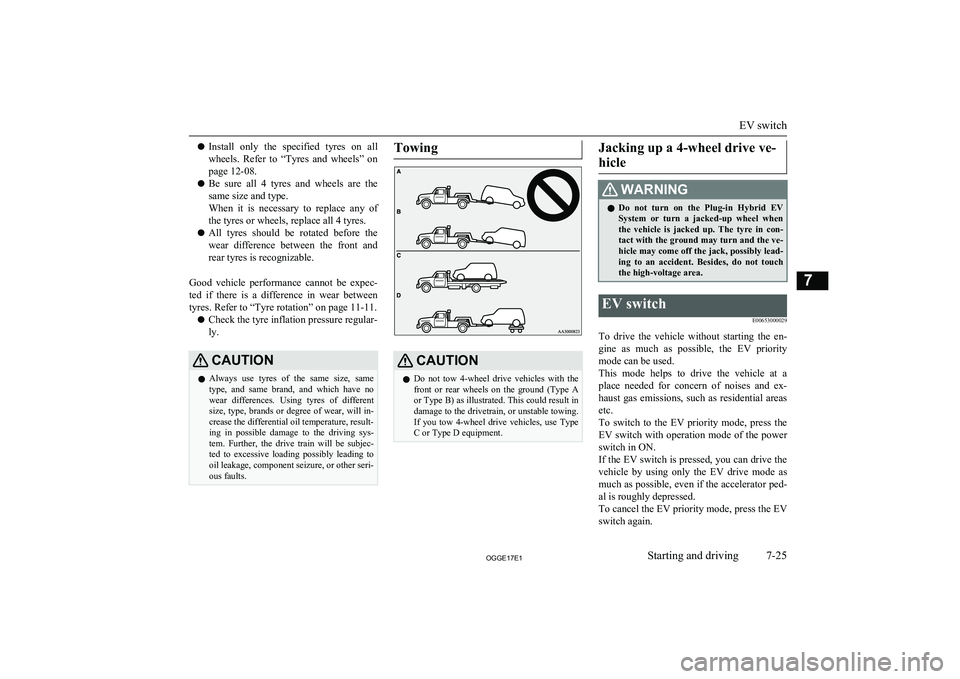
ous faults.TowingCAUTIONl Do not tow 4-wheel drive vehicles with the
front or rear wheels on the ground (Type Aor Type B) as illustrated. This could result in
damage to the drivetrain, or unstable towing. If you tow 4-wheel drive vehicles, use Type
C or Type D equipment.Jacking up a 4-wheel drive ve-
hicleWARNINGl Do not turn on the Plug-in Hybrid EV
System or turn a jacked-up wheel whenthe vehicle is jacked up. The tyre in con-
tact with the ground may turn and the ve- hicle may come off the jack, possibly lead-
ing to an accident. Besides, do not touch
the high-voltage area.EV switch
E00653000029
To drive the vehicle without starting the en-
gine as much as possible, the EV priority mode can be used.
This mode helps to drive the vehicle at a place needed for concern of noises and ex-
haust gas emissions, such as residential areas etc.
To switch to the EV priority mode, press the
EV switch with operation mode of the power switch in ON.
If the EV switch is pressed, you can drive the vehicle by using only the EV drive mode as much as possible, even if the accelerator ped-
al is roughly depressed.
To cancel the EV priority mode, press the EV
switch again.
EV switch
7-25OGGE17E1Starting and driving7
Page 257 of 548
CAUTIONlNever install a limited-slip differential,
which is not MITSUBISHI MOTORS GEN-
UINE parts, as the ABS may not function
normally.
We recommend you to consult a
MITSUBISHI MOTORS Authorized Serv-
ice Point.ABS warning lamp/display
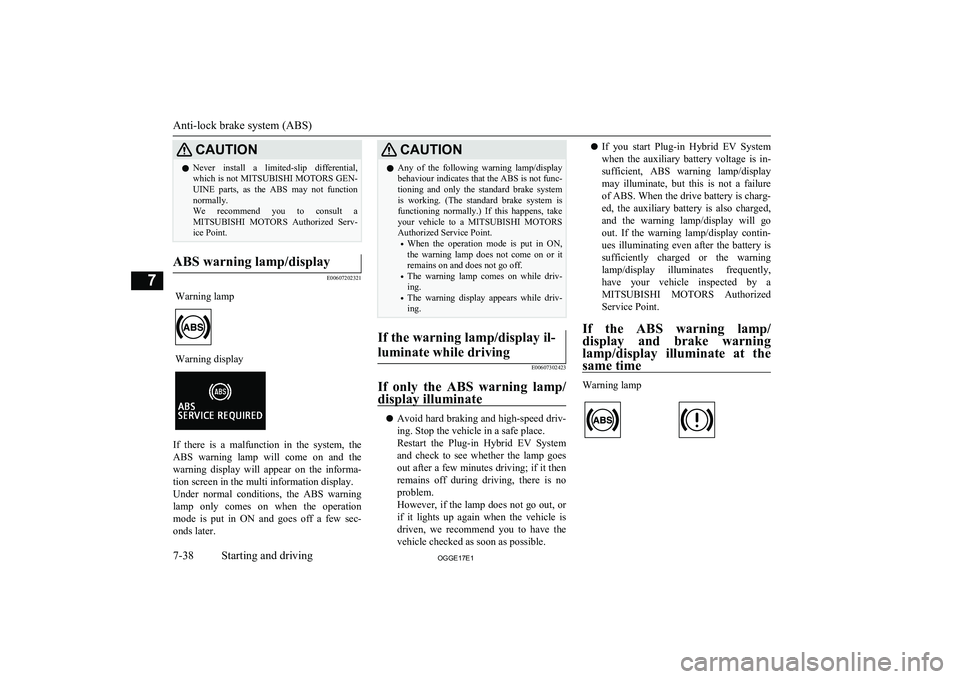
E00607202321
Warning lampWarning display
If there is a malfunction in the system, the
ABS warning lamp will come on and the
warning display will appear on the informa- tion screen in the multi information display.
Under normal conditions, the ABS warning
lamp only comes on when the operation
mode is put in ON and goes off a few sec- onds later.
CAUTIONl Any of the following warning lamp/display
behaviour indicates that the ABS is not func-tioning and only the standard brake system
is working. (The standard brake system is functioning normally.) If this happens, takeyour vehicle to a MITSUBISHI MOTORS
Authorized Service Point.
• When the operation mode is put in ON,
the warning lamp does not come on or it remains on and does not go off.
• The warning lamp comes on while driv-
ing.
• The warning display appears while driv-
ing.If the warning lamp/display il-
luminate while driving
E00607302423
If only the ABS warning lamp/ display illuminate
l Avoid hard braking and high-speed driv-
ing. Stop the vehicle in a safe place.
Restart the Plug-in Hybrid EV System and check to see whether the lamp goes
out after a few minutes driving; if it then remains off during driving, there is no
problem.
However, if the lamp does not go out, or if it lights up again when the vehicle is driven, we recommend you to have the
vehicle checked as soon as possible.
l If you start Plug-in Hybrid EV System
when the auxiliary battery voltage is in-
sufficient, ABS warning lamp/display may illuminate, but this is not a failure
of ABS. When the drive battery is charg-
ed, the auxiliary battery is also charged, and the warning lamp/display will go
out. If the warning lamp/display contin- ues illuminating even after the battery is
sufficiently charged or the warning
lamp/display illuminates frequently, have your vehicle inspected by a
MITSUBISHI MOTORS Authorized
Service Point.
If the ABS warning lamp/ display and brake warning
lamp/display illuminate at the same time
Warning lamp
Anti-lock brake system (ABS)
7-38OGGE17E1Starting and driving7
Page 259 of 548
NOTElIf you turn the steering wheel while the vehi-
cle is stationary with the headlamps on, the headlamps may become dim. This behaviour
is not abnormal. The headlamps will return to their original brightness after a shortwhile.
Electric power steering system
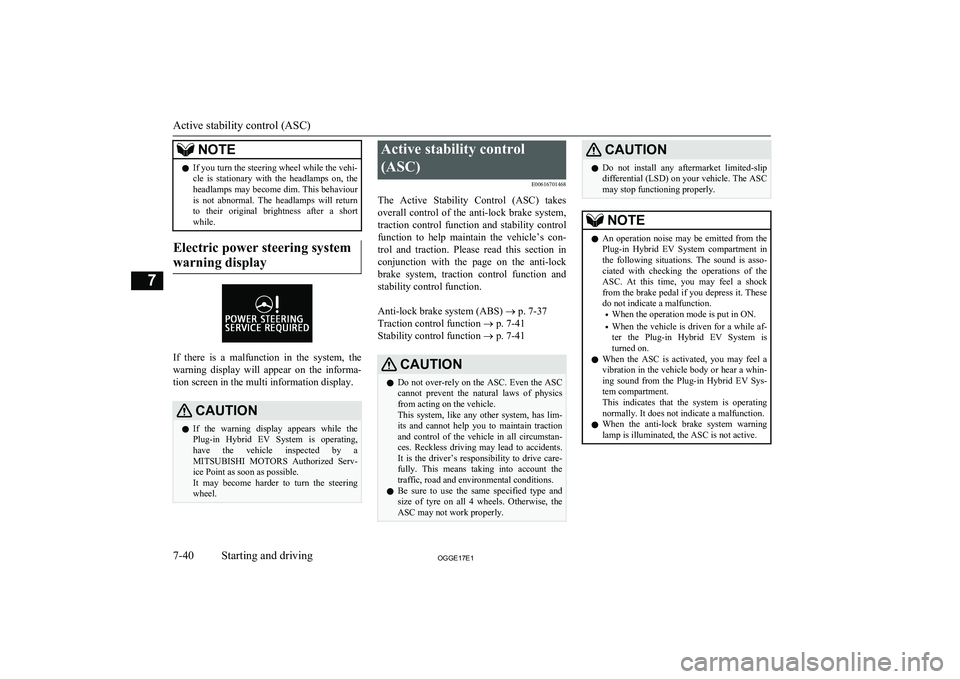
warning display
If there is a malfunction in the system, the warning display will appear on the informa-
tion screen in the multi information display.
CAUTIONl If the warning display appears while the
Plug-in Hybrid EV System is operating,
have the vehicle inspected by a
MITSUBISHI MOTORS Authorized Serv-
ice Point as soon as possible.
It may become harder to turn the steering wheel.Active stability control
(ASC) E00616701468
The Active Stability Control (ASC) takes
overall control of the anti-lock brake system, traction control function and stability control
function to help maintain the vehicle’s con-
trol and traction. Please read this section in conjunction with the page on the anti-lock
brake system, traction control function and stability control function.
Anti-lock brake system (ABS) ® p. 7-37
Traction control function ® p. 7-41
Stability control function ® p. 7-41CAUTIONl Do not over-rely on the ASC. Even the ASC
cannot prevent the natural laws of physics
from acting on the vehicle.
This system, like any other system, has lim-
its and cannot help you to maintain traction and control of the vehicle in all circumstan- ces. Reckless driving may lead to accidents. It is the driver’s responsibility to drive care-
fully. This means taking into account the traffic, road and environmental conditions.
l Be sure to use the same specified type and
size of tyre on all 4 wheels. Otherwise, the ASC may not work properly.CAUTIONl Do not install any aftermarket limited-slip
differential (LSD) on your vehicle. The ASC
may stop functioning properly.NOTEl An operation noise may be emitted from the
Plug-in Hybrid EV System compartment in
the following situations. The sound is asso- ciated with checking the operations of the ASC. At this time, you may feel a shock
from the brake pedal if you depress it. These
do not indicate a malfunction.
• When the operation mode is put in ON.
• When the vehicle is driven for a while af-
ter the Plug-in Hybrid EV System is
turned on.
l When the ASC is activated, you may feel a
vibration in the vehicle body or hear a whin-
ing sound from the Plug-in Hybrid EV Sys- tem compartment.
This indicates that the system is operating normally. It does not indicate a malfunction.
l When the anti-lock brake system warning
lamp is illuminated, the ASC is not active.
Active stability control (ASC)
7-40OGGE17E1Starting and driving7
Page 470 of 548
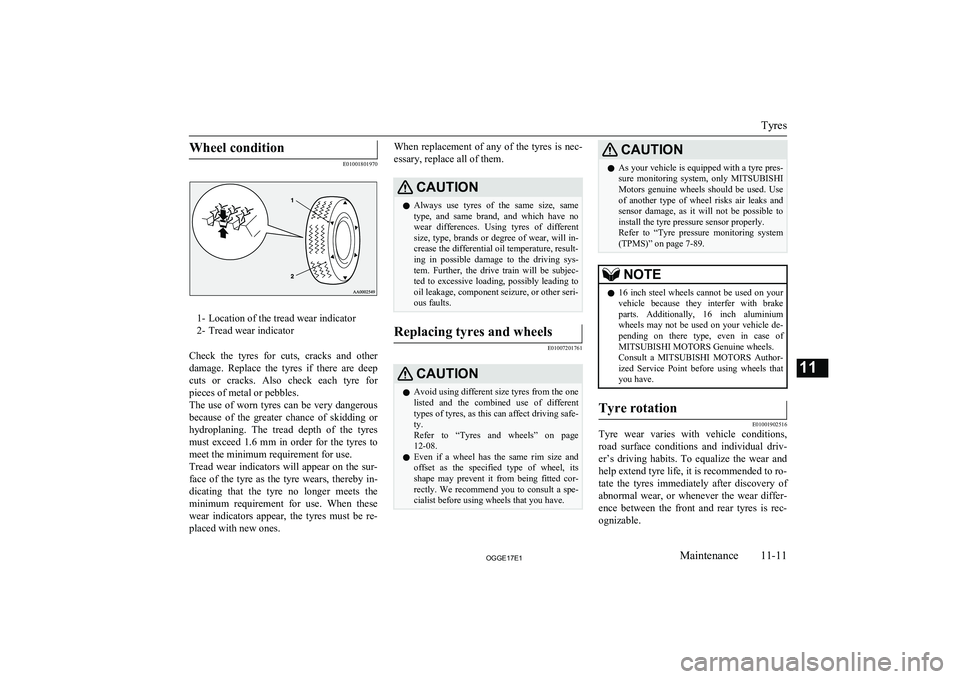
Wheel condition
E01001801970
1- Location of the tread wear indicator
2- Tread wear indicator
Check the tyres for cuts, cracks and other damage. Replace the tyres if there are deep
cuts or cracks. Also check each tyre for pieces of metal or pebbles.
The use of worn tyres can be very dangerous
because of the greater chance of skidding or
hydroplaning. The tread depth of the tyres
must exceed 1.6 mm in order for the tyres to meet the minimum requirement for use.
Tread wear indicators will appear on the sur-
face of the tyre as the tyre wears, thereby in-
dicating that the tyre no longer meets the
minimum requirement for use. When these wear indicators appear, the tyres must be re-
placed with new ones.
When replacement of any of the tyres is nec-
essary, replace all of them.CAUTIONl Always use tyres of the same size, same
type, and same brand, and which have no wear differences. Using tyres of differentsize, type, brands or degree of wear, will in-
crease the differential oil temperature, result-
ing in possible damage to the driving sys-
tem. Further, the drive train will be subjec- ted to excessive loading, possibly leading tooil leakage, component seizure, or other seri-
ous faults.Replacing tyres and wheels
E01007201761
CAUTIONl Avoid using different size tyres from the one
listed and the combined use of different
types of tyres, as this can affect driving safe- ty.
Refer to “Tyres and wheels” on page
12-08.
l Even if a wheel has the same rim size and
offset as the specified type of wheel, its
shape may prevent it from being fitted cor- rectly. We recommend you to consult a spe-
cialist before using wheels that you have.CAUTIONl As your vehicle is equipped with a tyre pres-
sure monitoring system, only MITSUBISHI
Motors genuine wheels should be used. Use
of another type of wheel risks air leaks and
sensor damage, as it will not be possible to install the tyre pressure sensor properly.
Refer to “Tyre pressure monitoring system
(TPMS)” on page 7-89.NOTEl 16 inch steel wheels cannot be used on your
vehicle because they interfer with brake
parts. Additionally, 16 inch aluminium wheels may not be used on your vehicle de-
pending on there type, even in case of MITSUBISHI MOTORS Genuine wheels.
Consult a MITSUBISHI MOTORS Author-
ized Service Point before using wheels that you have.Tyre rotation
E01001902516
Tyre wear varies with vehicle conditions,
road surface conditions and individual driv- er’s driving habits. To equalize the wear andhelp extend tyre life, it is recommended to ro-
tate the tyres immediately after discovery of
abnormal wear, or whenever the wear differ- ence between the front and rear tyres is rec-
ognizable.
Tyres
11-11OGGE17E1Maintenance11