battery MITSUBISHI OUTLANDER PHEV 2018 (in English) User Guide
[x] Cancel search | Manufacturer: MITSUBISHI, Model Year: 2018, Model line: OUTLANDER PHEV, Model: MITSUBISHI OUTLANDER PHEV 2018Pages: 538, PDF Size: 25.01 MB
Page 30 of 538
lSince the air conditioning (cooling or
heating) consumes power of the drive battery, its operation results in a shorterEV cruising range. Maintain an appro-
priate temperature.
l Put the selector lever to “B” (BRAKE)
position according to the road condition. To charge the drive battery with appro-priate use of the regenerative brake, it
can be increased the EV cruising range.Acoustic Vehicle Alerting
System (AVAS) E00205200042
The Acoustic Vehicle Alerting System(AVAS) is a device that uses sound to alert
pedestrians of the presence of the vehicle. The system operates when the vehicle speed
is about 35 km/h (22 mph) or less and the en-
gine is not running.
Refer to “Acoustic Vehicle Alerting System
(AVAS)” on page 7-29.
WARNINGl Even if the Acoustic Vehicle Alerting Sys-
tem (AVAS) sounds, pay special attention
to pedestrians.
Pedestrians may not notice the oncoming vehicle, which may cause an accident re-
sulting in serious personal injury or death.Operating sound under
charging or Remote ClimateControl E00205700050
Even if the operation mode of the powerswitch is OFF, you may hear an operating
sound such as the cooling fan for cooling the drive battery during charging, the air condi-
tioning compressor and for remote climate control (if so equipped).
This is not a malfunction.
Refer to “MITSUBISHI Remote control: Re-
mote Climate Control” on page 3-24.
In case of a collision
E00205300085
A crash or impact significant enough to re-
quire an emergency response for convention- al vehicles would also require the same re-sponse for Outlander PHEV.
Also follow the instructions described below
to avoid severe burns and electrical shock
that may result in serious injury or death.WARNINGl If your vehicle is drivable, pull your vehi-
cle off the road to a safe, nearby location
and remain on the scene.
Also, if possible, do the following opera- tions and stay out of the way of any on- coming traffic while awaiting the arrival
of emergency responders.
• Apply chocks to the wheels.
• Put the select position in “P” (PARK)
position.
• Apply the parking brake.
• Open the windows, doors and tailgate.
• Put the operation mode in OFF.
• Turn on the hazard warning flashers.
• Move the key away from the vehicle to
prevent unintended start-up of the sys- tem by inadvertent contact with a switch or impact from the crash.
l Never touch high-voltage wiring, connec-
tors, and other high-voltage parts, such as
the inverter unit and drive battery. An electric shock may occur if exposed elec-
tric wires are visible when viewed from inside or outside of your vehicle. For their locations, see “High-voltage components”
on page 2-08.
l If the vehicle receives a strong impact to
the floor while driving, stop the vehicle in
a safe place and check the floor.
Acoustic Vehicle Alerting System (AVAS)
2-06OGGE18E1General information2
Page 31 of 538
WARNINGlNever start the plug-in hybrid EV system
if you found a leak of a liquid (except wa-
ter of the air conditioner) while checking the outside of the vehicle because there is
possibility the fuel system has been dam- aged and causing of fire or exploding.
In such case, immediately contact your
MITSUBISHI MOTORS Authorized
Service Point.
l Leaks or damage to the drive battery may
result in a fire. If you discover them, con-
tact emergency services immediately.
Since the fluid leak may be lithium man- ganite from the Lithium-ion battery, nev- er touch any fluid leaking from the inside
or outside of the vehicle. If the fluid con- tacts your skin or eyes, wash it off imme-
diately with a large amount of water and receive immediate medical attention to
help avoid serious injury.
l If you are unable to safely assess the vehi-
cle due to vehicle damage, do not touch the vehicle. Leave the vehicle and contact
emergency services. Advise emergency responders that this is a Plug-in Hybrid
vehicle.WARNINGl If a fire occurs in this vehicle, leave the
vehicle as soon as possible and contact
emergency services. Do not attempt to ex- tinguish a fire by yourself. If the fire in-
volves a lithium-ion battery, it will re- quire large, sustained volumes of water for extinguishment. Using a small amount
of water or the incorrect fire extinguisher
can result in serious injury or death from electrical shock.
l When you leave the vehicle, if possible,
open the windows, doors and tailgate to
prevent accumulation of poisonous/ combustible gasses. This will also assist in
the rescue and fire fighting process.
l As with any vehicle fire, the byproducts of
combustion can be toxic. Do not inhale
smoke, vapors, or gas from the vehicle. Move to a safe distance upwind and uphill
from the vehicle fire and out of the way of any oncoming traffic while awaiting the
arrival of emergency responders.
l If you detect leaking fluids, sparks,
smoke, flames, gurgling, popping or hiss-
ing noises originating from the high volt- age battery compartment, contact emer-
gency services immediately. This may re- sult in a fire.
l Physical damage to the vehicle or high
voltage battery may result in immediate or delayed release of toxic and/or flamma- ble gases and fire.WARNINGl If your vehicle needs to be towed, trans-
port the vehicle on a flatbed truck or tow
the vehicle with all wheels off the ground.
If the any wheels are on the ground when towing, this may cause damage to the elec-
tric motors. This may also cause a fire, if
wiring in the electric motor unit room be- comes damaged. Refer to “Towing” on
page 9-17.
l Do not attempt to repair a damaged Plu-
gin Hybrid vehicle by yourself. Please contact a MITSUBISHI MOTORS Au-
thorized Service Point for service.
l In the event of an accident that requires
body repair and painting, the vehicle should be delivered to a MITSUBISHI
MOTORS Authorized Service Point to
have the drive battery and high voltage parts such as the inverter, including the
attached wiring harness, removed prior to
painting. If exposed to heat in the paint booth, the drive battery will experiencebattery capacity loss.
A damaged drive battery can also pose
safety risks to untrained mechanics and
repair personnel.NOTEl The emergency shut-off system will be acti-
vated and the high-voltage system will auto- matically turn off under the following condi-
tions:
In case of a collision
2-07OGGE18E1General information2
Page 32 of 538
NOTE•Certain front, side or rear collisions.
• Certain Plug-in Hybrid EV system mal-
functions.
l When the emergency shut-off system is acti-
vated, the ready indicator is turned off. Refer
to “Indicator and warning lamp list” on page
6-21.
l If the emergency shut-off system activates,
contact a MITSUBISHI MOTORS Author-
ized Service Point.Inspection and maintenance
E00205400031
When performing inspection and mainte-nance, be careful in the following points.
WARNINGl Before performing inspection or mainte-
nance, be sure to disconnect the charge connector from the vehicle and confirmthat put the operation mode of the power
switch in “OFF”.WARNINGl Never touch, disassemble, remove or re-
place highvoltage parts, exposed electrical
components, cables or connectors. Failure
to follow this instruction can result in se- vere burns or electric shock causing seri-ous injury or death. High-voltage cables are colored orange. The vehicle high volt-
age system has no user serviceable parts. Take your vehicle to a MITSUBISHI
MOTORS Authorized Service Point for
any necessary maintenance.
l Never touch the service plug under the
rear seat. Improper handling of this could
cause an electric shock which result in a
serious injury or death. The service plug
is used to shut off the high voltage from the drive battery when repairing the vehi-
cle at a MITSUBISHI MOTORS Author-
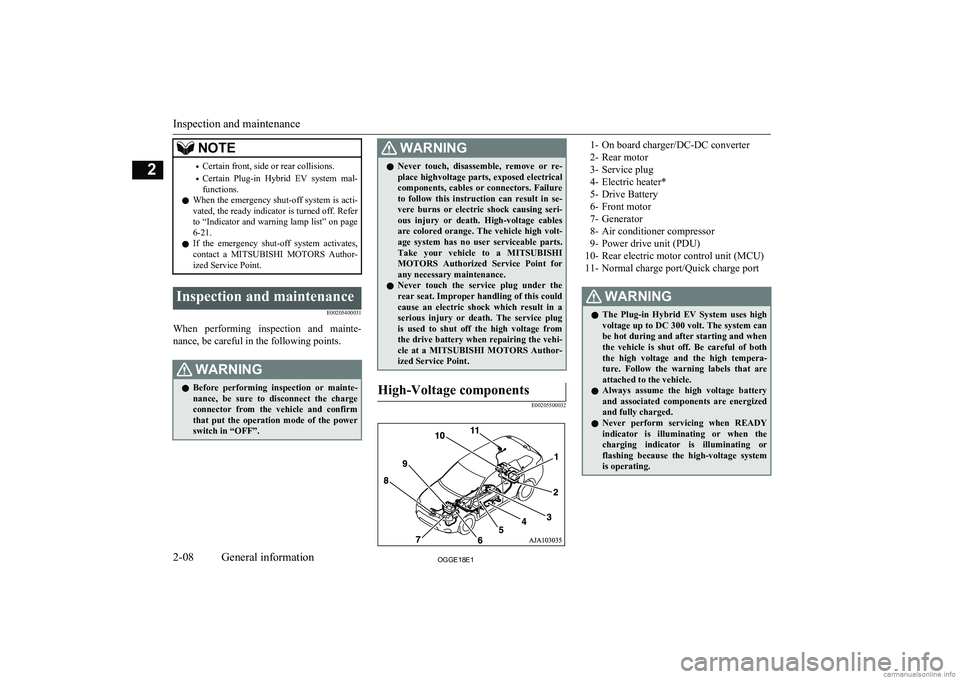
ized Service Point.High-Voltage components
E00205500032
1- On board charger/DC-DC converter
2- Rear motor
3- Service plug
4- Electric heater*
5- Drive Battery
6- Front motor
7- Generator
8- Air conditioner compressor
9- Power drive unit (PDU)
10- Rear electric motor control unit (MCU) 11- Normal charge port/Quick charge portWARNINGl The Plug-in Hybrid EV System uses high
voltage up to DC 300 volt. The system can
be hot during and after starting and when the vehicle is shut off. Be careful of both the high voltage and the high tempera-
ture. Follow the warning labels that are
attached to the vehicle.
l Always assume the high voltage battery
and associated components are energized and fully charged.
l Never perform servicing when READY
indicator is illuminating or when the charging indicator is illuminating orflashing because the high-voltage system
is operating.
Inspection and maintenance
2-08OGGE18E1General information2
Page 34 of 538
Cautions and actions to deal with intense heatE00203001128
l When the ambient temperature is approximately 45 °C or higher, the phenomena described below may occur. Please take the described
action.
l Even if the ambient temperature is approximately
45 °C or lower, when performing quick charging, driving at high-speed and uphill repeat-
edly, the phenomena described below may occur. Please take the described actions.Approx. ambient temperaturePhenomenaCorrective action
Approx. 45 °C or higherStartup and drivinglThe motor output is restricted and the vehicle perform-
ance may be decreased. Then, the “PROPULSION POW-
ER IS REDUCED” warning display* may be displayed.l Stop the vehicle at a safe
place if needed with the plu- gin hybrid EV system started.Charging and batteryl Charging time becomes longer, charging may not be pos-
sible or it may stop on the way.l Park in a well-ventilated,
shady place.NOTEl *: Refer to “PROPULSION POWER IS REDUCED warning display” on page
6-41. Display of the “PROPULSION POWER IS REDUCED” warning
display does not indicate a malfunction.
Cautions and actions to deal with intense cold
E00203101217
l When the ambient temperature is approximately -15 °C or lower, the phenomena described below may occur. Please take the described
corrective action.
Cautions and actions to deal with intense heat
2-10OGGE18E1General information2
Page 35 of 538
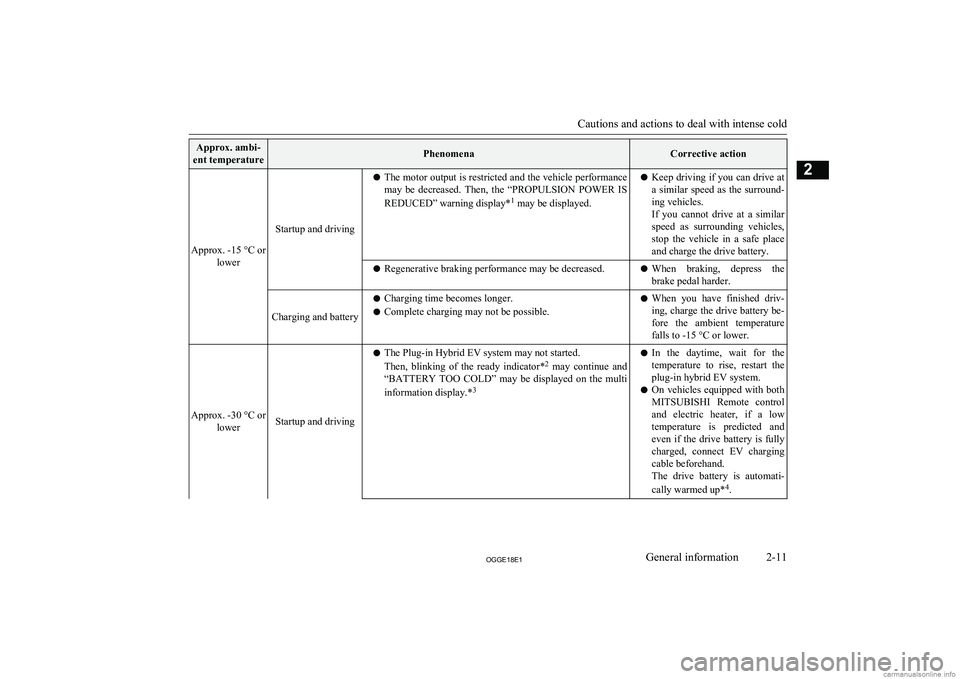
Approx. ambi-
ent temperaturePhenomenaCorrective action
Approx. -15 °C or lower
Startup and driving
lThe motor output is restricted and the vehicle performance
may be decreased. Then, the “PROPULSION POWER IS
REDUCED” warning display* 1
may be displayed.l Keep driving if you can drive at
a similar speed as the surround-
ing vehicles.
If you cannot drive at a similar
speed as surrounding vehicles, stop the vehicle in a safe placeand charge the drive battery.l Regenerative braking performance may be decreased.lWhen braking, depress the
brake pedal harder.
Charging and battery
l Charging time becomes longer.
l Complete charging may not be possible.lWhen you have finished driv-
ing, charge the drive battery be- fore the ambient temperature
falls to -15 °C or lower.
Approx. -30 °C or lowerStartup and driving
lThe Plug-in Hybrid EV system may not started.
Then, blinking of the ready indicator* 2
may continue and
“BATTERY TOO COLD” may be displayed on the multi
information display.* 3l
In the daytime, wait for the
temperature to rise, restart the plug-in hybrid EV system.
l On vehicles equipped with both
MITSUBISHI Remote control
and electric heater, if a low temperature is predicted and
even if the drive battery is fully charged, connect EV charging
cable beforehand.
The drive battery is automati-
cally warmed up* 4
.
Cautions and actions to deal with intense cold
2-11OGGE18E1General information2
Page 36 of 538
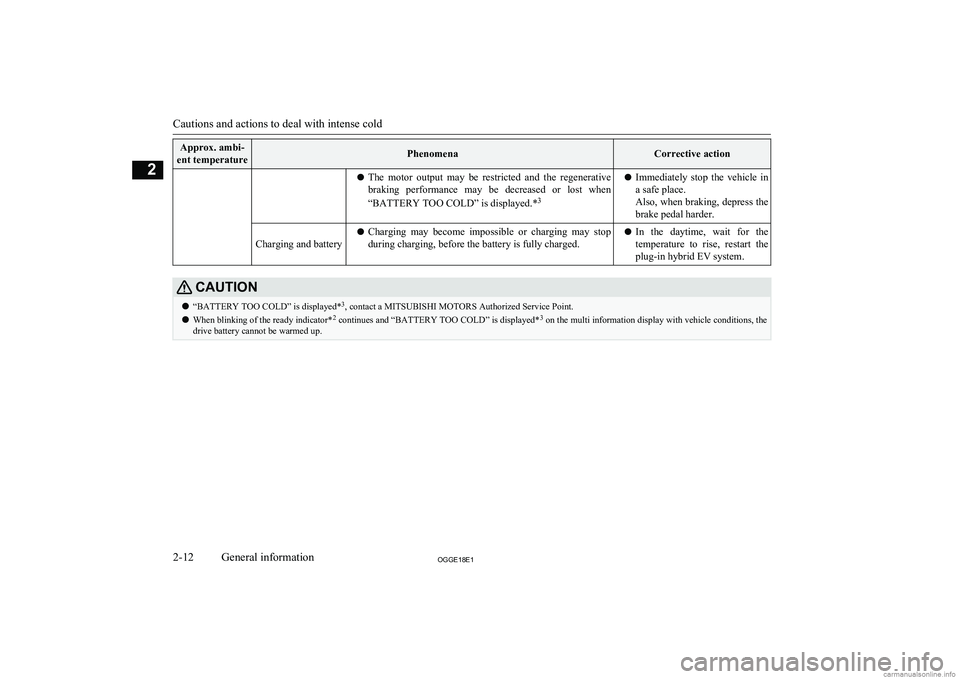
Approx. ambi-
ent temperaturePhenomenaCorrective actionl The motor output may be restricted and the regenerative
braking performance may be decreased or lost when
“BATTERY TOO COLD” is displayed.* 3l
Immediately stop the vehicle in
a safe place.
Also, when braking, depress the
brake pedal harder.Charging and batteryl Charging may become impossible or charging may stop
during charging, before the battery is fully charged.l In the daytime, wait for the
temperature to rise, restart the plug-in hybrid EV system.CAUTIONl “BATTERY TOO COLD” is displayed* 3
, contact a MITSUBISHI MOTORS Authorized Service Point.
l When blinking of the ready indicator* 2
continues and “BATTERY TOO COLD” is displayed* 3
on the multi information display with vehicle conditions, the
drive battery cannot be warmed up.
Cautions and actions to deal with intense cold
2-12OGGE18E1General information2
Page 37 of 538
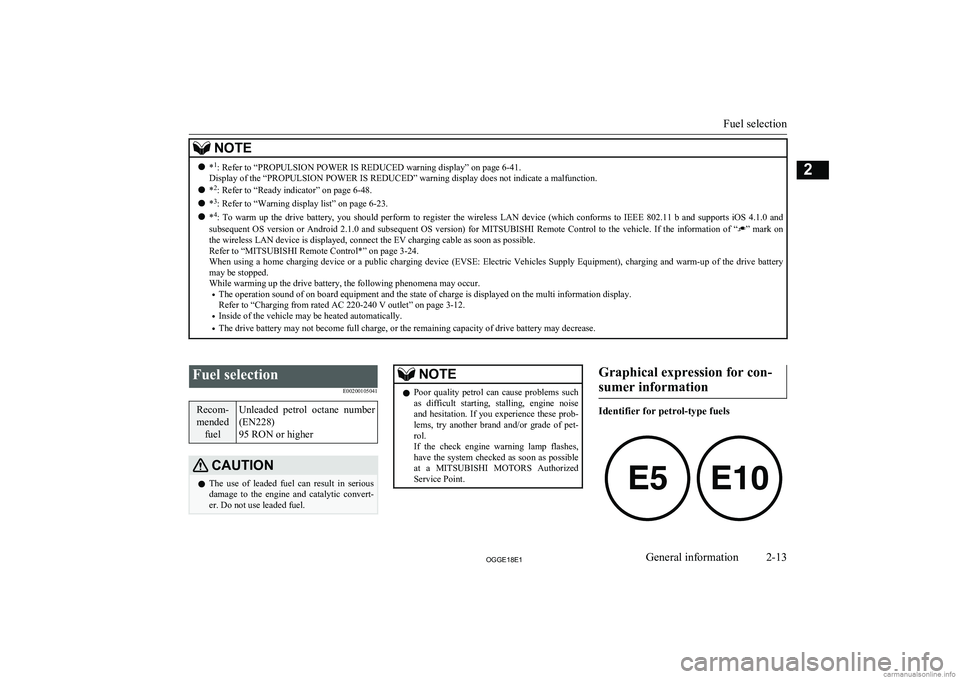
NOTEl*1
: Refer to “PROPULSION POWER IS REDUCED warning display” on page 6-41.
Display of the “PROPULSION POWER IS REDUCED” warning display does not indicate a malfunction.
l *2
: Refer to “Ready indicator” on page 6-48.
l *3
: Refer to “Warning display list” on page 6-23.
l *4
: To warm up the drive battery, you should perform to register the wireless LAN device (which conforms to IEEE 802.11 b and supports iOS 4.1.0 and
subsequent OS version or Android 2.1.0 and subsequent OS version) for MITSUBISHI Remote Control to the vehicle. If the information of “
” mark on
the wireless LAN device is displayed, connect the EV charging cable as soon as possible.
Refer to “MITSUBISHI Remote Control*” on page 3-24. When using a home charging device or a public charging device (EVSE: Electric Vehicles Supply Equipment), charging and warm-up of the drive battery may be stopped.
While warming up the drive battery, the following phenomena may occur.
• The operation sound of on board equipment and the state of charge is displayed on the multi information display.
Refer to “Charging from rated AC 220-240 V outlet” on page 3-12.
• Inside of the vehicle may be heated automatically.
• The drive battery may not become full charge, or the remaining capacity of drive battery may decrease.
Fuel selection
E00200105041Recom-
mended fuelUnleaded petrol octane number(EN228)
95 RON or higherCAUTIONl The use of leaded fuel can result in serious
damage to the engine and catalytic convert- er. Do not use leaded fuel.NOTEl Poor quality petrol can cause problems such
as difficult starting, stalling, engine noise
and hesitation. If you experience these prob- lems, try another brand and/or grade of pet-
rol.
If the check engine warning lamp flashes,
have the system checked as soon as possible at a MITSUBISHI MOTORS Authorized
Service Point.Graphical expression for con-
sumer information
Identifier for petrol-type fuels
Fuel selection
2-13OGGE18E1General information2
Page 38 of 538
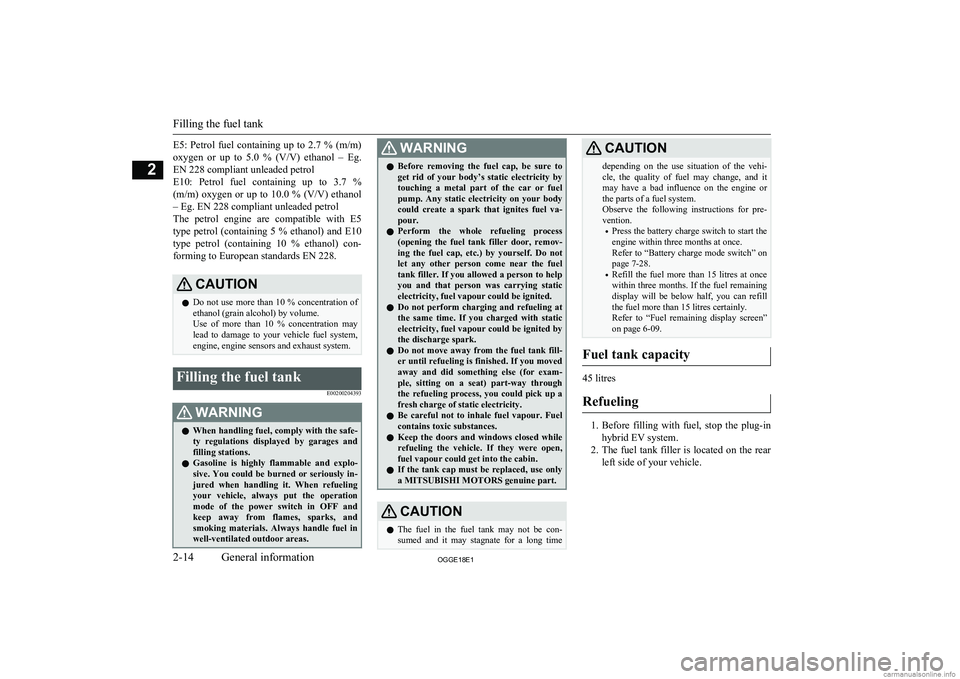
E5: Petrol fuel containing up to 2.7 % (m/m)
oxygen or up to 5.0 % (V/V) ethanol – Eg.
EN 228 compliant unleaded petrol
E10: Petrol fuel containing up to 3.7 % (m/m) oxygen or up to 10.0 % (V/V) ethanol
– Eg. EN 228 compliant unleaded petrol
The petrol engine are compatible with E5
type petrol (containing 5 % ethanol) and E10 type petrol (containing 10 % ethanol) con-forming to European standards EN 228.CAUTIONl Do not use more than 10 % concentration of
ethanol (grain alcohol) by volume.
Use of more than 10 % concentration may
lead to damage to your vehicle fuel system,
engine, engine sensors and exhaust system.Filling the fuel tank
E00200204393WARNINGlWhen handling fuel, comply with the safe-
ty regulations displayed by garages and
filling stations.
l Gasoline is highly flammable and explo-
sive. You could be burned or seriously in-
jured when handling it. When refueling
your vehicle, always put the operation mode of the power switch in OFF and
keep away from flames, sparks, and smoking materials. Always handle fuel in
well-ventilated outdoor areas.WARNINGl Before removing the fuel cap, be sure to
get rid of your body’s static electricity bytouching a metal part of the car or fuel
pump. Any static electricity on your body could create a spark that ignites fuel va-
pour.
l Perform the whole refueling process
(opening the fuel tank filler door, remov-
ing the fuel cap, etc.) by yourself. Do not let any other person come near the fuel tank filler. If you allowed a person to help
you and that person was carrying static electricity, fuel vapour could be ignited.
l Do not perform charging and refueling at
the same time. If you charged with staticelectricity, fuel vapour could be ignited by
the discharge spark.
l Do not move away from the fuel tank fill-
er until refueling is finished. If you moved
away and did something else (for exam- ple, sitting on a seat) part-way through
the refueling process, you could pick up a fresh charge of static electricity.
l Be careful not to inhale fuel vapour. Fuel
contains toxic substances.
l Keep the doors and windows closed while
refueling the vehicle. If they were open, fuel vapour could get into the cabin.
l If the tank cap must be replaced, use only
a MITSUBISHI MOTORS genuine part.CAUTIONl The fuel in the fuel tank may not be con-
sumed and it may stagnate for a long timeCAUTIONdepending on the use situation of the vehi-cle, the quality of fuel may change, and it
may have a bad influence on the engine or the parts of a fuel system.
Observe the following instructions for pre- vention.
• Press the battery charge switch to start the
engine within three months at once.
Refer to “Battery charge mode switch” on page 7-28.
• Refill the fuel more than 15 litres at once
within three months. If the fuel remaining display will be below half, you can refill
the fuel more than 15 litres certainly.
Refer to “Fuel remaining display screen” on page 6-09.
Fuel tank capacity
45 litres
Refueling
1. Before filling with fuel, stop the plug-in
hybrid EV system.
2. The fuel tank filler is located on the rear
left side of your vehicle.
Filling the fuel tank
2-14OGGE18E1General information2
Page 39 of 538
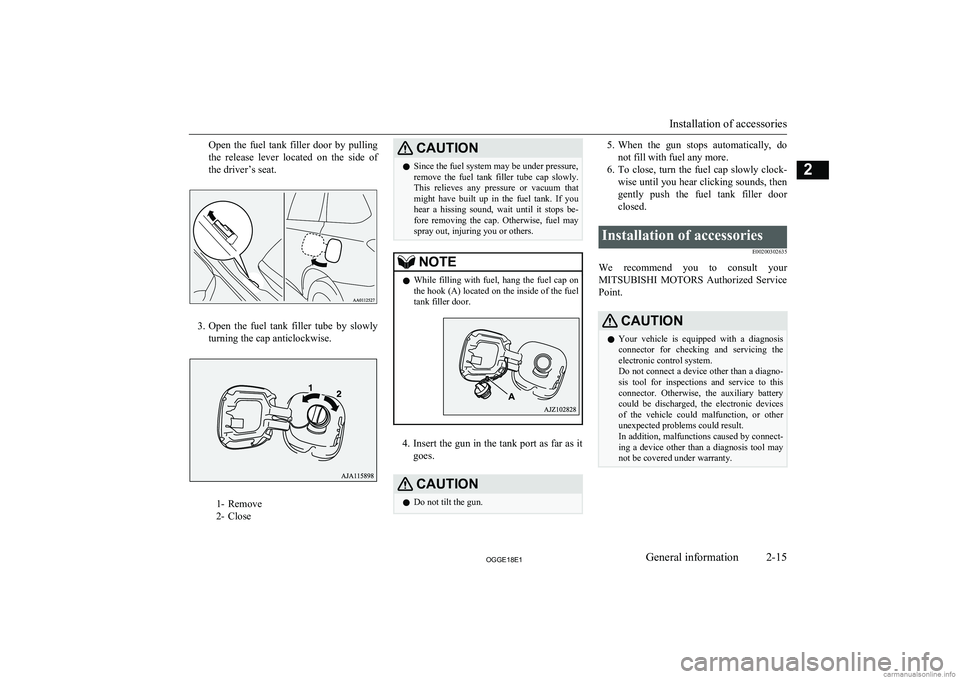
Open the fuel tank filler door by pullingthe release lever located on the side of
the driver’s seat.
3. Open the fuel tank filler tube by slowly
turning the cap anticlockwise.
1- Remove
2- Close
CAUTIONl Since the fuel system may be under pressure,
remove the fuel tank filler tube cap slowly. This relieves any pressure or vacuum that
might have built up in the fuel tank. If you
hear a hissing sound, wait until it stops be- fore removing the cap. Otherwise, fuel may
spray out, injuring you or others.NOTEl While filling with fuel, hang the fuel cap on
the hook (A) located on the inside of the fuel
tank filler door.
4. Insert the gun in the tank port as far as it
goes.
CAUTIONl Do not tilt the gun.5.
When the gun stops automatically, do
not fill with fuel any more.
6. To close, turn the fuel cap slowly clock-
wise until you hear clicking sounds, then
gently push the fuel tank filler door
closed.Installation of accessories
E00200302635
We recommend you to consult yourMITSUBISHI MOTORS Authorized Service
Point.
CAUTIONl Your vehicle is equipped with a diagnosis
connector for checking and servicing theelectronic control system.
Do not connect a device other than a diagno-
sis tool for inspections and service to this connector. Otherwise, the auxiliary battery
could be discharged, the electronic devices
of the vehicle could malfunction, or other unexpected problems could result.
In addition, malfunctions caused by connect-
ing a device other than a diagnosis tool may not be covered under warranty.
Installation of accessories
2-15OGGE18E1General information2
Page 43 of 538

Charging.............................................................................................. 3-02
Battery................................................................................................. 3-04 Basic knowledge for charging.............................................................3-04
EV charging cable*............................................................................. 3-07
Normal charging (charging method with rated AC 220-240V outlet).............................................................................3-10
Quick charging (charging method with quick charger)...................... 3-17
Charging troubleshooting guide.......................................................... 3-21 MITSUBISHI Remote Control*......................................................... 3-24Charging
OGGE18E13