lock MITSUBISHI OUTLANDER SPORT 2014 3.G User Guide
[x] Cancel search | Manufacturer: MITSUBISHI, Model Year: 2014, Model line: OUTLANDER SPORT, Model: MITSUBISHI OUTLANDER SPORT 2014 3.GPages: 384, PDF Size: 46.94 MB
Page 28 of 384
Rear seats
Seat and restraint systems 4-7
4
N00402500191 N00403000308
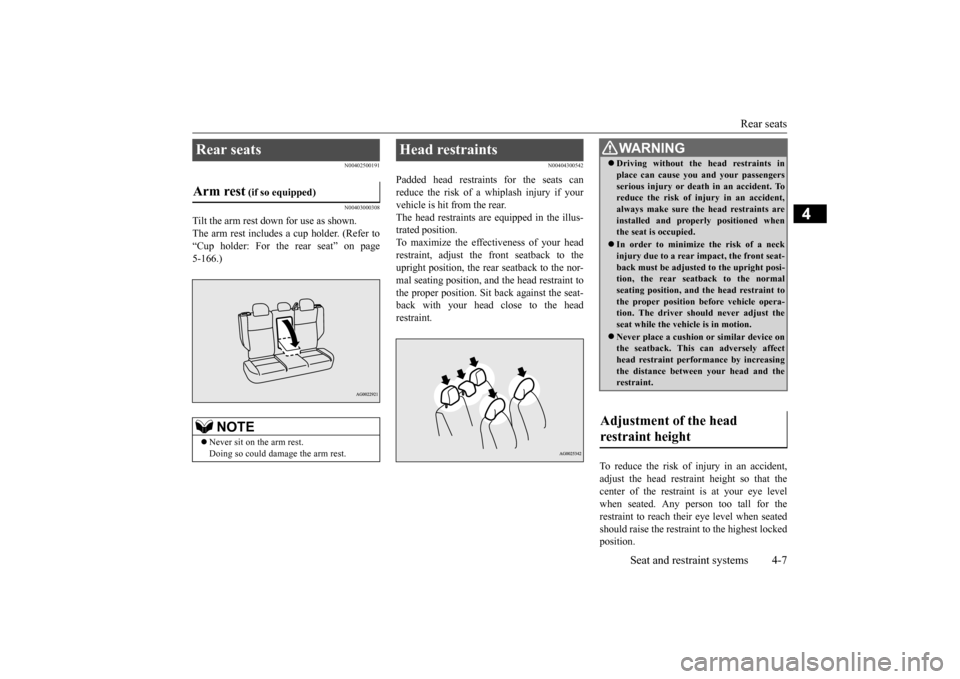
Tilt the arm rest down for use as shown. The arm rest includes a cup holder. (Refer to“Cup holder: For the rear seat” on page 5-166.)
N00404300542
Padded head restraints for the seats can reduce the risk of a whiplash injury if yourvehicle is hit from the rear. The head restraints are equipped in the illus- trated position.To maximize the effectiveness of your head restraint, adjust the front seatback to the upright position, the rear seatback to the nor-mal seating position, and the head restraint tothe proper position. Sit
back against the seat-
back with your head close to the head restraint.
To reduce the risk of injury in an accident, adjust the head restraint height so that thecenter of the restraint is at your eye level when seated. Any person too tall for the restraint to reach their eye level when seatedshould raise the restraint to the highest locked position.
Rear seats Arm rest
(if so equipped)
NOTE
Never sit on the arm rest. Doing so could damage the arm rest.
Head restraints
WA R N I N G Driving without the head restraints in place can cause you and your passengers serious injury or death in an accident. To reduce the risk of injury in an accident, always make sure the head restraints areinstalled and properly positioned when the seat is occupied. In order to minimize the risk of a neck injury due to a rear impact, the front seat- back must be adjusted to the upright posi-tion, the rear seatback to the normal seating position, and the head restraint to the proper position before vehicle opera-tion. The driver should never adjust the seat while the vehicle is in motion. Never place a cushion or similar device on the seatback. This can adversely affect head restraint performance by increasingthe distance between your head and the restraint.
Adjustment of the head restraint height
BK0202700US.bo
ok 7 ページ 2013年3月28日 木曜日 午前11時54分
Page 29 of 384
Head restraints 4-8 Seat and restraint systems
4
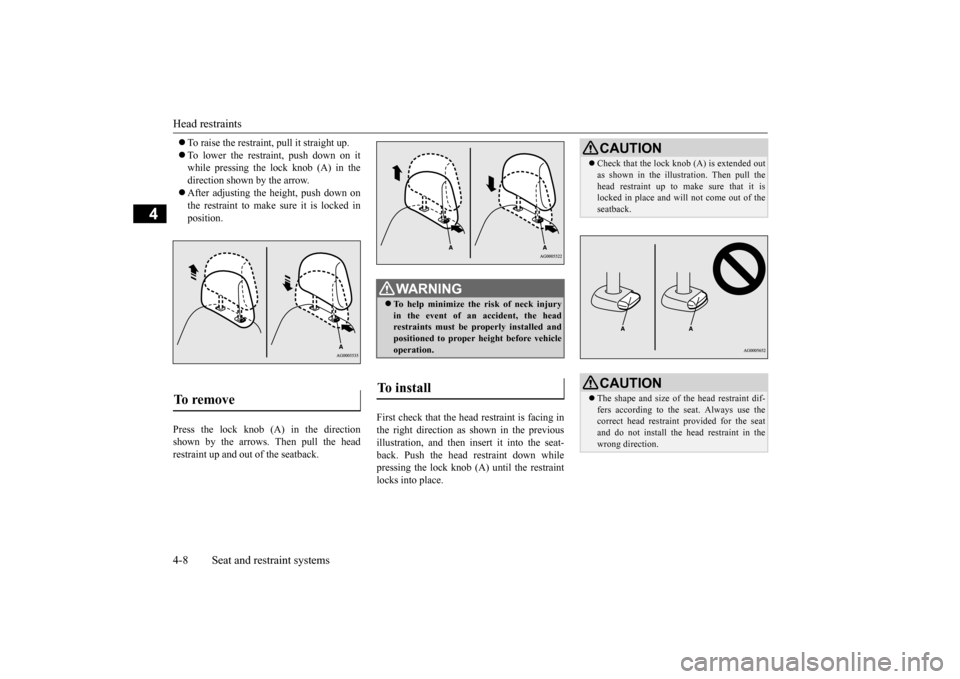
To raise the restraint, pull it straight up. To lower the restraint, push down on it while pressing the lock knob (A) in the direction shown by the arrow. After adjusting the height, push down on the restraint to make sure it is locked in position.
Press the lock knob (A) in the direction shown by the arrows. Then pull the head restraint up and out of the seatback.
First check that the head restraint is facing in the right direction as shown in the previous illustration, and then insert it into the seat-back. Push the head restraint down while pressing the lock knob (A) until the restraint locks into place.
To remove
WA R N I N G To help minimize the risk of neck injury in the event of an accident, the head restraints must be properly installed andpositioned to proper height before vehicle operation.
To install
CAUTION Check that the lock knob (A) is extended out as shown in the illustration. Then pull the head restraint up to make sure that it is locked in place and will not come out of the seatback.CAUTION The shape and size of the head restraint dif- fers according to the seat. Always use the correct head restraint provided for the seatand do not install the head restraint in the wrong direction.
BK0202700US.bo
ok 8 ページ 2013年3月28日 木曜日 午前11時54分
Page 31 of 384
Extending a luggage compartment 4-10 Seat and restraint systems
4
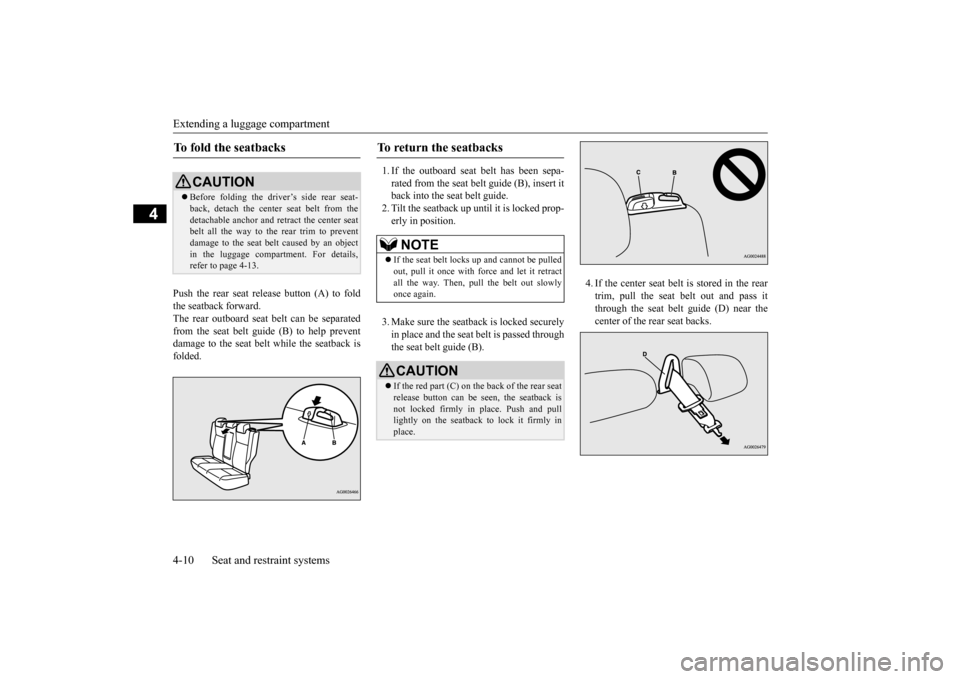
Push the rear seat release button (A) to fold the seatback forward.The rear outboard seat belt can be separated from the seat belt guide (B) to help prevent damage to the seat belt while the seatback isfolded.
1. If the outboard seat belt has been sepa- rated from the seat belt guide (B), insert it back into the seat belt guide.2. Tilt the seatback up until it is locked prop- erly in position. 3. Make sure the seatback is locked securely in place and the seat belt is passed through the seat belt guide (B).
4. If the center seat belt is stored in the rear trim, pull the seat belt out and pass it through the seat belt guide (D) near thecenter of the rear seat backs.
To fold the seatbacks
CAUTION Before folding the driver’s side rear seat- back, detach the center seat belt from the detachable anchor and retract the center seat belt all the way to the rear trim to preventdamage to the seat belt caused by an object in the luggage compartment. For details, refer to page 4-13.
To return the seatbacks
NOTE
If the seat belt locks up and cannot be pulled out, pull it once with force and let it retract all the way. Then, pull the belt out slowlyonce again.CAUTION If the red part (C) on the back of the rear seat release button can be seen, the seatback isnot locked firmly in place. Push and pull lightly on the seatback to lock it firmly in place.
BK0202700US.bo
ok 10 ページ 2013年3月28日 木曜日 午前11時54分
Page 33 of 384
Seat belts 4-12 Seat and restraint systems
4
N00406201496
All seats are equipped with a seat belt which uses one combined lap-and-shoulder belt with an emergency locking retractor. This system is designed to provide both com- fort and safety. It permits full extension and automatic retraction of the belts during nor- mal vehicle operation. A sensing deviceinside the belt retractor is designed to lock the retractor in the event of a sudden change in the vehicle’s motion.
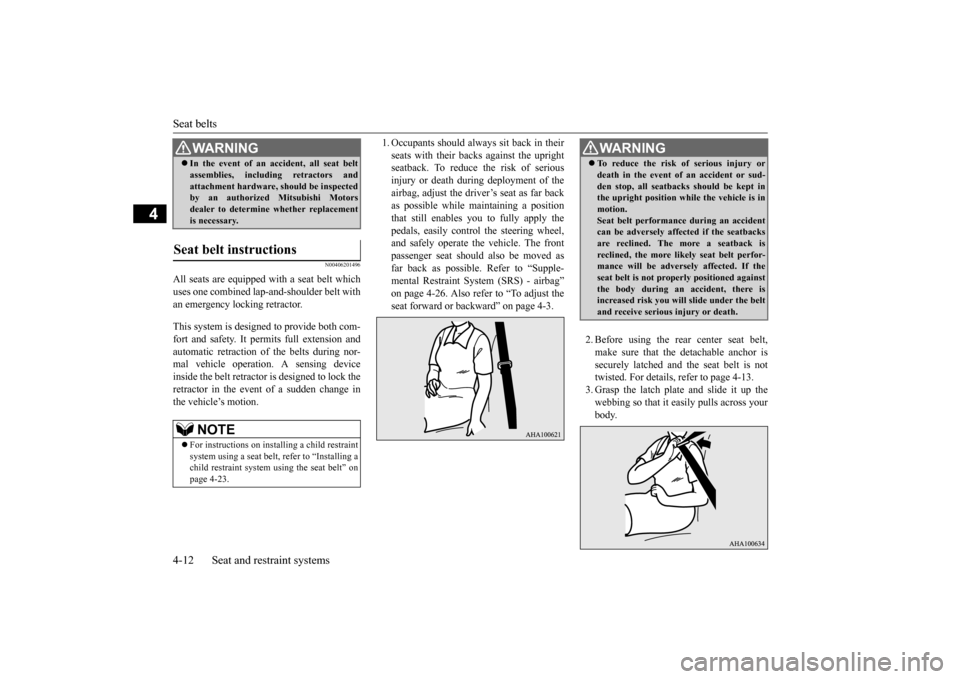
1. Occupants should always sit back in their seats with their backs against the upright seatback. To reduce the risk of serious injury or death during deployment of theairbag, adjust the driver’s seat as far back as possible while maintaining a position that still enables you to fully apply thepedals, easily control the steering wheel, and safely operate the vehicle. The front passenger seat should also be moved asfar back as possible. Refer to “Supple-mental Restraint System (SRS) - airbag” on page 4-26. Also refer to “To adjust the seat forward or backward” on page 4-3.
2. Before using the rear center seat belt, make sure that the detachable anchor issecurely latched and the seat belt is not twisted. For details, refer to page 4-13. 3. Grasp the latch plate and slide it up thewebbing so that it easily pulls across your body.
In the event of an accident, all seat belt assemblies, including retractors and attachment hardware, should be inspected by an authorized Mitsubishi Motors dealer to determine whether replacementis necessary.
Seat belt instructions
NOTE
For instructions on installing a child restraint system using a seat belt, refer to “Installing achild restraint system using the seat belt” on page 4-23.WA R N I N G
WA R N I N G To reduce the risk of serious injury or death in the event of an accident or sud- den stop, all seatbacks should be kept in the upright position while the vehicle is in motion.Seat belt performance during an accident can be adversely affected if the seatbacks are reclined. The more a seatback isreclined, the more likely seat belt perfor- mance will be adversely affected. If the seat belt is not properly positioned againstthe body during an accident, there is increased risk you will slide under the belt and receive serious injury or death.
BK0202700US.bo
ok 12 ページ 2013年3月28日 木曜日 午前11時54分
Page 34 of 384
Seat belts
Seat and restraint systems 4-13
4
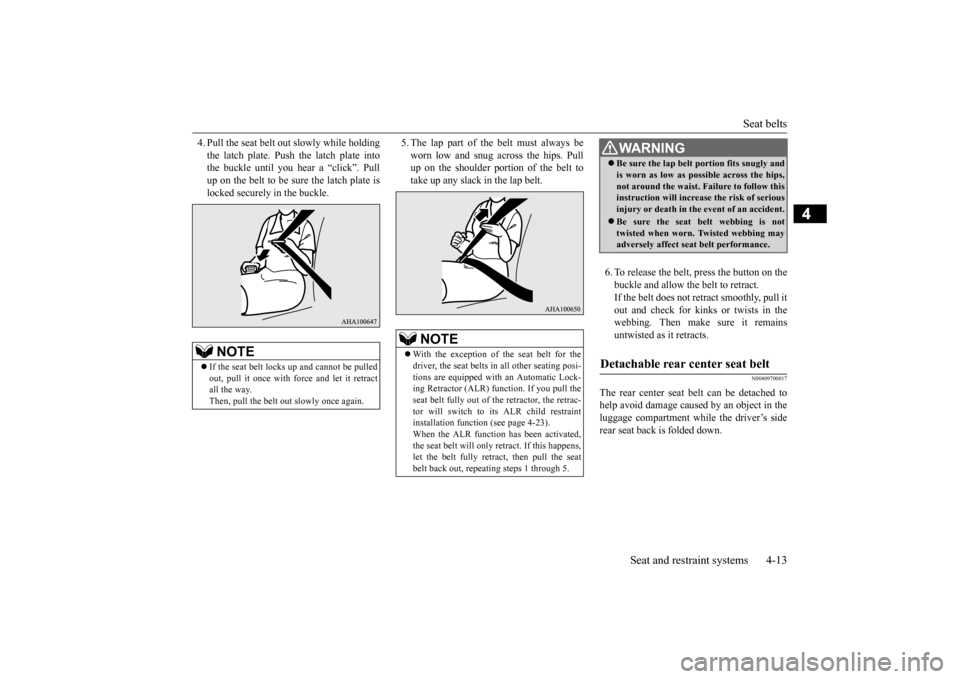
4. Pull the seat belt out slowly while holding the latch plate. Push the latch plate into the buckle until you hear a “click”. Pull up on the belt to be sure the latch plate islocked securely in the buckle.
5. The lap part of the belt must always be worn low and snug across the hips. Pull up on the shoulder portion of the belt to take up any slack in the lap belt.
6. To release the belt, press the button on the buckle and allow the belt to retract. If the belt does not retract smoothly, pull itout and check for kinks or twists in the webbing. Then make sure it remains untwisted as it retracts.
N00409700017
The rear center seat belt can be detached tohelp avoid damage caused by an object in theluggage compartment while the driver’s side rear seat back is folded down.
NOTE
If the seat belt locks up and cannot be pulled out, pull it once with force and let it retractall the way. Then, pull the belt out slowly once again.
NOTE
With the exception of the seat belt for the driver, the seat belts in all other seating posi- tions are equipped with an Automatic Lock- ing Retractor (ALR) function. If you pull theseat belt fully out of the retractor, the retrac- tor will switch to its ALR child restraint installation function (see page 4-23).When the ALR function has been activated, the seat belt will only retract. If this happens, let the belt fully retract, then pull the seatbelt back out, repeating steps 1 through 5.
WA R N I N G Be sure the lap belt portion fits snugly and is worn as low as possible across the hips, not around the waist. Failure to follow this instruction will increase the risk of serious injury or death in the
event of an accident.
Be sure the seat belt webbing is not twisted when worn. Twisted webbing mayadversely affect seat belt performance.
Detachable rear center seat belt
BK0202700US.bo
ok 13 ページ 2013年3月28日 木曜日 午前11時54分
Page 35 of 384
Seat belts 4-14 Seat and restraint systems
4
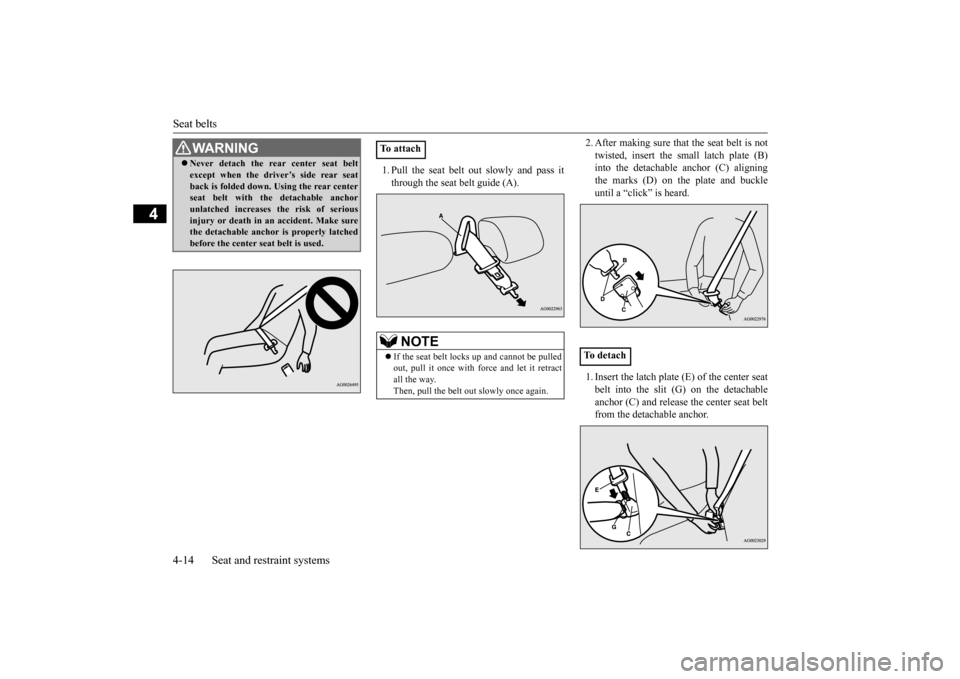
1. Pull the seat belt out slowly and pass it through the seat belt guide (A).
2. After making sure that the seat belt is not twisted, insert the small latch plate (B) into the detachable anchor (C) aligning the marks (D) on the plate and buckleuntil a “click” is heard. 1. Insert the latch plate (E) of the center seat belt into the slit (G) on the detachableanchor (C) and release the center seat belt from the detachable anchor.
WA R N I N G Never detach the rear center seat belt except when the driver’s side rear seat back is folded down. Using the rear center seat belt with the detachable anchor unlatched increases the risk of seriousinjury or death in an accident. Make sure the detachable anchor is properly latched before the center seat belt is used.
To attach
NOTE
If the seat belt locks up and cannot be pulled out, pull it once with force and let it retractall the way. Then, pull the belt out slowly once again.
To d e t a c h
BK0202700US.bo
ok 14 ページ 2013年3月28日 木曜日 午前11時54分
Page 37 of 384
Seat belts 4-16 Seat and restraint systems
4
N00418300194
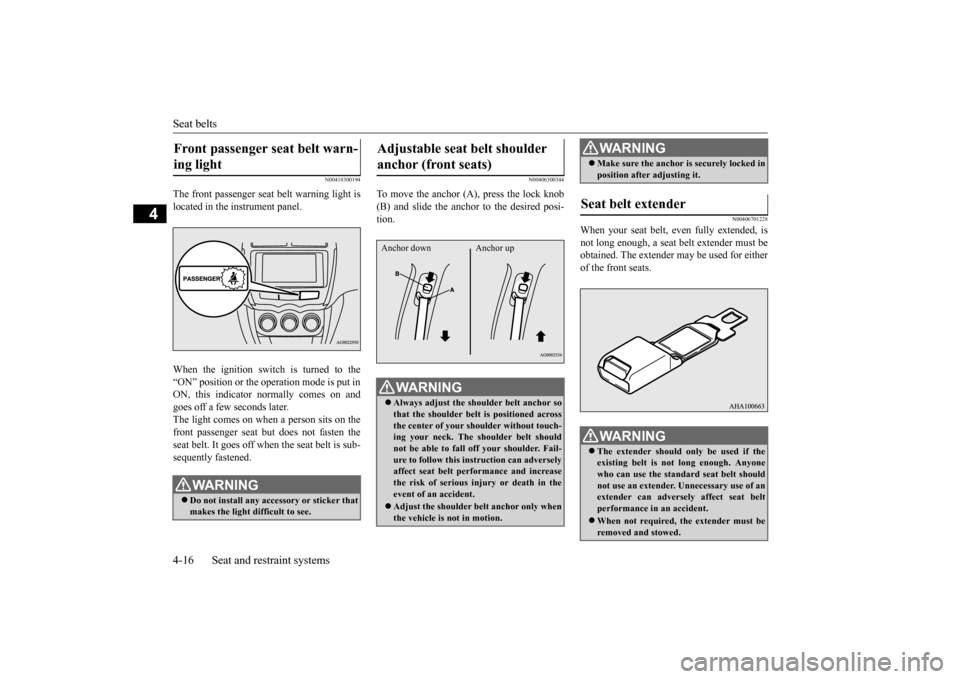
The front passenger seat belt warning light is located in the instrument panel. When the ignition switch is turned to the “ON” position or the operation mode is put inON, this indicator normally comes on andgoes off a few seconds later. The light comes on when a person sits on the front passenger seat but does not fasten theseat belt. It goes off when the seat belt is sub- sequently fastened.
N00406300344
To move the anchor (A), press the lock knob (B) and slide the anchor to the desired posi- tion.
N00406701228
When your seat belt, even fully extended, is not long enough, a seat belt extender must be obtained. The extender may be used for either of the front seats.
Front passenger seat belt warn- ing light
WA R N I N G Do not install any accessory or sticker that makes the light difficult to see.
Adjustable seat belt shoulder anchor (front seats)
WA R N I N G Always adjust the shoulder belt anchor so that the shoulder belt is positioned acrossthe center of your shoulder without touch- ing your neck. The shoulder belt should not be able to fall off your shoulder. Fail-ure to follow this instruction can adversely affect seat belt performance and increase the risk of serious injury or death in theevent of an accident. Adjust the shoulder belt anchor only when the vehicle is not in motion.
Anchor down Anchor up
Make sure the anchor is securely locked in position after adjusting it.
Seat belt extender
WA R N I N G The extender should only be used if the existing belt is not long enough. Anyone who can use the standard seat belt shouldnot use an extender. Unnecessary use of an extender can adversely affect seat belt performance in an accident. When not required, the extender must be removed and stowed.WA R N I N G
BK0202700US.bo
ok 16 ページ 2013年3月28日 木曜日 午前11時54分
Page 44 of 384
Child restraint systems
Seat and restraint systems 4-23
4
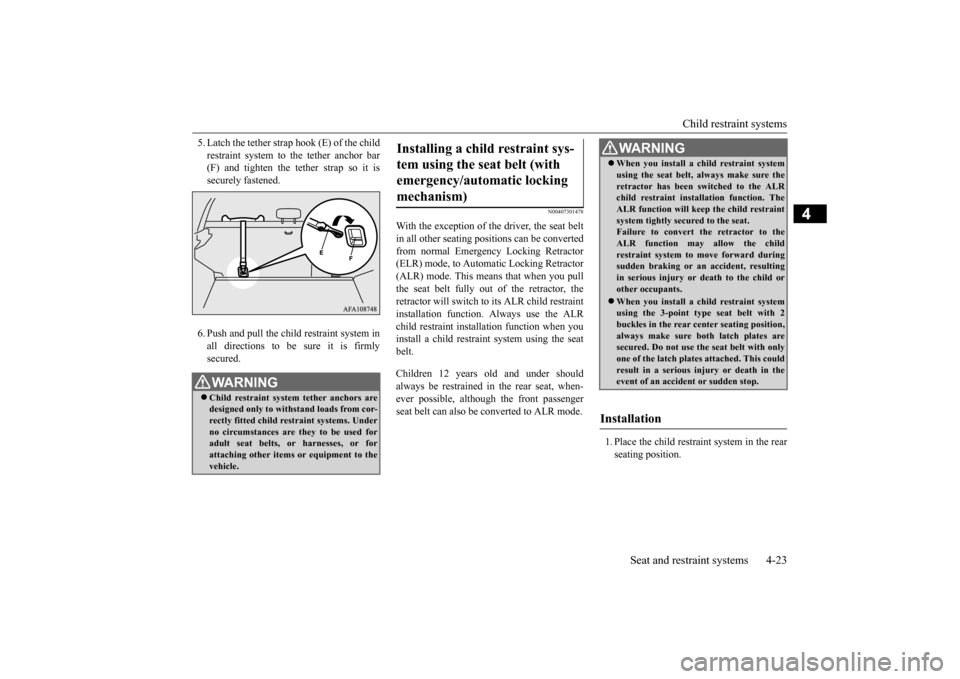
5. Latch the tether strap hook (E) of the child restraint system to the tether anchor bar (F) and tighten the tether strap so it is securely fastened. 6. Push and pull the ch
ild restraint system in
all directions to be sure it is firmlysecured.
N00407301478
With the exception of the driver, the seat beltin all other seating positions can be convertedfrom normal Emergency Locking Retractor (ELR) mode, to Automatic Locking Retractor (ALR) mode. This means that when you pullthe seat belt fully out of the retractor, theretractor will switch to its ALR child restraint installation function. Always use the ALR child restraint installa
tion function when you
install a child restraint system using the seat belt. Children 12 years old and under should always be restrained in the rear seat, when-ever possible, although the front passenger seat belt can also be converted to ALR mode.
1. Place the child restraint system in the rear seating position.
WA R N I N G Child restraint system tether anchors are designed only to withstand loads from cor-rectly fitted child restraint systems. Under no circumstances are they to be used for adult seat belts, or harnesses, or forattaching other items or equipment to the vehicle.
Installing a child restraint sys- tem using the seat belt (with emergency/automatic locking mechanism)
WA R N I N G When you install a child restraint system using the seat belt, always make sure the retractor has been switched to the ALR child restraint installation function. The ALR function will keep the child restraintsystem tightly secured to the seat. Failure to convert the retractor to the ALR function may allow the childrestraint system to move forward during sudden braking or an accident, resulting in serious injury or death to the child orother occupants. When you install a child restraint system using the 3-point type seat belt with 2 buckles in the rear center seating position, always make sure both latch plates aresecured. Do not use the seat belt with only one of the latch plates attached. This could result in a serious injury or death in theevent of an accident or sudden stop.
Installation
BK0202700US.bo
ok 23 ページ 2013年3月28日 木曜日 午前11時54分
Page 45 of 384
Child restraint systems 4-24 Seat and restraint systems
4
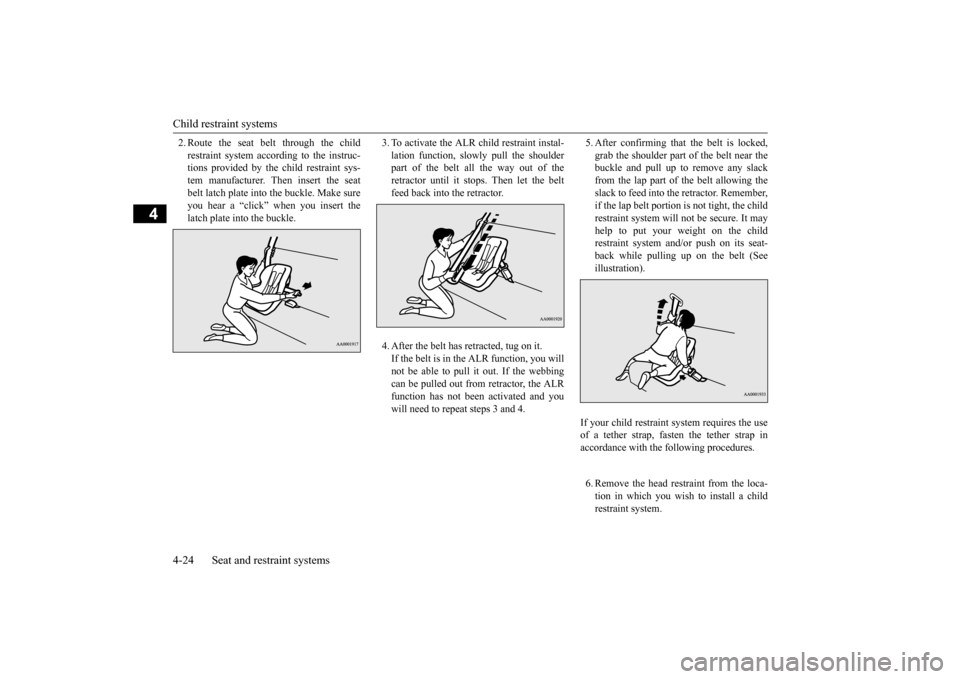
2. Route the seat belt through the child restraint system according to the instruc- tions provided by the child restraint sys- tem manufacturer. Then insert the seatbelt latch plate into the buckle. Make sure you hear a “click” when you insert the latch plate into the buckle.
3. To activate the ALR child restraint instal- lation function, slow
ly pull the shoulder
part of the belt all the way out of the retractor until it stops. Then let the beltfeed back into the retractor. 4. After the belt has retracted, tug on it. If the belt is in the ALR function, you willnot be able to pull it out. If the webbing can be pulled out from retractor, the ALR function has not been activated and youwill need to repeat steps 3 and 4.
5. After confirming that the belt is locked, grab the shoulder part of the belt near the buckle and pull up to remove any slack from the lap part of the belt allowing theslack to feed into the retractor. Remember, if the lap belt portion is not tight, the child restraint system will not be secure. It mayhelp to put your weight on the child restraint system and/or push on its seat- back while pulling up on the belt (Seeillustration). 6. Remove the head restraint from the loca- tion in which you wish to install a child restraint system.
If your child restraint system requires the useof a tether strap, fasten the tether strap in accordance with the following procedures.
BK0202700US.bo
ok 24 ページ 2013年3月28日 木曜日 午前11時54分
Page 46 of 384
Maintenance and inspection of seat belts
Seat and restraint systems 4-25
4
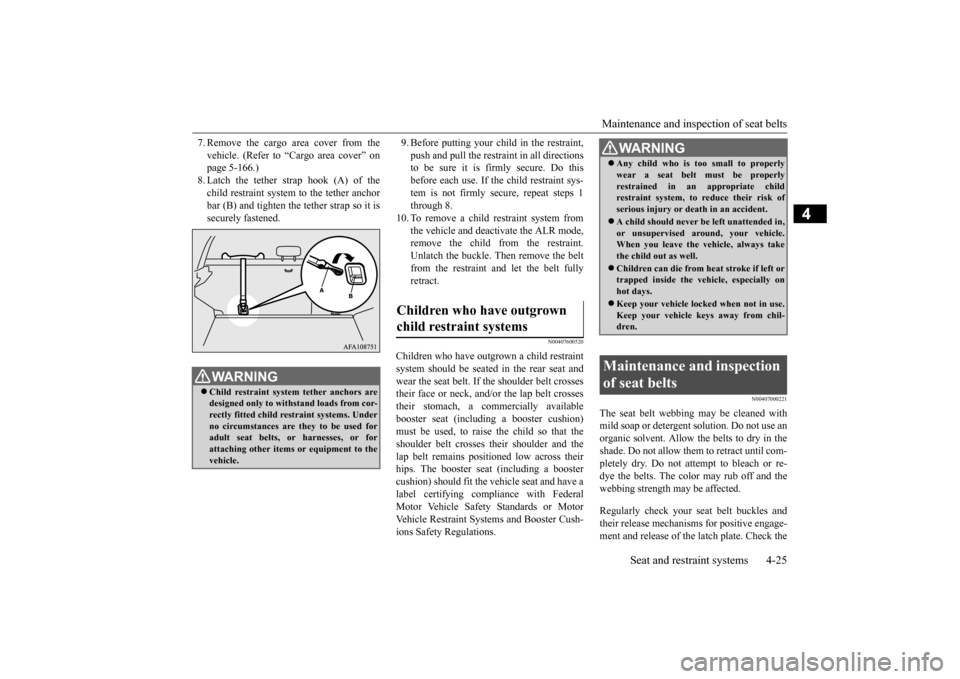
7. Remove the cargo area cover from the vehicle. (Refer to “Cargo area cover” on page 5-166.) 8. Latch the tether strap hook (A) of thechild restraint system to the tether anchor bar (B) and tighten the tether strap so it is securely fastened.
9. Before putting your child in the restraint, push and pull the restraint in all directions to be sure it is firmly secure. Do this before each use. If the child restraint sys-tem is not firmly secure, repeat steps 1 through 8.
10. To remove a child restraint system from
the vehicle and deactivate the ALR mode, remove the child from the restraint. Unlatch the buckle. Then remove the beltfrom the restraint and let the belt fullyretract.
N00407600520
Children who have outgrown a child restraint system should be seated in the rear seat and wear the seat belt. If the shoulder belt crossestheir face or neck, and/or the lap belt crosses their stomach, a commercially available booster seat (including a booster cushion)must be used, to raise the child so that the shoulder belt crosses their shoulder and the lap belt remains positioned low across theirhips. The booster seat (including a booster cushion) should fit the vehicle seat and have a label certifying compliance with FederalMotor Vehicle Safety Standards or Motor Vehicle Restraint Systems and Booster Cush- ions Safety Regulations.
N00407000221
The seat belt webbing may be cleaned withmild soap or detergent solution. Do not use anorganic solvent. Allow the belts to dry in the shade. Do not allow them to retract until com- pletely dry. Do not attempt to bleach or re-dye the belts. The color may rub off and the webbing strength may be affected. Regularly check your seat belt buckles and their release mechanisms for positive engage-ment and release of the latch plate. Check the
WA R N I N G Child restraint system tether anchors are designed only to withstand loads from cor- rectly fitted child restraint systems. Under no circumstances are they to be used foradult seat belts, or harnesses, or for attaching other items or equipment to the vehicle.
Children who have outgrown child restraint systems
WA R N I N G Any child who is too small to properly wear a seat belt must be properly restrained in an appropriate child restraint system, to reduce their risk of serious injury or death in an accident. A child should never be left unattended in, or unsupervised around, your vehicle.When you leave the vehicle, always take the child out as well. Children can die from he
at stroke if left or
trapped inside the vehicle, especially on hot days. Keep your vehicle locked when not in use. Keep your vehicle keys away from chil-dren.
Maintenance and inspection of seat belts
BK0202700US.bo
ok 25 ページ 2013年3月28日 木曜日 午前11時54分