child seat MITSUBISHI OUTLANDER SPORT 2014 3.G Owner's Manual
[x] Cancel search | Manufacturer: MITSUBISHI, Model Year: 2014, Model line: OUTLANDER SPORT, Model: MITSUBISHI OUTLANDER SPORT 2014 3.GPages: 384, PDF Size: 46.94 MB
Page 49 of 384
Supplemental Restraint System (SRS) - airbag 4-28 Seat and restraint systems
4
N00407800450
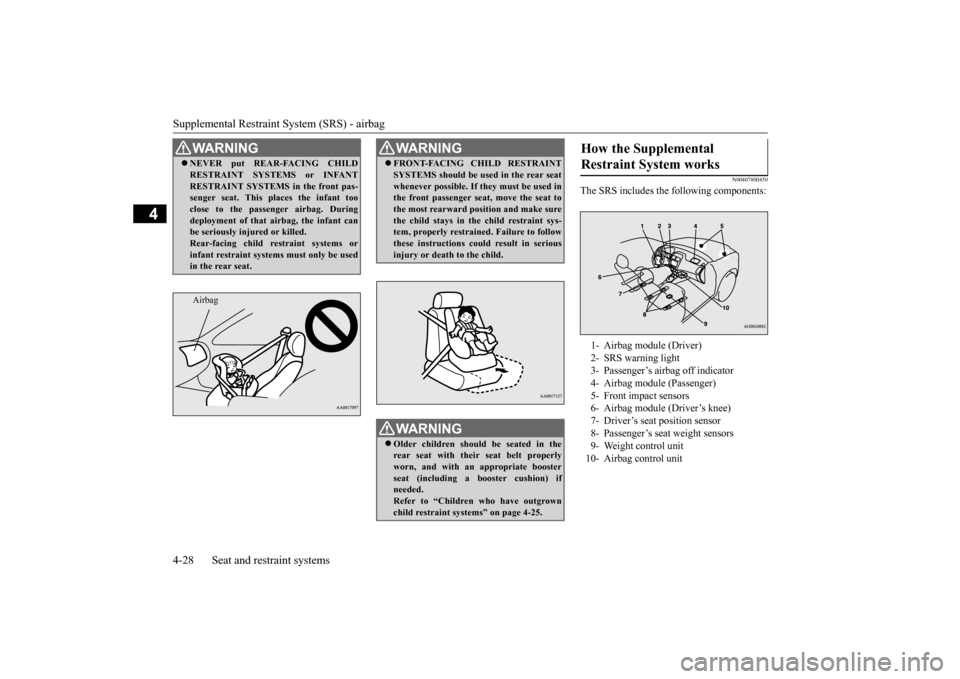
The SRS includes the following components:
WA R N I N G NEVER put REAR-FACING CHILD RESTRAINT SYSTEMS or INFANT RESTRAINT SYSTEMS in the front pas- senger seat. This places the infant too close to the passenger airbag. Duringdeployment of that airbag, the infant can be seriously injured or killed. Rear-facing child restraint systems orinfant restraint systems must only be used in the rear seat.Airbag
WA R N I N G FRONT-FACING CHILD RESTRAINT SYSTEMS should be used in the rear seat whenever possible. If they must be used in the front passenger seat, move the seat to the most rearward position and make surethe child stays in the child restraint sys- tem, properly restrained. Failure to follow these instructions could result in seriousinjury or death to the child.WA R N I N G Older children should be seated in the rear seat with their seat belt properlyworn, and with an appropriate booster seat (including a booster cushion) if needed.Refer to “Children who have outgrown child restraint systems” on page 4-25.
How the Supplemental Restraint System works 1- Airbag module (Driver) 2- SRS warning light3- Passenger’s airbag off indicator4- Airbag module (Passenger) 5- Front impact sensors 6- Airbag module (Driver’s knee)7- Driver’s seat position sensor 8- Passenger’s seat weight sensors 9- Weight control unit10- Airbag control unit
BK0202700US.bo
ok 28 ページ 2013年3月28日 木曜日 午前11時54分
Page 52 of 384
Supplemental Restraint System (SRS) - airbag
Seat and restraint systems 4-31
4
N00418100280
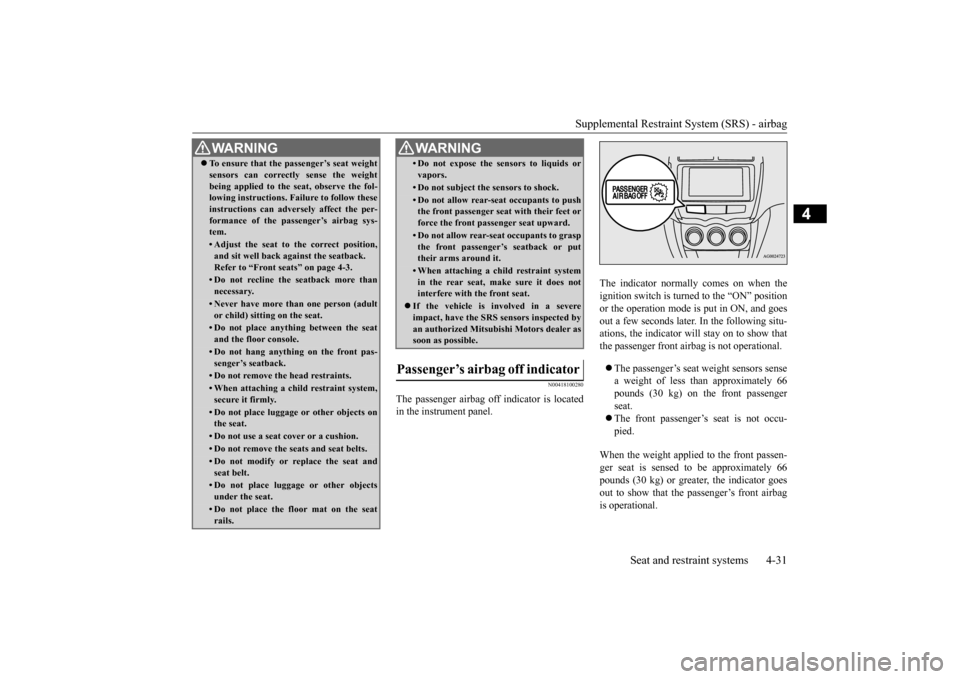
The passenger airbag off indicator is located in the instrument panel.
The indicator normally comes on when the ignition switch is turned to the “ON” position or the operation mode is put in ON, and goesout a few seconds later. In the following situ- ations, the indicator will stay on to show that the passenger front airbag is not operational. The passenger’s seat weight sensors sense a weight of less than approximately 66pounds (30 kg) on the front passenger seat. The front passenger’s seat is not occu- pied.
When the weight applied to the front passen- ger seat is sensed to be approximately 66 pounds (30 kg) or greater, the indicator goesout to show that the passenger’s front airbag is operational.
To ensure that the passenger’s seat weight sensors can correctly sense the weight being applied to the seat, observe the fol- lowing instructions. Failure to follow these instructions can adversely affect the per-formance of the passenger’s airbag sys- tem.• Adjust the seat to the correct position,and sit well back against the seatback. Refer to “Front seats” on page 4-3.• Do not recline the seatback more thannecessary.• Never have more than one person (adultor child) sitting on the seat.• Do not place anything between the seatand the floor console.• Do not hang anything on the front pas-senger’s seatback.• Do not remove the head restraints.• When attaching a child restraint system, secure it firmly.• Do not place luggage or other objects onthe seat.• Do not use a seat cover or a cushion.• Do not remove the seats and seat belts.• Do not modify or replace the seat and seat belt.• Do not place luggage or other objectsunder the seat.• Do not place the floor mat on the seatrails.WA R N I N G
• Do not expose the sensors to liquids or vapors.• Do not subject the sensors to shock.• Do not allow rear-seat occupants to pushthe front passenger seat with their feet or force the front passenger seat upward.• Do not allow rear-seat occupants to graspthe front passenger’s seatback or puttheir arms around it.• When attaching a child restraint systemin the rear seat, make sure it does not interfere with the front seat.
If the vehicle is involved in a severe impact, have the SRS sensors inspected by an authorized Mitsubishi Motors dealer assoon as possible.
Passenger’s airbag off indicator
WA R N I N G
BK0202700US.bo
ok 31 ページ 2013年3月28日 木曜日 午前11時54分
Page 59 of 384
Supplemental Restraint System (SRS) - airbag 4-38 Seat and restraint systems
4
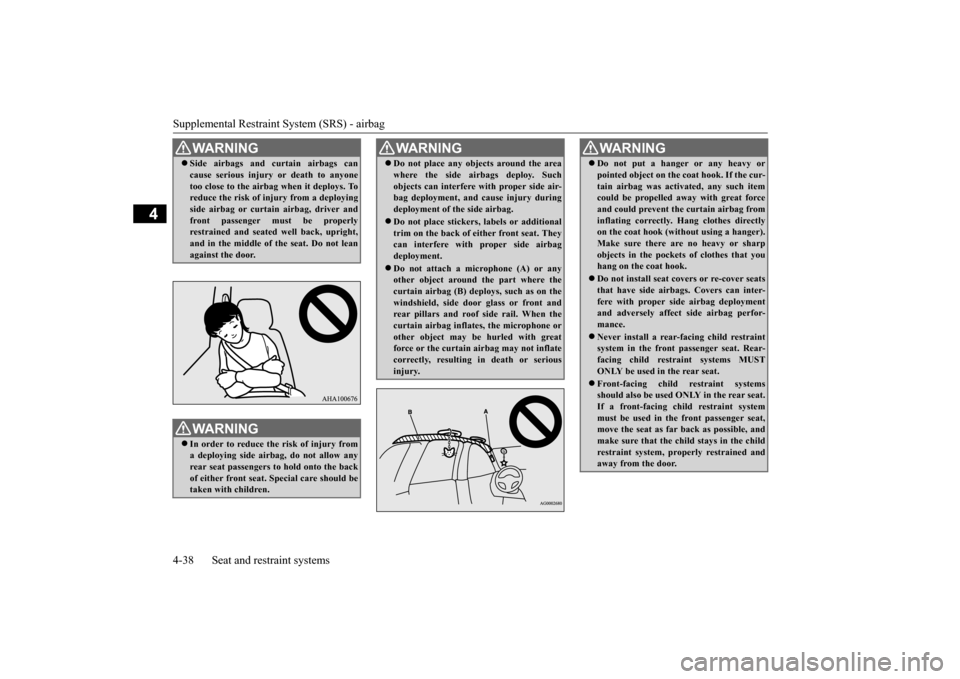
WA R N I N G Side airbags and curtain airbags can cause serious injury or death to anyone too close to the airbag when it deploys. To reduce the risk of injury from a deploying side airbag or curtain airbag, driver andfront passenger must be properly restrained and seated well back, upright, and in the middle of the seat. Do not leanagainst the door.WA R N I N G In order to reduce the risk of injury from a deploying side airbag, do not allow anyrear seat passengers to hold onto the back of either front seat. Special care should be taken with children.
Do not place any objects around the area where the side airbags deploy. Such objects can interfere with proper side air- bag deployment, and cause injury during deployment of the side airbag. Do not place stickers, labels or additional trim on the back of either front seat. Theycan interfere with proper side airbag deployment. Do not attach a microphone (A) or any other object around the part where the curtain airbag (B) deploys, such as on thewindshield, side door glass or front and rear pillars and roof side rail. When the curtain airbag inflates, the microphone orother object may be hurled with great force or the curtain airbag may not inflate correctly, resulting in death or seriousinjury.WA R N I N G
WA R N I N G Do not put a hanger or any heavy or pointed object on the coat hook. If the cur- tain airbag was activated, any such item could be propelled away with great force and could prevent the curtain airbag frominflating correctly. Hang clothes directly on the coat hook (without using a hanger). Make sure there are no heavy or sharpobjects in the pockets of clothes that you hang on the coat hook. Do not install seat covers or re-cover seats that have side airbags. Covers can inter- fere with proper side airbag deploymentand adversely affect side airbag perfor- mance. Never install a rear-facing child restraint system in the front passenger seat. Rear- facing child restraint systems MUSTONLY be used in the rear seat. Front-facing child restraint systems should also be used ONLY in the rear seat. If a front-facing child restraint system must be used in the front passenger seat,move the seat as far back as possible, and make sure that the child stays in the child restraint system, properly restrained andaway from the door.
BK0202700US.bo
ok 38 ページ 2013年3月28日 木曜日 午前11時54分
Page 60 of 384
Supplemental Restraint System (SRS) - airbag
Seat and restraint systems 4-39
4
N00408200493
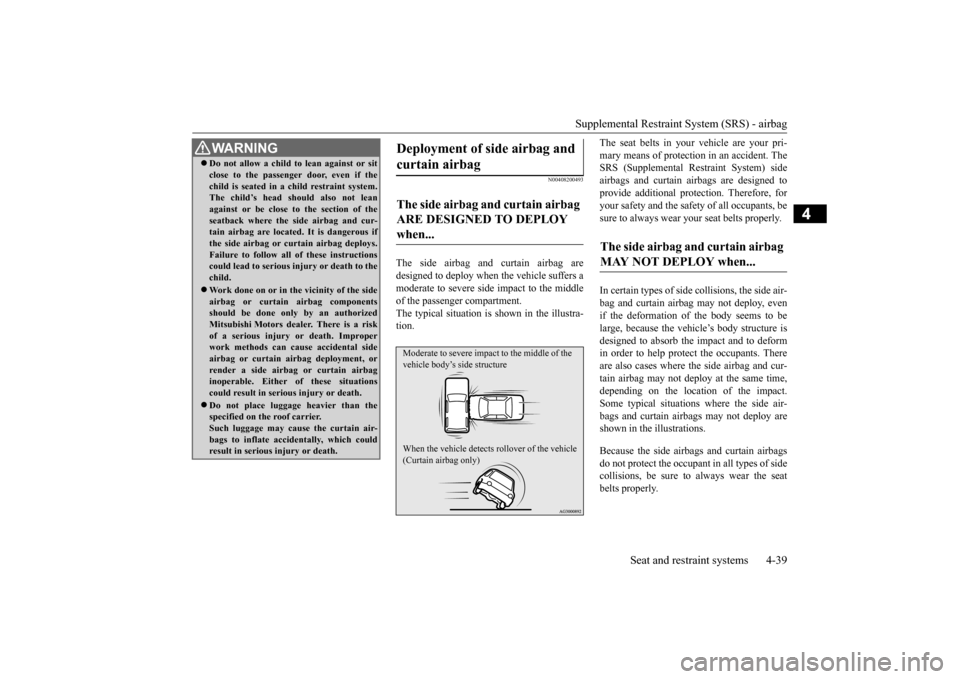
The side airbag and curtain airbag are designed to deploy when the vehicle suffers a moderate to severe side impact to the middleof the passenger compartment.The typical situation is shown in the illustra- tion.
The seat belts in your vehicle are your pri- mary means of protection in an accident. The SRS (Supplemental Restraint System) side airbags and curtain airbags are designed toprovide additional protection. Therefore, for your safety and the safety of all occupants, be sure to always wear your seat belts properly. In certain types of side collisions, the side air- bag and curtain airbag may not deploy, even if the deformation of the body seems to be large, because the vehicle’s body structure isdesigned to absorb the impact and to deform in order to help protect the occupants. There are also cases where the side airbag and cur-tain airbag may not deploy at the same time, depending on the location of the impact. Some typical situations where the side air-bags and curtain airbags may not deploy are shown in the illustrations. Because the side airbags and curtain airbags do not protect the occupant in all types of sidecollisions, be sure to always wear the seat belts properly.
Do not allow a child to lean against or sit close to the passenger door, even if the child is seated in a child restraint system. The child’s head should also not lean against or be close to the section of theseatback where the side airbag and cur- tain airbag are located.
It is dangerous if
the side airbag or curtain airbag deploys.Failure to follow all of these instructions could lead to serious injury or death to the child. Work done on or in the vicinity of the side airbag or curtain airbag componentsshould be done only by an authorized Mitsubishi Motors dealer. There is a risk of a serious injury or death. Improperwork methods can cause accidental side airbag or curtain airbag deployment, or render a side airbag or curtain airbaginoperable. Either of these situations could result in serious injury or death. Do not place luggage heavier than the specified on the roof carrier. Such luggage may cause the curtain air-bags to inflate accidentally, which could result in serious injury or death.WA R N I N G
Deployment of side airbag and curtain airbag The side airbag and curtain airbag ARE DESIGNED TO DEPLOY when... Moderate to severe impa
ct to the middle of the
vehicle body’s side structure When the vehicle detects
rollover of the vehicle
(Curtain airbag only)
The side airbag and curtain airbag MAY NOT DEPLOY when...
BK0202700US.bo
ok 39 ページ 2013年3月28日 木曜日 午前11時54分
Page 91 of 384
Door locks 5-28 Features and controls
5
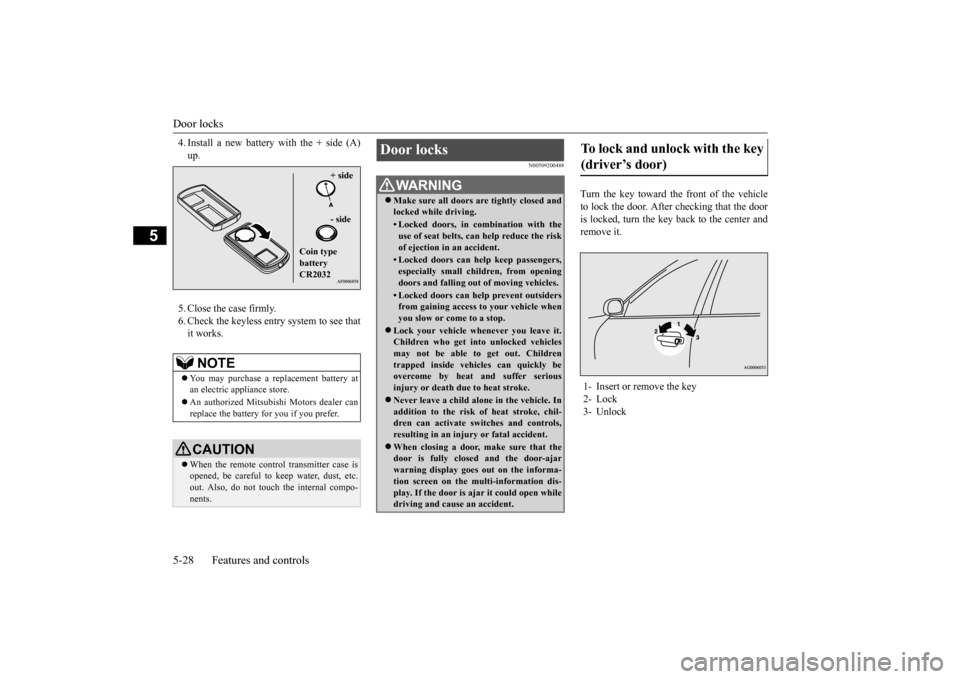
4. Install a new battery with the + side (A) up. 5. Close the case firmly. 6. Check the keyless entry system to see that it works.
N00509200488
Turn the key toward the front of the vehicleto lock the door. After checking that the door is locked, turn the key back to the center and remove it.
NOTE
You may purchase a replacement battery at an electric appliance store. An authorized Mitsubishi Motors dealer can replace the battery for you if you prefer.CAUTION When the remote control transmitter case is opened, be careful to keep water, dust, etc. out. Also, do not touch the internal compo-nents.
+ side - side
Coin type battery CR2032
Door locks
WA R N I N G Make sure all doors are tightly closed and locked while driving.• Locked doors, in combination with theuse of seat belts, can help reduce the risk of ejection in an accident.• Locked doors can help keep passengers,especially small children, from opening doors and falling out of moving vehicles.• Locked doors can help prevent outsidersfrom gaining access to your vehicle whenyou slow or come to a stop.
Lock your vehicle whenever you leave it. Children who get into unlocked vehicles may not be able to get out. Children trapped inside vehicles can quickly beovercome by heat and suffer serious injury or death due to heat stroke. Never leave a child alone in the vehicle. In addition to the risk of heat stroke, chil- dren can activate switches and controls,resulting in an injury or fatal accident. When closing a door, make sure that the door is fully closed and the door-ajar warning display goes out on the informa- tion screen on the multi-information dis- play. If the door is ajar it could open while driving and cause an accident.
To lock and unlock with the key (driver’s door) 1- Insert or remove the key 2- Lock 3- Unlock
BK0202700US.bo
ok 28 ページ 2013年3月28日 木曜日 午前11時54分
Page 233 of 384
Driving precaution 6-2 Driving safety
6
N00629300053
Utility vehicles have higher ground clearance and a narrower track, which enables them toperform in a wide variety of off-road situa- tions. Because of the higher ground clear- ance, these vehicles have a higher center ofgravity, which makes them handle differently than ordinary vehicles when driving on pave- ment. They are not designed to maneuver orcorner at the same speed on pavement as con- ventional 2-wheel drive passenger cars any more than low-slung sports cars are designedto perform satisfactorily in off-road condi- tions. Always drive safely and steer the vehiclecarefully. Avoid operating the vehicle in a manner that might require sharp turns or abrupt maneuvers. As with other vehicles ofthis type, failure to operate this vehicle cor- rectly can result in loss of control or vehicle rollover.In a rollover crash, an unbelted person is sig- nificantly more likely to die than a person wearing a seat belt. Before starting the vehi-
cle, always make certain that you and all your passengers are properly wearing their seat belts (with children in the rear seat, in appro- priate restraints).
N00628800152
Fuel economy is dependent on many factors.Your personal driving habits can have a sig-nificant effect on your fuel use. Several rec-ommendations for achieving the greatest fuel economy are listed below. Whenever accelerating from a stop, always accelerate slowly and smoothly. When parked for even a short period, do not idle the engine. Shut it off. Plan your trips to avoid unnecessary stops. Keep your tires inflated to the recom- mended pressures. When you drive on highways or dry improved roads, set the drive mode-selec- tor “2WD” or “4WD AUTO” position (ifso equipped). For freeway driving, maintain a speed of approximately 50 mph (80 km/h) whentraffic, roadway and weather conditions safely permit. Keep your air filter clean and your vehicle lubricated according to the recommenda- tions in this manual.
Always keep your vehicle well main- tained. A poorly maintained engine wastes fuel and costs money. Never overload your vehicle.
N00628900049
Drunk driving is one of the most frequent causes of accidents.Your driving ability can be seriouslyimpaired even with blood alcohol levels far below the legal minimum. If you have been drinking, don’t drive. Ride with a designatednon-drinking driver, call a cab or a friend, or use public transportation. Drinking coffee or taking a cold shower will not make you sober.Similarly, prescription and nonprescription drugs affect your alertness, perception and reaction time. Consult with your doctor orpharmacist before driving while under the influence of any of these medications.
Driving precaution
WA R N I N G Utility vehicles have
a significantly higher
rollover rate than other types of vehicles. Avoid abrupt maneuvers and excessive speed. Always buckle up.
Fuel economy
Driving, alcohol and drugs
WA R N I N G NEVER DRINK AND DRIVE. Your perceptions are less accurate, your reflexes are slower and your judgment is impaired.
BK0202700US.bo
ok 2 ページ 2013年3月28日 木曜日 午前11時54分
Page 235 of 384
Vehicle preparation before driving 6-4 Driving safety
6
N00629000669
For a safer and more enjoyable trip, always check for the following: Before starting the vehicle, make certain that you and all passengers are seated and wearing their seat belts properly (with children in the rear seat, in appropriaterestraints), and that all the doors and lift- gate are locked. Move the driver’s seat as far backward as possible, while still keeping good visibil- ity, and good control of the steering wheel, brakes, accelerator, and controls.Check the instrument panel indicators and multi-information display for any possible problem. In the same way, the front passenger seat should also be moved as far back as possi- ble. Make sure that infants and small children are properly restrained in accordance with all laws and regulations.
Check these by selecting the defroster mode, and set the blower switch on high. Youshould be able to feel the air blowing against the windshield. Refer to “Defrosting or defogging (wind-shield, door windows)” on page 7-8, 7-13, 7-19, 7-24. Check all the tires for heavy tread wear or uneven wear patterns. Look for stones, nails, glass, or other objects stuck in the tread. Look for any tread cuts or sidewall cracks. Checkthe wheel nuts for tightness, and the tires (including spare tire) for proper pressure. Replace your tires before they are heavilyworn out. As your vehicle is equipped with a tire pres- sure monitoring system, there is a risk ofdamage to the tire inflation pressure sensors when the tire is replaced on the rim. Tire replacement should, therefore, be performedonly by an authorized Mitsubishi Motors dealer.
Have someone watch while you turn all the exterior lights on and off. Also check the turnsignal indicators and high-beam indicators on the instrument panel. Check the ground under the vehicle after parking overnight, for fuel, water, oil, or other leaks. Make sure all the fluid levels are correct. Also, if you can smell fuel, you needto find out why immediately and have it fixed.
N00629200094
Even this vehicle’s safety equipment, andyour safest driving, cannot guarantee that you can avoid an accident or injury. However, ifyou give extra attention to the following areas, you can better protect yourself and your passengers: Drive defensively. Be aware of traffic, road and weather conditions. Leave plenty of stopping distance between your vehicle and the vehicle ahead.
Vehicle preparation before driving Seat belts and seats
Defrosters Tires
Lights Fluid leaks Safe driving techniques
BK0202700US.bo
ok 4 ページ 2013年3月28日 木曜日 午前11時54分
Page 381 of 384
Alphabetical index 12-4
12
Operation under adverse driving conditions
...
8-14 Outside rearview mirrors
.....................
5-43
Overheating
......................
...................
8-4
P
Parking
.........................
.......................
6-6
Parking brake break-in
....................
9-21
Parking brake lever stroke
...............
9-21
Parking brake
....................
.................
5-40
Parking lights
Bulb capacity
................
.................
9-29
Replacement
.................
.................
9-33
Polishing
.......................
.....................
9-41
Power brakes
.....................
.................
5-62
Power outlet
..................
...................
5-159
Power steering
Fluid
........................
.....................
11-5
Power windows
.................
.................
5-36
Puncture (Tire changing)
.......................
8-6
R
Radio
General information about your radio 7-59
Reading lights
Bulb capacity
................
.................
9-30
Rear axle oil
...............
...............
9-11
, 11-5
Rear combination lights
Bulb capacity
..................
................
9-29
Replacement
...................
................
9-36
Rear side-marker lights
Bulb capacity
..................
................
9-29
Replacement
...................
................
9-36
Rear turn signal light
Bulb capacity
..................
................
9-29
Replacement
...................
................
9-36
Rear-view camera
...............
................
5-79
Rearview mirror
Inside rearview mirror
.....................
5-41
Outside rearview mirrors
.................
5-43
Replacement of light bulbs
...................
9-29
Replacing tires and wheels
...................
9-18
Reporting Safety Defects
.....................
10-2
S
Safe driving techniques
.........................
6-4
Seat belt
......................
.......................
4-11
Adjustable seat belt shoulder anchor
.4-16
Child restraint systems
.....................
4-18
Front passenger seat belt warning light
.....
4-16 Maintenance and inspection
.............
4-25
Seat belt extender
............................
4-16
Seat belt force limitter
.....................
4-18
Seat belt pre-tensioners
....................
4-17
Seat belt use during pregnancy
.........
4-17
Seats
..........................
..........................
4-2
Arm rest
.......................
...................
4-7
Front seats
....................
...................
4-3
Head restraints
.................
................
4-7
Heated seat
...................
...................
4-6
Seats and restraint systems
................
4-2
Service brake
.....................
.................
5-61
Service precautions
...............
................
9-2
Side turn signal light
Bulb capacity
................
.................
9-29
Snow tires
.....................
.....................
9-20
Spark plugs
...................
.....................
9-22
Starting the engine
..............................
5-45
Steering
Power steering fluid
........................
11-5
Steering wheel height and reach adjustment 5-41
Stop lights
Bulb capacity
................
.................
9-29
Replacement
.................
.................
9-36
Storage spaces
...................
...............
5-163
Sun visors
.....................
...................
5-158
Sunshade
......................
.....................
5-39
Supplemental Restraint System
............
4-26
How the Supplemental Restraint System works
.....................
.....................
4-28
Maintenance service
.......................
4-41
BK0202700US.bo
ok 4 ページ 2013年3月28日 木曜日 午前11時54分