charging MITSUBISHI OUTLANDER SPORT 2014 3.G Owners Manual
[x] Cancel search | Manufacturer: MITSUBISHI, Model Year: 2014, Model line: OUTLANDER SPORT, Model: MITSUBISHI OUTLANDER SPORT 2014 3.GPages: 384, PDF Size: 46.94 MB
Page 10 of 384
2-1
2
If this warning light comes on or
flashes while you’re driving...
Quick index
N00200702175
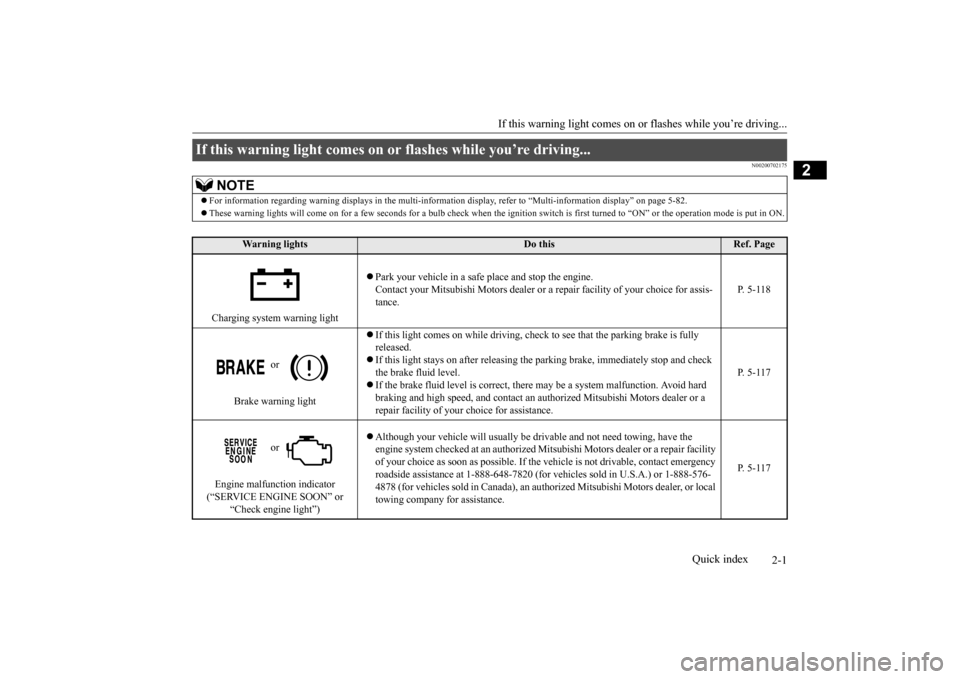
If this warning light comes on or flashes while you’re driving...
NOTE
For information regarding warning displays in the multi-informat
ion display, refer to “Multi-information display” on page 5-82.
These warning lights will come on for a few seconds for a bulb check
when the ignition switch is first turned to “ON” or the op
eration mode is put in ON.
Wa r n i n g l i g h t s
Do this
Ref. Page
Charging system warning light
Park your vehicle in a safe place and stop the engine. Contact your Mitsubishi Motors dealer or
a repair facility of your choice for assis-
tance.
P. 5 - 1 1 8
or
Brake warning light
If this light comes on while driving, check to see that the parking brake is fully released. If this light stays on after releasing the parking brake, immediately stop and check the brake fluid level. If the brake fluid level is correct, there may be a system malfunction. Avoid hard braking and high speed, and contact an aut
horized Mitsubishi Mo
tors dealer or a
repair facility of your choice for assistance.
P. 5 - 1 1 7
or
Engine malfunction indicator (“SERVICE ENGINE SOON” or
“Check engine light”)
Although your vehicle will usually be drivable and not need towing, have the engine system checked at an authorized Mits
ubishi Motors dealer or a repair facility
of your choice as soon as possible. If the
vehicle is not drivable, contact emergency
roadside assistance at 1-888-648-7820 (for ve
hicles sold in U.S.A.) or 1-888-576-
4878 (for vehicles sold in Canada), an auth
orized Mitsubishi Moto
rs dealer, or local
towing company for assistance.
P. 5 - 1 1 7
BK0202700US.bo
ok 1 ページ 2013年3月28日 木曜日 午前11時54分
Page 167 of 384
Indicator light, warning light, an
d information screen display list
5-104 Features and controls
5
N00557700048 N00557800267
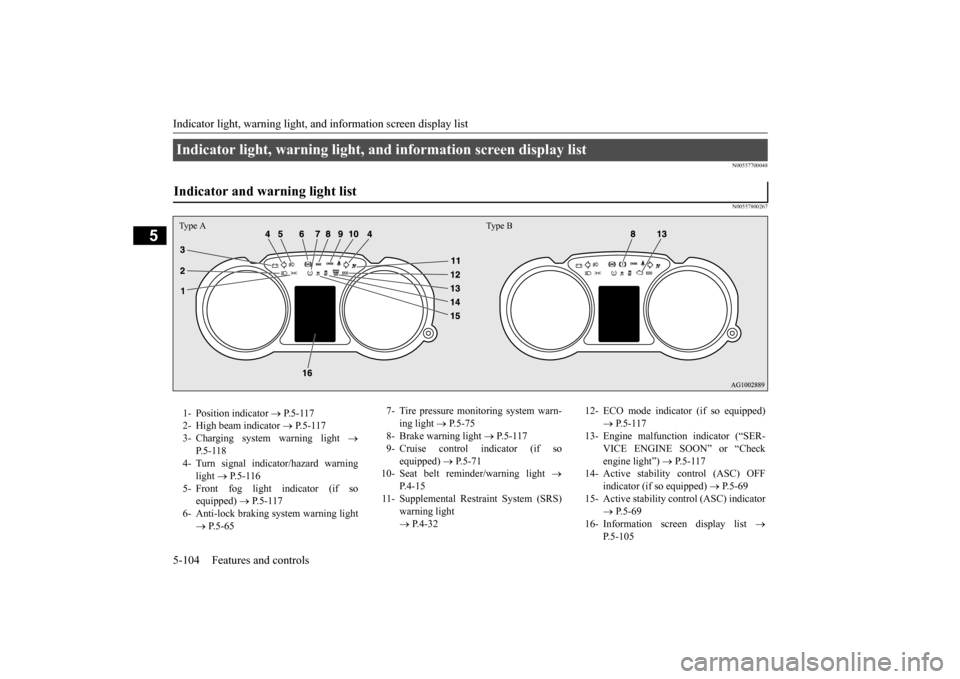
Indicator light, warning light, and information screen display list Indicator and warning light list Type A Type B1- Position indicator
P.5-117
2- High beam indicator
P.5-117
3- Charging system warning light
P. 5 - 1 1 8
4- Turn signal indicator/hazard warning
light
P.5-116
5- Front fog light indicator (if so
equipped)
P.5-117
6- Anti-lock braking system warning light
P.5-65
7- Tire pressure monitoring system warn-
ing light
P.5-75
8- Brake warning light
P. 5 - 1 1 7
9- Cruise control indicator (if so
equipped)
P.5-71
10- Seat belt reminder/warning light
P. 4 - 1 5
11- Supplemental Restraint System (SRS)
warning light P.4-32
12- ECO mode indicator (if so equipped)
P.5-117
13- Engine malfunction indicator (“SER-
VICE ENGINE SOON” or “Check engine light”)
P.5-117
14- Active stability control (ASC) OFF
indicator (if so equipped)
P.5-69
15- Active stability control (ASC) indicator
P.5-69
16- Information screen display list
P.5-105
BK0202700US.book
104 ページ 2013年3月28日 木曜日 午前11時54分
Page 175 of 384
Indicator light, warning light, an
d information screen display list
5-112 Features and controls
5
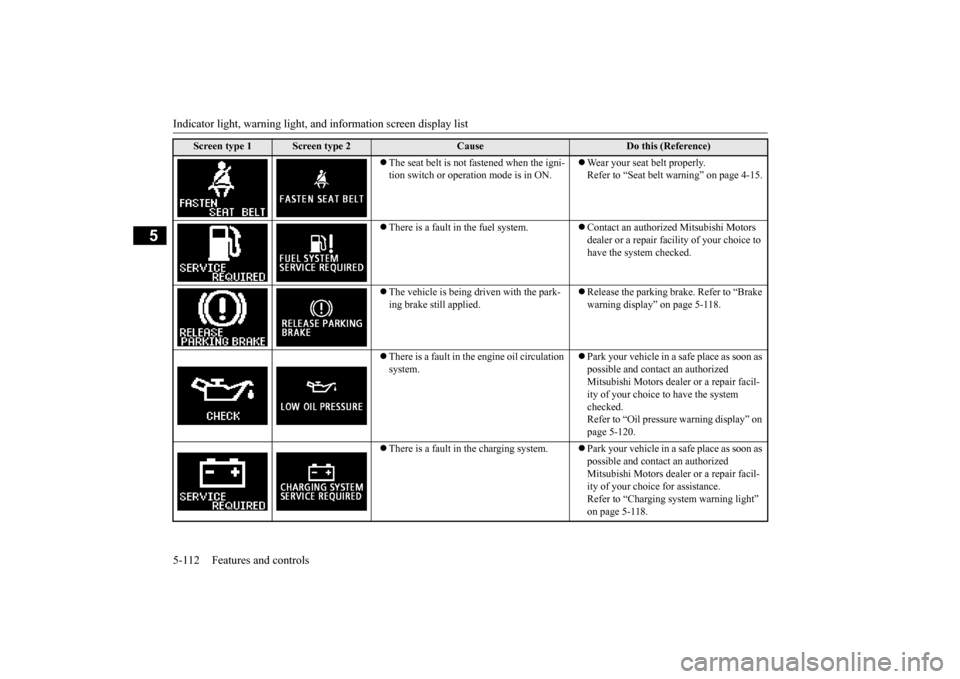
The seat belt is not fastened when the igni- tion switch or operation mode is in ON.
Wear your seat belt properly. Refer to “Seat belt warning” on page 4-15.
There is a fault in the fuel system.
Contact an authorized Mitsubishi Motors dealer or a repair facility of your choice to have the system checked.
The vehicle is being driven with the park- ing brake still applied.
Release the parking brake. Refer to “Brake warning display” on page 5-118.
There is a fault in the engine oil circulation system.
Park your vehicle in a safe place as soon as possible and contact an authorized Mitsubishi Motors dealer or a repair facil- ity of your choice to have the system checked. Refer to “Oil pressure warning display” on page 5-120.
There is a fault in the charging system.
Park your vehicle in a safe place as soon as possible and contact an authorized Mitsubishi Motors dealer or a repair facil- ity of your choice for assistance.Refer to “Charging system warning light” on page 5-118.
Screen type 1
Screen type 2
Cause
Do this (Reference)
BK0202700US.book
112 ページ 2013年3月28日 木曜日 午前11時54分
Page 181 of 384
Information screen display 5-118 Features and controls
5
system. If a problem is detected in one of these systems, this indicator illuminates or flashes. When the ignition switch is turned to the “ON” position or the operation mode isput in ON, this indicator normally comes on and goes off after the engine has started. This indicator will come on if the fuel tank filler cap is not properly tightened. If thisindicator comes on and stays on after refuel- ing, stop the engine an
d check that the cap is
properly tightened. (Turn the cap clockwiseuntil you hear clicking sounds.)If this indicator does not go off after several seconds or lights up while driving, have the system checked as soon as possible at anauthorized Mitsubishi Motors dealer or a repair facility of your choice.
N00520600300
This light comes on in the event of a malfunc-tion in the charging system or when the igni-
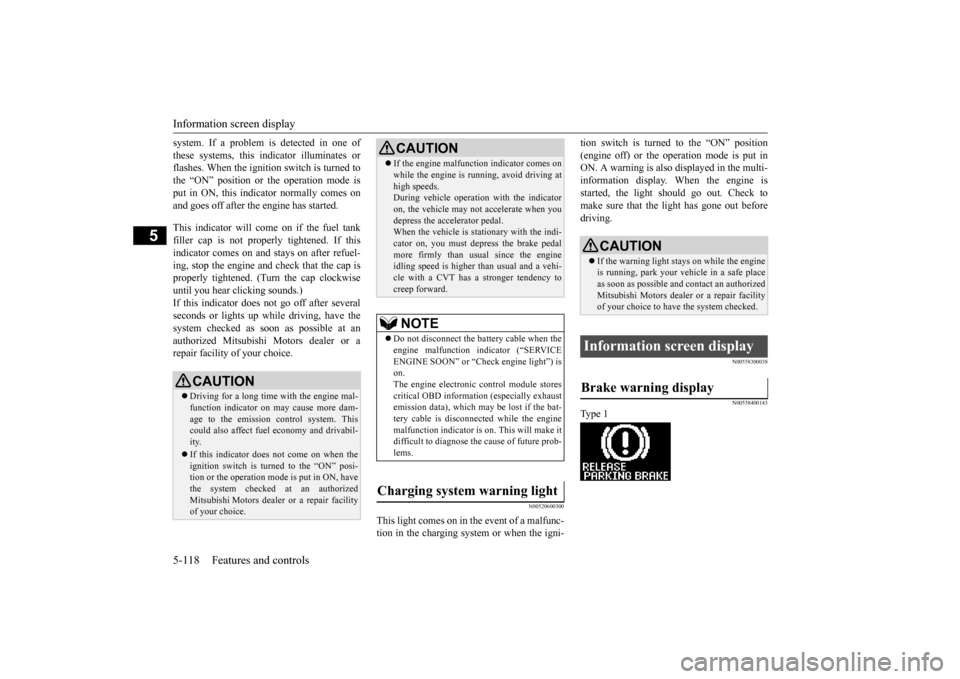
tion switch is turned to the “ON” position (engine off) or the operation mode is put in ON. A warning is also displayed in the multi- information display. When the engine isstarted, the light should go out. Check to make sure that the light has gone out before driving.
N00558300038 N00558400143
Ty p e 1
CAUTION Driving for a long time with the engine mal- function indicator on may cause more dam-age to the emission control system. This could also affect fuel economy and drivabil- ity. If this indicator does not come on when the ignition switch is turned to the “ON” posi- tion or the operation mode is put in ON, have the system checked at an authorizedMitsubishi Motors dealer or a repair facility of your choice.
If the engine malfunction indicator comes on while the engine is running, avoid driving at high speeds. During vehicle operation with the indicator on, the vehicle may not accelerate when youdepress the accelerator pedal. When the vehicle is stationary with the indi- cator on, you must depress the brake pedalmore firmly than usual since the engine idling speed is higher than usual and a vehi- cle with a CVT has a stronger tendency tocreep forward.NOTE
Do not disconnect the battery cable when the engine malfunction indicator (“SERVICE ENGINE SOON” or “Check engine light”) ison. The engine electronic control module stores critical OBD information (especially exhaustemission data), which may be lost if the bat- tery cable is disconnected while the engine malfunction indicator is on. This will make itdifficult to diagnose the cause of future prob- lems.
Charging system warning light
CAUTION
CAUTION If the warning light stays on while the engine is running, park your vehicle in a safe placeas soon as possible and contact an authorized Mitsubishi Motors dealer or a repair facility of your choice to have the system checked.
Information screen display Brake warning display
BK0202700US.book
118 ページ 2013年3月28日 木曜日 午前11時54分
Page 182 of 384
Information screen display
Features and controls 5-119
5
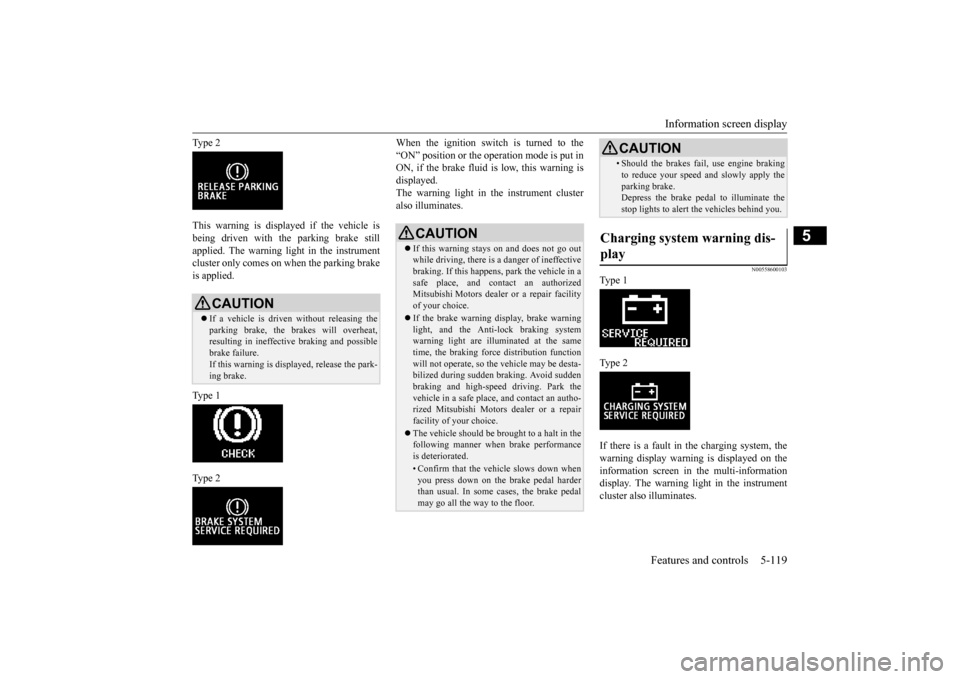
Type 2 This warning is displayed if the vehicle is being driven with the parking brake still applied. The warning light in the instrumentcluster only comes on when the parking brake is applied. Type 1 Type 2
When the ignition switch is turned to the “ON” position or the operation mode is put in ON, if the brake fluid is low, this warning is displayed.The warning light in the instrument cluster also illuminates.
N00558600103
Type 1 Type 2 If there is a fault in
the charging system, the
warning display warning is displayed on theinformation screen in the multi-information display. The warning light in the instrument cluster also illuminates.
CAUTION If a vehicle is driven without releasing the parking brake, the brakes will overheat,resulting in ineffective braking and possible brake failure. If this warning is displayed, release the park- ing brake.
CAUTION If this warning stays on and does not go out while driving, there is a danger of ineffective braking. If this happens, park the vehicle in a safe place, and contact an authorizedMitsubishi Motors dealer or a repair facility of your choice. If the brake warning display, brake warning light, and the Anti-lock braking system warning light are illuminated at the sametime, the braking force distribution function will not operate, so the vehicle may be desta- bilized during sudden braking. Avoid suddenbraking and high-speed driving. Park the vehicle in a safe place, and contact an autho- rized Mitsubishi Motors dealer or a repairfacility of your choice. The vehicle should be brought to a halt in the following manner when brake performance is deteriorated.• Confirm that the vehicle slows down when you press down on the brake pedal harderthan usual. In some cases, the brake pedal may go all the way to the floor.
• Should the brakes fail, use engine brakingto reduce your speed and slowly apply the parking brake. Depress the brake pedal to illuminate the stop lights to alert the vehicles behind you.
Charging system warning dis- play
CAUTION
BK0202700US.book
119 ページ 2013年3月28日 木曜日 午前11時54分
Page 308 of 384
Jump-starting the engine For emergencies 8-3
8
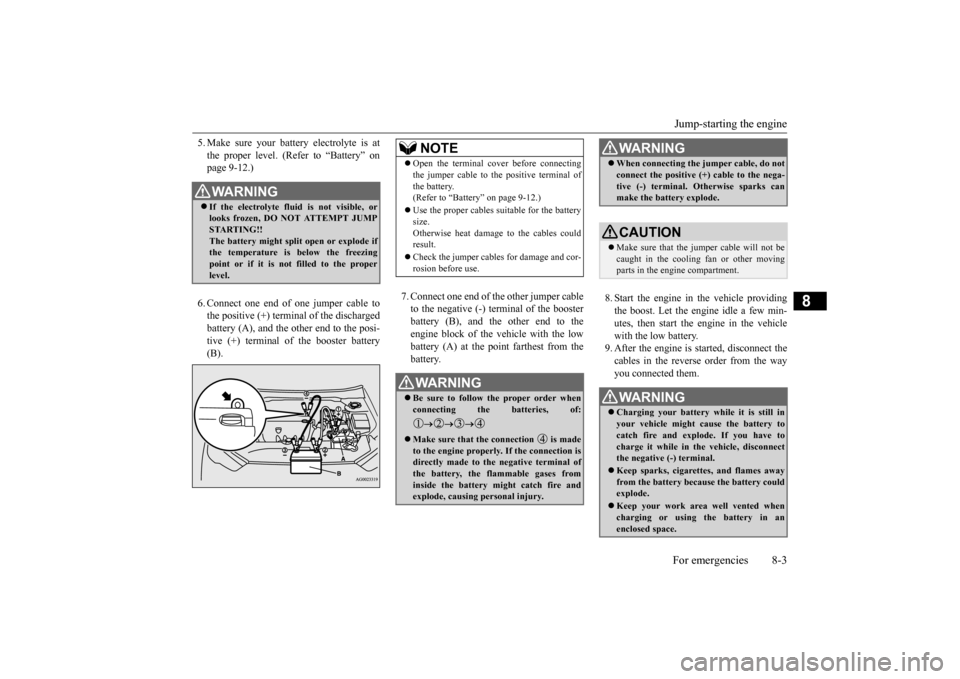
5. Make sure your battery electrolyte is at the proper level. (Refer to “Battery” on page 9-12.) 6. Connect one end of one jumper cable to the positive (+) terminal of the discharged battery (A), and the other end to the posi-tive (+) terminal of the booster battery (B).
7. Connect one end of the other jumper cable to the negative (-) terminal of the booster battery (B), and the other end to theengine block of the vehicle with the low battery (A) at the point farthest from the battery.
8. Start the engine in the vehicle providing the boost. Let the engine idle a few min- utes, then start the engine in the vehiclewith the low battery. 9. After the engine is started, disconnect the cables in the reverse order from the wayyou connected them.
WA R N I N G If the electrolyte fluid is not visible, or looks frozen, DO NOT ATTEMPT JUMP STARTING!!The battery might split open or explode if the temperature is below the freezing point or if it is not filled to the properlevel.
NOTE
Open the terminal cover before connecting the jumper cable to the positive terminal of the battery. (Refer to “Battery” on page 9-12.) Use the proper cables suitable for the battery size. Otherwise heat damage to the cables couldresult. Check the jumper cables for damage and cor- rosion before use.WA R N I N G Be sure to follow the proper order when connecting the batteries, of:
Make sure that the connection is made to the engine properly. If the connection is directly made to the negative terminal ofthe battery, the flammable gases from inside the battery might catch fire and explode, causing personal injury.
When connecting the jumper cable, do not connect the positive (+) cable to the nega- tive (-) terminal. Otherwise sparks can make the battery explode.CAUTION Make sure that the jumper cable will not be caught in the cooling fan or other movingparts in the engine compartment.WA R N I N G Charging your battery while it is still in your vehicle might cause the battery to catch fire and explode. If you have to charge it while in the vehicle, disconnect the negative (-) terminal. Keep sparks, cigarettes, and flames away from the battery because the battery couldexplode. Keep your work area well vented when charging or using the battery in an enclosed space.WA R N I N G
BK0202700US.bo
ok 3 ページ 2013年3月28日 木曜日 午前11時54分
Page 309 of 384
Engine overheating 8-4 For emergencies
8
If you drive your vehicle with a low battery charge after the engine has been started by using jumper cables, the engine may misfire. This can cause the anti-lock braking systemwarning light to blink on and off. This is only due to the low battery voltage. It is not a problem with the brake system. If this hap-pens, fully charge the battery and ensure the charging system is operating properly.
N00836500352
When the engine is overheating, the informa- tion screen in the multi-information displaywill be interrupted and the engine coolant temperature warning display will appear. Also “ ” blink. If this happens: 1. Stop the vehicle in a safe place. Turn on the hazard warning flashers.2. With the engine still running, carefully raise the engine hood to vent the engine compartment.3. Check that the cooling fan is running. If the fan is not turning, stop the engine immediately and contact an authorizedMitsubishi Motors dealer or a repair facil- ity of your choice for assistance. 4. If you see steam or spray coming from under the hood, turn off the engine.
5. If you do not see steam or spray coming from under the hood, leave the engine on until the bar graph for the engine coolant temperature warning display on the multi-information display goes down. When it is in the middle of the normal zone, you can start driving again. If the bar graphstays in the red zone, turn off the engine. 6. When you do not see any more steam or spray, open the hood. Look for obvious leaks, such as a split radiator hose. Be careful as components will be hot. Anyleak source must be repaired. 7. If there is no obvious leak source, check the coolant level in the engine coolantreserve tank. If there is none, or if it is too low, slowly add coolant.
Remove all the caps before charging the battery. Electrolyte (battery acid) is made of corro- sive diluted sulfuric acid. If electrolytecomes in contact with your hands, eyes, clothes, or the painted surface of your vehicle, thoroughly flush with water. Ifelectrolyte gets in your eyes, flush them immediately and thoroughly with water, and get prompt medical attention. Always wear protective clothing and gog- gles when working near the battery. Keep the battery out of the reach of chil- dren.
As your vehicle has anti-lock brakes
WA R N I N G
Engine overheating
WA R N I N G To avoid personal injury, keep hands, hair, jewelry and clothes away from the cooling fan. The cooling fan can start at any time.
WA R N I N G Before raising the engine hood, check to see if there is steam or spray coming fromunder the hood. Steam or spray coming from an overheated engine could seriously scald you.Do not open the hood until there is no steam or spray.
BK0202700US.bo
ok 4 ページ 2013年3月28日 木曜日 午前11時54分
Page 333 of 384
Battery 9-12 Vehicle care and maintenance
9
Use the brake fluid conforming to DOT 3 or DOT 4. The reservoir cap must be tightlysealed to keep dirt and water out.
N00939100930
The condition of the battery is very important for quick starting and to keep the vehicle’s electrical system working properly. Check thebattery regularly. If battery performance is suspect, have the battery and charging system tested by an authorized Mitsubishi Motors dealer or arepair facility of your choice.
N00901600031
The battery is weaker in cold temperatures.This has to do with its chemical and physicalproperties and is why a very cold battery, especially one with a low charge, will have a hard time starting your vehicle.It is recommended that you have your battery and charging system checked by an autho- rized Mitsubishi Motors dealer or a repairfacility of your choice before the start of cold weather. If necessary, have it charged. This will guarantee more reliable starting, and lon-ger battery life.
N00901701101
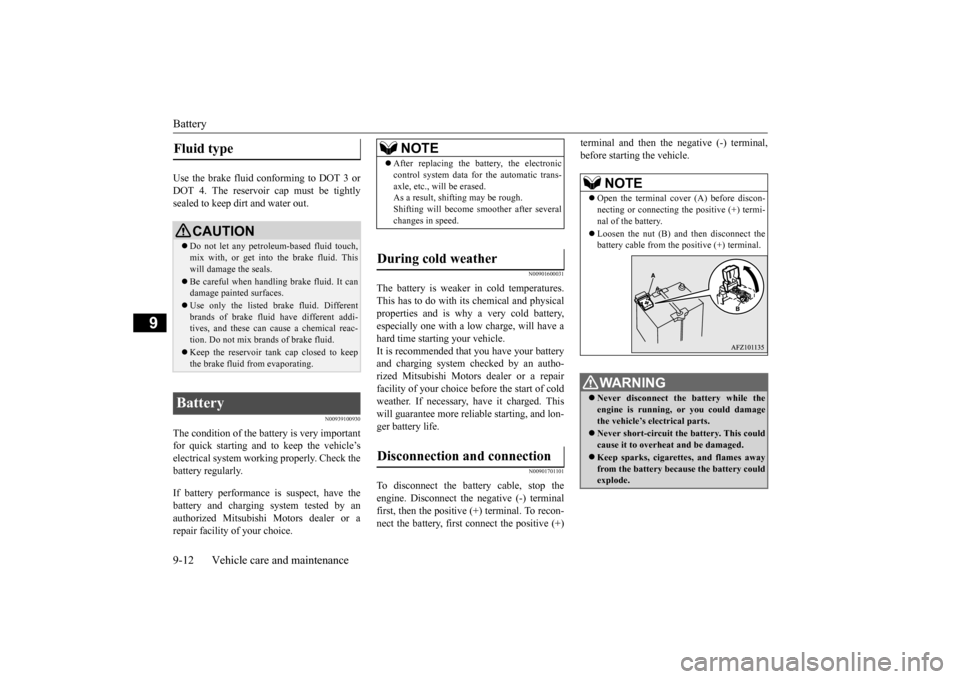
To disconnect the battery cable, stop theengine. Disconnect the negative (-) terminal first, then the positive (+) terminal. To recon- nect the battery, first connect the positive (+)
terminal and then the negative (-) terminal, before starting the vehicle.
Fluid type
CAUTION Do not let any petroleum-based fluid touch, mix with, or get into the brake fluid. This will damage the seals. Be careful when handling brake fluid. It can damage painted surfaces. Use only the listed brake fluid. Different brands of brake fluid have different addi-tives, and these can cause a chemical reac- tion. Do not mix brands of brake fluid. Keep the reservoir tank cap closed to keep the brake fluid from evaporating.
Battery
NOTE
After replacing the battery, the electronic control system data for the automatic trans- axle, etc., will be erased. As a result, shifting may be rough. Shifting will become smoother after severalchanges in speed.
During cold weather Disconnection and connection
NOTE
Open the terminal cover (A) before discon- necting or connecting the positive (+) termi- nal of the battery. Loosen the nut (B) and then disconnect the battery cable from the positive (+) terminal.WA R N I N G Never disconnect the battery while the engine is running, or you could damage the vehicle’s electrical parts. Never short-circuit the battery. This could cause it to overheat and be damaged. Keep sparks, cigarettes, and flames away from the battery because the battery couldexplode.
BK0202700US.bo
ok 12 ページ 2013年3月28日 木曜日 午前11時54分
Page 334 of 384
Tires
Vehicle care and maintenance 9-13
9
N00939201592
It is important to familiarize yourself with the following terms: Cold tire pressure: • The measured pressure after the vehicle has been parked for at least three hours,or • The measured pressure when the vehicle is driven less than 1 mile (1.6 km) afterhaving been parked for three hours.
Maximum pressure:the maximum permis- sible cold tire inflation pressure for thistire. Recommended inflation pressure: the inflation pressure for optimum tire perfor-mance. Intended outboard sidewall: • The sidewall that contains a whitewall,bears white lettering or bears manufac- turer, brand, and/or model name molding that is higher or deeper than the samemolding on the other sidewall of the tire, or
Electrolyte (battery acid) is made of corro- sive diluted sulfuric
acid. If it spills on
nearby parts, it can crack, stain, or dis- color them. And if it gets on your skin or in your eyes, it can cause burns or blind-ness. Please observe the following han- dling instructions:• If electrolyte gets on plastic parts orother nearby parts, wipe it off with a soft cloth or chamois soaked in a solution ofwater and neutral detergent then imme- diately rinse the affected parts with plenty of water.• If electrolyte gets on your hands orclothes, rinse thoroughly with water. Ifelectrolyte gets in your eyes, flush them with water immediately and get immedi- ate medical attention.
Open doors and windows in any closed space where you may be charging orworking with the battery. Always wear protective clothing and gog- gles when working with the battery, or have a skilled automobile technician do it. If you are quick-charging your battery, first disconnect th
e battery cables.
In order to prevent a short-circuit, be sure to disconnect the negative (-) terminal first, and reconnect it last. Battery posts, terminals and related acces- sories contain lead and lead compounds. Wash hands after handling.WA R N I N G
NOTE
Check each battery terminal for corrosion. You can stop more corrosion by washing with a solution of baking soda and water. Grease the posts and clamps after cleaning or tightening them. Check to see that the battery is securely installed and cannot be moved. Also checkeach terminal for tightness. If you will not be driving your vehicle for a long period of time, remove the battery and store it in a place where the battery fluid will not freeze. The battery only should be storedwith a full charge. Before cleaning the battery, tighten all the filler port caps to keep dirt and moisture out.
Tires
WA R N I N G Driving with tires that are worn, damaged or improperly inflated is dangerous.These type tire conditions will adversely affect vehicle performance. These type tire conditions can also cause a tread separation or blowout which may result in an accident causing seriousinjury or death.
Tires, including spare tire, degrade over time with age even when they are not being used. It is recommended that tires over 6 years generally be replaced even if damage isnot obvious.WA R N I N G
BK0202700US.bo
ok 13 ページ 2013年3月28日 木曜日 午前11時54分
Page 378 of 384
Alphabetical index
12-1
12
Numerics
4-wheel drive operation
.......................
5-58
A
Accessory (installation)
.........................
3-6
Active stability control (ASC)
..............
5-67
Air bag
......................
........................
4-26
Air cleaner filter
...................
................
9-8
Air conditioning
Automatic air conditioning
.....
7-14
, 7-20
Important air conditioning operating tips
..
7-25Manual air conditioning
.............
7-4
, 7-9
Air purifier
....................
.....................
7-25
Aluminum wheels
...............................
9-42
AM/FM radio
....................
.................
7-26
Antenna
Roof antenna
.................
.................
7-58
Anti-lock braking system
.....................
5-64
Arm rest
........................
.......................
4-7
Assist grip
.....................
...................
5-167
Audio
AM/FM radio
................
.................
7-26
CD player
.....................
.................
7-26
Troubleshooting
.............................
7-56
Automatic air conditioning
.........
7-14
, 7-20
Automatic transaxle
Fluid
.......................
......................
11-5
B
Back-up light
Bulb capacity
..................
...............
9-29
Replacement
...................
...............
9-37
Ball joint, steering linkage seals and drive shaft boots
.....................
..................
9-23
Battery
........................
......................
9-12
Charging system warning light
.......
5-118
Disconnection and connection
.........
9-12
During cold weather
.......................
9-12
Specification
...................
...............
11-4
Bluetooth 2.0 interface
.......................
5-134
Bottle holders
...................
.................
5-166
Brake
Fluid
.......................
......................
11-5
Brake assist system
.............................
5-64
Braking
.......................
........................
6-5
Anti-lock braking system
................
5-64
Hose
.......................
......................
9-23
Pad wear alarm
...............
...............
5-62
Parking brake
..................
...............
5-40
Pedal
.......................
......................
5-61
Pedal free play
................
...............
9-20
Power brakes
..................
...............
5-62
Service brake
..................
...............
5-61
Warning lights
..............................
5-117
Break-in recommendations
....................
5-3
Bulb capacity
.....................
.................
9-29
C
California Perchlorate Materials Requirements
.....................
................
3-6
Capacities
.....................
.....................
11-5
Card holder
...................
...................
5-158
Cargo area cover
................
...............
5-166
Cargo loads
...................
.....................
6-11
Cargo room light
Bulb capacity
................
.................
9-30
Catalytic converter
................
................
9-2
Cautions on the handling of all-wheel drive vehicles
.......................
.....................
5-60
CD player
......................
.....................
7-26
Certification label
...............................
11-3
Charging system warning light
...........
5-118
Child restraint systems
........................
4-18
Child safety locks for rear door
............
5-31
Cleaning
Inside of your vehicle
......................
9-39
Outside of your vehicle
...................
9-40
Clutch
Pedal free play
...............
.................
9-20
Coat hook
......................
...................
5-167
Consumer information
.........................
10-2
BK0202700US.bo
ok 1 ページ 2013年3月28日 木曜日 午前11時54分