key MITSUBISHI OUTLANDER SPORT 2014 3.G Owners Manual
[x] Cancel search | Manufacturer: MITSUBISHI, Model Year: 2014, Model line: OUTLANDER SPORT, Model: MITSUBISHI OUTLANDER SPORT 2014 3.GPages: 384, PDF Size: 46.94 MB
Page 4 of 384
Instruments and controls
Overview 1-2
1
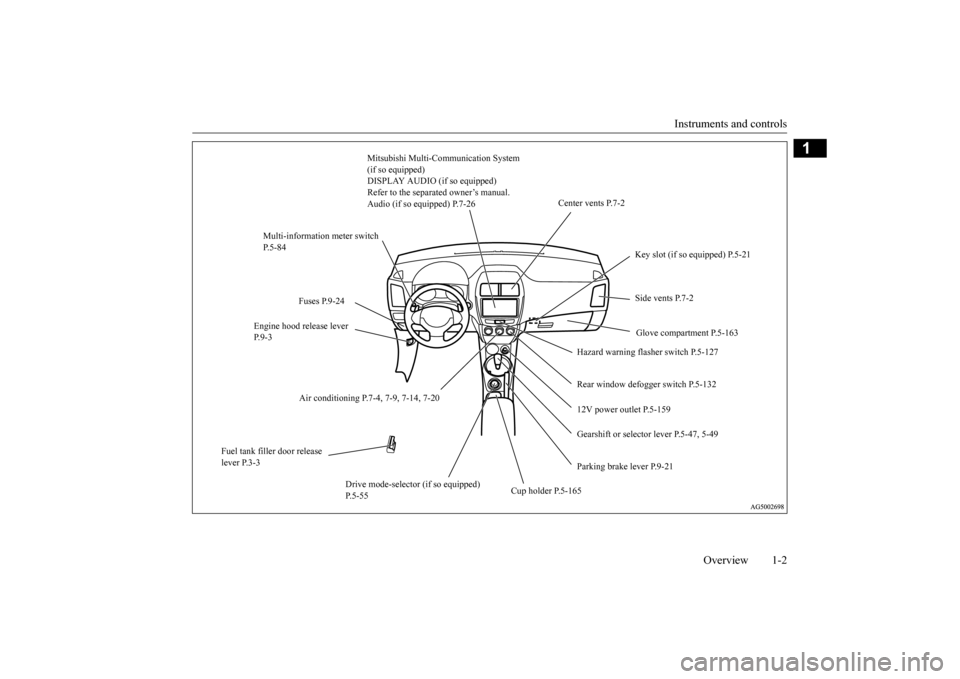
Mitsubishi Multi-Co
mmunication System
(if so equipped) DISPLAY AUDIO (if so equipped)Refer to the separated owner’s manual. Audio (if so equipped) P.7-26
Multi-information meter switch P.5-84
Key slot (if so equipped) P.5-21 Side vents P.7-2
Fuses P.9-24
Engine hood release lever P.9-3
Glove compartment P.5-163
Hazard warning flasher switch P.5-127 Rear window defogger switch P.5-132
Air conditioning P.7-4, 7-9, 7-14, 7-20
12V power outlet P.5-159 Gearshift or selector lever P.5-47, 5-49
Fuel tank filler door release lever P.3-3
Parking brake lever P.9-21
Drive mode-selector (if so equipped) P.5-55
Cup holder P.5-165
Center vents P.7-2
BK0202700US.bo
ok 2 ページ 2013年3月28日 木曜日 午前11時54分
Page 9 of 384
Outside 1-7 Overview
1
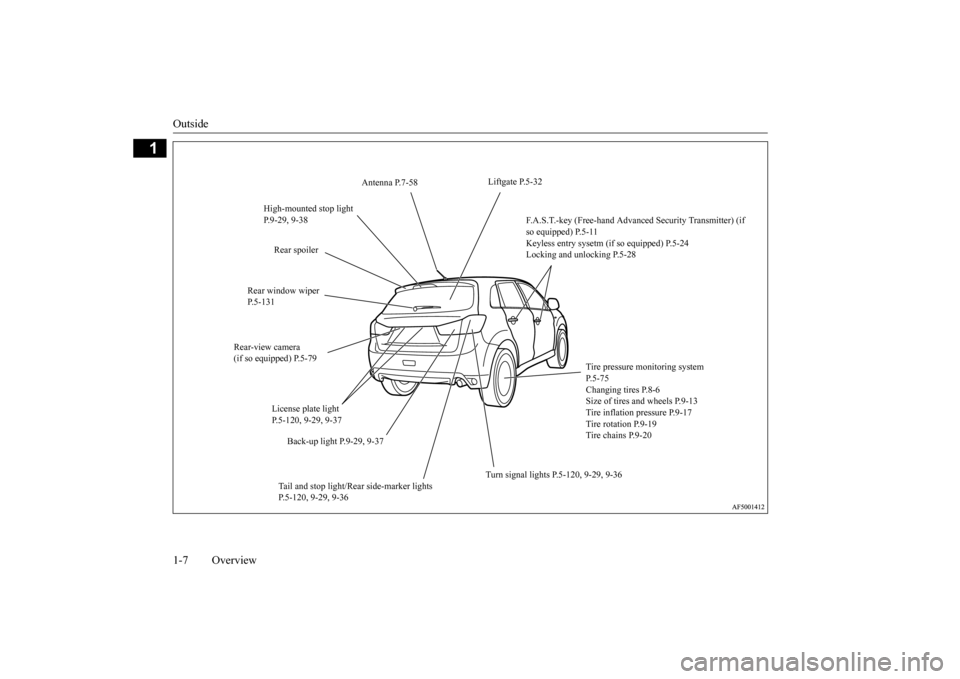
Liftgate P.5-32
Antenna P.7-58
High-mounted stop light P.9-29, 9-38
F.A.S.T.-key (Free-hand Advanced Security Transmitter) (if so equipped) P.5-11 Keyless entry sysetm (if so equipped) P.5-24Locking and unlocking P.5-28
Rear spoiler
Rear window wiper P.5-131
Rear-view camera (if so equipped) P.5-79
Tire pressure monitoring system P.5-75Changing tires P.8-6 Size of tires and wheels P.9-13 Tire inflation pressure P.9-17 Tire rotation P.9-19 Tire chains P.9-20
License plate light P.5-120, 9-29, 9-37
Back-up light P.9-29, 9-37
Turn signal lights P.5-120, 9-29, 9-36
Tail and stop light/Rear side-marker lights P.5-120, 9-29, 9-36
BK0202700US.bo
ok 7 ページ 2013年3月28日 木曜日 午前11時54分
Page 12 of 384
If this problem occurs...
Quick index 2-3
2
N00200900867
If this problem occurs...
Problem
Do this
Ref. Page
Cannot turn the key. (except for vehicles equipped with the F.A.S.T.-key)
Will not turn from “ACC” to “OFF”. Vehicles with continuously
variable transmission (CVT):
Check the position of the selector lever. The key cannot be removed unless the selector lever is set to the “P” (PARK) position.
P. 5-45
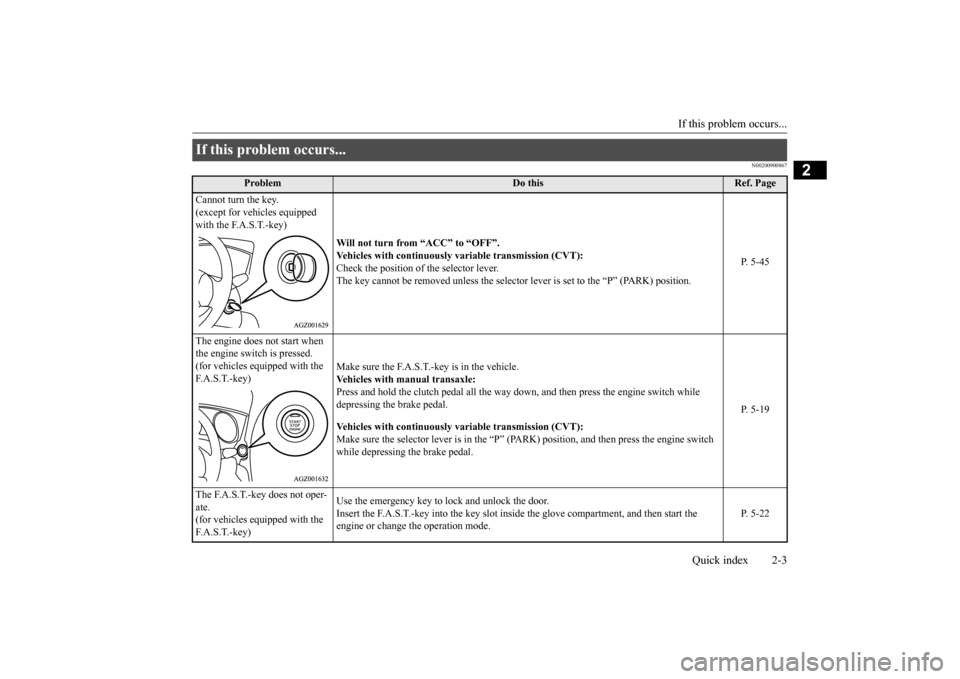
The engine does not start when the engine switch is pressed. (for vehicles equipped with the F. A . S . T. - k e y )
Make sure the F.A.S.T.-key is in the vehicle. Vehicles with manual transaxle: Press and hold the clutch pedal all the way
down, and then press the engine switch while
depressing the brake pedal. Vehicles with continuously
variable transmission (CVT):
Make sure the selector lever is in the “P” (P
ARK) position, and then press the engine switch
while depressing the brake pedal.
P. 5-19
The F.A.S.T.-key does not oper- ate. (for vehicles equipped with the F. A . S . T. - k e y )
Use the emergency key to lock and unlock the door. Insert the F.A.S.T.-key into the key slot insi
de the glove compartment, and then start the
engine or change the operation mode.
P. 5-22
BK0202700US.bo
ok 3 ページ 2013年3月28日 木曜日 午前11時54分
Page 38 of 384
Seat belt use during pregnancy
Seat and restraint systems 4-17
4
N00406800134
Seat belts work for ev
eryone, including preg-
nant women. Like all occupants, pregnantwomen are more likely to be seriously injured or killed in an accident if they do not wear seat belts.
N00417700641
The driver’s and front passenger’s seats eachhave a seat belt equipped with a pre-tensioner system.
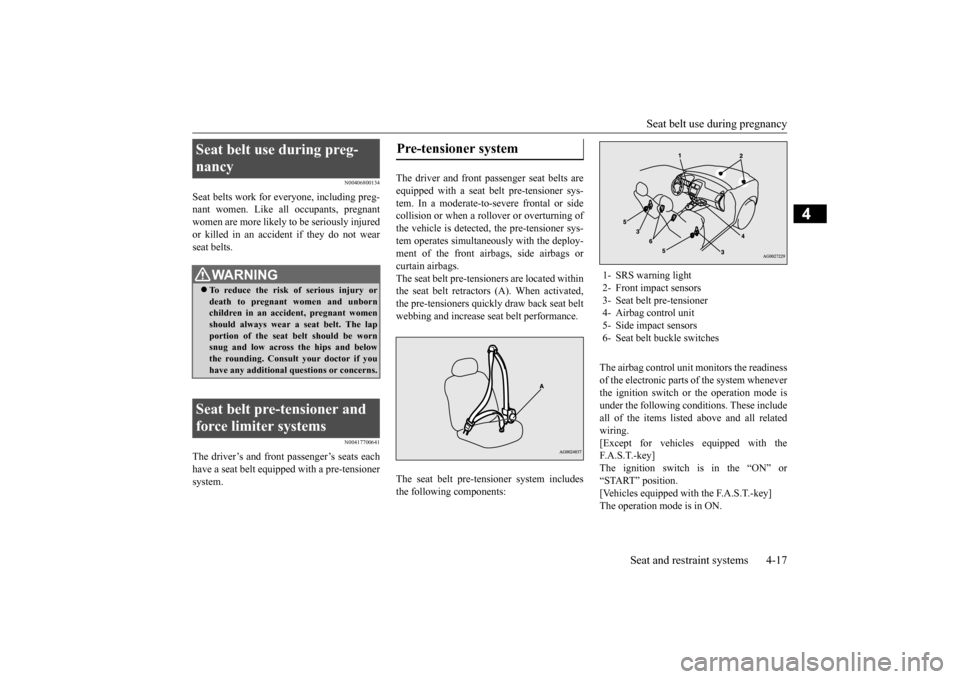
The driver and front passenger seat belts are equipped with a seat belt pre-tensioner sys-tem. In a moderate-to-severe frontal or side collision or when a rollover or overturning of the vehicle is detected, the pre-tensioner sys-tem operates simultaneously with the deploy- ment of the front airbags, side airbags or curtain airbags.The seat belt pre-tensioners are located withinthe seat belt retractors (A). When activated, the pre-tensioners quickly draw back seat belt webbing and increase seat belt performance. The seat belt pre-tensioner system includes the following components:
The airbag control unit monitors the readiness of the electronic parts of the system wheneverthe ignition switch or the operation mode isunder the following conditions. These include all of the items listed above and all related wiring.[Except for vehicles equipped with the F. A . S . T. - k e y ] The ignition switch is in the “ON” or“START” position. [Vehicles equipped with the F.A.S.T.-key] The operation mode is in ON.
Seat belt use during preg- nancy
WA R N I N G To reduce the risk of serious injury or death to pregnant women and unbornchildren in an accident, pregnant women should always wear a seat belt. The lap portion of the seat belt should be wornsnug and low across the hips and below the rounding. Consult your doctor if you have any additional questions or concerns.
Seat belt pre-tensioner and force limiter systems
Pre-tensioner system
1- SRS warning light 2- Front impact sensors3- Seat belt pre-tensioner 4- Airbag control unit 5- Side impact sensors6- Seat belt buckle switches
BK0202700US.bo
ok 17 ページ 2013年3月28日 木曜日 午前11時54分
Page 46 of 384
Maintenance and inspection of seat belts
Seat and restraint systems 4-25
4
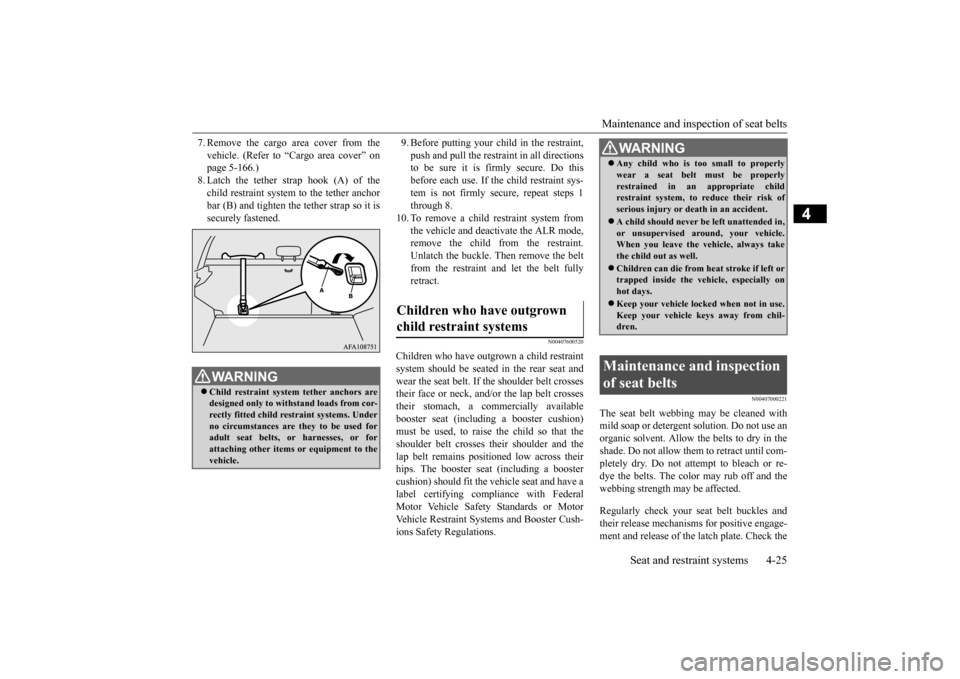
7. Remove the cargo area cover from the vehicle. (Refer to “Cargo area cover” on page 5-166.) 8. Latch the tether strap hook (A) of thechild restraint system to the tether anchor bar (B) and tighten the tether strap so it is securely fastened.
9. Before putting your child in the restraint, push and pull the restraint in all directions to be sure it is firmly secure. Do this before each use. If the child restraint sys-tem is not firmly secure, repeat steps 1 through 8.
10. To remove a child restraint system from
the vehicle and deactivate the ALR mode, remove the child from the restraint. Unlatch the buckle. Then remove the beltfrom the restraint and let the belt fullyretract.
N00407600520
Children who have outgrown a child restraint system should be seated in the rear seat and wear the seat belt. If the shoulder belt crossestheir face or neck, and/or the lap belt crosses their stomach, a commercially available booster seat (including a booster cushion)must be used, to raise the child so that the shoulder belt crosses their shoulder and the lap belt remains positioned low across theirhips. The booster seat (including a booster cushion) should fit the vehicle seat and have a label certifying compliance with FederalMotor Vehicle Safety Standards or Motor Vehicle Restraint Systems and Booster Cush- ions Safety Regulations.
N00407000221
The seat belt webbing may be cleaned withmild soap or detergent solution. Do not use anorganic solvent. Allow the belts to dry in the shade. Do not allow them to retract until com- pletely dry. Do not attempt to bleach or re-dye the belts. The color may rub off and the webbing strength may be affected. Regularly check your seat belt buckles and their release mechanisms for positive engage-ment and release of the latch plate. Check the
WA R N I N G Child restraint system tether anchors are designed only to withstand loads from cor- rectly fitted child restraint systems. Under no circumstances are they to be used foradult seat belts, or harnesses, or for attaching other items or equipment to the vehicle.
Children who have outgrown child restraint systems
WA R N I N G Any child who is too small to properly wear a seat belt must be properly restrained in an appropriate child restraint system, to reduce their risk of serious injury or death in an accident. A child should never be left unattended in, or unsupervised around, your vehicle.When you leave the vehicle, always take the child out as well. Children can die from he
at stroke if left or
trapped inside the vehicle, especially on hot days. Keep your vehicle locked when not in use. Keep your vehicle keys away from chil-dren.
Maintenance and inspection of seat belts
BK0202700US.bo
ok 25 ページ 2013年3月28日 木曜日 午前11時54分
Page 50 of 384
Supplemental Restraint System (SRS) - airbag
Seat and restraint systems 4-29
4
The airbag control unit monitors the readiness of the electronic parts of the system whenever the ignition switch or the operation mode is under the following conditions. These includeall of the items listed above and all relatedwiring. [Except for vehicles equipped with the F. A . S . T. - k e y ] The ignition switch is in the “ON” or “START” position. [Vehicles equipped with the F.A.S.T.-key]The operation mode is in ON. The airbags will operate under the same con- ditions as the airbag control unit.
When the impact sensors detect a sufficient front or side impact to deploy the airbag(s), the appropriate airbag(s) will be deployed. When the airbag control unit detects rollover of the vehicle, curtain airbags will bedeployed. When airbags deploy, some smoke is released accompanied by a loud noise. The smoke is not harmful, but do not intentionally inhalethe smoke as it may cause temporary irrita-tion to people with respiratory problems. An inflated airbag will deflate quickly, so you may not even notice that the airbag was inflated.Airbag inflation does not prevent the driver from seeing or being able to steer the vehicle, and does not prevent people from leaving thevehicle.
N00418600243
This vehicle is equipped with an event datarecorder (EDR).
The main purpose of an EDR is to record, in certain crash or near crash-like situations, such as an airbag deployment or hitting a road obstacle, data that will assist in under-standing how a vehicle’s systems performed. The EDR is designed to record data related to vehicle dynamics and safety systems for ashort period of time, typically 30 seconds or less. The EDR in this vehicle is designed to record such data as: How various systems in your vehicle were operating; Whether or not the driver and passenger safety belts were buckled/fastened; How far (if at all) the driver was depress- ing the accelerator and/or brake pedal; and, How fast the vehicle was traveling.
These data can help provide a better under- standing of the circumstances in which crashes and injuries occur.
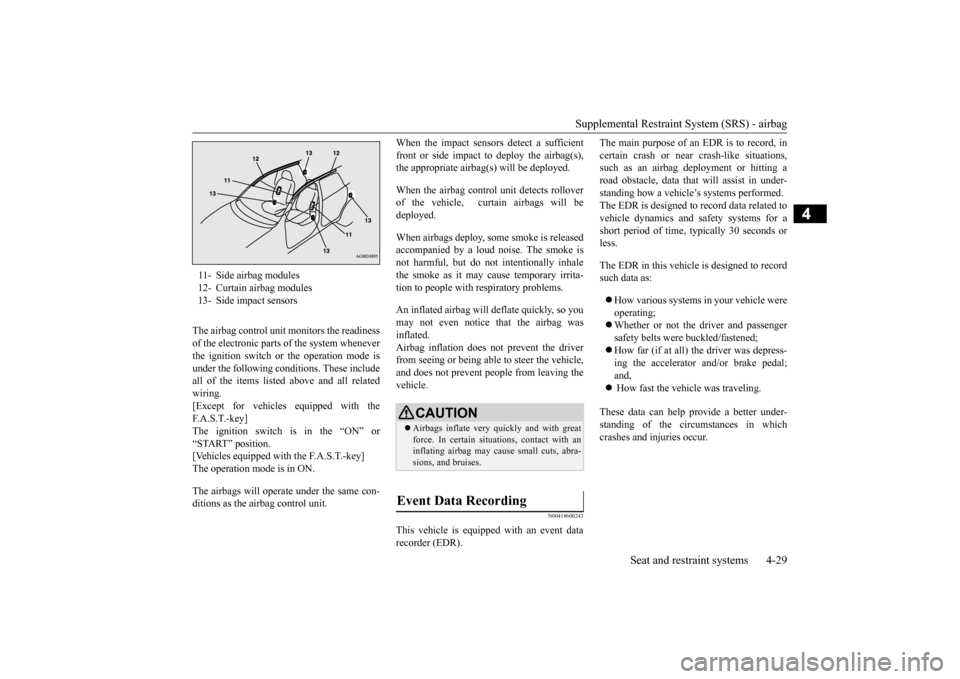
11- Side airbag modules 12- Curtain airbag modules13- Side impact sensors
CAUTION Airbags inflate very quickly and with great force. In certain situations, contact with an inflating airbag may cause small cuts, abra- sions, and bruises.
Event Data Recording
BK0202700US.bo
ok 29 ページ 2013年3月28日 木曜日 午前11時54分
Page 51 of 384
Supplemental Restraint System (SRS) - airbag 4-30 Seat and restraint systems
4
To read data recorded by an EDR, special equipment is required, and access to the vehi- cle or the EDR is needed. In addition to the vehicle manufacturer, other parties, such aslaw enforcement, that have the special equip- ment, can read the information if they have access to the vehicle or the EDR.
N00417900177
The driver’s seat position sensor is attachedto the seat rail and provides the airbag controlunit with information on the seat’s fore-aft position. The airbag control unit controls deployment of the driver’s front airbag inaccordance with the information it receives from this sensor. If there is a problem involving the driver’sseat position sensor, the SRS warning light in the instrument panel will come on. Refer to
“SRS warning light/display” on page 4-32.
N00418000322
The passenger’s seat weight sensors are attached to the seat rails and provide the air- bag control unit with information regarding the weight on the front passenger seat. Theairbag control unit controls deployment of the passenger’s front airbag in accordance with the information it receives from this sensor.
The passenger’s front airbag will not deploy in an impact when the weight on the seat is sensed to be less than approximately 66 pounds (30 kg). In this case, the passengerairbag off indicator will come on. Refer to “Passenger’s airbag off indicator” on page 4-31.If there is a problem involving the passenger seat weight sensors, the SRS warning light in the instrument panel will come on. Refer to“SRS warning light/display” on page 4-32.
NOTE
EDR data are recorded by your vehicle only if a non-trivial crash situation occurs; no data are recorded by the EDR under normal driv- ing conditions and no personal data (e.g., name, gender, age, and crash location) arerecorded. However, other parties, such as law enforcement, could combine the EDR data with the type of personally identifyingdata routinely acquired during a crash inves- tigation.
Driver’s seat position sensor
WA R N I N G If the SRS warning light or warning dis- play comes on, have the vehicle inspectedby an authorized Mitsubishi Motors dealer as soon as possible. Please observe the following instructions to ensure that the driver’s seat position sensor can operate correctly.• Adjust the seat to the correct position,and sit well back against the seatback.Refer to “Front seats” on page 4-3.• Do not recline the seatback more thannecessary when driving.• Do not place metallic objects or luggageunder the front seat.
If the vehicle is involved in a severe impact, have the SRS sensors inspected by an authorized Mitsubishi Motors dealer as soon as possible.
Passenger’s seat weight sensors
WA R N I N G If any of the following conditions occur, you should have your vehicle inspected by an authorized Mitsubishi Motors dealer assoon as possible:• The SRS warning light does not initiallycome on when the ignition switch or the operation mode is under the following conditions.• [Except for vehicles equipped with theF. A . S . T. - k e y ]The ignition switch is in the “ON” or “START” position. [Vehicles equipped with the F.A.S.T.-key] The operation mode is in ON.• The SRS warning light does not go outafter several seconds.• The SRS warning light comes on whileyou are driving.
BK0202700US.bo
ok 30 ページ 2013年3月28日 木曜日 午前11時54分
Page 57 of 384
Supplemental Restraint System (SRS) - airbag 4-36 Seat and restraint systems
4
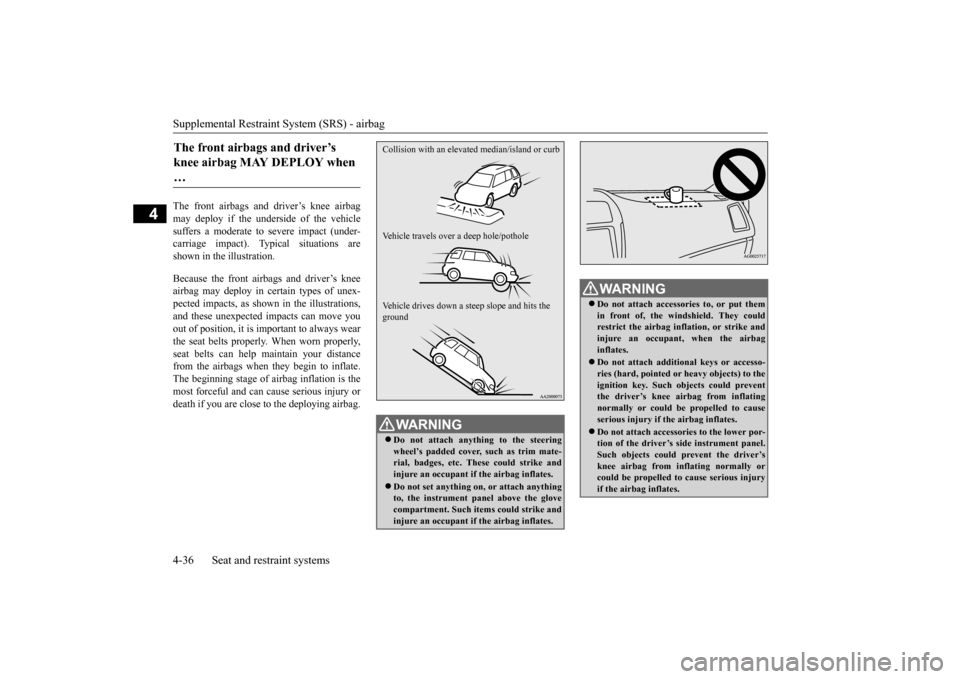
The front airbags and driver’s knee airbag may deploy if the underside of the vehicle suffers a moderate to severe impact (under- carriage impact). Typical situations areshown in the illustration. Because the front airbags and driver’s knee airbag may deploy in certain types of unex- pected impacts, as shown in the illustrations, and these unexpected impacts can move youout of position, it is important to always wear the seat belts properly. When worn properly, seat belts can help maintain your distancefrom the airbags when they begin to inflate. The beginning stage of airbag inflation is the most forceful and can cause serious injury ordeath if you are close to the deploying airbag.The front airbags and driver’s knee airbag MAY DEPLOY when …
WA R N I N G Do not attach anything to the steering wheel’s padded cover, such as trim mate- rial, badges, etc. These could strike and injure an occupant if the airbag inflates. Do not set anything on, or attach anything to, the instrument panel above the glovecompartment. Such items could strike and injure an occupant if the airbag inflates.Collision with an elevat
ed median/island or curb
Vehicle travels over a deep hole/pothole Vehicle drives down a st
eep slope and hits the
ground
WA R N I N G Do not attach accessories to, or put them in front of, the windshield. They could restrict the airbag inflation, or strike andinjure an occupant, when the airbag inflates. Do not attach additional keys or accesso- ries (hard, pointed or heavy objects) to the ignition key. Such objects could preventthe driver’s knee airbag from inflating normally or could be propelled to cause serious injury if the airbag inflates. Do not attach accessories to the lower por- tion of the driver’s side instrument panel.Such objects could prevent the driver’s knee airbag from inflating normally or could be propelled to cause serious injuryif the airbag inflates.
BK0202700US.bo
ok 36 ページ 2013年3月28日 木曜日 午前11時54分
Page 64 of 384
5
Features and controlsBreak-in recommendation
s ...............................................................5-3
Keys .....................................................
.............................................5-3
Electronic immobilizer (Anti-theft starting system) .........................5-4 Keyless entry system (if so equipped) ..............................................5-7Free-hand Advanced Security Tran
smitter (F.A.S.T.-key) (if so
equipped)................................
..................................................... 5-11
Door locks........................
...............................................................5-28
Power door locks .............
...............................................................5-30
Child safety locks for r
ear door ....................
..................................5-31
Liftgate.......................................
.....................................................5-32
Inside liftgate releas
e ..............................................
........................5-33
Theft-alarm system ..........
...............................................................5-33
Power window control
............................................
........................5-36
Sunshade (if so equi
pped)..............................................................5-39
Parking brake ...................
...............................................................5-40
Steering wheel height and reach adjustment...................................5-41Inside rearview mirro
r ............................................
........................5-41
Outside rearview mirr
ors ................................................................5-43
Ignition switch .................
...............................................................5-44
Starting the engine .
.................................................
........................5-45
Manual transaxle (if so equipped) .................................................5-47 Continuously variable transmission
(CVT) (if so equipped).........5-49
Electronically controlled 4WD system (if so equipped)................5-554-wheel drive operation
..........................................
........................5-58
Inspection and maintenance following rough road operation.........5-60 Cautions on the handling of 4-wheel drive vehicles.......................5-60Service brake ...................
...............................................................5-61
Hill start assist........
.................................................
........................5-62
Brake assist system
................................................
......................... 5-64
Anti-lock braking syst
em ......................................
......................... 5-64
Electric power steering syst
em (EPS) ........................................... 5-66
Active stability control
(ASC) .....................
................................... 5-67
Cruise control (if so eq
uipped) ....................................................... 5-70
Tire pressure monitoring
system .................................................... 5-75
Rear-view camera (if so
equipped)..............
................................... 5-79
Instrument cluster .
.................................................
......................... 5-81
Multi-information disp
lay .....................................
......................... 5-82
Indicator light, warning light, and information screen display list
.................................................................
................................. 5-104
Indicators ..................................
.................................................... 5-116
Warning lights...........................
.................................................... 5-117
Information screen disp
lay .......................................................... 5-118
Combination headlights and dimmer switch ............................... 5-120 Headlight leveling switch (if so equipped).................................. 5-125Turn signal lever ...
.................................................
....................... 5-126
Hazard warning flasher
switch ..................................................... 5-127
Front fog light switch (if
so equipped) ........................................ 5-127
Wiper and washer swit
ch ......................................
....................... 5-127
Electric rear window def
ogger switch .......................................... 5-132
Horn switch ..............................
.................................................... 5-133
Link System (if so equi
pped) .....................
................................. 5-133
Bluetooth
® 2.0 interface (if so
equipped)..................................... 5-134
USB input terminal (if so
equipped) ........................................... 5-155
Sun visors .................................
.................................................... 5-158
12 V power outlets..........
.................................................
............. 5-159
Interior lights ..................
.................................................
............. 5-159
BK0202700US.bo
ok 1 ページ 2013年3月28日 木曜日 午前11時54分
Page 66 of 384
Break-in recommendations
Features and controls 5-3
5
N00508700330
Advanced automobile manufacturing tech- niques permit you to operate your new vehi-cle without requiring a long break-in period of low-speed driving. However, you can add to the future perfor-mance and economy of your vehicle by observing the following precautions during the first 300 miles (500 km).Drive your vehicle at moderate speeds duringthe break-in period. Avoid revving the engine. Avoid rough driving such as sudden starts, sudden acceleration, prolonged high-speed driving and sudden braking. These would have a detrimental effect on the engine and also cause increased fuel andoil consumption, which could result in malfunction of the engine components. Be particularly careful to avoid full accelera-tion while in low shift position (low gears). Do not overload the vehicle. Stay within the seating capacity. (Refer to “Cargo load precautions” on page 6-11.) Do not use this vehicle for trailer towing.
N00508800562
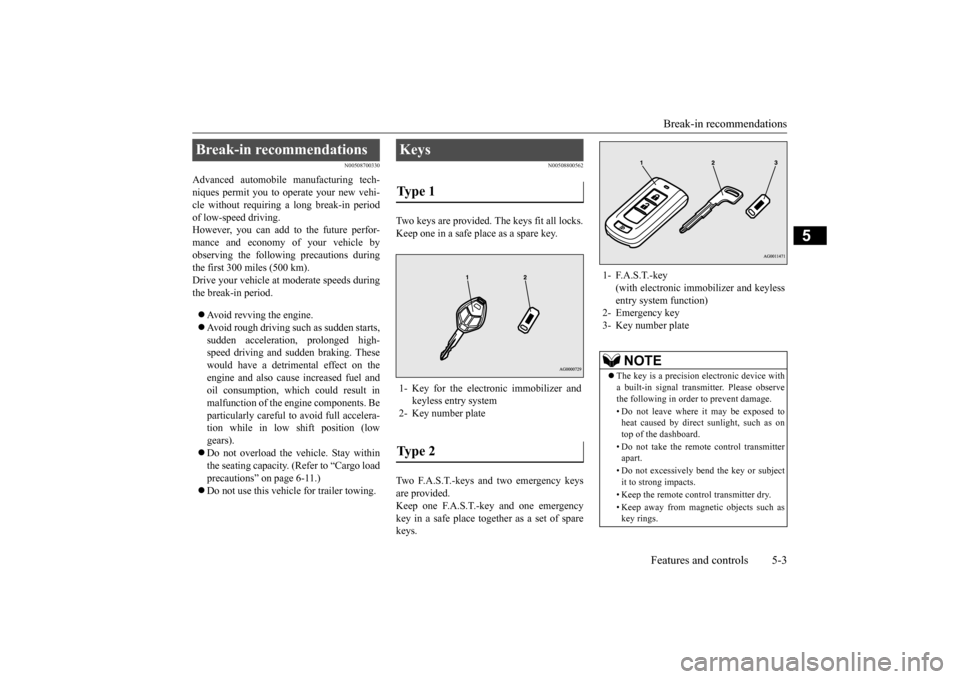
Two keys are provided. The keys fit all locks. Keep one in a safe place as a spare key. Two F.A.S.T.-keys and two emergency keys are provided. Keep one F.A.S.T.-key and one emergencykey in a safe place together as a set of spare keys.
Break-in recommendations
Keys Type 1 1- Key for the electronic immobilizer and
keyless entry system
2- Key number plateType 2
1- F.A.S.T.-key
(with electronic immob
ilizer and keyless
entry system function)
2- Emergency key 3- Key number plate
NOTE
The key is a precision electronic device with a built-in signal transmitter. Please observe the following in order to prevent damage. • Do not leave where it may be exposed to heat caused by direct sunlight, such as ontop of the dashboard. • Do not take the remote control transmitter apart. • Do not excessively bend the key or subject it to strong impacts. • Keep the remote control transmitter dry.• Keep away from magnetic objects such as key rings.
BK0202700US.bo
ok 3 ページ 2013年3月28日 木曜日 午前11時54分