remove seats MITSUBISHI OUTLANDER SPORT 2014 3.G Owners Manual
[x] Cancel search | Manufacturer: MITSUBISHI, Model Year: 2014, Model line: OUTLANDER SPORT, Model: MITSUBISHI OUTLANDER SPORT 2014 3.GPages: 384, PDF Size: 46.94 MB
Page 37 of 384
Seat belts 4-16 Seat and restraint systems
4
N00418300194
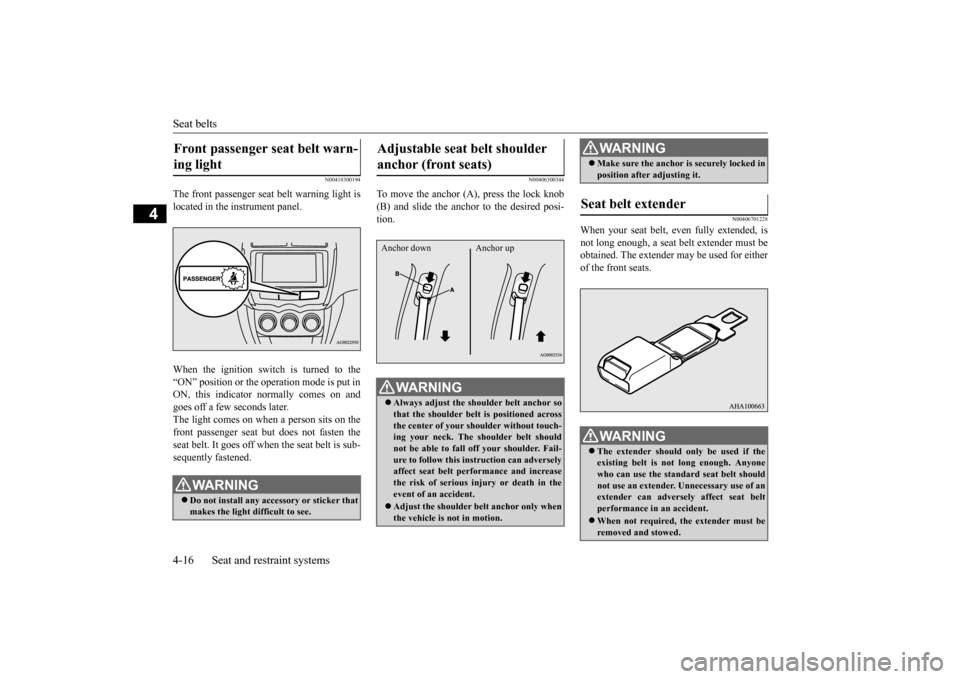
The front passenger seat belt warning light is located in the instrument panel. When the ignition switch is turned to the “ON” position or the operation mode is put inON, this indicator normally comes on andgoes off a few seconds later. The light comes on when a person sits on the front passenger seat but does not fasten theseat belt. It goes off when the seat belt is sub- sequently fastened.
N00406300344
To move the anchor (A), press the lock knob (B) and slide the anchor to the desired posi- tion.
N00406701228
When your seat belt, even fully extended, is not long enough, a seat belt extender must be obtained. The extender may be used for either of the front seats.
Front passenger seat belt warn- ing light
WA R N I N G Do not install any accessory or sticker that makes the light difficult to see.
Adjustable seat belt shoulder anchor (front seats)
WA R N I N G Always adjust the shoulder belt anchor so that the shoulder belt is positioned acrossthe center of your shoulder without touch- ing your neck. The shoulder belt should not be able to fall off your shoulder. Fail-ure to follow this instruction can adversely affect seat belt performance and increase the risk of serious injury or death in theevent of an accident. Adjust the shoulder belt anchor only when the vehicle is not in motion.
Anchor down Anchor up
Make sure the anchor is securely locked in position after adjusting it.
Seat belt extender
WA R N I N G The extender should only be used if the existing belt is not long enough. Anyone who can use the standard seat belt shouldnot use an extender. Unnecessary use of an extender can adversely affect seat belt performance in an accident. When not required, the extender must be removed and stowed.WA R N I N G
BK0202700US.bo
ok 16 ページ 2013年3月28日 木曜日 午前11時54分
Page 42 of 384
Child restraint systems
Seat and restraint systems 4-21
4
N00418800128
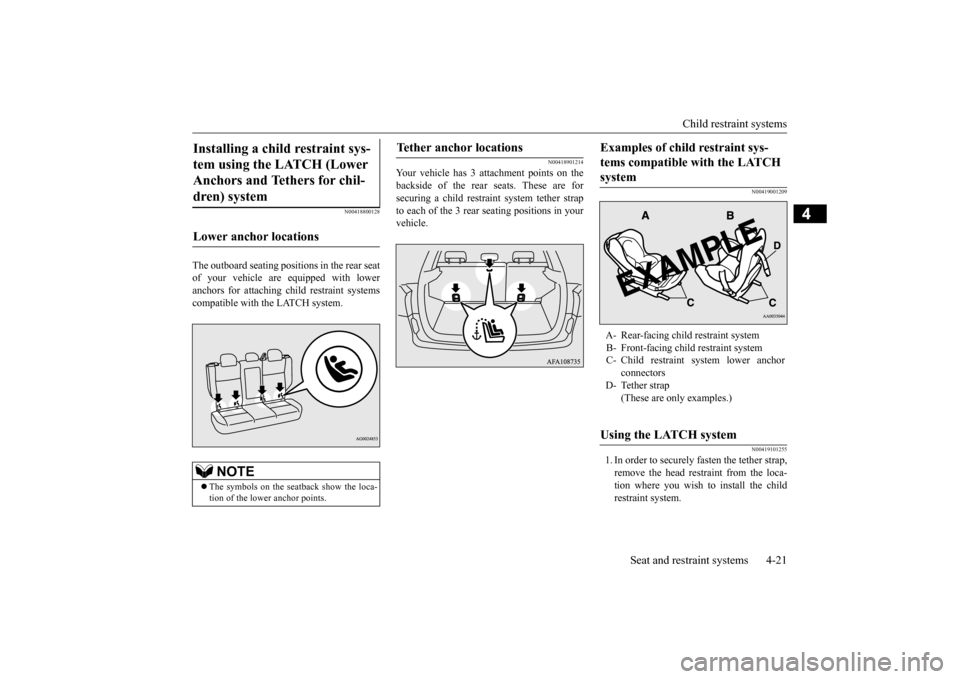
The outboard seating positions in the rear seat of your vehicle are equipped with loweranchors for attaching child restraint systemscompatible with the LATCH system.
N00418901214
Your vehicle has 3 attachment points on thebackside of the rear
seats. These are for
securing a child restraint system tether strap to each of the 3 rear seating positions in your vehicle.
N00419001209 N00419101255
1. In order to securely fasten the tether strap, remove the head restraint from the loca- tion where you wish to install the childrestraint system.
Installing a child restraint sys- tem using the LATCH (Lower Anchors and Tethers for chil- dren) system Lower anchor locations
NOTE
The symbols on the seatback show the loca- tion of the lower anchor points.
Tether anchor locations
Examples of child restraint sys- tems compatible with the LATCH system A- Rear-facing child restraint system B- Front-facing child restraint systemC- Child restraint system lower anchor
connectors
D- Tether strap
(These are only examples.)
Using the LATCH system
BK0202700US.bo
ok 21 ページ 2013年3月28日 木曜日 午前11時54分
Page 43 of 384
Child restraint systems 4-22 Seat and restraint systems
4
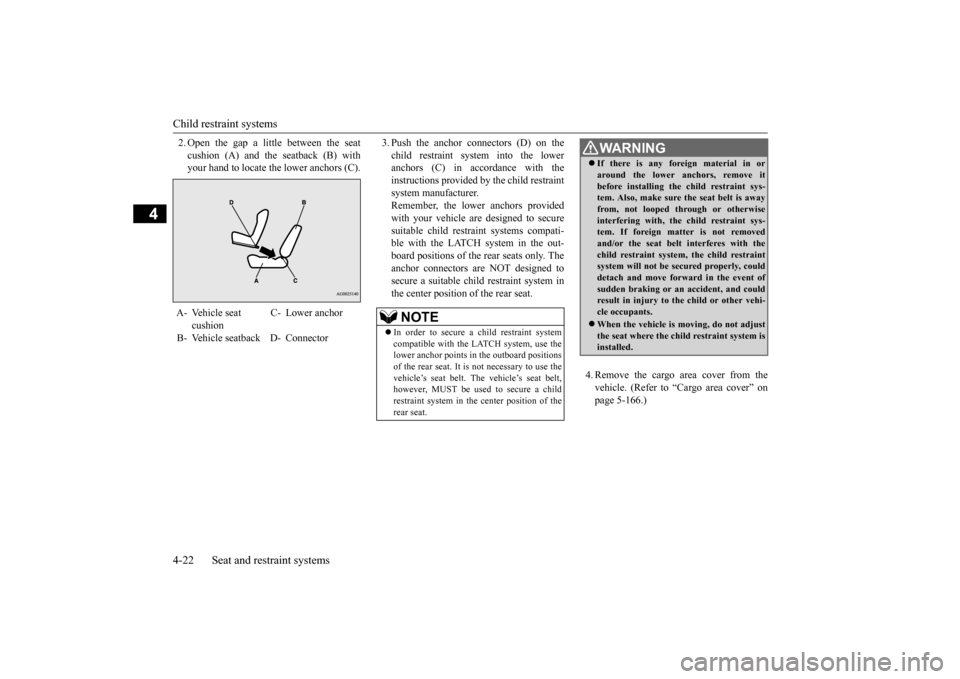
2. Open the gap a little between the seat cushion (A) and the seatback (B) with your hand to locate the lower anchors (C).
3. Push the anchor connectors (D) on the child restraint system into the lower anchors (C) in accordance with the instructions provided by the child restraintsystem manufacturer. Remember, the lower anchors provided with your vehicle are designed to securesuitable child restraint systems compati- ble with the LATCH system in the out- board positions of the rear seats only. Theanchor connectors are NOT designed tosecure a suitable child restraint system in the center position of the rear seat.
4. Remove the cargo area cover from the vehicle. (Refer to “Cargo area cover” on page 5-166.)
A- Vehicle seat
cushion
C- Lower anchor
B- Vehicle seatback D- Connector
NOTE
In order to secure a child restraint system compatible with the LATCH system, use the lower anchor points in the outboard positions of the rear seat. It is not necessary to use thevehicle’s seat belt. The vehicle’s seat belt, however, MUST be used to secure a child restraint system in the center position of therear seat.
WA R N I N G If there is any foreign material in or around the lower anchors, remove it before installing the child restraint sys- tem. Also, make sure the seat belt is away from, not looped through or otherwiseinterfering with, the child restraint sys- tem. If foreign matter is not removed and/or the seat belt interferes with thechild restraint system, the child restraint system will not be secured properly, could detach and move forward in the event ofsudden braking or an accident, and could result in injury to the child or other vehi- cle occupants. When the vehicle is moving, do not adjust the seat where the child restraint system isinstalled.
BK0202700US.bo
ok 22 ページ 2013年3月28日 木曜日 午前11時54分
Page 52 of 384
Supplemental Restraint System (SRS) - airbag
Seat and restraint systems 4-31
4
N00418100280
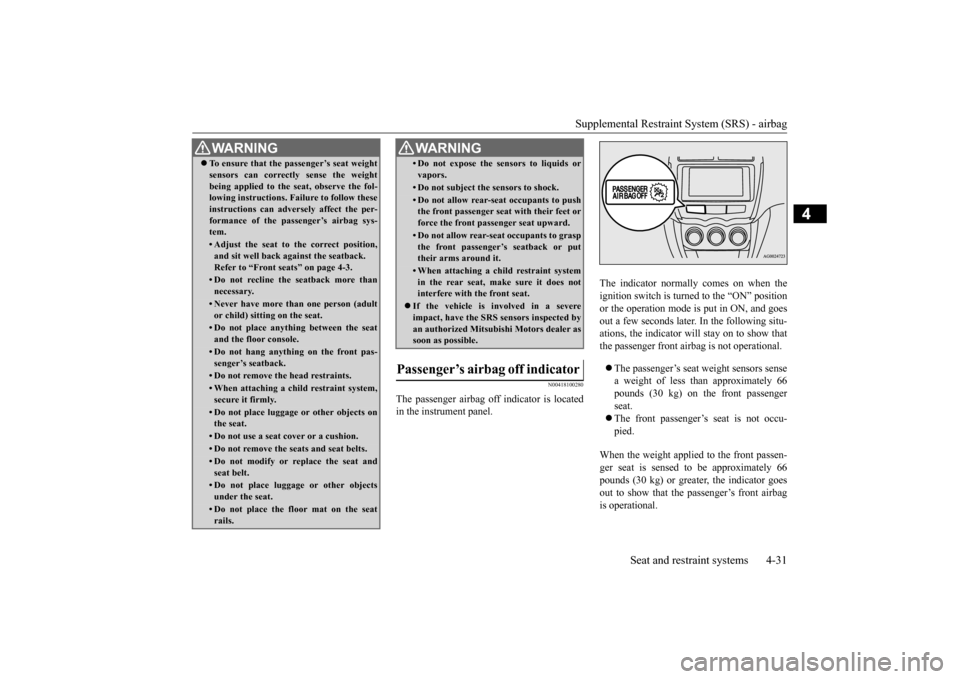
The passenger airbag off indicator is located in the instrument panel.
The indicator normally comes on when the ignition switch is turned to the “ON” position or the operation mode is put in ON, and goesout a few seconds later. In the following situ- ations, the indicator will stay on to show that the passenger front airbag is not operational. The passenger’s seat weight sensors sense a weight of less than approximately 66pounds (30 kg) on the front passenger seat. The front passenger’s seat is not occu- pied.
When the weight applied to the front passen- ger seat is sensed to be approximately 66 pounds (30 kg) or greater, the indicator goesout to show that the passenger’s front airbag is operational.
To ensure that the passenger’s seat weight sensors can correctly sense the weight being applied to the seat, observe the fol- lowing instructions. Failure to follow these instructions can adversely affect the per-formance of the passenger’s airbag sys- tem.• Adjust the seat to the correct position,and sit well back against the seatback. Refer to “Front seats” on page 4-3.• Do not recline the seatback more thannecessary.• Never have more than one person (adultor child) sitting on the seat.• Do not place anything between the seatand the floor console.• Do not hang anything on the front pas-senger’s seatback.• Do not remove the head restraints.• When attaching a child restraint system, secure it firmly.• Do not place luggage or other objects onthe seat.• Do not use a seat cover or a cushion.• Do not remove the seats and seat belts.• Do not modify or replace the seat and seat belt.• Do not place luggage or other objectsunder the seat.• Do not place the floor mat on the seatrails.WA R N I N G
• Do not expose the sensors to liquids or vapors.• Do not subject the sensors to shock.• Do not allow rear-seat occupants to pushthe front passenger seat with their feet or force the front passenger seat upward.• Do not allow rear-seat occupants to graspthe front passenger’s seatback or puttheir arms around it.• When attaching a child restraint systemin the rear seat, make sure it does not interfere with the front seat.
If the vehicle is involved in a severe impact, have the SRS sensors inspected by an authorized Mitsubishi Motors dealer assoon as possible.
Passenger’s airbag off indicator
WA R N I N G
BK0202700US.bo
ok 31 ページ 2013年3月28日 木曜日 午前11時54分
Page 62 of 384
Supplemental Restraint System (SRS) - airbag
Seat and restraint systems 4-41
4
N00408500698
SRS servicing
WA R N I N G Any maintenance performed on or near the components of the SRS should be per- formed only by an authorized Mitsubishi Motors dealer. Do not permit anyone elseto do any service, inspection, maintenance or repair on any SRS components or wir- ing. Similarly, no part of the SRS shouldever be handled, removed or disposed by anyone except an authorized Mitsubishi Motors dealer.Improper work methods on the SRS com- ponents or wiring could result in an acci- dental airbag deployment or could makethe SRS inoperable. Either of these situa- tions could result in serious injury or death. Do not modify your steering wheel or any other SRS component or related vehiclepart. For example, replacement of the steering wheel, or modifications to the front bumper or body structure canadversely affect SRS performance and may lead to injury. If your vehicle has received any damage, you should have the SRS inspected by an authorized Mitsubishi Motors dealer to make sure it is in proper working order.
Do not modify your front seats, center pil- lar or center console. Such modifications can adversely affect SRS performance and may lead to injury. Also, if you discover any tear or openseam in the seat fabric near the side air- bag, have the seat inspected by an autho- rized Mitsubishi Motors dealer. If you have found any scratch, crack or damage to the portion of the front andrear pillars and roof side rail, you should have the SRS inspected by an authorized Mitsubishi Motors dealer.NOTE
When you transfer ownership of the vehicle to another person, we urge you to alert the new owner that it is equipped with the SRS and refer that owner to the applicable sec-tions in this owner’s manual. If you decide to junk or scrap your vehicle, we urge you to first take
it to an authorized
Mitsubishi Motors dealer so that the SRS can be made safe for disposal. If any of the following parts needs to be modified for use by a handicapped person, the advanced airbag system will be greatly affected. Please consult an authorizedMitsubishi Motors dealer. • Driver’s seat• Front passenger seat • Front seat beltWA R N I N G
• Steering wheel • Instrument panel[For vehicles sold in U.S.A.] To contact Mitsubishi Motors North America, Inc. call 1-888-648-7820 or write to:Mitsubishi Motors North America, Inc. Customer Relations Department P.O. Box 6400Cypress, CA 90630-0064 [For vehicles sold in Canada] To contact Mitsubishi Motor Sales of Canada, Inc. call 1-888-576-4878 or write to:Mitsubishi Motor Sales of Canada, Inc. Customer Relations Department P.O. Box 410094141 Dixie Road Mississauga, ON L4W 5C9 [For vehicles sold in Puerto Rico] To contact Mitsubishi Motor Sales ofCaribbean, Inc. call 1-787-251-8715 or write to: Mitsubishi Motor Sales of Caribbean,Inc. Customer Service Department P.O. Box 192216SAN JUAN PR 00919-2216NOTE
BK0202700US.bo
ok 41 ページ 2013年3月28日 木曜日 午前11時54分
Page 238 of 384
Loading information Driving safety 6-7
6
More effort could be required to turn the steering wheel.Refer to “Electric power steering system (EPS)” on page 5-66. Always remove the key from the ignition switch and lock all doors and the liftgate when leaving the vehicle unattended.Always try to park your vehicle in a well lit area.
N00629900408
It is very importan
t to know how much
weight your vehicle can carry. This weight is called the vehicle capacity weight andincludes the weight of all occupants, cargo (including the roof load), non-factory-
installed options, if any, being towed. The tire and loading information placard located on the driver’s door sill of your vehicle will show how much weight it may properly carry. It is important to fami
liarize yourself with the
following terms before loading your vehicle: Vehicle maximum load on the tire: load on an individual tire that is determined by distributing to each axle its share of the maximum loaded vehicle weight anddividing by two. Vehicle normal load on the tire: load on an individual tire that is determined bydistributing to each axle its share of the curb weight, accessory weight, and nor- mal occupant weight and dividing by two. Maximum loaded vehicle weight: the sum of - (a) Curb weight;(b) Accessory weight; (c) Vehicle capacity weight; and (d) Production options weight.
Curb weight: the weight of a motor vehi- cle with standard equipment including the maximum capacity of fuel, oil, and cool- ant. Accessory weight: the combined weight (in excess of those standard items which may be replaced) of automatic transmis-sion, power steering, power brakes, power windows, power seats, radio, and heater, to the extent that these items are availableas factory- installed equipment (whetherinstalled or not). Vehicle capacity weight: the rated cargo and luggage load plus 150 lbs (68 kg)
*
times the vehicle’s designated seating capacity. Production options weight: the combined weight of those installed regular produc- tion options weighing over 5 lbs (2.3 kg) in excess of those standard items whichthey replace, not previously considered in curb weight or accessory weight, includ- ing heavy duty brakes, ride levelers, roofrack, heavy duty battery, and special trim. Normal occupant weight: 150 lbs (68 kg)
* times the number of specified
occupants. (In your vehicle the number is 3)
WA R N I N G Do not park your vehicle in areas where combustible materials such as dry grass or leaves can come in contact with a hot exhaust, since a fire could occur.
Do not keep the steering wheel fully turned for a long time When leaving the vehicle Loading information
WA R N I N G Never overload your vehicle. Overloading can damage your vehicle, adversely affectvehicle performance, including handling and braking, cause tire failure, and result in an accident.
BK0202700US.bo
ok 7 ページ 2013年3月28日 木曜日 午前11時54分
Page 360 of 384
Cleaning the inside of your vehicle
Vehicle care and maintenance 9-39
9
These can all be dangerous, and they all can damage your vehicle.
N00945200095
After washing the inside of your vehicle withany cleaner, wipe it dry in a shady, well venti-lated area.
N00945300142
1. Lightly wipe these off with a soft clothsoaked in a 3% solution of gentle soap and water. 2. To rinse, dip the cloth in fresh water,wring it out well, and wipe off all the soap.
N00945500128
1. To maintain the value of your new vehi- cle, maintain the upholstery carefully andkeep the interior clean. Use a vacuum cleaner and brush to clean the seats. If stained, vinyl and syntheticleather should be cleaned with an appro- priate cleaner. Cloth fabrics can be cleaned with either upholstery cleaner or a3% solution of gentle soap in lukewarmwater. 2. Clean the carpeting with a vacuum cleaner and remove any stains with carpetcleaner. Oil and grease can be removed by lightly dabbing with a clean white cloth and spot remover.
N00945600187
1. To clean, lightly wipe the leather with asoft cloth soaked in a 5% solution of gen- tle soap and water.
• Nail Polish Remover
Cleaning the inside of your vehicle
CAUTION Do not use organic substances (solvents, benzine, kerosene, alcohol, gasoline, etc.) or alkaline or acidic solutions. These chemicals can cause discoloring,staining or cracking of the surface. If you use cleaners or polishing agents, make sure their ingredients do not include the sub-stances mentioned above.NOTE
Always read the instructions on the cleaner label.CAUTION
Plastic, vinyl leather, fabric and flocked parts
NOTE
Do not use cleaners, conditioners, and pro- tectants containing silicones or wax. Such products, when applied to the instru- ment panels or other parts, may cause reflec-tions on the windshield and obscure vision. Also, if such products get on the switches of the electrical accessories, it may lead to fail-ure of these accessories.
Upholstery
NOTE
If fuzzing is difficult to remove from the seat upholstery, draw a suitable defuzzing brush over the surface in one direction.
Genuine leather
(if so equipped)
BK0202700US.bo
ok 39 ページ 2013年3月28日 木曜日 午前11時54分