load MITSUBISHI OUTLANDER SPORT 2015 3.G Owners Manual
[x] Cancel search | Manufacturer: MITSUBISHI, Model Year: 2015, Model line: OUTLANDER SPORT, Model: MITSUBISHI OUTLANDER SPORT 2015 3.GPages: 384, PDF Size: 61.37 MB
Page 25 of 384
Front seats 4-4 Seat and restraint systems
4
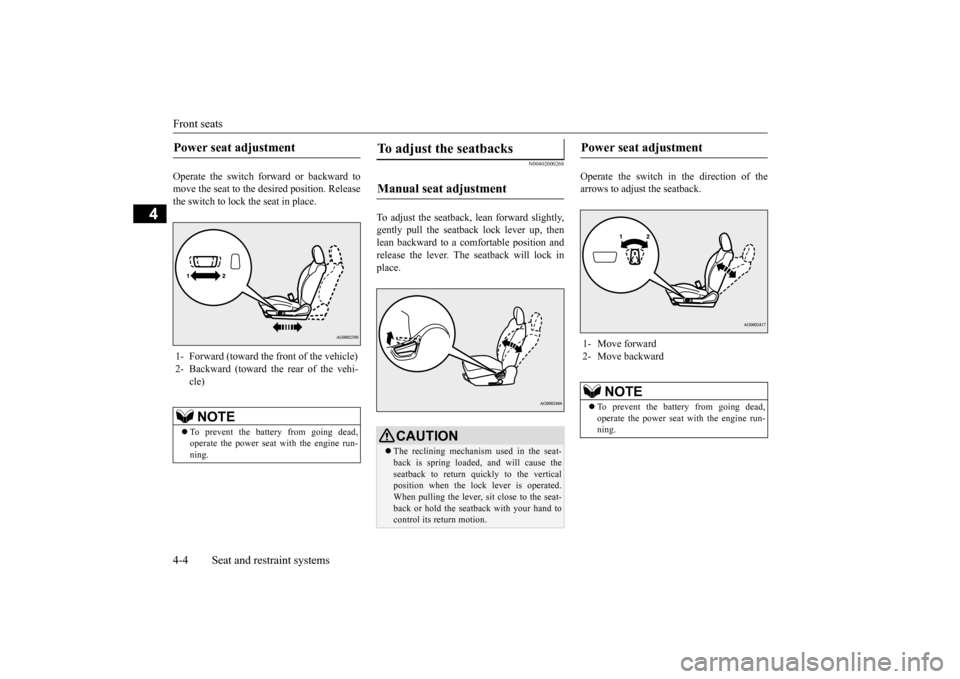
Operate the switch forward or backward to move the seat to the desired position. Releasethe switch to lock the seat in place.
N00402000268
To adjust the seatback,
lean forward slightly,
gently pull the seatb
ack lock lever up, then
lean backward to a comfortable position and release the lever. The seatback will lock in place.
Operate the switch in the direction of the arrows to adjust the seatback.
Power seat adjustment 1- Forward (toward the front of the vehicle)2- Backward (toward the rear of the vehi-
cle)NOTE
To prevent the battery from going dead, operate the power seat with the engine run-ning.
To adjust the seatbacks Manual seat adjustment
CAUTION The reclining mechanism used in the seat- back is spring loaded, and will cause the seatback to return quickly to the verticalposition when the lock lever is operated. When pulling the lever, sit close to the seat- back or hold the seatback with your hand tocontrol its return motion.
Power seat adjustment 1- Move forward 2- Move backward
NOTE
To prevent the battery from going dead, operate the power seat with the engine run- ning.
BK0206700US.bo
ok 4 ページ 2014年3月25日 火曜日 午後4時42分
Page 30 of 384
Extending a luggage compartment Seat and restraint systems 4-9
4
N00405500105
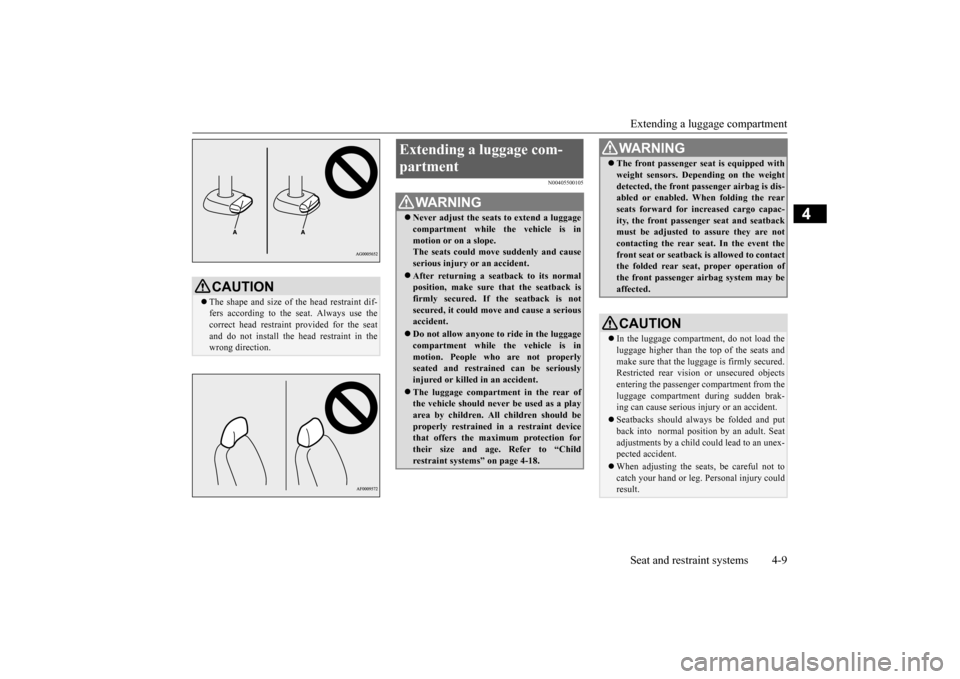
CAUTION The shape and size of the head restraint dif- fers according to the seat. Always use thecorrect head restraint provided for the seat and do not install the head restraint in the wrong direction.
Extending a luggage com- partment
WA R N I N G Never adjust the seats to extend a luggage compartment while the vehicle is in motion or on a slope. The seats could move suddenly and causeserious injury or an accident. After returning a seatback to its normal position, make sure that the seatback is firmly secured. If the seatback is not secured, it could move and cause a seriousaccident. Do not allow anyone to
ride in the luggage
compartment while the vehicle is in motion. People who are not properly seated and restrained can be seriouslyinjured or killed in an accident. The luggage compartment in the rear of the vehicle should never be used as a play area by children. All children should be properly restrained in a restraint devicethat offers the maximum protection for their size and age. Refer to “Child restraint systems” on page 4-18.
The front passenger seat is equipped with weight sensors. Depending on the weight detected, the front passenger airbag is dis- abled or enabled. When folding the rear seats forward for increased cargo capac-ity, the front passenger seat and seatback must be adjusted to assure they are not contacting the rear seat. In the event thefront seat or seatback is allowed to contact the folded rear seat, proper operation of the front passenger airbag system may beaffected.CAUTION In the luggage compartment, do not load the luggage higher than the top of the seats and make sure that the luggage is firmly secured.Restricted rear vision or unsecured objects entering the passenger compartment from the luggage compartment during sudden brak-ing can cause serious injury or an accident. Seatbacks should always be folded and put back into normal position by an adult. Seat adjustments by a child could lead to an unex- pected accident. When adjusting the seats, be careful not to catch your hand or leg. Personal injury could result.WA R N I N G
BK0206700US.bo
ok 9 ページ 2014年3月25日 火曜日 午後4時42分
Page 44 of 384
Child restraint systems
Seat and restraint systems 4-23
4
4. Remove the cargo area cover from the vehicle. (Refer to “Cargo area cover” on page 5-168.)
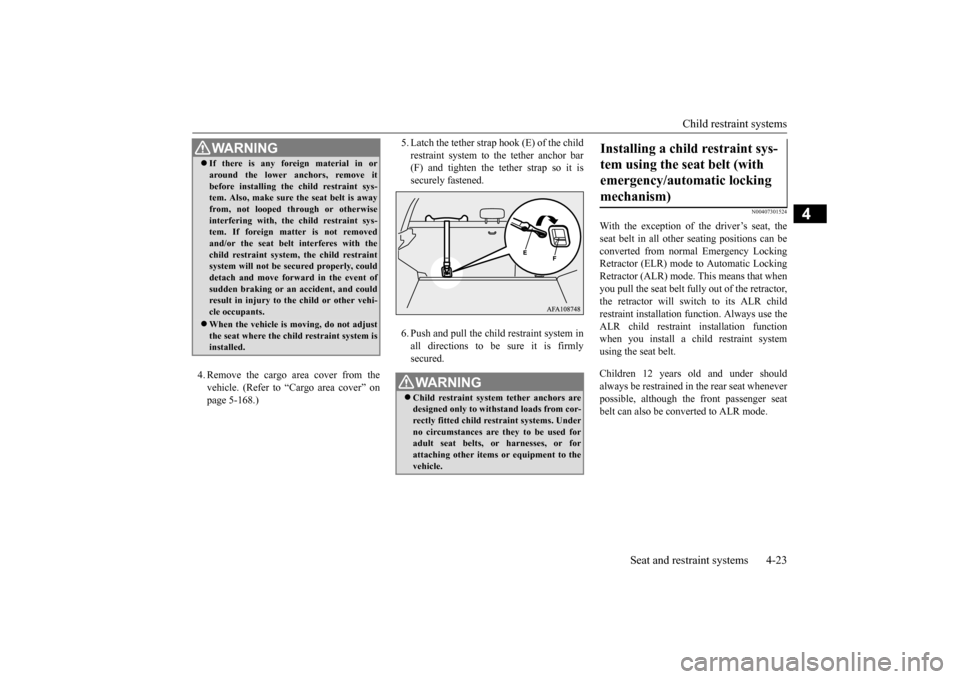
5. Latch the tether strap hook (E) of the child restraint system to the tether anchor bar (F) and tighten the tether strap so it is securely fastened. 6. Push and pull the ch
ild restraint system in
all directions to be sure it is firmlysecured.
N00407301524
With the exception of the driver’s seat, theseat belt in all other seating positions can beconverted from normal Emergency Locking Retractor (ELR) mode to Automatic Locking Retractor (ALR) mode. This means that whenyou pull the seat belt fully out of the retractor,the retractor will switch to its ALR child restraint installation function. Always use the ALR child restraint installation functionwhen you install a child restraint system using the seat belt. Children 12 years old and under should always be restrained in the rear seat wheneverpossible, although the front passenger seat belt can also be converted to ALR mode.
WA R N I N G If there is any foreign material in or around the lower anchors, remove it before installing the child restraint sys- tem. Also, make sure the seat belt is away from, not looped through or otherwiseinterfering with, the child restraint sys- tem. If foreign matter is not removed and/or the seat belt interferes with thechild restraint system, the child restraint system will not be secured properly, could detach and move forward in the event ofsudden braking or an accident, and could result in injury to the child or other vehi- cle occupants. When the vehicle is moving, do not adjust the seat where the child restraint system isinstalled.
WA R N I N G Child restraint system tether anchors are designed only to withstand loads from cor-rectly fitted child restraint systems. Under no circumstances are they to be used for adult seat belts, or harnesses, or forattaching other items or equipment to the vehicle.
Installing a child restraint sys- tem using the seat belt (with emergency/automatic locking mechanism)
BK0206700US.bo
ok 23 ページ 2014年3月25日 火曜日 午後4時42分
Page 46 of 384
Child restraint systems
Seat and restraint systems 4-25
4
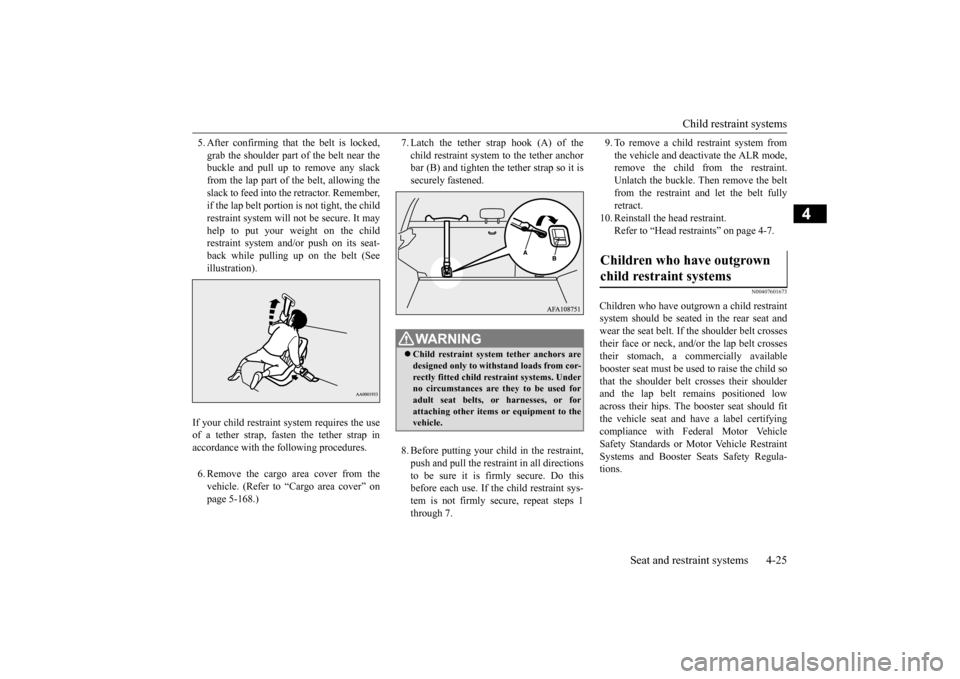
5. After confirming that the belt is locked, grab the shoulder part of the belt near the buckle and pull up to remove any slack from the lap part of the belt, allowing theslack to feed into the retractor. Remember, if the lap belt portion is not tight, the child restraint system will not be secure. It mayhelp to put your weight on the child restraint system and/or push on its seat- back while pulling up on the belt (Seeillustration). 6. Remove the cargo area cover from the vehicle. (Refer to “Cargo area cover” on page 5-168.)
7. Latch the tether strap hook (A) of the child restraint system to the tether anchor bar (B) and tighten the tether strap so it is securely fastened. 8. Before putting your child in the restraint, push and pull the restraint in all directionsto be sure it is firmly secure. Do this before each use. If the child restraint sys- tem is not firmly secure, repeat steps 1through 7.
9. To remove a child restraint system from the vehicle and deactivate the ALR mode, remove the child from the restraint. Unlatch the buckle. Then remove the beltfrom the restraint and let the belt fully retract.
10. Reinstall the head restraint.
Refer to “Head restraints” on page 4-7.
N00407601673
Children who have outgrown a child restraintsystem should be seated in the rear seat and wear the seat belt. If the shoulder belt crosses their face or neck, and/or the lap belt crossestheir stomach, a commercially available booster seat must be used to raise the child so that the shoulder belt crosses their shoulderand the lap belt remains positioned low across their hips. The booster seat should fit the vehicle seat and have a label certifyingcompliance with Federal Motor Vehicle Safety Standards or Motor Vehicle Restraint Systems and Booster Seats Safety Regula-tions.
If your child restraint system requires the use of a tether strap, fasten the tether strap in accordance with the following procedures.
WA R N I N G Child restraint system tether anchors are designed only to withstand loads from cor- rectly fitted child restraint systems. Under no circumstances are they to be used foradult seat belts, or harnesses, or for attaching other items or equipment to the vehicle.
Children who have outgrown child restraint systems
BK0206700US.bo
ok 25 ページ 2014年3月25日 火曜日 午後4時42分
Page 66 of 384
Break-in recommendations
Features and controls 5-3
5
N00508700330
Advanced automobile manufacturing tech- niques permit you to operate your new vehi-cle without requiring a long break-in period of low-speed driving. However, you can add to the future perfor-mance and economy of your vehicle by observing the following precautions during the first 300 miles (500 km).Drive your vehicle at moderate speeds duringthe break-in period. Avoid revving the engine. Avoid rough driving such as sudden starts, sudden acceleration, prolonged high-speed driving and sudden braking. These would have a detrimental effect on the engine and also cause increased fuel andoil consumption, which could result in malfunction of the engine components. Be particularly careful to avoid full accelera-tion while in low shift position (low gears). Do not overload the vehicle. Stay within the seating capacity. (Refer to “Cargo load precautions” on page 6-10.) Do not use this vehicle for trailer towing.
N00508800562
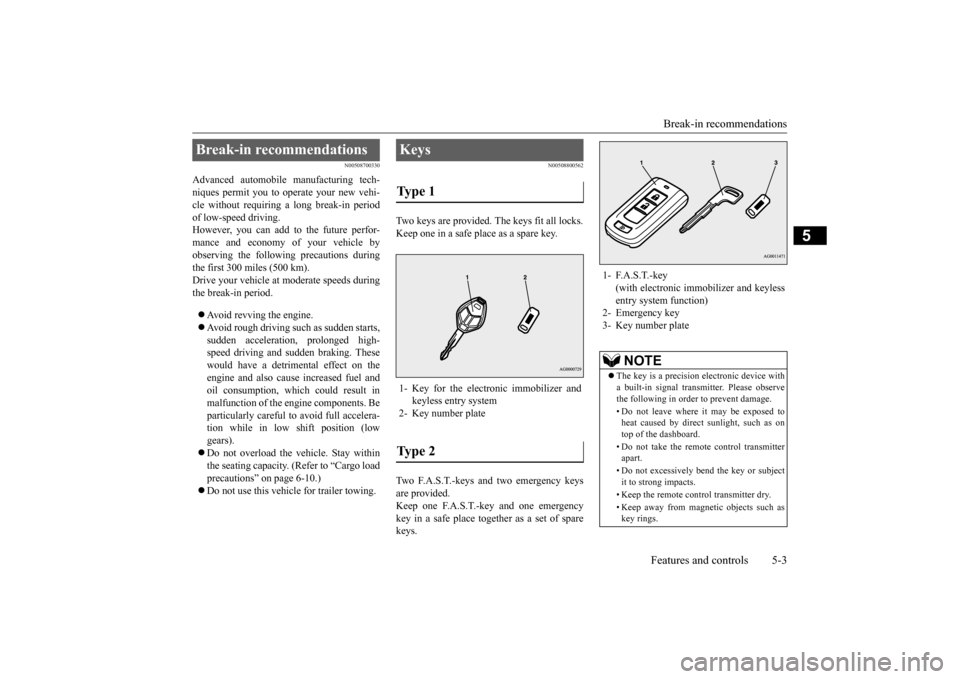
Two keys are provided. The keys fit all locks. Keep one in a safe place as a spare key. Two F.A.S.T.-keys and two emergency keys are provided. Keep one F.A.S.T.-key and one emergencykey in a safe place together as a set of spare keys.
Break-in recommendations
Keys Type 1 1- Key for the electronic immobilizer and
keyless entry system
2- Key number plateType 2
1- F.A.S.T.-key
(with electronic immob
ilizer and keyless
entry system function)
2- Emergency key 3- Key number plate
NOTE
The key is a precision electronic device with a built-in signal transmitter. Please observe the following in order to prevent damage. • Do not leave where it may be exposed to heat caused by direct sunlight, such as ontop of the dashboard. • Do not take the remote control transmitter apart. • Do not excessively bend the key or subject it to strong impacts. • Keep the remote control transmitter dry.• Keep away from magnetic objects such as key rings.
BK0206700US.bo
ok 3 ページ 2014年3月25日 火曜日 午後4時42分
Page 95 of 384
Liftgate 5-32 Features and controls
5
N00510101253
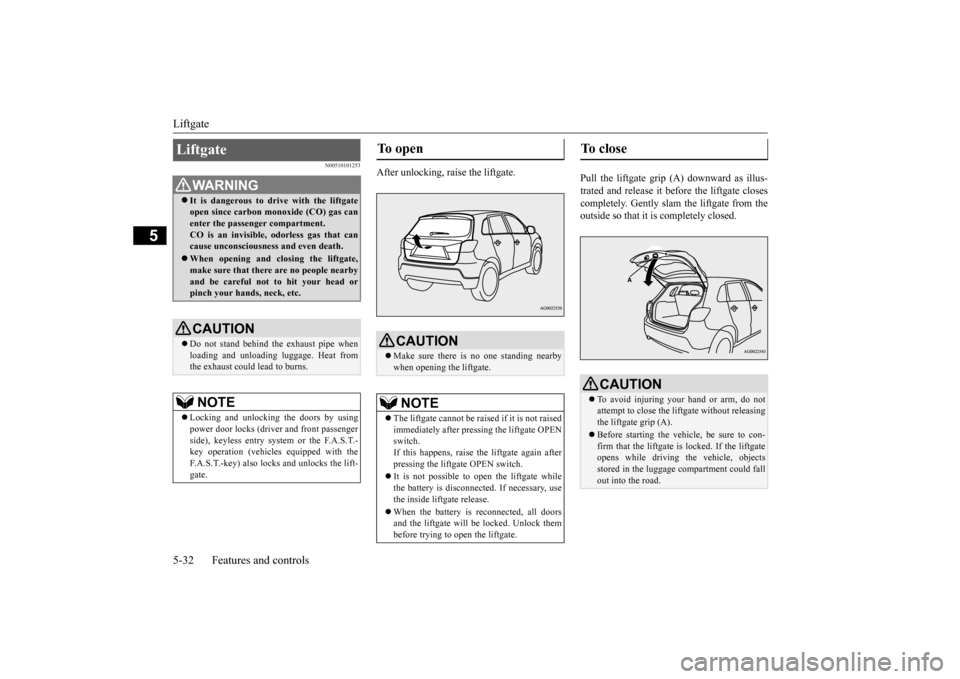
After unlocking, raise the liftgate.
Pull the liftgate grip
(A) downward as illus-
trated and release it before the liftgate closescompletely. Gently slam the liftgate from the outside so that it is completely closed.
Liftgate
WA R N I N G It is dangerous to drive with the liftgate open since carbon monoxide (CO) gas can enter the passenger compartment. CO is an invisible, odorless gas that cancause unconsciousness and even death. When opening and closing the liftgate, make sure that there are no people nearby and be careful not to hit your head or pinch your hands, neck, etc.CAUTION Do not stand behind the exhaust pipe when loading and unloading luggage. Heat from the exhaust could lead to burns.NOTE
Locking and unlocking the doors by using power door locks (driver and front passenger side), keyless entry system or the F.A.S.T.- key operation (vehicles equipped with the F.A.S.T.-key) also locks and unlocks the lift-gate.
To open
CAUTION Make sure there is no one standing nearby when opening the liftgate.NOTE
The liftgate cannot be raised if it is not raised immediately after pressing the liftgate OPENswitch. If this happens, raise the liftgate again after pressing the liftgate OPEN switch. It is not possible to open the liftgate while the battery is disconnected. If necessary, usethe inside liftgate release. When the battery is reconnected, all doors and the liftgate will be locked. Unlock them before trying to open the liftgate.
To close
CAUTION To avoid injuring your hand or arm, do not attempt to close the liftgate without releasingthe liftgate grip (A). Before starting the vehicle, be sure to con- firm that the liftgate
is locked. If the liftgate
opens while driving the vehicle, objects stored in the luggage compartment could fallout into the road.
BK0206700US.bo
ok 32 ページ 2014年3月25日 火曜日 午後4時42分
Page 124 of 384
Inspection and maintenance fo
llowing rough road operation Features and controls 5-61
5
N00530700098
After operating the vehicle in rough road con- ditions, be sure to perform the following inspection and maintenance procedures: Check that the vehicle has not been dam- aged by rocks, gravel, etc. Carefully wash the vehicle with water. Drive the vehicle slowly while lightlydepressing the brake pedal in order to dry out the brakes. If the brakes still do not function properly, co
ntact an authorized
Mitsubishi Motors dealer or a repair facil- ity of your choice as soon as possible to have the brakes checked. Remove the insects, dried grass, etc. clog- ging the radiator core.
After driving through water, check the engine, transaxle and differential oil. If the oil or grease is milky or cloudy because of water contamination, it mustbe replaced with new oil. Check the inside of the vehicle. If water entry is found, dry the carpet etc. Inspect the headlights. If water is in the headlight housing, have it drained at an authorized Mitsubishi Motors dealer or arepair facility of your choice. Have an authorized Mitsubishi Motors dealer replace grease in the wheel bear- ings.
N00530800187
Since the driving torque can be applied to thefour wheels, the driving performance of thevehicle when operating in 4-wheel drive is greatly affected by the condition of the tires. Pay close attention to the tires. Install only the specified tires on all wheels. Refer to “Tires and wheels” onpage 11-5.
Be sure all four tires and wheels are the same size and type. When it is necessary to replace any of the tires or wheels, replace all four. All tires should be rotated before the wear difference between the front and rear tires is recognizable.
Good vehicle performance cannot be expected if there is a difference in wear between tires. Refer to “Tire rotation” on page 9-19. Check the tire inflation pressure regularly.
After driving through water, apply the brakes to be sure they are functioning properly. If the brakes are wet and not functioning prop- erly, dry them out by driving slowly while lightly depressing the brake pedal. Inspecteach part of the vehicle carefully.
Inspection and maintenance following rough road opera-tion
CAUTION
Cautions on the handling of 4-wheel drive vehicles Tires and wheels
CAUTION Always use tires of the same size, type, and brand that have no wear differences. Usingtires of different size, type, brands or degree of wear, will increase the differential oil tem- perature and result in possible damage to thedriving system. Further, the drive train will be subject to excessive loading, possibly leading to oil leakage, component seizure, orother serious failures.
BK0206700US.bo
ok 61 ページ 2014年3月25日 火曜日 午後4時42分
Page 126 of 384
Hill start assist
Features and controls 5-63
5
authorized Mitsubishi Motors dealer or a repair facility of your choice immediately.
N00550700124
The disc brakes have an alarm that makes ametallic squeal when the brake pads have worn down enough to need service. If you hear this sound, have the brake padsreplaced at an authorized Mitsubishi Motors dealer or a repair facility of your choice.
N00562600074
The hill start assist makes it easy to start off on a steep uphill slope by preventing thevehicle from moving back
wards. It keeps the
braking force for about 2 second when you move your foot from the brake pedal to theaccelerator pedal.
N00562700059
1. Stop the vehicle completely using thebrake pedal. 2. On vehicles equipped with manual trans- axle, place the gearshift lever into the 1stpositon. On vehicles equipped with a continuously variable transmission (CVT), place theselector lever into the “D” position. 3. Release the brake pedal and the hill start assist will maintain the braking force applied while stopping for approximately2 seconds.
WA R N I N G Never coast downhill with the engine OFF. Keep the engine running whenever your vehicle is in motion. If you turn off theengine while driving, the power brake booster will stop working and your brakes will not work as well. If the power assist is
lost or if either brake
hydraulic system stops working properly,take your vehicle to an authorized Mitsubishi Motors dealer or a repair facil- ity of your choice immediately.
Brake pad wear alarm
WA R N I N G Driving with worn brake pads will make it harder to stop, and can cause an accident.
Hill start assist
CAUTION Do not overly rely on the hill start assist to prevent backwards movement of the vehicle. Under certain circumstances, even when hillstart assist is activated, the vehicle may move backwards if the brake pedal is not suf- ficiently depressed, if the vehicle is heavilyloaded, or if the road is very steep or slip- pery. The hill start assist is not designed to keep the vehicle stopped in place on uphill slopes for more than 2 seconds. When facing uphill, do
not rely on using the
hill start assist to maintain a stopped positionas an alternative to depressing the brake pedal. Doing so could cause an accident.
Do not perform the following operation while the hill start assist is operating. [Except for vehicles equipped with the F. A . S . T. - k e y ] Turn the ignition switch to the “OFF” or“ACC” position. [Vehicles equipped with the F.A.S.T.-key] Put the operation mode in OFF or ACC. Thehill start assist could stop operating, which could result in an accident.
To operate
NOTE
When reversing on an uphill slope, place the gearshift lever or the selector lever into the“R” position.CAUTION
BK0206700US.bo
ok 63 ページ 2014年3月25日 火曜日 午後4時42分
Page 143 of 384
Rear-view camera (if so equipped) 5-80 Features and controls
5
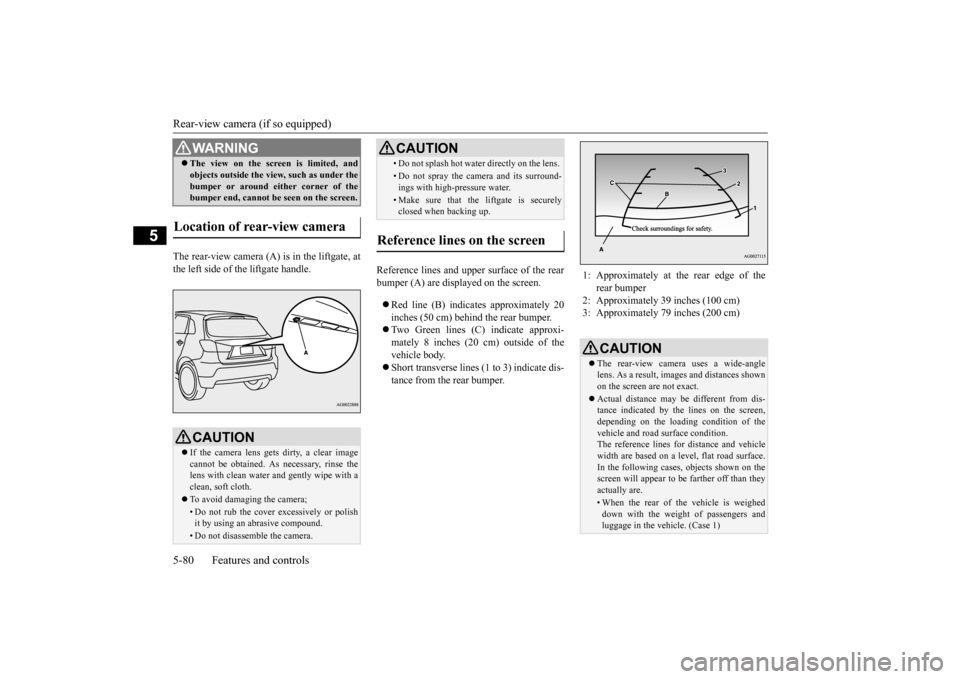
The rear-view camera (A) is in the liftgate, at the left side of the liftgate handle.
Reference lines and upper surface of the rear bumper (A) are displayed on the screen. Red line (B) indicates approximately 20 inches (50 cm) behind the rear bumper. Two Green lines (C) indicate approxi- mately 8 inches (20 cm) outside of the vehicle body. Short transverse lines (1 to 3) indicate dis- tance from the rear bumper.
The view on the screen is limited, and objects outside the view, such as under the bumper or around either corner of the bumper end, cannot be seen on the screen.
Location of rear-view camera
CAUTION If the camera lens gets dirty, a clear image cannot be obtained. As necessary, rinse thelens with clean water and gently wipe with a clean, soft cloth. To avoid damaging the camera;• Do not rub the cover excessively or polish it by using an abrasive compound. • Do not disassemble the camera.WA R N I N G
• Do not splash hot water directly on the lens. • Do not spray the camera and its surround- ings with high-pressure water.• Make sure that the liftgate is securelyclosed when backing up.
Reference lines on the screen
CAUTION
1: Approximately at the rear edge of the
rear bumper
2: Approximately 39 inches (100 cm) 3: Approximately 79 inches (200 cm)
CAUTION The rear-view camera uses a wide-angle lens. As a result, images and distances shownon the screen are not exact. Actual distance may be different from dis- tance indicated by the lines on the screen, depending on the loading condition of the vehicle and road surface condition.The reference lines for distance and vehicle width are based on a level, flat road surface. In the following cases, objects shown on thescreen will appear to be farther off than they actually are.• When the rear of the vehicle is weigheddown with the weight of passengers and luggage in the vehicle. (Case 1)
BK0206700US.bo
ok 80 ページ 2014年3月25日 火曜日 午後4時42分
Page 190 of 384
Headlight leveling switch (if so equipped)
Features and controls 5-127
5
N00537100105
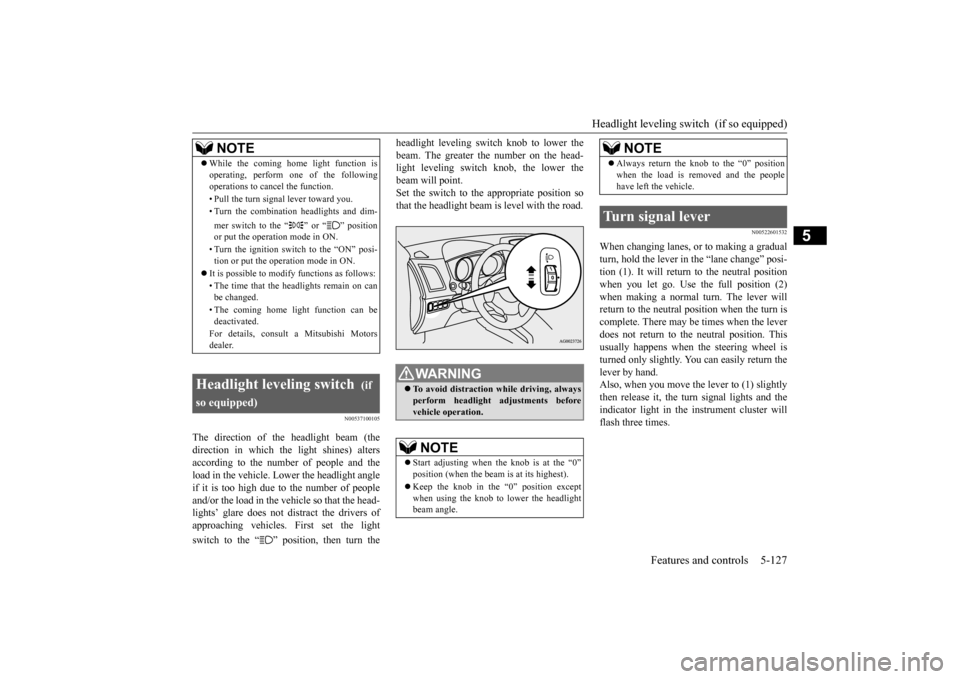
The direction of the headlight beam (the direction in which the light shines) altersaccording to the number of people and the load in the vehicle. Lower the headlight angle if it is too high due to the number of peopleand/or the load in the vehicle so that the head- lights’ glare does not distract the drivers of approaching vehicles. First set the light switch to the “ ” position, then turn the
headlight leveling switch knob to lower the beam. The greater the number on the head- light leveling switch knob, the lower the beam will point.Set the switch to the appropriate position so that the headlight beam is level with the road.
N00522601532
When changing lanes, or to making a gradual turn, hold the lever in
the “lane change” posi-
tion (1). It will return to the neutral positionwhen you let go. Use
the full position (2)
when making a normal turn. The lever will return to the neutral position when the turn iscomplete. There may be times when the lever does not return to the neutral position. This usually happens when the steering wheel isturned only slightly. You can easily return the lever by hand. Also, when you move the lever to (1) slightlythen release it, the turn signal lights and the indicator light in the instrument cluster will flash three times.
NOTE
While the coming home light function is operating, perform one of the following operations to cancel the function. • Pull the turn signal lever toward you.• Turn the combination headlights and dim- mer switch to the “ ” or “ ” position or put the operation mode in ON. • Turn the ignition switch to the “ON” posi- tion or put the operation mode in ON.
It is possible to modify functions as follows: • The time that the headlights remain on can be changed. • The coming home light function can be deactivated. For details, consult a Mitsubishi Motors dealer.
Headlight leveling switch
(if
so equipped)
WA R N I N G To avoid distraction while driving, always perform headlight adjustments beforevehicle operation.NOTE
Start adjusting when
the knob is at the “0”
position (when the beam is at its highest). Keep the knob in the “0” position except when using the knob to lower the headlightbeam angle.
Always return the knob to the “0” position when the load is removed and the people have left the vehicle.
Turn signal lever
NOTE
BK0206700US.book
127 ページ 2014年3月25日 火曜日 午後4時42分