ignition MITSUBISHI PAJERO IV 2011 User Guide
[x] Cancel search | Manufacturer: MITSUBISHI, Model Year: 2011, Model line: PAJERO IV, Model: MITSUBISHI PAJERO IV 2011Pages: 377, PDF Size: 29.43 MB
Page 34 of 377
Rear side/quarter window
E00302600091
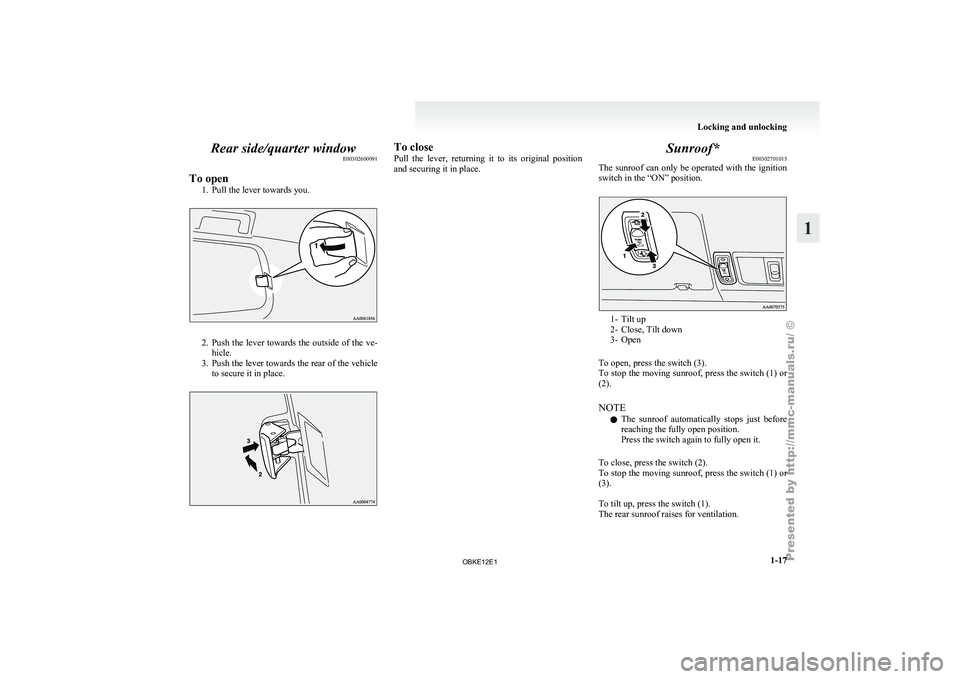
To open 1. Pull the lever towards you. 2. Push the lever towards the outside of the ve-
hicle.
3. Push
the lever towards the rear of the vehicle
to secure it in place. To close
Pull the
lever,
returning it to its original position
and securing it in place. Sunroof*
E00302701015
The sunroof can
only be operated with the ignition
switch in the “ON” position. 1- Tilt up
2- Close, Tilt down
3-
Open
To open, press the switch (3).
To
stop the moving sunroof, press the switch (1) or
(2).
NOTE
l The sunroof automatically stops just before
reaching the fully open position.
Press the switch again to fully open it.
To close, press the switch (2).
To stop the moving sunroof, press the switch (1) or
(3).
To tilt up, press the switch (1).
The rear sunroof raises for ventilation. Locking and unlocking
1-17 1
OBKE12E1
Page 45 of 377
NOTE
l To
prevent the
battery from running down,
operate the power seat with the engine run-
ning.
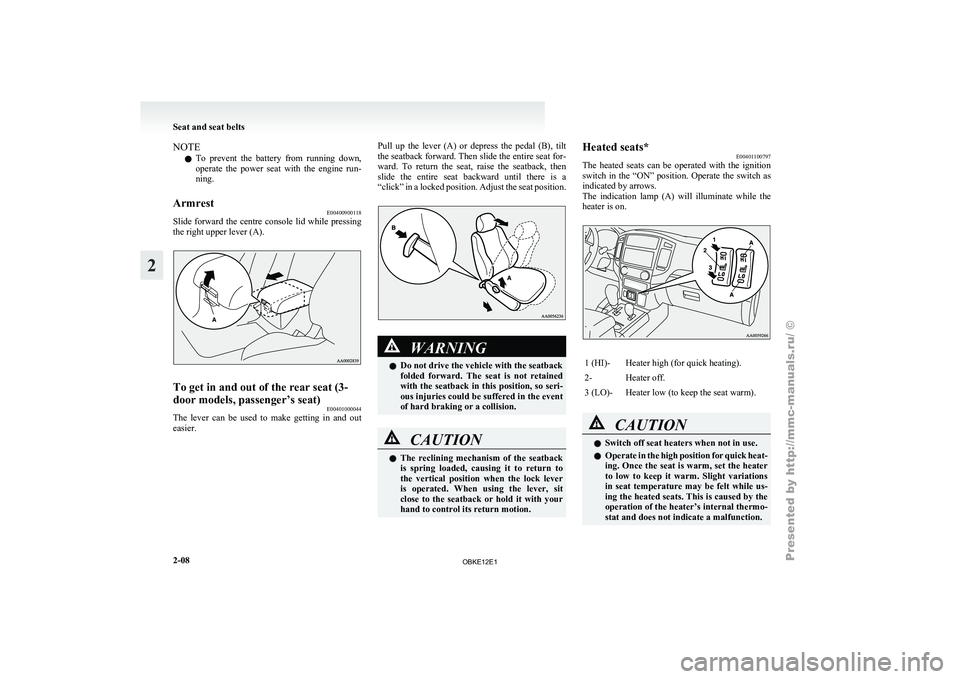
Armrest E00400900118
Slide forward the centre console lid while pressing
the right upper lever (A). To get in and out of the rear seat (3-
door models, passenger’s seat)
E00401000044
The lever can be used to make getting in and out
easier. Pull up the lever (A) or depress the pedal (B), tilt
the seatback forward.
Then slide the entire seat for-
ward. To return the seat, raise the seatback, then
slide the entire seat backward until there is a
“click” in a locked position. Adjust the seat position. WARNING
l Do not drive the vehicle with the seatback
folded forward. The
seat is not retained
with the seatback in this position, so seri-
ous injuries could be suffered in the event
of hard braking or a collision. CAUTION
l
The reclining
mechanism
of the seatback
is spring loaded, causing it to return to
the vertical position when the lock lever
is operated. When using the lever, sit
close to the seatback or hold it with your
hand to control its return motion. Heated seats*
E00401100797
The heated seats
can be operated with the ignition
switch in the “ON” position. Operate the switch as
indicated by arrows.
The indication lamp (A) will illuminate while the
heater is on. 1 (HI)- Heater high (for quick heating).
2- Heater off.
3 (LO)- Heater low (to keep the seat warm).
CAUTION
l
Switch off seat heaters when not in use.
l Operate in
the
high position for quick heat-
ing. Once the seat is warm, set the heater
to low to keep it warm. Slight variations
in seat temperature may be felt while us-
ing the heated seats. This is caused by the
operation of the heater’s internal thermo-
stat and does not indicate a malfunction. Seat and seat belts
2-08
2
OBKE12E1
Page 58 of 377
WARNING
l The seat belts must not be twisted when
worn.
3. Pull the belt slightly to adjust slackness as de-
sired.
To unfasten
Hold the
latch plate and push the button on the buck-
le. NOTE
l As
the belt
retracts automatically, keep hold-
ing the latch plate while retracting so that the
belt stows slowly. Failure to do this could
damage the vehicle. Seat belt reminder/warning lamp
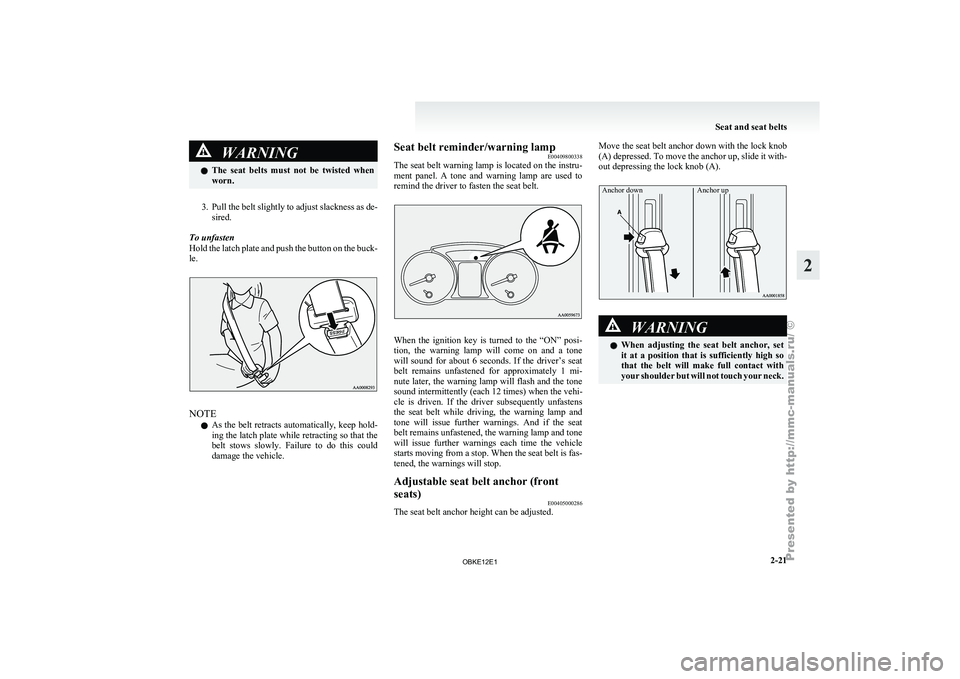
E00409800338
The seat belt
warning lamp is located on the instru-
ment panel. A tone and warning lamp are used to
remind the driver to fasten the seat belt. When the ignition key is turned to the “ON” posi-
tion, the warning
lamp will come on and a tone
will sound for about 6 seconds. If the driver’s seat
belt remains unfastened for approximately 1 mi-
nute later, the warning lamp will flash and the tone
sound intermittently (each 12 times) when the vehi-
cle is driven. If the driver subsequently unfastens
the seat belt while driving, the warning lamp and
tone will issue further warnings. And if the seat
belt remains unfastened, the warning lamp and tone
will issue further warnings each time the vehicle
starts moving from a stop. When the seat belt is fas-
tened, the warnings will stop.
Adjustable seat belt anchor (front
seats) E00405000286
The seat belt anchor height can be adjusted. Move the seat belt anchor down with the lock knob
(A) depressed. To
move the anchor up, slide it with-
out depressing the lock knob (A).
Anchor down Anchor up WARNING
l When adjusting
the
seat belt anchor, set
it at a position that is sufficiently high so
that the belt will make full contact with
your shoulder but will not touch your neck. Seat and seat belts
2-21 2
OBKE12E1
Page 60 of 377
Seat belt pretensioner system and
force limiter system E00405700081
The driver’s seat
and front passenger’s seat each
have a seat belt equipped with a pretensioner system.
Pretensioner system E00405800747
The pretensioner system will retract their respec-
tive seat belts
instantaneously, thus maximizing the
seat belt’s effectiveness, if there is a frontal impact
severe enough to injure the driver and/or front pas-
senger and the ignition switch is in the “ON” or
“START” position. WARNING
l To obtain
the
best results from your pre-
tensioner seat belt, make sure you have ad-
justed your seat correctly and wear your
seat belt properly. CAUTION
l
Installation of
audio
equipment or re-
pairs in the vicinity of the pretensioner
seat belts or floor console must be per-
formed in line with MITSUBISHI
MOTORS guidelines. It is important to
do so because the work could affect the
pretensioner systems. CAUTION
l
If you need
to scrap the vehicle, please con-
sult a MITSUBISHI MOTORS Author-
ized Service Point.
It is important to do so because unexpec-
ted activation of the pretensioner seat
belts could cause injuries.
NOTE l The
pretensioner seat
belts will be activated
if the vehicle suffers a severe frontal impact,
even if the seat belts are not worn.
l The pretensioner seat belts are designed to
work only once. After the pretensioner seat
belts have been activated, we recommend
you have them replaced by a MITSUBISHI
MOTORS Authorized Service Point.
SRS warning lamp E00405900083
This warning lamp is shared by the SRS airbags
and the pretensioner
seat belts. Refer to “SRS warn-
ing lamp” on page 2-43.
Force limiter system E00406000153
In the event of a collision, each force limiter sys-
tem will effectively
absorb the load applied to the
seat belt to minimize the impact to the passenger. Child restraint
E00406401604
When transporting children
in your vehicle, some
type of child restraint system should always be
used according to the size of the child. This is re-
quired by law in most countries.
The regulations concerning driving with children in
the front seat may differ from country to country.
You are advised to comply with the relevant regula-
tions. WARNING
l When possible,
put
children in the rear
seat. Accident statistics indicate that chil-
dren of all sizes and ages are safer when
properly restrained in the rear seat rath-
er than in the front seat.
l Holding a child in your arms is no substi-
tute for a restraint system. Failure to use
a proper restraint system can result in se-
vere or fatal injury to the child.
l Each child restraint device or fixing is to
be used only by one child.
l When attaching a child restraint to the
rear seat, place the front seatbacks in the
upright position.
Otherwise, the child could be seriously in-
jured in the event of hard braking or a col-
lision. Seat and seat belts
2-23 2
OBKE12E1
Page 71 of 377
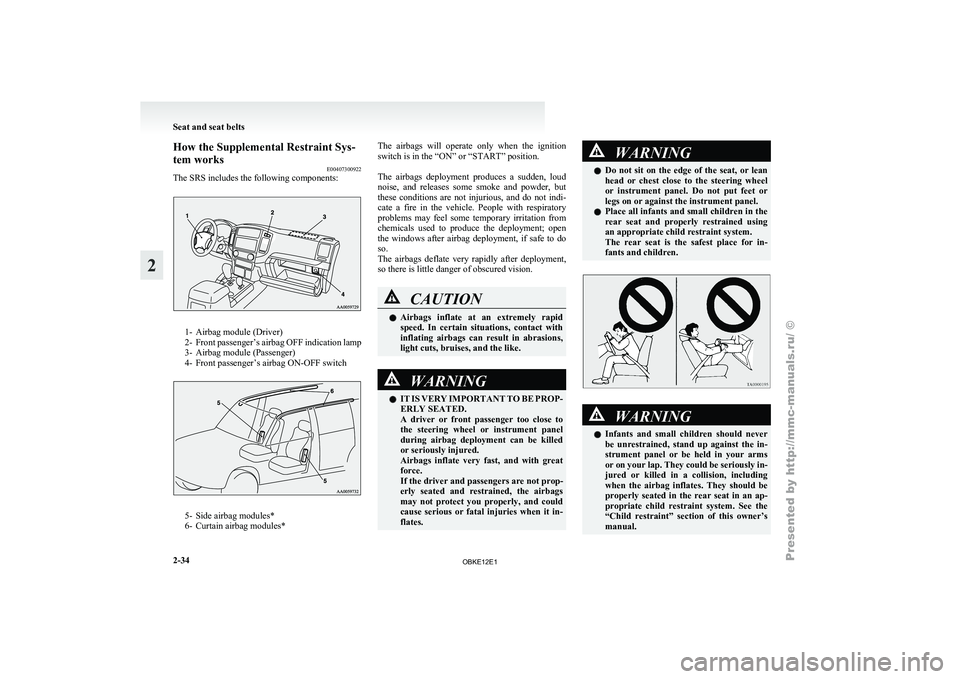
How the Supplemental Restraint Sys-
tem works
E00407300922
The SRS includes the following components: 1- Airbag module (Driver)
2- Front passenger’s airbag
OFF indication lamp
3- Airbag module (Passenger)
4- Front passenger’s airbag ON-OFF switch 5- Side airbag modules*
6- Curtain airbag modules* The
airbags
will operate only when the ignition
switch is in the “ON” or “START” position.
The airbags deployment
produces a sudden, loud
noise, and releases some smoke and powder, but
these conditions are not injurious, and do not indi-
cate a fire in the vehicle. People with respiratory
problems may feel some temporary irritation from
chemicals used to produce the deployment; open
the windows after airbag deployment, if safe to do
so.
The airbags deflate very rapidly after deployment,
so there is little danger of obscured vision. CAUTION
l
Airbags inflate
at
an extremely rapid
speed. In certain situations, contact with
inflating airbags can result in abrasions,
light cuts, bruises, and the like. WARNING
l IT IS VERY
IMPORTANT TO BE PROP-
ERLY SEATED.
A driver or front passenger too close to
the steering wheel or instrument panel
during airbag deployment can be killed
or seriously injured.
Airbags inflate very fast, and with great
force.
If the driver and passengers are not prop-
erly seated and restrained, the airbags
may not protect you properly, and could
cause serious or fatal injuries when it in-
flates. WARNING
l Do not sit
on the edge of the seat, or lean
head or chest close to the steering wheel
or instrument panel. Do not put feet or
legs on or against the instrument panel.
l Place all infants and small children in the
rear seat and properly restrained using
an appropriate child restraint system.
The rear seat is the safest place for in-
fants and children. WARNING
l Infants and
small
children should never
be unrestrained, stand up against the in-
strument panel or be held in your arms
or on your lap. They could be seriously in-
jured or killed in a collision, including
when the airbag inflates. They should be
properly seated in the rear seat in an ap-
propriate child restraint system. See the
“Child restraint” section of this owner’s
manual. Seat and seat belts
2-34
2
OBKE12E1
Page 73 of 377
Front passenger’s airbag ON-OFF
switch
E00410100070
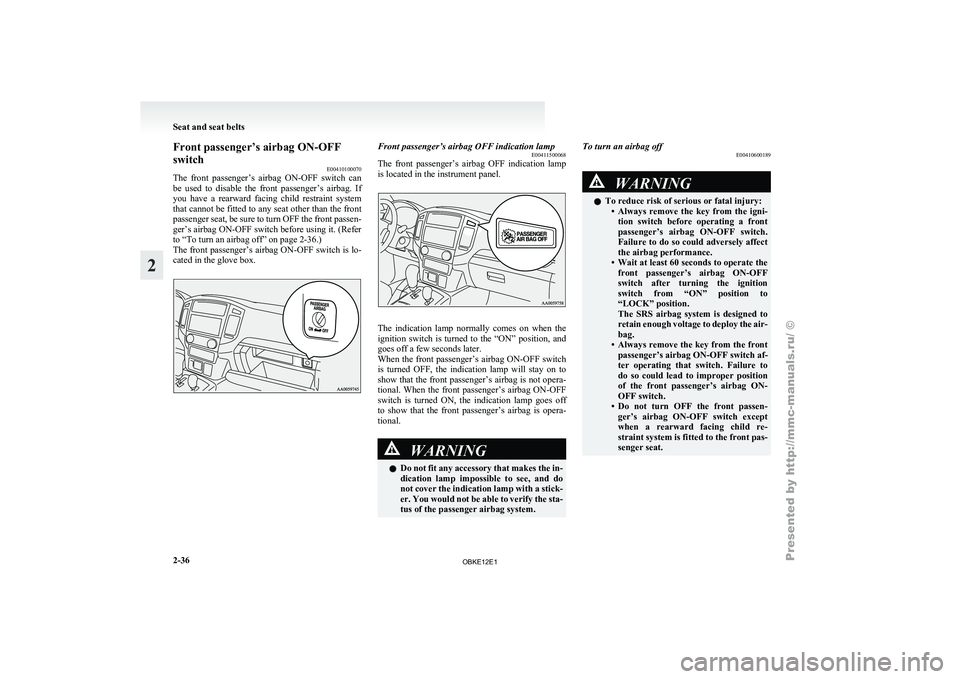
The front passenger’s
airbag ON-OFF switch can
be used to disable the front passenger’s airbag. If
you have a rearward facing child restraint system
that cannot be fitted to any seat other than the front
passenger seat, be sure to turn OFF the front passen-
ger’s airbag ON-OFF switch before using it. (Refer
to “To turn an airbag off” on page 2-36.)
The front passenger’s airbag ON-OFF switch is lo-
cated in the glove box. Front passenger’s airbag OFF indication lamp
E00411500068
The front passenger’s
airbag OFF indication lamp
is located in the instrument panel. The indication lamp normally comes on when the
ignition switch is
turned to the “ON” position, and
goes off a few seconds later.
When the front passenger’s airbag ON-OFF switch
is turned OFF, the indication lamp will stay on to
show that the front passenger’s airbag is not opera-
tional. When the front passenger’s airbag ON-OFF
switch is turned ON, the indication lamp goes off
to show that the front passenger’s airbag is opera-
tional. WARNING
l Do
not
fit
any accessory that makes the in-
dication lamp impossible to see, and do
not cover the indication lamp with a stick-
er. You would not be able to verify the sta-
tus of the passenger airbag system. To turn an airbag off
E00410600189 WARNING
l To reduce risk of serious or fatal injury:
• Always remove the
key from the igni-
tion switch before operating a front
passenger’s airbag ON-OFF switch.
Failure to do so could adversely affect
the airbag performance.
• Wait at least 60 seconds to operate the front passenger’s airbag ON-OFF
switch after turning the ignition
switch from “ON” position to
“LOCK” position.
The SRS airbag system is designed to
retain enough voltage to deploy the air-
bag.
• Always remove the key from the front passenger’s airbag ON-OFF switch af-
ter operating that switch. Failure to
do so could lead to improper position
of the front passenger’s airbag ON-
OFF switch.
• Do not turn OFF the front passen- ger’s airbag ON-OFF switch except
when a rearward facing child re-
straint system is fitted to the front pas-
senger seat. Seat and seat belts
2-36
2
OBKE12E1
Page 74 of 377
WARNING
• If the indication lamp does not come on when
the front passenger’s airbag
ON-OFF switch is turned OFF, do not
fit a rearward facing child restraint
system to the front passenger seat. We
recommend you to have the system in-
spected by a MITSUBISHI MOTORS
Authorized Service Point.
• If the indication lamp remains on when the front passenger’s airbag ON-
OFF switch is turned ON, do not al-
low anyone to sit on the front passen-
ger seat. We recommend you to have
the system inspected by a
MITSUBISHI MOTORS Authorized
Service Point.
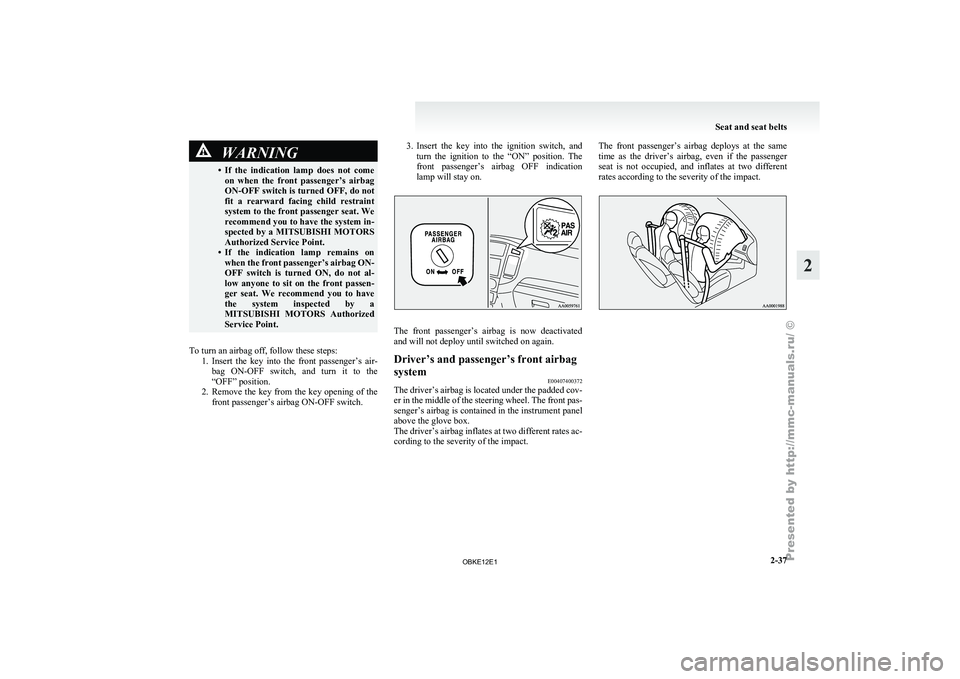
To turn an airbag off, follow these steps: 1. Insert the key
into the front passenger’s air-
bag ON-OFF switch, and turn it to the
“OFF” position.
2. Remove the key from the key opening of the front passenger’s airbag ON-OFF switch. 3. Insert
the key into the ignition switch, and
turn the
ignition to the “ON” position. The
front passenger’s airbag OFF indication
lamp will stay on. The front passenger’s airbag is now deactivated
and will not deploy until switched on again.
Driver’s and passenger’s front airbag
system
E00407400372
The driver’s airbag is located under the padded cov-
er in the
middle of the steering wheel. The front pas-
senger’s airbag is contained in the instrument panel
above the glove box.
The driver’s airbag inflates at two different rates ac-
cording to the severity of the impact. The front passenger’s airbag deploys at the same
time as
the
driver’s airbag, even if the passenger
seat is not occupied, and inflates at two different
rates according to the severity of the impact. Seat and seat belts
2-37 2
OBKE12E1
Page 80 of 377
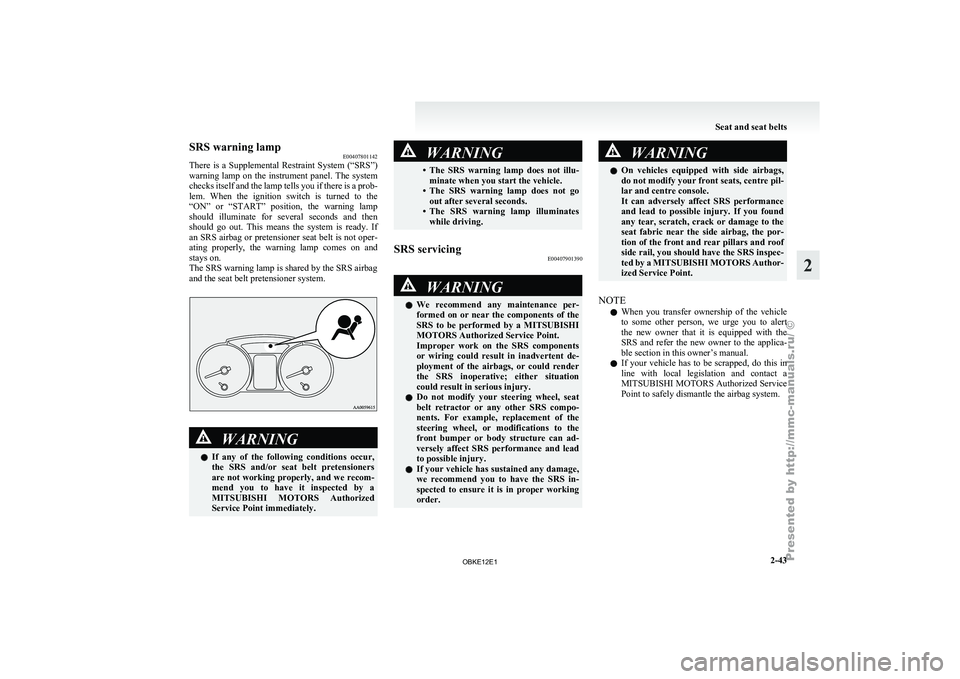
SRS warning lamp
E00407801142
There is a
Supplemental Restraint System (“SRS”)
warning lamp on the instrument panel. The system
checks itself and the lamp tells you if there is a prob-
lem. When the ignition switch is turned to the
“ON” or “START” position, the warning lamp
should illuminate for several seconds and then
should go out. This means the system is ready. If
an SRS airbag or pretensioner seat belt is not oper-
ating properly, the warning lamp comes on and
stays on.
The SRS warning lamp is shared by the SRS airbag
and the seat belt pretensioner system. WARNING
l If any of
the following conditions occur,
the SRS and/or seat belt pretensioners
are not working properly, and we recom-
mend you to have it inspected by a
MITSUBISHI MOTORS Authorized
Service Point immediately. WARNING
• The SRS warning lamp does not illu- minate when you start the vehicle.
• The
SRS warning lamp does not go
out after several seconds.
• The SRS warning lamp illuminates while driving.
SRS servicing E00407901390 WARNING
l We recommend
any
maintenance per-
formed on or near the components of the
SRS to be performed by a MITSUBISHI
MOTORS Authorized Service Point.
Improper work on the SRS components
or wiring could result in inadvertent de-
ployment of the airbags, or could render
the SRS inoperative; either situation
could result in serious injury.
l Do not modify your steering wheel, seat
belt retractor or any other SRS compo-
nents. For example, replacement of the
steering wheel, or modifications to the
front bumper or body structure can ad-
versely affect SRS performance and lead
to possible injury.
l If your vehicle has sustained any damage,
we recommend you to have the SRS in-
spected to ensure it is in proper working
order. WARNING
l On vehicles equipped
with side airbags,
do not modify your front seats, centre pil-
lar and centre console.
It can adversely affect SRS performance
and lead to possible injury. If you found
any tear, scratch, crack or damage to the
seat fabric near the side airbag, the por-
tion of the front and rear pillars and roof
side rail, you should have the SRS inspec-
ted by a MITSUBISHI MOTORS Author-
ized Service Point.
NOTE l When
you transfer
ownership of the vehicle
to some other person, we urge you to alert
the new owner that it is equipped with the
SRS and refer the new owner to the applica-
ble section in this owner’s manual.
l If your vehicle has to be scrapped, do this in
line with local legislation and contact a
MITSUBISHI MOTORS Authorized Service
Point to safely dismantle the airbag system. Seat and seat belts
2-43 2
OBKE12E1
Page 83 of 377
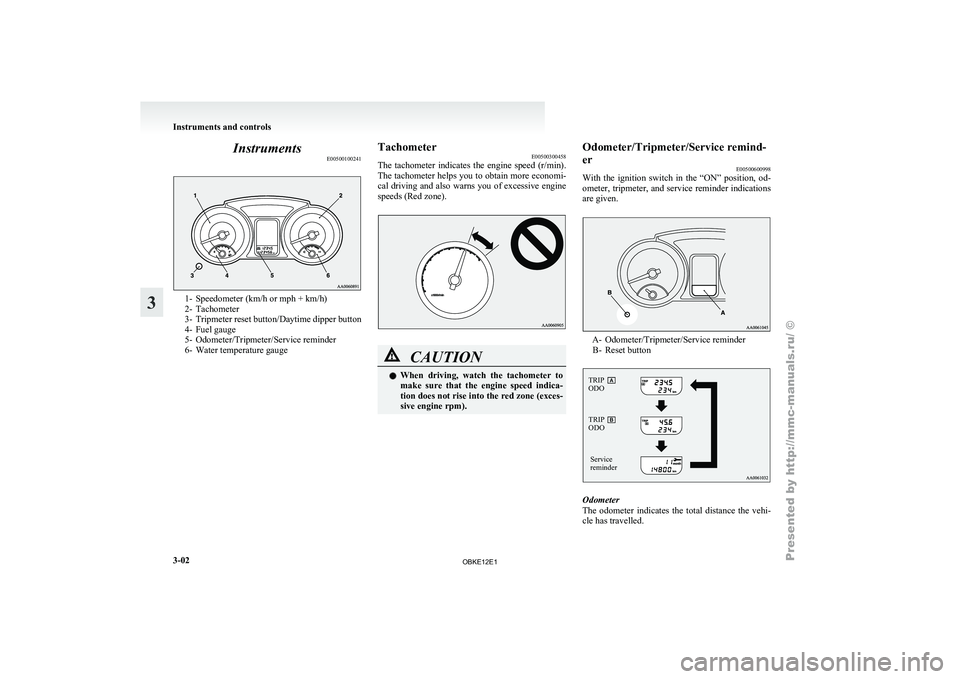
Instruments
E005001002411- Speedometer (km/h or mph + km/h)
2- Tachometer
3-
Tripmeter
reset button/Daytime dipper button
4- Fuel gauge
5- Odometer/Tripmeter/Service reminder
6- Water temperature gauge Tachometer
E00500300458
The tachometer indicates
the engine speed (r/min).
The tachometer helps you to obtain more economi-
cal driving and also warns you of excessive engine
speeds (Red zone). CAUTION
l
When driving, watch
the tachometer to
make sure that the engine speed indica-
tion does not rise into the red zone (exces-
sive engine rpm). Odometer/Tripmeter/Service remind-
er
E00500600998
With the ignition
switch in the “ON” position, od-
ometer, tripmeter, and service reminder indications
are given. A- Odometer/Tripmeter/Service reminder
B- Reset button
TRIP
ODO
Service
reminder
TRIP
ODO Odometer
The
odometer indicates
the total distance the vehi-
cle has travelled. Instruments and controls
3-02
3
OBKE12E1
Page 84 of 377
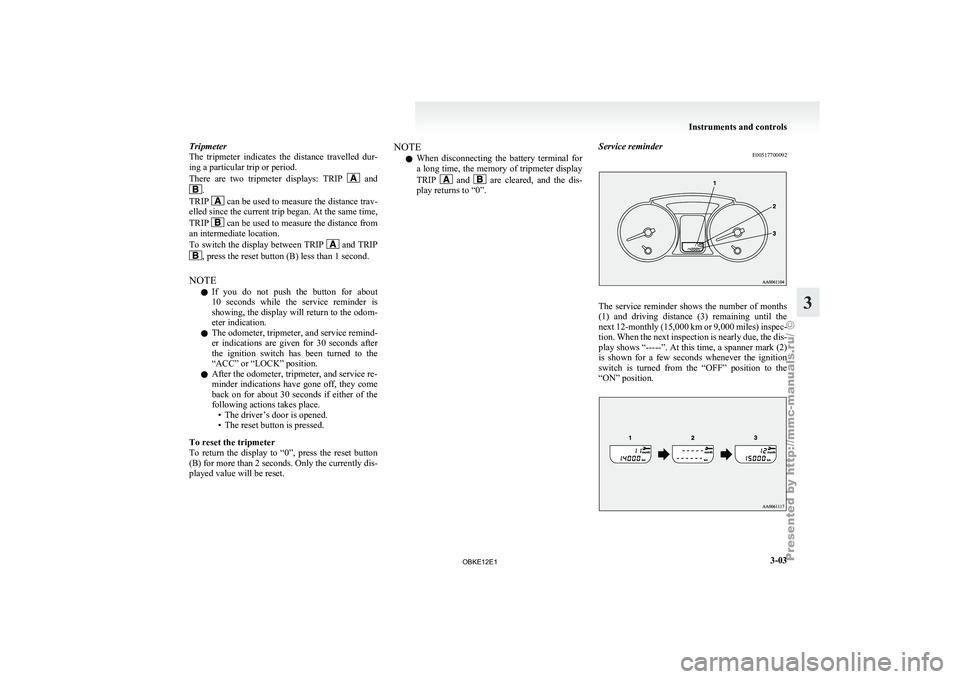
Tripmeter
The tripmeter indicates
the distance travelled dur-
ing a particular trip or period.
There are two tripmeter displays: TRIP and
.
TRIP can be used to measure the distance trav-
elled since the
current trip began. At the same time,
TRIP can be used to measure the distance from
an intermediate location.
To switch the
display between TRIP and TRIP
, press the reset button (B) less than 1 second.
NOTE l If
you do
not push the button for about
10 seconds while the service reminder is
showing, the display will return to the odom-
eter indication.
l The odometer, tripmeter, and service remind-
er indications are given for 30 seconds after
the ignition switch has been turned to the
“ACC” or “LOCK” position.
l After the odometer, tripmeter, and service re-
minder indications have gone off, they come
back on for about 30 seconds if either of the
following actions takes place.
• The driver’s door is opened.
• The reset button is pressed.
To reset the tripmeter
To return the display to “0”, press the reset button
(B) for more than 2 seconds. Only the currently dis-
played value will be reset. NOTE
l When disconnecting
the
battery terminal for
a long time, the memory of tripmeter display
TRIP and are cleared, and the dis-
play returns to “0”. Service reminder
E00517700092 The service reminder shows the number of months
(1) and
driving
distance (3) remaining until the
next 12-monthly (15,000 km or 9,000 miles) inspec-
tion. When the next inspection is nearly due, the dis-
play shows “-----”. At this time, a spanner mark (2)
is shown for a few seconds whenever the ignition
switch is turned from the “OFF” position to the
“ON” position. Instruments and controls
3-03 3
OBKE12E1